Brading Haven Yacht Club 2021 / 2022 - Notice of Race Race Sailing Instructions & Race Officer Guidance
←
→
Page content transcription
If your browser does not render page correctly, please read the page content below
Brading Haven Yacht Club

        Notice of Race
  Race Sailing Instructions &
    Race Officer Guidance

        2021 / 2022
Racing for 2021 / 2022 is organised on behalf of Brading Haven Yacht Club Racing Section by: Polly Schafer - Rear Commodore Offshore Duncan Bates - RTC Principal & Chief Instructor Richard Coleman - Captain of Racing Mike Bottoms - Scow Fleet Captain Chris Wilkinson - Flying Fifteen Fleet Captain Grainne Andrews - Sailing Committee Member Roger Herbert - Sailing Committee Member Robin Powell - Sailing Committee Member Any amendments to the Instructions, Programme or Support Rota will be published in the club foyer, on the notice board in the Jubilee Training Centre, on the Club Web Site www.bhyc.org.uk and where possible will be circulated by e- mail and/or newsletter to those who have this facility. All racing at Brading Haven Yacht Club will be governed by the rules as defined in the Racing Rules of Sailing 2021- 2024 (RRS) published and defined by World Sailing.
Basic Principles
SPORTSMANSHIP AND THE RULES

Competitors in the sport of sailing are governed by a body of rules that they are
expected to follow and enforce. A fundamental principle of sportsmanship is that when
a boat breaks a rule and is not exonerated, she will promptly take an appropriate
penalty or action, which may be to retire.

ENVIRONMENTAL RESPONSIBILITY

Participants are encouraged to minimize any adverse environmental impact of the
sport of sailing.

FUNDAMENTAL RULES

1. SAFETY

1.1 Helping Those in Danger

A boat, competitor or support person shall give all possible help to any person
or vessel in danger.

1.2 Life-Saving Equipment and Personal Flotation Devices

A boat shall carry adequate life-saving equipment for all persons on board,
including one item ready for immediate use, unless her class rules make some
other provision. Each competitor is individually responsible for wearing a
personal flotation device adequate for the conditions.

2. FAIR SAILING

A boat and her owner shall compete in compliance with recognized principles
of sportsmanship and fair play. A boat may be penalized under this rule only if
it is clearly established that these principles have been violated. The penalty
shall be a disqualification that is not excludable.
DECISION TO RACE

The responsibility for a boat’s decision to participate in a race or to continue
racing is hers alone.

ACCEPTANCE OF THE RULES

By participating or intending to participate in an event conducted under the rules,
each competitor and boat owner agrees to accept the rules.

(b) A support person by providing support, or a parent or guardian by permitting their
child to enter an event, agrees to accept the rules.

Each competitor and boat owner agrees, on behalf of their support persons, that such
support persons are bound by the rules.

Acceptance of the rules includes agreement

(a) to be governed by the rules;
(b) to accept the penalties imposed and other action taken under the rules, subject to
the appeal and review procedures provided in them, as the final determination of any
matter arising under the rules;
(c) with respect to any such determination, not to resort to any court of law or tribunal
not provided for in the rules; and
(d) by each competitor and boat owner to ensure that their support persons are aware of
the rules.

The person in charge of each boat shall ensure that all competitors in the crew and
the boat’s owner are aware of their responsibilities under this rule.
BHYC RACING SAILING INSTRUCTIONS & RACE OFFICER GUIDANCE

1. Notice of Race:
   Racing will take place on the dates and times published in the BHYC Sailing
   Programme. The schedule for racing in the East Wight Combined Clubs Regattas is
   published in the EWCC programme.

2. Entry Form:
   Entrants for all races in the BHYC Racing programme and the East Wight Combined
   Clubs Regatta Series must have signed an Entry Form, which includes agreement to
   be bound by the Conditions of Entry, prior to taking part in their first race of the season
   (April 2021 – April 2022).

   It is essential that each competitor completes their sailing declaration form online.
   This online form must be completed and signed in person together with an ICE and
   telephone number for quick access in an emergency. In addition, enters the correct
   PY No. which must reflect the exact configuration of the boat being sailed. Examples
   include Pico with or without a jib or a Laser with a specific sail plan. In addition, a
   number of older boats have ‘Classic’ status such as the Fireball, Solo and Flying
   Fifteen.

   Parents or guardians must countersign Entry Forms for persons under 18 years of
   age. The online form will be on the Club website and a link can be sent via the Club
   Office. Information will be held in the Jubilee Training Centre and online. Failure to
   complete the form will result in the boat being scored DNS (Did Not Start) for all
   members.

3. Conditions of Entry:
   RISK STATEMENT

   Rule 4 of the Racing Rules of Sailing states: "The responsibility for a boat's decision to
   participate in a race or to continue racing is hers alone."

   Sailing is by its nature an unpredictable sport and therefore inherently involves an
   element of risk. By taking part in the event, each competitor agrees and acknowledges
   that:

      a) They are aware of the inherent element of risk involved in the sport and accept
         responsibility for the exposure of themselves, their crew and their boat to such
         inherent risk whilst taking part in the event.
      b) They are responsible for the safety of themselves, their crew, their boat and
         their other property whether afloat or ashore.
      c) They accept responsibility for any injury, damage or loss to the extent caused
         by their own actions or omissions.
      d) Their boat is in good order, equipped to sail in the event and they are fit to
         participate.
      e) The provision of a race management team, patrol boats and other officials and
         volunteers by the event organiser does not relieve them of their own
responsibilities.
f) The provision of patrol boat cover is limited to such assistance, particularly in
extreme weather conditions, as can be practically provided in the
circumstances.
g) It is their responsibility to familiarise themselves with any risks specific to this
venue or this event drawn to their attention in any rules and information
produced for the venue or event and to attend any safety briefing held for the
event.
h) They are responsible for ensuring that their boat is equipped and seaworthy so
as to be able to face extremes of weather; that there is a crew sufficient in
number, experience and fitness to withstand such weather; and that the safety
equipment is properly maintained, stowed and in date and is familiar to the
crew.
i) Their boat is adequately insured, with cover of at least £3,000,000 against third
party claims.
4. General Conditions of Racing and Sailing Instructions:
a) Racing is conducted in accordance with the RYA racing charter to promote fair
and enjoyable racing for all. Any competitor that contravenes this rule will be
subject to review with the Offshore Committee.
b) All races will be governed by the Racing Rules of Sailing 2021/2024 published
by World Sailing, SCRA Regulations except as any of these are changed by
these sailing instructions.
c) The international Regulations for Prevention of Collisions at Sea (IRPCS) apply
when a boat sailing under racing rules meets a vessel that is not. If the racing
boat fails to comply with this obligation she may be protested and penalised.
The Club draws attention of members to Rule 9 of the International Regulations
Preventing Collisions at Sea (COLREGS 1972), in respect of operation of
vessels operating in Narrow Channels. This rule includes the sailing in the
confines of the Harbour. All sailors and powerboat boat users must respect all
vessels entering and existing the Harbour and if required move out of their way
as they have rights to navigate the channel.
d) All entrants are required to sign on either in the Jubilee Training Centre Failure
to do so may cause them to be classified as DNS. They must notify the Race
Officer if they retire or fail to complete the course as instructed.
e) Entrants from other RYA-affiliated sailing clubs are welcome to participate in all
BHYC Open racing events. If they attend normal club racing, they are allowed
a maximum of six occasions each year; they must obtain the approval of the
Race Officer before entering a race and complete the conditions of Entry Form
and the sign on form at the Jubilee Training Centre.
f) The Race Officer may brief the competitors and safety crews prior to the
commencement of racing and/or the regatta highlighting the course to be sailed
and the sailing area it is to be sailed in.
g) All competitors must wear personal buoyancy at all times when racing, except
when changing personal clothing or personal equipment. An adequate flotation
device is a lifejacket or buoyancy aid to a minimum of 50 Newtons
EN393/ISO12402-5, or 100 Newtons for weak swimmers or non-swimmers.
(This adds to RRS 1.2, Failure to comply with this rule will result in
disqualification without hearing. Flag “Y” will not be displayed, this changesRRS 40.) If it is cold weather competitors should wear either a wet suit or a dry
suit.
h) Any collision with a moored boat must be notified to the owner and to the Race
Officer without delay. If the owner of the moored boat cannot be identified the
Harbour Authority should be informed.
5. Racing Notices and Signals:
a) The racing committee would like to see separate races for the Fast Handicap,
Lasers, Scow and Slow handicap fleets with separate results and prizes however,
the numbers of dinghies may not support individual fleets. A separate fleet start
must consist of at least two dinghies. If only one dinghy is available in a fleet, they
can join in with either the Fast or Handicap start dependent on their dinghy
handicap.
b) The schedule of racing for the season is shown in the Club programme. Unless
notified otherwise, dinghies will race in four groups with the Fast Handicap (under
PY 1250), Lasers (all types under PY1250), Slow Handicap (PY 1250 and over)
and Scow (PY 1250 and over) starting after.
c) Fast Handicap and Lasers will normally have the same course.
d) Scow and Slow Handicap will normally have the same course.
e) There will only be set laps for each race set. The race officer may shorten course
as required. There will be no Average Time Laps calculated this year as most
sailors consulted did not like this method of scoring.
f) Competitors should make every effort to sign-on for the race 30 minutes before the
published Start time. If there is a committee boat start, the Race Officer may leave
the Jubilee Training Centre early to set up the racing marks. If there is no signing
on sheet at the Jubilee Training Centre Sailing Centre then ensure you tell the
Race Officer on the committee boat you intend to race before the 5-minute gun of
your start sequence.
i) Notice of alterations or supplements to the racing instructions may be indicated by
International Code Flag “L” being flown from the Jubilee Training Centre or
Committee Boat. The additional instructions will be posted on the official Notice
Board, which is located in the Jubilee Training Centre or, in case of a Committee
Boat start, may be given orally by loudhailer (under RRS 80.2). In addition, a board
may be used.
j) The following Class Boards/Class Flags, or combinations, will be used to identify
racing groups:
Fast Handicap: Numeral Pennant 3
Laser Fleet: Laser class flag
Slow Handicap: Numeral Pennant 4
Scows: Pennant numeral 76. Courses and Course Signals:
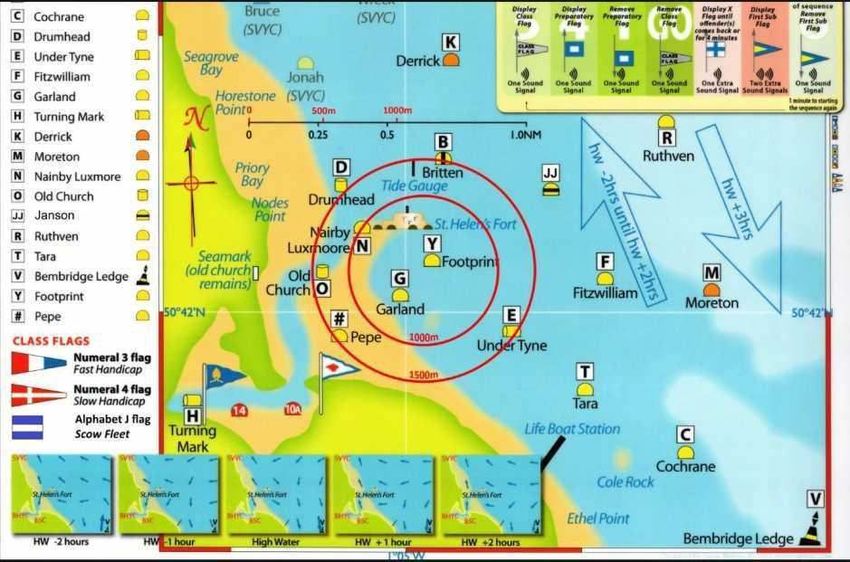
a) The racing area is shown on the chart within these instructions. The course to
be sailed and the number of rounds is at the discretion of the Race Officer.
Guidance for Race Officers is found in the Appendix.
b) Race officers are reminded that when setting a course that the angles
between the Windward, Leeward and Downwind mark are set as close as
possible to the angles prescribed in the Appendix’s.
c) The course to be sailed, consisting of fixed and movable inflatable buoys will
be displayed by letters, numbers and symbols as listed on the chart within
these instructions. This will be displayed on the frame above the Jubilee
Training Centre or on the Committee Boat no later than at the Preparatory
Signal (5 Minute gun).
d) A Green background indicates a mark to be left to Starboard; a Red background
indicates a mark to be left to Port.
e) The sequence of marks indicates the order in which the course is to be sailed.
When inflatable marks are to be used their approximate position will either be
indicated on the white board at the Jubilee Training Centre or directions issued
by the committee boat.
f) The symbols used to denote buoys 10A and 14 may be substituted by their
numerals.
g) Other buoys within the Harbour may be used, in which case the number shown
will correspond with the buoy number.
7. Mandatory Marks:
To minimise the risk of collision with larger vessels using the main
channel the following course restrictions must be obeyed.
Course Leave to Port Leave to Starboard
On a leg of a course which is leaving the
Buoys 14, 12A, & 12 Buoys 11 & 9
Harbour:
On a leg of a course returning to the Harbour: Buoys 9 & 11 Buoys 12, 12A & 14
Note: Buoys 12, 12A & 14 are red can main channel marks situated between
Fisherman’s Wharf and the Harbour entrance. Buoys 9 & 11 are green conical main
channel marks situated just outside the Harbour entrance.
a) Boats must not pass through the Groynes on either the St. Helens or the Bembridge shore.
b) Spinnakers must not be set before passing St Helens Groyne on leaving the Harbour must
be doused before passing St Helens Groyne on re-entering.8. Number of Rounds:
a) The set course may be shortened at the discretion of the Race officer.
b) When a race requires the course, or part of the course, to be sailed more than
once, a black board with white diamonds will be displayed on the Committee
Boat, or in case of Harbour Start from the Jubilee Training Centre. The number
of diamonds on the course board indicates the number of times that the
sequence preceding it shall be sailed before continuing with the remainder of
the course.
c) If a black and orange chequered board is displayed in the course sequence,
the mark(s) of the course preceding it shall be sailed before continuing to the
marks and number of rounds displayed thereafter.
d) In all cases competitors are to sail through the finish line on the windward leg
each time after rounding the leeward mark. On any other leg of the course the
start / finish line shall constitute an obstruction and shall not be sailed through.
9. Distant Windward & Leeward Marks:
a) To enable all classes to be sailing windward/leeward legs in the same area a
course may be set with two windward or two leeward inflatable marks. The fast
Handicap and Laser class will use the further distant inflatable windward or
leeward mark as displayed. The Scow and Slow class will use the nearer
standard windward/leeward mark.
b) The designated legend for a distant windward mark will be:
Two white triangles, pointing up, on a red or green
background.
c) The designated legend for a distant leeward mark will be:
Two white triangles, pointing down, on a red or green background.
d) For all courses: Green background, leave to starboard; Red background, leave
to port.
10. Shorten Course and Course Changes:
a) These will be indicated by the display of International Code Flag “S” or “C”
respectively, with appropriate sound signals (2 blasts for S, multiple sounds for C)
and new course displayed, or where necessary, by verbal instructions of the Race
Officer relayed by the Support Boats this changes RRS 33.
b) The finishing line shall be,
at a rounding mark, between the mark and a staff displaying flag S.
or at a line, the course requires boats to cross.
or at a gate, between the gate marks.11. Courses: The course to be sailed and the number of rounds is at the discretion of
the Race Officer. Guidance for Race Officers is found in the Appendix.
When starting from a Committee Boat, excepting in the case of a special event, one
of the following five course types should be set: Course 1 (Olympic triangle-sausage),
Course 2 (Olympic trapezoid), Course 3 (q or p) Course 4 (trapezoidal) or Course 5
(Windward/Leeward). The course to be sailed will be indicated by a black board with
a white numeral ‘1’; ‘2’; ‘3’; ‘4’; ‘5’, or alternative
Course 1. (See Illustration for further details)
Will be sailed with marks rounded to port or starboard in the following
order: Start-1-2-3-1-3-1-2-3-Finish.
Course 2 (See Illustration for further details)
Will be sailed with marks rounded to port or starboard in the following order: Start-1-
2-3-2-3- Finish.
Course 3. (See illustration for further details)
Will be sailed with marks rounded to port or starboard.
Course 4. (See illustration for further details)
Will be sailed with marks rounded to port or starboard.
Course 5. (See illustration for further details)
Will be sailed with marks rounded to port or starboard.
Course 6. (See illustration for further details)
Will be sailed with marks rounded to port or starboard.
Marks will be displayed on the frame of the Jubilee Training Centre or Committee
Boat. Green background leave marks to starboard. Red background leave marks to
port.
12. Starting Signals:
For both Harbour Line and Committee Boat Starts, Starting Signals will conform
to RRS (5,4,1,0). The Harbour Line Starting System is further modified by using
lights instead of flags as follows.
Postponement: In the event of a postponement flag AP shall be replaced with a
flashing red light (This alters race signals)
Starting:
Class Warning Preparatory Signal One Minute Start
Signal (-5) (-4) (-1)
All Red light On Orange light On Green light Lights Off
classes On13. Recalls:
Altering Race Signals
a) Individual boats over the line at the start of a race will be recalled by a second
sound signal. For a Committee Boat start the X flag will be flown, or in the case
of Harbour Starts, a solid red and flashing green light will show for four minutes
b) Where a number of unidentified premature starters are involved, or there has been
an error in the starting procedure, a General Recall will be signaled by two sound
signals and hoisting International Code Flag 'First Substitute', or in the case of
Harbour starts all lights will flash.
c) The warning signal for a new start for the recalled class will be made one minute
after the 'First Substitute' is removed (one sound) or the lights extinguished. Starts
for any succeeding classes will follow the new start.
14. Starting and Finishing Lines:
Harbour Line
a) The Starting and Finishing Line is the extension of a line through the Red and
White Post on the Jubilee Training Centre and the Black and White Post situated
on the foreshore in front of it, which also serves as the Inner Limit. The Outer Limit
is a Black and White Post situated 500 feet North of the Jubilee Training Centre.
Please note the Outer Limit post is not the starting line.
b) Only those boats in their start sequence may be in the immediate vicinity of the
start line prior to the commencement of the race.
Committee Boat Line
a) The Starting Line is an imaginary line connecting the orange rectangular flag on
the Committee Boat, and the adjacent nominated Navigation Buoy, Racing Mark
or Inflatable Mark which serves as the Outer Limit. A small buoy - the Inner Limit -
may also be laid, not necessarily on the line, approximately 10 yards from the
Committee Boat. For the purpose of RRS 31.1 the Outer Limit, Inner Limit and
Committee Boat are Marks of the Starting Line.
b) The Finishing Line is an imaginary line connecting the blue rectangular flag on the
Committee Boat, and the adjacent nominated Navigation Buoy, Racing Mark or
Inflatable Mark which serves as the Outer Limit. A small buoy - the Inner Limit -
may also be laid, not necessarily on the line, approximately 10 yards from the
Committee Boat. For the purpose of RRS 31.1 the Outer Limit, Inner Limit and
Committee Boat are Marks of the Starting Line.
c) Only those boats in their start sequence may be in the immediate vicinity of the
start line prior to the commencement of the race
d) Boats must cross the Starting Line in the direction of the first Racing Mark and
must finish from the direction of the last Racing Mark.
e) The Committee Boat will normally fly a blue flag to indicate it is in position for the
finish.
15. Finishing:
When sailing in separate fleets boats shall finish by sailing through the finish line.
For a Pursuit Race, where competitors start on their nominated handicap times, they
will sail multiple laps of a fixed time until the Committee Boat or Support boat signalthe completion of the race. All competitors should note the competitor directly ahead
and astern of them themselves at the exact time of the race completion signaled by
the finishing gun. Boats should remain in their finishing position until a support boat
has registered your position.
16. Penalty System:
The penalties specified under RRS 44.1 shall be varied as follows: Breaking Part 2
rule – 1 penalty turn shall apply.
17. Time Limit:
The time limit will be 20 minutes after shortening of the course. That race will be valid
only for those boats finishing in the time limit.
18. Protests:
An informal protest hearing may be heard in order to encourage competitors to lodge
protests when they might not normally do so. The parties to the protest must first agree
to the Informal Meeting, otherwise a formal hearing will take place as per RRS Part 5
Sections A & B. Protesters should lodge their intention with the Race Officer as soon
as possible after the incident. The time limit is one hour after the last boat finishes the
race, where 2 races are scheduled that shall be 1 hour after the second race. The full
procedure for the informal hearing is in the Racing Results folder, situated in the Jubilee
Training Centre.
19. Scoring:
a) Scoring for Series Events will be in accordance with RRS Appendix A4.1 as
modified by Appendix A9 using the Low Point System. Ties will be broken by RRS
Appendix A8. Points will be awarded to entrants, not the boat.
b) Appendix A5.3 Applies so that a boat that came to the starting area but did not
start, did not sail the course, did not finish, retired or was disqualified shall be
scored points for the finishing place one more than the number of boats that came
to the starting area, and a boat that did not come to the starting area shall be
scored points for the finishing place one more than the number of boats entered in
the series.
c) Entrants who carry out Race Management duties, or represent BHYC in a
programmed sailing match in lieu of racing in a series, may be awarded average
points as compensation, calculated from the mean of their other results from races
they have actually sailed in the series. It is the duty of the entrant to notify the Race
Officer that they wish to claim “average points” by signing the race entry form with
the boat class and sail number noted.
d) A minimum of two entrants must sign on to constitute a race. Where only one
entrant signs on for and starts a race they may be awarded “average points” for
that race by the Race Officer who must complete a results form and annotate it
accordingly. Alternatively, the entrant can decide to join either the Fast or Slow
Handicap race depending on their dinghy handicap.
e) There will be one race discard available for each competitor during a single series.
20. Double Race Scoring:
On days when two races are scheduled, each race will be scored separately.
21. Handicap Adjustment:
Unless otherwise agreed by the Sailing Committee, handicaps for classes will beassigned in accordance with the following order of precedence:
● BHYC PY 2021/2022 As decided by the Race Committee (available on the Web Site)
● RYA Portsmouth Yardstick List updated for 2021
● Class Association Portsmouth Yardstick numbers
● Boat Suppliers’ Portsmouth Yardstick number
22. Support Boats:
No assistance will be given after the Preparatory Signal (5 Minute Gun) of the class
starting except for Novices & inexperienced Cadets where help with navigation, and
sail trimming will be offered for those requesting it. This varies RRS 41.
23. Declarations, Retirements, Results and Prizes:
a) Any boat which crosses the Finishing Line and does not signify that it has retired
shall be deemed to have completed the race in accordance with the sailing
instructions.
b) Entrants retiring from a race shall inform the Patrol Boats/Race Officer at the
earliest opportunity.
c) Race results will be posted online as soon as is practical after racing finishes along
with up dated Series Results.
d) Prizes will be awarded as follows:
Minimum number of qualifiers Two Four Six or more
in series
Prizes awarded First only First and Second First, Second and
Third
24. Schedule of Racing:
To reduce congestion in the Harbour and to reduce the risk of collision, most weekend
racing will be from a Committee Boat outside the Harbour. Evening races may be
started and finished from the Harbour Line (H). Separate sailing instructions shall apply
to the open icebreaker series. All race details are published in the Club Sailing
Programme available in the Club foyer or can be downloaded as a pdf from the Club
website www.bhyc.org.uk .
For clarity, if due to weather conditions a race is set in the Harbour, the race results
will stand as an official race and the results will be part of the series or event sailed.
25. Racing Groups & Race Starts:
a) Dinghies will race, where possible due to the participant numbers, in four separate
groups, Fast Handicap, Lasers, Scow and Slow handicap with 5 minutes between
starts. The Start sequence will be 5, 4, 1, Start.
b) Separate Starts may be organised for Special Races and Classes.
c) The start time and starting line (Home ‘H’ or Committee Boat ‘CB’) shown in the
programme is that of the first race.
26. Novice/Cadet Races:
Cadet and Novices are encouraged to join in the Racing Programme at any time. If
requested, assistance on the course and the conduct of the race will be given by the
Race Officer and those on the support boats. In races specifically for Novices, in eachcrewed boat the helm must be a novice (less than two years’ experience). In each single
hander (including Scows) the helm must be a Novice but an experienced advisor may
be carried.
27. Rubbish/Trash:
Rubbish and Trash may be placed aboard support or official boats. The penalty for
breaking rule 55, Trash Disposal, is at the discretion of the protest committee (DPI)
and may be less than disqualification.
28. Risk Statement:
The responsibility for the boat's decision to participate in a race or to continue racing is
hers alone. Sailing is by its nature an unpredictable sport and therefore involves an
element of risk. By taking part in the event, each competitor acknowledges that:
a) They are responsible for the safety of themselves, their crew, their boat and others
property whether afloat or ashore.
b) They accept responsibility for any injury, damage or loss to the extent caused by
their own actions or omissions.
c) Their boat is in good order, equipped to sail in the event and is fit to participate as
per the Class rules.
d) The provision of a race management team, patrol boats, umpires and other officials
and volunteers by the organiser does not relieve them of their responsibilities.
e) The provision of patrol boat cover is limited to such assistance, particularly in
extreme weather conditions, as practically provided in the circumstances.
f) All boats must be adequately insured, with cover of a least £3million against third
party claims.SPECIAL COURSE 1
(showing marks left to Port)
Windward leg to
be
1000-1500mWindward leg to be 1000-1500m
Special Course 3 ‘q or p’

                               60⁰

          90⁰

                                     Start /   Windward leg
                                               to be
                                     Finish     1000-1500m

                Run to be
                one third of
                windward
                leg
Special Course 4 ‘Trapezoidal’
60⁰
120⁰
Start / Windward leg
Run to be Finish to be
one third of 1000-1500m
windward
leg
120⁰Special Course 5 Windward/Leeward
Windward leg to
be 1000 -1500m
Start/finishFlags & Signals (see RRS for full list)
Fast Scow Postponement
General Recall
Change of Course Shorten Course
Preparatory Signal Racing Abandoned Code ‘L’ Refer to Notice
board
Sail all marks shown before this
board then the remainder of Code ‘X’ Individual
Slow Recall
course.
Marks Special CoursesAPPENDIX
RACE OFFICER GUIDANCE
Race officers are required to run races in accordance with the BHYC Standard
Operating Procedures (SOPs) and Sailing Instructions variation of which must be
approved by the BHYC Racing Section and notified to competitors in advance
All Race Officers must complete a risk assessment form (using the risk management
template) to record the prevailing conditions for racing and assess that they have the
required level of support referring to RYA and local guidelines. They must log the
number of boats taking part and check that they all returned safely before releasing
the support boats.
Course 3 and 4 provide shorter laps and consequently better scope to manage racing
within time constraints.
A different course may be set at the discretion of the race officer for special events.
The 2021 - 2024 edition of World Sailing's Racing Rules of Sailing have been
published and came into effect on 1 January 2021.New Racing Rules view online here
2021 - 2024
NotesRacing Area Chart Sail - RSIs
You can also read


