Bringing the latest insights on the Greek Tourism & Hospitality sector - Scenarios on the impact of COVID-19 - Deloitte
←
→
Page content transcription
If your browser does not render page correctly, please read the page content below

Bringing the latest insights on the Greek Tourism & Hospitality sector
Scenarios on the impact of COVID-19
May 2020
x

    Contents

     Introduction                                                           2

     COVID-19 impact on the global Tourism & Hospitality sector             3

     COVID-19 impact on the Greek Tourism & Hospitality sector              5

     Key uncertainties for the Greek Tourism & Hospitality sector           6

     Making sense of the future | Global economic cases                     7

     Making sense of the future | Scenarios for the Greek Tourism
                                                                            11
     & Hospitality sector

     Combating COVID-19 with resilience                                     15

     Questions about the future                                             16

     Contact us                                                             17

                                                                                 1
    Copyright © 2020 Deloitte Central Mediterranean. All rights reserved.
Introduction

As tourism faces unprecedented challenges and uncertainties,
leaders of hospitality companies must take decisive action to
                                                                                                                                     Objectives of
ensure their organizations navigate the COVID-19 crisis.
                                                                                                                                     this document
For at least a generation, business leaders, in all                     No strategy will survive fully intact and more likely than   Share scenarios about how the landscape of
industries and sectors, including Tourism and                           not the challenges organizations face will get tougher       the Greek Tourism & Hospitality sector might
Hospitality, have been operating in and living through                  and more complex as the world is trying to recover and       evolve in the next two years to help the
what all believed were uncertain times.                                 adapt to the new reality posed by COVID-19.                  sector's business leaders and key
The COVID-19 pandemic, however, is changing – or has                    Within this turbulent environment, business leaders          stakeholders:
already changed – our collective calculus of                            are challenged to stabilize their organizations and
                                                                                                                                     • Undertake strategic, financial, and
uncertainty. The reality is, there exists no reference                  prepare for a newly uncertain future.
case for the COVID-19 crisis in living memory.                                                                                         operational planning for 2020 and 2021.
                                                                        Therefore, now is the time for leaders to take decisive
No country or sector, and no company or organization                    action as it is almost certain that decisions made in the    • Take decisive action to respond to the
has been or will be immune from the pandemic’s                          short term will drive how their organizations are              shocks yet to come, and at the same time
impact and consequences.                                                sustained in the future.                                       prepare for what might change in the
                                                                                                                                       months and years ahead.
The economic cases and the Greek Tourism & Hospitality specific scenarios presented in this                                          • Question themselves and think how trends
document are not predictions about what will happen; they are hypotheses about what could                                              and developments we experience during
                                                                                                                                       the pandemic could shape what the global
happen, over the next 18 or so months, designed to assist Tourism & Hospitality leaders both                                           and Greek Tourism & Hospitality sector
plan their immediate actions and reflect upon what might change in the medium to long                                                  might look in the more long run.
term. The purpose is not only to respond to the COVID-19 crisis but also to learn and emerge
stronger and also prepare for the “next normal”.

Copyright © 2020 Deloitte Central Mediterranean. All rights reserved.                                                                                                       Page2 2
COVID-19 impact on the global Tourism & Hospitality sector
The travel sector is currently one of the hardest-hit by the outbreak of the COVID-19, with
impacts across the value chain and both travel supply and demand.
COVID-19 current impact on Tourism & Hospitality UNWTO revised 2020 forecast, international tourist arrivals (in mil.)
• Travel restrictions, border shutdowns and reduction in number of flights have an 1,460
1,407
immediate, severe impact on global travel in 2020. According to the UNWTO, up to 1,332
1,243
March, 67 million fewer international tourists resulted in US$80 bn. less revenue. 1,142
1,197
1,097
• Potential supply constraints (e.g. airlines bankruptcies, lower flight frequency), 952
997
1,044
912 929 892
impacts on consumer sentiment (e.g. fear of travelling) and lower disposable 809
855
756
income likely to disrupt global travel further and have longer-term effects. 674 674 694 691
Travel
• UNWTO estimates that global international tourist arrivals could decline by 58%-
610
78% in 2020 resulting in a loss of US$910 bn. to US$1.2 tn. in export revenues 2009
(-58%)
Global Economic Crisis
2003 -4,0% 320
• Sharp decrease in business and leisure travel leads to significant occupancy and ADR SARS (-78%) 2020
-0,4% COVID-19
declines and financial pressures (e.g. decline in stock prices, liquidity constraints).
• Lockdowns and limited demand force major hotel chains to temporarily close 2000 2001 2002 2003 2004 2005 2006 2007 2008 2009 2010 2011 2012 2013 2014 2015 2016 2017 2018 2019 2020
Hospitality properties and waive cancellation fees for existing and new bookings at all their Source: World Tourism Organization (UNWTO)
properties.
• All major tour operators have announced total suspension of operations.
• UNWTO stresses that small and medium size enterprises, which make almost 80% of
• In a sector already facing challenges (e.g. Thomas Cook bankruptcy in 2019), the global tourism sector, are particularly exposed to the COVID-19 crisis.
preliminary estimates show a minimum 50% drop in 2020 revenues.
Tour • State aid (such as the €1.8 bn. loan granted to TUI Germany by the Federal • UNWTO suggests that 100 to 120 mil. direct tourism jobs could be at risk due to the
Operators Government) seems necessary to keep major players in business. pandemic.
• COVID-19 has become a new downside risk in a context of an already weaker world
• Many major events (e.g. Olympics 2020, Euro 2020, ITB in Berlin) and conferences economy and its outbreak comes on top of a rather uncertain scenario of continued
have been cancelled or postponed. geopolitical, social and trade tensions, post-Brexit effects, and an uneven performance
• The economic loss in the global MICE industry until now is estimated at around $2.5 among major outbound travel markets.
MICE tn. and the ripple effect to the rest of the sector is expected to be severe.
Copyright © 2020 Deloitte Central Mediterranean. All rights reserved. Page3 3COVID-19 impact on the global Tourism & Hospitality sector
People around the world and in key source markets feel unsafe about flying or staying in a
hotel, whereas they are becoming more inclined to cut on their travel spend.
Citizens’ perceptions of safety Citizens’ spending intent
Restaurant /
Travel Entertainment
takeout food
United States -50% -18% -4%
43%
Canada -72% -45% -16%
38% 38%
United Kingdom -63% -50% 0%
34%
Germany -30% -9% 15%
31%
30% 30%
France -43% -35% -6%
25% 25% 25% 25%
Italy -63% -41% 2%
22% 22%
21% 21% 21%
20% Spain -64% -49% -2%
19% 19%19% 19%
18%
17%
16%
15%
Netherlands -67% -25% 3%
15% 14%
11% China -31% 5% 16%
India -16% -12% 41%
Japan -69% -38% -19%
South Korea -55% -7% 6%
Australia -72% -34% -4%
Net spending intent
1 2 Lowest Highest
Staying in a hotel Taking a flight
Net spending intent = the % of respondents who selected “somewhat / a lot more” minus the %
1: Percentage of agree / strongly agree responses to the statement “I would feel staying in a hotel right now.” of respondents who selected “somewhat / a lot less” to the question “How much do you plan to
2. Percentage of agree / strongly agree responses to the statement “I would feel safe flying right now.” spend on each of the following items over the next four weeks compared to the last four weeks?”
Source: Biweekly Deloitte survey conducted in 13 countries and designed to be nationally representative of the overall population in each market, poll 1,000 consumers in each country.
Copyright © 2020 Deloitte Central Mediterranean. All rights reserved. Page4 4COVID-19 impact on Greek Tourism & Hospitality sector
The Greek tourism in expected to be severely affected by COVID-19 due to travel restrictions
and a collapse in demand by key source markets.
Key issues / areas for consideration COVID-19 severity on the 10-top Greek tourism source markets
(based on 2019 tourist receipts - % of total)
Vulnerabilities of Greek tourism COVID-19 challenges for Greek tourism Travel
Epidemiology Lockdowns restrictions
Dependence on international leisure travel Severe impact on key source markets
• More than 90% of total tourism spending from • Main source markets among the most heavily 1. Germany (16.7%)
international guests (87% for leisure travel) impacted, resulting to lockdowns, travel
• Top-5 key markets account for 46% of the total restrictions, lower disposable income and 2. UK (14.5%)
international arrivals, while top-10 for 60% weaker appetite for International travel
3. USA (6.7%)
Dependence on air travel and tour operators Travel restrictions in Greece
• 69% of all travel traffic to Greece in 2019 took • Land borders closures, air travel restrictions
place by air, mostly through charter flights and limited flights, suspensions of ferry 4. France (6.2%)
• Greek tourism is highly depended on tour connections, no entry to non-EU citizens,
operators mandatory quarantine for international arrivals 5. Italy (5.7%)
Strong seasonality Impact on tour operators 6. Netherlands (3.0%)
• 71% of total international arrivals take place • Suspension of operations and payments from
between June and September major international tour operators; pressure 7. Romania (2.7%)
• In the period 2002-2019, 90% of annual tourist on hoteliers to lower prices even for next year
receipts took place between May and October • Potential bankruptcies may have domino effect
8. Cyprus (2.6%)
Overleveraged hospitality companies Hotel closures
• According to Bank of Greece 2019 data, 27.7% • Most all year-round and seasonal hotels
9. Switzerland (2.6%)
of corporate loans in the Greek hospitality temporarily closed
sector are considered as NPEs • Many hotels and resorts may not open for the 10. Austria (2.6%)
season even if restrictions are lifted
Mild Moderate Severe
Note: 2019 cruises figures are not included in travel traffic / international arrivals. The above analysis is based on data and information per country as of 7 May 2020
Copyright © 2020 Deloitte Central Mediterranean. All rights reserved. Page5 5Key uncertainties for the Greek Tourism & Hospitality sector
Four fundamental uncertainties related to COVID-19 are likely to have a significant impact.
The overall severity of the pandemic and pattern of disease progression
01
Lower impact Higher impact
Rapid peak Self-damping Gradual progression Roller-coaster Second act
The virus’s spread shows a Rapid exposure across A gradual and prolonged Seasonal waves of the viral A second wave of viral
rapid peak before quickly individuals leads to eventual development of the virus’s disease are seen with infections emerges stronger
declining “herd immunity” spread is seen decreasing degrees of severity than the first
The demand for international travel
02 •
•
•
•
Duration of travel restrictions to/from Greece and lockdowns in key source markets
Speed of economic recovery in key source markets
Psychological and behavioral changes after quarantine; ability and willingness of people to travel, especially internationally
Impacts on airlines, tour operators and travel companies
03
The supply of the Greek hospitality sector
• Financial consequences of the crisis on Greek hospitality companies; ability and willingness of hoteliers to open their hotels
• Nature and extent of the government support
• Changes and impacts on hotel operations (e.g. health & safety measures)
The ability of Greece to capitalize on the good response to COVID-19
04 •
•
•
•
Ability to maintain low levels of disease spread and control when inbound travels begin
Duration of positive image and sense of safety
Tour Operators’ consideration and relevant investments
Effectiveness of relevant marketing initiatives and campaigns
Copyright © 2020 Deloitte Central Mediterranean. All rights reserved. Page6 6Making sense of the future | Global economic cases
Deloitte has developed three solid economic cases with a
medium-term view (18-24 months).
Mild economic case Each of the following economic cases
1 In this case, the pandemic eases sooner than most experts
currently anticipate. Effective public measures coupled with
faster COVID-19 testing combine to contain the virus; the crisis
abates within a matter of months.
posits a potential future state—
including trends in epidemiology,
society, technology, policy, and the
environment—leading to
corresponding economic implications.
Harsh economic case They have been developed by Deloitte
2 In this case, the pandemic continues apace, with waves of infection
lasting through the summer and perhaps into the fall.
globally and they are presented
herein as they provide the basis for
the formulation of the specific
scenarios for the Greek tourism and
hospitality sector.
Severe economic case
3 In this case, countries that today seem to have things under control
confront a return of the virus, while those still struggling find that the
virus outruns every effort at containment.
Copyright © 2020 Deloitte Central Mediterranean. All rights reserved. Page7 7Making sense of the future | Global economic cases
Mild economic case
Epidemiology Economy
• Relatively constrained disease dynamic and effective health system response Economic activity rebounds in late 2020 as the virus dissipates. Recovery initially slow,
• Outbreak recedes in China and North Asia; supply chains begin to recover but speedsup in second half of 2021 as consumers become more confident
• Virus spreads rapidly in European Union and United States • Dramatic change in behavior and public policy
• Warmer weather in summer helps to limit the outbreak • Deep but quick recessions in European Union and United States; small and
medium businesses disproportionately impaired
• Revival of virus in autumn is dealt with through testing and tracking rather
than shutting down the economy • Substantial fiscal programs in European Union and United States help to limit
damage
• Overall stifled human movement limits spread of virus
GDP growth in 2020
United States European Union China Japan
Society, technology, policy, environment
• Increased social cohesion emerging from periods of quarantine -5% -5% 3% 0%
• Acceleration in tech development, with more business models shifting online
• Growing respect for public institutions and local government as their efforts appear to
slow the pandemic Production cuts in European Union and United States,
Industry impact (supplyside) disruption of supply chains
Weak demand in European Union and United States
Industry impact (demandside) spreads globally; multiple industries hurt
Duration from1/1/20 6 quarters
Recovery Slow recovery begins in second half of 2021
Impact on FY 2021 globalGDP 0.0%
Copyright © 2020 Deloitte Central Mediterranean. All rights reserved. Page8 8Making sense of the future | Global economic cases
Harsh economic case
Epidemiology Economy
• Outbreak in China mostly contained, but some revival due to inbound travel The virus follows a wave pattern, abating and then peaking again in multiple global
• European Union and United States have severe outbreak, which comes in geographies. Economic recovery begins late 2021. Recovery slow in early 2022 and
waves and lasts until early 2021 speeds up by second half of 2022
• Virus contained by early 2021 • Chinese economy rebounds slowly
• Deep and prolonged recession in the West affects supply chains and consumer
demand
• Fiscal stimulus limits business failures, but does not boost spending
GDP growth in 2020
United States European Union China Japan
Society, technology, policy, environment
• Extended and severe virus leads to all things virtual as the norm -8% -8% 1% -3%
• Comfort with life online increases, even among previous holdouts
• Technologies of the fourth industrial revolution accelerate in development due to
greater demand
Industry impact (supplyside) Deep drop in output; supply chains disrupted
• Mixed environmental impact occurs
• Centralized surveillance mechanisms become more prominent Industry impact (demandside) Severe decline in global demand; financial stress akin to 2008
Duration from1/1/20 9 quarters
Recovery Recovery starts in second half of 2021
Impact on FY 2021 globalGDP -3.0%
Copyright © 2020 Deloitte Central Mediterranean. All rights reserved. Page9 9Making sense of the future | Global economic cases
Severe economic case
Epidemiology Economy
• Outbreak returns to North Asia, with negative economic consequences The epidemic continues with severe infection rates into 2021 until either crowd
• European Union and United States outbreak prolonged, coming in multiple immunity and/or a vaccine reduces the virality. Economic recovery by mid-2022.
waves Significant risk of cascading outbreaks with feedback loops, limiting recovery
• Efforts at stifling activity are only partly successful • Financial system breaks down despite central bank efforts
• Near-complete shutdown of society • Fiscal stimulus is substantial, but fails to boost spending
• Health care system severely disrupted • Many business failures and household disruptions occur
• Severe outbreak in emerging countries; possible feedback to West • Widespread and enduring nationalization of industries takes hold
• Containment is achieved in the West by late 2021, largely due to herd
immunity and/or a vaccine GDP growth in 2020
United States European Union China Japan
Society, technology, policy, environment
• Social cohesion begins to unravel; suspicion of others becomes the norm and -10% -10% -3% -6%
xenophobia rises
• Technology advances to meet society’s virtual demands; government obliges data-
sharing
Industry impact (supplyside) Severe drop in output, supply chains break down
• Economic recovery prioritized over fighting climate change
Severe decline in demand, many business
• Isolationism practiced globally, with strict border controls and shortened supply Industry impact (demandside) failures, some nationalization
chains
Duration from1/1/20 12 quarters
Recovery Starts in 2022
Impact on FY 2021 globalGDP -6.0%
Copyright © 2020 Deloitte Central Mediterranean. All rights reserved. Page1010Making sense of the future | Scenarios for the Greek Tourism & Hospitality sector
Three distinct scenarios for the state of the Greek Tourism & Hospitality sector in 2020 and
2021 emerge, based on the global economic cases, current trends and critical uncertainties.
Mild scenario Harsh scenario Severe scenario
• The pandemic is met with an increasingly • The pandemic persists as attempts to • The epidemic continues with severe
effective health system and political remove lockdowns in various countries infection rates into 2021 until either crowd
response in Q3 2020. result to consequent waves of the disease, immunity and/or a vaccine reduce the
• There is no “second wave” and even during summer. virality.
international traveling begins again aided • In Greece, the disease is somewhat • Rolling waves of the disease continue to
by effective health protocols. contained during summer but outbreaks rock the globe, the economy and the
• City hotels and summer resorts gradually occur from September onwards. international markets for longer than
open sometime in June or early July, • The economy and international travel anyone was prepared for, creating
respectively, whereas strong Government market start to rebound late in 2020, widespread social unrest and leading to
measures have positive impact. continuing to recover slowly until the increased isolationism.
• Greek tourism rebounds to 2019 levels second half of 2021, as confidence • Economic and international travel market
within 2-3 years, as international travelling gradually returns. recovery starts in 2022 with structural
returns gradually to normal and Greece • Greek tourism rebounds to 2019 levels in 3- changes in the sector
increases its market share. 4 years. • It takes more than 5 years for Greek
tourism to rebound.
Copyright © 2020 Deloitte Central Mediterranean. All rights reserved. Page1111Making sense of the future | Scenarios for the Greek Tourism & Hospitality sector
Mild scenario
Key facts Main implications
• The pandemic is met with an increasingly effective health system and political • Sharp decline in occupancy, RevPAR and overall revenue albeit the season is not
response in Q3 2020. completely lost.
• There is no severe “second wave” and international traveling begins again, albeit • Seasonal hotels and resorts will be more vulnerable to performance and value
slowly, aided by concrete and effectively implemented health protocols. declines compared to city hotels.
• Social distancing measures (e.g. economy-wide lockdowns) in key source markets • Smaller Greek islands (especially those with limited and/or poor healthcare
for Greek Tourism (e.g. UK, France, Italy, Netherlands, US, Russia, Balkan countries) infrastructure) will be more vulnerable compared to large islands such as Crete and
are gradually lifted and travel restrictions are eased as rapid-testing infrastructure is mainland Greece (e.g. due to access to healthcare facilities).
established in airports. Any revival of the virus is dealt with through testing and
• Hospitality companies will need to focus on potential new guest / markets /
tracking rather than lockdowns and shutting down the economy.
tourism segments (e.g. domestic market, markets less affected by COVID-19 such
• City hotels and summer resorts gradually open sometime in June or early July, as Cyprus, Balkans and Middle East, road tourism) and on prolonging the tourism
respectively. season in Q4 2020.
• Most seasonal hotels operate during the peak months of July, August and • Appropriate measures in order to safeguard personnel and guest well-being, health
September; the season is extended in October and November. & safety become top of mind for all hotel operators but increased costs pose a
substantial challenge.
• Business travelling, MICE activity and city breaks slowly start again from September
onwards and thus occupancy in city hotels increases. • Small and / or overleveraged hospitality companies might not be able to survive
liquidity / cash constraints as well as the drop in demand and increased costs,
• Government measures to support the sector and boost domestic travel demand
leading to potential hotel closures, bankruptcies and distressed sales.
along with national marketing campaigns are having positive effect.
• Potential increase in non-performing loans in the tourism sector.
• Greek tourism rebounds strongly in 2021, as summer season begins smoothly and
Greece increases market share capitalizing on the country’s good response to the • Strong Government support to the sector will be needed in order to ensure
COVID-19 pandemic. appropriate hygiene measures, promote Greece as a destination, enhance liquidity
of businesses, support employment and boost domestic travel.
• Greek tourism rebounds to 2019 levels within 2-3 years, as international travelling
gradually returns to normal and Greece maintains its increased market share.
Copyright © 2020 Deloitte Central Mediterranean. All rights reserved. Page1212Making sense of the future | Scenarios for the Greek Tourism & Hospitality sector
Harsh scenario
Key facts Main implications
• The pandemic persists as attempts to remove lockdowns in various countries result • In 2020, almost no revenue for summer hotels and severe drop for city hotels.
to consequent waves of the disease, even during summer.
• Sharp decline in demand and prices in 2021 impacting further the profitability of
• In Greece, the disease is somewhat contained during summer but outbreaks occur hotel companies.
from September onwards.
• Significant liquidity issues and rising funding costs in the sector.
• Despite attempts to kick-start international travelling, travel restrictions continue
and no reliable health protocols come in place. • Both city hotels and seasonal hotels and resorts exhibit significant losses due to the
• For summer hotels, the whole 2020 season is lost as only domestic travelling is loss of the 2020 season and the impact on leisure and business travel.
allowed and thus limited number of hotel units, mostly small ones, operate. • Travel restrictions on international flights and cruises have resulted in huge
• City hotels are severely affected both during summer and as business travelling, reductions in tourist numbers, with significant impacts across the whole tourism &
MICE and city breaks show very weak activity during 2020 and early 2021. hospitality value chain.
• The economy and international travel market start to rebound late in 2020, • An important number of hospitality companies not able to survive liquidity / cash
continuing to recover slowly until the second half of 2021, as confidence gradually constraints as well as the drop in demand.
returns. • Substantial increase in non-performing loans in the tourism sector.
• Key source markets (e.g. UK, France, Italy, Netherlands, USA) start to recover and
• Capital market disruption may lead to all-cash transactions, seller financing, and
show an increase in spending on all categories of travel and tourism in 2021.
other capital solutions that could put downward pressure on values.
• Government support in fire-fighting mode to prevent mass bankruptcies and long-
term unemployment in the sector; efforts to boost demand have limited impact in • Digitalization of Greek tourism sector accelerates as hotel operators / hospitality
the short term but manage to keep the Greek tourism sector internationally companies realize its importance in a post-pandemic world where tailor-made and
competitive and in better condition than in other competing countries. personalized customer experience becomes key, traditional channels have been
disrupted and demand for package holidays decline.
• Greek tourism recovers slowly in 2021 having gained market share within a shrunk
global travel market. • The nature and extent of the government support and the efficiency and
effectiveness of relevant policies, measures and initiatives will be critical for the
• Greek tourism rebounds to 2019 levels within a minimum of 3-4 years.
future of the sector.
Copyright © 2020 Deloitte Central Mediterranean. All rights reserved. Page1313Making sense of the future | Scenarios for the Greek Tourism & Hospitality sector
Severe scenario
Key facts Main implications
• The epidemic continues with severe infection rates into 2021, until either crowd • Business and leisure travel faces intense pressure, uncertainty, disruption and
immunity and/or a vaccine reduces the virality. almost non-existent demand in 2020 and through to 2021.
• Rolling waves of the disease continue to rock the globe, the economy and the • In the short-term, smaller hotel units with healthy financials and the ability to serve
international markets for longer than anyone was prepared for, creating domestic travelers may have an advantage; in the longer term, branded hotels
widespread social unrest and leading to increased isolationism. should outperform independent and hotel brands will grow faster, as trust will be
paramount for guests.
• International travelling is restricted in both 2020 and 2021 seasons and potential
ripple effects exist longer as isolationism affects freedom of movement and travel. • In alignment with the global travel industry, the Greek hospitality sector may face
structural changes, as:
• Domestic travel also harshly affected due to insecurity and reduced disposable
income. - Significant number of hotel closures and bankruptcies; hospitality sector
NPLs skyrocket and banks become owners of large distressed portfolios.
• International travel supply chain severely disrupted as airlines, tour operators, etc.
face mass bankruptcies and/or operational problems. - Consolidation in the market and numerous changes of control will be
inevitable as good properties will still be on demand.
• Most summer hotels in Greece unable to operate in 2020 and similar situation
occurs in 2021. - New players may emerge.
• City hotels severely affected also in 2021 as business activity and MICE are • OTAs might get more powerful and increase their market share, while the growth
impacted and city breaks are very limited. of sharing economy platforms (e.g. Airbnb) will be severely affected.
• Consumer behavior changes and travel habits and preferences are shaped based • The Greek Tourism & Hospitality sector will need to have adapted and become
on the COVID-19 experience. more agile and flexible to respond to the new normal.
• Economic and international travel market recovery starts in 2022 but with • The size and shape of the Greek Tourism & Hospitality sector will be dependent on
structural changes in the sector. the support provided by the Government.
• It takes more than 5 years for Greek tourism to rebound within a “new normal”.
Copyright © 2020 Deloitte Central Mediterranean. All rights reserved. Page1414Combating COVID-19 with resilience
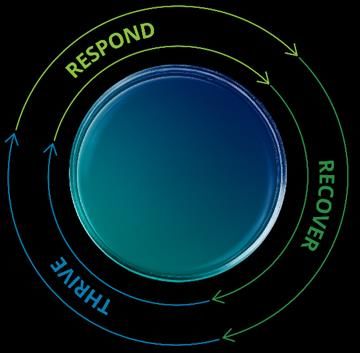
Within that context, leaders and companies need to plan both for the short term in order to
Respond to and Recover from the COVID-19 crisis, but also for the medium to long term in
order to Thrive after the “new normal” is established.
RESPOND RECOVER THRIVE
Manage continuity Learn and emerge stronger Prepare for the next normal
Set-up and operate a COVID-19 response “Command Develop Business Plan based on medium term (2-3 Develop strategic plan based on long-term scenarios
Center” to coordinate internally and to support years) scenarios to support relevant business decisions assessing key uncertainties of the “next normal” (e.g.
effective decision-making and communication with key and/or potential financial restructuring. consumer/traveler preferences and behavior, global
stakeholders (e.g. customer, suppliers, lenders). dynamics, shape of travel industry value chain, long-
Assess investment pipeline and redefine investment term economic impact).
Understand impact of and handle contractual
plan (M&A, new developments, etc.).
obligations (e.g. Tour Operators, suppliers). Develop a solid M&A strategy and roadmap that
Enhance customer engagement and experience (incl.
Develop short-term financial (e.g. cash flow forecast prioritizes growth pathways and targets.
and liquidity plan, financial stress testing) and relevant digital capabilities).
Assess digital capabilities and develop/update digital
operational (e.g. personnel, commercial/customer, cost Focus on improving operations and financial results in
strategy and roadmap based on the lessons learned
reduction, etc.) plan based on different options for the the post-COVID-19 era (e.g. organizational structure from the COVID-19 crisis and the new requirements of
2020 season (e.g. opening vs no opening of one or and staffing, commercial plan and sales/front office the “next normal”.
more hotel units), taking also into consideration COVID- operations, pricing and revenue management, cost
19 restrictions, requirements and health protocols (e.g. structure optimization, policies, processes and Update and formalize crisis and resilience playbook and
guest distancing, food preparation and serving, establish crisis and resilience planning as business as
controls).
personnel training, testing and measuring). usual.
Assess the effectiveness of the organization’s response
Identify and assess funding solutions and initiate Be prepared to adapt to regulatory changes due to the
relevant actions (e.g. discussions with lenders, to the COVID-19 crisis, understand lessons-learned and
COVID-19 crisis (e.g. incentives, taxation, labor, health
Government incentives, accelerated M&A). develop a Business Continuity Management System.
and safety, data protection/privacy).
Monitor, comply to and take advantage of Government Proactively handle dispute resolution issues.
Rethink and redesign your employment arrangements
measures against the COVID-19 crisis. Assess third party risks (e.g. main customers/Tour to reflect requirements of the “next normal”.
Assess and address systems and cyber vulnerabilities, as Operators, key suppliers and service providers) and take
well as GDRP implications of respond actions and appropriate actions.
measures.
Copyright © 2020 Deloitte Central Mediterranean. All rights reserved. Page1515Questions about the future
The COVID-19 is arguably a shock that shakes the foundations of the world. This too shall pass
but most likely things will be very different. It is never too early for business leaders to start
asking questions on how the new normal for the Tourism & Hospitality sector will look like.
Will people’s attitude towards international travel be affected? Will there be major changes on what travelers value most and on what they seek?
How will consumer preferences evolve? Will any new travel segments evolve? How will new ways of doing business affect MICE and business travelling?
Society &
Consumers Will the COVID-19 crisis foster trust in humanity, social cohesion and a heightened What will be the impact on different generations (e.g. older people struggling to follow
appreciation for relationships and human interaction or will it augment xenophobia, virtual interactions and shift to digital channels, Baby Boomers and early Gen Xers
suspicion of others and decline in individual freedom? What the impact on travel will be? postponing retirement) and consequently on travel behavior and spend?
Will virtual socializing become a norm and more advanced tools occur, helping to keep How can developments in technology and relevant regulation (e.g. data sharing) help
friends and families connected regardless of distance and without the need to travel? travel companies improve customer experience and build trust in the post-COVID-19 era?
Technology
Will a new digitally integrated traveler experience evolve as innovation explosion occurs, Will ripple effects of the pandemic (e.g. social distancing as a norm) force travelling to
with significant investment into new applications in areas such as VR and AI? become more impersonal and thus the adoption of relevant technologies (e.g. robots, AI)?
Will there be long-term impacts on employment, disposable income and attitudes Will there be structural changes in the travel industry, globally and particularly in Greece
Market & towards discretionary spending such as travel? What will happen in source markets? (e.g. airlines, sales channels, role of sharing economy platforms, consolidation)?
Economy Will global recession exacerbate socioeconomic inequality, due to people’s and countries’ What kind of disruptive business models may arise in the tourism and hospitality sector
uneven ability to weather the storm? What will be the impact on international travel? due to the new reality brought on by the COVID-19 crisis?
Will globalization and freedom of movement persevere or isolationism and more Will there be an impact on the future of EU and inter-European tourism?
Politics & authoritarian political governance will prevail globally (e.g. stricter border control policies,
Can the COVID-19 crisis lead to political unrest in certain parts of the world and thus
Regulation travel restrictions, cancellation of visa programs)?
affect tourism flows?
Will the aftermath of the pandemic lead to renewed efforts to fight climate change or to Will the environmental agenda be mainly driven by global collaboration between
Environment an overall decline in emphasis on environmental sustainability as people and countries countries, climate change agreements and relevant regulatory changes or by demands
focus on the economy and try to recover from the recession? from the customer and initiatives by sustainability-minded companies?
Copyright © 2020 Deloitte Central Mediterranean. All rights reserved. Page1616Contact us
“ While the full extent of COVID-19’s impact and
disruption to the Greek Tourism & Hospitality sector
remains to be seen, it already presents a challenge
Vassilis Kafatos
Partner
across the industry. Traditionally, tourism and Clients & Industries Leader
consequently hospitality is one of the sectors that Travel, Hospitality & Services Leader
recover quickly after a crisis and thus, it is expected
vkafatos@deloitte.gr
that Greek tourism can rebound in 2021 if COVID-
19 pandemic is eliminated promptly (e.g. successful
contact tracing and quarantine measures in all
countries, vaccine becomes available).
Nevertheless, it remains to be seen if there will be Thodoris Papakonstantinou
Principal
any structural changes (e.g. bankruptcies of major
Consulting - Strategy, Analytics & M&A
players, hotel closures), shifts in travelers’ behavior
and preferences and other long term impacts on tpapakonstantinou@deloitte.gr
the sector. We recognize the importance and
urgency of the current situation and we help our
”
clients to TAKE ACTION NOW.
Copyright © 2020 Deloitte Central Mediterranean. All rights reserved. Page1717This document has been prepared by Deloitte Business Solutions Societe Anonyme of Business Consultants, Deloitte Certified Public Accountants Societe Anonyme, Deloitte Business Process Solutions Single Member Societe Anonyme for the Provision of Accounting Services and Deloitte Alexander Competence Center Single Member Societe Anonyme of Business Consultants. Deloitte Business Solutions Societe Anonyme of Business Consultants, a Greek company, registered in Greece with registered number 000665201000 and its registered office at Marousi Attika, 3a Fragkokklisias & Granikou str., 151 25, Deloitte Certified Public Accountants Societe Anonyme, a Greek company, registered in Greece with registered number 0001223601000 and its registered office at Marousi-Attica, 3a Fragkokklisias & Granikou str., 151 25, Deloitte Business Process Solutions Single Member Societe Anonyme for the Provision of Accounting Services, a Greek company, registered in Greece with registered number 0009622801000 and its registered office at Marousi Attica, 3a Fragkokklisias & Granikou str., 151 25 and Deloitte Alexander Competence Center Single Member Societe Anonyme of Business Consultants, a Greek company, registered in Greece with registered number 144724504000 and its registered office at Thessaloniki, Municipality of Pylaia - Chortiatis of Thessaloniki, Vepe Technopolis Thessaloniki (5th and 3rd street), are one of the Deloitte Central Mediterranean S.r.l. (“DCM”) Countries. DCM, a company limited by guarantee registered in Italy with registered number 09599600963 and its registered office at Via Tortona no. 25, 20144, Milan, Italy is one of the Deloitte NSE LLP Geographies. Deloitte NSE LLP is a UK limited liability partnership and member firm of Deloitte Touche Tohmatsu Limited, a UK private company limited by guarantee (“DTTL”). DTTL and each of its member firms are legally separate and independent entities. DTTL, Deloitte NSE LLP and Deloitte Central Mediterranean S.r.l. do not provide services to clients. Please see www.deloitte.com/about to learn more about our global network of member firms. This document and its contents are confidential and prepared solely for your use, and may not be reproduced, redistributed or passed on to any other person in whole or in part, unless otherwise expressly agreed with you. No other party is entitled to rely on this document for any purpose whatsoever and we accept no liability to any other party, who is provided with or obtains access or relies to this document. © 2020 Deloitte Central Mediterranean. All rights reserved.
You can also read


