COMMUTING BY MOTORCYCLE: IMPACT ANALYSIS
←
→
Page content transcription
If your browser does not render page correctly, please read the page content below
COMMUTING BY MOTORCYCLE:
IMPACT ANALYSIS

Final report commissioned by:
Febiac vzw
Woluwedal 46, box 6
1200 BRUSSELS

21 September 2011

                                TRANSPORT & MOBILITY LEUVEN
                                DIESTSESTEENWEG 57
                                3010 KESSEL-LO (LEUVEN)
                                BELGIUM
                                +32 (16) 31.77.30
                                http://www.tmleuven.be

                                Report number:
                                10.69
                                Author:
                                I. Yperman (TML)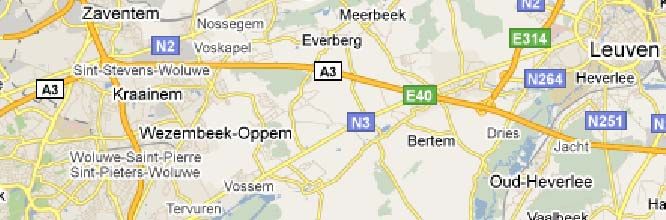
2
Contents

CONTENTS ..................................................................................................................................................... 3

TABLES............................................................................................................................................................. 4

ILLUSTRATIONS............................................................................................................................................ 5

1       INTRODUCTION................................................................................................................................... 6

2       EFFECT ON TRAFFIC FLOW AND CONGESTION ........................................................................ 7

    2.1     LEUVEN-BRUSSELS CASE STUDY ............................................................................................................................7
       2.1.1 Reference scenario .....................................................................................................................................................8
       2.1.2 Modal shift scenario ...............................................................................................................................................19
       2.1.3 Effect of modal shift on traffic flow..........................................................................................................................27
    2.2     OVERALL EFFECT ON THE ROAD NETWORK ......................................................................................................29
       2.2.1 Case study: modal shift scenario including knock-on effect ........................................................................................30
       2.2.2 Lost vehicle hours and time benefits on the entire network of primary roads...............................................................32
    2.3     OVERALL EFFECT ON THE SECONDARY ROAD NETWORK ...............................................................................32

3       EFFECT ON EMISSIONS.....................................................................................................................34
    3.1     EMISSIONS FROM MOTORCYCLES AND CARS ......................................................................................................34
       3.1.1 Emission factors.....................................................................................................................................................34
       3.1.2 External emission costs ..........................................................................................................................................37
    3.2     LEUVEN-BRUSSELS CASE STUDY: EMISSION COSTS ............................................................................................39

4       CONCLUSIONS .....................................................................................................................................43

    4.1     EFFECT ON TRAFFIC FLOW AND CONGESTION ..................................................................................................43
       4.1.1 Leuven-Brussels case study......................................................................................................................................43
       4.1.2 Overall effect on the primary road network ..............................................................................................................43
       4.1.3 Overall effect on the secondary road network ............................................................................................................44
    4.2     IMPACT ON EMISSIONS...........................................................................................................................................44

REFERENCES ................................................................................................................................................45

APPENDIX A:                   DESCRIPTION OF THE LINK TRANSMISSION MODEL .......................................47

                                                                                                                                                                                    3
Tables
Tabel 1: Value in 2010 in terms of €/kg (CO2 in €/ton), euro at 2009 value (source: De Nocker et al. (2010)) 38
4Illustrations
Figure 1: The area of the case stury between Leuven and Brussels 7
Figure 2: Sites in the study area where remote data is collected 8
Figure 3: Traffic intensities and speeds in Sterrebeek travelling towards Brussels on Tuesday 18 May 2010. 9
Figure 4: R0 Zaventem observation points in an intensity-speed diagram 11
Figure 5: R0 Zaventem observation points in a density-intensity diagram 11
Figure 6: traffic intensities on the main carriageway in Sterrebeek in the direction of Brussels (measured and simulated) 12
Figure 7: traffic speeds on the main carriageway in Sterrebeek in the direction of Brussels (measured and simulated) 13
Figure 8: Queue propagation in the morning rush hour in the reference scenario 17
Figure 9: Travel times on the E40 between Leuven and Sint-Stevens-Woluwe/Woluwe Saint Etienne in the morning rush hour in the
reference scenario 18
Figure 10: PCE value of the motorcycle in relation to traffic density 20
Figure 11: Queue propagation in the morning rush hour in the modal shift scenario 25
Figure 12: Travel times on the E40 between Leuven and Sint-Stevens-Woluwe/Woluwe Saint Etienne in the morning rush hour in the
modal shift scenario 26
Figure 13: Travel time on the E40 between Leuven and Sint-Stevens-Woluwe/Woluwe Saint Etienne in the morning rush hour in the
reference scenario and in the modal shift scenario 28
Figure 14: Travel time on the E40 between Leuven and Sint-Stevens-Woluwe/Woluwe Saint Etienne in the morning rush hour in the
reference scenario and in the scenarios with modal shift 29
Figure 15: Travel time on the E40 between Leuven and Sint-Stevens-Woluwe/Woluwe Saint Etienne in the morning rush hour in the
modal shift scenario including knock-on effects and in the other scenarios reviewed 31
Figure 16: Emission factors for motorcycles and cars on motorways as a function of average speed 36
Figure 17: Emission factors of the different pollutants for motorcycles and cars 37
Figure 18: External emission costs for motorcycles and cars on motorways as a function of average speed 38
Figure 19: External emission costs of the different pollutants for motorcycles and cars 39
Figure 20: External emission costs for all vehiclecategories on motorways as a function of average speed 40
Figure 21: Totale emission costs by Vehicle category for the Leuven-Brussels journey during the morning rush hour 41
Figure 22: Total emission costs per pollutant for the Leuven-Brussels journey in the morning rush hour 42
51 Introduction
Reducing traffic congestion and improving air quality in relation to road traffic represent
important challenges for our mobility.
In this study, we investigate whether commuting by motorcycle can make a contribution in this
context. We examine whether achieving a modal shift from cars to motorcycles has an effect on
traffic flow and congestion. Furthermore, we look at the impact such a modal shift would have
on vehicle emissions and air quality.
The report is structured as follows: Chapter 2 considers the effect on traffic flow and congestion
of a modal shift of commuters from cars to motorcycles. The effect on emissions is examined in
Chapter 3. Finally, in Chapter 4 we formulate the main conclusions.
62 Impact on traffic flow and congestion
In this Chapter we study the effect on traffic flow of a modal shift in commuter traffic from cars
to motorcycles. Because motorcycles take up less physical space on the road, a smoother flow of
traffic can be expected when more commuters leave their cars at home and travel to work by
motorcycle.
The impact on traffic flow is examined using by a case study in which the traffic on the
motorway route between Leuven and Brussels is accurately simulated (see Section 2.1), first in a
reference scenario and then in a scenario in which there is a modal shift from cars to
motorcycles. In Section 2.2 we look at the effect of a modal shift on the overall road network in
Belgium. Finally, Section 2.3 considers the overall impact on the secondary road network.
2.1 Leuven-Brussels case study
As a case study we consider the traffic flow on the motorway route between Leuven and
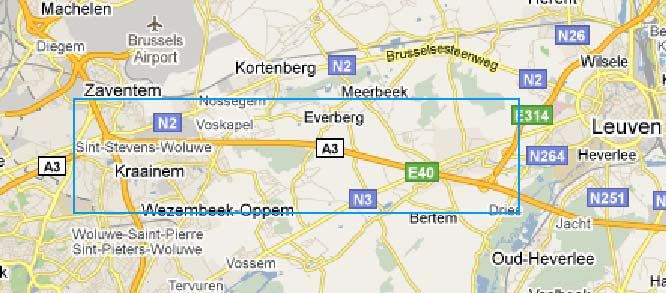
Brussels during a typical morning rush hour. Figure 1 is a map of the area covered by the case
study: the E40 motorway between Leuven and Brussels, from the intersection in the east
between the E314 and the E40 (in Leuven), to the intersection in the west of the E40 and the R0
Brussels orbital motorway (in Sint-Stevens-Woluwe/Woluwe Saint Etienne).
Figure 1: The area of the case study between Leuven and Brussels
As a first step we construct the reference scenario, in which we analyse the traffic flow under
existing conditions (Section 2.1.1). Next we consider a scenario in which there is a modal shift
from cars to motorcycles (Section 2.1.2). By comparing both scenarios we can determine the
effect of the modal shift on traffic flow (Section 2.1.3).
72.1.1 Reference scenario
The reference scenario shows the traffic flow under existing conditions. Using a traffic model,
realistic simulations are made of the traffic flows in the area of the study.
2.1.1.1 Traffic model
The traffic model that we use is the Link Transmission Model (LTM) that was developed at
KULeuven (Yperman (2007)). LTM simulates traffic flows in networks in a realistic manner. It is
a dynamic model that shows the evolution of the traffic situation in arbitrary time intervals (e.g. 5
minutes). The process of the build-up and dispersal of queues is modelled in detail. This state-of-
the-art model lends itself perfectly to the simulation of queues and the propagation of queues in
large road networks. A detailed description of the model and how it works is included as
Appendix A.
Data is entered into the traffic model in respect of traffic demand and a traffic network. After
this has been entered, the model calculates how the traffic flows propagate in the traffic network.
As output we get a graphic representation of traffic intensities, speeds and densities on the
different parts of the network over the course of time. The origin and proliferation of queues is
visualised in a film. Travel times over the course of the time period under review are the model’s
output.
2.1.1.2 Traffic demand
Traffic demand has to be defined and input into the model. For the case study under
consideration the traffic demand can be derived from traffic censuses made available by the
Flemish Traffic Centre.
We can use traffic censuses at 7 locations in the study area, where data is continuously collected
remotely by means of sensors located in the road network. These data collection sites are located
at the entrances and exits at the Leuven complex (E314), Haasrode (E40), Bertem (E40),
Sterrebeek (E40), Kraainem (E40), Wezembeek-Oppem (R0) and Zaventem (R0).
Figure 2 shows an overview of these 7 sites at which remote data is collected:
Zaventem Sterrebeek Bertem Leuven
Kraainem Wezembeek-Oppem Haasrode
Figure 2: Sites in the study area where remote data is collected
86 sensors have been installed at each location: at the entrance, exit, main carriageway between the
entrance and exit, and each of these in both directions.
The remote data at these locations was made available by the Flemish Traffic Centre for the
entire month of May 2011, at time intervals of 5 minutes. Bertem was the only site at which no
data was available for the period of May 2011. Data for this location, is therefore taken from the
month of May 2010.
The morning rush hour of Thursday 12 May 2011 was selected in order to come up with a
‘typical morning rush hour’. The total traffic volume in the morning rush hour was equal to the
median of the traffic volumes in the morning rush hour of all working days in May 2011. The
morning rush hour of 12 May 2011 is assumed to be representative of a typical morning rush
hour. In Bertem and Sterrebeek the data of Tuesday 18 May 2010 were used to represent a
typical morning rush hour. Traffic volumes in the morning rush hour in Sterrebeek on this day
are virtually identical to those of Thursday 12 May 2011.
Figure 3 shows an example of the measured intensities and speeds in Sterrebeek on the main
carriageway towards Brussels on Tuesday 18 May 2010. The blue curve shows the traffic
intensity (Car equivalents/5min) over the course of the day, the red curve shows the speed of the
traffic flow (km/h).
Sterrebeek hoofdrijbaan richting Brussel 18 mei 2010
700 intensiteit (PAE/5min)
snelheid (km/u)
600
500
400
300
200
100
0
0u 1u 2u 3u 4u 5u 6u 7u 8u 9u 10u 11u 12u 13u 14u 15u 16u 17u 18u 19u 20u 21u 22u 23u 24u
Tijdsindex
Figure 3: Traffic intensities and speeds in Sterrebeek travelling towards Brussels on Tuesday 18 May
2010.
There is a strong increase in traffic intensity between 5 a.m. and 7 a.m. A queue forms at around
6.45 that is characterised by the slower speed of the traffic flow. The queue continues until
approximately 9 a.m. From here on we will consider the period from 6.30 a.m. to 9.30 a.m. as the
morning rush hour period.
9Note that an incident occurred on 18 May 2010 at around 2 p.m. Low intensities and very slow
speeds are observed until approximately 8 p.m. On a ‘normal’ day at Sterrebeek there is no
structural queue after midday in the direction of Brussels.
Based on the traffic censuses of 12 May 2011 and 18 May 2010, source-destination matrices were
prepared at the different locations for each time interval of 5 minutes between 6.30 a.m. and 9.30
a.m. These matrices show for each time interval the number of trips made between the different
sources and destinations. The traffic demand was entered in the traffic model in the form of
source-destination matrices. These matrices were prepared by applying one of the Source-
Destination estimating methodologies developed at KULeuven (Frederix et al. (2010)).
The traffic censuses also contain information about the composition of the traffic flows. On
average, for the morning rush hour in the area of the study, we noted that:
83.4% of vehicles were shorter than 4.9m (cars and motorcycles)
7.5% of vehicles were between 4.9m and 6.9m in length (vans)
9.1% of vehicles were longer than 6.9m (trucks and buses)
The first category can be sub-divided into cars and motorcycles in proportion to the vehicle
kilometres travelled on the Belgian motorway network of both vehicle categories. For this we
rely on the traffic censuses carried out by the Federal Planning Bureau (Federaal Planbureau
(2009)). This then results in the following traffic mix:
0.9% motorcycles
82.5% cars (< 4.9m)
7.5% vans (4.9m to 6.9m)
9.1% trucks and buses (> 6.9m)
2.1.1.3 Traffic network
Apart from the traffic demand, a traffic network also has to be constructed and entered. For this,
the study area was divided into road sections of approximately 1 km in length. A maximum
speed, capacity (or maximum intensity) and a maximum density are defined for each road
section. Where possible, we derive these quantities from the traffic censuses.
We illustrate this with the road section that corresponds with the main carriageway on the outer
ring R0 at Zaventem.
In Figure 4 all observations (traffic censuses) from the month of May 2011 on the outer ring R0
in Zaventem are plotted as a scatter diagram. Each point is an observation (intensity and average
speed) in a time interval of 5 minutes.
10Figure 4: R0 Zaventem observation points in an intensity-speed diagram
The traffic density is calculated as the quotient of the intensity and the average speed. Figure 5
places the observation points in a density-intensity diagram.
Figure 5: R0 Zaventem observation points in a density-intensity diagram
11From these observations we can deduce the following values that are allocated to the road
section in question on the R0 outer ring in Zaventem:
maximum speed = 120 km/h
capacity = maximum intensity = 8000 vehicles/hour
maximum density = 400 vehicles/km
The maximum speed, capacity and maximum density of the other links in the traffic network are
determined in an analogous manner.
2.1.1.4 Results
After inputting the traffic demand and the traffic network, the traffic model can start to be
calculated. For each road section the traffic model calculates traffic intensities, densities and
speeds for each time interval of 5 minutes. This is how the traffic flows were simulated in the
area of the study on 12 May 2011 between 6.30 a.m. and 9.30 a.m.
Following the simulation, the resulting intensities and speeds are checked to see whether they
correspond to the data collected remotely. The simulation results correspond well with the
remote data at all locations and time intervals. Figure 6 and Figure 7 illustrate the simulated and
measured intensities and speeds in Sterrebeek.
Sterrebeek hoofdrijbaan richting Brussel
9000
8000
7000
6000
Intensiteit [pae/u]
5000
4000
3000
2000
Metingen
1000 Simulatie
0
6u 7u 8u 9u 10u 11u
Tijdsindex
Figure 6: Traffic intensities on the main carriageway in Sterrebeek in the direction of Brussels (measured
and simulated)
12Sterrebeek hoofdrijbaan richting Brussel
140
120
100
Snelheid [km/u]
80
60
40
Metingen
20
Simulatie
0
6u 7u 8u 9u 10u 11u
Tijdsindex
Figure 7: Traffic speeds on the main carriageway in Sterrebeek in the direction of Brussels (measured
and simulated)
Queue propagation
Figure 8 illustrates the queue propagation during the morning rush hour. A snapshot is shown
every 10 minutes. The bars on the various links represent the traffic densities. Thicker and darker
bars represent higher densities.
Brussel Leuven
6u30
Brussel Leuven
6u40
13Brussel Leuven
6u50
Brussel Leuven
7u00
Brussel Leuven
7u10
Brussel Leuven
7u20
Brussel Leuven
7u30
14Brussel Leuven
7u40
Brussel Leuven
7u50
Brussel Leuven
8u00
Brussel Leuven
8u10
Brussel Leuven
8u20
15Brussel Leuven
8u30
Brussel Leuven
8u40
Brussel Leuven
8u50
Brussel Leuven
9u00
Brussel Leuven
9u10
16Brussel Leuven
9u20
Brussel Leuven
9u30
Figure 8: Queue propagation in the morning rush hour in the reference scenario
A queue begins to form at 6.40 a.m. near the intersection of the E40 and the R0. The main
carriageway on the R0 outer ring around Zaventem does not have sufficient capacity to
accommodate both streams i) from the easterly E40 and ii) from the southerly R0. This road
section on the R0 outer ring acts as a bottleneck. Behind this bottleneck a queue forms on the
E40 in the direction of Leuven. From 6.40 a.m. this queue in the direction of Leuven gets
continuously longer and traffic density increases steadily. At 7.30 a.m. the queue stretches all the
way back to Haasrode. At 7.40 a.m. the queue reaches Leuven. From 8 a.m. the queue in the
direction of Brussels starts to disperse. The queue had disappeared by 9.10 a.m.
Travel times
The queues also result in higher travel times. Figure 9 shows the travel time on the E40 from the
E40-E314 intersection (Leuven) to the E40-R0 intersection (Sint-Stevens-Woluwe/Woluwe
Saint Etienne) over the course of time. The travel time starts to increase from 6.40 a.m. At 7.50
a.m. a journey on the E40 between Leuven and Sint-Stevens-Woluwe/Woluwe Saint Etienne
takes 14 minutes longer than at 6.40. After 7.50 the travel time gradually starts to decrease, to
return to the same level at 9.00 a.m. as it was at 6.40.
17Reistijden Leuven-Brussel in de ochtendspits
22
20
18
16
14
Reistijd [minuten]
12
10
8
6
4
referentiescenario
2
0
6u00 7u00 8u00 9u00 10u00
Tijdsindex
Figure 9: Travel times on the E40 between Leuven and Sint-Stevens-Woluwe/Woluwe Saint Etienne in the
morning rush hour in the reference scenario
Lost vehicle hours
We work out the total number of lost vehicle hours for the reference scenario. These show how
much time is lost by all vehicles combined. This gives a good indication of traffic congestion.
In the first instance we determine the time lost over the course of the peak period, on the E40
from the E40-E314 intersection (Leuven) to the E40-R0 intersection (Sint-Stevens-
Woluwe/Woluwe Saint Etienne). Time lost is the difference between the observed actual travel
time and the travel time in an uncongested network with free-flowing traffic.
Next we determine the total lost vehicle hours by multiplying the time lost by the volume of
traffic that is subject to the loss of time. Lost vehicle hours is the total time lost by all vehicles
combined and is calculated as follows:
t 9 u 30
VVU qVdt
t 6 u 30
where VVU = lost vehicle hours in the morning rush hour (Vehicle hours)
q = traffic volume (Vehicles/time unit)
V = lost time (hours)
There was a total of 1925 lost vehicle hours in the reference scenario.
182.1.2 Modal shift scenario
In this scenario we consider a modal shift from cars to motorcycles. We assume that 10% of the
cars are replaced. First we look at how to adjust the simulation parameters in order to be able to
model a modal shift of this sort (Section 2.1.2.1). We then perform a simulation with these new
parameters and look at the results (Section 2.1.2.2).
2.1.2.1 Adjusting simulation parameters
Car equivalent (PCE) of the motorcycle
The space occupied by motorcycles on the road can be compared with the space taken up by the
cars, and can then be expressed in terms of passenger car equivalents (PCE). The PCE value of a
motorcycle represents how many cars would have the same effect on the flow of traffic and the
capacity of the road.
When there is little traffic on the road, it can be expected that motorcycles will take up as much
space on the road as cars. A motorcycle then has a PCE value of 1. However, when the road
becomes busier, and the speed of the traffic flow falls, motorcycles take up less space. Some
motorcycles keep less distance from the vehicle in front or ride between two lanes. The
passenger car equivalent of the motorcycle is consequently reduced. When traffic comes to a
complete standstill, it can be assumed that all motorcycles drive between two lanes. In this case,
the motorcycle has a PCE value of 0.
The PCE value of a motorcycle is therefore dependent on the speed and the traffic situation on
the road. Furthermore, the PCE value is also dependent on the type of road (motorway, regional
road, crossroads, etc…) and on the number of motorcycles in the traffic flow.
Different values can be found in the literature for the PCE of a motorcycle.
In 1963, Holroyd suggested a value of 0.6 PCE, based on empirical material that was researched
at the UK Transport and Road Research Laboratory (Holroyd (1963)). This value was not
differentiated by road type or traffic flow regime. Furthermore, the vehicle and traffic flow
characteristics from 1963 are no longer relevant to the current situation.
In 2007, Lee recognised that the PCE value is dependent on the share of motorcycles and the
speed of the traffic flow. He developed a model to determine the PCE of motorcycles in
different circumstances. Lee proposes values of 0.4 PCE to 0.75 PCE depending on the traffic
situation (Lee (2007)).
Various researchers suggested values of 0 PCE to 0.33 PCE in an urban environment close to
traffic lights (Ellis (2005), UK Department for Transport (2004), Powell (2000), Holroyd (1963)).
These values cannot be applied to motorways.
Minh finds a PCE value of 0.28 (Minh (2005)) and Powell finds values between 0 PCE and 0.65
PCE (Powell (2000)), but these are based on tests in Indonesia, Malaysia and Thailand where
19there is a very high proportion of motorcycles and they cannot be used in Europe without
adjustment.
Wigan reviewed the existing literature and decided that the most suitable value for motorways
amounted to 0.5 PCE.
For the case study under consideration, this value of 0.5 PCE was used in order to characterise
the traffic situation with the maximum intensity (capacity). At this maximum intensity (qM) there
is a traffic density kM. In free-flowing traffic with low traffic density (k ≈ 0) the value approaches
1 PCE. In this case the distance between vehicles is more or less identical, regardless whether
they are cars or motorcycles. Intermediate traffic regimes (0 < kM < kMAX) are characterised by an
intermediate value (1 > PCE > 0.5). In heavily congested traffic with a high traffic density (k ≈
kMAX) the value approaches 0 PCE. In this situation, motorcycles drive in between the lanes and
overtake cars without hindering them. Intermediate traffic regimes (kM < k < kMAX) are
characterised by an intermediate value (0.5 > PCE > 0).
Taking account of the above information, we postulate the following relationship between the
PCE and traffic density:
k
PCE_motorcycle = (1 0.5 ) for k ≤ kM
kM
k kM
PCE_motorcycle = 0.5(1 ) for k ≥ kM
k max k M
where:
k = traffic density (PCE/km)
kM = traffic density at regime capacity (PCE/km)
kMAX = maximum traffic density (PCE/km)
This relationship is represented graphically in Figure 10:
PAE motorfiets ifv dichtheid
1
0.9
0.8
0.7
PAE motorfiets (-)
0.6
0.5
kM
0.4
0.3
0.2
0.1 kMAX
0
0 50 100 150 200 250 300 350 400 450
dichtheid (pae/km)
Figure 10: PCE value of the motorcycle in relation to traffic density
20Simulation parameters
In order to simulate the modal shift scenario, the traffic flows from the points of origin have
been adapted, as has the capacity of the bottleneck links. This was done as follows:
BG pw
Q Q * (1 f . p pw . pae pw f . p pw c
paemoto )
BGmoto
C C * ( paemoto
k
paemoto
c
). f . p pw .Q *
where:
Q = adjusted traffic demand from point of origin (PCE/u)
Q* = original traffic demand from point of origin (PCE/u)
f = fractions of cars that are replaced (-)
ppw = original percentage of cars in the traffic flow (-)
PCEpw = PCE value for cars (-)
BGpw = occupancy rate for cars (-)
BGmoto = occupancy rate for motorcycles (-)
PCEcmoto = PCE value for motorcycle in congestion (kM < k) (-)
C = adjusted capacity of bottleneck link (PCE/u)
C* = original capacity of bottleneck link (PCE/u)
PCEkmoto = PCE value of motorcycle at capacity (k = kM) (-)
The modal shift can be modelled using these formulae. It is assumed that a certain fraction f (in
this case 10%) of the car traffic exchanges their car for a motorcycle. This also allows the
different occupancy rate of cars compared to motorcycles to be taken into account. There are
usually more people in a car than on a motorcycle. For commuter traffic in Flanders, there is an
occupancy rate of 1.1 persons per car (OVG Vlaanderen (2010)). For motorcycles we take an
occupancy rate of 1 person per motorcycle. This means that 10 cars will be replaced by 11
motorcycles. The number of vans and trucks remains unchanged. The following simulation
parameters were used:
f = 10%
ppw = 83.4%
PCEpw = 1
BGpw = 1.1
BGmoto = 1
PCEkmoto = 0.5
2.1.2.2 Results
After the simulation parameters have been adjusted, we can use the traffic model to calculate a
modal shift scenario. This yields the following results:
21Queue propagation
Figure 11 illustrates the queue propagation in the morning rush hour. A snapshot is shown every
10 minutes. The bars on the various links represent the traffic densities. Thicker and darker bars
represent higher densities.
Brussel Leuven
6u30
Brussel Leuven
6u40
Brussel Leuven
6u50
Brussel Leuven
7u00
22Brussel Leuven
7u10
Brussel Leuven
7u20
Brussel Leuven
7u30
Brussel Leuven
7u40
Brussel Leuven
7u50
23Brussel Leuven
8u00
Brussel Leuven
8u10
Brussel Leuven
8u20
Brussel Leuven
8u30
Brussel Leuven
8u40
24Brussel Leuven
8u50
Brussel Leuven
9u00
Brussel Leuven
9u10
Brussel Leuven
9u20
Brussel Leuven
9u30
Figure 11: Queue propagation in the morning rush hour in the modal shift scenario
25At 6.40 a.m. a queue starts to form at the intersection of the E40 and the R0. The main
carriageway on the R0 outer ring in the area around Zaventem has insufficient capacity to
accommodate both streams i) from the easterly E40 and ii) from the southerly R0. This road
section on the R0 outer ring acts as a bottleneck. Behind this bottleneck a queue forms on the
E40 in the direction of Leuven. From 6.40 a.m. this queue in the direction of Leuven continues
to lengthen and traffic density increases steadily. The queue reaches its maximum extent at 7.50
when it stretches back to around half-way between Sterrebeek and Bertem. From 8 a.m. the
queue in the direction of Brussels starts to ease. The queue had disappeared by 8.30 a.m.
Travel times
The queues also result in higher travel times. Figure 12 shows the travel time on the E40 from
the E40-E314 intersection (Leuven) to the E40-R0 intersection (Sint-Stevens-Woluwe/Woluwe
Saint Etienne) over the course of time. Travel times start to increase from 6.40 a.m. At 7.50 a.m.
a journey on the E40 between Leuven and Sint-Stevens-Woluwe/Woluwe Saint Etienne takes 6
minutes longer than at 6.40. After 7.50 the travel time gradually starts to decrease, returning to
the same level at 8.30 a.m. as it was at 6.40.
Reistijden Leuven-Brussel in de ochtendspits
22
20
18
16
14
Reistijd [minuten]
12
10
8
6
4
2 scenario modale verschuiving 10%
0
6u00 7u00 8u00 9u00 10u00
Tijdsindex
Figure 12: Travel times on the E40 between Leuven and Sint-Stevens-Woluwe/Woluwe Saint Etienne in
the morning rush hour in the modal shift scenario
Note that these are the travel times of an ‘average’ vehicle in the traffic flow. It is assumed that
motorcycles travel at the same speed as cars.
Lost vehicle hours
26Lost vehicle hours, which shows how much time is lost by all vehicles combined, is calculated in
the same way as was indicated in Section 2.1.1.4.
In the modal shift scenario there was a total of 706 lost vehicle hours.
2.1.3 Impact of modal shift on traffic flow
By comparing the modal shift scenario with the reference scenario we can work out the effect of
the modal shift on the traffic flow.
2.1.3.1 Queue propagation
In both scenarios, a queue begins to form on the E40 in the area of its intersection with the R0
at the same time (6.40 a.m.) and for the same reason. The queue goes back in the direction of
Leuven. The queue increases at a faster rate in the reference scenario and also becomes
somewhat longer. The queue reaches its peak at 7.40/7.50. In the reference scenario the queue
stretches all the way back to Leuven (see Figure 8), while in the modal shift scenario the queue
stretches no further than halfway between Sterrebeek and Bertem (see Figure 11). From 8.oo
a.m. the queue begins to ease in the direction towards Brussels. In the reference scenario the
queue has disappeared by 9.10, while in the modal shift scenario it has already gone by 8.30.
We can conclude that the queue becomes shorter and disperses more quickly as a result of the
modal shift.
2.1.3.2 Travel times
These findings are confirmed when we compare the travel times in both scenarios. Figure 13
shows the travel times on the E40 from the entrance at the E40-E314 intersection (Leuven) to
the exit at the E40-R0 intersection (Sint-Stevens-Woluwe/Woluwe Saint Etienne) over the
course of time.
27Reistijden Leuven-Brussel in de ochtendspits
22
20
18
16
14
Reistijd [minuten]
12
10
8
6
4
referentiescenario
2 scenario modale verschuiving 10%
0
6u00 7u00 8u00 9u00 10u00
Tijdsindex
Figure 13: Travel times on the E40 between Leuven and Sint-Stevens-Woluwe/Woluwe Saint Etienne in
the morning rush hour in the reference scenario and in the modal shift scenario
Travel time starts to increase from 6.40 a.m. The travel time increases at a faster rate in the
reference scenario. At 7.50 a.m. the travel time lost in this scenario is almost double that in
comparison with the modal shift scenario, where the queue is somewhat shorter. The queue is
not only shorter, it also disappears more quickly in the modal shift scenario. At 8.30 a.m. the
travel time has returned to its original level. In the reference scenario this does not occur until
9.10 a.m.
2.1.3.3 Lost vehicle hours
The modal shift results in a fall in the number of lost vehicle hours (i.e. the time lost by all
vehicles combined) from 1925 to 706 hours. This represents a reduction of 63%. Note that this
does not take account of any possible knock-on effects.
2.1.3.4 Scenario without congestion
In addition to the scenario where 10% of the cars are replaced by motorcycles, we also
considered the modal shift that would be required to eliminate queues completely. To this end
we systematically adjust the simulation parameter f (fraction of cars that are replaced) and look at
the resulting traffic flow after running it through the traffic model. It turns out that a modal shift
of 25% of cars would be required in order to eliminate congestion completely. Figure 14 shows
the corresponding travel times in comparison with the other scenarios.
28Reistijden Leuven-Brussel in de ochtendspits
22
20
18
16
14
Reistijd [minuten]
12
10
8
6
4 referentiescenario
scenario modale verschuiving 10%
2 scenario modale verschuiving 25%
0
6u00 7u00 8u00 9u00 10u00
Tijdsindex
Figure 14: Travel times on the E40 between Leuven and Sint-Stevens-Woluwe/Woluwe Saint Etienne in
the morning rush hour in the reference scenario and in the modal shift scenarios
2.2 Overall effect on the road network
In this Section we consider the impact on lost vehicle hours when a modal shift is achieved
throughout the Belgian road network. We try to determine the effect when 10% of cars are
replaced by motorcycles on the entire road network during the rush hour period. To this end we
extrapolate the effects of the modal shift that emerged in the case study to the entire road
network.
However, it is clear that the effects of a modal shift are dependent on the local traffic situation.
The queues that develop at each bottleneck have different characteristics, which are dependent
on local circumstances, such as the local traffic demand and the capacity of the local bottleneck
and upstream road sections. The relationship between the modal shift and the change in traffic
flow, the reduction in travel times and the reduction in lost vehicle hours will consequently differ
for each location.
The result of an overall calculation for the entire road network based on extrapolating the results
of the case study can therefore only serve as an indication of the order of magnitude of the
impact of a global modal shift. In order to obtain more precise results, a traffic simulation would
have to be carried out across the entire Belgian road network. This is outside the scope of this
study.
29Below we examine first the impact in the Leuven-Brussels case study on travel times and lost
vehicle hours of a modal shift of 10% from cars to motorcycles, in which we take the knock-on
effect into account (Section 2.2.1). Next the results are extrapolated to the entire road network
(Section 2.2.2). The total time benefits are also calculated.
2.2.1 Case study: modal shift scenario including knock-on effect
A reduction of 63% in total lost vehicle hours was observed in the Leuven-Brussels case study.
This took no account of possible knock-on effects. When a particular transport option becomes
more attractive, this option can be expected to attract more traffic. Thus, an improvement in the
situation resulting in shorter travel times on the primary road network will attract extra traffic.
This extra traffic will partly be made up of journeys that previously would not have been made,
and partly of journeys that previously would have been made in a different manner, e.g. using the
secondary road network or another mode of transport (public transport, bicycle, etc…).
Using ‘elasticity’ we can see how much extra traffic is attracted when the traffic situation
improves, i.e. when the transport cost falls. In the literature on commuter traffic (‘essential trips
in peak periods’) price elasticity (with respect to the generalised transport cost) of -0.2 has been
suggested (Mayeres (1999)). This maintains that for commuter traffic, traffic demand will
increase by 0.2% when the total price of a journey falls by 1%, or conversely, that traffic demand
will fall by 0.2% when the total price of a journey rises by 1%.
For the Leuven-Brussels case study under consideration, we now determine the extent of the
knock-on effect and its impact on lost vehicle hours.
We base this on a ‘typical’ journey, assuming that a journey from Leuven to Brussels on the E40
from the entrance at the E40-E314 intersection (Leuven) to the exit at the E40-R0 intersection
(Sint-Stevens-Woluwe/Woluwe Saint Etienne) covering a distance of 14 km can be considered
as a ‘typical’ journey. The cost of this journey is made up of a vehicle cost (purchase,
maintenance, fuel, road taxes, insurance, etc…) and a time cost.
The vehicle cost is reflected in the official mileage allowance for business trips undertaken using
one’s own car. This vehicle cost current amounts to €0.33/km (Agentschap voor binnenlands
bestuur – Local government agency (2011)). In other words, the vehicle cost for a journey of 14
km amounts to €4.70.
In order to determine the time cost, a monetary value has to be placed on travel time. For
commuter traffic we assume a time value of €21.60/hour per traveller (source: De Ceuster
(2010)). To put it another way, a commuter would pay €21.60 to save an hour of travel time
during the peak period. We multiply this number by the occupancy rate of 1.1 travellers per
vehicle, giving us a time value of €23.76/hour per vehicle for commuter traffic.
In the reference scenario the time cost of the 14 km journey varies between €2.80 (for journeys
that take place before 6.40 a.m. or after 9.00 a.m.) and €8.30 (for a journey at 7.50 a.m.). In the
modal shift scenario this time cost varies between €2.80 and € 5.50.
30For a journey at 7.50 a.m. (at the peak of congestion) the total cost of a journey (vehicle cost +
time cost) is 21% lower in the modal shift scenario compared to the reference scenario (total
journey costs amount to €10.20 and €13.00 respectively). Consequently, traffic volume will
increase by around 4%. For journeys before 6.40 a.m. and after 9.00 a.m. the transport cost will
remain the same and no extra traffic will be attracted. Between 6.40 and 9.00 an average of
around 2% of extra traffic will be attracted.
When we calculate a scenario with respect to the traffic model that takes account of this extra
traffic demand, it delivers the following results:
Travel times
Figure 15 compares the travel times in this modal shift scenario including the knock-on effects
with the travel times in the other scenarios considered. With respect to the modal shift scenario
without knock-on effects, travel times increase at a faster rate (because of longer queues) and
persist for a longer time before returning to their original level (i.e. before the queue has
disappeared).
Reistijden Leuven-Brussel in de ochtendspits
22
20
18
16
14
Reistijd [minuten]
12
10
8
6
referentiescenario
4 scenario modale verschuiving 10%
scenario modale verschuiving 25%
2
scenario modale verschuiving 10% + aanzuig
0
6u00 7u00 8u00 9u00 10u00
Tijdsindex
Figure 15: Travel times on the E40 between Leuven and Sint-Stevens-Woluwe/Woluwe Saint Etienne in
the morning rush hour in the modal shift scenario including knock-on effects, as well as in the other
scenarios considered
Lost vehicle hours
As a consequence of the knock-on effects, the total of lost vehicle hours increases from 706
hours (in the modal shift scenario without knock-on effects) to 1158 hours. Compared to the
31reference scenario, the modal shift scenario including knock-on effects shows a reduction in lost
vehicle hours of 40%.
In the modal shift scenario without knock-on effects the reduction in lost vehicle hours
amounted to 63%. This is despite the fact that the knock-on only results in (on average) 2% of
extra traffic. Note that the results in this case study are highly sensitive to small fluctuations in
traffic demand.
2.2.2 Lost vehicle hours and time benefits on the entire primary road network
We now determine the reduction in lost vehicle hours and the resulting time benefits, when a
modal shift of 10% takes place from cars to motorcycles across the entire network of primary
roads in Belgium. As described above, we extrapolate the result of the case study to the whole of
the primary road network. Taking account of the knock-on effects, we assume that there would
be 40% fewer lost vehicle hours as a consequence of a modal shift from cars of 10%. Note once
more that this figure (40%) only has an indicative value.
In the study ‘Analysis of congestion in Belgium’ (Maerivoet S. & I. Yperman (2008)) it was found
that a total of around 37,000 hours were lost every day on the primary road network in Belgium
by all vehicles combined. When we apply a reduction of 40% as a consequence of the modal
shift, a saving could be made of approximately 15,000 lost vehicle hours. Multiplying this by the
time value of €23.76/hour per vehicle, gives us a total time benefit of around €350,000 per day
as a consequence of the modal shift from cars to motorcycles.
2.3 Overall effect on the secondary road network
The impact of a modal shift on the secondary road network is difficult to determine without
additional research and further case studies and traffic simulations. The secondary road network
is characterised by a number of factors that make it different from the main road network. For
example, there is a different composition of traffic on the secondary network. There is also a
different relationship between the passenger car equivalent of a motorcycle and traffic density.
Moreover, the proportion of commuter traffic on the secondary road network is smaller than on
the primary road network. We do not have precise figures available. While it is assumed that
passenger transport on the primary road network in the morning rush hour consists of 100%
commuter traffic, it is also assumed (for the purposes of this exercise) that commuters account
for 30% of passenger traffic on the secondary road network (calculated on the basis of the
average percentage of commuter traffic during the morning rush hour in Flanders (55%)(OVG
Vlaanderen (2010)) and on the basis of the known traffic volumes on the primary and secondary
networks (primary road network 34.86 x 10⁹ vehicle km/year; secondary road network 61.15 x
109 vehicle km/year)(Maerivoet S. & I. Yperman (2008))).
32Given the different character of the primary and secondary road networks, there will in general
be a different relationship between the modal shift on one hand and the change in traffic flow,
reduction in travel times and reduction in lost vehicle hours. Based on the Leuven-Brussels case
study we cannot make any quantitative statements about the secondary road network.
We can however make the following observations:
In the literature, lower values are generally proposed for the PCE of motorcycles on the
secondary road network than those applicable to the primary road network (see Section
2.1.2.1).
First, with the primary road network becoming more attractive, it will attract a number of
journeys that previously would have used the secondary road network. This phenomenon
could have a favourable impact on curtailing traffic creep. Furthermore, the secondary
road network will also become more attractive (because of shorter travel times) so that a
knock-on effect can occur here also.
If a modal shift is only achieved for commuter traffic, the overall shift in relative terms
will be 3 times smaller on the assumption that only 30% of traffic consists of commuters
compared to the situation on the primary road network where commuters are assumed
to account for 100% of passenger traffic.
By contrast, the daily number of lost vehicle hours on the secondary road network is
more than 5 times higher than the daily number of lost vehicle hours on the primary road
network (Maerivoet S. & I. Yperman (2008)).
Based on the above considerations, at first sight a time benefit can be expected of the same order
of magnitude as that on the primary road network. Additional research is needed to substantiate
this assertion and to obtain more concrete numbers.
333 Impact on emissions
In this Chapter we examine the effect on emissions of a modal shift from cars to motorcycles.
First, an effect can be expected as a result of the difference in emissions between motorcycles
and cars. Section 3.1 goes into this in more detail. Moreover, the changed character of the traffic
flow can also be expected to have an effect. The total impact on emissions (i.e. the sum of these
two effects) will be looked at in Section 3.2 using the Leuven-Brussels case study.
3.1 Emissions from motorcycles and cars
3.1.1 Emission factors
An emission factor expresses the emission of a particular pollutant per vehicle kilometre driven
(unit: g/km). In this study we consider the emission factors of 7 pollutants (CO2, NOX, NO2,
PM2.5_exhaust emissions, EC, PM2.5_non-exhaust emissions, VOC) for 4 classes of vehicle:
A motorcycle ≤ 250 cc, emissions class Euro 3
An ‘average’ car
An ‘average’ van
An ‘average’ truck
The pollutants listed above are together responsible for (as good as) the complete external cost
of emissions in the transport sector (see Section 3.1.2). Other pollutants are not significant and
are not considered in this study. Note that NO2 is a component of NOX. PM2.5 are fine
particulates with a diameter smaller than 2.5 micrometres. A distinction is made between
PM2.5_exhaust emissions that are emitted directly from the vehicle exhaust, and PM2.5_non-
exhaust emissions that are caused by wear on brakes, tyres and the road surface. EC is an
abbreviation of ‘Elemental Carbon’ or ‘soot’ and is a component of PM2.5_exhaust emissions.
VOC stands for ‘Volatile Organic Compounds’.
The emission factor of an ‘average’ car is compiled from the emission features that are available
for each type of fuel, engine capacity and emissions class (Euro1, Euro2, etc…). These emission
features are then weighted in accordance with the mileage of vehicles on the Belgian motorway
network within certain sub-categories (fuel type, engine capacity and emissions class).
The emission features that we use are the most recently available COPERT IV emission features
(Ntziachristos et al., (2010)). The COPERT IV database is largely based on measurements of
emissions obtained in rolling road test cycles in combination with emissions models. These
driving cycles are as far as possible representative of certain driving patterns in urban areas or on
motorways and country roads. In this study we use the emission features that were prepared for
motorways.
34The number of kilometres driven on the Belgian motorway network by vehicles within the
various subcategories (fuel type, engine capacity and emissions class) of the Belgian vehicle parc
is derived from the transport model TREMOVE v3.3 (De Ceuster et al. (2010)).
In the remainder of this Section 3.1.1 we compare the emission factors of an ‘average’ car with
the emission factors of a motorcycle subcategory 4-stroke, ≤ 250 cc, emissions class Euro 3. In
the modal shift scenario it is assumed that average cars are replaced by new motorcycles of the
type 4-stroke, ≤ 250 cc, emissions class Euro 3.
Emission factors are dependent on the average speed of the vehicles. Figure 16 shows the
emission factors of the different pollutants for motorcycles and cars as a function of the average
speed of vehicles on motorways:
Emissiefactoren CO2 Emissiefactoren NOx
1
motorfiets < 250 cc, Euro 3 motorfiets < 250 cc, Euro 3
gemiddelde personenwagen 0.9 gemiddelde personenwagen
0.3
0.8
0.25 0.7
Emissie C02 (ton/km)
Emissie NOx (g/km)
0.6
0.2
0.5
0.15
0.4
0.1 0.3
0.2
0.05
0.1
0 0
10 20 30 40 50 60 70 80 90 100 10 20 30 40 50 60 70 80 90 100
Snelheid (km/u) Snelheid (km/u)
Emissiefactoren NO2 Emissiefactoren PM2.5
0.045
motorfiets < 250 cc, Euro 3 motorfiets < 250 cc, Euro 3
gemiddelde personenwagen 0.04 gemiddelde personenwagen
0.25
0.035
Emissie PM2.5 (g/km)
0.2 0.03
Emissie NO2 (g/km)
0.025
0.15
0.02
0.1 0.015
0.01
0.05
0.005
0 0
10 20 30 40 50 60 70 80 90 100 10 20 30 40 50 60 70 80 90 100
Snelheid (km/u) Snelheid (km/u)
35Emissies EC in functie van snelheid Emissiefactoren PM2.5-niet-uitlaat
0.035 0.02
motorfiets < 250 cc, Euro 3 motorfiets < 250 cc, Euro 3
gemiddelde personenwagen 0.018 gemiddelde personenwagen
0.03
0.016
Emissie PM2.5-niet-uitlaat(g/km)
0.025 0.014
Emissie EC (g/km)
0.012
0.02
0.01
0.015
0.008
0.01 0.006
0.004
0.005
0.002
0 0
10 20 30 40 50 60 70 80 90 100 10 20 30 40 50 60 70 80 90 100
Snelheid (km/u) Snelheid (km/u)
Emissiefactoren VOC
1
motorfiets < 250 cc, Euro 3
0.9 gemiddelde personenwagen
0.8
0.7
Emissie VOC (g/km)
0.6
0.5
0.4
0.3
0.2
0.1
0
10 20 30 40 50 60 70 80 90 100
Snelheid (km/u)
Figure 16: Emission factors for motorcycles and cars on motorways as a function of average speed
Most pollutants obtain minimum emission factors at an average speed of 60 to 70 km/h. At all
speeds the emission factors of the pollutants CO2, NOX, NO2, PM2.5 and EC are higher for an
average car than for a motorcycle (type 4-stroke, ≤ 250 cc, emissions class Euro 3). The emission
factor of VOC is the only one that is higher for motorcycles. Figure 17 shows the emission
factors of the different pollutants for motorcycles and cars next to each other. The emission
factors in this case are those for motorway driving at an average speed of 90 km/h.
36Emissiefactoren (g/km) (CO2:ton/km)
Snelweg - Gemiddelde snelheid 90 km/u
motorfiets < 250 cc, Euro 3 gemiddelde personenwagen
0.6000
0.5000
(CO2: ton/km)
0.4000
0.3000
g/km
0.2000
0.1000
0.0000
t
at
x
aa
C
2
2
EC
O
tl a
O
O
VO
it l
N
C
N
ui
-u
5_
et
2.
ni
5_
PM
2.
PM
Figure 17: Emission factors of the different pollutants for motorcycles and cars for motorway driving at
an average speed of 90 km/h
3.1.2 External emission costs
Emissions have a negative impact on public health, the climate, ecosystems, or more generally on
the environment. Taking this environmental damage into account, emissions can be given a
monetary value or linked to so-called ‘external emission costs’. External costs are those costs that
result from a journey, but which the motorist does not take into account.
The link between emissions and external emission costs is made by means of a monetary
valuation of these emissions. In this study we based the monetary valuation of the emissions on
the results of the study ‘Update of external environmental costs - Actualisering van de externe
milieuschadekosten’ by VITO (De Nocker et al. (2010)). In this study, the cost of environmental
damage in Flanders is determined in accordance with the ExternE method. This method
considers all steps from the emission to its impact on the environment. It takes account of the
distribution of emissions, and their effect on people and the environment (increased symptoms
of illness, reduced crop yields, erosion of building materials, contribution to the greenhouse
effect, etc…). These effects are given a monetary value using the principle of ‘willingness-to-pay’,
or how much someone would be prepared to pay in order to reduce the environmental impact.
Table 1 gives the emission values of the pollutants in question, which apply to traffic on the
motorway:
37Table 1: Value in 2010 in terms of €/kg (CO2 in €/ton), euro at 2009 value (source: De Nocker et al. (2010))
NOx (€/kg) PM2.5 (€/kg) VOC (€/kg) CO2 (€/ton)
0.577 135.503 7.535 20.000
Note that values are available for NOX and PM2.5, but not for the subcategories NO2 and EC.
When we multiply the above emission valuations by the emission factors for motorcycles and
cars, we can determine the total external emission costs (of all pollutants combined) for both
vehicle categories as a function of the average speed. Figure 18 shows the results.
Externe emissiekosten
2
motorfiets < 250 cc, Euro 3
1.8 gemiddelde personenwagen
1.6
Emissiekost (EUR/100km)
1.4
1.2
1
0.8
0.6
0.4
0.2
0
10 20 30 40 50 60 70 80 90 100
Snelheid (km/u)
Figure 18: External emission costs for motorcycles and cars on motorways as a function of average
speed
The external emission costs of motorcycles (type 4-stroke, ≤ 250 cc, emissions class Euro 3) are
lower than those of an average car at all speeds. For both vehicle categories the external emission
costs are at their lowest at an average speed of 60 to 70 km/h.
Figure 19 compares the external emission costs of the different pollutants for motorcycles and
cars are compared with each other. The emission factors applied in this case are for motorway
driving at an average speed of 90 km/h.
38Externe kosten emissies (EUR/100km)
Snelweg - Gemiddelde snelheid 90 km/u
motorfiets < 250 cc personenwagen
0.9
0.8
0.7
EUR/100km
0.6
0.5
0.4
0.3
0.2
0.1
0
T
2
x
C
t
t
aa
aa
TO
CO
NO
VO
it l
tl
ui
-u
5_
et
ni
2.
5_
PM
2.
PM
Figure 19: External emission costs of the various pollutants for motorcycles and cars
The external costs of CO2, PM2.5 and VOC emissions are especially relevant. Cars generate
higher costs in comparison with motorcycles in respect of CO2 and particulates, but lower costs
in respect of VOC. The total external emission costs of motorcycles (type 4-stroke, ≤ 250 cc,
emissions class Euro 3) is 21% lower than that of an average car.
3.2 Leuven-Brussels case study: emission costs
For the Leuven-Brussels case study under consideration (see Section 2.1) we determine external
emission costs in the reference scenario and in the modal shift scenario. By comparing both
scenarios we can then determine the effect of the modal shift on the external emission costs.
First we work out the external emission cost for each individual vehicle in both scenarios, taking
account of the average speed of this vehicle during the journey from Leuven to Brussels.
External emission costs are determined by multiplying emission values by emission factors (see
Section 3.1.2). Figure 20 shows the total external emission cost as a function of the average
speed for all vehicle categories.
39Externe emissiekosten
12
motorfiets < 250 cc, Euro 3
gemiddelde personenwagen
10 gemiddelde bestelwagen
gemiddelde vrachtwagen
Emissiekost (EUR/100km)
8
6
4
2
0
10 20 30 40 50 60 70 80 90 100
Snelheid (km/u)
Figure 20: External emission costs for all vehicle categories on motorways as a function of average
speed
When the emission cost has been worked out for each vehicle, we sum up the emission costs of
all vehicles that make the journey from Leuven to Brussels during the morning rush hour (6.30 –
9.30 a.m.). The result is the total emission cost of all vehicles combined travelling from Leuven
to Brussels. We now calculate these total emission costs both for the reference scenario and for
the modal shift scenario.
Figure 21 compares the total emission costs by vehicle category in both scenarios:
40Totale Emissiekosten in case study
referentiescenario scenario met modale verschuiving
3500
3000
2500
2000
EUR
1500
1000
500
0
en
ts
n
L
en
e
A
fie
ag
ag
ag
TA
or
tw
nw
w
TO
ot
el
ch
ne
m
st
a
be
o
vr
rs
pe
Figure 21: Total emission costs by vehicle category for the Leuven-Brussels journey during the morning
rush hour
The total emission costs in the modal shift scenario are 6% (or €180) lower than in the reference
scenario. There are two causes for this: in the modal shift scenario a number of cars are replaced
by motorcycles, which have a lower external emission cost, while the modal shift scenario also
results in a smoother traffic flow with higher average speeds in congestion.
Let us just examine these effects a little more closely:
Because of the increase in the number of motorcycles in the modal shift scenario the emission
cost of motorcycles increases by €150 compared to the reference scenario.
The emission cost of cars falls in the modal shift scenario by €240. Of this, €180 can be
attributed to the reduced number of cars and €60 to the higher average speed in congestion of
the remaining cars. The replacement of cars by motorcycles therefore delivers a gain of €30
(€180 - €150 = €30).
The emission cost of trucks falls in the modal shift scenario by €90 (or 10%) compared to the
reference scenario. The number of trucks remains the same, but in the modal shift scenario they
travel faster when there is congestion, with the result that their emission cost falls. The smoother
traffic flow with higher average speeds in congestion generates a total gain of €150 (€60 + €90 =
€150).
From the total 6% (or €180) reduction in emission costs in the modal shift scenario, 1% (or 30
EUR) can therefore be attributed to the changed vehicle composition, and 5% (or €150) to the
smoother traffic flow with higher average speeds in congestion.
41You can also read


