Creation and Diversified Applications of Plane Module Libraries for Prefabricated Houses Based on BIM - MDPI
←
→
Page content transcription
If your browser does not render page correctly, please read the page content below
sustainability

Article
Creation and Diversified Applications of Plane
Module Libraries for Prefabricated Houses Based
on BIM
Yanqiu Cui 1 , Simeng Li 1,2, *, Chunlu Liu 2 and Ninghan Sun 1
 1    School of Architecture and Urban Planning, Shandong Jianzhu University, Jinan 250101, China;
      cyq@sdjzu.edu.cn (Y.C.); sunnh2020@gmail.com (N.S.)
 2    School of Architecture and Built Environment, Deakin University, Geelong 3220, Australia;
      chunlu.liu@deakin.edu.au
 *    Correspondence: loraloverain@gmail.com; Tel.: +86-1564-104-1830

 Received: 27 November 2019; Accepted: 3 January 2020; Published: 7 January 2020

 Abstract: In recent years, due to the advantages of high construction efficiency and less environmental
 pollution, prefabricated housing has been of increasing interest and vigorously promoted. However
 at present, most prefabricated houses simply pursue an increase in assembly rate, and the floor plan
 design still continues to follow the traditional design method of housing, which does not meet the
 requirements of industrialization and cannot achieve the goal of product diversification. This paper
 puts forward a method for floor plan designs of prefabricated houses whose core is building plane
 module libraries. The modules in module libraries all conform to standardized and refined designs.
 A new residential floor plan can be obtained by selecting and recombining modules in module libraries.
 The richer the module library, the more diverse the results will be under the same combinatorial logic,
 which can greatly improve design efficiency. In addition, this paper probes the method of creation
 and applications of plane module libraries in detail, so as to provide a new idea for floor plan designs
 of prefabricated houses. This research is of great significance for improving the efficiency of floor
 plan design of prefabricated housing and realizing goals of standardization and diversification of
 prefabricated housing development.

 Keywords: building information modelling; module library; prefabricated house; floor plan design

1. Introduction
     Compared with the traditional method of housing construction, prefabricated housing has the
advantages of increasing design and production efficiency, improving construction quality, and ensuring
housing quality [1]. In the process of housing industrialization and modernization, developing
prefabricated houses can help save energy, reduce consumption, improve construction efficiency,
and so on [2]. It has been widely used in a lot of countries due to the benefits [3]. Prefabricated buildings
are also very popular in China [4]. However at present, the floor plan design of the prefabricated house
in China still follows the traditional house floor plan design method, and even applies the traditional
house plane directly, resulting in problems in the market such as an unreasonable distribution of the
suite types of the fabricated house, a low utilization rate of the space of the suite types, an unreasonable
plan size with too much variation, a lack of flexibility in the space design, etc. For the floor plan
design of prefabricated housing, we must find a unique design method to meet the requirements of its
industrial production and construction, and finally, realize the standardization and diversity of the
design results.
     The modular building is assembled from many pre-production modules which are produced
in an off-site fabrication center [5]. The modular construction method can improve construction

Sustainability 2020, 12, 453; doi:10.3390/su12020453                        www.mdpi.com/journal/sustainability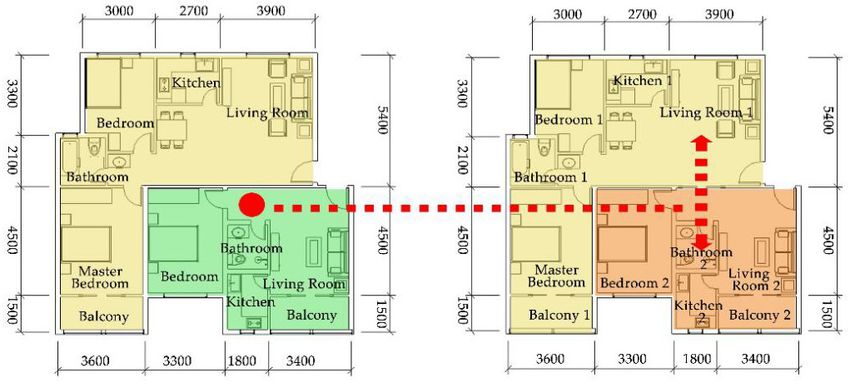
Sustainability 2020, 12, 453                                                                          2 of 17

safety and efficiency [6,7]. The modular design is still in the primary stage of development in
China’s architectural design community. It is the development trend of housing industrialization
and standardization [8,9], in which the modular design method is used in the floor plan design of
prefabricated housing [10]. With modular design theory, the plan is divided into modular parts and
the module library is established; then the modules are recombined into new monomer according to
certain logic [11], which can obtain a standardization of results and diversity [12].
      Building information modeling (BIM) technology is an architectural design method emphasizing
a whole process and life-cycle [13,14], which is another significant change in the construction industry
after the transition from manual drawing to computer aided design [15,16]. The development of
BIM technology can provide more comprehensive information [17]. It can realize the design and
management during the whole life cycle of the building [18,19]. However, how to apply BIM technology
to the floor plan design of prefabricated housing is still lacking research. Based on the theory of
modular design and the BIM technology platform [20,21], this paper discusses a new method for floor
plan designs of prefabricated houses, and diversified designs have also been considered. In the floor
plan designs of prefabricated houses, guided by the theory of modular design method and using BIM
technology as a means of implementation [22,23], the plane module libraries of prefabricated houses
are preliminarily established.
      At present, architects still use traditional design methods [24]. In order to meet the characteristics
of industrialization, an information conversion process is required, which disconnects the design
stage and production stage and increases the workload. Perhaps some companies form a collection of
residential planes, but these products are basically messy because there is no clear system. In some
collections, the hierarchical relationship is not clear, and in other collections the attributes are crossed
to make the objects unrepresentative. It is likely that many objects are duplicated and redundant, and it
is difficult for designers to quickly select the ones that meet the requirements. Using plane module
libraries based on BIM to design the plane for the prefabricated houses can result in the informatization
and visualization of every module in the whole life cycle [25,26]. BIM gives modules three-dimensional
characteristics, so it can help give a more intuitive feel to the space, with quicker module selection and
modifications. It is very feasible and also of great benefit to improve the design efficiency and meet the
design and construction requirements [27,28].
      The problem of this research is how to find a suitable floor plan design method for prefabricated
houses. The purpose of the research is to improve the efficiency and standardization of floor plan
designs of prefabricated houses, and to meet the diversified needs of residents. In addition, the research
line of this paper consists of three steps. First, the modular design theory is used to systematically
separate the residential plan to establish a clear modular system. Then, the concept of a module
library corresponding to each level of the module system is established, and the principles of module
selection and the method of creating information based on BIM are discussed. The module library is
initially established in this step. The establishment of module libraries is the core of the floor plan
design method for prefabricated houses. They are selected to combine into a new plane, and can be
replaced with each other. There will be many different results under the same combinatorial logic,
which will definitely improve design efficiency. Finally, the plane combination and diversified design
methods based on module libraries are studied. Moreover, this article innovatively applies the modular
design theory to floor plan designs of prefabricated houses, which helps to establish a clear plane
modular system. Furthermore, a concept of module libraries corresponding to the plane modular
system is creatively proposed, and it is initially established using BIM. Compared with traditional
design methods it is more orderly, and can greatly improve design efficiency. The contribution of
this research is to provide a new idea for the floor plan designs of prefabricated houses. The new
method can not only greatly improve the efficiency of designs of prefabricated houses and meet the
diverse needs of users, but also improve the level of information in the design process and promote
the industrialization of the housing industry. This study also has reference significance for the design
of facades and parts of prefabricated houses. The research can be applied to floor plan designs of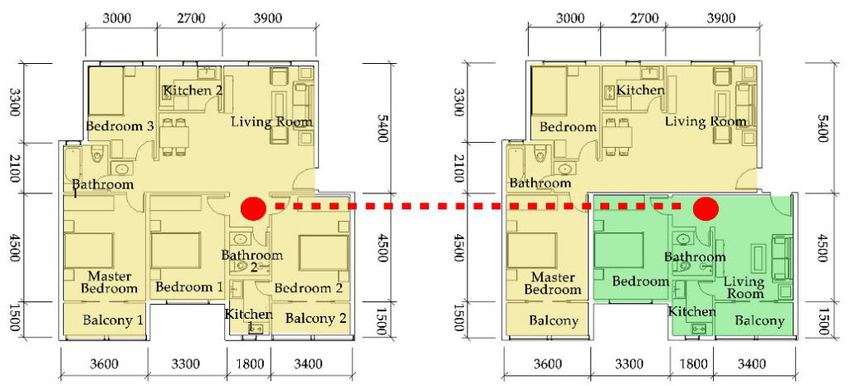
Sustainability 2020, 12, 453                                                                        3 of 17

prefabricated houses in design institutes to help save time and improve design quality. It can also
promote the industrial development of housing.

2. Building Modular Library Method for Prefabricated Houses
     The establishment of the BIM plane module library is the core of the floor plan design method
for prefabricated houses [29]. The floor plan design method based on plane module libraries can
improve the design efficiency and the degree of refined design. The establishment of the plane module
library is divided into three steps: module classification and selection, module coding, and module
information creation.
     In the module classification stage, the modular design method is used to systematically separate
residential planes to establish a plane modular system. The key at this stage is to choose an appropriate
separated point. The results of structural systems will be very different if the separated points are
different. In addition, planes cannot be separated in a too fragmented manner. It will increase the design
steps and reduce the design efficiency if the modular system has too many levels. After establishing
the plane module system and the concept of corresponding module libraries, guidelines of selecting
modules to be included in module libraries must be discussed, which guarantees that the modules in
module libraries are representative and standard. The setting of the principle of storage should ensure
that the modules in the module library are representative and standard. In the module coding stage,
the technical point to be resolved is to determine which feature attributes of modules are extracted to
form coding structures. It is necessary to solve this problem by considering what the architects’ needs
are in the design phase and what the residents’ requirements are in the selection phase. The points
of interest for both are extracted to make up the coding structure. After completing the above steps,
module information can be created based on BIM technology. The information creation process must
be checked repeatedly. Only qualified modules can enter the module library.

2.1. The Classification and Selection of Plane Modules for Prefabricated Housing

2.1.1. Classification of the Plane Modules
     Completely individual modular systems will be different if they are formed through different
methods of decomposition [30]. In order to facilitate research on the architectural design of residential
plans of the prefabricated housing, the plan systems are divided by the decomposition of the functions
into three levels of modules [31]: the first-level suite-type module, the second-level functional space
module, and the third-level component module.
     Figure 1 shows the combination of modules between the levels. The third-level component module
and its use spaces form the second-level functional space module, and the third-level washbasin
module, the shower module, and the toilet module together form a second-level bathroom module.
The different functional space modules form the first-level suite module, just like the kitchen module,
the bathroom module, the living room module, and the other functional space module together
constitute a suite module. In addition, the suite module can be combined with other suite modules or
core wall module to form a larger residential unit module.
     According to these hierarchical relationships of levels, the corresponding module libraries are
established, that is, the third-level component module library, the second-level functional space module
library, and the first-level suite-type module library. Each library represents a collection of the same
type of module, and the modules in each library have the same properties. In the case of the same
combination logic, content-rich module libraries can achieve the aim of diversity of design, which
plays an important role in improving design efficiency [32].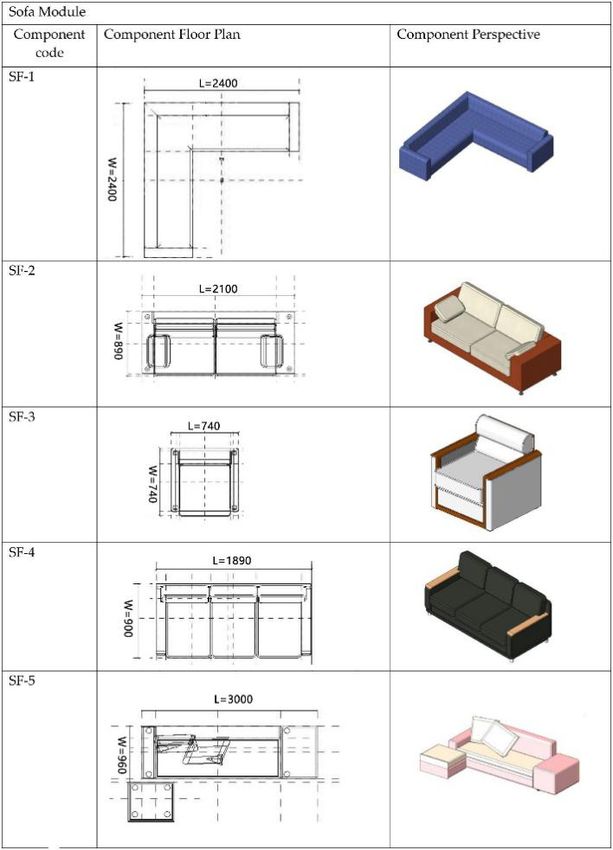
Sustainability2020,
Sustainability 12,453
2020,12, 453 4 4ofof17
17
Figure 1. Module composition diagram.
Figure 1. Module composition diagram.
2.1.2. Selection of Inputting Plane Modules into the Libraries
2.1.2. Selection of Inputting Plane Modules into the Libraries
There are two requirements for selecting modules into the libraries. The first one is to ensure
There are twomodule
that the selected requirements
conforms fortoselecting modules
the properties of into the libraries.
the module libraryThe firstAnother
type. one is toone
ensure
is to
that
ensurethethat
selected modulemodule
the selected conforms to the properties
is standard of theso
and universal, module librarythat
as to ensure type.
theAnother one is to
module conforms
ensure that the selected
to the standardized module is
production andstandard and universal,
the number so as
of the types aretowithin
ensureathat the controllable
certain module conforms
range.
to the standardized production and the number of the types are within a certain
The selection process of each plane module has four steps. Firstly, the plan of a prefabricated house controllable range.
The
is toselection process
be separated of each to
according plane module
a suitable has four
system. steps. Firstly,
Secondly, the plan
the modules of abe
must prefabricated house
classified. Thirdly,
isthe
to main
be separated according
control factors are to abesuitable
grasped, system. Secondly,factors
the secondary the modules
are to bemust be classified.
ignored, Thirdly,
and the modules
the main
of the control
same typefactors
in the are to be library
module grasped, the
are tosecondary
be mergedfactors are to be
as possible, so ignored,
as to reduceand the
the excessive
modules
of the of
types same type in the
components module
caused library
by too are to
detailed be merged
division of theas
main possible,
controlsofactors,
as to reduce
in ordertheto excessive
obtain the
types
modules of components caused by
with high standard andtoo detailed Fourthly,
generality. division of the main
it must controliffactors,
be checked in order
the modules areto obtain
standard
the
andmodules
versatile.with high standard
However, the typesand generality.
of modules Fourthly,
should not beittoomustfew,besochecked
as to avoidif the
notmodules
meetingare the
standard
requirementsand versatile.
of floor planHowever, the types[33].
design diversity of modules should not be too few, so as to avoid not
meeting Thethe requirements
establishment of floor plan
of module design
libraries diversity
is the [33].floor plan design method for prefabricated
core of the
housesThebased
establishment
on BIM. Basedof module
on the libraries is the core
module libraries, of the floor
the modules plan the
that meet design method for
requirements are
prefabricated
to be selectedhouses based on
and combined BIM.
into newBased on the which
individuals, modulenot libraries, the modules
only improves that meet
the design the
efficiency
requirements
and the degree areoftodefined
be selected
design,andbut combined
also the into
richernew
theindividuals,
module libraries,whichthe nothigher
only improves
the degree the
of
design efficiency
diversification and theresults
of design degreeunderof defined
the same design, but also
combination the richer the module libraries, the
logic.
higher the degree of diversification of design results under the same combination logic.
2.2. Coding of Plane Modules
2.2. Coding of PlaneofModules
The coding modules should not only reflect the classification of objects but also show their
characteristics
The coding[34]. When coding,
of modules shouldthe
notfollowing principles
only reflect should be followed.
the classification of objects First, the show
but also uniqueness
their
principle: each[34].
characteristics codeWhen
can only correspond
coding, to a single
the following module.should
principles Second,bethe rationality
followed. principle:
First, any code
the uniqueness
should correspond
principle: each codetocan
certain
only corresponding
correspond to classification of modules.
a single module. Second, Third, the simplicity
the rationality principle:
principle: any
the coding should use as few characters as possible for identifying which module it belongs
code should correspond to certain corresponding classification of modules. Third, the simplicity to. Fourth,
the integrity
principle: the principle: the coding
coding should use asmust
few be completeaswithout
characters possiblelack
for of corresponding
identifying whichinformation.
module it
Fifth, theto.
belongs standardization principle: principle:
Fourth, the integrity all the coding must usemust
the coding the same formal specification.
be complete without lack Sixth,
of
corresponding information. Fifth, the standardization principle: all the coding must use the same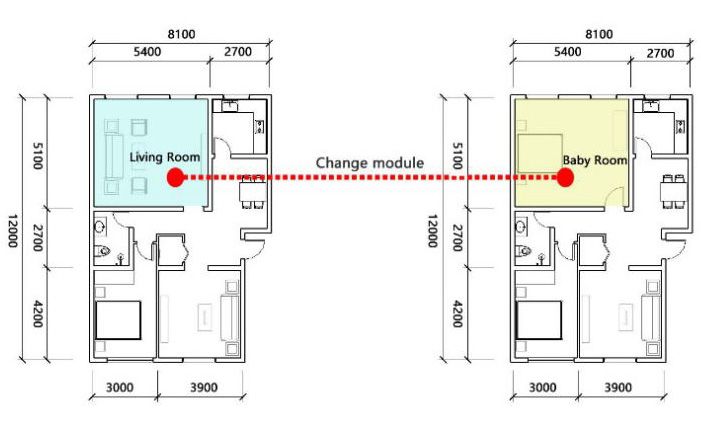
Sustainability 2020, 12, 453                                                                                   5 of 17

the practicality principle: the coding should be as convenient as possible for the use and management
of professionals.
     The general coding structure is shown in Table 1: Letter groups X1 and X2 usually stand for
the module classification. X3 generally stands for the basic properties of an object by using digit
or alphanumeric mixture. X4 can be added when the previous three encodings are all the same.
For example, when coding the second-level function module, X1 stands for the names of various
function rooms, such as “Bedroom”, “Living Room”, “Bathroom”, etc., which are represented by “BD”,
“L”, and “BT”, respectively. The areas of the same functional rooms vary from small to large. In the
design of the suite and functional space, the design institutes, real estate developers, and users always
classify and select the suites by the size of the area. Therefore, in order to facilitate the search of the
suite types in the module libraries, the author classifies the functional spaces and suite modules into
three types: economic type, comfortable type, and higher comfort level type, according to the size
of the area, which are coded respectively with “E-”, “C-”, “HC-”. The coding principle of the suite
type module is the same as above. For example, “E-51.7-2BD1L1K1BT” indicates that the size of the
suite area belongs to the economic type of suite just meeting the basic use demand, with a suite area
of 51.7 m2 , and the residential unit is equipped with two bedrooms, one living room, one kitchen,
and one bathroom.

                                     Table 1. Coding structure of modules.

                                          X1                          X2                           X3
                                                                                          Alphanumeric Mixture
                                         Letter
        First-level suite-type                                       Digit               (e.g., 3BD2L2BT means 3
                                    (e.g., C means
           module library                                           (Area)                   bedrooms, 2 living
                                  comfortable type)
                                                                                         rooms and 2 bathrooms)
                                                                     Letter
                                         Letter
      Second-level functional                            (e.g., E means economic type,           Digit
                                    (e.g., L means
       space module library                                  and HC means higher                 (Size)
                                     living room)
                                                               comfort level type)
       Third-level component              Letter                     Digit
           module library        (e.g., SF means sofa)              (Type)

2.3. Creation of Module Information
      In the whole life cycle of the building, the information creation of the models is divided into two
stages: information creation of modules in the module library and information addition to project BIM
model [35]. As shown in Figure 2, in the first stage the module is classified firstly; then the module is
coded according to the type and characteristics, and then the geometric information of the module is
created. After that, the non-geometric information of the module is added. Next, the model information
should be verified and reviewed. If the model geometry information has problems, the model should
be returned to correct the geometric information. If the non-geometric information is checked out, the
non-geometric information should also be re-edited. After checking, the model without any problems
can enter the corresponding type of module library for later use. In the project, the original module
that is closest to our needs is chosen, then detailed information to the selected modules is added and
the detailed design of the BIM model is carried out. Then the BIM model is to be submitted to the next
level of construction organization after passing the review to guide the organization for production
and construction. The subsequent information addition is a dynamic process, adding what is not
included in the module libraries. When establishing the module libraries, some blank space should
be reserved for BIM model information addition. For example, when building the “bed module”,
after the bed form is determined, the length, width, and height are to be set as parameters in the BIM
model, which will be convenient for change and application in different functional spaces. After the
module is given a parameter, it has the characteristics of the BIM family, but they are different from
those families because its shape parameters can only be changed in a certain range, and they also have
many limitations.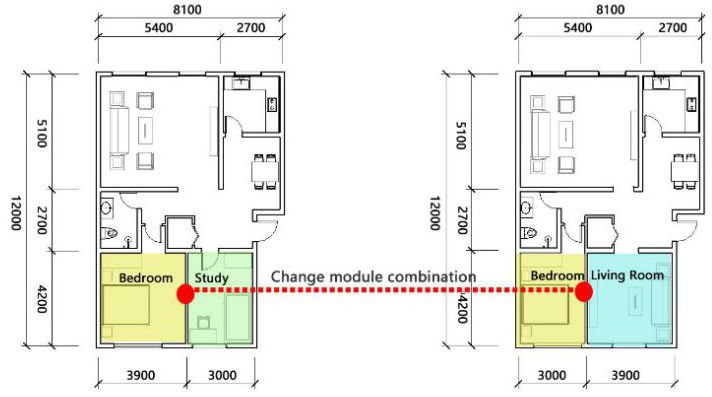
Sustainability 2020, 12, 453 6 of 17
characteristics of the BIM family, but they are different from those families because its shape
Sustainability 2020, 12, 453 6 of 17
parameters can only be changed in a certain range, and they also have many limitations.
Figure 2. Module
Figure 2. Module information
information creation
creation process.
process. BIM:
BIM: building
building information
information modeling.
modeling.
After
After module
module decomposition,
decomposition, selection,
selection, coding,
coding, andand information
information model model creation,
creation, the
the first-level
first-level
suite module library, the second-level function space module library, and
suite module library, the second-level function space module library, and the third-level component the third-level component
module
modulelibrary
libraryare established.
are established.Figures 3–5 3–5
Figures showshowsomesomeparts of the module
parts libraries.libraries.
of the module Figure 3 describes
Figure 3
some comfortable suites of the suite module library. The code simply
describes some comfortable suites of the suite module library. The code simply describes describes the composition of the
the
set, which helps to quickly find the desired set. Figure 4 illustrates living room
composition of the set, which helps to quickly find the desired set. Figure 4 illustrates living room modules from small to
large, from comfort to super comfort. The size of the plan on the left is in accordance
modules from small to large, from comfort to super comfort. The size of the plan on the left is in with the modulus
system,
accordance whichwithis athe
multiple
modulusof three.
system,Thewhich
perspective on the right
is a multiple givesThe
of three. an intuitive feeling
perspective of space.
on the right
Figure
gives an intuitive feeling of space. Figure 5 shows the sofa modules. Their styles are different,each
5 shows the sofa modules. Their styles are different, and the length, width and height of and
style of sofa are
the length, widthset to
and changeable
height ofparameters.
each style In of the
sofaapplication
are set toprocess, a styleparameters.
changeable of sofa is selected
In the
according
applicationtoprocess,
the needs, and of
a style then
sofatheisparameters such as length
selected according and width
to the needs, and are
thenadjusted according
the parameters to
such
the size of the functional space.
as length and width are adjusted according to the size of the functional space.
AA three-dimensional
three-dimensional effect effect has
has been
been applied
applied to to the
the module
module library
library based
based onon BIM,
BIM, which
which makes
makes
it more intuitive than the traditional atlas, and conducive to the refined
it more intuitive than the traditional atlas, and conducive to the refined design of the house. The design of the house.
The establishment
establishment of model
of model information
information with
with a complete
a complete systemwill
system willpromote
promotethe the use
use of
of modular
modular
design
design methods
methodsininpractical
practicalengineering
engineering andandimprove
improve design
designandand production efficiency.
production Factories
efficiency. can
Factories
prefabricate standardized modules and the entire industry chain will become
can prefabricate standardized modules and the entire industry chain will become more robust [36]. more robust [36].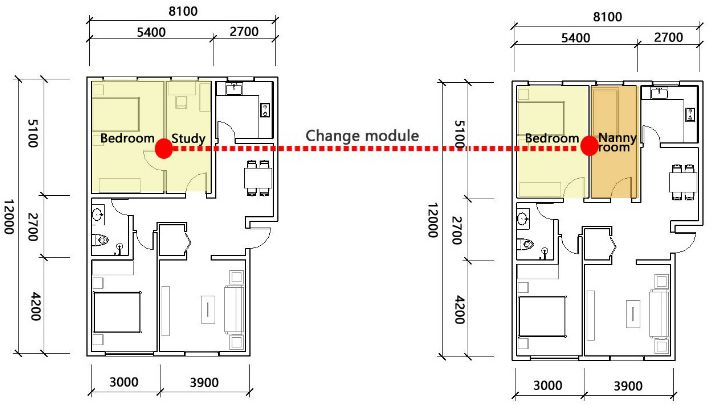
Sustainability 2020, 12, 453                                                                       7 of 17
   Sustainability
   Sustainability 2020,
                  2020, 12,
                        12, 453
                            453                                                                77 of
                                                                                                  of 17
                                                                                                     17

                                         Figure
                                        Figure  3. Part of
                                                3. Part
                                         Figure3.       of the
                                                           the suite
                                                               suitemodule
                                                               suite modulelibrary.
                                                                     module  library.
                                                                            library.

                                  Figure   4.Part
                                   Figure4.4.
                                   Figure     Part of
                                              Part of the functional
                                                      the functional  spacemodule
                                                          functional space
                                                                     space modulelibrary.
                                                                           module   library.
                                                                                  library.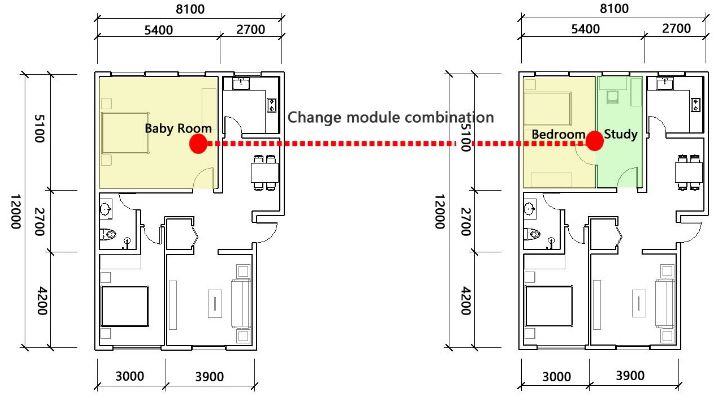
Sustainability 2020, 12, 453                                                                                           8 of 17
Sustainability 2020, 12, 453                                                                                          8 of 17

                                   Figure 5. Part
                                   Figure 5. Part of
                                                  of the
                                                     the component
                                                         component module
                                                                   module library.
                                                                          library.
3. The Application of Plane Module Library for Prefabricated Housing
3. The Application of Plane Module Library for Prefabricated Housing
      Based on the module library, the modules that meet the requirements are to be selected and then
      Based on the module library, the modules that meet the requirements are to be selected and
to be combined into new individuals, which can not only improve the design efficiency and the degree
then to be combined into new individuals, which can not only improve the design efficiency and
of refined design, but also meet the needs of users for the variety of suite types and units by using
the degree of refined design, but also meet the needs of users for the variety of suite types and units
certain design methods [37,38]. In the following, the application method of module libraries and
by using certain design methods [37,38]. In the following, the application method of module
diversification of floor plan designs are probed.
libraries and diversification of floor plan designs are probed.
3.1. Application Method of Plane Module Libraries
3.1. Application Method of Plane Module Libraries
      For most residences, a complete suite consists of bedrooms, living rooms, kitchens, dining rooms,
      For most
bathrooms,     studyresidences,    a complete
                        rooms, entrance       halls,suite  consists
                                                      balconies,      of bedrooms,
                                                                   storage,   and other living  rooms,spaces.
                                                                                           functional      kitchens,  dining
                                                                                                                  There   are
rooms, bathrooms,
one-bedroom,              study rooms,
                  two-bedroom,               entrance and
                                     three-bedroom,       halls, balconies, storage,
                                                              multi-bedroom       suites. and   other
                                                                                           People        functional
                                                                                                    usually   choose spaces.
                                                                                                                      a right
Thereaccording
type    are one-bedroom,
                    to their usetwo-bedroom,
                                  needs and economic three-bedroom,      andThe
                                                             capabilities.     multi-bedroom       suites.
                                                                                  floor plan designs      of People
                                                                                                             houses usually
                                                                                                                     should
conform to the principles of economy, adaptability, comfort and diversity. In the combinationdesigns
choose   a  right  type  according     to  their use  needs   and   economic    capabilities.  The    floor plan            of
                                                                                                                   of spaces,
houses
the  mostshould
           important conform
                         work istotothe  principles
                                      perform           of economy,
                                                 functional             adaptability,
                                                              partitioning.               comfort
                                                                               For example,    it is and   diversity.
                                                                                                     necessary         In the
                                                                                                                 to consider
combination     of   spaces,  the  most    important    work   is to  perform   functional    partitioning.
activity zoning and clean-dirt partition, not only to ensure that the space is independent and free of         For example,
it is necessarybut
interference,      to also
                       consider   activity
                            to ensure        zoning
                                          that         and clean-dirt
                                                the spaces    need to be partition,
                                                                            connectednot toonly
                                                                                             eachto other
                                                                                                     ensuretothat  the space
                                                                                                               improve    the
is independent
use efficiency.      and  free  of interference,     but  also  to  ensure   that  the spaces   need    to be  connected    to
eachFigure
       other to6 improve     the use   efficiency.
                  shows the common space combination relationship of one-bedroom, two-bedroom,
      Figure 6 showssuites.
and three-bedroom          the common When space      combination
                                               designing               relationship
                                                             other suites,    designer of can
                                                                                           one-bedroom,
                                                                                               make topology  two-bedroom,
                                                                                                                    changes
and   three-bedroom        suites.   When     designing     other    suites,  designer    can  make
according to the combination relationship of each type to achieve reasonable design of other suites.     topology   changes
according to the combination relationship of each type to achieve reasonable design of other suites.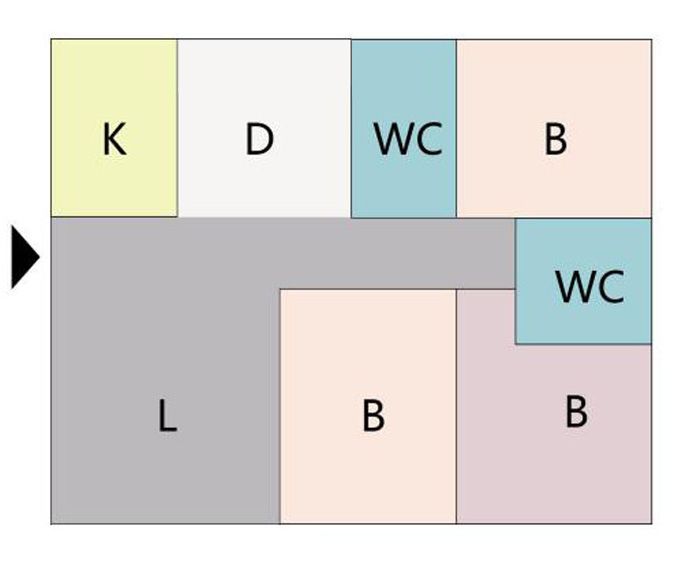
Sustainability 2020, 12, 453                                                                        9 of 17
Sustainability 2020, 12, 453                                                                        9 of 17

      Figure 6. Common space combination relationship. (Note: L means living room, K means kitchen, B
      Figure 6. Common space combination relationship. (Note: L means living room, K means kitchen, B
      means bedroom, D means dining room, and WC means toilet)
      means bedroom, D means dining room, and WC means toilet)

      Based on the above architectural background knowledge, when carrying out the floor plan design
      Based on the above architectural background knowledge, when carrying out the floor plan
of prefabricated residence it is necessary to first query the required suite type in the module library
 design of prefabricated residence it is necessary to first query the required suite type in the module
according to the architectural design and the user’s needs. Then it is necessary to combine the suite
 library according to the architectural design and the user’s needs. Then it is necessary to combine
module with the public transport module to form the unit module, and finally combine the unit
 the suite module with the public transport module to form the unit module, and finally combine the
module to achieve the initial design. The completed initial BIM model needs to be analyzed and
 unit module to achieve the initial design. The completed initial BIM model needs to be analyzed
optimized. When there is no problem, it means that the BIM model meets the user’s needs of use
 and optimized. When there is no problem, it means that the BIM model meets the user’s needs of
and comfort, and then the floor plan design scheme is basically determined and can be delivered to
 use and comfort, and then the floor plan design scheme is basically determined and can be
other disciplines to continue design and input model information. When the BIM model does not
 delivered to other disciplines to continue design and input model information. When the BIM
meet the use requirements, modules can be selected from the module library for replacement. When
 model does not meet the use requirements, modules can be selected from the module library for
the modules that meet the requirements cannot be found from the module library, it is necessary to
 replacement. When the modules that meet the requirements cannot be found from the module
design new modules according to the requirements and input the representative new modules into
 library, it is necessary to design new modules according to the requirements and input the
the libraries for future use. Due to the existence of the module library, some universal modules can
 representative new modules into the libraries for future use. Due to the existence of the module
be manufactured in advance to improve the production and construction efficiency. The richness
 library, some universal modules can be manufactured in advance to improve the production and
of the module library determines the feasibility and applicability of the BIM-based prefabricated
 construction efficiency. The richness of the module library determines the feasibility and
residential floor plan design method. When the module libraries are not perfect, it is difficult to design
 applicability of the BIM-based prefabricated residential floor plan design method. When the
a residential unit that meets the needs of users. Therefore, it is very important to enrich the module
 module libraries are not perfect, it is difficult to design a residential unit that meets the needs of
libraries in the early stage, and it is necessary to continuously improve them by adding representative
 users. Therefore, it is very important to enrich the module libraries in the early stage, and it is
modules that are not included in them.
 necessary to continuously improve them by adding representative modules that are not included in
      As the modules in the module library all meet the requirements of standardization and
 them.
generalization, users can select modules from the functional space module library to replace other
      As the modules in the module library all meet the requirements of standardization and
functional space modules in a suite module according to their needs, so as to achieve diverse designs.
 generalization, users can select modules from the functional space module library to replace other
In addition, selecting different furniture from the component module library to replace parts in a
 functional space modules in a suite module according to their needs, so as to achieve diverse
functional space can realize different layout forms. The diversified combination of modules enables a
 designs. In addition, selecting different furniture from the component module library to replace
wide range of design results.
 parts in a functional space can realize different layout forms. The diversified combination of
      In the following, this article chooses three typical residential plans to explore the flexibility and
 modules enables a wide range of design results.
variability of floor plan designs based on module libraries. These three cases all conform to the basic
      In the following, this article chooses three typical residential plans to explore the flexibility and
principles of residential designs, with clear functional partitioning, reasonable space organization,
 variability of floor plan designs based on module libraries. These three cases all conform to the
and modular size. The suites belong to the comfortable type with the largest market demand, and the
 basic principles of residential designs, with clear functional partitioning, reasonable space
functional space configuration is reasonable. It has reference significance for flexible and variable
 organization, and modular size. The suites belong to the comfortable type with the largest market
designs of other prefabricated houses through the case study.
 demand, and the functional space configuration is reasonable. It has reference significance for
 flexible and variable designs of other prefabricated houses through the case study.

3.2. Flexible and Variable Design of the Suite
     Flexible and variable design of the suite based on the above said three-level module libraries
can adapt to the long-term needs of family so that the residential units can also “continue to grow”
to extend their service lives [39], and become real sustainable development buildings, mainly
through the method of replacement of the spaces within a suite or between the suites.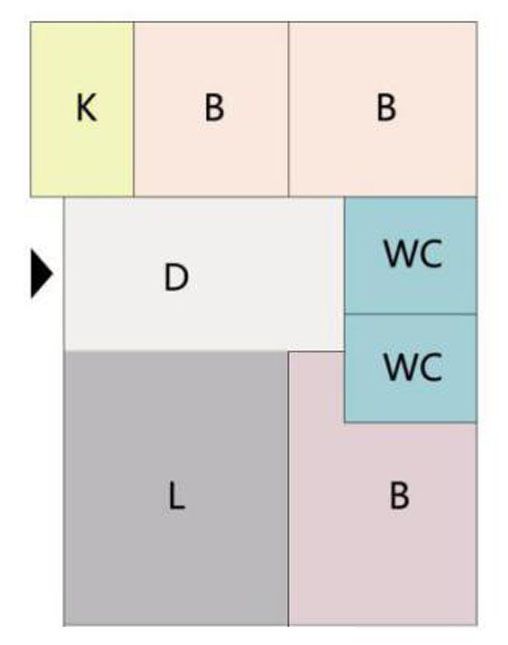
Sustainability 2020, 12, 453 10 of 17
3.2. Flexible and Variable Design of the Suite
Flexible and variable design of the suite based on the above said three-level module libraries can
adapt to the
Sustainability long-term
2020, 12, 453 needs of family so that the residential units can also “continue to grow” 10 of to
17
extend their service lives [39], and become real sustainable development buildings, mainly through the
method of replacement of the spaces within a suite or between the suites.
3.2.1. Space Replacement within a Suite
3.2.1. Space Replacement within a Suite
There are two ways to replace the spaces within a suite: the diversified combination of
There are
functional twomodules,
space ways to replace
and thethe spaces within
large-space a suite:
design. Thethe diversified
suite combination
is composed of many of functional
functional
space
spacemodules,
modules,and so the
thelarge-space
change of design.
a suiteThe
typesuite
canisbecomposed
realizedofthrough
many functional
differentspace modules, so
combinations of
the change of a suite
functional space modules. type can be realized through different combinations of functional space modules.
As
As shown
shownininFigureFigure7,7,it it
is is
a scheme
a schemeof diversified combination
of diversified combinationof function modules
of function insideinside
modules a suite.a
The change
suite. of the whole
The change of the suite
wholecan be realized
suite by replacing
can be realized the function
by replacing space module
the function space of the “Study”
module of the
with the function
“Study” with the space module
function spaceofmodule
the “Bedroom”. For the family
of the “Bedroom”. For thewith a large
family population,
with the latter
a large population,
can be selected,
the latter can beWhen the When
selected, two spaces arespaces
the two replaced,
are the other spaces
replaced, arespaces
the other not affected ataffected
are not all. at all.
Figure 7.7. The
Figure The“study”
“study”function
functionspace replaced
space by by
replaced the the
“bedroom” function
“bedroom” module
function insideinside
module a suitea type.
suite
type.
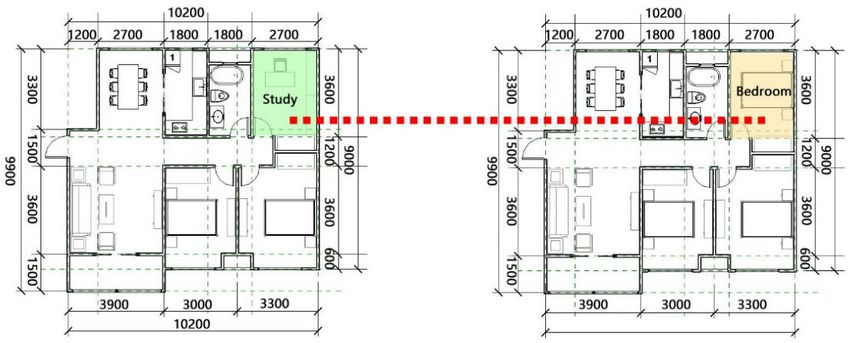
Figures 8–10 show a scheme of large space design in a suite type. In the newly married stage,
the family
Figures structure
8–10 show is aafamily
scheme ofof
two, and
large young
space couples
design in a usually
suite type. focus on work.
In the newly Therefore,
married stage, the
large space in the south is composed of a master bedroom module with
the family structure is a family of two, and young couples usually focus on work. Therefore, thea width of 3.9 m and a study
module
large spacewithina width
the southof 3.0is m. The living
composed of room withbedroom
a master a width of 5.4 m iswith
module designed
a widthto the north
of 3.9 m of andthea
suite.
study During
modulethe baby-rearing
with a width of 3.0 stage, the living
m. The livingroom
roomon theanorth
with widthside of the
of 5.4 m issuite is changed
designed to the to the
north
baby room, and the large space on the south side is changed from the original
of the suite. During the baby-rearing stage, the living room on the north side of the suite is changed module to bedroom
module
to the babywithroom,
a width and of the
a 3.3 m, with
large space theonremaining
the southspaceside isforchanged
living roomfrommodule with amodule
the original width of to
3.6 m (Figure
bedroom module8) [40].
withAtathe school-age
width of a 3.3 stage
m, withof the child, the original
remaining space for nursery
living room
room can be divided
module with a
into
width“Bedroom (Figure 8)+ [40].
of 3.6 m module” “Study At module” to meetstage
the school-age the learning needs
of the child, oforiginal
the the childnursery
under the roomcondition
can be
that otherinto
divided rooms remained
“Bedroom unchanged
module” + “Study(Figure 9). In the
module” elderly
to meet thecare stage,needs
learning the family
of thestructure
child under has
become a two-person structure, but the children will occasionally go back
the condition that other rooms remained unchanged (Figure 9). In the elderly care stage, the family home to live, so the large
space on the
structure hasnorth
becomesideacan be dividedstructure,
two-person into two independent
but the children spaces willconsisting
occasionallyof a bedroom
go back home module to
and
live,aso
nanny roomspace
the large module on (Figure
the north10).side
From
canthe
beabove
divided changes,
into two thanks to the usespaces
independent of large space design
consisting of a
techniques,
bedroom module the replacement
and a nanny of functional
room module spaces inside10).
(Figure the From
suite can
the meet
abovethe needs of
changes, life fortodecades
thanks the use
from newlyweds
of large space designto thetechniques,
elderly, which greatly improves
the replacement the service
of functional life ofinside
spaces the suite.
the suite can meet the
needs of life for decades from newlyweds to the elderly, which greatly improves the service life of
the suite.Sustainability 2020,12,
Sustainability2020, 12,453
453 11 of 17
11 17
Sustainability 2020, 12, 453 11 of 17
(a)
(a)
(b)
(b)
Figure 8. Analysis of the change from the newly-married type to the baby-rearing type: (a) Change
Figure 8. Analysis
of combination of
of the
from the change from
changeand
bedroom from the
thenewly-married
study newly-marriedtype
typetotothe
modules to bedroom baby-rearing
the
and type:
baby-rearing
living room (a)(a)
type:
modules;Change of
Change
and (b)
of combination
combination from
from bedroom
bedroom and and
studystudy modules
modules
Change of modules from living room to baby room. to to bedroom
bedroom and and
living living
room room modules;
modules; and (b) and (b)
Change
of modules
Change from living
of modules from room to room
living baby room.
to baby room.
Figure 9. Analysis of the change from baby nursery to school-age.
Analysis of
Figure 9. Analysis of the
the change
change from baby nursery to school-age.
Figure 10. Analysis
Figure10. Analysis diagram
diagram of
of the
the change
change from
from school-age
school-ageto
toelderly
elderlycare.
care.
Figure 10. Analysis diagram of the change from school-age to elderly care.Sustainability 2020, 12, 453 12 of 17
Sustainability 2020, 12, 453 12 of 17
3.2.2.
3.2.2. Space
Space Replacement
Replacement between
between Suite
Suite Types
Types
The
The division
division andand combination
combination of of the
the functional
functional space
space between
between the the suites
suites cancan result
result inin the
the
diversification of the suite types without changing the building structure,
diversification of the suite types without changing the building structure, and the suite types can and the suite types can be
flexibly determined to meet the demand of the users. In Figure 11 a flexible
be flexibly determined to meet the demand of the users. In Figure 11 a flexible design example of design example of space
division and combination
space division and combination between two adjacent
between suitessuites
two adjacent is presented.
is presented.At first, in Figure
At first, 11a, 11a,
in Figure the
four-room suite A1 is divided into two independent suites B and C by connecting
the four-room suite A1 is divided into two independent suites B and C by connecting walls and adding walls and adding
an entry door
an entry doorto toseparate
separatespaces.
spaces.Type
TypeB Bhashas twotwo rooms,
rooms, oneone bathroom
bathroom andandoneone
hall,hall,
andand
typetype
C hasC one
has
one
room, one bathroom, and one hall. The spaces of the two suites are completely separated. As showsAs
room, one bathroom, and one hall. The spaces of the two suites are completely separated. in
shows
Figure in11b,Figure 11b, by ainserting
by inserting a sliding
sliding door on thedoor on thewall
adjacent adjacent wall the
interface, interface, the two independent
two independent suites can
suites can be
be changed changed
into into two
two relatively relatively suites.
independent independent
The twosuites.
spacesThecan two spaces can
be connected be the
when connected
sliding
when
door is opened, but when the sliding door is closed, the two spaces are independent. Since there are
the sliding door is opened, but when the sliding door is closed, the two spaces are
independent. Since there are two entry doors, mutual interference can
two entry doors, mutual interference can be completely avoided between the two sets. The suite A2 is be completely avoided
between
suitable forthefamilies
two sets. The generations,
of three suite A2 is suitable
with the for families
elderly livingofinthree generations,
the middle with the
suite, which means elderly
they
living in the middle suite, which means they not only get the care from their
not only get the care from their children but also have relative privacy in the two spaces. Through children but also have
the
relative privacy in the two spaces. Through the method of space replacement
method of space replacement between suites, the diversity of suites can be realized. The number of between suites, the
diversity
each typeof of suites can
suite in be realized.
a unit The
is flexibly number ofaccording
determined each typetoofthe suite in a unitdemand,
customer’s is flexibly determined
which greatly
according to the customer’s demand,
improves the flexibility of the suite design. which greatly improves the flexibility of the suite design.
(a)
(b)
Analysis diagram
Figure 11. Analysis diagram for space replacement between suite types: (a)
(a) Dividing
Dividing type A1 with
type B ++ C;
C; and
and (b) Combination BB ++CCwith
(b) Combination withtype
typeA2.
A2.
3.3. Diversified Combination Design of Suite Modules
3.3. Diversified Combination Design of Suite Modules
Based on the selection of standardized suite type, the residential unit can be combined into
Based on the selection of standardized suite type, the residential unit can be combined into
tower-type or slab-type residence according to the requirements and consideration of the volumetric
tower-type or slab-type residence according to the requirements and consideration of the
volumetric rate [41]. There are various methods of combination. The author summarizes theSustainability 2020, 12, 453 13 of 17
Sustainability 2020, 12, 453 13 of 17
rate [41]. There are various methods of combination. The author summarizes the following methods:
First, for a single
following residential
methods: unit,
First, for the unit
a single form canunit,
residential be changed
the unitby changing
form can bethe suite type.
changed As shown
by changing the
insuite
Figure 12a,
type. Asthe original
shown four type
in Figure 12a, S2
thesuites facing
original foursouth
type S2have been
suites changed
facing southtohave
the form of type
been changed
2S2 + 2S3.
to the formSecond,
of typethe2S2unit form
+ 2S3. can bethe
Second, changed by increasing
unit form the number
can be changed of a certain
by increasing suite type.
the number of a
As shown in Figure 12b, the unit form is changed by adding two southward
certain suite type. As shown in Figure 12b, the unit form is changed by adding two southwardS1-type units. Third,
for the same
S1-type suiteThird,
units. combination
for the plan,
samethe whole
suite unit form can
combination bethe
plan, changed
wholethrough changing
unit form can be thechanged
traffic
cores to adapt
through to thethe
changing floor change,
traffic cores as
to shown
adapt tointhe
Figure
floor12c. Fourth,
change, the unit
as shown in form
Figurecan12c.beFourth,
changed the
through
unit formthecan
vertical splicingthrough
be changed of the unit. As shown
the vertical in Figure
splicing of the12d, theAsunit
unit. planin
shown changes
Figure the
12d,original
the unit
unit
planform by adding
changes two S1-type
the original suites
unit form bylongitudinally.
adding two S1-type suites longitudinally.
(a)
(b)
(c) (d)
Figure Method
Figure12.12. Method analysis diagram
analysis of changing
diagram unit: (a)
of changing Changing
unit: suite types;
(a) Changing suite(b) Adding
types; (b) the number
Adding the
ofnumber
suites; (c) Changing
of suites; traffic cores;
(c) Changing andcores;
traffic (d) Vertical
and (d)splicing.
Vertical (Note:
splicing.S (Note:
means Ssuites and
means T means
suites and T
traffic
means core)
traffic core)
3.4.
3.4.Diversified
DiversifiedCombination
CombinationMethod
MethodofofUnit
UnitModules
Modules
For
Forthe
thecombination
combinationofof multiple
multipleunits, first,
units, a new
first, a newunit cancan
unit be formed
be formed by combining
by combining twotwounits in
units
parallel (Figure 13). Second, the unit form can be changed by changing the traffic
in parallel (Figure 13). Second, the unit form can be changed by changing the traffic box, as shown box, as shown in
Figure 14. In14.
in Figure addition, the unitthe
In addition, module
unit also has the
module methods
also has the of one-direction
methods of splicing, two-direction
one-direction splicing,
splicing, three-direction splicing, multiple directions splicing, and heteromorphic
two-direction splicing, three-direction splicing, multiple directions splicing, and heteromorphic splicing. As shown
insplicing.
Figure 15,
Asthe one-direction
shown in Figure splicing means the splicing
15, the one-direction in ameans
splicing singlethe
direction,
splicingwhich can bedirection,
in a single spliced
into strip-type
which or oblique
can be spliced intoserration
strip-typeshape according
or oblique to the
serration landaccording
shape conditionstoor theterrain constraints.
land conditions or
Two-direction
terrain constraints. Two-direction splicing means that the unit at the corner has a certainisdegree
splicing means that the unit at the corner has a certain degree of closure, which formedof
inclosure,
the horizontal
which isorformed
vertical indirections. Theor
the horizontal three-direction splicing
vertical directions. Themeans the splicing
three-direction is made
splicing in
means
three directions, and its form has more changes. Multiple direction splicing means
the splicing is made in three directions, and its form has more changes. Multiple direction splicing the splicing in
multiple
means thedirections
splicingtoinform the I-shape,
multiple X-shape,
directions to form frogthe
shape, and X-shape,
I-shape, other shapes
frogofshape,
the plan.
and The
othersplicing
shapes
inofmultiple directions can not only obtain rich architectural forms but also obtain
the plan. The splicing in multiple directions can not only obtain rich architectural forms but also a good orientation.
Inobtain
order to make orientation.
a good plan shapes In of houses
order to better
make adapt
plantoshapes
the terrain and can
of houses utilize
better the land
adapt in an
to the efficient
terrain and
way, heteromorphic splicing can also be applied. The heteromorphic splicing
can utilize the land in an efficient way, heteromorphic splicing can also be applied. The can be carried to break
the monotonous layout
heteromorphic splicingandcan
provide more possibilities
be carried to break for the getting good orientation.
monotonous layout and provide more
possibilities for getting good orientation.
The above said unit module combination methods should be judged according to the specific
project situation, and BIM simulation software can be used for ventilation and sunshine analysis to
meet the residential use demand [42].Sustainability 2020,
Sustainability2020, 12, 453
12, 453
453 14 of 17
Sustainability 2020, 12, 1414ofof17
17
Sustainability 2020, 12, 453 14 of 17
Figure 13. Transverse splicing of unit modules.
Figure13.13.Transverse
Figure Transverse splicing
splicing ofof unit
unit modules.
modules.
Figure 13. Transverse splicing of unit modules.
Figure 14. Change of traffic cores to adapt to floor change in the same plan.
Figure14.
Figure Changeof
14.Change oftraffic
trafficcores
coresto
toadapt
adaptto
tofloor
floor change
change in
in the
the same
same plan.
plan.
Figure 14. Change of traffic cores to adapt to floor change in the same plan.
Figure 15. Schematic diagram of unit combination method. (a) One-direction slicing; (b) Two-direction
Figure 15. Schematic diagram of unit combination method. (a) One-direction slicing; (b)
splicing;15.
Figure (c) Three-direction splicing;
Schematic diagram of (d) Heteromorphic
unit combinationsplicing;
method.and(a)
(e) One-direction
Multiple Splicing.
slicing; (b)
Two-direction splicing; (c)
Figure 15. Schematic Three-direction
diagram of unit splicing; (d) Heteromorphic
combination splicing; and (e)
method. (a) One-direction Multiple
slicing; (b)
Two-direction splicing; (c) Three-direction splicing; (d) Heteromorphic splicing; and (e) Multiple
Splicing.
Two-direction
The above splicing;
said unit (c) Three-direction
module combination splicing;
methods(d) Heteromorphic
should be splicing;
judged and (e)toMultiple
according the specific
Splicing.
Splicing.
project situation, and BIM simulation software can be used for ventilation and sunshine analysis to
4. Discussion
meet the residentialand Implications
use demand [42].
4. Discussion and Implications
4. Discussion and Implications
4.1. Method andand
4. Discussion Application
Implications
4.1. Method and Application
4.1. Method and Application
Modular theory can be applied to industrial production. The method of building modular
4.1. Method
Modular andtheory
Application
can be applied to industrial production. The method of building modular
libraries for floor
Modular theoryplancan design of prefabricated
be applied to industrialhousing in this paper
production. The ismethod
also a specific application
of building modular of
libraries for
Modular floor plan
theory design
can be of prefabricated
applied to housing
industrial in this paper
production. The ismethod
also a specific
of application
building modular of
modular
libraries for theory.
floorBIM plantechnology can realize thehousing
design of prefabricated informatization
in this paper of buildings
is also a in the whole
specific life cycle.
application of
modular
libraries theory.
for floorBIM technology
planthe design can realize thehousing
of prefabricated informatization
in this paper of buildings
isstage
also aof in the whole
specific life cycle.
application
This
modularpaper embodies
theory. BIM application
technology can method
realize the of BIM technology
informatization in
of the
buildings in floor plan
the whole designs
life cycle.of
This papertheory.
modular embodies BIM the application
technology can method
realize of BIM
the technology inofthe
informatization stage ofinfloor
buildings the plan designs
whole life of
cycle.
prefabricated
This paper embodies houses the as well. Based method
application on the design
of BIMmethod technology of this paper,
in the stagewe of can
flooralso
planexplore
designsthe of
prefabricated
This paperdesign houses as
embodies the well. Based on
application the design
method of for method
BIMprefabricated
technology of this paper,
inhouses.
the stage we can
flooralso
ofpracticalplan explore
designsthe of
modular
prefabricated housesof facades
as well. and
Based components
on the design method of this paper, In
we can also engineering
explore the
modular
prefabricated design houses of facades
as well. and components
Based on the design for
method prefabricated
of this paper,houses.
we canInalso
practical
explore engineering
the modular
applications, the architectural design institute can apply
modular design of facades and components for prefabricated houses. In practical engineering the modular design method to separate
applications,
design of facades the architectural
and components design forinstitute can apply
prefabricated houses. the Inmodular
practical design methodapplications,
engineering to separate
prefabricated
applications, house
the planes,
architectural and then
design use BIM can
institute technology
apply to modular
the build information
design module
method to libraries.
separate
prefabricated
the architectural house planes,
design and then
institute can use BIM
apply the technology
modular to build
design methodinformation module libraries.
When the types
prefabricated house of planes,
modules and in then
module use libraries
BIM are rich
technology toenough,
build the tomodules
information separate prefabricated
that
module meet the
libraries.
When
house the types
planes, and of modules
then use BIM intechnology
module libraries
to build are rich enough,
information module the modules
libraries. Whenthatthe meet
types the
of
requirements
When the types of modules in module libraries are rich enough, the modules that meet the
can be selected quickly and combined from the module libraries according to
requirements
modules in can belibraries
module selectedarequickly
rich and combined
enough, the modules from that the
meetmodule
the libraries according
requirements can be to the
selected
needs of the owner,
requirements can be which selected canquickly
greatlyand improve
combined the design
from the efficiency.
moduleInlibrariesaddition, for real to
according estate
the
needs
quicklyof thecombined
owner, which canmodule
greatlylibraries
improve the design efficiency. In addition, for real estate
companies
needs ofandtheand residents,
owner, fromthe
which the
canmodule
greatly library
improve isaccording
like
thea design
menu. to the needscan
People
efficiency. of the owner,
search
In which
modules
addition, can greatly
according
for real estate
companies
improve theanddesignresidents, the module
efficiency. In addition,library is like a menu. Peopleand can search modules according
to their requirements.
companies and residents, Thetheinformation
module of for
each
library real estate
is module
like a menu.companiesPeople canresidents,
is comprehensive the module
and intuitive.
search modules Due library
to the
according
to their
is like requirements. The information of each module is comprehensive and intuitive. Due toeach
the
to theira requirements.
benefits menu.
of modular People can search
design,
The modules
the modules
information ofcanaccording
each bemodule
replaced to their requirements.
istocomprehensive
realize personalized Theintuitive.
and information
design. Due of
Comparedto the
benefits
module of modular design,and
is traditional
comprehensive theintuitive.
modules Due can be to replaced
the benefits to realize
of modularpersonalized
design, design.
the modulesComparedcan be
with
benefits theof modular design, floor theplanmodules
design can method,
be this
replaced method
to realize combined
personalized with the
design. information
Compared
with the
replaced traditional
to realize floor
personalizedplan design
design. method,
Compared this
with method
the combined
traditional floorwith
plan the information
design method,
technology
with the traditionaland modular floor design
plan design concept can greatly
method, this method improvecombined the degree withofthe spatial design
information
technology
this methodand and
combinedmodular with design
the concept can
information greatly and
technology improvemodular the design
degree concept
of spatial can design
greatly
refinement
technology and efficiency
modular of design
design and production.
concept can greatly Thisimprove
method can degree
the not onlyof improve
spatial design
refinement
improve the and
degree efficiency
of of design
spatial designrefinement
and production.and This method
efficiency of design canand not only improve
production. This design
method
quality but can also reduce the investment cost.
refinement and efficiency of design and production. This method can not only improve design
quality
can notbut only can also reduce
improve design thequality
investment
but can cost.
also reduce the investment cost.
quality but can also reduce the investment cost.
4.2. Strengths and Limitations
4.2.
4.2. Strengths
Strengthsand andLimitations
Limitations
4.2. Strengths and Limitations
The research method in this paper can improve the design efficiency of prefabricated houses
The
The research
research method
method in this
this paper
inFirst, paper can
can improve
improve the
the design
design efficiency
efficiency of
of prefabricated
prefabricated houses
houses
fromThe the research
followingmethod aspects:in this the modules
paper can in the the
improve module design library all meet
efficiency of the requirements
prefabricated houses of
from
from the
the following
following aspects:
aspects: First,
First, the
the modules
modules inin the
the module
module library
library all
all meet
meet the
the requirements
requirements of
of
modularization, so they meet the requirements of industrialized
from the following aspects: First, the modules in the module library all meet the requirements of production and can avoid
modularization,
modularization, so
so they meet the requirements of industrialized production and can avoid
repeatedly
modularization, adjusting sothey the
they meet
plane
meet the the
requirements
to meet of
size requirements industrialized
industrial production
requirements
of industrialized and can
which
production avoid
often
and repeatedly
occurs
can using
avoid
repeatedly adjusting the plane size to meet industrial requirements which often occurs using
repeatedly adjusting the plane size to meet industrial requirements which often occurs usingYou can also read


