CHARTER & STRATEGIC PLAN - 2020-2022 MOE Number: 2099 - Trentham School
←
→
Page content transcription
If your browser does not render page correctly, please read the page content below
CHARTER & STRATEGIC PLAN
       2020-2022

                           MOE Number: 2099
OUR VISION
EMPOWERED LEARNERS FOR THE FUTURE
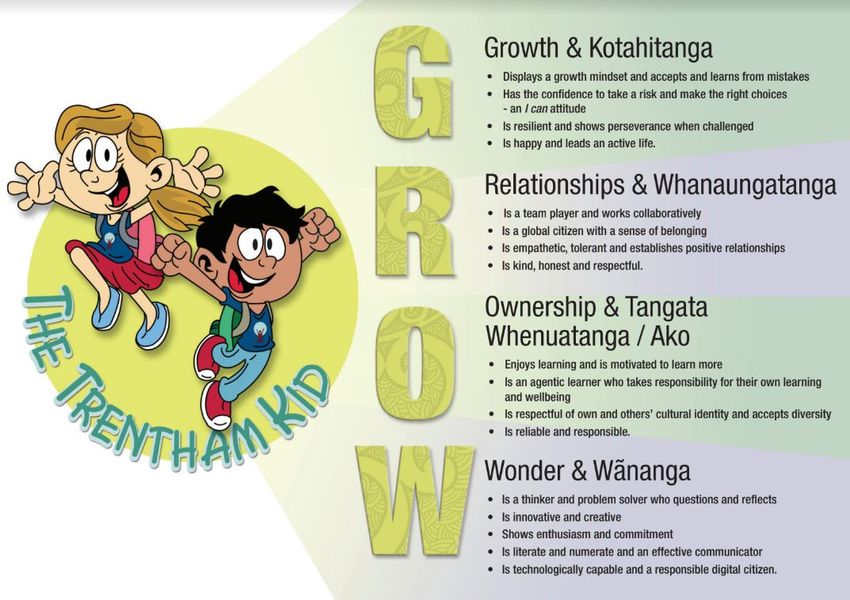
OUR GROW - Growth, Relationships, Ownership, Wonder
PRINCIPLES
OUR Kia puawai enei rakau ‘Kia Kaha’ mo ake tonu atu │ May these trees bloom with strength forever
WHAKATAUKI
OUR VALUES Resilience │ Respect │ Team Work │ Compassion │ Responsibility │ Integrity │ Creativity │ Excellence
OUR WELLBEING / HAUORA LEARNING / AKORANGA TEACHING / WHAKAAKO
STRATEGIC Strengthen the wellbeing of our school Create a culturally responsive, localised Empower staff to create innovative and
GOALS community curriculum that empowers and excites our collaborative learning environments
learners
OUR SUCCESS Our students, staff and whanau are happy and Our learners are actively engaged in relevant Our staff are equipped with the pedagogy and
successful at school and well supported to and authentic learning and feel confident, skills to develop agentic and inquiring learners.
manage their own wellbeing. valued and successful at school.
OUR 1a Review, develop and implement an effective 2a Develop and implement a curriculum driven 3a Strengthen staff capability to empower an
STRATEGIC school wide wellbeing/behaviour by our GROW principles and Te Tiriti o authentic and engaging curriculum
INITIATIVES programme Waitangi
3b Develop understanding of Deep Learning
1b Nurture and foster staff wellbeing and 2b Strengthen our cultural competency across
review workload expectations to enable our school community
staff to do less, better
2c Continue to develop a learning through play
1c Establish practices to support whanau to programme and explore a shared school
increase student readiness for learning philosophy
OUR WHY? The health and wellbeing of our students, their Our learners need to be energised and engaged Teachers’ roles are changing from instructors to
whanau and our staff are paramount. We learn in a curriculum that is responsive, supports facilitators. Our work needs to focus on
best when we are fit, well and happy. The learner progress, embraces Te Tiriti o Waitangi, designing learning experiences that challenge,
responsibility of this lies with us collectively so and helps learners engage with the knowledge, provoke, stimulate and celebrate learning, and
we can then look after ourselves. values and key competencies they need to be equips students with the necessary skills to
successful. succeed.
Trentham School Strategy 2020-2022 2VISION PRINCIPLES Trentham School Strategy 2020-2022 3
STRATEGIC ROAD MAPPING
 Strategic                            2020                                                         2021                                                        2022
Initiatives     Term 1         Term 2     Term 3              Term 4         Term 1         Term 2     Term 3              Term 4         Term 1         Term 2     Term 3            Term 4
               Review current behaviour          Develop Wellbeing                Trial Wellbeing
        S.1a             plan                       programme                       programme
                                                                                                               Implement Wellbeing programme              Review

                  Staff                        Gather
                               Plan staff                      Revise
        S.1b    Wellbeing
                               supports
                                             feedback on
                                                            expectations
                                                                                     Implement expectations                 Review
                 Survey                      expectations

                                                                                                             Establish practices to
        S.1c                                                                                                   support whanau
                                                                                                                                                   Implement practices                 Review

                                                                               Develop a learning pathway for students to actively
        S.2a   Revisit & strengthen the front of the Trentham Curriculum
                                                                                        monitor their learning progress
                                                                                                                                               Implement learning pathway              Review

                                               Develop shared cultural
        S.2b                                         practices
                                                                                      Implement shared cultural practices

                   Establish and implement a learning through play           Consider a learning through play programme for Year 2        Consider how learning through play may be utilised in
        S.2c                programme for Year 1 students                                      and Year 3 students                                         the senior school
               Staff professional learning on GROW, Te Tiriti o Waitangi and culturally
        S.3a                              responsive practice
                                                                                                    Staff professional learning on student learning pathways

                             Deep Learning professional learning for the                                                                     Consolidate and implement Deep Learning with
        S.3b                             Leadership Team
                                                                                Deep Learning professional learning for teachers
                                                                                                                                                               students

Trentham School Strategy 2020-2022                                                                                                                                             4
2020 ANNUAL PLAN
Strategic Goal: 3 year success measures:
WELLBEING / HAUORA 1a 95% of students report feeling safe at school always or most of the time.
Strengthen the wellbeing of Reduction in the number of behaviour incidents during class time and breaks.
our school community 1b Increase in the number of staff reporting positive wellbeing at work.
1c 90% attendance rate for Year 0 and 1 students.
Strategic 2020 2021 2022
Initiatives Term 1 Term 2 Term 3 Term 4 Term 1 Term 2 Term 3 Term 4 Term 1 Term 2 Term 3 Term 4
Review current behaviour Develop Wellbeing Trial Wellbeing
S.1a plan programme programme
Implement Wellbeing programme Review
Staff Gather
Plan staff Revise
S.1b Wellbeing
supports
feedback on
expectations
Implement expectations Review
Survey expectations
Establish practices to
S.1c support whanau
Implement practices Review
Initiative Key actions Who Timeframe 12 month milestone
1a Review, develop and ● Review current behaviour plan, collecting staff, Benjamin Term 1 A school behaviour/wellbeing
implement an student and whanau voice. programme ready to trial in
effective school wide ● Gather voice from Māori and Pasifika community Benjamin & Term 1 2021.
wellbeing/behaviour and ensure part of the development journey. Rochelle
programme ● Review our school Peer Mediation programme. Benjamin Term 1 Students, whanau, staff and
● Research various behaviour and wellbeing models Benjamin Term 2 wider community, including
and programmes, i.e. PB4L, Restorative Practices, Māori and Pasifika
Zones of Regulation, Pause Breathe Smile, communities, feel connected to
Sparklers, Te Whare Tapa Whā, Circle Time. Share the school behaviour/wellbeing
findings with the Leadership Team. programme.
● Develop a school wellbeing/behaviour programme Benjamin Term 3-4
aligned to our GROW vision. GROW vision is evident in
● Share draft programme with whanau, Māori and Benjamin & Term 4 school behaviour/wellbeing
Pasifika community for feedback. Rochelle programme.
● Participate in Mental Health Awareness week. Benjamin Term 3 - Sept
● Become a water-only school. Suzanne Term 1
Trentham School Strategy 2020-2022 51b Nurture and foster ● Staff to complete a Wellbeing Survey to gain a Isabel Term 1 Shared understanding of
staff wellbeing and better understanding of the needs of our staff. expected workload.
review workload ● Involvement in the CORE Educators’ Wellbeing Isabel & Term 1-3
expectations to Toolkit. Suzanne Agreed ways of working more
enable staff to do ● Support staff to learn how to look after their own Isabel & Term 1-4 efficiently.
less, better wellbeing with techniques, strategies, activities, Suzanne
readings, etc. Wellbeing Statement of Intent
● Collect teacher voice on current workload. Isabel Term 2 TOD (SOI) development to support
● Identify expectations to keep doing, stop doing, Isabel & staff Term 2 TOD staff.
start doing and why. Use the Staff Handbook as a
guide. Staff are resilient and better
● Schedule time for conversations to discuss these Isabel Term 3 Hub able to look after their own
expectations. Why do we need to do some things? mtgs wellbeing.
What can we remove? What can we do in a
different way?
● Investigate workload models from other schools Isabel Term 3
and outside sectors.
● Expectations developed ready for 2021 and clearly Isabel & Term 4
communicated to staff. Suzanne
● Develop a Wellbeing Statement of Intent (SOI). Isabel Term 4
Trentham School Strategy 2020-2022 6Strategic Goal: 3 year success measures:
LEARNING / AKORANGA 2a Increase in the Me & My School survey data.
Create a culturally responsive, Students are more able to talk about their learning at Student Led Learning Conversations.
localised curriculum that 2b Increase in the number of students and parents reporting strong cultural competency within the school.
empowers and excites our 2c Increase in GROW dispositional data for Year 0-1 students.
learners
Strategic 2020 2021 2022
Initiatives Term 1 Term 2 Term 3 Term 4 Term 1 Term 2 Term 3 Term 4 Term 1 Term 2 Term 3 Term 4
Develop a learning pathway for students to actively
S.2a Revisit & strengthen the front of the Trentham Curriculum
monitor their learning progress
Implement learning pathway Review
S.2b Develop shared cultural practices Implement shared cultural practices
Establish and implement a
Consider a learning through play programme for Year 2 Consider how learning through play may be utilised in
S.2c learning through play
and Year 3 students the senior school
programme for Year 1
Initiative Key actions Who Timeframe 12 month milestone
2a Develop and ● Utilise the Ministry of Education designing a Jillian & Dave Term 1 A deep, wide curriculum with
implement a localised curriculum resource. rich learning opportunities to
curriculum driven by ● Review and refine current curriculum Jillian & Dave Term 1-3 engage all students.
our GROW principles documentation to focus on identified effective
and Te Tiriti o pedagogy across all learning areas. GROW indicators developed for
Waitangi ○ Make links between curriculum year groups to show a clear
implementation plans. progression for dispositions.
○ Collect teacher voice.
● Review relationships for learning, rich learning Jillian, Dave & Term 1 Assessment schedule reviewed
opportunities teachers and updated for 2021.
● Unpack GROW Learner Profile and develop Jillian & Dave Term 1 TOD
indicators.
● Identify local community resources to support Jillian & Dave Term 3-4
school curriculum.
● Review assessment practices to align with our Rochelle, Jillian Term 3-4
curriculum. & Dave
Trentham School Strategy 2020-2022 72b Strengthen our ● As a staff brainstorm the kawa (protocols) desired Rochelle & staff Term 2 TOD Ownership of kawa across the
cultural competency for Trentham School. school and community.
across our school ● Consult with whanau at hui and review. Rochelle Term 3
community ● Gather student and whanau voice on cultural Rochelle Term 3 Increased use of Te Reo across
competency. the school.
● Create shared kawa and share with students and Rochelle Term 3
whanau, seeking feedback. A plan developed to unpack a
● Provide support for individual staff members Rochelle Term 4 Trentham School model for
regarding any kawa they need assistance with. cultural competency reflection.
● Staff to create a visual pepeha for the office foyer. All staff TOD
● Develop and implement a plan to support staff to Rochelle Term 3-4
increase use of Te Reo.
● Ensure the Te Reo progression of learning is Rochelle Term 3-4
maintained.
● Investigate models for reflection of our cultural Rochelle Term 3
competencies.
● Revisit our Māori Graduate Profile alongside Rochelle & staff Term 4
whanau, and increasing the profile of this work
amongst staff.
● Involvement in the Kura Ahurea programme. Rochelle & staff Term 1-4
2c Continue to develop a ● Professional reading and discussion around Heather & staff Term 3 Learning through play is
learning through play learning through play across the school. reflected in our Trentham
programme and ● Collect voice from whanau. Heather Term 3 School curriculum.
explore a shared ● Develop a shared understanding of learning Heather & staff Term 4
school philosophy through play and the pedagogy that sits behind it. Year 1 students involved in a
● Develop and implement Year 1 learning through Heather & Kiwi Term 3-4 learning through play
play programme. Hub teachers programme.
● Kiwi Hub will share learning through play journey Kiwi Hub Term 4
with the rest of the staff. teachers
Trentham School Strategy 2020-2022 8Strategic Goal: 3 year success measures:
TEACHING / WHAKAAKO 3a Teacher voice shows an increase in confidence and capability to deliver an empowering curriculum.
Empower staff to create Evidence of agency, collaboration, cultural responsiveness, GROW learner dispositions in class observations and
innovative and collaborative coaching sessions.
learning environments 3b Shared understanding of deep learning by all teachers and deep learning evident during classroom observations.
Strategic 2020 2021 2022
Initiatives Term 1 Term 2 Term 3 Term 4 Term 1 Term 2 Term 3 Term 4 Term 1 Term 2 Term 3 Term 4
Staff professional learning on GROW, Te Tiriti o Waitangi and culturally
S.3a responsive practice
Staff professional learning on student learning pathways
Deep Learning professional learning for the Leadership Consolidate and implement Deep Learning with
S.3b Team
Deep Learning professional learning for teachers
students
Initiative Key actions Who Timeframe 12 month milestone
3a Strengthen staff ● Develop and implement a professional learning Erica & staff Term 1-4 Teachers more confident and
capability to plan to support teachers to: capable to deliver our localised
empower an ○ effectively deliver GROW and our school curriculum.
authentic and values in classroom programmes.
engaging curriculum ○ Increase staff knowledge and understanding A shared knowledge of Te Tiriti
on Te Tiriti o Waitangi and Māori history. o Waitangi and Māori history.
○ develop a shared understanding about what
an authentic curriculum looks like.
● Utilise strengths within the school and cluster to Erica Terms 1-4
deliver professional learning.
● Involvement in the Cluster professional learning. Erica & staff Terms 1-4
3b Develop ● Leadership professional reading on Deep Leadership Term 4 - Term 1 Leadership Team has a shared
understanding of Learning. Hub Leaders Ongoing understanding of Deep
Deep Learning ● Key points of professional reading shared with Learning.
Hub teachers throughout the year. Leadership Term 1-4
● Leadership Team participate in New Pedagogies Professional Learning plan for
for Deep Learning professional learning with CORE 2021-2022.
and the cluster. Mary & Suzanne Term 4
Trentham School Strategy 2020-2022 9● Develop a 2021-2022 professional learning plan.
2020 ANNUAL TARGETS
Strategic Goal Wellbeing / Hauora
Annual Target 1. To increase the number of students feeling safe at school always or most of the time by 10%
Background Ensuring students feel safe at school is a priority at Trentham School. We want to strengthen the wellbeing of our students so
they are happy and successful at school.
In 2019 Year 3-6 students were asked to complete a survey online regarding safety at school. 226 students completed the
survey. They were asked to rate how much they agreed with 9 statements about safety at school. If they did not feel safe at
school they were asked to tell us why and give suggestions on what we could do to make them feel safer at school.
● 87% of students feel safe at school always or most of the time
● 88% of students feel safe at breaks, an increase of 6%
● 86% of students feel safe before and after school always or most of the time
● 73% of students always or most of the time feel comfortable talking to their teacher about problems
Planned Actions to Achieve Targets
1. Individual Behaviour Plans established for students with high behaviour needs.
2. Teacher Aides utilised for specific students requiring support during breaks.
3. Review of Student Behaviour Management Plan and establishment of a wellbeing plan.
4. Support from external agencies sought when necessary.
5. Students informed that all gates except one are locked during the school day so people are less likely to wander through the school. Also reminded to
tell a duty teacher if they see something they don’t like outside of the school grounds.
6. Teachers to continue to develop positive relationships with students and to follow up on all student concerns to ensure that children feel heard and
that issues have been dealt with. Educate students on what bullying is and how it is different to children being mean.
7. Teachers to remind students what they need to do if they have an issue with another student or they don’t feel safe.
8. Teachers to carry out emergency drills in a way that doesn’t frighten students. These need to be regular in the classroom alongside school wide drills.
9. Regular reminders to be sent home about signing in at the office and not to wander through the playground, particularly during break times.
10. Duty teachers to be visible in the playgrounds by wearing supplied fluro vests.
Trentham School Strategy 2020-2022 10Trentham School Strategy 2020-2022 11
Strategic Goal Learning / Akoranga
Annual Targets 2. To accelerate the progress of Year 2 students reading below the expected level to be reading at Turquoise (Level 17) by the
end of Year 2. (9 students)
3. To accelerate the progress of Year 3 students who are achieving below the expected level in reading, to achieve at by the
end of 2020. (9 students)
4. To accelerate the maths progress of Year 4 students who are achieving below the expected level in mathematics, to achieve
at by the end of 2020. (9 students)
5. To accelerate the progress of Year 5 Maori students who are working below the expected level in writing, to achieve at by
the end of 2020. (6 students)
6. To accelerate the progress of Year 6 students who are working below the expected level in writing, to achieve at by the end
of 2020. (9 students)
Background Over 2018-2019 the professional learning focus was on the effective use of acceleration strategies in the area of mathematics.
These strategies now need to be embedded into practice and transferred into other learning areas.
2019 end of year data shows:
● 18% of Year 2 students (2020 Year 3) are achieving below the expected curriculum level for reading.
● 39% of Year 3 students (2020 Year 4) are achieving below or well below the expected level for mathematics.
● 57% of Year 4 Maori students (2020 year 5) are achieving below or well below the expected level for writing.
● 59% of Year 5 students (2020 Year 6) are achieving below or well below the expected level for writing.
Planned Actions to Achieve Targets
1. Hubs to develop an action plan for their target students and review termly to monitor progress.
2. Regular discussion of progress and achievement of target students at hub and leadership level.
3. Teacher inquiry to focus on target students and effective practice to accelerate their achievement levels.
4. Induction of new staff to include acceleration strategies in maths and literacy.
5. Regular moderation of tasks and OTJs across syndicates and the school.
6. Engage with whanau to inform them of target students and how they can support at home.
7. Explicitly teach and model working collaboratively and sharing ideas.
8. Use acceleration strategies such as frontloading, talk moves, mixed ability grouping, and formative assessment to provide an environment for
accelerated learning.
9. Develop the use of Te Whare Tapa Wha in literacy and maths programmes.
10. Strengthen links between Inquiry and writing.
11. Target blends and digraphs during Guided Reading sessions as well as running the Yolanda Soryl phonics programme.
Trentham School Strategy 2020-2022 1212. Do either a visual reading or a rich introduction to prepare students for unknown vocab.
13. Engage reluctant writers with a range of different approaches, e.g. Game of Awesome.
14. Build inquiry planning into our literacy and maths.
15. Teacher collaboration in planning for reading, writing and maths.
16. Opportunities for student collaboration in all learning areas.
17. Strengthen student learning dispositions using the GROW Learner profile - focus on perseverance, collaboration, reflection and creativity to increase
student agency and ownership.
18. When possible give students an opportunity to choose their topics for learning.
Trentham School Strategy 2020-2022 13You can also read


