Child Care Plan for Maine: September 2021 Updates
←
→
Page content transcription
If your browser does not render page correctly, please read the page content below
Janet T. Mills                                                  Maine Department of Health and Human Services
     Governor                                                                               Child and Family Services
                                                                                                11 State House Station
                                                                                                    2 Anthony Avenue
     Jeanne M. Lambrew, Ph.D.
                                                                                           Augusta, Maine 04333-0011
     Commissioner
                                                                        Tel.: (207) 624-7900; Toll Free: (877) 680-5866
                                                                     TTY: Dial 711 (Maine Relay); Fax: (207) 287-5282

                      Child Care Plan for Maine: September 2021 Updates

Maine recognizes the importance of quality, accessible, affordable child care to support working families. The
benefit of quality child care is multifold – it supports working parents to provide for their families while
children benefit educationally, socially, and emotionally from a caring, nurturing environment. From an
economic perspective, the Federal Reserve Bank of Boston states, “Research demonstrates child care problems
lower worker productivity and cost U.S. employers and working parents billions of dollars annually.
Furthermore, job stability and family income directly affect a child’s social, physical, and emotional health.”
This Child Care Plan for Maine summarizes the system landscape pre-pandemic and the supports implemented
to providers and families during the pandemic. Our focus then turns to recovery and the strategies that will be
implemented to support Maine families, children, and child care providers toward a sustainable recovery and
brighter future. This plan contains updates based on Federal guidance and the State’s disbursement of funds
since May.

Pre-Pandemic
Prior to the COVID-19 pandemic, the Office of Child
and Family Services (OCFS), in alignment with the
Children’s Cabinet’s Strategic Plan for Young
Children, established both long-and short-term goals
to increase access to affordable quality child care in
Maine and focus on child care workforce recruitment
and retention. Maine participated in the Bipartisan
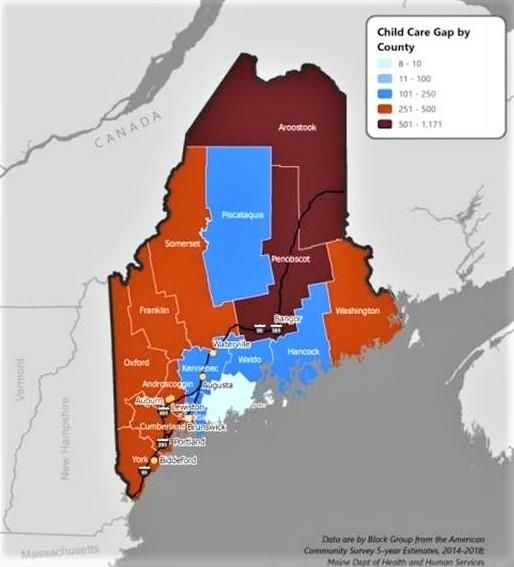
Policy Center’s Child Care Gap Analysis Project in
the winter of 2019. The results showed overall there
was a 9.2% need of care gap across Maine for
children under the age of six with all available
parents working. Rural areas of the State saw the
most significant gap in the need versus the supply.
While Maine does not have true data on the gap
specific to infants and toddlers, anecdotal evidence
indicated this was a common challenge with
concerns expressed by several stakeholders. Maine
was one of the two states participating with a gap
under 10% which positioned the state to withstand
the challenges of the pandemic better than other
states. Despite this relative strength, the child care
system was heavily impacted by the pandemic and
continues to need support for an effective recovery.
The Maine Department of Education, in collaboration with Maine Department of Health and Human Services,
was awarded the Preschool Development Grant (PDG), Birth through Age 5 in 2019. This Initial PDG B-5,
which expired in 2020, was a planning grant to study and improve the Early Child Care and Education mixed
delivery system. This grant supported the Children’s Cabinet goal that all Maine children will enter
kindergarten prepared to succeed. The planning grant provided the state with valuable information gathered
from stakeholders across the state through the needs assessment B-5 for ME: Quality, Accessibility, and
Affordability of Services for Maine’s Children & Families. This work informed the development of The State of
Maine Strategic Plan for Meeting the Needs of Vulnerable Children Birth to Age 5 and Their Families, a
roadmap for moving toward an aligned, efficient, and high-quality system for all children birth-age 5 and their
families, especially those who are considered vulnerable. DHHS and DOE collaborated to submit an
application to receive the PDG implementation grant, and while the implementation grant was not awarded to
Maine, the child care plan and spending strategies stem from the initiatives outlined in the grant application and
strategic plan between the Departments.
These findings were the driving factors in initiatives implemented in 2020. Despite the pandemic, these
initiatives were implemented beginning in state fiscal year 2021:
• Providers participating in the Child Care Subsidy Program (CCSP):
o Receive a weekly stipend of $100 per infant on CCSP.
o Receive a 10% quality bump payment for infants and toddlers served through CCSP.
• OCFS, in an attempt to boost the recruitment and retention of early child care educators, began:
o Covering the cost of licensing fees for both family child care providers and facilities.
o Offering several quality awards in partnership with Maine Roads to Quality Professional
Development Network (MRTQ PDN) with new Registry member awards, newly licensed mini-
grants, moving up a quality level award, reimbursement for the cost of accreditation, and
maintaining accreditation mini-grants.
o Partnering with Maine Association for the Education of Young Children (AEYC) to create
TEACH scholarship program.
• OCFS also began efforts to enhance the Child Care Choices website to improve the availability and
accessibility of information about providers for families who may be seeking child care.
Prior to the pandemic OCFS had been dedicating significant time and resources to ensuring CCSP was easily
accessible to families and in full compliance with federal Child Care Development Block Grant (CCDBG)
requirements set out in the 2014 Reauthorization Act. During 2020, OCFS was able to achieve this goal
through the creation and implementation of fingerprint-based background checks for providers. To date over
13,000 background checks have been completed to ensure the safety of children served in Maine’s child care
settings. OCFS achieved full compliance in July of 2020. In addition, in January of 2020, OCFS began a one
application process through the financial and program eligibility requirements for CCSP making the program
application simpler for families.
Impact of Pandemic on Child Care
While the COVID-19 pandemic has had an immense impact on the world of child care, through several
funding supports and targeted efforts, OCFS has been able to support providers in order to maintain the
majority of Maine’s child care capacity. As of September 2021, Maine has 96% of the pre-COVID licensed
programs open and operating. In addition, the Child Care Subsidy Program (CCSP) has seen a steady increase
in total families and children receiving CCSP over the last four months. Currently 3,013 families representing
4,596 children are served by the program.
2
September 2021County February July 2021
2020 Total Total
Providers providers
Androscoggin 291 273
Aroostook 121 113
Cumberland 514 485
Franklin 57 56
Hancock 89 90
Kennebec 231 210
Knox 57 58
Lincoln 51 48
Oxford 101 100
Penobscot 245 241
Piscataquis 26 26
Sagadahoc 67 53
Somerset 75 73
Waldo 71 76
Washington 50 52
York 291 279
Total1 2,337 2,233
1
Total includes camps, CCSP licensed exempt resources, child care facilities and family child care providers.
3
September 2021Pandemic Support for Providers
Throughout the pandemic, OCFS has provided regularly updated guidance to child care providers on health and
safety measures related to COVID-19. This included recommended screening protocols, cleaning requirements,
procedures when a staff person or child tested positive, etc. OCFS also collaborated with Maine CDC to provide
Binax NOW COVID-19 Antigen Test Cards to child care providers. This onsite testing allows providers to
ensure the health and safety of their staff while maintaining continuity of operations whenever possible. OCFS
also implemented procedures for Emergency Temporary Licensing of child care providers to address access
issues, particularly for essential personnel. Through this process OCFS has supported over 40 providers with a
total capacity of nearly 2,200 child care slots.
OCFS in partnership with Maine Roads to Quality Professional Development Network (MRTQ PDN) made the
COVID-19 vaccine available to all licensed child care programs in early March as a priority group through the
MRTQ PDN Registry as proof of employment in the field statewide. The Registry had over 500 new individuals
enrolled, and each new enrollee received a $100 incentive.
OCFS engaged stakeholders in developing plans to stabilize and support providers through the multiple funding
sources:
Coronavirus Aid, Relief, and Economic Security (CARES) Act
In May of 2020, Maine received $10.9 million in CCDBG funding through the CARES Act. The funds were
utilized in several ways, including grants to directly to providers to cover COVID-19 related costs and build
capacity, providing child care subsidy for essential workers (regardless of income eligibility), and increasing
support to low income families receiving traditional CCSP by waiving parent fees through the first stage of
Maine’s Economic Recovery Plan.
Coronavirus Relief Funds (CRF)
In August of 2020 the Governor announced additional financial support would be provided to child care
programs through CRF funding. The Governor allocated $8.4 million to the initiative which provided
reimbursement to providers for COVID-19 related business expenses. The grants distributed through OCFS in
December of 2020 totaled $2,176,464.
Coronavirus Response and Relief Supplemental Appropriation (CRRSA) Act
In March of 2021, Maine received $30.5 million in CCDBG funding through CRRSA Act. OCFS took a
wholistic approach to utilizing the funds by focusing on supporting the child, family, and child care provider.
This plan included allocating 75% of the funding directly to child care providers through stabilization grants.
Remaining funds were used to expand professional development for providers through the Maine Roads to
Quality (MRTQ) Professional Development Network (PDN) system, provide mental health and social
emotional learning support to children and providers through the Early Childhood Consultation Program
(ECCP), further enhance the Child Care Choices website with additional program specific fields and the
addition of a mobile app, waiving copayments for CCSP families through 9/30/22, and reimbursing CCSP
providers based on enrollment. Three of four quarterly provider grant installments totaling $11,159,470 have
been distributed. Payments to providers were in April, June, and September 2021 with the final installment
planned for December. Grant funds are to be used to offset COVID-19 related costs and build capacity within
the child care system. These supports are providing essential funds to continue the stabilization and recovery
efforts in 2021.
4
September 2021CRRSA funds will also be utilized to provide enhanced professional development for providers through MRTQ
by an improved design of the Strengthening Business Practices for Child Care Programs trainings by updating
the training, recruiting 18 train the trainers, offering added Communities of Practices (CoP) on the trainings,
and the inclusion of business software and technology training. In addition, the funds will establish a Statewide
Apprenticeship Program for Child Care Providers, provide Mini-grants and awards for achieving or maintaining
accreditation, and/or for completing one of the Maine Credentials (Director, Infant Toddler, Inclusion, Youth
Development).
Payroll Protection Program (PPP)
Further support to the child care industry in Maine to assist in stabilization is through the PPP loans with the
U.S. Small Business Administration (SBA) with first and second draw loans. OCFS has worked with SBA
Region 1 office to identify and provide outreach to identified eligible programs. Data from SBA (2020) shows
an increase in the total percentage of programs receiving a loan from 22.2% to 30.5%. Loan amounts increased
from an average of $16,044 for first draw and $58,830 for second draw per loan.
American Rescue Plan Act (ARP)
Maine has received an additional $121.9 million in CCDBG funds that will be allocated to the state through the
federal American Rescue Plan Act (ARP). The ARP child care funds will be broken up into three sections.
Below are the amounts Maine received:
1. Discretionary - $45,752,460
2. Stabilization Subgrants - $73,176,466
3. Match- $2,984,281
Once again the funds will be used to implement the Child Care Plan for Maine with a whole system approach
to the utilization of the funds meant to enhance Maine’s entire child care delivery system with intentional
strategies that again align with the Children’s Cabinet’s strategic plan which focuses on access, quality, and
workforce. These plans support short-term stabilization and recovery as well as long-term growth and system
improvement.
The Office of Child and Family Services (OCFS) plans to spend the funds utilizing the following strategies that
build upon the goals of the Children’s Cabinet as well as many of the cross-system initiatives that were part of
the joint Department of Education (DOE) and Department of Health and Human Services (DHHS) Preschool
Development Grant Application. These strategies will further stabilize Maine’s child care providers, continue
to place value on quality child care, and invest in long-term infrastructure building. Each strategy below also
indicates the goal area the strategy supports (Access, Quality, or Workforce). The information below is subject
to change as more guidance and information becomes available from ACF.
1. Access
• Waive Child Care Subsidy Program (CCSP) parent fees for families at or below 60% of State
Median Income to support low income families until 9/30/23 ($6,496,764)
• Continue waiving child care licensing fees for 2 years to support new and existing child care
providers ($300,000)
• Provide a 35% weekly increase of reimbursement to child care providers who take subsidy and are
serving children with special needs
• Cover CCDF short fall for FFY23 to help ensure that there is not a waiting list for families to access
child care subsidy ($18,000,000)
• Reimburse CCSP based on enrollment for 2½ years ($10,614,672)
5
September 2021• Expand the Parent Ambassador program to empower more parent advocates and to include parents
from family child care ($175,000)
• Translate CCSP materials into identified languages for both families and providers ($65,000)
• Hire a temporary staff position to create the technology and reporting procedures to process monthly
stabilization subgrant payments ($203,452)
• Two-year limited period position for a Children’s Behavioral Health and Child Development
administrative assistant position ($130,000)
• Supply a one-time $2,000 stipend to newly licensed family child care providers focused on
increasing access to child care for families in rural and gap areas. From 7/1/21-9/30/23 ($500,000)
2. Quality
• Support Maine Center for Disease Control (CDC) physical activity and nutrition program in early
care and education work to align with Quality Rating and Improvement System (QRIS) revision
standards with TA, tools, and resources ($50,000)
• Complete an evaluation of Early Childhood Consultation Partnership (ECCP) pilot ($150,000)
• Invest in Ages and Stages Questionnaire (ASQ) online screening tool for child care providers to
screen and refer children to early intervention when delays in development are detected ($557,250)
• Support the creation of the Early Childhood Integrated Data System (ECIDS) to assess
programmatic outcomes of early childhood programs across the lifespan ($256,000)
o Hire temporary project manager ($215,000)
• Provide Second Step curriculum for child care to support social emotional learning ($200,000)
• Expand Classroom Assessment Scoring System (CLASS) to measure outcomes in child care and
incentive program participation with $500 per program ($800,000)
• Train early care and education providers on Maine Early Learning Development
Standards ($115,000)
• Increase child care quality payments to 3%, 10%, 15% for 2-years to support an increase in high-
quality programs ($6,500,000)
• Build child care information system onto CCWIS ($10,000,000 over two years)
• Hire temporary staff to manage all ARPA projects ($244,230)
3. Workforce
• Develop and deliver a Parent Engagement training to child care providers ($50,000)
• Expand Classroom Assessment Scoring System (CLASS) to measure outcomes in child care and
incentive program participation with $500 per program (estimate 200 programs) ($800,000)
• Hire a temporary staff position to implement building the child care information system onto
Comprehensive Child Welfare Information System (CCWIS) ($225,092) Train early care and
education providers on Maine Early Learning Development Standards ($115,000)
• Child Care Stabilization Grants will include monthly payments from October 2021 to September
2022. The grants will retain all current CRRSA application elements. ($73,176,466)
o Payments will be:
▪ Required to be on a rolling basis and prorated on operating expenses
▪ Based on capacity
▪ Increased payments for quality, for providers taking subsidy, and for
providing nontraditional hours of care (6am-6pm or weekends)
▪ Will provide stipends to child care providers at $200 per staff member that
will be required to be paid directly to eligible staff.
6
September 2021In addition to the ARPA funds, OCFS will continue to support child care through ongoing efforts, including the
infant/toddler stipend, workforce development through the TEACH scholarship, technical assistance through
Maine Roads to Quality, and other efforts.
Taken together, the Federal funding from the coronavirus response laws is roughly 4.5 times the annual Federal
and state block grant spending on child care in Maine. The White House describes ARPA as the single biggest
investment in child care since World War II.
Federal Relief – Child Care Budget Impacts
Funding
$140,000,000
+364% over base
$120,000,000
$100,000,000
$80,000,000
$60,000,000 $121,913,207
+87% over base
$40,000,000
+55% over base
$20,000,000 $34,968,807 $19,300,000 $30,506,173
$0
"Base" CCDBG CARES Act + CRF CRRSA ARPA
Funds (State and
Federal)
Funding
Infrastructure
The Governor’s ARPA infrastructure initiative (LD 1733) includes $10 million in support for grants that would
provide direct infrastructure support, including “bricks-and-mortar” expansion efforts, to expand existing or
build new child care facilities and programs. These funds will effectively further leverage the federal funds to
support Maine working families. More information on the application and distribution of these funds will be
forthcoming.
7
September 2021You can also read


