Kingston Health and Care Plan and Commissioning Intentions 2019/20 - Governing Body meeting in public November 2018 Julia Travers, Director of ...
←
→
Page content transcription
If your browser does not render page correctly, please read the page content below
Kingston Health and Care Plan
 and Commissioning Intentions
           2019/20
Governing Body meeting in public November 2018
Julia Travers, Director of Commissioning
Kingston & Richmond CCGs
Context • Clinical Commissioning Groups (CCGs) work to continuously improve the services they commission for their local populations • Traditionally, once a year, CCGs write to the providers of services to inform them of the plans for the coming year(s) and the likely impact of these plans. This is known as commissioning intentions • This year, the planning round is in the context of the Kingston Health and Care Plan, delivered through the CCGs transformational programmes • This approach marks a move towards greater collaboration with providers and commissioners of health and care services • This presentation summarises those plans, and their impact on the health and wellbeing of Kingston residents
The Kingston Health and Care Plan

•   Is a 2 year plan covering 2019/20 – 2020/2021 being developed by the CCG and
    the Royal Borough of Kingston (RBK) with input from partner organisations
    including the voluntary sector

•   It is informed by the Joint Strategic Needs Assessment (JSNA) and insights from
    engagement across Kingston and South West London (SWL)

•   It addresses the health and care needs of people living in Kingston and Focuses
    on what health and care together can achieve for the whole population

•   It identifies the joint health and care priorities for Start Well, Live Well, Age Well
    from existing work, plans and health & wellbeing priorities

                                                                                             3
What local people have told us
• Perceived lack of funding and resources to invest in service changes
• Current local services would not have the capacity to take on additional
work from hospitals
• Improving and increasing signposting to services to make the public aware
of services in the area, educating people about health care choices
• Concerns over quality of services and of equality in accessing these
services
• Need to improve staff communication skills so that patients and carers are
treated with empathy and respect, especially those with complex or
additional needs
• Need for more joined-up IT systems to aid communication between
services and avoid patients having to repeat themselves
4Quality, Performance & Finance
Kingston Hospital Demographic pressures and finances
• Rated overall “outstanding” by CQC • Expected growth in population, and demand
• Rated “requires improvement” for use of for new treatments and therapies, projected
resources ( linked to financial position) to significantly outstrip any growth in the
budget
• Patient experience ratings 8.1/10
• A&E standard • CCG and Council significant savings
requirements
South West London and St Georges Hospital
• Rated overall “good” by the CQC. Quality
issues relate mainly to community services:
- Consistency and variation in community
services
- Pressure with acute care pathwayKey themes from local strategies
• Greater preventative and early interventions to enable people to become more
independent and confident in managing their care
• Better support to enable people to look after themselves and staying healthy
through greater involvement by the voluntary sector
• Greater delivery of joined-up care because of increased collaboration between
acute, primary, community, mental health and voluntary sector providers in
delivering care
• Consistent high quality care closer to home and access to more specialised
services within the community
• Bringing together physical and mental health to improve outcomes for people
with long term conditions and reduce the health inequalities in people with
serious mental health illness
• Access to improved technology that improves the ability to access necessary
services, advice or information relevant for their needs
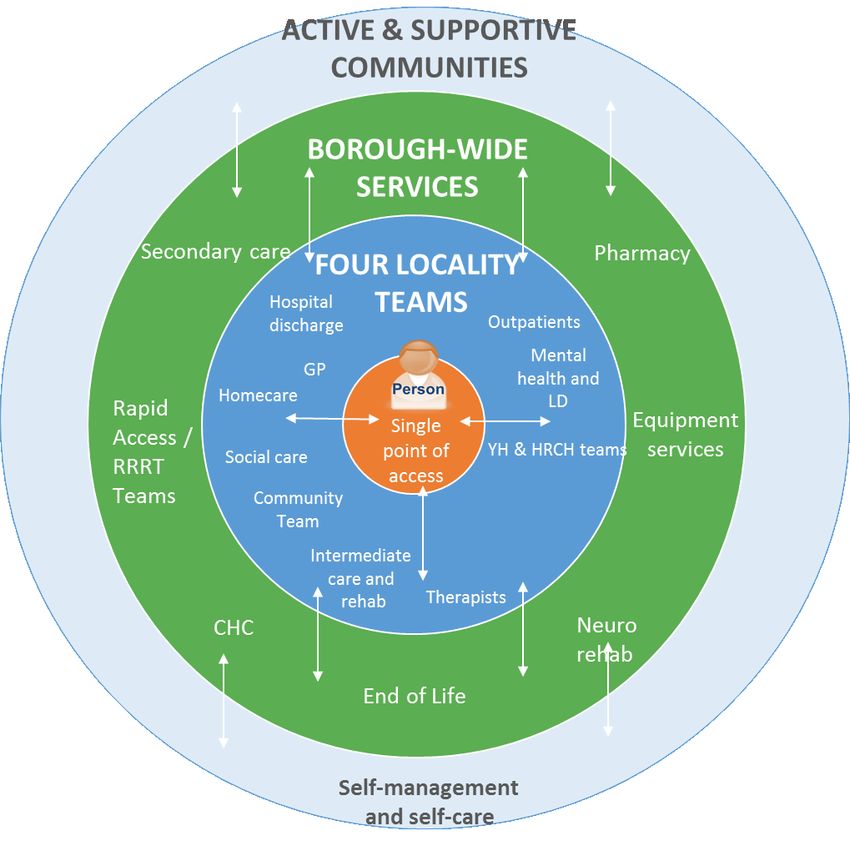
6The local vision and approach for health and social care integration – Kingston Coordinated Care Our local vision for health and social care integration is to • to support the development of active and supportive communities in which people are enabled to stay healthy and well, living independently as part of a thriving and resilient community and; • to develop truly patient -centred care that supports people with complex needs to achieve the best possible quality of life and the goals that matter to them with an increased focus on prevention, proactive care, and self-reliance.
Locality Working
Based on 50,000 population /geographical alignment
of GP practices
Population health
All age and patient groups
Focus
•   improving health and reducing inequalities
•   Self care and self management
Risk stratification
Multidisciplinary team working and case
management of those people with complex care
needs
Outreach specialist care
Commissioning Intentions 2019/20
Commissioning Intentions
As an overriding principle behind our commissioning intentions, Kingston CCG will work
with partners, to co-design and implement a financially and clinically sustainable health
and care system. Our borough based local health and care plan (LHCP) will be published by
March 2019. The LHCP will identify the health and care needs across the local system and
detail the transformation
Our priorities for this work in 2019/20 will be:
•       Delivering the transformation priorities identified in the Local Health and Care
        Plan
•       Implementation of new models of care across care settings
•       To take a system wide approach to our collective financial challenges
•       Local implementation of SWL wide initiatives and service changes
Responding to the needs of Kingston Residents… …Kingston Local Health and Care Plan Priorities …to improve the lives of
Create environments and enable communities and individuals to lead healthy lives and be confident in their
Kingston residents
Start well
Children quarter of the population What happens in early life, starting from conception, affects health and Improved experience of and
Over 2000 school children estimated to have a mental health problem & wellbeing in later life. Prevention is critical to ensuring that all children access to mental health
numbers are rising and young people can fulfil their potential provision
29% of 10-11 year olds are overweight or obese Maximise the mental wellbeing and resilience of our children
Slightly more likely to smoke at age 15 and young people Service tailored to individual
2,700 children with special educational needs/disabilities Improve the health of children and young people with a focus on and family needs
A&E attendance is higher than England & admission to hospital for tackling childhood obesity
injuries is higher than London Give children and young people with SEN and disabilities the Reduced need for emergency
MMR immunisation rate (86.1%) to too low to protect the population opportunities to flourish and be independent intervention
Live well
113,000 working age adults Healthy choices are influenced by our environment, communities and Improved wellbeing and
Healthier habits compared to Londoners -physically active, wellbeing. Drives forward preventative approaches at all levels; independence
58.2% are overweight or obese engaging communities, utilizing local assets (e.g. parks) and targeting
Prevention
21,000 have common mental illnesses (depression or anxiety) approaches to reach those most at risk. Greater LTC control and
Nearly 1 in 3 people have a long-term condition & nearly 1 in 10 people outcomes
have 3 plus long- term conditions Support people to have good physical and mental health and
c3,000 predicted number of PLD prevent ill health Improved access to primary and
Cancer screening coverage breast, cervical & bowel - lower than Support people to manage their long-term conditions community services
England- with cancer being the leading cause of death Reduce health inequalities for those people with poor health
3.8% of people are thought to have coronary heart disease - the leading with a focus on people with learning disability, serious mental
ability to care for themselves and others
cause of death in men Improved access to mental
illness or multiple long term conditions health support
6.9% of people are predicted to have diabetes – a cause of ill health in
Kingston
Age well
23,500 adults are 65 years & over Whilst people are living longer lives, many older people are also living Improved experience, and
10.6% live alone with a reduced quality of life due to ill health or disability, or control of care
8,060 people unable to manage at least one self-care activity. experience loneliness and isolation.
Cancer is the leading cause of death (46.7%), circulatory disease (23.7%) Reduction in falls and
& respiratory disease (19.2%) Maximise people’s independence and resilience to enable them ambulance callouts
High blood pressure (42.4%); diabetes (11.6%) and chronic kidney to live well at home where that is their choice
disease (10.7%) are the most prevalent conditions Enable people to live their last years of life well and end well Fewer emergency admissions
6,511 admissions to hospital for over 75 years’ olds for a stay less than Reduce loneliness and isolation for everyone particularly older and A&E attends
24 hours (higher than England) people
1600 people have dementiaFocus Area Commissioning Intention Likely Impact
Start Well
The CCG is committed to working in partnership with local
authority children services and education to take a whole Pre-and post-diagnostic support for those families Better after care and support for young people who experience
system approach to the commissioning of services for with children and young people with Autistic mental health problems
children and young people in line with national policy and Spectrum disorder (ASD) and attention deficit
guidance, inspection frameworks and statutory duties. hyperactivity disorder (ADHD). Improved access to community services
CAMHS Early Intervention & Prevention service for
under 5’s to support parents in the care of their Reduction in wait times
The focus will be on keeping children and young people well
children, foster good attachment and healthy
and promoting emotional resilience. development. Improved outcomes for CYP in crisis
Assessment and positive behaviour support plans
and programmes for those families with children and Reduction in emergency attendances through building resilience
young people who need support to address
challenging behaviours
Additional community paediatric support to ensure
local follow-up of children and young people who
have experienced sexual abuse
Review the A&E attendances and hospital
admissions for CYP & agree a work programme to
deliver alternative settings of care.Focus Area Commissioning Intention Likely Impact
Live Well
Integrated Care
• Embedding & extending the integrated person centred model of health and care to
The CCG remains committed to working in deliver care at home and closer to home through Kingston Co-ordinated Care to include Delivery of new models of care for people
partnership with the local authorities and the commissioning of community health services. with complex care needs
providers including the voluntary sector to deliver • Deliver a home-based model for End of Life Care
integrated care through borough wide locality • A new service model for the prevention, early intervention and management of falls
models for all patient groups. Improved resilience in community services
and fractures
• Support self-management promoting health, independence and access to a range of Reduced number of deaths in hospital
A foundation of this work is the Locality and MDT non-clinical services as an alternative to formal care.
working to support people to live independently • Improve the care model for the most vulnerable people in our communities,
and prevent admission to hospital through pro- Reduction in NEL admissions
specifically those in care homes (in line with enhanced health for care homes) and those
active and preventative care planning and people within the last year of life to avoid unnecessary admissions.
management. • Bring together the work in physical and mental health arenas to deliver seamless Reduction in ED attendances
services wherever people access them
Mental Health
• Work with secondary and primary care to ensure that people diagnosed with a Serious
Our focus will be to prevent mental health illness Mental Illness receive annual physical health checks and any associated follow up Better care and support for people with
and promote emotional wellbeing across the • Commission IAPT services to meet the NHSE improved access rate and expand the psychological and mental health problems
populations. We will work with partners to pathways to deliver tailored IAPT services for Long Term Physical Health conditions
improve the mental health and wellbeing of • Review the Crisis support pathways across the borough and implement a model of Reduction in unnecessary emergency
people living with or vulnerable to mental health integrated Mental health for Kingston to provide attendances to ED
problems through the delivery of timely and • A Common Assessment Framework across secondary and primary care
accessible high quality care and treatment this • Clearer access to services: such as single point of referral. Improved outcomes for people in crisis
will be aligned with the locality model across • Support timely step up and step down within mental health pathways
each borough. • Review psychiatric liaison and primary care models to understand the impact of those Improved access to community mental
service models on the wider health system and future commissioning needs health services
• Identify people with dementia and commission pathways that support patients and
their families Improved quality of care for SMI
People with a Learning Disability
Increasing annual health checks for people with learning disabilities
The CCG will work with partners in SWL to deliver Improved quality of care for PLD
implement the all age learning disability strategy “making life Journeys” (2017)
the national plan “Building the Right Support”
locally and reduce health inequalities for people
with a learning disability and support life style
choices.Focus Area Commissioning Intention Likely Impact
Age Well
Whilst people are living longer lives, many older people are
also living with a reduced quality of life due to ill health or Extending and embedding the integrated person
disability, or experience loneliness and isolation. centred model of health and care to deliver care at Delivery of new models of care for people with ill health and
Maximise people’s independence and resilience to home and closer to home through Kingston Co- disability that maximises their independence and reduces
enable them to live well at home where that is their ordinated Care to include the commissioning of loneliness and isolation
choice community health services.
Enable people to live their last years of life well and Deliver a home-based model for End of Life Care Timely and supported discharge from hospital
end well Implement services that focus on Home first,
Reduce loneliness and isolation for everyone Discharge to Assess and Frailty to facilitate timely
particularly older people discharge from hospital
Commission an integrated therapy service
Commission a crisis team at the ‘front door’Focus Area Commissioning Intention Likely Impact
Urgent Care
Improve the management of people who require urgent or
emergency treatment to prevent admissions to hospital • Commission an Ambulatory Emergency model of care
where possible, when an admission cannot be prevented at Kingston Hospital and across the out of Hospital Reduction in emergency admissions specifically the short stay
to facilitate discharge and reduce their length of stay pathways: admissions and for those conditions that can be delivered as
• Reviewing the pathways that can be delivered in a ambulatory care and in different care settings
different setting e.g.
• Commission a community DVT service
Timely and supported discharge from hospital
• Expand the community IV antibiotic services across
Kingston
Reduction in Excess bed days
• Review and commission the emergency pathway
through UTC, CDU, AAU, PAU and inpatient beds.
• Review the A&E attendances and hospital admissions Reduction/streamlining of activity across the urgent care
for CYP & agree a work programme to deliver pathway
alternative settings of care.Focus Area Commissioning Intention Likely Impact
Planned Care
The CCG is committed to work with local partners across
south west London to deliver effective and efficient Implement new pathways in Cardiology,
elective pathways across the whole system, to transform Gastroenterology, Gynaecology, Urology and Reduction in hospital based Outpatient first and follow-up
the way in which out-patients are delivered embracing Respiratory attendances through a different delivery model
innovative modalities and reducing unnecessary face-to- Implementation of heart failure pathway and
management in the community Reduction in elective activity
face contacts in secondary care. We will commission end
Development of anticoagulation services within the
to end integrated pathways across different care
community
settings. Implement the expanded MSK SPT & alternative
care pathways to include a review of physiotherapy
services
The redesign of pathways will lead to a review of
existing GPWSI and intermediate community
servicesFocus Area Commissioning Intention Likely Impact
Primary Care
Kingston CCG has a clear set of plans supporting delivery
of primary care at scale Organising community pharmacy into locality areas
that match the Kingston health and social care Improve access to primary care services and provide resilience to
localities creating opportunities for workforce the local primary care systems.
transformation across the local primary and
community systems.
Continue extended primary care access and
commission an integrated urgent treatment
/extended access/out of hours /111 service model to
simplify access to general practice in and out of hours.
Bring the locally commissioned services into the local
contract known as Kingston Medical Services (KMS).Engagement and partnerships
• Kingston’s developing health and care plan and the CCG’s commissioning
intentions reflect what patients, carers and people living and working in
Kingston have had to say about local health and social care services. We are
working in partnership with the Royal Borough of Kingston, local health and
care providers, Healthwatch and Kingston Voluntary & Community Sector
(VCS) on the health and care plan. We will build on this by:
Continuing to engage with voluntary and community organisations and
groups as part of our community engagement programme
Inviting up to 200 members of the public, health and care staff and
stakeholders to a Kingston health and care plan event on 21 November
Working with partners to develop a longer term approach to engagement
and co-production to support delivery of our health and care plan
priorities and transformation programmes. This will be an opportunity to
co-design with people with lived experience of local services.Next Steps Commissioning and Contracting • Provider /Commissioner responses to Provider and Commissioning Intentions (notified end of September 2018) • Review of the NHS I & E Approach to Planning 2019/20 includes outline timeline • Business case development • Publication of NHS Long Term Plan • Publication of Operational Planning Guidance • Negotiations with providers
You can also read


