EU AND THE PHILIPPINES: TOGETHER TOWARDS UNIVERSAL HEALTH CARE - Department of Health
←
→
Page content transcription
If your browser does not render page correctly, please read the page content below
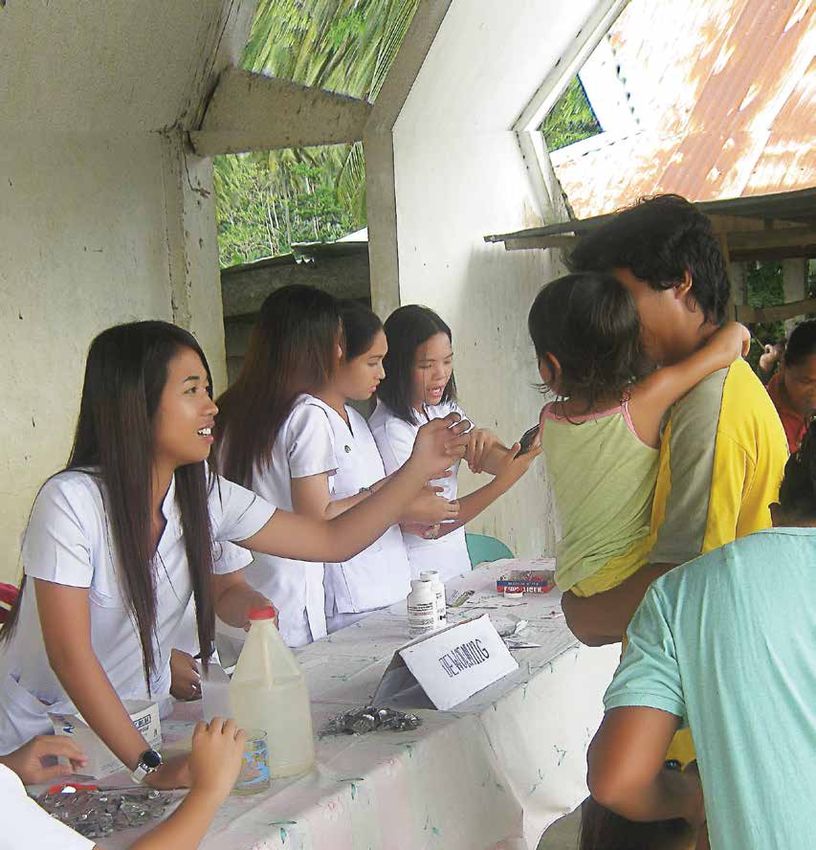
EU AND THE PHILIPPINES:
TOGETHER TOWARDS UNIVERSAL HEALTH CARE

                Republic of the Philippines
                Department of Health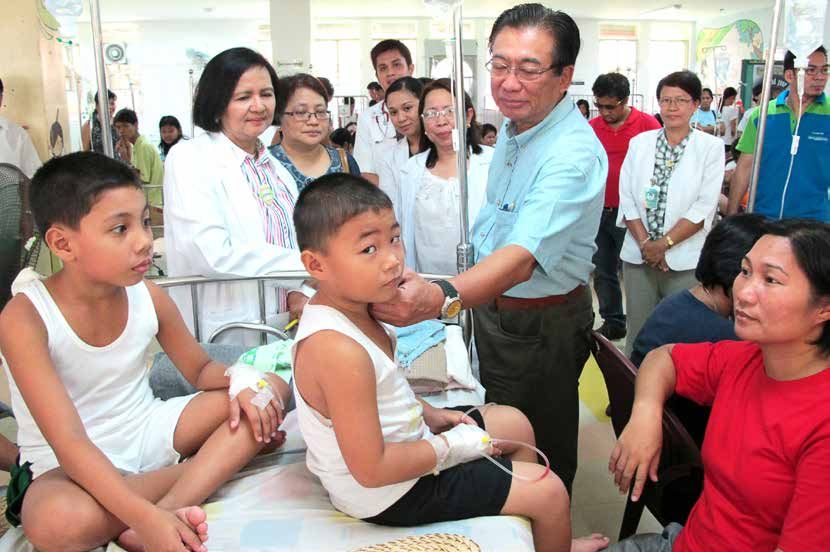
EU Ambassador Guy Ledox and Philippines Foreign Affairs Assistant
Secretary Elisabeth Buensuceso sign two financing agreements
addressing key areas in the expanded bilateral relations namely climate
change and maternal and child health.

                                                               EU AND THE PHILIPPINES:
                                              TOGETHER TOWARDS UNIVERSAL HEALTH CARE
The European Union (EU) is one of the Philippines’ major                  The first Health Sector Policy Support Programme (HSPSP-I),
development partners for over four decades. In 2004, the first of         launched in 2006, supported 16 provinces. The second health
three Health Sector Policy Support Programmes (HSPSP-I) was               sector budget support programme (HSPSP-II), launched in 2010,
conceived. The EU has been strongly contributing to the Philippines’      supported the nationwide rollout of health sector reforms. The
Health Sector Reform Agenda. EU financial support provided to the         third health sector budget support programme, the Philippine
Philippines’ Health Sector over the period 2006-2018 amounts to           Health Sector Reform Contract launched in 2014, consolidates
EUR 118 million (approx. PhP 7.2 billion, at current                      achievements and will be complemented by technical assistance.
exchange rate).                                                           The third sector budget support amounts to EUR 30 million.

In 2010, the Government of the Philippines launched the Aquino            ACHIEVEMENTS OF UNIVERSAL HEALTH CARE SO FAR
Health Agenda highlighting the Universal Health Care strategy
                                                                          •   Improvement of access to and quality of health services
(UHC). This strategy aims at making essential health services more
                                                                              based on an increase of births taking place in a health facility
affordable and available for all Filipinos.
                                                                              from 38% in 2008 to 74% in 2012
                                                                          •   Deployment of almost 31,000 registered nurses to various
The EU confirms its confidence in the UHC framework through
                                                                              localities, targeting poor communities
the health sector budget support. Budget support is a financial
                                                                          •   Increase in the population’s insurance enrollment from 62% in
grant directly channeled to the National Treasury. It is not tracked
                                                                              2010 to 83% in 2012; through the Sponsored Program
separately from the rest of the national budget, but fully integrated
                                                                              coverage, 53% of enrolled insurance members come from the
and managed by the government. The Department of Health (DOH)
                                                                              poorest families in the country
and EU have a common understanding of what is to be achieved
                                                                          •   Declining rates of under-five mortality from 58 in 1998 to 30
through a continuous policy dialogue based on partnership and
                                                                              deaths per 1,000 live births in 2011
mutual responsibility. A Performance Assessment Framework
                                                                          •   27 provinces declared malaria free since 2007, 82% of TB
assures that results are measured and progress in the health
                                                                              patients successfully treated, and prevalence of HIV and AIDS
sector reported.
                                                                              remains below 1%

                                                                          In 2012 two hallmark legislations were passed – The Sin Tax Law
                                                                          and the Reproductive Health Law (RH Law). The Sin Tax Law will
                                                                          increase taxes on alcohol and tobacco products to fund health care,
                                                                          especially for the poor. The RH Law addresses maternal and infant
                                                                          mortality and specifically family planning.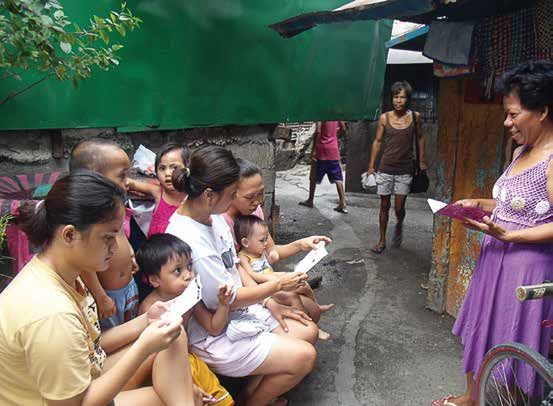
WIDENING REACH OF HEALTH INITIATIVES

EU supports many other innovative health initiatives in partnership
with government agencies, local government units, and especially
civil society organizations.

The EU-funded Maternal, Neonatal and Child Health and Nutrition
Needs of Indigenous Cultural Communities / Indigenous People
(ICC/IP) and other Disadvantaged Communities in Mindanao
project, launched in 2012, amounts to EUR 7 million (approx. PhP 42
million, at current exchange rate). It is implemented by the National
Commission on Indigenous Peoples (NCIP) in close coordination with
DOH. A Contribution Agreement with the United Nations Population
Fund (UNFPA) was signed in January 2013. It aims at strengthening
the quality of reproductive health care services.

Maternal and Young Child Nutrition Security in Asia (MYCNSIA)

The EU/UNICEF Partnership on Nutrition in Asia is a 4-year programme
in the Philippines, Indonesia, Bangladesh, Nepal and Lao PDR (EUR 28.4
million with approx. EUR 3.2 million for the Philippines or approx.
PhP 192 million, at current exchange rate). It aims to prevent and control
malnutrition and anaemia in children 0-23 months, pregnant and
postpartum women. The partnership focuses on support to nutrition
policy-making, capacity development, knowledge sharing, and scaling
up evidence-based key nutrition interventions.

    Chronic undernutrition remains a major problem in the world
    and the EU has increased its commitment to fight hunger
    worldwide. The EU has issued a Communication on Maternal
    and Child Nutrition, which aims to reduce undernutrition among
    children under five years of age. This statement underlines the
    importance that the EU and the Member States attach to this
    subject.

Increasing Use of Effective Contraception Methods
by Urban Poor in Metro Manila

The EU-funded action of Save the Children and Likhaan, seeks to
promote and advocate for appropriate information and access to quality
family planning services among the inhabitants of the three poorest
districts of the city of Manila.

     Emma, Volunteer Community Health Promoter
     from Tondo District

     “I would like to express my heartfelt thanks for the provision of
     free family planning services to us poor women in Tondo District.
     With these services, I am able to take care of my health. I am able
     to help others and convey whatever knowledge and information
     I learned from my training.”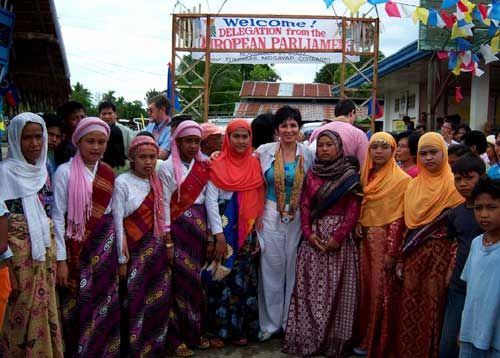
Enhancing maternal health services to selected
underserved sectors in Eastern Visayas through
the Cooperative Enterprise System

The Cooperative Enterprise System is a dynamic platform which
established Social Health Enterprises (SHE) to enhance access
to quality, adequate, and affordable maternal and family health
services (including HIV/AIDS prevention) to vulnerable groups in
remote communities in Eastern Visayas.

Integrating Population, Reproductive Health and Coastal Resources
Management Actions in Tawi-Tawi, Mindanao

This project is implemented by a local NGO, the Kabang Kalikasan ng
Pilipinas Foundation, Inc. (KKPFI), in partnership with the Provincial
Government of Tawi-Tawi, the Tawi-Tawi Marine Research and the
Mindanao State University. The Action contributes to improve the
delivery of basic services to the poor and vulnerable population where
population growth has impact on the coastal and
marine resources.

MODEL Family Planning Services: MObilizing Local Groups in
DELivering and Expanding Family Planning Services to the Poor,
Marginalized, Socially Excluded and Underserved Residents of
San Jose del Monte City, Bulacan

The EU-funded MODEL FP was established by a national NGO, the Family
Planning Organization of the Philippines (FPOP) to help reduce maternal
mortality and morbidity. Barangay Health Workers and the project staff
provide free family planning information and commodities.

    One year after receiving family planning services,
    Judith, a young woman from San Jose Del Monte
    City, stated:

    “I feel so much renewed, rejuvenated, and worry-
    free. I can perform my duties as mother and wife.
    On the side, I sell food stuff for the neighbors and the
    additional income supplements my husband’s salary.
    Life is still hard, but now there is always food on the
    table. There is a little more left for the kids’ schooling.
    This is very different from when I was burdened by
    pregnancy worries. Now, neighbours look at me
    with envious eyes, especially the women who are
    scared of family planning because of so many myths
    and baseless thoughts. I look at them with proud
    eyes, and wishing them to let go of these beliefs that
    shackle them to ignorance and poverty.”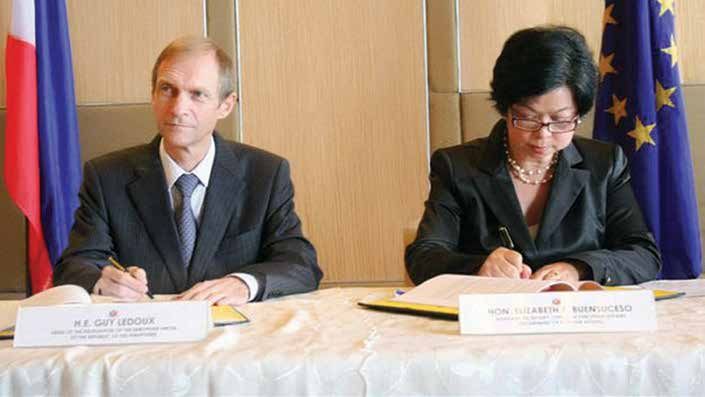
EXPECTED RESULTS

                                                                   The EU and the Philippine government are working together to
                                                                   achieve the following:
THE PHILIPPINE
                                                                   •      Timely implementation of the reconstruction plan
HEALTH SECTOR TODAY                                                       after Typhoon Yolanda
                                                                   •      Improved health service delivery and wider access to health
                                                                          services and essential medicines
The Philippine health sector has seen great improvement            •      Sufficient number of doctors, nurses, and other health
in the last few decades, thanks to programs established by                workers, evenly distributed across the country
the government through the Department of Health (DOH).             •      More Filipinos covered by the National Health Insurance
Within a decentralized health service delivery system,                    System, particularly the poor
                                                                   •      Enhanced capability of government to enforce health
these policies and programs are promoted by the DOH’s
                                                                          regulations to ensure quality of services, medicines,
regional offices called Centers for Health Development
                                                                          and supplies
(CHD) and implemented by the Local Government Units and
                                                                   •      Continued implementation, monitoring and evaluation of
Community Health Teams.
                                                                          policies and reforms for all health programmes
                                                                   •      Improvements in achieving the country’s health-related
The Philippine Health Sector Reform Agenda (HSRA) aims at                 Millennium Development Goals
achieving better health for Filipinos by providing access to a
more responsive health system. In 2010, the Universal Health
                                                                       The “Universal Health Care” (UHC) framework has three strategic thrusts:
Care (UHC) framework, dubbed “Kalusugan Pangkalahatan”
(KP), was launched to address inequities in the health                 1) Financial risk protection through expansion in enrollment and benefit
system. UHC or KP seeks to reach all Filipinos, particularly the          delivery of the National Health Insurance Program (NHIP)
poor, vulnerable and disadvantaged peoples.                            2) Improved access to quality hospitals and health care facilities
                                                                       3) Attainment of health-related Millennium Development Goals (MDGs)

The health sector’s progress is impressive. Nevertheless               The UHC framework integrates and assures nationwide rollout of
disparities in health care delivery prevail and access to              FOURmula One for Health (F1) achievements. F1 was adopted as the
quality care for the poor remains a major challenge.                   implementation framework for the country’s Health Sector Reform
                                                                       Agenda. F1 identified four major pillars: Good Governance, Service
                                                                       Delivery, Health Care Financing, and Regulations.
THE EUROPEAN UNION
Who we are and what we stand for

The EU is a unique, deep economic and political partnership between 28 countries covering much of the European
continent. It is home to 500 million people.

Created in the aftermath of the Second World War, it first pursued economic cooperation inspired by the idea that
countries that trade with one another become economically interdependent and less likely to descend into conflict.
It now covers almost all areas of government from trade and foreign policy to energy and
development cooperation.

Today, the EU is the largest single market in the world, with the euro as the common currency of 18 Member
States. It has delivered half a century of peace, stability, and prosperity and dramatically raised living
standards through a social market model that links economic progress to the protection of the rights of
workers, consumers and the environment.

 Thanks to the abolition of border controls among EU countries, EU citizens can travel freely
 throughout most of the continent to settle, study and work.

 The EU is based on the rule of law. This means that everything that it does is
 founded on treaties, voluntarily and democratically agreed by all member
 countries. The EU remains focused on making its governing institutions more
 transparent and democratic and giving European citizens more channels to
 take part in the political process.

 One of its main goals is to promote human rights both internally
                                                                                                      30/F Tower 2, RCBC Plaza,
 and around the world. Human dignity, freedom, democracy,
                                                                                                             6819 Ayala Avenue
 equality, the rule of law and respect for human rights, are
                                                                                                   Makati City, 1200 Philippines
 core values of the EU.
                                                                                                    Telephone: + 632 859.5100
                                                                                                            Fax: + 632 859.5109
     EU Member States
                                                                                                                        Email:
                                                                                        Delegation-Philippines@eeas.europa.eu
     The 28 member states of EU are Austria,
     Belgium, Bulgaria, Cyprus, Czech Republic,
                                                                                                                      Website:
     Denmark, Estonia, Finland, France, Germany,
                                                                                  http://eeas.europa.eu/delegations/philippines
     Greece, Hungary, Ireland, Italy, Latvia, Lithuania,
     Luxembourg, Malta, Netherlands, Poland,                                                                       Facebook:
     Portugal, Romania, Slovakia, Slovania, Spain,
                                                                                                 EUDelegationToThePhilippines
     Sweden and United Kingdom. On 1 July 2013,
     Croatia joined as the 28th Member State.                                                                           Twitter:
                                                                                                                     EUinthePH

Photo Credits:

EU Delegation to the Philippines
Department of Health (DOH)
Alicia Municipal Health Office (Alicia, Bohol)
Likhaan Center for Women’s Health
Save the Children
UNICEF
You can also read


