COMMUNITY Clean City CLEAN-UP - Toronto District School Board
←
→
Page content transcription
If your browser does not render page correctly, please read the page content below
Clean City

              GUIDE
                      2005
COMMUNITY
 CLEAN-UP
Acknowledgements

Writer: Michèle Martin
Contributors: Richard Christie, Eleanor Dudar, Mieke Foster, Toronto DSB
Editor: Eleanor Dudar, Toronto DSB
Reviewers: Scott Baker, Leaders Today; Bryan Blenkin, Toronto Board of Trade; Richard Bishop, City of Toronto,
Mieke Foster, Toronto DSB; Suzana Greenaway, Toronto DSB; PC Diana Korn-Hassani, Toronto Police Service;
Rose MacDonald, Toronto Catholic DSB; Bruce McKelvey, Toronto Board of Trade; Garry Norman, Leaders Today;
Greg Rogers, Toronto Catholic DSB; Barbara Spyropoulos, Community Police Liaison Committee (12 Division);
Tobin Walsh, Toronto Catholic DSB
Special thanks to Trustee Josh Matlow for his leadership, and to the staff at the following schools for sharing
their community clean-up experiences with us: Jane Bates, Brian P.S.; Judy Campbell, H.A. Halbert Jr. P.S.;
Val Copeland, Malvern C.I.; David Ehrlich, Hodgson Sr. P.S.; Sharon Janes, Swansea P.S.; Suzana Greenaway,
Vaughan Road Academy; Stewart MacSween, Sir Robert L. Borden B.T.I.; Brian McClure, Garden Avenue Jr. P.S.;
Karl Sprogis, North Albion C.I.

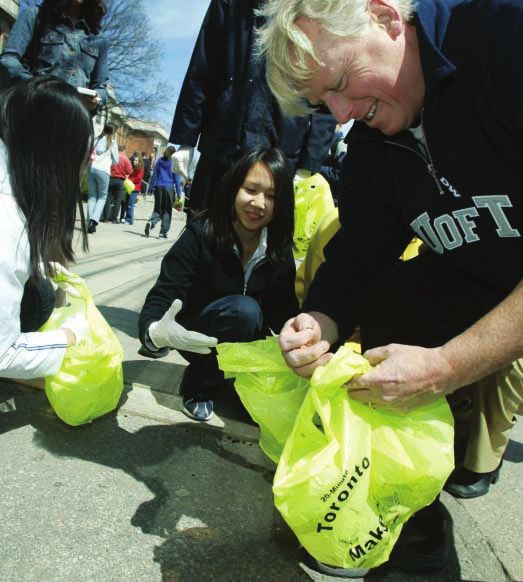
Cover Photo: Peter Power/Toronto Star

The use of the logos courtesy of the City of Toronto, the Clean and Beautiful City initiative, and the
Toronto Board of Trade; the use of the Toronto Police crest courtesy of the Toronto Police Services Board.

Clean City Community Clean-up Guide
© 2005 Toronto District School Board
Reproduction of this document for use in schools within the Toronto District School Board is encouraged.
For anyone other than Toronto District School Board staff, no part of this publication may be reproduced,
stored in a retrieval system, or transmitted in any form or by any other means, electronic, mechanical,
photocopying, recording or otherwise, without permission in writing from the copyright holder:
Toronto District School Board
Library and Learning Resources
3 Tippett Road
Toronto, ON M3H 2V1
Tel: 416-397-2595
Fax: 416-395-8357
Email: curriculumdocs@tdsb.on.ca
Every reasonable precaution has been taken to trace the owners of copyrighted material and to make due
acknowledgement. Any omission will gladly be rectified in future printings.
Designer: Comet art + design
Printer: TDSB Printing Services
Clean City and EcoSchools
TDSB EcoSchools is a comprehensive program that engages staff,
students, and parents in taking leadership and action to help build
a healthy and sustainable future. In addition to providing teaching
resources for elementary and secondary schools, the program provides
guides to reduce the impact of school operations on the environment,
and opportunities for learning and action outside of the classroom.

The Clean City Community Clean-up Guide forms part of the EcoSchools
resource series. It is intended to help TDSB schools plan and implement a
clean-up event, whether it be small or large in scale. Many schools have
organized clean-ups in the past: this guide consolidates lessons learned,
pointing to how a clean-up event can promote youth leadership and
initiate partnerships with the wider community.

Clean-ups can help students develop a sense of pride in their community
and a sense of responsibility for making their environment healthy and safe.
A clean-up event can also introduce participants to the bigger social,
ecological, and safety issues related to garbage and littering. It is our hope
that clean-up events will open the door to other environmental projects and
initiatives in schools.

      For information about EcoSchools, please visit http://ecoschools.tdsb.on.ca

MARCH 2005
On the Web
Register your event on TDSBWeb:
From a TDSB computer
• Go to http://tdsbweb/>Facility Services>Principals>Community Clean-up>
• Select your school, then click on Register a New Community Clean-up Event
• Enter data in each field
• Click Save to submit
To view a sample registration screen, turn to page 27 of this guide.
Download useful clean-up “tools” from http://ecoschools.tdsb.on.ca:
• Certificate to recognize participants
• Insert for your school’s newsletter, and
• Blank action plan template
Visit www.toronto.ca for information about the City of Toronto’s
Clean and Beautiful City program. You will find
• The City’s Five Point Action Plan for making Toronto a clean and beautiful city
• Ways that people can get involved
• Litter tips
• Where to find beauty in the city
• A community news section where neighbourhoods can submit
stories and photos that showcase local efforts
Clean City Community Clean-up Guide 2005Clean City
GUIDE
2005
COMMUNITY
CLEAN-UP
Contents
1. Why is a clean city important? 2
2. What is the Clean City campaign? 5
3. Different approaches to organizing community clean-ups 6
4. Youth leadership and community involvement 8
5. Organizing a community clean-up 9
The five-step process…at a glance
The five steps…in detail
i. Establish a team 10
ii. Conduct a review 11
iii. Develop an action plan 12
iv. Implement the action plan 13
v. Evaluate your results, recognize participants, and celebrate 14
Sample Action Plan 16
6. Safety and equipment 17
7. Connecting with community partners 21
School Board Trustee and City Councillor contacts 23
8. Clean City Toolkit 25
Blank action plan template 26
Instructions for registering your project and submitting feedback 27
Certificate of appreciation for students and community partners 29
Sample school newsletter insert 30
Walking excursion permission form 31
Clean-up participants’ feedback forms 32
Going beyond litter – ideas for further action 33
Tree planting
Creating gardens
Painting murals
Teaching about waste
“We Recycle” poster 35
1 Clean City Community Clean-up Guide 20051 WHY IS A CLEAN CITY IMPORTANT?
Toronto’s leaders support youth involvement in the Clean City campaign
2 Clean City Community Clean-up Guide 2005Greetings to the Toronto District School Board
City Council’s Clean and Beautiful initiative is much more than a superficial clean-up. True, it
begins with the worthy goal of getting rubbish off our streets and out of our parks, but this is only the
first step.
At its heart, Clean and Beautiful reaffirms the City’s commitment to the public realm. It is
meant to give Torontonians new pride in their city. Recently, council approved a five-point action
plan to help us move ahead with Clean and Beautiful. Those five points are: sweep it, design it, build
it, grow it, and celebrate it. These are simple ideas, but they are carrying us forward from clean-up
initiatives, toward our ultimate goal of an architecturally splendid city that we are proud to show off
to the world.
Much of the work around Clean and Beautiful deals with specific details and concrete issues –
how can we keep our public spaces free of litter? What should the new opera house look like? How
can we increase the number of trees on our streets?
Every one of these issues is important, but if Toronto is to be truly clean and beautiful, we
need a to realize a grand vision that encompasses our entire city. We have to continue to celebrate
the diversity of our fabulous neighbourhoods, and at the same time, we have to invest in our public
spaces in ways that give the whole city unity. You should be able to walk down a street anywhere in
the city and have it be an unmistakably Toronto experience. It has to show in the architecture, the
streetscapes, the bus shelters, the recycling bins and a hundred other elements of the public realm.
It all begins with every resident doing their part to clean up our city. This is especially
important for young people, so they can see the value of investing in, and engaging with, their city.
I hope to see as many Torontonians as possible joining in on this project, so that we can all help
transform our city together.
Yours truly,
Mayor David Miller
March 2005
February 14, 2005
Dear Participants to Community Clean-up Day:
For the past few years, students at several schools across the city have taken it upon themselves to organize
Earth Day beautification projects in their communities. This year, I am delighted to see that this endeavour
will spread to all schools in Toronto when students across this city will take part in a variety of projects
during Earth Week 2005 to clean up and generally improve the appearance of their neighbourhoods.
A clean, well cared-for environment sends a clear message that someone cares about that area and they are
willing to protect it. People like to walk in these beautiful neighbourhoods, making them lively, welcoming
places. Those intending to do harm generally stay away from such areas. Thus, removal of litter and graffiti
and other beautification projects are actually very important crime prevention initiatives and help to create a
safe environment for everyone.
Our young people are providing a shining example to the rest of the citizens of Toronto. Their willingness to
be environmentally and socially responsible is outstanding. We are certain that the efforts of these young
stewards will result in safer, more peaceful, and attractive communities.
The Toronto Police Service is proud to stand with our young people in this exceptional project as their
community partner. Members of our Community Response Units, our School Liaison officers, our
Community Police Liaison Committees and our Auxiliary officers will support and assist your efforts in
every way that they can.
We are all very proud of your outstanding efforts.
Yours truly,
Julian Fantino, C.O.M., O.Ont.
Chief of Police
To view these letters in full size, go to http://ecoschools.tdsb.on.ca
3 Clean City Community Clean-up Guide 2005What do we do with the litter?
For small amounts of litter:
• If you have collected up to 5 bags of litter weighing no more than 20 kilograms each,
dispose of the bags in the normal way by placing them at the curb on the school’s
regular pick-up day, or in the bulk garbage bin.
• Off school property, you may be able to use public garbage bins for small amounts
of litter collected. Ensure that it is secured in the bin and cannot blow away.
For large quantities of litter:
• The City of Toronto’s Works and Emergency Services will pick up large quantities
of litter if your event takes place on Friday April 22, 2005 or Saturday April 23, 2005.
To arrange for a special pick-up, call 416-338-0338 by April 15.
A note about recyclables:
• Whenever possible, separating recyclables in good condition from the litter you are
collecting should be an integral part of your community clean-up, particularly if the
clean-up is taking place on school property. The recyclables you collect can be placed
in the school’s recycling boxes or toters.
• When recyclables are soggy, dirty, or decomposing, you should put them with the
non-recyclable garbage.
4 Clean City Community Clean-up Guide 20052 WHAT IS THE CLEAN CITY CAMPAIGN?
All of our students and staff participated in our 20 minute clean-up in 2004. Before our event
the senior students made and put up posters to teach everyone about how to sort waste and
recyclables. Kids from K-4 cleaned up litter on the school grounds while the older kids in grade 5
and 6 went to clean up in a nearby park. Some parents came out to help too. We got all of our
equipment from the school, but were concerned about the amount of garbage produced by the
latex gloves we used – this year we might ask students to bring in gloves from home instead.
We’ll also try to plan our clean-up more in advance!
BRIAN MCCLURE, GRADE 3 TEACHER, GARDEN AVENUE PUBLIC SCHOOL
Years ago, Peter Ustinov famously described other partners to tackle Toronto’s litter problem
Toronto as “New York run by the Swiss,” by developing an effective campaign to educate
and we enjoyed an international reputation and motivate the people and businesses of
as a vibrant and exciting cosmopolitan centre Toronto. After all, it is human behaviour that
with low crime rates, efficient services, and creates litter – only changes in that behaviour
clean streets. Today, Toronto remains one can help to solve the litter problem.
of the world’s great cities, but some of our
Community clean-ups organized by schools
sterling attributes have been slipping. The
and other groups are one facet of the Clean
clearest public example, for visitors and
City campaign. A community clean-up
Torontonians alike, is the litter in our
basically consists of a group of people getting
streets, alleyways, parks, and ravines.
together to clean up and improve an urban or
The loss of Toronto’s reputation as a clean natural area in their community. The clean-
city should be of concern to all residents and up might be anything from a quick “20
businesses, and indeed, Torontonians have minute makeover” or litter pick-up in a
identified litter as one of the top problems school ground, to a huge garbage removal
in the city today. The ugliness of litter effort spanning several days, involving many
undermines our civic pride, leaves tourists community partners and participants, and
with a bad impression, and makes it harder including an array of activities such as
for Toronto to attract and retain the skilled picking up litter and garbage, planting,
workers we need to thrive and prosper. or painting murals.
In 2004, the Toronto Board of Trade The Mayor has set a goal of 50% reduction
created a Clean City Task Force to work in in Toronto’s litter within five years (between
collaboration with the City of Toronto, the 2003 and 2007). Schools can make an
school boards, Business Improvement Areas, and important contribution to achieving this goal.
5 Clean City Community Clean-up Guide 20053 DIFFERENT APPROACHES TO
ORGANIZING COMMUNITY CLEAN-UPS
Our whole school participated in a spring clean-up of the school grounds which went on all
day with classes going out in shifts. We often do fall clean-ups as well. Kids picked up litter,
raked, and did gardening. Everyone picking up litter wore gloves for protection. Student
council representatives from different classrooms helped to organize the clean-up. Morning
announcements throughout the month of April always include readings on the environment.
JANE BATES, PRINCIPAL, BRIAN PUBLIC SCHOOL
Many Toronto schools have organized clean- Location
ups before, and indeed some have been doing • Will the clean-up take place on or off
it as an annual Earth Day or Earth Week school property, or a combination of
event for years. Each school has its own both?
culture, context, and ideas about how to
approach the organization of events such as Timing
clean-ups. This guide describes strategies • Will the clean-up take place on a school
used successfully in the past which we hope day or on a weekend?
will help schools in organizing their own
community clean-up. Here are a number • Will everyone clean up at the same
of factors to consider when planning the time, or will groups go out to clean
approach your school might take: up at different times, spread out over
a day or several days?
Organizers
• Will the clean-up be organized by adults, Duration
students, or a combination of both? • For how long will participants be
cleaning up?
• Will the school EcoTeam, environment
club, environment committee, or youth Participants
leadership group be involved? • Who will be involved in the clean-up –
everyone in the school, interested
• Will the school invite parents, the police,
classes/students only, older students only,
and other community partners
parents, other community partners?
to help organize the event?
6 Clean City Community Clean-up Guide 2005• Can our school act as a hub to There is no one right way to organize a
encourage others in our family of community clean-up. Schools will have
schools to participate? different approaches, and any clean-up
event can be a success as long as students
• Will older students be involved in the
participate, the place looks better, and
same activities as younger students?
everyone is safe. Throughout this guide
you’ll find inspiring stories about the
Activities community clean-ups organised by several
• Will activities focus on litter pick-up TDSB schools in 2004. And these are only
only? a small sample!
• Will the clean-up also include planting
or painting murals?
What is litter?
Litter is any product or material that is lying around on our
highways, parks, beaches, or streets that doesn’t belong there.
Examples of litter include cups, lids, cans, plastic bottles, napkins, cigarette butts,
candy bar wrappers, chip bags, bottle caps…the list goes on! Litter comes from a
variety of sources: it can blow out of full garbage cans or be pulled out by urban
wildlife, fall out of trucks and cars, or be dropped carelessly by any one of us. Litter
does not, however, include leaves, branches, and other natural waste – all of these
belong on the grass or open ground where they can decompose and enrich the soil.
Our school held a community clean-up event on Saturday May 1st, 2004. Leaders Today
partnered with the TDSB, the Toronto Star, Toronto 1, Rona, and Pizza Pizza for this day
and invited schools to participate. Seven schools took part, including Sir John A. Macdonald,
Agincourt, C.W. Jefferys, Kipling, Scarlett Heights, Western Tech, Central Tech and us.
Interested clubs and groups in our school signed up to take care of different activities, such
as cleaning up litter in the school grounds, fixing up the track and field pits, and gardening.
Involving students in the planning and running of events such as this is key to the long-term
impact of developing students’ sense of pride in the school. Our school caretakers were also
fabulous and provided a lot of support for the event.
VAL COPELAND, GUIDANCE TEACHER, MALVERN COLLEGIATE
7 Clean City Community Clean-up Guide 20054 YOUTH LEADERSHIP AND
COMMUNITY INVOLVEMENT
Youth Leadership section on page 21 for more information
Giving students a role in helping to plan about these and other youth leadership
and implement a clean-up event can initiatives.
provide an excellent opportunity to
develop leadership skills. Existing school Community Involvement
environment clubs often take responsibility High school students involved in a
for organizing clean-up events; however, community clean-up event can obtain
there may be other students in the school community involvement credit for work done
also willing and able to get involved. outside of school hours, e.g., helping with
planning the event during lunch break, spare
In elementary schools, older students can periods, and for the clean-up itself if it takes
plan and publicize the event, as well as teach place outside of class time or on a weekend.
the clean-up safety rules to younger students. Obtaining community involvement hours
Older students can also be paired up with might be a significant motivating factor in
their “reading buddy” from younger grades getting students to participate in the clean-
during the clean-up itself. up event. If your event takes place outside of
school hours, make sure that your organizers
Youth Programs have extra copies of the Community
Many secondary schools have a number of Involvement Passport on hand and delegate
youth leadership initiatives already in place, an adult organizer to be the signing
often with the input of external community authority for the event.
partners. Examples include the Empowered
Student Partnerships (ESP) program and For more information, please consult the
SMILE, both supported by the Toronto Police TDSB’s Community Involvement Manual
Service, or “Volunteer Now” and “It’s up to and Community Involvement Passport.
YOUth,” run by Leaders Today. Students who They are both available online (in PDF
are or have been involved in such leadership format) at www.tdsb.on.ca. Click on
initiatives are in an ideal position to organize >Students>Secondary>Community
a clean-up event and help to motivate other Involvement>TDSB Community
students to participate. Check out the Involvement Manual.
“Connecting with Community Partners”
8 Clean City Community Clean-up Guide 20055 ORGANIZING A COMMUNITY CLEAN-UP
The five-step process…at a glance
Step 1
Spread the word to everyone at school
and possible community partners
Hold a start-up meeting
Step 1
Establish
Step 2
Find out what was learned from previous
Team clean-ups
Ste
Review possible clean-up locations
Review resources available in the school
2p
Coneview
lts
aR
or community
5 Your Resue
Evaluat
duct
Organize Find out if, when, and where other local
Step
your community organizations are also holding
Clean-Up clean-ups
Event
3
Ac ev
Step
ur
yo n
la
ti
D
Ste
o
P el n Pl
ion nt 3 Define what you want to accomplish and how
op an
Act leme
p
an
4
Imp
Step
Think about how you will evaluate your success
List resources you need
Include strategies for publicizing your event
Delegate tasks
Get school administration approval
Register online
Step 4
Involve team members
Clean-up your community!
Reward your participants
Step 5
Get your team members together for a party!
Make follow-up recommendations
Provide feedback about your event online
Start planning your next community
clean-up…(and back to Step 1!)
9 Clean City Community Clean-up Guide 2005Step 1
THE FIVE STEPS…in detail
Establish
Team
Ste CoRnedvuiecwt
p 2
lts
a
5 Your Resue
Evaluat
Organize
Step One – Establish Your Clean-Up Team
Step
your
Clean-Up
Event
Ac ev
ur
yo n
la
ti
D
Ste
o
P el n Pl
ion nt 3
op an
Act leme
p
an
4
Imp
Step
Once you’ve decided you want to hold a At your first meeting decide how big an
community clean-up, you’ll need a team to event you want to organize, and brainstorm
plan and oversee the event. Organizing a possible dates and sites for your community
great clean-up event is too much for one clean-up. Find out what people are good
person to do alone! Hold a start-up meeting at doing and start delegating responsibilities
and invite people representing different e.g., publicity, fundraising, equipment,
groups to come: safety, food, rewards, and recognition for
participants.
• students (don’t forget to invite
representatives from the school
environment club, environment committee,
or any youth leadership initiatives)
• teachers and principal
• caretakers and school administrative staff
Tip:
Not everyone will want to be on
• the police
the organizing team, but they might
• parents
like to be involved as participants on
• local community groups and businesses
the clean-up day or as sponsors.
(check out “Connecting with Community
Create a list of everyone interested
Partners” on page 21) in the community clean-up so that
• representatives from other schools you can keep them informed
in your area about the event.
Toronto Police Service
All of Toronto’s schools already work in collaboration with the Toronto Police Service in
a variety of capacities. Your school’s police partners can help you plan your event, identify
hotspots in your community that require a clean-up, connect you with community partners,
advise you on safety issues relevant to clean-ups, and perhaps provide officers to help
supervise your event. Contact your school’s police liaison officer to invite him/her to
become involved in your clean-up event.
10 Clean City Community Clean-up Guide 2005Step 1
Establish
Team
Ste CoRnedvuiecwt
p 2
lts
a
5 Your Resue
Evaluat
Organize
Step Two – Conduct a Review
Step
your
Clean-Up
Event
Ac ev
ur
yo n
la
ti
D
Ste
o
P el n Pl
ion nt 3
op an
Act leme
p
an
4
Imp
Step
Review what was done in any previous risk? You can mitigate some safety risks
clean-up events organized by your school by having older participants work on
to learn from past experience. more difficult sites, or having older
participants lead and supervise small
Which area should we clean up? groups of younger ones. You can also
Check out a few possible sites both on
invite the police to help supervise
and off school property. For a map of
the event.
your school neighbourhood, go to
http://tdsbweb/>Facility Services> • Suitability of site for age of participants and
Vital Systems. size of group – if most of your participants
are young, you might want to stay on
Factors to consider: school property or choose a site close to
• Amount and type of work needed – choose the school that has few safety risks. If
a worthwhile site that will show marked your group will be very large, you will
improvement as a result of your clean-up. want to consider choosing a fairly large
If you wish to broaden your scope, site so that you can keep people busy
consider the potential of the site for work and have maximum impact.
other than just garbage removal. Your
• Location and accessibility – if you do
school liaison police officer or the city
a clean-up off school property on a
parks department might also have an
weekend, choose a site that is easily
idea of hotspots that need a clean-up.
accessible by foot or public transit, and
• Safety of participants – is the clean-up in a location that is in reasonably close
site along busy streets? Are there steep proximity to most of the expected
ravines or water that might pose a safety participants.
Two hundred and fifty students at Sir Robert L. Borden B.T.I. took part in our annual Earth
Week clean-up during the week of May 1-7, 2004. We advertised the clean-up in school
announcements and then interested classes signed up and went out for a period during that
week to go out into our community to clean up. Some classes went off school property to clean
up a churchyard, a park, a fire hall, and a strip mall, and this made a great impression on
members of our community outside of the school. Participating classes were entered in a raffle
and the winners received a pizza lunch.
STEWART MACSWEEN, HEAD OF GUIDANCE, SIR ROBERT BORDEN B.T.I.
11 Clean City Community Clean-up Guide 2005Step 1
Establish
Team
Ste CoRnedvuiecwt
p 2
lts
a
5
Step Three - Develop Your Action Plan
Your Resue
Evaluat
Organize
Step
your
Clean-Up
Event
Ac ev
ur
yo n
la
ti
D
Ste
o
P el n Pl
ion nt 3
op an
Act leme
p
an
4
Imp
Step
Now that you have gathered information the event. Check out the sample action plan
about your community and the resources on page 16 for ideas, and then go to the
available, you need to draw up an action toolkit at the end of this guide, or online
plan. This doesn’t have to be complicated! to http://ecoschools.tdsb.on.ca, for a blank
Basically, you need a plan so that your whole action plan template.
team is clear about the objectives you are
trying to achieve, the actions you need to Indicators of Success
take to meet those objectives, who will do It’s a good idea at the action planning stage
the tasks, and when – simple! to think about how you will measure your
success. Once your event is finished, you’re
Define your objective(s) –
going to want to be able to tell people what
a good starting point
you have accomplished – on your website,
What exactly does your team want to in the school newspaper, and/or through the
accomplish by doing a community clean-up? local media. List the indicators of success for
You might have more than one objective. each action in your plan, and don’t forget to
Here are some examples: collect this information on the day of your
• Collect and dispose of all litter from the clean-up!
following streets: Baine, Withrow, Riverdale
Here are a few examples of success indicators:
• Clean up and sort all litter and other garbage
• Number and types of participants, e.g., students,
in Gracedale Park
staff, parents, community partners
• Collect, sort, and dispose of all litter from school
• Amount of garbage and recyclables collected (can
property
be measured by counting, and if possible,
• Discourage graffiti by creating a mural
weighing the bags)
• Discourage school littering
• Number of streets/total approximate
• Create a butterfly garden to enhance pride
area cleaned up
of place
• Amount of time spent/number of students
• Demonstrate to community that students
collecting litter
are responsible citizens
• Other activities accomplished, e.g., 4m2 butterfly
garden created, murals painted
Once you know what your objectives are, you
on panels, etc.
need to decide what actions you will take to
• Impact of clean-up activity on participants/
accomplish them, before, during and after
school/community
12 Clean City Community Clean-up Guide 2005Registering your clean-up event
If you want your school’s community clean-up to be considered
part of the 2005 spring Clean City campaign, it should take place
between Monday April 18th and Saturday May 28th, 2005. To register your clean-up,
complete the TDSB online registration form three weeks before your event. Please see
page 27 for instructions on registering your event online.
Step 1
Establish
Team
Ste CoRnedvuiecwt
p 2
lts
a
Step Four – Implement the Action Plan
5 Your Resue
Evaluat
Organize
Step
your
Clean-Up
Event
Ac ev
ur
yo n
la
ti
D
Ste
o
P el n Pl
ion nt 3
op an
Act leme
p
an
4
Imp
Step
Branch out responsibilities for getting your clean-up
• Organize other activities to help event organized and implemented. If you
clean up and improve your school are undertaking a large clean-up, the team
or community, such as tree planting, might need to meet a few times before the
gardening, mural painting, etc. event to make sure that everything is on
target, and that everyone is up to date. Keep
Before the event brief notes of these meetings, and send them
At this stage, everyone on your team should out to anyone who could not attend to ensure
have been assigned specific roles and that everyone knows what’s going on.
On the big day! • Set up a first aid station and an
You want to make sure your clean-up event equipment station, and designate
goes smoothly, and one of the best ways of garbage drop-off areas.
achieving this goal is to be well organized.
• Have participants work in teams (e.g.,
Here are a few ways to avoid chaos:
a class, club or other group) and assign
• Create a master plan showing where and each team to a different clean-up area
when each team will be working, and or activity.
what they will be doing. Consider
• Assign a leader to each team who can
making a large copy and posting it in a
distribute gloves and garbage bags, and
busy part of the school so that everyone
who knows where the garbage is to be
can see what is happening. Use a map!
taken and where the first aid station
• Designate one person as the main event is located.
coordinator. This person should know
exactly what is in the master plan.
13 Clean City Community Clean-up Guide 2005Step 1
Establish
Team
Ste CoRnedvuiecwt
p 2 Step Five – Evaluate Your Results and Celebrate!
lts
a
5 Your Resue
Evaluat
Organize
Step
your
Clean-Up
Event
Ac ev
ur
yo n
la
ti
D
Ste
o
P el n Pl
ion nt 3
op an
Act leme
p
an
4
Imp
Step
Once you have completed your clean-up event, Certificate of Appreciation for
get your team back together to see what you students and community partners
did well, and what could have been done While your school will receive one
better. Have some treats on hand to entice Certificate of Participation from the Mayor
people and create a celebratory atmosphere! to acknowledge your contribution to the
Fill in the results section of the action plan, Clean City campaign, your school may also
and make a list of recommendations for the wish to issue its own Certificates of Appreciation
next clean-up event. to recognize the contributions of individual
participants, classes or community partners.
Consider collecting information about the
impact of the event on the participants A certificate template is provided in the guide’s
themselves to use in the school newsletter, toolkit on page 29, and is also available online
website or in a display – also very useful at http://ecoschools.tdsb.on.ca. You can
when you go online to provide feedback! insert your school logo and make changes
This could be done by giving participants to the text to make this certificate specific
a feedback form to complete, either at the to your event.
event or soon afterwards. For sample forms
see page 32 in the toolkit section, or
on-line at http://ecoschools.tdsb.on.ca.
Submit feedback about
your clean-up event!
Now is the time to go back to the online registration system and send in your
feedback – who participated, how it went, what you did. Feedback should be
submitted by Monday May 30th (see the toolkit, page 28).
Once you submit your feedback you’ll receive a Certificate of Participation for your
school from the Mayor. Information about your event may be shared publicly.
14 Clean City Community Clean-up Guide 2005PRACTICAL TIPS FROM THE PROS!
Here are a few tips to consider while • Have a party for participants – ask
putting together your action plan, community partners to donate healthy
gathered from the experiences of drinks or snacks (try to avoid turning
organizers of previous school this into a garbage-producing party!)
community clean-ups:
• Hold a draw for participating classes
and give the winning class a pizza lunch
Prepare your participants
or other prize
• Obtain the equipment your participants
will need for a successful clean-up (and
be sure that each piece is clearly labelled
Celebrate your accomplishments
• Give individual participants or
for easy return)
participating classes a certificate
• Communicate safety rules every day during acknowledging their contribution
the week leading up to your event
• Invite the media to cover your event,
• Delegate different clean-up areas to particularly the local community paper
classes or teams to cover more ground
• Include a story about your community
clean-up in the school newspaper or
Make it fun!
on the school website
• Give raffle prizes (donated by community
partners) to participants
Every morning during the week leading up to our clean-up event in the school yard, grade two
students reviewed safety rules on the announcements. It worked well at our school to just ask
each class to go out for 20 minutes when it was convenient, rather than make up a schedule.
Letting students take leadership where possible was a successful strategy. The kids participated
with enthusiasm and the school grounds showed a real improvement! The students recognized
that a lot of garbage was present in our school yard, and they could see that, in many cases, it
was litter that they had created.
JUDY CAMPBELL, VICE PRINCIPAL, H.A. HALBERT JR. PUBLIC SCHOOL
15 Clean City Community Clean-up Guide 2005SAMPLE ACTION PLAN - Community Clean-up
Objective (s) Actions Indicators Resources When Results
of Success (human, material, $) (How did we do?)
Clean up and sort 1. Register event & publicize • participants • team members • register 3 weeks • clean-up registered online
all litter and other • register online • involvement • school administration before event • 1 article in community paper
16
garbage on school • create flyer, publicity materials of community • media list • flyers, media release • 50 flyers posted
property and • distribute flyers in school & community partners outside • sample media release 2 weeks before • PA announcements every day
Gracedale Park • send out media release school • permission & PA for 1 week
• send permission forms home 1 week before
• make announcements on PA
2. Organize equipment • equipment organized • school team members • pick up 1 week • no cloth gloves available - used latex
• check equipment available in school and well distributed • parent volunteers before event supply from school, one
• purchase needed equipment • canvas gloves, bags, • deliver to drop-off per participant
• organize into bundles for teams recycling boxes and toters point morning of • used school garbage bags/
• containers for hazardous waste April 22nd recycling boxes
and sharps
3. Fundraise • 10 raffle prizes • team and team leaders • Fri. April 15th • pizza lunch donated by pizza shop
• obtain donations, raffle prizes, secured • school stationery • 20 raffle prizes obtained and awarded
Clean City Community Clean-up Guide 2005
team prizes, and reusable gloves • 1 pizza lunch donated
• personal visits to local businesses
4. Train team leaders • no incidents – • team • Wed. April 20th • training session held
• select students to be team leaders everyone safe • older students • environment club formed after event
• visit site & assign areas (team leaders) by participants
• go over equipment & sorting rules • clean-up equipment
• establish safety guidelines
5. Clean-up day • amount of garbage • everyone in school • Fri. April 22nd • 43 bags of garbage collected, incl. 10
• divide participants into teams collected • parents bags recyclables, from school ground,
• collect & sort litter • recyclables sorted • community partners local park and
• leave garbage at drop-off points • total area covered • used grocery bags for smaller 2 streets
for city to collect students
• large bags for garbage and recyclables
6. Follow-up • garbage removed • team members • Fri. April 29th • certificates to all participating classes
• thank you letters to community partners promptly • raffle prizes • thank you letters sent 1 week later
• rewards & prizes for participants • thank you letters done • other prizes • pizza lunch won by Room 5
• submit feedback online • certificates distributed • certificates • feedback submitted
A blank action plan template can be found in the guide’s toolkit section on page 26, or online at http://ecoschools.tdsb.on.ca6 SAFETY AND EQUIPMENT
Undeniably, the first concern of many • Contact the rail police ahead of time if
schools interested in organizing a you are planning to conduct a clean-up
community clean-up is the safety of on rail lands. See “Connecting with
their participants. By following these Community Partners” on page 21.
safety guidelines and obtaining some basic
clean-up equipment, you should be able Safety – during your event
to organize a safe and successful clean-up
• Provide at least one glove for each
event involving students from kindergarten
student. For community clean-ups
through high school.
in ravines or heavily vegetated areas,
reusable cloth gloves will provide
Safety – before your event
more protection.
• Plan ahead to ensure that there is
• Make certain that students do not touch
sufficient adult supervision of the
any dangerous materials (such as broken
students involved in picking up litter
glass, needles, sharp objects, and used
and other garbage. Parents and
condoms).
volunteers could be invited to help
teachers supervise students. • If dangerous or suspicious items are
found, mark the location using a pylon
• Arrange for the caretaker to look for and
or hula hoop so that the caretaker or
safely remove dangerous items on the
another adult can find and safely
school grounds before a clean-up is
remove them.
done. Other adults can help with this
off school property.
• Use school announcements to review
safety guidelines during the week
Tip:
preceding your clean-up event. Consider involving the police officer
affiliated with your school – he/she
• Include information about safety in any can help you address safety in the
newsletter articles or other publicity planning stages as well as provide
inviting people to participate in your support at your actual clean-up event.
clean-up event.
17 Clean City Community Clean-up Guide 2005Safety – during your event…cont’d.
• Extra care should be taken around shrubs Permission forms
because dangerous materials are more
• Parents of the students involved should
difficult to spot in these locations.
be asked to sign standard school board
• Students should work in teams permission forms stating that they
supervised by an adult, and always support their children participating in
remain in a group, particularly in the clean-up activity, whether it takes
densely vegetated areas. place on a school day or the weekend.
Look for the sample permission form
• Keep younger children away from on page 31.
the edges of ponds or creeks.
• Have a first aid station, and ensure that Equipment
all team leaders know where it is and who You’re going to need some basic equipment
to contact in case a problem does arise. for your community clean-up, most of which
is already in the school. Here are a few ideas
• For clean-ups off school property, someone
to consider:
should have a cell phone handy in case of
emergencies. Essential Equipment
Garbage bags:
Safety – after your event • Used grocery bags – ask students to
• All participants should wash their hands bring these in from home prior to the
afterwards. If your community clean-up clean-up event. Used bags are ideal
event is off school property, plan ahead for participants to use for collecting
for hand washing, particularly if you litter, especially younger children. Use
are having refreshments. If public separate bags for collecting reasonably
washrooms are nearby, coordinate with clean recyclable container products.
the owner or city parks department to
• Large garbage bags – the school
arrange for them to be open/available
caretaker may be able to supply these.
to participants. Alternatively, you could
Have several large bags available and ask
bring along a portable water dispenser,
students to dump the contents of their
soap and towels, or hand disinfectant.
grocery bags in them.
• Make sure that all garbage is put in
• Recycling containers – designate students
school bulk bins, stored away, or picked
to collect recyclable container products
up promptly following your event to
that are reasonably clean and put these
avoid the possibility of garbage being
in the school’s blue boxes or blue toters.
re-strewn around the cleaned up area
For a list of which container products
by raccoons or other animals.
are recyclable, please see recycling poster
on page 35.
18 Clean City Community Clean-up Guide 2005Gloves wagon may be helpful to carry supplies
• One glove per student should be to and litter from the clean-up location.
adequate, unless you’re doing a major
Rubber boots
clean-up of a ravine or park and dealing
• If your community clean-up is in a wet
with more than litter.
or muddy area, encourage participants to
• The school should be able to provide wear rubber boots or old shoes.
latex gloves from their own supply.
Rakes and brooms
• If you are planning to make clean-ups • Rakes and brooms come in handy for
an annual event and are concerned about collecting litter in grassy or paved
creating more garbage with latex gloves, areas and tidying up gardens.
ask a community partner to sponsor
• Ask students to bring them in from
reusable cloth gloves. You’ll need to
home (with names on the handle!).
collect them and find a volunteer to wash
them all when your clean-up is over!
Litter grabbers
• Or, ask students to bring in their own • If your school does a lot of clean-ups, and
gloves from home (clearly marked with your students are K-6, you may consider
their names). investing in a set of “litter grabbers” or
“reachers,” which have a pincer on the
Sensible clothing end to grasp items (often used by seniors)
• Participants should be warned that and can be ordered through a pharmacy.
cleaning up garbage can be messy! Try to find a community partner who
The community clean-up is not the best will help cover the cost.
occasion to show off a favourite new
Hip waders
fashion item - older clothes and sensible
• If your participants are in high school
shoes with strong soles are ideal.
and your community clean-up involves
• Long sleeves and pants are recommended a wet area, you may consider having a
for clean-ups around bushes and shrubs. few pairs of hip waders on hand. You
may be able to borrow these from a
Extra Equipment college or university, or a company that
Shopping cart or child’s wagon does environmental impact assessments.
• If you are working away from the school
grounds, a shopping cart or child’s
19 Clean City Community Clean-up Guide 2005Our school organized a 20 minute clean-up, and all classes went over safety rules prior to the
event. All of our 700 students went out at the same time collecting litter around our school in
the field and on the sloping wooded areas where they play. We sent a letter home in advance
informing parents about the clean-up and inviting them to participate, and quite a few of them
came. It felt great being part of a big clean-up event happening all over the city. The clean-up
made a big impact on the students – several of them kept collecting litter in the playground on
their own for several days afterwards.
SHARON JANES, VICE-PRINCIPAL, SWANSEA PUBLIC SCHOOL
On behalf of the environment and community, about a dozen students, 4 teaching staff, a Vice-
Principal and the Principal participated in our community clean-up of Smithfield Park behind
Smithfield Middle School on Saturday April 24th, 2004. Supplies and equipment for the clean-
up were supplied by Councillor Hall. ‘Never have so few collected so much for the benefit of the
many.’ Mother Nature would have been proud! A large pile of full garbage bags was produced,
several shopping carts were pulled from the stream, a number of mattresses and bed frames,
various forms of scrap metal, a couple of bicycle frames, a couple of cans of paint, 3 car
batteries, large amounts of plastic sheeting. This is the pile of litter that my team was working
on: there were others that I did not see! Despite the list above, there was still a large amount
of debris left that the students had not a chance of moving, e.g., discarded sofas, or could not
access because some of it was lying in the creek bed and hard to dislodge because of silting.
KARL SPROGIS, PRINCIPAL, NORTH ALBION COLLEGIATE
20 Clean City Community Clean-up Guide 20057 CONNECTING WITH COMMUNITY PARTNERS
Your school might be interested in Community Police Liaison
organizing your clean-up in collaboration Committees (CPLC)
with other partners in the community. Secondary schools should get in touch
Following is a list of community partners with the Police and Community Liaison
to consider. This list is just the beginning – Committee (CPLC) in their Division to enlist
there are many other potential partners in the assistance of that unit’s officers. CPLCs
the community that might be interested are active in all Divisions across the city
in helping with your school’s clean-up and can help schools connect with many
event, such as local environmental groups, community partners. The contact number
residents’ associations, faith communities. is 1-808-(Division number)00. Ask for the
Community Response Staff Sargeant.
School Trustees
Your school trustee can help you publicize Rail Police
your clean-up event, and may be interested If rail lands are to be targeted, the
in participating. Check the table on page 23 appropriate rail police must be notified.
for the trustee in your ward. They will provide assistance in ensuring
protection for students working on the rail
Parents lands. The contact for CP Police is Ron
Invite parents to get involved in your clean- Morrison, Community Services Unit, CPR
up – they can help with planning the event Police Service, Toronto, 416-696-6601
and supervising groups of students as well (office), 416-600-4337 (pager), e-mail:
as helping to clean up. Some of them might ron_morrison@cpr.ca. CN Rail can be
also be able to help with equipment or reached through Constable Matthew
supplies. Davidson, CN Police, 905-815-0312 (office)
or 1-800-465-9239 (24hr).
City Councillors
Let your city councillor know about your
clean-up event – he or she may be able to
help you connect with community groups,
help publicize your event, and even be
interested in participating!
21 Clean City Community Clean-up Guide 2005Empowered Student Business Improvement Areas
Partnerships (ESP) Toronto currently has about 50 “Business
ESP is a Toronto Police Service initiative Improvement Areas” or BIAs. A BIA is
in partnership with the school boards of an association of business people within a
Toronto, the Canadian Safe School Network, particular part of the city who are working
ProAction Cops and Kids, and other together, with official approval of the City,
partners. Many Toronto high schools have on a self-help program aimed at stimulating
an ESP group – these students and the local business. Their goal is to draw more
associated police officer can help your school prospective customers to their area by
put together a safe and successful clean-up improving the attractiveness of the area
event. Find out more about ESP: and promoting it as a good place to shop,
www.esponline.ca visit, and do business. Litter is one of their
concerns, so it is worth checking to see if
Students and Staff Maximizing your school falls within an existing BIA.
Intercommunity Leadership If so, contact it about potential partnership
Experiences (SMILE) for your event. Visit www.toronto-bia.com
Middle school and secondary students who for maps and contact details.
have participated in the Toronto Police
Service’s SMILE camp may be interested Local Businesses
in applying their leadership skills to help Invite local businesses to sponsor equipment,
organize a community clean-up. raffle prizes, or refreshments and invite
employees to participate.
Leaders Today
Leaders Today is a non-profit organization
that provides and supports youth leadership
and volunteer initiatives in many of Toronto’s
high schools. Their programs include
Tip:
Create a photo display of your
“Volunteer Now” and “It’s up to YOUth.”
community clean-up and put it up
Participating students are in an ideal
in a prominent spot in the school or
position to organize and coordinate
community, e.g., the library, a busy
a school community clean-up. Check out
bank, or a business run by one of
their website for contact information your community partners.
and details on how to get Leaders
Today involved at your school:
www.leaderstoday.com
22 Clean City Community Clean-up Guide 2005School Board Trustee and City Councillor Contacts 2005
Check the table below for your locally elected representatives. If you’re not sure which ward
your school is in, you can find out by visiting http://app.toronto.ca/wards/jsp/wards.jsp
To contact your trustee, call 416-397-3061. To contact your city councillor, call 416-338-0338.
WARD TRUSTEE COUNCILLOR
1 Suzan Hall
Etobicoke North 1 Stan Nemiroff 2 Rob Ford
3 Doug Holyday
Etobicoke Centre 2 John Campbell 4 Gloria Lindsay Luby
5 Peter Milczyn
Etobicoke-Lakeshore 3 Bruce Davis 6 Mark Grimes
7 Giorgio Mammoliti
York West 4 Stephnie Payne 8 Peter Li Preti
9 Maria Augimeri
York Centre 5 Sheine Mankovsky 10 Mike Feldman
11 Frances Nunziata
York South-Weston 6 Elizabeth Hill 12 Frank Di Giorgio
13 Bill Saundercook
Parkdale-High Park 7 Irene Atkinson 14 Sylvia Watson
15 Howard Moscoe
Eglinton-Lawrence 8 Howard Goodman 16 Karen Stintz
17 Cesar Palacio
Davenport 9 Maria Rodrigues 18 Adam Giambrone
19 Joe Pantalone
Trinity-Spadina 10 Chris Bolton 20 Olivia Chow
21 Joe Mihevc
St. Paul’s 11 Josh Matlow 22 Michael Walker
23 John Filion
Willowdale 12 Mari Rutka 24 David Shiner
25 Cliff Jenkins
Don Valley West 13 Gerri Gershon 26 Jane Pitfield
27 Kyle Rae
Toronto Centre-Rosedale 14 Sheila Ward 28 Pam McConnell
29 Case Ootes
Toronto-Danforth 15 Rick Telfer 30 Paula Fletcher
31 Janet Davis
Beaches-East York 16 Sheila Cary-Meagher 32 Sandra Bussin
33 Shelley Carroll
Don Valley East 17 Michael Coteau 34 Denzil Minnan-Wong
35 Gerry Altobello
Scarborough Southwest 18 Gary Crawford 36 Brian Ashton
37 Michael Thompson
Scarborough Centre 19 Scott Harrison 38 Glenn De Baeremaeker
39 Mike Del Grande
Scarborough-Agincourt 20 David Shory 40 Norm Kelly
41 Bas Balkissoon
Scarborough-Rouge River 21 Noah Ng 42 Raymond Cho
43 David Soknacki
Scarborough East 22 Patrick Rutledge 44 Gay Cowbourne
School Trustee ward numbers City Councillor ward numbers
23 Clean City Community Clean-up Guide 2005In 2002, York Memorial Collegiate Institute, 12 Division Toronto Police Service, and the
Community Police Liaison Committee of 12 Division initiated a community clean-up in
conjunction with their family of schools and community partners. In 2003, these original
6 were joined by an additional 7 area schools. As well as gathering up litter and removing
graffiti, students painted a mural at the gateway to the Eglinton Hill community, and planted
beautiful gardens throughout the area.
In 2004, 22 schools* participated in our massive community clean-up event, held from 9am
to 12 noon on Earth Day (Thursday April 22nd). Over 3500 square feet of inappropriate
graffiti were removed by York Memorial C.I. students alone. Collectively, the 22 schools had
approximately 7000 participants including students, staff, residents, and business partners,
and managed to fill 3/4 of a garbage truck. According to our contact at the City’s Works
and Emergency Service department that adds up to approximately 8 tons (16000 lbs.) of
garbage!!!!! In addition, 14 - 4’x 8’ panels of art work were created by York Memorial students
and donated to CN/CP for embellishing an underpass. Ten of the 22 schools also organized
activities to beautify their school grounds - planting trees, shrubs, flowers. Each school was
given a tree and $100 by ProAction towards the purchase of “greens.” Terrific work by all!
SUZANA GREENAWAY, PRINCIPAL, VAUGHAN ROAD ACADEMY
* Briar Hill Junior Public School Portage Trail Community School
Cordella Junior Public School Portage Trail Middle School
C.R. Marchant Middle School Rockcliffe Middle School
Downsview Junior Public School Roselands Junior Public School
George Harvey Collegiate Institute Silverthorn Junior Public School
Harwood Junior Public School Tumpane Community School
Kane Middle School Vaughan Road Academy
Keelesdale Junior Public School Webster Junior Public School
Lambton Park Community School Weston Collegiate Institute
Pierre Laporte Middle School York Humber High School
Lawrence Heights Middle School York Memorial Collegiate Institute
24 Clean City Community Clean-up Guide 20058 CLEAN CITY TOOLKIT
Blank community clean-up action plan template* 26
Instructions for registering your project and submitting feedback 27
Certificate of Appreciation template (for students and community partners)* 29
Sample school newsletter insert* 30
Walking excursion permission form* 31
Clean-up participants’ feedback form* 32
Going beyond litter – ideas for further action 33
Tree planting
Creating gardens
Painting murals
Teaching about waste
“We Recycle” Poster 35
* Also available at http://ecoschools.tdsb.on.ca
25 Clean City Community Clean-up Guide 2005COMMUNITY CLEAN-UP ACTION PLAN TEMPLATE
Objective (s) Actions Indicators Resources When Results
of Success (human, material, $) (How did we do?)
26
Clean City Community Clean-up Guide 2005
Also available at http://www.ecoschools.tdsb.on.caINSTRUCTIONS FOR REGISTERING
YOUR CLEAN-UP BEFORE THE EVENT
To register:
• go to http://tdsbweb/>Facility Services>Principals>Community Clean-up
• select your school, then click on Register a New Community Clean-up Event
• enter data in each field
• click Save to submit
Here is what the registration screen will look like:
27 Clean City Community Clean-up Guide 2005INSTRUCTIONS FOR SUBMITTING
FEEDBACK AFTER THE EVENT
To provide feedback:
• go to http://tdsbweb/>Facility Services>Principals>Community Clean-up
• select your school, then click on Feedback on your Community Clean-up Event
You will need to register your clean-up event before you can provide your feedback.
• enter data in each field
• click Save to submit
Here is what the feedback screen will look like:
28 Clean City Community Clean-up Guide 2005You can also read


