Community Clinic Association of Los Angeles County March 23, 2021 - Population health management strategies to improve cardiovascular and diabetic ...
←
→
Page content transcription
If your browser does not render page correctly, please read the page content below
Population health management strategies
       to improve cardiovascular and diabetic
                  health outcomes.

    Community Clinic Association of Los Angeles
                     County

                      March 23, 2021

Team Members: Matt Moyer, Vipra Bhakri, Amy Kim, Gerardo Cruz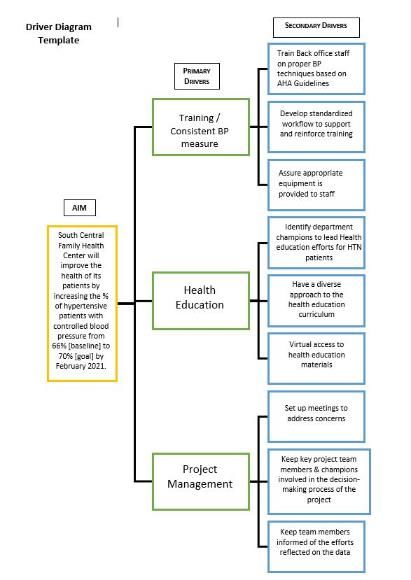
WHAT WERE WE TRYING TO ACCOMPLISH?
                                                           Problem Statement
Member clinics underperforming on Centers for Medicare & Medicaid Services (CMMS)
chronic disease management measures related to Diabetes (Baseline: 32.7%) and
Hypertension (Baseline: 60.9%).
                                   Aim Statement

   Health Center Name                                                         Project Aim*

Watts Healthcare                        Decrease by 5% from 2018 baseline of 38% to 33% the number of Diabetic patients with
Corporation                             HbA1c>9 by utilizing a clinical pharmacist by March 31, 2021.

ParkTree Community                      By March 2021, Lower Average HbA1c by 1% for 25% Uncontrolled Diabetic patients at
Health Center                           our Archibald site via enrollment into Diabetes Clinic.

East Valley Community                   Improve the health of our hypertensive patients by increasing controlled blood pressure
Health Center                           measures from 62% to 72% by the end of January 2021.

South Central Family                    Improve the health of our patients by increasing the percent of hypertensive patients
Health Center (SCFHC)                   with controlled blood pressure from baseline: 64% to 70% by June 2021.

The Children's Clinic                   Improve on HbA1c scores for diabetic patients for our provider at one of our school-
(TCC Family Health)                     based clinics.

 *Aims of the project were modified for the 5 HC's due to COVID-19 in 2020.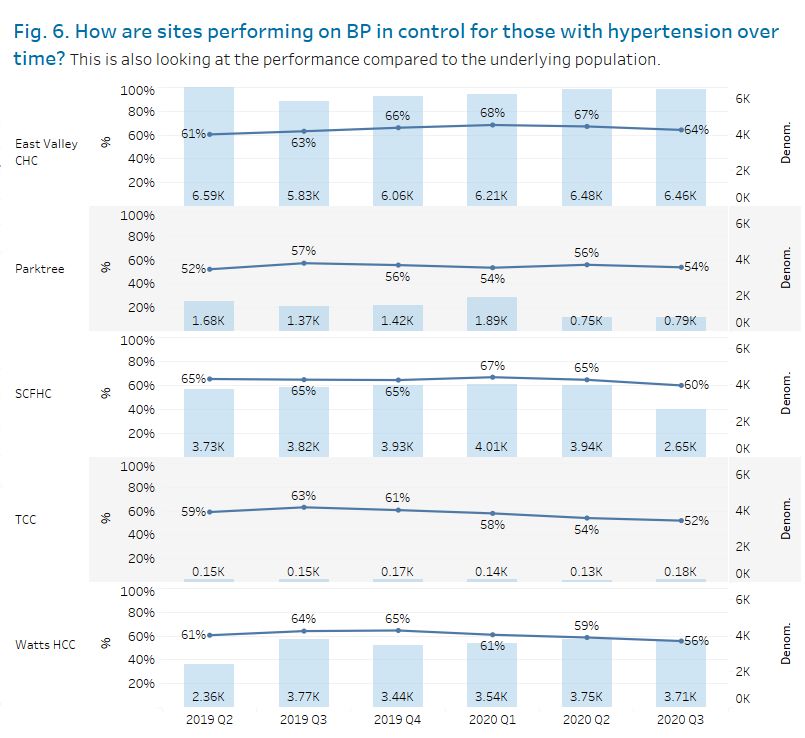
WHAT CHANGES DID WE MAKE THAT RESULTED IN IMPROVEMENT?
      Our Theories for Change: How We Learned About Our Process

CCALAC worked with 5-member health centers to develop
their focus areas by:
• Administering clinic assessments to identify key drivers
• Defining project charters, including aims and drivers
    • Refining charter and driver diagrams as the
       program progressed
• Defining processes to shadow on-site visits
• Understanding the current state of clinical processes through
  staff shadowing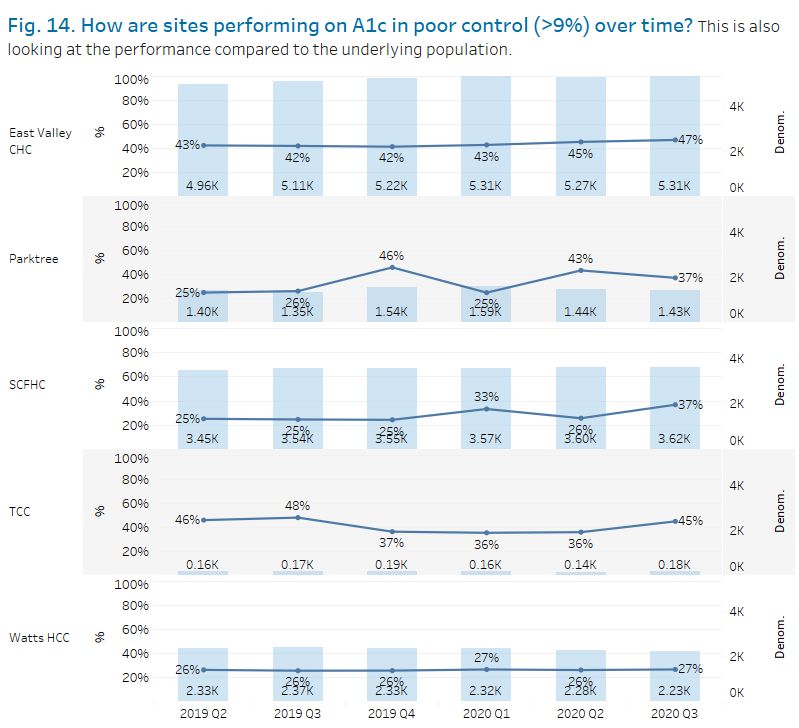
WHAT CHANGES DID WE MAKE THAT RESULTED IN IMPROVEMENT?
                      Our Theories for Change: How We Learned About Our Process

                        Organizational Driver Diagram: East Valley Community Health Center

                                      Primary Drivers           Secondary Drivers            Change Ideas

                                                                     Diet/Weight
                                                                     Management
                                     Team-Based Care

                                                                 Stress Management            Educational
                                                                 (Behavioral Health)           Messages

                                                                System Alerts regarding
  Will improve the health of our                                      Care Gaps
    hypertensive patients by
   increasing controlled blood        Data Systems
pressure control from 62% to 72%
   by the end of January 2021                                     Appointment &/or
                                                                 Medication Reminder

                                                                  Self Monitor Blood
                                                                   Pressure (SMBP)            Workflows
                                      Patient Self-
                                      Management

                                                                  Case Management
WHAT CHANGES DID WE MAKE THAT RESULTED IN IMPROVEMENT?
Our Theories for Change: How We Learned About Our Process
Organizational Driver Diagram: South Central Family Health CenterProcess Flow Map: East Valley Community Health Center – SMBP Pilot Project
Start
Navigator (PCN) / QI
Patient Care PCN schedules
PCN will inform PCN will reach out
patient for Blood After 1 week,
Patient Care
Navigator [1] WC Back Office to patient to QI will provide
Pressure (BP) Lead (Cyndy) or PO PCN will
confirm they’ve results to
(PCN) recruits Check with SMBP QI Dept will
Dept
Admin Assistant
patients from Trainer (Gaby) &
received materials obtain
analyze results patients’ Care
End
[2] SMBP Trainers of and they patients’ BP
“TC3 BP Check”
list made by (Mon-Fri before 3 TC3 BP Appointments understand to take team
for iPad reservation BP for 1 week numbers
providers PM)
After visit, SMBP
SMBP Trainer takes Trainer will scan
SMBP Trainer will SMBP Trainer SMBP Trainer
patient’s Blood Patient
pick up iPad on TC3 SMBP Trainer SMBP Trainer Pressure (BP) with records
SMBP Trainer SMBP Trainer gives patient Agreement forms
BP Check days SMBP Trainer has patient shows patient clinic BP monitor. patient’s BP on to QI Analyst
from WC Back (RN) calls start timing TC3 packet SMBP Trainer
Patient
gives overview sign Patient video on how performs Accuracy (Faustine Tay) &
Office Lead patient to visit with and SMBP Agreement
(Cyndy) or PO of TC3 & SMBP Agreement to SMBP (3m test (refer to PCN (Violet
device
SMBP Trainer (RN)
Admin Assistant
triage room patient handout) form Estrada)
45s) & Interoffice mail
(Gaby)
to Violet/Faustine
(PO)
SMBP Trainer
SMBP Trainer will SMBP Trainer
SMBP Trainer overviews give patient AHA stops time for
SMBP Trainer Follow TC3-
instructs patient to what is in the contact info if they patient visit and
shows patient measure BP 2x in the have any SMBP Nurse
morning and evening packet records on bottom
how to record questions while right-hand corner Visit
for 7 days. Inform PCN *Highlight
BP on log will reach out to they’re taking of Patient Documentatio
patient to collect BP blue SMBP their BP at home Agreement Form
numbers guide n Guidelines
Patient Patient records
their blood
teaches back pressure on
Patient checks
Patient
to SMBP “Control Your Patient asks Patient leaves
in with front clinic
trainer to Blood Pressure” questions
desk (colorful) handout
gauge
understanding
Front Desk
Front desk
marks BP
Check Appt as
KEPT
SMBP Pilot Project Process MapWHAT CHANGES DID WE MAKE THAT RESULTED IN IMPROVEMENT?
Process Flow Map: ParkTree Community Health Center - Diabetes Clinic Workflow
High Level
Team based
workflow for
approach at the
Diabetes
Diabetes Clinic
ClinicWHAT CHANGES DID WE MAKE THAT RESULTED IN IMPROVEMENT?
Process for Selecting Test Ideas
How We Engaged the Patient
“Voice of the Customer”
• East Valley Community Health Center:
• Administered post-PDSA survey for our SMBP training
• “Todos fueron amables conmigo” (Translation: "Everyone was nice to me")
• Contacted two patients over the phone before we started our hypertensive text messaging campaign
to get their feedback (ex. How do they feel about a text messaging program?; What kind of content
would they be interested in reading?)
• Allowed patients to respond via text messages
• We contacted patients over the phone after our SMBP pilot and provided a hypertensive text message
campaign to get patient feedback
How We Engaged Leaders, Providers, and Staff at our 5 Health Centers
• Initial Phase: Administered clinic assessments to identify key drivers •Defined charters, including aims and
drivers• Defined processes to shadow on-site visits •Built our learning community •Shared best practices
•Understood current state of clinical processes though shadowing
• Created a CMO/Clinical champion work group for the TC3 program
• Held Bi-weekly and/or Monthly check-ins with health center leads to discuss project updates
• Shared best practice examples at the 2020 Quality Improvement SummitWHAT CHANGES DID WE MAKE THAT RESULTED IN IMPROVEMENT?
Changes We Tested
Adopted,
Org Change Idea
Summary of PDSAs Adapted,
Tested
Abandon?
Watts Healthcare Decrease by 5% from 2018 baseline of 38% to 33% the number of Diabetic patients with HbA1c>9 by
Corporation - Clinical utilizing a clinical pharmacist by March 31, 2021.
Pharmacist for Out-of- • Discharge Nurse calling out-of-control diabetic patients post in person visits Abandon
Control Diabetics • Clinical Pharmacist reached out to uncontrolled diabetics Adopted
ParkTree Community By March 2021, Lower average HbA1c by 1% for 25% of uncontrolled diabetic patients at our Archibald
Health Center - site via enrollment into Diabetes Clinic.
Diabetes Clinic • Evaluation and medication management by Diabetes lead provider Adopted
• Provided case management by Care Coordinator in-between visits
East Valley Community • Trained 7 RNs on how to train patients to take their own blood pressure
Health Center - SMBP • Recruited 27 patients to be a part of the SMBP cohort Would like to adopt
Training for Patients • Patients were trained by RNs and learned how to take their blood pressure but do not have
• Patients were given a blood pressure monitors to take home and use to record values capacity yet
• Patients were asked to monitor their blood pressure 2 times in the morning and 2 times in the
evening for 7 days
South Central Family Improve the health of its patients by increasing the percent of hypertensive patients with controlled
Health Center - SMBP blood pressure from 64% [baseline] to 70% [goal] by June 2021.
Training for Patients • Contact 4-5 patients that have an uncontrolled BP and provide them with a BP machine. Patients will be Adapted
trained on how to properly use it. For this PDSA we chose one specific provider to test this method.
TCC Family Health - QI Coordinator generated non-compliant patient lists to conduct reminder calls with call center staff. Efforts
Out-of-Control were not sustainable and were not making an impact on the outcome measure. Abandon
Diabetics - Patient Health education staff member tried to conduct 1:1 health education to diabetic patients from non-
Outreach and Diabetic compliant lists. Most patients were not interested in attending and of those who showed interest most did
Health Education not end up attending the scheduled sessions.How Did We Know the Changes Were An Improvement?
What We Measured
Measures Set
Measure Type/Name Description/ Specifications Baseline % Target %
Outcome (Directly related to the aim):
Control BP (SCFHC, East Valley) % of patients with controlled BP 60.9% 3-5% increase
Control HbA1c (TCC, Watts, 32.7% 1-3 % decrease/increase
% of Patients with their HbA1c >9
ParkTree)
Process (Steps to achieve outcome):
CCALAC: # of trainings and best Convene events/trainings to support and share 0% 100%
practice-sharing meetings evidence-based practices and outcomes with (0 Health Centers) (5 Health Centers)
facilitated by CCALAC cohort clinics
The number of patients who scheduled 0 patients 20 patients
East Valley Community Health
an appt with an SMBP trainer, showed up to
Center: # of patients who
the appt, and received SMBP training & blood
received SMBP training
pressure monitor
The number of patients who received 0% 100%
East Valley Community Health
SMBP training and a blood pressure
Center: # of patients who
monitor and reported at least 12 BP data points
provided blood pressure readings
within a one-week timeframe to EVCHC
Balancing (Unintended impact/consequence):
0% 100%
SMBP staff Survey: Overall, how would you rate (since we didn’t have an (Very Positive rating)
the effectiveness of the Self-Measured Blood SMBP Training Program)
East Valley Community Health Pressure Program for patients?
Center: SMBP Effectiveness Rating (very negative, somewhat negative, neither
negative nor positive, somewhat positive, very
positive)How Did We Know the Changes Were An Improvement?
Results: HbA1c in poor control (>9%)How Did We Know the Changes Were An Improvement?
Results: BP Control for Those with HypertensionHow Did We Know the Changes Were An Improvement?
Results: Run Charts
Process: CCALAC
Process Measure
CCALAC convened 10 meetings between August 2019 and March 2021
to share evidence-based practices, train staff from all 5 participating
health centers on data and programs related to Hypertension
management for the TC3 program.How Did We Know the Changes Were An Improvement?
Results: Run Charts
Process: East Valley Community Health Center
Process Measure #1
Number of Patients who received SMBP Training
30
27
25 24
20
20
Goal
16
15
10
7
5 4
3
0
Week 1 Week 2 Week 3 Week 4 Week 5 Week 6 Week 7
Process Measure #2
85% (23/27) of patients provided blood pressure readingsHow Did We Know the Changes Were An Improvement?
Results: Run Charts
Balancing: East Valley Community Health Center
SMBP Effectiveness Rating (Staff):
Overall, how would you rate the effectiveness of the Self-Measured Blood
Pressure Program for patients?
2 Responses:
• Very Positive
• Neither Negative nor PositiveHow Did We Know the Changes Were An Improvement?
Here’s What We Learned
Bright Spots/Accomplishments
CCALAC:
• Distribution of SMBP devices (Blood Pressure machines and Glucometers/Strips) to the
participating health centers.
• Implementation of structured reports for data collection and reporting through i2i
Population Health Management tool at 4 of 5 participating health centers.
• Resilience of health center staff to pivot and change projects during the COVID-19
pandemic.
Participating Health Centers Comments:
• Providers and staff are more open to change and utilizing technology for patient
outreach and remote patient monitoring for controlling chronic conditions was a good by-
product of the TC3 program and during the COVID-19 pandemic.
• Improvement in other measures like podiatry and optometry for out-of-control diabetic
patients.
• Rapid PDSA cycles are hard to facilitate but can provide a lot of information to help us
improve our internal processes.
• Our team is very patient-centered. We are so grateful that our Patient Care Navigator and
RNs makes invaluable connections with our patients.
• We generated new workflows related to SMBP implementation at our clinic sites.How Did We Know the Changes Were An Improvement?
Here’s What We Learned
The Challenge of the COVID-19 Pandemic
• Participating health centers experienced moderate to severe workforce issues.
• Participants had to quickly adapt and change to providing services via telehealth.
• All organizations had to review and revise operational policies and procedures.
• CCALAC had to adapt its in-person coaching services to virtual formats.
Overall Challenges
Challenge How We Overcame/Resolution
Clinic Staff Layoffs Responded to initial challenges of pandemic – now clinics are re-evaluating
workforce needs.
Limited Staff Capacity Staff had to adjust to working from home and their need to provide child and
family care - now clinics are adapting to more use of telehealth services.
Staff Burnout Issuing workforce guided policies and procedures.
COVID-19 Fall 2020 Surge We all had to ride the wave and adjust week to week.
Increase in No-Show rates for in Outreach staff worked to have patients with chronic conditions scheduled as
person appointments needed through telehealth appointments and on-site.
Pilot Site Closure Re-evaluating options.What’s Next for PHASE/TC3?
Here’s How We Will Continue the Work
SPREAD
CCALAC:
• Work across 64 health centers in our consortia to provide support on improved Quality Metrics
• Share best practices related to SMBP and use of Remote Patient Monitoring tools at the Quality
Improvement peer network groups and with Chief Medical Officers
• Document and share workflows that organizations can use for services related to Telehealth and RPM
implementation
SUSTAINABILITY
CCALAC:
• Advocate for telehealth reimbursement
• Advocate for reimbursement for remote patient monitoring tools and devices
• Assist health centers in building more infrastructure and provide technical assistance and resources
THE DESIRED FUTURE
By December 31, 2022, we will improve the health of patients in our member organizations as evidenced by:
1) Increasing controlled hypertension from 64% to 70%
2) Decreasing uncontrolled HbA1c>9 from 37% to 32%You can also read


