Complex Structure Workspace Sweeping Using Semiautonomous Vacuum Cleaners
←
→
Page content transcription
If your browser does not render page correctly, please read the page content below
WSEAS TRANSACTIONS on SYSTEMS and CONTROL                              Krzysztof Skrzypczyk, Agnieszka Pieronczyk

 Complex Structure Workspace Sweeping Using Semiautonomous Vacuum
                              Cleaners
                                           KRZYSZTOF SKRZYPCZYK
                                          Department of Automatic Control
                                          Silesian University of Technology
                                           Akademicka 16, 44-100 Gliwice
                                                      POLAND
                                           krzysztof.skrzypczyk@polsl.pl

                                          AGNIESZKA PIERONCZYK
                                  School of Engineering, Design and Technology
                                             University of Bradford
                                      Richmond Road, Bradford BD7 1DP
                                              UNITED KINGDOM
                                               agatpi@gmail.com

Abstract: The paper presents the study of design and synthesis of the system dedicated for sweeping large and
complex spaces using a team of cleaning robots. The problems of coordination of activities of individual robotic-unit
is discussed. Application of the Game Theory for creation of coordination algorithms is proposed. The paper deals also
with design and implementation of algorithms of movement of autonomous (or semiautonomous) vacuum cleaner,
that would be able to work inside of a flat, but not free of obstacles workspaces. In the paper several proposed
algorithms of surface covering are discussed. The two algorithms were selected as the most appropriate and presented
in this work. Experimental validation of efficiency of the proposed approach were done and the results of the
validation are discussed in the paper.

Key-Words: - Mobile robotics, game theory, multi-robot, semiautonomous systems, vacuum cleaners, surface covering

1 Introduction                                                     only if their performance, utility and prices would be
                                                                   optimized to accomplish a satisfactory trade off. Of
                                                                   course in order to design a properly working robotic-
Domestic robots are robots which are used in
                                                                   cleaner a number of problems related to mobile
homesteads. This group of robots is intended to
                                                                   robotics must be solved. That is enough to mention
perform tasks such as housekeeping as well as, serving
                                                                   path planning, data representation etc. [3,5,8,9].
as educational and entertainment robots. Despite of the
                                                                   Another aspect of application of robots to the task of
fact, that the area of domestic robotics is much less
                                                                   indoor cleaning is using multiple cleaning devices. It is
funded than for example the military robotics – it has
                                                                   well known fact that larger number of simpler devices
still been growing and developing rapidly,
                                                                   can perform complex tasks. When we consider the
simultaneously increasing the level of human comfort
                                                                   work of a team of robots, that are intended to perform
and life. With reference to human kind history, people
                                                                   some complex task (workspace cleaning for instance)
have always been looking for simplifications and
                                                                   the additional problem of coordinating actions (tasks)
improvements that would made their life easier.
                                                                   of individual robots needs to be taken into account.
Housekeeping devices, especially domestic robots
                                                                   Wrong coordination may lead to ineffective task
generate wide range of possibilities to achieve this goal.
                                                                   execution or even to inability of completion the task.
The issue is relatively up to date matter, specially
                                                                   The problem of coordination of multiple robots can be
nowadays – when robotics is so popular and creation of
                                                                   stated as a conflict situation between individual robotic-
its applications became less expensive than any time
                                                                   agents and can be modeled as a decision making
before. The status that housekeeping robots can obtain
                                                                   problem. The Game Theory [1,4] seems to be a
in the future, can be compared to the status of all others
                                                                   convenient tool for modeling problems of conflict
domestic devices (e.g. oven, fridge, hairdryer) which
                                                                   nature. In this work the approach to coordination of
are nowadays omnipresent at our homes, and create
                                                                   multiple cleaning robots operating in a complex
basics of each home’s equipment. That can be done
                                                                   structured indoor environment is presented. The

        ISSN: 1991-8763                                      745                       Issue 9, Volume 5, September 2010
WSEAS TRANSACTIONS on SYSTEMS and CONTROL Krzysztof Skrzypczyk, Agnieszka Pieronczyk
problem of coordination of elementary tasks is modeled platform (cleaning and collision avoiding algorithms)
as a N-person, noncooperative team decision problem. and the second, that provides information of robots
The hybrid architecture of a system that is designed to location and communication between robots. The first
control the work of agents discussed. one that is considered in this work has typical hybrid
Apart from the problem of team coordination there
exist another, important issue to solve which is the
problem of effective and robust surface covering by
individual devices [11]. Therefore in the paper the
aspect of design and implementation of an algorithm
of movement of autonomous (or semiautonomous)
vacuum cleaner, that would be able to work inside of a
flat, but not free of obstacles workspaces is also
considered.
The history of all robots which application was based
on the vacuum cleaners cannot be fully ordered. The
cause of it is that most robots were created by the
commercial companies, which official secrets have not
allowed to catalog all created prototypes. Fortunately
most of hovering robots, which have been sold on
market till now, had been somehow described or at
least mentioned in wide range of articles and websites.
That gave a possibility to make the historical outline of
those robots.
First mentioned, was a prototype of the first sold on
market robotic vacuum cleaner called trilobite [11],
manufactured by the Swedish corporation Electrolux
was available for purchase in 2001.
One year later, in 2002 the first generation of the most
wide known, the Roomba [6] robotic floor cleaners has Fig. 1 Overview of the multi device cleaning system
been on sale. Nevertheless, to date second and third
generations of that robot have been produced. At once,
with each generation new improvements were obtained. structure. It consists in behavior-based motion
To begin with better brushes and larger dust bins, controller that is responsible for executing elementary
finishing with new algorithms of cleaning. navigational tasks (modeled further by operators) and
As was previously stated, design and implementation of non-cooperative game based planner. The function of
a robotic vacuum cleaner is the very present issue. the planner is to choose from admissible actions the one
What is more, according to documentation and articles that provide execution of a part of primary mission
which addresses this group of devices – their (clearing operation).
algorithms should still be enhanced in order to obtain
more immune for environment’s disturbances and more
The workspace model
efficient system. Additionally construction of the
multiple vehicle, cleaning system considered in this
Robots are intended to operate inside a well structured,
paper has steel been an open issue.
complex human made workspace. In order to simplify
the navigation problem a partial knowledge about the
environment is introduced to the system. In fig. 2a an
2 System overview exemplary office environment plan is presented. An
overall workspace is divided into regions named
The problem considered in the paper is two fold one. sectors. Each sector represents an area occupied by a
The first stage of research includes the study of room, corridor or a part of a corridor. Moreover
construction of multiple robot system and coordination passages between rooms are distinguished and
mechanisms. The second one is focused on design and introduces to the model as door-objects called further
evaluation of surface covering algorithms. door for simplicity. The workspace model is stored onto
A general structure of the control system is presented in two layers: topological and geometrical. The first one is
fig.1. The system can be split into two layers. The first given by weighted graph:
one that is intended to be implemented on mobile
ISSN: 1991-8763 746 Issue 9, Volume 5, September 2010WSEAS TRANSACTIONS on SYSTEMS and CONTROL Krzysztof Skrzypczyk, Agnieszka Pieronczyk
Fig. 2 An Exemplary Workspace Layout (a) and
M = (V ,W ) V = {v1 , v2 ,...vM } , W ⊂ V × V (1) its Topological Model (b)
which nodes represent objects of the environment: The planner
sectors VS and doors VD where V = VS ∪ VD. On the From the perspective of this work the planner is the
topological level each object is described by a real core of the system. It consists of three modules: local
number that is an "cluttering coefficient" ci in case the coordinator, decision process modeling module and the
object is a sector and by a probability of being opened solution computation one. The work of the planner can
oj when the object is a door. The first coefficient be briefly described in a following way. The local
reflects the number of objects placed inside of the given coordinator receives information of location of all the
sector. On a geometrical level i-th sector is represented cleaning devices. Moreover it is provided with a world
by coordinates of its top left corner ( xit , yit ) , bottom model and a primary task data. Depending on a type of
the task, location of all of teammates and a state of the
right corner (x , y ),
b
i
b
i and a center point (x i
p
, yip ) . task execution, a model of a decision process is built.
Similarly the j-th door-object is described by a circle of The model is in fact the cost function that depends on
radius rj and a center of the circle ( x jp , y jp ) . The edges actions made by individual agents and a state of task
completion. Next the problem is solved and the solution
of the graph define relations of neighborhood between computed. The solution of the problem determines an
environmental objects related to vertices of the graph. elementary action which is optimal for a given agent
Weighting factors fixed to the edges of the graph are from the point of view of primary task execution.
related to some costs of moving robot from the i-th to Detailed description of the process of building the
the j-th vertex (object model (taking the cleaning task as an example) and the
methods of solution shall be presented in further
It is worth of noticing that the model describes only sections.
invariable features of the workspace. The layout of
objects (furniture, equipment) placed inside sectors is
not known. Moreover it can undergo dynamic changes. Task execution module
The role of this module is to execute elementary
navigational tasks. It is designed using the behavior-
based idea of control. It is composed of six behaviors
that process the state and sensory information into
proper set-points for motion controller which are values
of linear and angular velocity. The coordination of
behaviors activities is made by fixed priority arbiter.
For the purpose of this article that is enough to consider
the module as the one which is able to execute four
different elementary tasks, represented by following
operators:
• FindDoor(D) - the task of moving the robot
inside the area of door-object D;
• TraverseDoor(D,S) -the task of going
through the door-object D to the sector S;
• Wait() - the simple command that stop the
robot;
• GoTo(S1,S2) - the task of moving robot from
the sector S1 to S2;
• Clean(S) - the task of cleaning the sector S by
the robot;
3. Cleaning coordination strategy
ISSN: 1991-8763 747 Issue 9, Volume 5, September 2010WSEAS TRANSACTIONS on SYSTEMS and CONTROL Krzysztof Skrzypczyk, Agnieszka Pieronczyk
action ak⊂Ai for k = 1, 2,..., 4 is a mapping:
3.1 The problem formulation
The task of complex structured workspace sweeping is ak : xin → xin +1 xin ⊂ X xin +1 ⊂ V ai ⊂ Ai (5)
similar to the exploration problem [2]. This task can be
generally stated as a problem of visiting a given part of where xkn is the current state of the i-th robot, and xkn +1 is
the workspace by teammates with a cost as low as a state the robot will be in as a result of the action ak. The
possible.. In terms of this work the cleaning task is primary task of the team of robots is to visit and clean all
defined as visiting a part M V ⊂ VS of the workspace M objects defined by a set M G ⊂ VS . We introduce an
in a number of steps as small as possible. Here in this auxiliary set defining objects that have already been
work, we model the problem as a sequence of one stage, cleaned and we denote it by M V ⊂ M G . Using this
non zero sum games in a normal form. notation we can precisely formulate a goal of the team as
satisfying the equality: MV = MG. The task of the
3.2 Game theory based approach planning algorithm is to choose for each robot one of the
possible action, that applied to the robot will result in
Let us first introduce a notation that will be used performing a part of the primary task. The problem of
hereafter. The state of a team of robots is denoted by a selection of proper action is in this work perceived as a
set: game between individual robotic-players. The result of
the game related to the defined task depends on decisions
X = {xi } i = 1, 2,...N , xi ∈ V (2) made by individual game participants. Moreover the task
of exploration has a specific nature that can be classified
what is equivalent to the fact that there is the i-th robot as a team-work problem where all of the players (robots)
inside the area described by the vertex xi. The set of all want to optimize one performance index. Although the
possible actions of the robot described by operators is environment is in principle dynamic we model the
given by the set: problem of action planning as a sequence of static N-
person games in a normal form. Therefore we need to
A = {a1 , a2 ,...aM } 3) define for each stage of the planning process the single
cost function value of which depends on actions made by
all of teammates and on the task completion state. We
where M is a number of all operators (in this work
propose to define the cost function as a sum of three
M=5). A set of possible actions of the i-th robot in the
components:
state xi is defined by :
Ai ( xi ) = {a1 , a2 ,...aK } (4)
I ( a1 ,..., ai ,...aN ) = − I R + I E + I D (6)
and it is determined by precondition lists of individual
operators. In our case they are as follows: The first one is related to a some value of ”reward” that is
given to robots for cleaning part of the workspace and it
is given by:
FindDoor(D) N
{
preconditions = xi ∈ VS , wxi , D ≠ ∞ } I R ( a1 ,..ai ,...aN ) = ∑ Ri ( ai )
i =1
TraverseDoor(D,S)
1 (7)
{
preconditions = xi = D ∈ VD , wD , xi ≠ ∞ } R > 0 if
Ri = k
x in+1 ∈ M G ∩ xin +1 ∉ M V
Wait() 0 otherwise
preconditions = φ
where R is a positive number that denotes the reward
GoTo(S1,S2) value. The k is a number of robots visiting the same
preconditions = { xi = S1∈VS , w S1,S2 ≠ ∞} object as a result of their actions. The value of the second
component IE is dependent on an amount of energy
Clean(S) necessary to make an action ai which is proportional to a
cost of transition of robots between environmental
preconditions = { xi = S }
objects defined by the model M:
In the terms of the decision making process model of an
ISSN: 1991-8763 748 Issue 9, Volume 5, September 2010WSEAS TRANSACTIONS on SYSTEMS and CONTROL Krzysztof Skrzypczyk, Agnieszka Pieronczyk
N
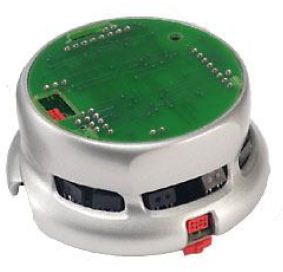
I E ( a1 ,..ai ,...aN ) = ∑ w ( xin , xin +1 ) (8) The Khepera II is a small, differential wheeled mobile
i =1
robot, designed as a scientific research and teaching tool
at Federal Institute of Technology Lausanne (EPFL) in
Third component denotes cost of moving the robot to the
Switzerland. First of all, the robot is well suited for
nearest (in the sense of costs defined by W) unexplored
project’s purposes because it renders rapid idea
object. Let us first denote a path of minimal cost between
generation, prototyping and evaluation. In its User
an object n and m as:
Manual can be found, that the robot allows also
confrontation to the real world of algorithms developed
pmin ( n, m ) = {vn ,...vk ,...vm } ⊂ V (9) in simulation for trajectory execution, obstacle
avoidance, preprocessing of sensory information,
and let the set of unexplored objects is given as hypothesis on behaviors processing [7].
M U = {ul } = M G \ M V . Then the cost ID is given by:
4.2 The problem formulation
N
I D ( a1 ,..., ai ,..., aN ) = ∑ Dmin,i Another aim of the work is creation of surface
i =1 (10) covering algorithms for hovering robot that would be a
Dmin,i = min pmin ( xin +1 , ul ) part of discussed multiple device cleaning system. The
l
algorithm should enable the unit to work inside of a
flat, but not free of obstacles workspaces.
where Dmin,i is the cost of moving the i-th robot from the
state xin +1 to the ”nearest” unexplored object
4.3 Proposed solution
4. Surface covering problem
In this section details on two designed surface covering
4.1 The vacuum cleaner model algorithms are presented end discussed. The first is the
simple random-walk based one. The second one is more
As a testbed for validation of proposed solution the complicated hybrid concept that merges two different
miniature, laboratory mobile robot Khepera II [7] was approaches – random movement and spiral motion.
used. The Khepera is presented in fig. 3. As a matter of
fact, that implied also an usage of The MATLAB Random walk based algorithm
software, which was required to program the robot.
Detailed specification of the Khepera II and is usage in The first algorithm has been based on the idea of random
the MATLAB can be found on the www.k-team.com movement (fig. 4). The robot is moving in forward
web site. Nevertheless, the robot used in experiments is a direction till an obstacle is sensed, then it stops. Next, by
complex device and it seems reasonable to highlight its comparing sensor readings decides in which direction to
main features. Thus, hardware and software description turn – left or right. Finally, by generating a random
is presented below in order to introduce some essential number decides how much to turn. The overriding aspect
knowledge, required for full apprehension of developed of this algorithm is a distance between the robot and
algorithms, that are afterwards presented. obstacles. It has been done, by setting into its source
code, a distance threshold value. Simply, when the
distance is lower than the given threshold value, the
robot takes an action in order to omit obstacles. As a
result of this, the manner in
which robot is moving depends strongly on its
surrounding. Despite the fact, that the algorithm assumes
ongoing turns from the obstacle (i.e. if obstacle is sensed
on the left, it turns right) what may cause stacking in
corners, the random turning banishes the issue. All in all,
the algorithm fulfills the aim of the work, allowing the
robot to move around a room avoiding obstacles.
However, its efficiency should be compared with more
sophisticated movement manner in order to examine its
Fig.3 The Khepera II robot as a model of vacuum cleaner utility.
[7]
ISSN: 1991-8763 749 Issue 9, Volume 5, September 2010WSEAS TRANSACTIONS on SYSTEMS and CONTROL Krzysztof Skrzypczyk, Agnieszka Pieronczyk
The second algorithm has been based on the idea of a
spiral motion coupled with random turning (fig. 6). First
of all, the robot checks if there is enough place to start
moving spirally. If yes, the robot convolutes in a RHS
direction, increasing a radius from centre point, the till an
obstacle is sensed. When the obstacle is sensed, robot
stops and compares sensor readings to decide in which
direction to turn – left or right. After the decision is
made, the robot turns a given direction for a previously
allotted angle. Finally, in order to allow itself to begin
convoluting, it moves away from the obstacle for a given
range. Invariably, the overriding aspect of the algorithm
Fig. 4 The visualization of 8 iterations of robot’s is a distance between the robot and obstacles. It has been
movement according to random walk based algorithm. done likewise to algorithm I, by setting into its source
code, a distance threshold value, thanks to which an
action in order to omit obstacles can be taken. As a result
This working mode is presented below in a form of a of this, the manner in which robot is moving depends
flow chart (fig.5). strongly on its surrounding characteristics.
The principle how the algorithm works is shown in the
form of a simplified flow chart (fig. 7) that gives a full
and clear view on properties of the algorithm.
Fig. 6 The visualization of 3 iterations of robot’s
movement according to algorithm II
Fig. 5 The flow chart for the random walk based
algorithm.
Hybrid algorithm
ISSN: 1991-8763 750 Issue 9, Volume 5, September 2010WSEAS TRANSACTIONS on SYSTEMS and CONTROL Krzysztof Skrzypczyk, Agnieszka Pieronczyk
environment The layout of the simulated workspace is
shown in fig.8.
Fig. 8 The layout of a workspace used for a
Simulation
It is an example of a typical office environment. It
consists of twelve sectors VS = {v1 , v2 ,...v12 } that represent
rooms and parts of corridors, and thirteen passages
(doors) between rooms Vd = {v13 ,..., v25 } . The area of the
workspace is of a size 15 × 10 [m] (width, height).
Various pieces of furniture and equipment are placed
inside of individual rooms. The robot model used for the
simulation is described in section 4.1. We consider the
following cleaning task. A team of three vacuum
cleaners (N=3) is intended to clean the workspace what is
equivalent to visiting all of the sectors. Thus the task is
defined as M G = VS . Initially, vacuum cleaners are inside
of sectors X init = {v4 , v9 , v2 } so MV=Xini . A sequence of
operators that was used to perform the task is presented
in the table 1 and the illustration of the simulated process
is presented in fig. 9. The symbols FD, TD, GT, W,CL
denote operators: FindDoor, TraverseDoor, GoTo, Wait
and Clean. We can see that algorithm works well,
providing completion of the task stated above. One can
notice that robot 1 perform only a small part of the task,
exploring only one room. But it has to be taken into
account, that the door D3,6 is modeled as the one that is
almost for sure closed. That is the reason of this ”strange”
Fig. 7 The flow chart for the hybrid algorithm. task execution. Yet another aspect is worth of
commenting. The algorithm presented in paper make
only ”one step ahead” planning. It causes that the task
execution may be not optimal. Using other planning
5. Simulation and experimental results algorithms we would obtain better or even optimal
solution. But such an approach would be valid if the
environment was static as well as we assumed perfect
5.1 Coordination process
result of each action.
In order to show how the approach discussed in the paper
works we present a result of an exemplary simulation.
We implemented the method using a simulation
ISSN: 1991-8763 751 Issue 9, Volume 5, September 2010WSEAS TRANSACTIONS on SYSTEMS and CONTROL Krzysztof Skrzypczyk, Agnieszka Pieronczyk
Two described surface covering strategiesy have been
tested if they are operating properly, what means that
n Robot 1 Robot 2 Robot 3 they fulfilled aim and all assumed objectives. All
1 FD(‘D3,4’) FD(‘D9,10’) FD(‘D1,2_1’) provided tests helped in speed and proximity sensors
2 TD(D3,4,S3) TD(D9,10,S10) TD(D1,2_1,S1) calibration. Finally, when proper work manners for both
3 CL(S3) CL(S10) CL(S1) algorithms were obtained, their outputs gave appropriate
3 FD(D2,3) FD(D10,11) FD(D1,8) and satisfactory results – for infinite period of time, the
4 TD(D2,3,S2) TD(D10,11,S11) TD(D1,8,S8) free from obstacles area of the workspace would be
5 CL(S2) CL(S11) CL(S8) almost fully covered and obstacles would be avoided.
6 W() FD(D11,12) GT(S7) However, it has to be mentioned that black or very
7 W() TD(D10,11,S12) CL(S7) reflective objects would not be avoided due to sensors
8 W() CL(S12) GT(S6) insensitivity for that kinds of materials. At the same time,
9 W() W() CL(S6) the prominent issue of all objectives was algorithm
10 W() W() GT(S5) efficiency. The efficiency was seen as area coverage in
11 W() W() CL(S5) time. Taking into account sensors and motors constraints
it had been very important to keep illumination levels
and initial conditions as similar as possible for each type
of test. That assured the most applicable results from
Table 1 A Sequence of operators that provides
each simulation. Owing the fact that both algorithms
completion of the workspace cleaning task
involved random movement, their outputs were highly
unpredictable. Nevertheless, based on numerous tests,
following efficiencies for operation time equals 1 minute
have been achieved (table 2).
Workspace dimensions: 400x500 mm; no obstacles
Random Motion Spiral Motion
1114 cm² 1430 cm²
Workspace dimensions: 800x500 mm; no obstacles
Random Motion Spiral Motion
1850 cm ² 2034 cm²
Workspace dimensions: 800x500x100 mm; one
obstacle: 100 cm²
Random Motion Spiral Motion
1532 cm² 1296 cm²
Workspace dimensions: 800x500x100 mm; five
obstacles sum: 150 cm²
Random Motion Spiral Motion
870 cm² 540 cm²
Table 2 Comparison of the efficiency of the two
presented surface covering algorithms.
As it can be observed spiral motion algorithm has better
efficiency coefficient for grater workspace dimensions
and smaller number of obstacles. What is more, its
Fig. 9 Stages of realization of the cleaning task
efficiency depends strongly from the initial point. The
best results were obtained for initial point being in the
5.2 Surface covering middle of the workspace, what allowed the robot to
convolute with greater radius. On the other hand, when
ISSN: 1991-8763 752 Issue 9, Volume 5, September 2010WSEAS TRANSACTIONS on SYSTEMS and CONTROL Krzysztof Skrzypczyk, Agnieszka Pieronczyk
the initial point is closer to the workspace’s boundaries, stacked accidently at any of the workspace recesses. As
or when the workspace area is filled with obstacles – the it has been mentioned before, although mechanical
random motion algorithm accomplishes better efficiency aspect of the project has been qualified to consider only
results than the spiral motion. To sum up, both different types of a testbed robots, environmental
algorithms that had been developed for the robotic perception and physical characteristics have given some
version of a vacuum cleaner, have been checked and they additional constraints influencing simultaneously on the
worked properly. Regardless of the fact that their project’s final output. Those constraints together with
efficiencies varied within environmental changes, their project’s output have been deeply analyzed and resulted
empirically derived efficiencies were still satisfactory. in proposals for future developments. Despite of the fact
that all the described system is in the design phase the
6. Conclusion preliminary results obtained are promising.
Acknowledgements
In this paper we discussed a problem of
planning and coordination of tasks in a multi system. This work has been granted by the Polish Ministry of
The role of the discussed system is sweeping Science and Higher Education from funds for years 2008-
large and complex spaces using a team of cleaning 20011.
robots. We considered a team of robotic-vacuum
cleaners that was intended to perform a task cleaning of References:
a human-made workspace of complex structure. We
proposed both the hybrid architecture of a control [1] Basar, M. and G.J. Olsder. 1982. Dynamic
system and method of coordination of multiple robotic Noncooperative Game Theory. Mathematics in
agents. In the paper we also presented an algorithm of Science and Engeneering, Academic Press Inc. Ltd,
exploration of workspace. The core of the algorithm is London.
the model of the process that is stated as a
[2] Burgard, W. et al. 2000. “Collaborative Multi-Robot
noncooperative game in a normal form. We applied the
Exploration.” Proc. IEEE International Conference on
Nash equilibrium concept to generate a solution of the
Robotics and Automation (ICRA), San Francisco CA
problem. Although the result of only one simulation was
presented, we had made a numer of simulation
[3] Ching Chang Wong et al., An Intuitional Method for
experiments using both various parameters and
Mobile Robot Path Planning in Dynamic
workspace configurations. In all cases we obtained
Environment, WSEAS Recent Advances in
correct task execution. On the basis of simulations we
Computers Computing and Communications,
carried out we can conclude that this algorithm works
ISBN:960-8052-62-9, 2002, pp. 275-280
well and provides effective exploration of even very
complex-structured environments. However, the
[4] A. Galuszka, A. Swierniak, Game Theoretic
algorithm can not guarantee optimal task performance.
Approach to Multi Robot Planning, WSEAS
It is caused the algorithm uses only one-step-ahead
Transactions on Computers, Issue 3, Vol. 3, July 2004
planning method. But this approach on the other hand
has other advantage - it allows to track dynamical
[5] D. Glavski et al, Robot Motion Planning Using Exact
changes of the environment and it does not need the
Decomposition and Potential Field Methods, Proc. of
assumption that a given action is always executed in a
the 9th WSEAS International Conference on
perfect way
Simulation Modelling and Optimization, Budapest,
The second issue discussed in the work was the
Hungary, September, 2009 pp. 126-131
design and implementation of algorithms of movement
of autonomous (or semiautonomous) vacuum cleaner,
[6] iRobot Roomba, The official polish iRobot Roomba
that would be able to work inside of a flat, but not free
webpage Available: http://roomba.pl/
of obstacles workspaces, have yet to be compared with
the achieved outcome. Unquestionably, developed
[7] K-Team, Khepera II User Manual, 1.1 version,
algorithms fulfilled this goal. What is more, the main
Switzerland, page 11, 2002
objectives for the project were based on analysis of
developed algorithms, their limitations and efficiencies.
[8] F.G. Martin, Robotic Explorations A Hands-On
The Khepera II returned appropriate response with
Introduction to Engineering, 1st ed. New Jersey,
respect to both programs, keeping a distance to objects,
United States of America: Tom Robbins, 2001.
as well as to the area coverage. The robot has not
ISSN: 1991-8763 753 Issue 9, Volume 5, September 2010WSEAS TRANSACTIONS on SYSTEMS and CONTROL Krzysztof Skrzypczyk, Agnieszka Pieronczyk
[9] P. J. McKerrow, Introduction to Robotics, 1st ed.
Singapore: Addison-Wesley Publishing Company,
1991.
[10] K. Skrzypczyk, Behaviour Activity Based Maps
Applied to Mobile Robot Navigation, Proc. of 13th
WSEAS International Conference On Systems,
Rodos, Greece, July, 2009, pp. 295-300
[11] Trilobite (2010), Robotyka – The official
Electrolux’s Trilobite webpage Available:
http://www.electrolux.pl/node37.aspx?categoryid=66
81
[12] I. R. Urlich, F. Monada, J. Nicoud, Autonomous
vacuum cleaner. Available:
ftp://lamiftp.epfl.ch/khepera/papers/ulrich_RAS96.
.
ISSN: 1991-8763 754 Issue 9, Volume 5, September 2010You can also read


