REVISION 6 - International Automotive Task Force IATF GLOBAL WAIVERS AND MEASURES IN RESPONSE TO
←
→
Page content transcription
If your browser does not render page correctly, please read the page content below
REVISION 6
                      ―
                Date d 1 June 2 02 1

                                            ®

   International Automotive Task Force
     IATF GLOBAL WAIVERS AND
  MEASURES IN RESPONSE TO THE
CORONAVIRUS PANDEMIC (COVID-19)
                      ―
           www.iatf globalover sight .org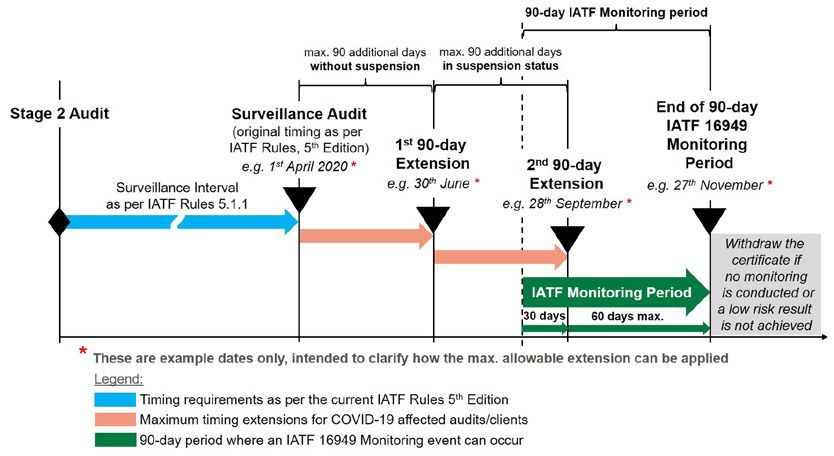
IATF - International Automotive Task Force
                                                        2
MEASURES CORONAVIRUS PANDEMIC (COVID-19) — REVISION 6

CONTENTS

Foreword                                                4

Initial Release                                         5

Revision 1                                              5

Revision 2                                              6

Revision 3                                              6

Revision 4                                              7

Revision 5                                              8

Revision 6                                              8

General Remarks                                         9

IATF 16949 Certificates                                10

Affected IATF 16949 3rd Party Audits                   11

Remote Audit                                           12

Remote Audit Day Calculation                           13

Remote Audit Planning                                  13

Conducting the Remote Audit                            14

Postponed Audits in Accordance
                                                        15
with the REVISION 4 of this Document
Nonconformity Management                               20

    ®

        www.iatfglobaloversight.org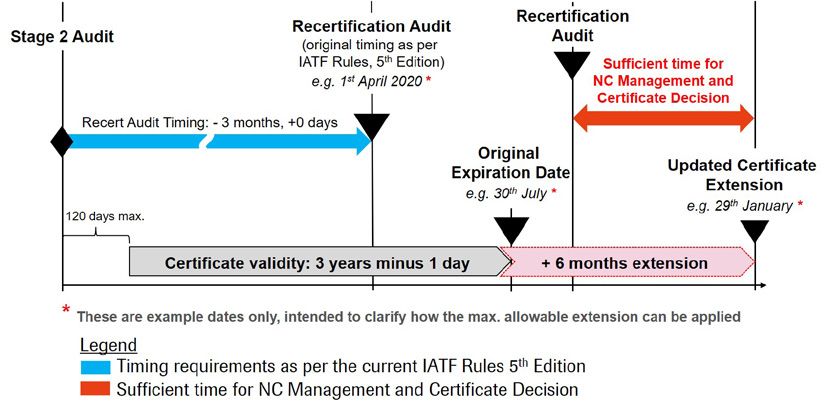
IATF - International Automotive Task Force
                                                        3
MEASURES CORONAVIRUS PANDEMIC (COVID-19) — REVISION 6

Certification Decisions                                21

Auditor Assignments                                    21

Certification Body Internal Audits                     22

IATF 16949 3rd Party Auditor Waivers                   22

IATF 16949 Monitoring                                  23

Frequently Asked Questions (FAQs)                      29

Annex A - IATF Remote Audit Requirements               33

Contacts                                               36

    ®

        www.iatfglobaloversight.org
IATF - International Automotive Task Force
4
MEASURES CORONAVIRUS PANDEMIC (COVID-19) — REVISION 6
FOREWORD
The International Automotive Task Force (IATF) is constantly reviewing the impact of the
coronavirus 2019-nCoV on the IATF 16949 certification scheme. First and foremost, our current
top priority is the safety, and well-being of everyone involved in the IATF 16949 scheme.
The impact on the global economy and, in particular, on the automotive industry is
unprecedented. Each day brings new developments and we want to assure you that the IATF
leadership continues to both monitor and address all the emerging situations regionally and
globally as they occur.
The IATF is in close communication and working together to assess the next steps to be
implemented from our contingency plan(s) and the IATF will make frequent updates to these
extraordinary waivers as needed.
All updates and subsequently visible in the IATF Certificate Validity Check which can be found
on the IATF Global Oversight website:
www.iatfglobaloversight.org
Please subscribe to the IATF mailing list on the IATF Global Oversight website to automatically
receive notification of these updates.
®
www.iatfglobaloversight.orgIATF - International Automotive Task Force
5
MEASURES CORONAVIRUS PANDEMIC (COVID-19) — REVISION 6
INITIAL RELEASE
Initial Release – dated 27 March 2020
This newly created document supersedes the previously issued IATF Certification Body
Communiqué (CBC) 2020-001.
In addition to the global waivers and measures already published in the CBC 2020-001, the
IATF approved a major change affecting the validity of all issued and currently valid IATF 16949
certificates (these are described in Section “IATF 16949 Certificates”).
REVISION 1
Revision 1 - dated 9 April 2020
The first Revision incorporates two additional Frequently Asked Questions (FAQs no. 2 and
3) that were approved by the IATF. Additionally minor grammatical errors and graphical
modifications were corrected and
—— a small clarification added to the section “Special audits”
—— the timing requirements in the section “NONCONFORMITY MANAGEMENT” were
changed from a maximum of sixty (60) calendar days to a maximum of ninety (90)
calendar days to allow for further flexibility and to align the possible maximum
extensions throughout this document
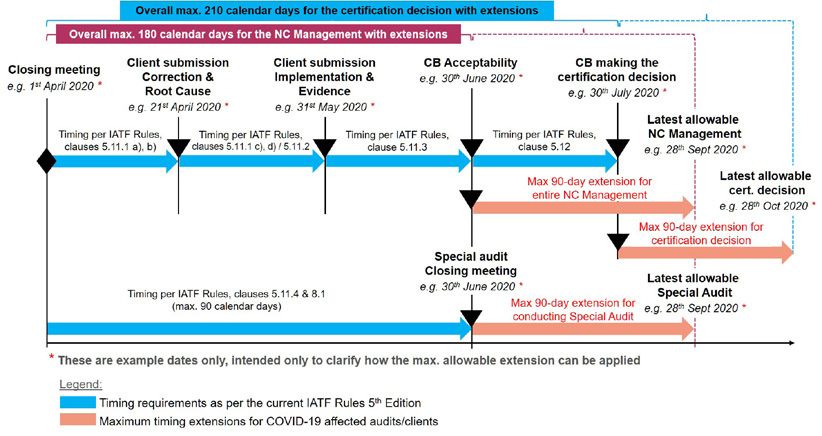
—— an additional graphic has been created for the section “NONCONFORMITY
MANAGEMENT” to explain the original timings and additional maximum allowances
in one graphic
—— the timing requirements in the section “CERTIFICATION DECISIONS” were changed
from a maximum of sixty (60) calendar days to a maximum of ninety (90) calendar
days to allow for further flexibility and to align the possible maximum extensions
throughout this document.
®
www.iatfglobaloversight.orgIATF - International Automotive Task Force
6
MEASURES CORONAVIRUS PANDEMIC (COVID-19) — REVISION 6
REVISION 2
Revision 2 - dated 27 April 2020
The second revision incorporates a new chapter “IATF 16949 Monitoring” between the existing
chapters “Affected IATF 16949 3rd party audits” and “Nonconformity Management”. This
new chapter introduces a process to enable the IATF-recognized certification body (CB) to
remotely monitor the status of the client´s Quality Management System to assess the continued
effectiveness of the client’s Quality Management System to the requirements of IATF 16949
during this extraordinary period of the COVID-19 pandemic and to proactively identify risks to
the certified Quality Management System of a certified client.
REVISION 3
Revision 3 – dated 8 June 2020
The third Revision incorporates the following updates:
—— The IATF 16949 Monitoring usage is now limited to the surveillance audit cycle
—— An IATF 16949 Monitoring can start no earlier than 30 days prior to the end of the
2nd 90-day extension period
—— The criteria for conducting an IATF 16949 Monitoring were simplified, as well as the
output recommendations
—— A simplified guidance is now available for the use of information sharing technologies
during an IATF 16949 Monitoring
—— The specific instructions (for certification body internal audits and CB waivers) were
moved to a separate IATF Certification Body Communiqué
—— Four new Frequently Asked Questions (FAQs) were added
®
www.iatfglobaloversight.orgIATF - International Automotive Task Force
7
MEASURES CORONAVIRUS PANDEMIC (COVID-19) — REVISION 6
REVISION 4
Revision 4 – dated 17 July 2020
The fourth Revision incorporates the following updates:
—— The IATF 16949 Monitoring period is expanded to last 90 days and starts 30 days
before the end of the 2nd 90 day surveillance audit extension
—— For surveillance audits, the certificate is withdrawn if no IATF 16949 Monitoring is
conducted or a low risk result is not achieved
—— The latest possible extended recertification audit is aligned with IATF Rules, 5th
Edition time allowances
—— Clarification on when onsite audits must be conducted
—— Clarification that the IATF 16949 Monitoring information includes data from related
Remote Support Location processes
—— C
larified criteria for high risk and low risk assessments during IATF 16949
Monitoring(s)
—— Clarification on steps if high risk is assessed during an IATF 16949 Monitoring
—— Clarified criteria for the 100% resolved status of nonconformities
—— Simplification of FAQ 2, clarification for FAQ 7 and newly added FAQ 8
®
www.iatfglobaloversight.orgIATF - International Automotive Task Force
8
MEASURES CORONAVIRUS PANDEMIC (COVID-19) — REVISION 6
REVISION 5
Revision 5 – dated 30 October 2020
The fifth Revision incorporates the following updates:
—— The IATF clarifies that recertification audits are not extended even though all
certificate expiration dates were extended
—— A Remote Auditing section was added, including audit day calculation, audit
planning, and conducting of the remote audit(s)
—— Minor clarification in the graphic for postponed recertification audits of Revision 4
—— Changed a “should” to a “shall” for the IATF Monitoring with low risk
—— Updated Frequently Asked Question (FAQ) no. 1 and added a new FAQ no. 9
—— Added Annex A - IATF Remote Audit Requirements
REVISION 6
Revision 6 – dated 1 June 2021
This sixth Revision incorporates the following updates:
—— Two new Frequently Asked Question (FAQs) were added: FAQs no. 10 and no. 11
—— Best Practices for remote audits were added
—— Minor clarifications were introduced on pages 11, 15 and 26
All changes to the previously communicated Revision 5 are highlighted in red.
®
www.iatfglobaloversight.orgIATF - International Automotive Task Force
9
MEASURES CORONAVIRUS PANDEMIC (COVID-19) — REVISION 6
GENERAL REMARKS
The purpose of this document is to advise all IATF-recognized certification bodies and
subsequently all affected certified organisations and other stakeholders that the IATF has
approved global waivers in response to the outbreak of the recent coronavirus, affecting
certification activities globally. These waivers and measures are not limited to a certain country
or region but can be applied globally if the audits and certification activities are affected as
described.
The IATF has developed and approved the following global waivers for which the IATF-
recognized certification bodies will not need to request a waiver from their relevant IATF
Oversight Office; however, the IATF-recognized certification body is required to document
the justification and all related information for these waivers internally, in all related audit
documentation and in the IATF Database as applicable.
Whenever it is specified: “…the IATF is granting an additional extension of X days…” in the
following situations, it is to be understood that these are additional days to the defined
maximum timing(s) of the IATF Rules, 5th Edition. This extra time will allow for a certain flexibility
and prolongation of activities for affected audits and certification activities.
If there are no reasons directly related to the COVID-19 pandemic that prevent an onsite audit
within the allowable timing and intervals as per the IATF Rules, 5th Edition section 5.1.1, then
the CB shall conduct the audit onsite at the manufacturing site and remote support location(s)
(as applicable).
®
www.iatfglobaloversight.orgIATF - International Automotive Task Force
10
MEASURES CORONAVIRUS PANDEMIC (COVID-19) — REVISION 6
IATF 16949 CERTIFICATES
The IATF has approved a global extension to all currently issued and valid IATF 16949
certificates to prevent the automatic expiration of certificates if a recertification audit could not
be conducted due to reasons directly related to the COVID-19 pandemic. Although all certificate
expiration dates were extended 6 months in the IATF database, that does not mean that all
recertification audits are automatically extended 6 months.
With this major change in direction, the IATF requires that audits due from 1 January 2021
forward be conducted onsite or remotely and the certification body can no longer apply the
conditions and waivers described in the previous revisions of this document. Special conditions
apply if the organisation is not operating or is not manufacturing automotive products when
the audit is due.
The extension of six (6) months (i.e. 183 calendar days) to every currently issued and valid
certificate (including those certificates that are currently in the status of suspension) will be
reflected in the Global IATF Database and subsequently visible in the IATF Certificate Validity
Check: LINK
In this extraordinary situation the IATF-recognized certification bodies are not required to
reissue the certificates immediately. This document together with automated updates to the
IATF Database and the IATF Certificate Validity Check are providing the evidence that the
certificate is valid beyond the documented expiration date printed on the certificate.
If the IATF-recognized certification body is required to update the certificate due to any
changes, the revised expiration date shall be updated accordingly and the certificate shall be
uploaded in the IATF Database.
If a certified organization needs an updated IATF 16949 certificate, please contact your relevant
IATF-recognized certification body.
®
www.iatfglobaloversight.orgIATF - International Automotive Task Force
11
MEASURES CORONAVIRUS PANDEMIC (COVID-19) — REVISION 6
AFFECTED IATF 16949
3RD PARTY AUDITS
The IATF prefers audits to be conducted onsite. However, in cases where an IATF 16949 audit
cannot be conducted onsite within the allowable timing and intervals per IATF Rules, 5th Edition
section 5.1, the IATF is permitting the certification body to conduct the audit using remote
auditing methods and technology (i.e. remote audit) under the following condition (including
for audits conducted subsequent to a remote audit):
—— It is demonstrably evident that a regular onsite audit will not be possible for
reasons that are directly linked to the COVID-19 pandemic.
A remote audit is conducted the same as an onsite audit but using electronic methods, such
as video conferencing, to remotely obtain audit evidence and evaluate it in order to determine
the extent of conformity to the audit criteria.
The certification body shall have a defined process for approving the use of remote auditing
methods for each remote audit, including the justification for why an onsite audit is not possible.
If there are no reasons directly related to the COVID-19 pandemic that prevent an onsite
audit within the allowable timing and intervals, as per IATF Rules, 5th Edition then the CB shall
conduct the audit onsite and remote audits shall not be used.
In cases where a manufacturing site or a remote support location is completely shut down, or
is not producing automotive parts at the time an audit is required, the certification body shall
gather the necessary information from the client to understand their current and expected
future situation. Based on the evidence gathered, the certification body shall determine the
potential date for the audit and contact the appropriate IATF Oversight office with a waiver
request.
®
www.iatfglobaloversight.orgIATF - International Automotive Task Force
12
MEASURES CORONAVIRUS PANDEMIC (COVID-19) — REVISION 6
REMOTE AUDIT
If the conditions listed above are met, the certification body can conduct audits using remote
auditing methods at the following client sites:
—— Manufacturing sites (including extended manufacturing sites)
—— Remote Support Locations
Audit types which can be conducted using remote auditing methods:
—— Initial audit (stage 1 and stage 2)
—— In cases where the stage 2 audit is performed remotely, the validity of
the certificate shall not exceed 12 months (the expiration date of the
certificate is twelve months minus 1 day). The subsequent audit would
be a recertification audit.
—— Surveillance audit
—— Recertification audit
—— Transfer audit
—— Special audit
The certification body shall use the remote auditing principles outlined in:
—— IAF ID 12 (Principles on Remote Assessment)
—— IAF MD 4 (Use of ICT for Auditing/Assessment Purposes)
—— Annex A - IATF Remote Audit Requirements
®
www.iatfglobaloversight.orgIATF - International Automotive Task Force
13
MEASURES CORONAVIRUS PANDEMIC (COVID-19) — REVISION 6
REMOTE AUDIT DAY CALCULATION
The duration of the remote audit shall be equivalent to that of an onsite audit per the IATF Rules,
5th Edition section 5.2.
The certification body shall calculate 10% of the total audit days, but no more than a maximum
of eight (8) hours, and apply this time to complete the additional audit planning steps required
for a remote audit (refer to Annex A - IATF Remote Audit Requirements for details).
REMOTE AUDIT PLANNING
The certification body shall comply with all requirements for establishing the audit team as
defined in the IATF Rules, 5th Edition section 5.6, and for audit planning in section 5.7, based on
the specific audit type.
The certification body shall have a process to evaluate and select IATF 16949 3rd party auditors
that are competent in the use of the technologies necessary to carry out an audit remotely.
A remote audit shall only be conducted by qualified IATF 16949 3rd party auditors.
The certification body shall require the client to provide the following information related to the
COVID-19 pandemic to be used as input for developing an audit plan:
a) Length of time the client was shut down, as applicable;
b) Startup verification plan/risks identified, etc. (after medium term shutdowns
[greater than 1 month], including across the different regions of operation);
c) Any extraordinary measures taken;
d) Resources lost (permanent or temporary);
e) Changes in regulations or operating conditions (including operator safety);
f) List of customers to the site, identifying which are operational or not.
®
www.iatfglobaloversight.orgIATF - International Automotive Task Force
14
MEASURES CORONAVIRUS PANDEMIC (COVID-19) — REVISION 6
The audit team shall successfully implement the IATF Remote Audit Requirements – Planning
section (refer to Annex A in this document), including IAF MD4 (Use of ICT for Auditing /
Assessment Purposes).
Based upon the completion of audit planning requirements listed above, the certification body
shall determine if it is appropriate to proceed with the remote audit or not. The decision shall be
documented and retained as part of the audit record(s) (refer to Rules Annex 3).
The final audit plan shall clearly identify if the audit was to be conducted remotely.
CONDUCTING THE REMOTE AUDIT
The remote audit is considered to be a regular audit and shall comply with all requirements
defined in the IATF Rules, 5th Edition sections 5.8 - 5.12, 5.14 and 6.4 - 7.2 (depending on the
audit type).
The remote audit shall be conducted taking into consideration the Annex A - Remote Audit
Requirements.
In addition to the audit report content per IATF Rules, 5th Edition section 5.10, the report shall
clearly include an explanation of the following in the Audit Summary section of the Result page
in the audit report:
1) Any portions of the audit activities which could not be effectively completed, or
where a complete determination could not be made (e.g. failure of technology);
2) Any portions of the audit already excluded during audit planning preparation; and
3) Risks to the customers due to changes related to COVID-19, especially to the
IATF OEM customer(s).
If during the audit a portion of the audit activities could not be effectively completed, then the
equivalent amount of time shall be added to the subsequent audit to adequately cover those
activities.
During the closing meeting of the remote audit, the audit team shall explain to the client any
increase in audit days for the subsequent audit based on the outcome of the remote audit.
The certification body shall identify the audit as a remote audit in the IATF database.
NOTE: The IATF reserves the right to witness or observe any of the remote audits,
including the audit planning between the client and CB auditor to test the technology to
be used for a remote audit. The client cannot refuse the witnessing or observation of a
remote audit by an IATF witness auditor or IATF representative.
®
www.iatfglobaloversight.orgIATF - International Automotive Task Force
15
MEASURES CORONAVIRUS PANDEMIC (COVID-19) — REVISION 6
POSTPONED AUDITS IN ACCORDANCE
WITH THE REVISION 4 OF THIS DOCUMENT
Audits that will become due from 1 January 2021 forward can no longer apply the conditions
and waivers described in the Revision 4 of this document (provided below for reference).
Although all certificate expiration dates were extended 6 months in the IATF database, the
timing requirements per IATF Rules 5th Edition for audits are not extended.
Nonconformities requiring a decision of acceptability after 1 January 2021 shall follow the
requirements in IATF Rules, 5th Edition section 5.11.
For those clients with a postponed audit, the certification body shall either conduct an onsite
or a remote audit. The timing of the audit (onsite or remote) shall not exceed the current
extensions described in this section of the document. The certification body shall comply with
all applicable requirements defined in the IATF Rules, 5th Edition.
As of 1 January 2021, Monitoring events are no longer permitted.
This section of the document describes how to manage existing audits which were already
postponed due to the COVID-19 pandemic prior to the release of Revision 5 of this document.
Stage 2 audits:
In cases where the stage 2 audit cannot be conducted within the specified ninety (90) calendar
days from the last day of the stage 1 readiness review, the IATF is granting an additional
extension of ninety (90) calendar days to commence the stage 2 audit.
In cases where an initial audit (stage 1 readiness review and stage 2 audit) is to be conducted
to “upgrade” from a letter of conformance to an IATF 16949 certificate, the IATF is granting an
additional extension of ninety (90) calendar days to commence with a maximum reduction of
50% in the stage 2 audit days after the expiration date of the letter of conformance.
As a result, the stage 2 audit shall commence within a maximum of one hundred and eighty
(180) calendar days from the last day of the stage 1 readiness review.
In cases where an initial audit (stage 2 audit) is to be conducted to “re-apply for another letter
of conformance”, the IATF is granting an additional extension of ninety (90) calendar days to
commence with a maximum of 50% reduction in the stage 2 audit days after the expiration date
of the letter of conformance.
In situations where the remote supporting location cannot be audited prior to the manufacturing
site, as required as per the IATF Rules 5th Edition section 5.5, the IATF-recognized certification
body shall submit a waiver to the relevant IATF Oversight Office for consideration of approval.
®
www.iatfglobaloversight.orgIATF - International Automotive Task Force
16
MEASURES CORONAVIRUS PANDEMIC (COVID-19) — REVISION 6
Surveillance audits:
In cases where the required surveillance audit cannot be conducted within the allowable
intervals and timing as per the IATF Rules, 5th Edition (Table 5.1: Surveillance interval), the
IATF is granting an additional extension of ninety (90) calendar days to commence with the
surveillance audit without initiating the decertification process. This is referred to as the “1st
90-day extension” in the graphic below. When this additional timing cannot be met, the
decertification process shall be initiated in accordance with IATF Rules 5th Edition, section 8.1
e). This leads to an additional 90-day extension referred to as the “2nd 90-day extension” in
the graphic below.
NOTE: during the suspension period the certificate remains valid and is still recognized
by the IATF.
In cases where the decertification process has already been initiated prior to 27 March 2020
as per IATF Rules, 5th Edition, section 8.1 e), the IATF-recognized certification body shall lift
the already imposed suspension and follow the timing requirements in the paragraph above.
When an onsite surveillance audit cannot be conducted due to COVID-19, an IATF 16949
Monitoring is to be conducted as described above; also refer to the IATF 16949 Monitoring
chapter of this document on page 23.
The IATF 16949 Monitoring shall be conducted in the period from 30 days prior to the end of the
2nd 90-day COVID-19 extension to 60 days after the end of the 2nd 90-day COVID-19 extension
(i.e. the IATF 16949 Monitoring Period, see graphic above), and only if it becomes demonstrably
®
www.iatfglobaloversight.orgIATF - International Automotive Task Force
17
MEASURES CORONAVIRUS PANDEMIC (COVID-19) — REVISION 6
evident that a regular onsite audit will not be possible to be conducted, see graphic above. IATF
16949 Monitoring is no longer applicable 60 days after the end of the 2nd 90-day COVID-19
extension.
If an IATF 16949 Monitoring is conducted and low risk is identified (see the IATF 16949
Monitoring chapter), then the suspension is lifted.
The certificate is withdrawn for the two following conditions:
—— If an IATF 16949 Monitoring event is not scheduled by the certification body to occur
during the IATF 16949 Monitoring Period (see graphic above)
—— IATF 16949 Monitoring is conducted during the IATF 16949 Monitoring Period, but
a low risk assessment is not achieved before the end of the IATF 16949 Monitoring
Period (see the IATF 16949 Monitoring chapter)
Recertification audits:
In cases where the required recertification audit cannot be conducted onsite within the
allowable interval and timing as per the IATF Rules, 5th Edition section 5.1.1 for reasons that are
directly linked to the COVID-19 pandemic, the recertification audit timing can be extended per
the graphic below.
The scheduling of the onsite recertification audit shall provide sufficient time to close or 100%
resolve any nonconformities that may be raised at the onsite recertification audit and the
certification decision made prior to the prolonged expiration of the existing IATF 16949 certificate.
®
www.iatfglobaloversight.orgIATF - International Automotive Task Force
18
MEASURES CORONAVIRUS PANDEMIC (COVID-19) — REVISION 6
If there are no reasons directly related to the COVID-19 pandemic that prevent an onsite
recertification audit within the allowable interval and timing as per the IATF Rules, 5th Edition
section 5.1.1, then the CB shall conduct the recertification audit onsite at the manufacturing site
and this extension shall not be applied.
Transfer audits:
In cases where a transfer audit is planned to take place at the planned recertification audit
timing (see IATF Rules, 5th Edition section 7.1.1), the transfer audit shall be completed no later
than 120 calendar days prior to the prolonged expiration date of the currently valid IATF 16949
certificate.
In cases where a transfer audit is planned to take place during the surveillance audit cycle, the
new IATF-recognized certification body is still permitted to transfer the client as long as the
global waiver conditions for not conducting the surveillance audit are met.
NOTE: if transfer requests were rejected during this extraordinary situation in the semi-
automated transfer audit process of the IATF Database (refer to IATF Rules 5th Edition,
section 7.1.1), the IATF-recognized certification body is requested to contact the relevant
IATF Oversight Office.
®
www.iatfglobaloversight.orgIATF - International Automotive Task Force
19
MEASURES CORONAVIRUS PANDEMIC (COVID-19) — REVISION 6
Special audits:
In cases where a (required) on-site special audit cannot be conducted, the IATF is granting an
additional extension of ninety (90) calendar days to commence with the special audit.
NOTE: the impact of the Coronavirus may affect the site or certification process at
different timing periods; for a special audit to close the major nonconformity with
extended timing and applicability of using open but 100% resolved, please see
“NONCONFORMITY MANAGEMENT”.
The IATF is also aware that an extension to conduct a required special audit will result in
situations where a certificate suspension will exceed 110 calendar days. Also, in these situations
the suspended certificate still remains valid and is still recognized by the IATF.
In all the above-mentioned situations the certification body is required to enter a comment in
the IATF Database, i.e. in the relevant comment field of the affected audit and/or the affected
certificate.
®
www.iatfglobaloversight.orgIATF - International Automotive Task Force
20
MEASURES CORONAVIRUS PANDEMIC (COVID-19) — REVISION 6
NONCONFORMITY MANAGEMENT
In cases where the client is unable to submit required documentation as per the timings of
the IATF Rules 5th Edition, section 5.11.1 and/or 5.11.2 for reasons that are directly linked to
the COVID-19 pandemic, the IATF is granting an additional extension of a maximum of ninety
(90) calendar days for all the relevant required steps to be completed (including the timing
requirements of the IATF Rules 5th Edition, section 5.11.3), as applicable.The additional extension
is to be understood as a maximum potential extension to the overall process and not to be
understood as a potential extension for every single step. This results in an overall extension of
a maximum of ninety (90) calendar days to resolve the corrective action process.
In cases where the client is unable to complete the corrective action process defined by IATF
Rules 5th Edition sections 5.11.1 or 5.11.2, or the CB is unable to complete an onsite special audit
to verify the effective implementation of the corrective actions, for reasons that are directly
linked to the COVID-19 pandemic, the CB can consider the nonconformity to be 100% resolved,
if the following conditions have been met:
a) The nonconformity management 90-day extension has been exceeded, and
b) The client submits the evidence that meets the requirements of IATF Rules 5th
Edition sections 5.11.3 a) and b)
When a major nonconformity is considered to be open but 100% resolved, the certification body
schedules an onsite special audit as soon as onsite audits are permitted.
When a minor nonconformity is considered to be open but 100% resolved, onsite verification
of the corrective action is at the discretion of the CB per IATF Rules 5th Edition 5.11.5. The
certification body shall review the corrective action evidence submitted by the client and
determine the next steps per the process for minor nonconformities in IATF Rules 5th edition 5.11.
NOTE: For minor nonconformities that are 100% resolved for reasons that are directly
linked to the COVID-19 pandemic, an onsite special audit is not required prior to the
next planned onsite audit. However, for major nonconformities, an onsite special audit
is required when onsite audits are permissible.
In cases where the client cannot submit the required documentation or it is found not to be
acceptable and the extension is exceeded, the final audit result shall be considered failed, the
IATF database shall be updated and the certificate withdrawn.
®
www.iatfglobaloversight.orgIATF - International Automotive Task Force
21
MEASURES CORONAVIRUS PANDEMIC (COVID-19) — REVISION 6
CERTIFICATION DECISIONS
As described in the above sections “Special audits” and “Nonconformity management”, the
IATF is granting an additional extension of ninety (90) calendar days for submitting data and
conducting a special audit. Subsequently the IATF is granting an additional maximum extension
of ninety (90) calendar days that can be applied to making a certification decision.
AUDITOR ASSIGNMENTS
In cases where the original audit team member(s) cannot be assigned to an on-site audit
due to official travel restrictions, the IATF-recognized certification body may assign new audit
team member(s) to an audit (see IATF Rules, 5th Edition section 5.6 – force majeure). The
IATF-recognized certification body shall determine additional audit days, if required, based on
experience with the client.
The newly assigned audit team member(s) are permitted to participate on the audit team for
the subsequent three (3) year audit cycle.
®
www.iatfglobaloversight.orgIATF - International Automotive Task Force
22
MEASURES CORONAVIRUS PANDEMIC (COVID-19) — REVISION 6
CERTIFICATION BODY INTERNAL AUDITS
Section moved to the CB Communiqué no. 2020-008
IATF 16949 3RD PARTY AUDITOR WAIVERS
Section moved to the CB Communiqué no. 2020-008
®
www.iatfglobaloversight.orgIATF - International Automotive Task Force
23
MEASURES CORONAVIRUS PANDEMIC (COVID-19) — REVISION 6
IATF 16949 MONITORING
Definition
The IATF has developed and approved a monitoring method for IATF-recognized certification
bodies and their certified clients that are affected by the current global COVID-19 pandemic.
This method is named “IATF 16949 Monitoring” and is described in the following process.
This “IATF 16949 Monitoring” is a method for IATF-recognized certification bodies to request
information from IATF 16949-certified clients to remotely monitor and assess the status of the
client’s certified Quality Management System (QMS) only if a regular onsite audit cannot be
conducted for reasons that are directly linked to the COVID-19 pandemic.
Objective/Purpose:
The IATF 16949 Monitoring is not to be understood as a “remote audit”. Its purpose is for the
IATF-recognized certification body (CB) to remotely monitor the status of the client´s Quality
Management System to assess the continued effectiveness of the client’s Quality Management
System to the requirements of IATF 16949 during this extraordinary period of the COVID-19
pandemic and to proactively identify potential risks with the certified Quality Management
System of a certified client that could also constitute a risk to the client´s customers.
The IATF 16949 Monitoring event is not an audit, and therefore, nonconformities cannot be
written as a result of identifying gaps or risks during an IATF 16949 Monitoring.
The IATF 16949 monitoring shall only occur when the following criteria are met:
a) The client is currently manufacturing automotive parts or products for customers
(even if the volume of manufactured parts is significantly reduced), and
b) The IATF 16949 3rd party audit cannot be conducted onsite for reasons that are
directly linked to the COVID-19 pandemic.
If the above criteria are not met, a regular onsite audit shall take place.
NOTE 1: An onsite audit is to be conducted by the certification body if the client is
currently manufacturing automotive parts or products and the auditor is permitted to go
onsite before the end of the 2nd 90 day extension (see surveillance section).
NOTE 2: Recertification, initial, special and transfer audits are excluded from this process.
®
www.iatfglobaloversight.orgIATF - International Automotive Task Force
24
MEASURES CORONAVIRUS PANDEMIC (COVID-19) — REVISION 6
The IATF 16949 Monitoring shall be scheduled only if it is demonstrably impossible for reasons
that are directly linked to the COVID-19 pandemic to conduct a regular onsite audit and if the
timing of the monitoring event is between 30 days prior to the end of the 2nd 90-day COVID-19
extension and 60 days after the end of the second 90-day COVID-19 extension (during the IATF
16949 Monitoring Period, see surveillance audit section).
IATF 16949 Monitoring Information
The certification body shall notify clients that the following information shall be available at the
time of the IATF 16949 Monitoring event. The following information a) through t) shall include
processes and performance results for both the manufacturing site and for any applicable
Remote Support Location(s) linked to the manufacturing site.
a) the number of employees of the site and all associated remote support location(s);
b) the client’s Quality Management System documentation, including evidence about
conformity to IATF 16949 requirements and showing the linkages and interfaces to
any remote support functions and/or outsourced processes;
c) customer and internal performance data since the previous audit;
d) customer satisfaction and complaint summary since the previous audit, including
a copy of the latest customer reports and/or scorecards;
e) identification of any customer special status condition since the previous audit;
f) notification about any new customers since the previous audit;
g) results of internal audits and management review since the previous audit,
including extraordinary measures due to COVID-19;
h) Start up verification plan/risks identified etc. (after medium term shut-downs
[greater than 1 month] associated with the COVID-19 pandemic);
i) Equipment Maintenance status;
j) Measurement equipment calibration status;
k) Length of time the client was shut down (as applicable);
l) Resources lost due to COVID-19 pandemic;
m) List any processes distributed across different locations or regions impacted by
the COVID-19 pandemic;
n) Changes in regulations or operating conditions due to the COVID-19 pandemic
(including operator safety);
o) List of customer CSRs which cannot be met and corrective action plans to address
the gap(s);
®
www.iatfglobaloversight.orgIATF - International Automotive Task Force
25
MEASURES CORONAVIRUS PANDEMIC (COVID-19) — REVISION 6
p) List of customers to the site identifying which are operational or not;
q) Major changes in the QMS since the prior onsite audit;
r) Identification of any new products or processes initiated just before the impact of
the COVID-19 pandemic;
s) Whether or not the client has multiple customer programs, new program launches
and stage/maturity of the launches; and
t) Whether or not the site has safety – critical commodities.
NOTE: Safety–critical parts or products are those which include characteristics
identified by risk analysis (such as FMEAs) and to be important to meet customer/
regulatory safety requirements (such as being assigned a severity of 9 or 10 in FMEAs).
CBs shall analyze the client-provided information to assess the effectiveness of the client´s
certified QMS. During the remote IATF 16949 Monitoring, per the CB analysis, the CB shall
focus its questions to the client on that information which appears to pose the greatest risks
and what is unclear.
Conducting an IATF 16949 Monitoring
The above event shall be conducted by a qualified 3rd Party IATF 16949 auditor, preferably the
lead auditor of one of the audits in the current audit cycle. If the lead auditor is not available,
the IATF 16949 Monitoring may be conducted by an auditor who was part of an audit team for
the site in the current cycle.
The duration of the IATF 16949 Monitoring shall be a minimum of 1 working day (8 hours).
NOTE 1: the Certification body should consider the size of the organization when
determining the number of days for the IATF 16949 Monitoring event.
NOTE 2: IATF reserves the right to witness any of the IATF 16949 Monitoring events.
The client cannot refuse the witnessing of an IATF 16949 Monitoring event by an IATF
witness auditor.
To ensure robust IATF 16949 Monitoring, the IATF 16949 certification body auditor and the client
shall follow the guidance outlined in IAF ID 12 (Principles on Remote Assessment) and MD 4
(Use of Information and Communication Technology (ICT) for Auditing/Assessment Purposes).
IAF ID 12 (Principles on Remote Assessment)
IAF MD 4 (Use of ICT for Auditing/Assessment Purposes)
®
www.iatfglobaloversight.orgIATF - International Automotive Task Force
26
MEASURES CORONAVIRUS PANDEMIC (COVID-19) — REVISION 6
Output of an IATF 16949 Monitoring
The IATF 16949 certification body auditor conducting the IATF 16949 Monitoring activity shall
analyze all information gathered during this IATF 16949 Monitoring and establish the conclusion.
The auditor shall identify any risks to the customer(s) and/or issues found with respect to the
effective implementation of the quality management system related to the items a) through t)
above.
The certification body shall issue a written report to the client.
The written report shall include a description of the auditor´s recommendation to the
certification body.
Recommendation options made by the auditor based on risk are:
A) Incomplete IATF 16949 Monitoring due to not all items a) through t)
above being available and presented during the IATF 16949 Monitoring
a) Additional IATF 16949 Monitoring event(s) required within the IATF 16949
Monitoring Period or the certificate is withdrawn
B) Low risk to the customer or to the QMS identified
a) The IATF 16949 Monitoring can replace the original surveillance
manufacturing site aud it
i) if the next audit is a surveillance audit, the onsite audit days shall be
equivalent to recertification audit days.
ii) If the next audit is a recertification audit, the onsite audit days shall be
equivalent to stage 2 audit days.
C) High risk to the customer or to the QMS identified
a) Conduct additional IATF 16949 Monitoring event(s) during the IATF 16949
Monitoring Period to review the client’s corrective action responses to the
high risks identified, until low risk is achieved.
b) Withdraw the certificate if a low risk assessment is not achieved before the
end of the IATF 16949 Monitoring Period.
NOTE: if high risk is initially assessed, all evidence for items a) through t) must meet the
requirements for low risk (including current customer and other performance metrics)
during a subsequent IATF 16949 Monitoring event; otherwise the certificate is to be
withdrawn.
Low risk assessment means low likelihood throughout the client’s operations of non-conforming
product (to quality and delivery requirements) reaching the customer.
®
www.iatfglobaloversight.orgIATF - International Automotive Task Force
27
MEASURES CORONAVIRUS PANDEMIC (COVID-19) — REVISION 6
High risk assessment means high likelihood anywhere within the client’s operations of non-
conforming product (to quality and delivery requirements) reaching the customer.
The certification body shall issue the final written IATF 16949 Monitoring report within seven (7)
calendar days of each IATF 16949 Monitoring.
The final written report of an IATF 16949 Monitoring shall contain the following information:
a) scope, products, and a list of all automotive customers whose performance
information was reviewed and analyzed during this IATF 16949 Monitoring;
b) total number of employees on site, including permanent, part time, contract, the
average number of daily workers, and temporary employees. For a single site
with an extended manufacturing site certificate structure, the total number of
employees at each site shall be identified separately;
c) list of all automotive customers and, if applicable, the latest date of their customer-
specific requirements;
d) list of IATF OEM supplier codes of the client manufacturing site;
e) summary of the client’s performance (i.e., product quality, delivery, and special
status) to the IATF OEM customers;
f) information on the performance of each process audited (i.e., defined objectives,
targets, and current performance);
g) names of the audit team and any technical expert or translator used, where
relevant;
h) if a remote support location is included as a part of this report, the report shall
include their address, their functions, a list of the sites it supports, and a written
description of the interactions;
i) the auditor recommendation to the certification body decision function (e.g.
qualified and approved Veto Power) for review;
j) for a single site with an extended manufacturing site certification structure, the
report shall include the complete address of all sites, including the identification of
the main manufacturing site and the complete scope of the certification covering
all sites;
k) any risks to the customer and/or issues found with respect to the effective
implementation of the Quality Management System; and
l) Identification of risks to the Quality Management System and customer(s)
associated with IATF 16949 Monitoring information items a) through t) above.
®
www.iatfglobaloversight.orgIATF - International Automotive Task Force
28
MEASURES CORONAVIRUS PANDEMIC (COVID-19) — REVISION 6
The certification body decision function shall make a decision on the recommendation
of the auditor after reviewing the content of the written IATF 16949 Monitoring report. The
decision shall be to confirm the level of risk assessed by the auditor, the identified risks and
any recommended subsequent actions. Before a decision is made, the certification decision
function may require additional information in order to clarify any aspect of the auditor’s final
written IATF 16949 Monitoring report.
A decision shall be made within a maximum of twenty (20) calendar days from the last day of
the IATF 16949 Monitoring event.
The certification body shall enter the IATF 16949 Monitoring in the IATF database, including
the IATF 16949 Event recommendation and a summary of the risks in the comment field, within
twenty (20) calendar days of the IATF 16949 Monitoring.
®
www.iatfglobaloversight.orgIATF - International Automotive Task Force
29
MEASURES CORONAVIRUS PANDEMIC (COVID-19) — REVISION 6
FREQUENTLY ASKED QUESTIONS (FAQs)
1 Can the upcoming audit be conducted remotely by using web-
conference tools or similar?
The fifth Revision of the document introduced the option of remote auditing.
2 If the client is manufacturing automotive parts, but with a
reduced headcount, how should the audit days be calculated?
There is currently no change to the requirements of IATF Rules 5th Edition. The
certification body shall determine the number of audit days based on the total number
of employees (as per IATF Rules 5th Edition, section 5.2). The number of employees
includes permanent, part time, contract and the average number of daily workers
for the previous six (6) month period and temporary employees. The total number
of employees does include all employees that are under contract to the client even
if these employees might not currently be actively involved in the on-site activities of
the client.
3 During this crisis the conducting of internal system audits by
certified organizations in accordance with the requirements of
the IATF 16949 Standard (i.e. sections 9.2 and the subsequent
sections) may be restricted or limited. How shall compliance with
these requirements be justified and documented?
Even during this crisis, the basic requirements outlined in section 9.2.2.1 are still
applicable. The requirements specify, for example, “The audit programme shall be
prioritized based upon risk, internal and external performance trends, and criticality of
the process(es).” Therefore, this requirement already covers the risk associated with
conducting internal audits. In this crisis, the risk for the safety and health of internal
auditors and auditees is at an even higher priority than during “normal” times. The
organization shall determine the risk associated with physical on-site audits and
potentially consider other auditing methods (e.g. remote audits), providing the
organization is able to demonstrate the effectiveness of these auditing methods and
associated risk assessments.
®
www.iatfglobaloversight.orgIATF - International Automotive Task Force
30
MEASURES CORONAVIRUS PANDEMIC (COVID-19) — REVISION 6
4 If the organization is on a 6-month surveillance audit interval and
the next surveillance audit (e.g. April 2020) was delayed due to
COVID-19 pandemic, can the two 6-month surveillance audits
(e.g. April 2020 and October 2020) be combined into a single
annual surveillance audit?
Yes. The two surveillance audits can be combined into a single annual surveillance
audit. The new combined surveillance audit shall be scheduled based on the allowable
timing and intervals in IATF Rules 5th Edition, 5.1.1. for the second surveillance audit
(e.g. October 2020). No waiver is required to change the interval. The duration of the
combined surveillance audit is based on the total number of audit days that would
have been conducted with the two separate surveillance audits.
5 Does a certificate suspension affect the validity of the IATF 16949
certification?
No. During the suspension period, the certificate remains valid and is still recognized
by the IATF, per the definition in the IATF Rules 5th Edition, section 8.3.
6 Is the certification body required to complete the Annex 3 (Table
for documenting the output of the audit planning process)
document, per IATF Rules 5th Edition, section 5.7.2, for each the
IATF Monitoring event?
No. The IATF Monitoring event is not an audit and therefore Annex 3 is not required.
However, it is up to the certification body to determine if the Annex 3 or an equivalent
document should be used by the audit team to organize the Monitoring event
information received from the client.
NOTE: since the Monitoring information items a) through t) are not required to be
submitted to the CB ahead of the monitoring event, and if Annex 3 is used as described
above, the first three items in Annex 3 may not be applicable.
®
www.iatfglobaloversight.orgIATF - International Automotive Task Force
31
MEASURES CORONAVIRUS PANDEMIC (COVID-19) — REVISION 6
7 If a CB auditor is able to enter the organization’s site, but some
of the support activity staff (all not involved in manufacturing
or handling of products), normally assigned to work at the
site, continue to perform their work off-site due to protection
measures implemented by the organization directly related to the
COVID-19 pandemic; can those off-site staff be included in the
onsite audit?
Yes. The staff off-site due to the COVID-19 pandemic can participate in the onsite audit
remotely, providing the guidance outlined in IAF ID 12 and MD 4 is followed.
IAF ID 12 (Principles on Remote Assessment)
IAF MD 4 (Use of ICT for Auditing/Assessment Purposes)
8 If a CB auditor is able to conduct an onsite audit at a Remote
Support Location, but some of the employees, (not involved
in handling of product), continue to perform their work offsite
due to protection measures implemented by the organization
directly related to the COVID-19 pandemic; should those offsite
employees be included in the onsite Remote Support Location
audit?
Yes. The Remote Support Location employees, working offsite due to the COVID-19
pandemic, should participate in the onsite Remote Support Location audit remotely, as
required, providing the guidance outlined in IAF ID 12 and MD 4 is followed.
IAF ID 12 (Principles on Remote Assessment)
IAF MD 4 (Use of ICT for Auditing/Assessment Purposes)
9 Is it possible to transfer a client whose previous audit was
replaced with a IATF Monitoring event?
Yes. However, the new certification body shall also apply the increase in audit days
identified for a low risk assessment recommendation. The onsite audit days for the
transfer audit would be equivalent to stage 2 audit days.
®
www.iatfglobaloversight.orgIATF - International Automotive Task Force
32
MEASURES CORONAVIRUS PANDEMIC (COVID-19) — REVISION 6
New FAQ
10 Can a blended audit approach be used where one auditor is
onsite at the organization’s site and other audit team member(s)
are remote for the same audit, for reasons directly related to
COVID-19?
Yes. The audit team needs to operate as if they were all onsite, auditing processes
during the same period. The audit team leader must be onsite. The audit team
members onsite are expected to audit the manufacturing processes and may audit
other onsite processes. Other audit team member(s) can audit remotely. The audit
team leader ensures the audit plan identifies which processes are audited onsite and
which ones are audited remotely. There will be one opening meeting and one closing
meeting for the audit. A blended audit is recorded, with justification, as a remote audit
in the IATF database and in the audit report.
New FAQ
11 If the stage 2 audit (following a stage 1 audit) was conducted
remotely, can the audit team carryover to the subsequent
recertification audit required the following year?
Yes. Per this document, for a remotely conducted or blended Stage 2 audit (following
a stage 1 audit), the validity of the certificate shall not exceed 12 months and the
subsequent audit shall be a recertification audit. In this case, all or some of the Stage 2
auditors may conduct the subsequent recertification audit and surveillance audit cycle.
®
www.iatfglobaloversight.orgIATF - International Automotive Task Force
33
MEASURES CORONAVIRUS PANDEMIC (COVID-19) — REVISION 6
ANNEX A - IATF REMOTE AUDIT
REQUIREMENTS
A successful and effective remote audit requires a different approach with different technical
equipment, techniques, and increased preparation time as compared with an onsite audit.
The certification body is encouraged to add time to ensure an effective and robust audit
process, over and above that stated in IATF Rules, 5th Edition section 5.2, due to time to retrieve
and display information, connect necessary participants, address any technology issues, allow
for breaks to avoid screen fatigue, and follow audit trails beyond the initial audit plan.
1.0 Planning steps prior to an IATF remote audit
The certification body shall comply with the following requirements when planning an
IATF remote audit:
1.1 The certification body has approved the audit to be conducted remotely, based on
meeting all the requirements 1.2 through 1.9 below.
1.2 The certification body may decide to prevent one (or more) of its auditors from auditing
onsite if the certification body determines that the auditor’s safety could be at risk by
being onsite.
1.3 The certification body shall have a standard documented agreement with the client
which includes:
a) Identifying the specific remote audit technology(ies) to be used at each stage
during the audit.
b) Identifying the specific equipment which may be needed for different
environments (e.g. wireless connection may not work in a manufacturing
environment, but a cellular connection may operate; noise cancelling headsets
with microphones may be needed).
c) Confidentiality requirements and how the information requested during the audit is
to be shared (e.g. via email vs. shared on the screen), what type of communication
technology can be used in certain facilities (e.g. some areas may not allow video-
refer to 1.3 below).
d) An audit coordinator (or host) for the audit is identified. This coordinator manages
connections, availability of auditees and manages technical issues throughout the
entire audit. It may be necessary to have more than one coordinator, especially
if there is more than one CB auditor with parallel audits being conducted
simultaneously.
®
www.iatfglobaloversight.orgIATF - International Automotive Task Force
34
MEASURES CORONAVIRUS PANDEMIC (COVID-19) — REVISION 6
e) Contingency plan, in case technology fails or becomes unavailable during the audit.
f) Availability of client backup equipment, including fully charged batteries for mobile
equipment, in case of mobile device power loss or other failure.
g) Technology test, including a short mock audit session for each environment to test
the operation and effectiveness of the remote audit.
1.4 The client communicates internally to all auditees the remote auditing methods to be
used, including the use of video. If any objections exist, the client shall notify the audit
team prior to the start of the audit.
1.5 The client establishes meeting passwords and other necessary security protocols, only
issued to those affected participants for each stage of the audit. The client may prefer
the audit coordinator to manage that.
1.6 The client ensures all identified auditees are familiar with the communication
technology and can use it to navigate to find information requested and that sound and
video work, including for auditees working remotely.
1.7 The audit team conduct a successful technology test session with the client prior to
the audit for all technology types to be used in all environments, facilities and locations
planned for the audit, including the use of a mock audit test. This includes all areas
on the manufacturing floor as applicable (audit planning should include possible
contingencies for possible trails, recognizing that some specific individuals identified
for the audit may not be needed during the audit due to contingencies).
1.8 The audit team ensures they have backup equipment in case of mobile device power
loss or other failure.
1.9 The audit team and the client follow the guidance outlined in IAF ID 12 (Principles on
Remote Assessment) and MD 4 (Use of Information and Communication Technology
(ICT) for Auditing/Assessment Purposes):
IAF ID 12 (Principles on Remote Assessment)
IAF MD 4 (Use of ICT for Auditing/Assessment Purposes)
2.0 During an IATF remote audit
The certification body shall:
2.1 Conduct the audit using methods and approaches to replicate an onsite audit as much
as possible.
2.2 Use standard list of topics to cover during the opening meeting, to ensure coverage of
all required steps.
®
www.iatfglobaloversight.orgYou can also read


