COMPLICATED
DELIVERY
The Yemeni mothers and children
dying without medical care
←
→
Page content transcription
If your browser does not render page correctly, please read the page content below
COMPLICATED DELIVERY The Yemeni mothers and children dying without medical care
THE YEMENI MOTHERS
AND CHILDREN DYING
WITHOUT MEDICAL CARE

             01                    COMPLICATED DELIVERY                                                                                     04

             02                     AIZ HOUBAN MOTHER AND CHILD
                                   T                                                                                                        08

                                   HOSPITAL AND ABS HOSPITAL, HAJJAH

             03                    ACCESS TO MEDICAL CARE                                                                                   14

             04                    THE IMPACT OF THE ECONOMIC                                                                               18

                                   COLLAPSE ON MEDICAL CARE

             05                    SAFETY AND SECURITY WHEN                                                                                 22

                                   SEEKING MEDICAL CARE

             06                    MEDICAL CONSEQUENCES OF                                                                                  26

                                   IMPEDED ACCESS TO HEALTHCARE

             07                    CONCLUSION                                                                                               30

CREDITS
© 2019 Médecins Sans Frontières          Médecins Sans Frontières
Cover image © Matteo Bastianelli         Plantage Middenlaan 14,
Two premature twins closely monitored    1018 DD Amsterdam
at the neonates department of the        Tel: + 31 (20) 520 87 00
MSF run “Mother and Child”.              Fax: +31 (20) 620 51 70
Taiz Houban. Yemen                       W: www.msf.org
                                            www.facebook.com/msf.english
Art Direction & Design: Atomodesign.nl      https://twitter.com/MSF

                                                                    Complicated delivery The Yemeni mothers and children dying without medical care 3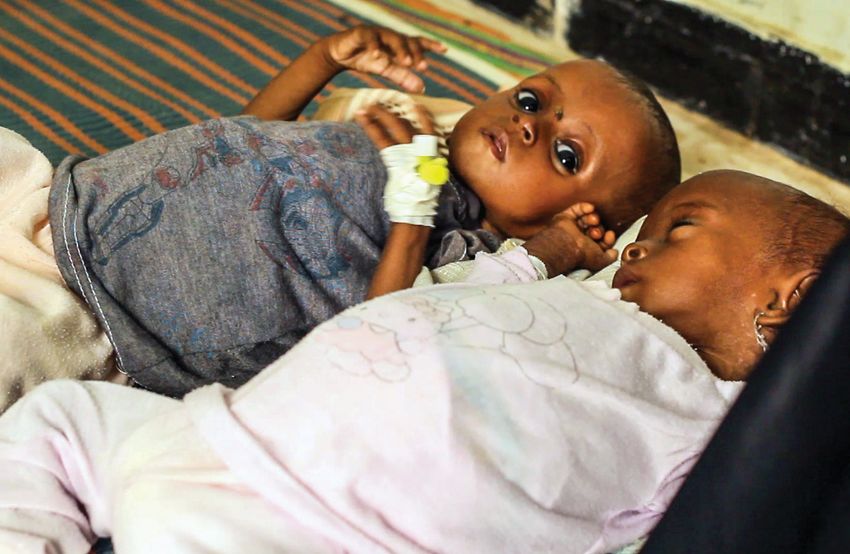
01 COMPLICATED
DELIVERY
After four years of conflict, the Today, the ability of Yemenis to access private or public
medical and humanitarian situation healthcare has dramatically diminished, as the conflict
has ravaged the economy and devalued people’s savings.
in Yemen continues to deteriorate Receiving treatment in a private clinic was a significant and
01
due to violent clashes, continuous widely affordable part of Yemen’s pre-conflict health system,
but this is now out of the reach of all but a limited section
airstrikes, political interference in aid
of Yemeni society, leaving the vast majority reliant on a
operations by warring parties, and hollowed-out public health service.
an economic maelstrom in what The country is exceptionally dependent on imports of food
was already the poorest country in and fuel. Before the escalation of the conflict, 80 to 90
the Middle East. percent of staple foods and an estimated 544,000 metric
tons of fuel were imported each month.2 Currently, only
around half of the fuel that Yemen needs is entering the
For Yemenis living through this protracted crisis, getting hold of country, causing increased transport and energy costs. This
the essentials of daily life is a constant struggle. This is especially has negatively affected all sectors of the economy, and hit the
true of medical care, as Yemen’s public health system is far from poorest people hardest.
meeting the needs of the country’s 28 million people.
While medical needs are significant across all demographic
In March 2015, the conflict in Yemen escalated when Ansar groups, those of mothers and children are alarming. Despite
Allah (also known as the Houthi movement) took control weaknesses in Yemen’s public health system before 2015,
over Sana’a and continued advancing south, then the Saudi there had been a steady decline in infant and maternal
and Emirati-led coalition (SELC) started its campaign of aerial mortality. However, since the outbreak of the current conflict,
bombardment in support of the internationally recognised these improvements have reversed.3
Government.
The reduced number of functioning health facilities, the
Since 2015, Yemen’s public health infrastructure has collapsed economic damage wrought by the conflict, and the physical
under the strain of displacement, violence and health authority barriers of active fighting and shifting frontlines, all combine
funding cuts, as well as the dissolution – and duplication – of to make reaching medical care a difficult and often dangerous
state institutions. According to the World Health Organization, process. As a result, women and children often arrive so late at
of the 3,507 health facilities it surveyed in 2016, more than medical facilities that their lives cannot be saved.
50 percent were either non or partially functional. The same
survey reported just 6.2 hospital beds per 10,000 people were
available – well under the recommended minimum of 10 per
beds per 10,000 people. It also found that 42 percent of the
districts surveyed had just two doctors, or fewer, present.1 1 World Health Organization, Health Resources Availability
Monitoring System (HeRAMS) – Yemen, November 2016, https://
The lack of functioning health facilities and public www.who.int/hac/crises/yem/sitreps/yemen-herams-infographic-
november2016.pdf?ua=1
vaccination programmes has seen a resurgence of deadly
2 Yemen Economic Monitoring Brief – Winter 2019 (Accessed
vaccine-preventable diseases such as cholera, measles and March 2019)https://reliefweb.int/report/yemen/yemen-
diphtheria, while disruption to the movement of medical economic-monitoring-brief-winter-2019-enar
3 Naseeb Qirbi and Sharif A Ismail et al.; Health Policy
and humanitarian aid is commonplace. and Planning (2017) https://academic.oup.com/heapol/
article/32/6/911/3591753
4 Complicated delivery The Yemeni mothers and children dying without medical care Complicated delivery The Yemeni mothers and children dying without medical care 5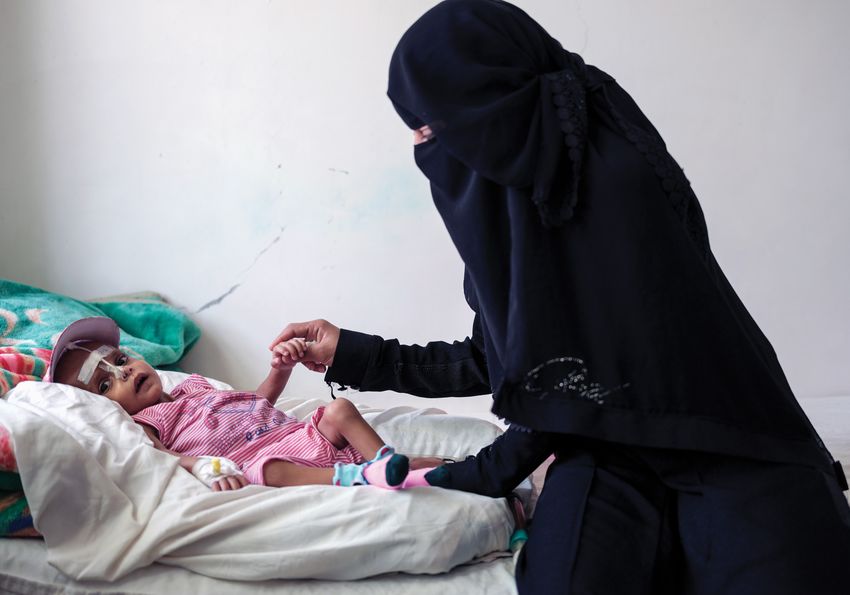
MSF IN YEMEN
              METHODOLOGY AND LIMITATIONS                                                                                                                               MSF has scaled up its work
             Methods                                                                                                                                                    in Yemen since the conflict
             Information was collected between November 2018 and February 2019.                                                                                         escalated in 2015. Today, MSF
             10 semi-structured individual interviews with patients, caretakers and                                                                                    runs 12 hospitals and health
              medical staff in MSF’s Taiz Houban mother and child hospital in Taiz                                                                                      centres across the country.

                                                                                                         20 11
              governorate, and 10 semi-structured individual interviews with patients
              and staff in an MSF-supported hospital in Abs, Hajjah governorate.            MSF also                       hospitals             governorates: Abyan,
                                                                                            provides                       or health             Aden, Amran, Hajjah,
             Additional information                                                         support to                     facilities            Hodeidah, Ibb, Lahj, Saada,
             Health data and indicators from MSF medical reports from these                more than                      across                Sana’a, Shabwah and Taiz.
              facilities were collected between 2016 and 2018.

                                                                                            81,102                                                                        2,200
                                                                                            From March 2015 to December 2018, MSF teams performed                         As of 2019, MSF has
             Patient sampling
             Convenience sampling of patients and caretakers was used in the
             neonatal, maternal and paediatric departments within the two hospitals.

             Limitations and potential bias                                                                                                                               international and locally-hired staff
             The locations were chosen on the basis of MSF’s presence at the facility.                                                                                    in Yemen
             It was not possible to access the wider community to assess their
             barriers to accessing healthcare. The issues raised cannot be said to be
             representative of the challenges facing mothers and children across
             the entire country. The report also cannot conclude which barriers to
                                                                                            surgical interventions
             healthcare had a greater impact on mothers’ and children’s ability to

                                                                                            119,113
                                                                                            Provided treatment to
             reach the MSF facilities compared to others.

             Although this report focuses specifically on MSF’s work in both the Taiz and
             Hajjah governorates, the conclusions and recommendations of this report
             are drawn from MSF’s operational experience throughout the country.            patients with injuries related to war and violence

             Having interviewed solely those who managed to access an MSF-run/              Delivered

                                                                                            68,702
             supported facility, this report likely underestimates the scale of the

                                                                                                                                                                          700
                                                                                                                                                                          and provides incentive payments to
             challenges facing those who never make it to an MSF facility. As the
             facilities chosen were analysed with a focus on the provision of care to
             mothers and children, it has not been possible to compare their access
                                                                                            newborn babies
             to healthcare to that of adult males.

                                                                                            and cared for more than                                                       Ministry of Health staff across

                                                                                            116,687
             Participants were also aware that the interviews were being conducted                                                                                        the country.
             by MSF, which possibly led to some social desirability bias in the findings.

                                                                                            suspected cholera cases.

6 Complicated delivery The Yemeni mothers and children dying without medical care                                                                Complicated delivery The Yemeni mothers and children dying without medical care 7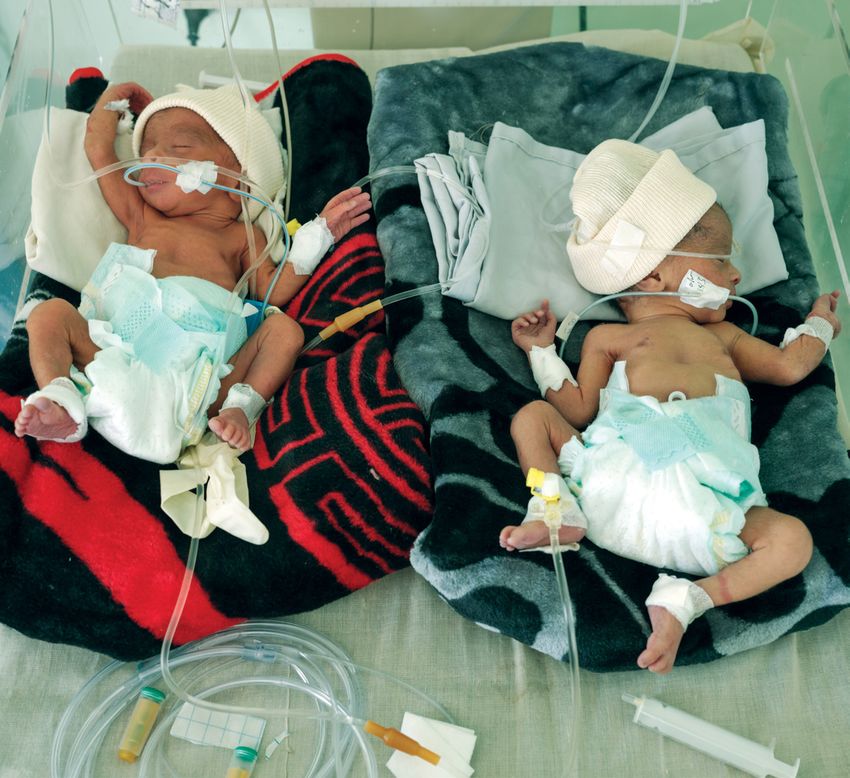
02 TAIZ HOUBAN MOTHER
AND CHILD HOSPITAL AND
ABS HOSPITAL, HAJJAH
Taking a look at two facilities where Taiz Houban mother and child hospital provides
MSF is providing free healthcare – the free healthcare to children under five and women of
reproductive age, including the management of complicated
MSF-run Taiz Houban mother and deliveries, neonatal care and a therapeutic feeding
child hospital and the MSF supported
02
programme. Since opening, demand for these services has
been high and has increased year on year – doubling from
hospital in Abs – offers an insight
4,100 deliveries in 2016 to 8,443 deliveries in 2018. In
into some of the challenges facing 2018 alone, the hospital saw 6,915 inpatient admissions and
mothers and children in Yemen. admitted 1,432 malnourished children to its therapeutic
feeding programme.
MSF established its Taiz Houban mother and child hospital In the district where the hospital is located, there is no
in late 2015, converting a local hotel into a 130-bed public hospital for a population of approximately 263,871.
hospital and trauma centre to try and address some of the Given the lack of public hospitals, the number of referrals
healthcare needs in Taiz governorate. Houban is a suburb made by MSF from Taiz Houban to private hospitals has
of the city of Taiz, which has been divided by an active also been increasing year on year since 2015. In 2018, MSF
frontline since 2015. Fighting has left many health facilities referred 3,322 patients to private health facilities to receive
out of operation or out of reach and displaced many care that it lacked the capacity to provide.
healthcare workers from the city. Those facilities that still
Returning from a recent visit to Taiz Houban, Christian
function often lack vital drugs and staff.
Katzer, MSF’s operations manager for Yemen described
Health facilities themselves often come under attack. the experience of one patient: “I was particularly touched
On 2 December 2015, an airstrike by the SELC hit the by the story of one heavily pregnant woman. This woman
immediate vicinity of an MSF tented clinic located in came from some distance away and had spent a lot of
Houban. The attack injured nine people including an MSF money on transport to reach MSF’s mother and child
health educator and a guard. Although airstrikes have hospital – money that the family had had to borrow from
significantly reduced in frequency over the past two years neighbours. When they reached the hospital, we had so
in Taiz governorate, fighting on the frontline of the city has many women giving birth that we had actually had to close
made Taiz one of the most dangerous regions of the country. our maternity admissions. The 130-bed hospital was at
full capacity. It’s heartbreaking for our staff to have to
turn away pregnant women who are desperately in need
“Taiz used to be one city. Houban is on the of medical care. In the end, we were able to find space for
outskirts of the city, and when the frontline the woman to give birth, but it isn’t always possible.”5
cut the city in two, most if not all of the
surgical hospitals were left on the other side
of the frontline. On the Houban side, where
we are now, there was no public hospital
providing any maternal or paediatric care.
Now what used to be a 10-minute drive
across the city takes up to seven hours, over 4 Interview with MSF head nurse Karolina at Taiz Houban,
and around the mountains.” November 2018
5 Interview with MSF operations manager Christian Katzer
Karolina, MSF head nurse, Taiz Houban4 at Taiz Houban, April 2018
8 Complicated delivery The Yemeni mothers and children dying without medical care Complicated delivery The Yemeni mothers and children dying without medical care 9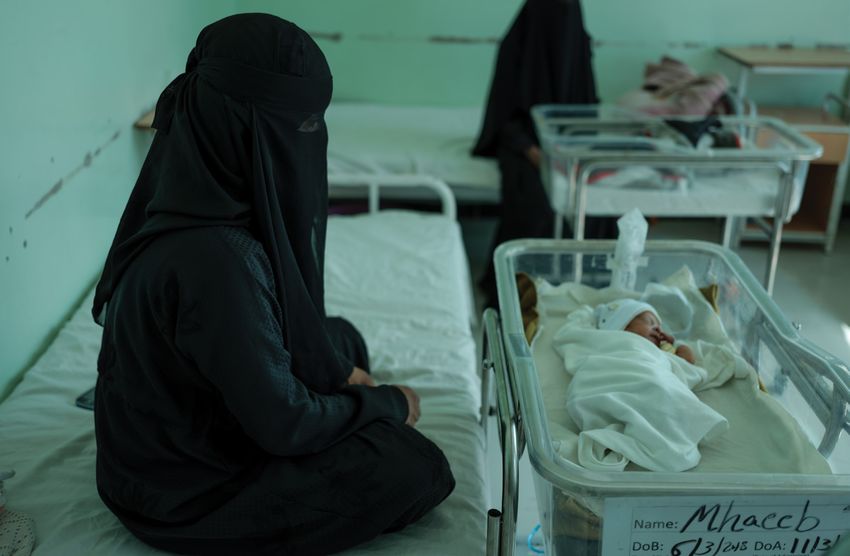
YEMEN HAJJAH YEMEN TAIZ
AL
HUDAYDAH
IBB
Shara’b Ar
Rawnah
Shafa’b AL DHALE’E
As Salam
At Ta’iziyah
At Ta’iziyah
Mawiyah
Maqbanah Sabir Al Mawiyah
Jabal Dimnat
Habashy Sabir Al Khadir
Mawadim
Ad Dimnah
Yafrus
Al Misrakh
TAIZZ Al
Misrakh
Al Mukha Sama
Harad As Silw
Mawza Al Ma’afer
5
Harad Al Mawasit
S 2311 Hayfan
Hayran Mustaba
Dhubab Ash
0 St
Shamayatayn
ree
t
N2 6
Taiz
Al Hadad a Ro
ad
Houban
na
Sa
S 2211 2
Al Wazi’iyah
Taiz
Abs Governorate Boundary
Bab Musa
A 52 Al-Mahabis District Boundary
Frontline Roads
Road Contested area
10 Complicated delivery The Yemeni mothers and children dying without medical care Complicated delivery The Yemeni mothers and children dying without medical care 11In Hajjah governorate, MSF has been supporting Abs
hospital since 2015 in collaboration with local health
authorities.
Since opening, demand for “Imagine my situation;
the services has been high imagine how painful this
and has increased year on
Abs is located in the northwest of Yemen. Bordering Saudi
Arabia, the area has seen some of the conflict’s worst year – doubling from
all was in my state of
pregnancy, being delayed
violence, with airstrikes and displacement a feature of life
for its residents. Between 26 March 2015 and 24 March 4,100 at checkpoints like this.
2018, the Yemen Data Project reported 1,617 airstrikes
deliveries in 2016 to I suffered a lot, with the
8,443
in the governorate. Following an increase in shelling from
the Saudi border in March 2015, large numbers of people unpaved roads and the
fled towards the south of the governorate, which led to the checkpoints.”
establishment of settlements for internally displaced people deliveries in 2018.
(IDPs) in the region.6 In 2018 alone,
the hospital saw
6,915
Before 2015, the governorate – specifically its western
areas – was affected by malnutrition and scarcity of water.
Now, as a result of the conflict, both displaced people and
host communities suffer from the decreased availability of inpatient admissions
healthcare and the rising prices of basic commodities. and admitted
Abs hospital was bombed by the SELC in August 2016,
killing 19 people and wounding 24. On 12 June 2018, an 1,432
MSF cholera treatment centre was again attacked by the malnourished children
SELC. Fortunately no one was killed in this attack as the to its therapeutic
centre was not yet open. feeding programme.
After increasing the capacity of Abs hospital from 30 beds
to 200 today, MSF supports the emergency room, inpatient
department, operating theatre, maternity ward, inpatient
therapeutic feeding centre, laboratory and sterilisation
unit, as well as outreach activities in the surrounding areas.
A referral system allows emergency cases to be transferred
to Hajjah or Sana’a.
© Matteo Bastianelli
Two mothers with their
children inside the MSF run
Mother and Child Hospital in
6 Yemen Data Project, http://yemendataproject.org/ Taiz Houban. Yemen
data/, accessed 5 March 2019
12 Complicated delivery The Yemeni mothers and children dying without medical care Complicated delivery The Yemeni mothers and children dying without medical care 1303 ACCESS TO
MEDICAL CARE
Before the escalation of the conflict, services within the community, women are waiting
until the last minute to make the dangerous journey
Taiz governorate had nine public
to receive care.”7
hospitals. Five of these were located
03
in Taiz city, which is home to some Traditionally, women in Yemen give birth at home with the
assistance of birth attendants, rather than delivering in
615,000 people, according to the hospital. When complications occur, access to care was a
country’s 2014 census. much simpler process before the outbreak of the conflict
than it is now.8 Current difficulties in accessing healthcare
mean that medical complications during pregnancy have
As of March 2019, no public hospital in Taiz governorate become much more deadly.
is fully functioning. Three of the five hospitals in Taiz city
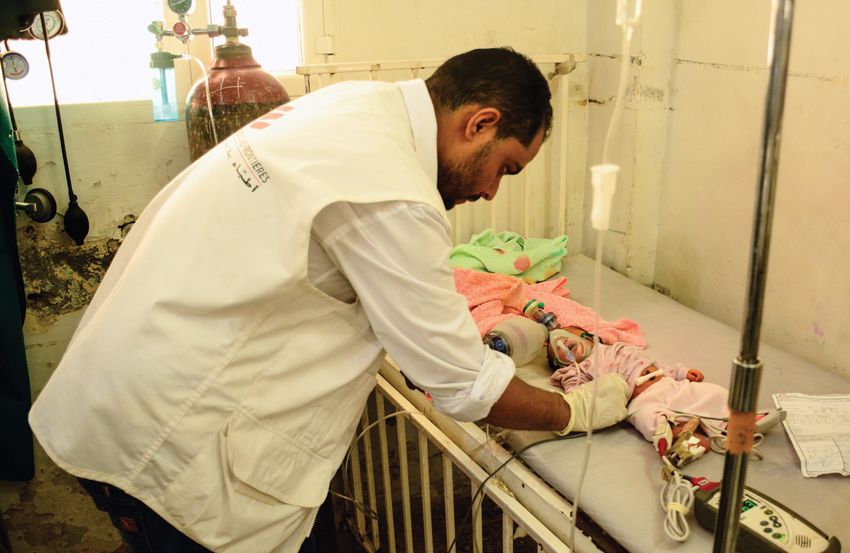
centre remain partially open, with support from MSF As a result of not being able to access basic emergency
and other international non-governmental organisations obstetric and newborn care, 70 percent of women arriving
(INGOs). However, the hospitals do not provide the at MSF’s Taiz Houban hospital suffer from life-threatening
same level of services they did before the conflict and complications including obstructed labour, prolonged
are not easily accessible for those living across the labour, pre-eclampsia, eclampsia, uterus rupture and
frontline in Houban. From time to time, MSF’s Taiz post-partum bleeding. As a result, they need high-level
Houban hospital receives patients who have crossed the comprehensive emergency obstetric and newborn care.
frontline – not only to receive better quality healthcare,
but also to be in a safer hospital environment. MSF- Without community-based health clinics providing
supported hospitals in Taiz city centre are hit by warring antenatal care, complicated pregnancies go undiscovered
parties regularly and their safety and security is often until it is time to give birth. Adequate screening would
compromised by armed groups operating in and around allow pregnant women to be referred to MSF’s Taiz
the hospital compounds. Houban hospital in time and would likely reduce the
pressure on the hospital, as it would have fewer emergency
MSF’s hospital manager in Taiz Houban describes the cases to care for.
situation in Taiz governorate: “Primary healthcare
services are not fully functioning and have not been in MSF nurse Zainab, who works in Taiz Houban, describes a
a long time. More often than not they are not staffed recent patient: “I remember a woman who tried to give birth
by healthcare professionals and, if they are, the staff at home but could not due to complications. Her home was
are not usually trained in the management of the cases far from the MSF hospital and, when she arrived, she was
presented. Without sufficient capacity or trust in these suffering from uterine rupture and her baby was dead. The
doctors hurried to perform an emergency operation for her
as she was bleeding heavily. We expected the woman to die,
7 Interview with Taiz Houban hospital manager Rachel but she lived.” 9
at Taiz Houban, November 2018
8 Naseeb Qirbi and Sharif A Ismail et al.; Health Policy “I have four children at home and the fifth
and Planning (2017) https://academic.oup.com/heapol/
article/32/6/911/3591753 one is here in the hospital. It took us six hours
9 Interview with MSF nurse Zainab at Taiz Houban, to get here. We do not have [hospitals in
November 2018 our village]. The hospital is so far.”
10 Interview with patient Khamisa from Al Wa’shah village,
Taiz, at Taiz Houban, November 2018 Khamisa, patient at Taiz Houban, from Al Wa’shah, Taiz10
Complicated delivery The Yemeni mothers and children dying without medical care 15© XXXX
As in Taiz governorate, the lack of functioning health
“It was the time to
centres is also a challenge facing communities in Abs,
Hajjah governorate. Women arriving at the MSF-supported
maternity ward in Abs often describe the long and difficult give birth to the baby.
journeys they made to get there.
We were looking for
Sadeqa, an MSF midwife in Abs, says: “This distance from a car. If we arrived
medical care is a big problem. The areas around Abs are
mountainous. Sometimes patients are prevented from
late at the hospital,
travelling because of airstrikes and clashes. Many of the no one knew what
roads they use are unpaved and are very bad after it rains. would happen.”
Also, patients do not go out at night because they are afraid
they could be attacked. Once it happened that a car was hit
by an airstrike, killing everyone inside.” 11
“Imagine my situation; imagine how painful
this all was in my state of pregnancy, being
delayed at checkpoints like this. I suffered
a lot, with the unpaved roads and the
checkpoints. If this war was not happening,
I could go to any public hospital. But in
this situation of war, with checkpoints and
gunshots, we arrived at Taiz Houban in a
state of panic.”
Eftekar, patient at Taiz Houban, from Al Wazeera, Ibb 12
“A woman came here six months ago. Her
family took her to the health centre. They
gave her oxytocin. Her uterus was ruptured.
When she arrived here, it was too late and
she died. They came here with a hope that
they could save her, but she and her baby
died at the gate of the hospital.”
© Mohammed Almahdi/MSF
Safana, MSF midwife, Abs hospital 13
Bra’ah Fawzan - 6-day-old breathes from an
oxygen tube in the emergency room of Abs
11 Interview with MSF midwife Sadeqa at Abs Hospital, Rural Hospital, which has been run by MSF
since 2015. Bra’ah came from Khiran area by
Hajjah, January 2019 a taxi, where the roads are very rough. Khiran
12 Interview with patient Eftekar from Al Wazeera, Ibb, area is a contact area and it was bombed by
at Taiz Houban, November 2018 more than 50 airstrikes. It is about 100 km
away from Abs district.
13 Interview with MSF midwife Safana at Abs Hospital,
Hajjah, January 2018
16 Complicated delivery The Yemeni mothers and children dying without medical care Complicated delivery The Yemeni mothers and children dying without medical care 1704 THE IMPACT OF THE
ECONOMIC COLLAPSE
ON MEDICAL CARE
“The war has had a terrible impact on the 52 percent of Yemen’s population were living on less than
whole of Yemeni society – in terms of the US$1.90 per day.19
blockade, increased commodity prices,
In Hajjah and Taiz governorates, daily labourers can expect
insecurity and everything else that comes
to earn between 2,000 (US$3.4) and 6,000 (US$10.3) rials
04
with conflict. People are very poor and
per day, depending on whether they are unskilled labourers,
cannot afford the cost of a single medicine.” farmers or builders.20
Eftekar, patient at Taiz Houban, from Al Wazeera, Ibb14
“It was the time to give birth to the baby.
We were looking for a car. If we arrived
The high mortality rates witnessed by MSF in Taiz Houban
late at the hospital, no one knew what
are likely underpinned by the economic vulnerability faced
would happen. We found a car and the
by many families, which limits people’s freedom to choose
driver asked for 20,000 rials (US$35),
which medical facility to attend, if any. As of January 2019,
the Yemeni rial’s purchasing power is 148 percent lower
so we agreed.”
than in the pre-crisis period. The average weekly food bill Maryam, patient at Abs hospital, from Hajjah21
for Yemeni families has risen by 96 percent, while the prices
of diesel and petrol are up 98 percent and 106 percent Today, the cost of private healthcare in Taiz governorate
respectively.15 Since 2014, Yemen’s gross domestic product varies, but can often be costly. In one local hospital, the cost
has fallen by 29 percent, with the conflict causing wide- of an uncomplicated caesarean section is approximately
spread disruption to formal economic activities.16 US$160; the cost of neonatal care with an incubator is
US$16-24 per day; while one night in the intensive care
Before the escalation of the conflict in 2015, most medical unit costs around US$105. The overall cost of admission
services in Yemen were provided by private health facilities, to a private hospital for a few days could be US$400-500,
with the remainder provided by the Yemeni public health
service. Private healthcare was not free, but it was affordable
for many people. While private and public healthcare was 14 Interview with patient Eftekar from Al Wazeera, Ibb,
at Taiz Houban, November 2018
sometimes unavailable in rural areas, transport to nearby
15 WFP Yemen – Monthly Market Watch – January 2019,
towns was both available and affordable. https://www.wfp.org/content/yemen-monthly-market-
watch-2018, accessed 2 March 2019
As highlighted in MSF’s report Saving lives without salaries, 16 Yemen Economic Monitoring Brief – Winter 2019
(Accessed March 2019)
public workers including healthcare professionals, teachers https://reliefweb.int/report/yemen/yemen-economic-
and other government employees have received partial or no monitoring-brief-winter-2019-enar
salaries since August 2016.18 In 2018, payments of salaries 17 Increasing Health Care Access in Yemen Through
Community-Based Health Insurance (2016), Matthew Fuss,
were resumed for employees in the areas nominally under www.repository.law.indiana.edu/ijgls/vol23/iss2/14/
the control of the internationally recognised government 18 Yemen: Saving lives without salaries (MSF 2017), https://
of Yemen, but public sector workers in other areas are still www.msf.org/yemen-government-health-staff-are-saving-
lives-without-salaries
waiting for their salaries to be paid in full, according to MSF 19 The World Bank, Yemen’s Economic Outlook - October
Yemeni staff. 2018, https://www.worldbank.org/en/country/yemen/
publication/economic-outlook-october-2018
As public sector salaries accounted for 37 percent of public 20 Daily rates derived from conversations with MSF staff in
Taiz Houban and Abs
expenditure in 2012, the reduced payment of these salaries is 21 Interview with patient Maryam from Hajjah, at Abs
having a major impact on Yemen’s population. In 2018, some hospital, January 2019
Complicated delivery The Yemeni mothers and children dying without medical care 19which could rise as high as US$1,500 for complicated cases
© MSF
requiring specific procedures and a longer hospital stay.
“The driver told us that
As demand continues to outpace capacity, MSF’s ability the route is dangerous
and they would be taking
to refer patients could plateau, leaving nowhere to refer
complicated cases.
a risk by driving us to the
hospital. We were so scared
MSF’s hospital manager in Taiz Houban says: “Previously
people had a little bit of money, allowing them to seek
care in local private clinics and afford transport. Now, as because the coalition
resources are tighter, they are delaying their arrival at the
remaining medical facilities, including our one, which is free.
attacks anything. They
One example is a child [being cared for at a private clinic] in attack the passengers, the
Sana’a, where the family paid for the operation but could not houses, the hospitals and
afford the aftercare. So they disconnected the child from
the oxygen and intravenous fluids and travelled for eight
the health centres.”
hours to bring the child here to us. When the child arrived, it
was at its last breath. They brought the child here thinking
we could care for the child – which we could and would have
done – but at that point it was too late. We did what we
could, but sadly the child passed away. It is distressing that
families have to go to these extremes.”22
The damage to Yemen’s economy – compounded by the
lack of public sector salaries – has also affected Hajjah
governorate, where many people struggle to provide the
basics for their families.
MSF midwife Sadeqa in Abs hospital says: “Most of the
medical facilities that remain in the governorate are private.
The public ones are either closed or not equipped with
medical staff or equipment, and are not ready to receive
patients. The private facilities that still function ask the
patients to pay a lot of money. People are poor. Some of
them do not go to hospitals because they cannot pay for
the expense, or else they come here because it is free.”23
Kholah and Saher were
22 Interview with MSF midwife Sadeqa at Abs malnurished and dehidrated.
Hospital, Hajjah, January 2019” Once in hospital they were
fed milk, as they hovered
23 Interview with MSF nurse Zainab at Taiz Houban, between life and death.
November 2018
20 Complicated delivery The Yemeni mothers and children dying without medical care Complicated delivery The Yemeni mothers and children dying without medical care 2105 SAFETY AND SECURITY
WHEN SEEKING MEDICAL
CARE
“The long distances, the explosions and the In Abs hospital, Hajjah, multiple patients spoke of their
clashes make the patients come late. We fear of the threat of airstrikes in the governorate when
ask them ‘Why are you late? Why did you attempting to access healthcare. Many said they would
not come early?’ They answer that they not risk travelling at night for fear of robbery or being shot
05
travelled from 6 am and arrived at midnight. approaching a checkpoint in the dark.
The clashes and the blocked roads made
Khattab, MSF’s mental health manager in Abs, describes
them late. Therefore we receive terrible the situation: “Abs hospital itself was targeted before, and
cases: premature birth, bleeding, dead fetus. the whole Abs area has suffered many airstrikes over the
Mothers lose their lives. When we ask their course of the war. This has put huge pressure on people
families why they came late, they tell us it is from the governorate and makes people afraid they will be
because of the security situation and their attacked on the road or even that the hospital will be hit
economic conditions.” again. We have many patients showing symptoms of post-
Zainab, MSF nurse, Taiz Houban24 traumatic stress disorder who are extremely fearful of loud
noises. Even the sound of a motorbike starting can be very
Due to the myriad armed groups and ongoing hostilities, upsetting for patients.”28
travelling to a medical facility can be a dangerous
experience, especially for those crossing frontlines. The “The driver told us that the route is
multiple checkpoints between territories controlled by dangerous and they would be taking a
different warring parties are often points of extreme risk by driving us to the hospital. We were
tension and violence. Over the course of 2018, 4,836 so scared because the coalition attacks
incidents of armed violence had a significant impact on the anything. They attack the passengers, the
civilian population of Yemen. Thirty-two percent of these houses, the hospitals and the health centres.”
violent incidents involved women and children.25 Maryam, patient at Abs hospital, from Hajjah 29
While the majority of those who attended MSF’s Taiz
Houban hospital did not have to cross frontlines some of
those that did spoke of the risks. Abdulkhabeer, a patient
caretaker from Ibb governorate says: “We left at one in the
early morning and, while we were on the road, bandits shot
at our car, three bullets, but we survived.” 26
Eftekar, a patient, also from Ibb governorate echoed the 24 Interview with MSF nurse Zainab at Taiz Houban,
November 2018
risks of reaching Taiz Houban: “The road from home to the
25 Civilian Impact Monitoring Report Annual 2018 (Accessed March
hospital is not safe. In the past, we can take pregnant women 2019) https://www.humanitarianresponse.info/en/operations/yemen/
to the hospitals at night but now we cannot, as the cars are document/civilian-impact-monitoring-report-annual-2018
26 Interview with caretaker Abdulkhabeer from Al Mudaikera, Ibb,
not allowed to move at night. We keep watching the pregnant
at Taiz Houban, November 2018
women in our community suffering and dying. If it is a critical 27 Interview with patient Eftekar from Al Wazeera, Ibb, at Taiz
case, we can take them by car at night, but there is a risk we Houban, November 2018”
will be shot. Movements are allowed only from 6 am to 6 pm. 28 Interview with MSF mental health manager Khattab at Abs
hospital, Hajjah, February 2019”
Before the war, it was safe to take the pregnant women to 29 Interview with patient Maryam from Hajjah, at Abs hospital,
hospital in Al Rahedah [40 km from Houban] anytime.” 27 Hajjah, February 2019”
Complicated delivery The Yemeni mothers and children dying without medical care 23© Nuha Mohammed
HUMANITARIAN ACCESS
IN YEMEN
Despite the needs that exist in Yemen,
access by humanitarian organisations to
the most vulnerable populations is often
hampered by restrictions placed on them
by parties to the conflict.
For MSF teams in Yemen, access –
especially to rural and district communities
in areas close to frontlines – remains a
significant challenge.
Overly bureaucratic and cumbersome
procedures delay the issuing of visas to
Yemen for medical and non-medical
humanitarian staff. This has a deeply
negative impact on the capacity of MSF to
deliver quality, timely medical care to our
patients in projects around the country.
Similarly, bureaucratic delays by authorities
under the control of the parties to the
conflict impede the rapid importation and
movement of lifesaving medical supplies
into and around the country. This is having
a negative knock-on effect – threatening to
disrupt medical supplies for our activities
and slowing down our ability to swiftly
respond to outbreaks and other medical
emergencies.
Taken together, these constrain
humanitarian operations in the country and
threaten to compromise the provision of
uninterrupted medical care in MSF facilities.
“People are poor.
Some of them do not
go to hospitals because
they cannot pay for the
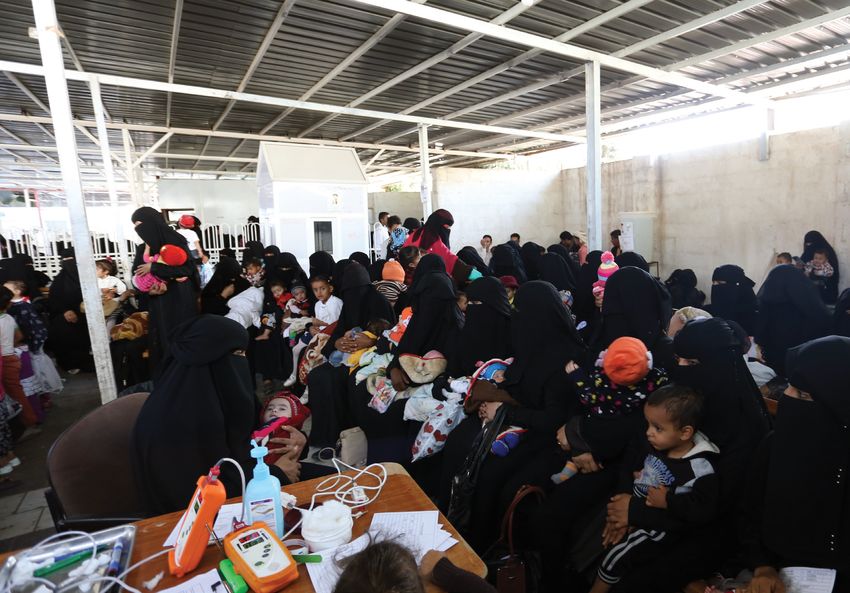
expense, or else they Mother’s and their children waiting their
come here because turn at the triage and waiting area in the
outpatient department in the mother
it is free.” and child Hospital. Taiz Houban, Yemen.
24 Complicated delivery The Yemeni mothers and children dying without medical care Complicated delivery The Yemeni mothers and children dying without medical care 2506 MEDICAL CONSEQUENCES
OF IMPEDED ACCESS TO
HEALTHCARE
TAIZ HOUBAN MSF’s hospital manager at Taiz Houban says: “Last month
MSF is witnessing the deadly consequences of people’s in our emergency room we had 10 cases of children arriving
difficulties accessing medical care on a daily basis. Between dead. Of those 10 deaths, four were clearly the result of
2016 and 2018, there were 860 deaths of reported in Taiz travelling for several days to get here. If they had lived closer
06
Houban – 17 mothers, 242 children and 601 newborns. to MSF’s hospital or had had the ability to pay for transport
Of these deaths, almost one-third (227) were children and or medicines to treat a simple chest infection, it would not
newborns who were dead on arrival. have resulted in such a serious outcome as the child dying.”30
The number of children and newborns who were dead
ABS
on arrival at Taiz Houban increased from 52 in 2016, to
In the MSF-supported hospital in Abs, MSF has witnessed
72 in 2017, to 103 in 2018.
a similar situation unfold. Between 2016 and 2018 the
The desperate need for medical care of the children arriving facility recorded the deaths of 705 people – 19 mothers,
at Taiz Houban is further exemplified by the 170 children and 269 children and 417 newborns. Among the 417 neonates,
newborns who were alive on arriving at the facility but died 106 died on the day of arrival.
within the following six hours. Children under one month old
In the neonatal department, 65 percent (1,338/2,058)
made up the majority of these deaths (71 percent).
of all admissions during the period were of children born
Overall, newborn babies – under the age of one month old outside the MSF-supported hospital, many presenting with
– accounted for 71 percent of child deaths in Taiz Houban low birthweight. In mothers, pre-eclampsia, eclampsia and
(601/843). Many newborns brought to MSF for care have a low conditions such as post-partum bleeding and rupture of
birthweight or were born prematurely, either at home or in small the uterus are not uncommon. Within MSF’s maternity
private clinics. The most common causes of deaths in neonates department in Abs, 19 percent (2,312/12,306) of children
were prematurity, birth asphyxia and severe infections (sepsis). born in the hospital were of a low birthweight.
30 Interview with Taiz Houban hospital manager Rachel at
Taiz Houban, November 2018
Complicated delivery The Yemeni mothers and children dying without medical care 273-year-old Hassan, suffering from Thrombocytopenia
Anaemia and malnutrition, is seen playing with
his aunt on a bed inside the Inpatient Therapeutic
Between 2016 and Feeding Center, a department of the “Mother and
2018, there were Child” Hospital. The aunt brought him to the hospital
860
with very challenging condition after she have been
told, in other facilities, “that there was nothing to do
for him.” MSF doctors managed to save his life and
now they call him the “miracle baby”.
Taiz Houban, Yemen
deaths reported
in Taiz Houban
17
mothers
242
children and
601
newborns. Of
these deaths,
almost one-third
227
were children and
newborns who were
dead on arrival.
“Taiz used to be one city.
Houban is on the outskirts
of the city, and when the
frontline cut the city in
two, most if not all of the
surgical hospitals were
© Matteo Bastianelli
left on the other side
of the frontline.”
28 Complicated delivery The Yemeni mothers and children dying without medical care Complicated delivery The Yemeni mothers and children dying without medical care 2907 CONCLUSION
“When we look at our statistics, we would have • A quicker and more transparent procedure is needed for
to build five mother and child hospitals in humanitarian staff to be able to obtain the necessary visas
Taiz governorate to provide enough care and to enter Yemen.
coverage for the people of the governorate,
• Additional humanitarian organisations should begin
07
but that is not possible. A more coordinated
operations in Yemen and their registration process should
approach and a stronger presence of other
be facilitated and expedited by local authorities.
INGOs could be a way to strengthen primary
healthcare services and allow us to focus on
• Humanitarian actors in Yemen should increase efforts to
treating the complicated cases.”
ensure that experienced and specialist staff are in place
Rachel, MSF hospital manager, Taiz Houban31
to oversee the implementation and quality control of
humanitarian activities.
The warring parties in Yemen and their international
backers have allowed a situation to unfold where one of the • The importation of lifesaving drugs and their movement
country’s most vulnerable sections of society – mothers and around the country should be unburdened from any
children – are unable to reach adequate medical care in a unreasonably protracted bureaucratic procedures and/
safe and timely manner, with deadly consequences. or duplications of administration that lead to ruptures in
supply and shortages.
Humanitarian organisations in Yemen operate in an
environment of deep suspicion and intimidation – often • Humanitarian organisations’ access, and permission to
hampering their ability to reach the most vulnerable. Although work in, rural and district-level areas needs to be opened
MSF maintains a presence in some of the most challenging up by the warring parties. This would allow for adequate
areas of Yemen, it is limited in its access to rural communities, implementation and supervision of medical humanitarian
especially those living close to areas of active fighting. programming such as community primary healthcare
clinics, health promotion activities, outreach activities
Despite the efforts of international organisations and
and vaccination initiatives.
INGOs in the country, the obstruction of humanitarian
assistance and the lack of access to communities living near
frontlines is crippling their ability to improve overall health
outcomes for the Yemeni population.
RECOMMENDATIONS
• International humanitarian law must be respected by all
parties to the conflict. Attacks on medical facilities must
cease and the protected status of civilians and medical
and humanitarian staff must be respected. As part of this,
from the local to international level, the warring parties
need to improve their awareness of and obligations under
international humanitarian law and abide by them.
31 Interview with Taiz Houban hospital manager, Rachel,
at Taiz Houban, November 2018
30 Complicated delivery The Yemeni mothers and children dying without medical care Complicated delivery The Yemeni mothers and children dying without medical care 31www.msf.org
You can also read


