Conference proceedings - eTwinning Indire
←
→
Page content transcription
If your browser does not render page correctly, please read the page content below

Conference proceedings
Conference proceedings
Ideation: eTwinning Italy NSS Indire - www.etwinning.it

Editorial coordination: Lorenzo Mentuccia, eTwinning NSS Italy, Indire

Design and layout: Miriam Guerrini, Indire Communication Office

Print: Ediguida

The views expressed in this publication are those of the authors and not necessarily those of Indire or
the eTwinning Italy NSS. This book is published under the terms and conditions of the Attribution-Non
Commercial-Share Alike 3.0 Unported Creative Commons licence. This publication was created with the
financial support of the Erasmus+ Programme of the European Union. This publication reflects the views
only of the authors and the European Commission cannot be held responsible for any use that may be
made of the information contained therein.

Florence, October 2018

ISBN: 9788899456450

This publication is a collection of the proceedings of the eTwinning Thematic Conference
“Empowering eTwinning Schools: Leading, Learning, Sharing”, held in Rome (Italy) on May 14-16,
2018.

Hosted by the Italian eTwinning National Support Service (NSS), the Conference was organized
in collaboration with the eTwinning Central Support Service (CSS), EACEA, the European
Commission, the Italian National Agency Erasmus+/INDIRE, and the other NSSs and PSAs
participating in the event.

Context

The eTwinning School Label recognises the work of schools who are deeply engaged in eTwinning
and encourages these leading schools to become proactive in supporting and become a model
for other schools at local and national level. The concept of “eTwinning school” is multifaceted.
On one side, it is closely aligned to the educational policy priorities of the European Commission
as outlined in a recent report “Teachers and school leaders in schools as learning organisations”.
On the other, it makes indirect reference to the concept, expounded in educational research
studies, that teachers are “leaders of change” by establishing new forms of professional
relationships with their colleagues based on sharing and peer mentoring. The individual teacher
can make significant change in the school when management creates the necessary conditions
that favour collaboration amongst colleagues.

The eTwinning School also makes reference to the notion of “Distributed leadership” and the
capability of the school management to recognise the in-depth knowledge and the expertise
of teacher leaders. This is implemented by creating the opportunities for teachers to develop
further, and through identifying and enhancing the conditions in the school for the sharing of
experiences and good practice, thus making the school a “learning organisation”.

Such elements are certainly present in all eTwinning Schools to various degrees, but they may
not be necessarily visible, formalised, sharable and scalable.

Conference objectives

The overall goal of the Conference was to identify, highlight, feature, recognise and promote the
elements which characterise the eTwinning Schools, so that they can be further nurtured within
and beyond the school itself. Only schools who fully capitalise on the results achieved will be able
to act as models, promoters and multipliers for others.

More specifically, the conference aimed at:
   • Featuring and further reflect on the pedagogical, organisational, communication and
      promotional elements of the eTwinning School
   • Providing participants tools and methods to leverage on the success of the eTwinning
      School to become a stronger ‘learning organisation’
   • Validating the idea of a network of eTwinning Schools
   • Preparing the ground for the further development of the eTwinning School concept
Event Details

Participating countries: Armenia, Austria, Azerbaijan, Belgium, Bosnia and Herzegovina, Bulgaria,
Croatia, Cyprus, Czech Republic, Denmark, Estonia, Finland, France, Georgia, Germany, Greece,
Iceland, Ireland, Italy, Lithuania, Luxembourg, Malta, Moldova, Norway, Poland, Portugal,
Romania, Serbia, Slovakia, Slovenia, Spain, Sweden, Turkey, Ukraine, United Kingdom.

Working language: English

Size of the event: 250 participants

Audience: School Heads, Deputies, school teachers with special coordinating tasks

Online Materials

All the materials (presentations and multimedia resources) are available at http://etwinning.
indire.it/etwinning-thematic-conference-rome-2018/

Contacts
More info on www.etwinning.net
Table of Contents
INTRODUCTION
Building the Future Together - Anne Gilleran, European Schoolnet                                  9
KEYNOTE SPEECHES
Shared Leadership: a mindset and tool to empower eTwinning Schools - Patricia                     15
Wastiau, European Schoolnet
Developing a whole school approach for promoting inclusive systems in and around                  21
schools: some issues for eTwinning? - Paul Downes, Dublin City University
Distributed Leadership, school improvement and student learning - Angelo Paletta,                 27
University of Bologna
WORKSHOPS
The eTwinning School Label                                                                        32
Online Safety for eTwinning schools: building an eSafety eco-system                               34
Threasure your eTwinning school team!                                                             36
Redesign the school space                                                                         38
Project based learning in the eTwinning School                                                    40
Use your voice to make your school known                                                          43
Shared leadership in practice: discussing case studies on schools’ leadership                     44
Leadership for resilient schools and communities                                                  46
New accountability systems to promote change in teaching practices                                49
From out of the map to the center of Europe: building a culture of inclusion through              52
eTwinning
A new tendency for school improvement: rethinking schools as learning organizations               54
Building safe, aware and inclusive schools in the digital era. Guidelines from the MEET project   56
Networking innovative schools. Avanguardie Educative, an Italian example                          60
Enhancing the School Leadership using the visual analysis methodology                             63

CONCLUSIONS
Empowering eTwinning Schools: from theory to practice - Santi Scimeca, European                   67
Schoolnet
Anne Gilleran
    European Schoolnet

8
INTRODUCTION
Building the future together
Anne Gilleran, eTwinning Senior Pedagogical Adviser European Schoolnet

When preparing this presentation, the word future in the title was a cause of contem-
plation as to which future we are thinking about here, the future of eTwinning?, the
future of our schools?, the future of our society?, the future of education in Europe?,
the future of Europe itself? In fact we need to think about all of these to some degree.

The It goes without saying that we live in a world today that is in a constant state of flux,
change and uncertainty. The educational needs of our young people are on one hand a
constant, they still need to be competent in literacy & numeracy but this is not enough
anymore to help their resilience to the changing nature of the world they live in.
Take for example the graph1 below. It plots the decline in manual and cognitive tasks of
a simple nature against the rise of analytic and interpersonal tasks in the labour market
in the USA. Our students need to be prepared for the tasks of interpersonal work style
and in-depth analysis of problems.

Let us look now at the priorities for European Education as stated in the Horizon 2020
manifesto
Priorities for the 2016-2020:
      • Relevant and high-quality skills and competences for employability, innovation,
        active citizenship and well-being (e.g. creativity, sense of initiative and critical
        thinking);

  1
   Source: Autor, David H. and Brendan M. Price. 2013. “The Changing Task Composition of the US Labor Market: An
  Update of Autor, Levy, and Murnane (2003).” MIT Mimeograph, June.

                                                                                               Introduction 9
• Inclusive education (i.e. including the increasing diversity of learners), equality,
             non-discrimination and the promotion of civic competences (e.g. mutual
             understanding and democratic values);
           • Open and innovative education and training, including fully embracing the digital
             era;
           • Strong support for educators (e.g. improved recruitment, selection and training
             processes as well as continuing professional development)
     These priorities touch not only the lives of our students, but also our lives as teachers
     as the objectives here go way beyond the traditional subject based curriculum into
     the interpersonal and analytic trend as we saw in the graph earlier. For us as teachers
     to achieve this, we need to be committed to long term continuing professional
     development.
     So how does eTwinning fit into this picture? Let’s look at the diagram below which cites
     eTwinning among 7 examples of innovation in ICT – enabled learning from Europe &
     Asia. So already eTwinning is receiving world-wide recognition as means of changing
     the educational paradigm.

     In 2018 eTwinning developed a new initiative. For the first time recognition for work
     done was extended to schools as a whole organisation to complement the long standing
     recognition in the form of quality labels for the work of individual teachers. This new
     initiative for schools is known as the eTwinning School Label. In April 2018, 1211 schools
     were awarded this label having passes two rigorous rounds of assessment2 But what

       2
        Further information on the criteria and assessment procedures may be found at https://www.etwinning.net/en/pub/
       recognition/etwinning-school-labels.htm

10
does it mean to be an eTwinning School? The title of this conference is ‘Empowering
eTwinning Schools, Leading, Learning. Sharing’; the vision for eTwinning schools is just
that, that they will be leaders in spreading the word of eTwinning, becoming hubs in
their communities of innovation and creativity. Our vision is that eTwinning Schools
will have a transformative effect on education, regionally, nationally and on a European
level. We see eTwinning schools as the professional development network for eTwinning
School leaders and teachers to build schools as learning organisations support systemic
educational change. Our challenge is how best to help the 1211 schools to act as agents
of change in their educational arenas.
A start has been made in several ways:
   • By providing symbols of recognition and leadership such as the eTwinning School
     Plaque, the letter from the European Commissioner, the digital badge for use on
     websites and printed material.
   • By providing tools of empowerment and sharing such as:
         -- A dedicated eTwinning Group for all eTwinning Schools
         -- Quarterly online meetings open to all eTwinning Schools
         -- 4 dedicated newsletters a year for eTwinning Schools
         -- An annual event for eTwinning Schools giving opportunity for them to
           meet and exchange
   • By providing continuous learning opportunities such as a specific online
     Professional development for eTwinning Schools in the form of a 6 weeks online
     course, specific learning events and online seminars
In addition to the above there is the ongoing work with the Ministries of Education
and the National Support Services for eTwinning.. We meet the representatives of the
Ministries twice a year to discuss eTwinning. During these meetings we will continue
to promote the potential of the eTwinning Schools in national educational agendas,
particularly in those countries who see the development of digital competence as a
priority and those who are working on programmes of integration and inclusion. Our
aim is that together we will build an active dynamic network to work on making the
future of education a reality at systemic level.
You may ask yourselves the question ‘ where do we begin?’ The answer to that is, that

                                                                          Introduction 11
it is probably best to begin at home. The table below shows the number of eTwinning
schools in a country v the number of registered eTwinning Schools in that country. As
you can see there is certainly work to be done, and the new Erasmus+ eTwinning School
Partnerships, recently announced by the European Commission, will certainly play a
role here.
So now you are eTwinning Schools, and your rewards have been mentioned and to a
certain degree what you can expect to receive, but what are your responsibilities? The
notion of distributed leadership has been discussed a lot during this conference and this
is your main responsibility: to share this leadership at every level, to promote eTwinning
and its opportunities, to encourage other schools to emulate your achievements, to
train other teachers and leaders and at all time to lead discussion about education,
educational change and what is best for our students in this time and this place, to truly
become hubs of innovation and agents of change.
12We can even talk in ideal terms of what attributes an eTwinning School may aspire to
Main attributes of the Ideal eTwinning School
1. Leadership
The school principal understands the possibilities offered by eTwinning both at a pedagogical
and professional level and is actively supporting staff involvement in eTwinning activities
2. Collaboration and team work
The teachers in the school work together as a team to plan their eTwinning activities and
share their experiences and practices with their other eTwinning colleagues. They collaborate
on providing an eTwinning action plan for their school
3. Communication
The eTwinning teachers disseminate their experiences of their eTwinning activities with the appropriate
audiences, other non-eTwinning colleagues, parents, local community representatives
4.Promotion
The school is committed to becoming a centre of excellence for other schools in their area/
region actively promoting eTwinning through as many means as possible.
5. Commitment to Professional Development
The eTwinning teachers in the school show commitment not only to their own professional
development but also the Professional Development of interested colleagues in their own
and other schools in their area. Any activities undertaken here are supported by the School
Principal
6. Involvement of pupils and students as eTwinning Ambassadors
If teachers and principals are the main leaders in the transformation of the school, pupils
should be seen as an essential element and actor in such transformation. Their role must be
foreseen as promoters towards other teachers but also as the most important sounding board
for all innovations taking place in pedagogy and use of ICT in education.
If all the eTwinning Schools can reach this ideal, grow it and encourage others to grow
with them, then they can change the path of educations for future generations. It is
fitting to end with a quote that is of the utmost relevance here: “We did not come here
to fear the future. We came here to change it”, Barack Obama.
Introduction 13KEYNOTE SPEECHES
Shared leadership: a mindset and a
                      tool to empower eTwinning Schools
                      Patricia Wastiau, Principal Adviser for Research and
                      Studies, European Schoolnet

Shared leadership is presented as a process of social influence focusing on interactions
between individuals in a school, enabling them to reach their objectives. Revealing all
teachers and other school staff’s potential and expertise, it builds the collective capacity
for teaching and school improvement. Applied within eTwinning, shared leadership can
reinforce professional development networking of change agents with an influence
within the classroom and the school, between schools, and beyond. Patricia Wastiau
articulated her key note speech around three main ideas. She first discussed the
concept of shared leadership and its purpose. She then explored the conditions for
shared leadership to be implemented and the challenges to be overcome. She finally
addressed the purpose of implementing shared leadership in eTwinning schools.

What is shared leadership and why does it matter?
Management versus leadership - Management focuses on the maintenance of current
organizational arrangements and ways of doing business (planning, organising,
coordinating people, goods, finances, etc.). While sometimes understood as a synonym
(especially by non-native English speakers), leadership is a different concept concerned
with shaping the future, inspiring people and motivating them to achieve their aims
and vision through a clear strategy. Leadership often focuses on actions intended to
influence relationships that are tied to the school’s core work defined as teaching
and learning; some practitioners and experts nonetheless (correctly) point out that
for school staff, the core work might be preserving the school and their positions.
Management activities, which are designed to produce stability, may differ substantially
from leadership activities designed to promote change. In school daily practice
though, what leaders do for management purpose, may nonetheless be an essential
component of leadership in general, and leadership for instruction in particular. For
example, maintaining scheduling arrangements (a typical action of management) for
teachers for them to meet with one another can enable instructional innovation (what

                                                                       Keynote speeches        15
is part of the leadership vision). Leaders who neglect managerial concerns, such as
respecting the constraints on the daily schedule, may have difficulties leading change.
Such observation from daily practice underlines that, while the management versus
leadership distinction is helpful for practitioners to efficiently and purposefully design
actions and strategy, it may be difficult to classify real context actions once implemented
as purely managerial or purely leadership as the same activity can be designed to meet
both organisational and leadership goals.
From leadership to shared leadership – Looking at school leadership often dwells on
leaders and leadership structures, functions, and roles, focusing mostly on leaders in
formal roles and on what they do in broad and general terms. Knowing what leaders in
formal roles do is one thing, but a rich understanding of how, why, when, and with whom
they do it, is essential. Shared leadership supports such richer and more qualitative
approach, envisaging school leadership as emanating from a group of multiple leaders,
some in formal role, others in informal ones (like group work or specific projects)
even sometimes temporary. That way, shared leadership adopts a practice or action
perspective, by looking at the school daily reality as a matter of actions and interactions
between a set of players/actors (not only rules, decisions, etc.) sharing a common
vision, able to inspire and motivate others, deliver and build a school community. Two
key aspects are usually to be associated to shared leadership. First, shared leadership
needs to be aligned to the core of learning and teaching if it is to really make a difference
to learner outcomes. Second, to be most effective, the diagnostic and design elements
associated with shared leadership need to be firmly located within a clear, overarching
model of professional collaboration and learning, aiming at the development of the
whole school collective professional capacity.
16Does shared leadership matter, and to what extent?
Evidence from research reports that shared leadership can make a positive difference
to school organisational outcomes and student learning, especially when student
learning is at the core of it. Contemporary research in various sectors, education and
health included, underlines that performing organisations is a matter of choice coupled
with focused and deliberate collaboration action. Research reveals that continued
transformation of organisations is dependent upon the quality, nature, and stability
of the interdependent relationship they establish. Staying at the top and remaining
relevant is no longer only related to the quality of people hired, but rather fundamentally
determined by social capital, that is, the way the organisation functions as a collective,
productive unit or team. The top performing schools and education systems around
the world invest in collective professional capacity rather than individual expertise
indeed. They ensure that their teachers continue to learn and are deeply engaged in
collaborative professional learning, investing in social capital and collective professional
learning. In spite of that evidence, some systems are nonetheless still wedded to
improving one school, or one teacher at a time. This individualised, fragmented, and
incremental approach to change seems not only inherently slow but also unlikely to
bring about lasting improvement, particularly at scale. Shared leadership at teacher,
school and system level may reveal all teachers and other school staff potential; and
is suited to develop new models of schooling in complex environment, what public
education has become no doubt. Shared leadership indeed reflects changes in
leadership practices of many schools where the idea of the ‘single leader’ declines.
Whatever named collaborative, distributed, rotated, etc., shared leadership in practice
reveals, encourages and supports leadership capability of all players in the school. In
that sense, it can represent a way for eTwinning teachers to be given in their school the
opportunity to act as change agents.
If carefully planned and supported, shared leadership can be a potentially powerful force
for teaching and learning improvement. It is nonetheless important to acknowledge that
as each school is different, inevitably, shared leadership implementation, while sticking
to the intention at its core, will be different in each context and setting and that there
is no blueprint. Ultimately, leadership will be dependent upon the individuals within an
organisation, their particular expertise, and the unique set of relational dynamics.
Keynote speeches 17What are the conditions and challenges of implementing shared leadership at school
level?
Shared leadership, or indeed any leadership practice, can be used for good or ill.
Evidence from research clearly states that shared leadership has a true potential to have
a positive influence on organisational change and improvement in student learning
and achievement provided it is implemented under the right conditions. The pace of
change, the pressures of the external climate, and the internal demands make it clear
that the job of the school leader is now quite big for one, what in turn urges for a better
understanding of what such positive conditions can be.
Clear and grounded orientations for the school, the competences required to
implement them, and collaboration processes within the school are needed for
shared leadership to flourish. Orientations must be specific and relevant to the school
context; knowledge as well as social, interpersonal and communication are part of the
competences to be acquired; collaboration has to be well organised, focused, and
effective. Empathy, invitational style and trust become part of the mind set and daily
attitudes. Team configuration, time and work load are usual pitfalls. The main conditions
to be guaranteed can be summarised the following way:
Ensuring a common understanding of what shared leadership is in practice - The
first condition to be present is to distinguish shared leadership from cosy consensus
or unfocused cooperation. Shared leadership is not about locating, reinforcing, or
celebrating sameness or interacting only with the like-minded. Shared leadership is
about collaboration in a right mixture of established relationships and newcomers, in a
way that supports effective interdependent working.
Planning workload and time management – Shared leadership approaches will inevitably
and prematurely create problems if perceived by those within the organisation to
18simply be the allocation of more work. In addressing this question, it is important to
ask whether there is anything more important than developing others or anything
more pressing than organisational improvement. Furthermore, in most schools as
in any human organisation, a great deal of time is devoted to routine and sometimes
unproductive meetings. The real issue may not be about finding extra time but in using
existing time more productively, and for purposeful actions directly supporting student
learning.
Nurture a supportive school culture - The school existing culture is an important factor
for shared leadership practice to be successfully implemented. But the way leadership is
shared and distributed can, in itself, have a powerful impact on cultural norms within the
school. When the pre-existing school culture is not fully aligned to shared leadership
approach, preliminary action may therefore be about generating some structural
change within the organisation to start to disrupt and alter the current ways of working
and to instigate some changes that will require greater teamwork and collaborative
practices.
Formal leadership balance – Last but not least, a distributed framework for leadership
doesn’t mean giving minimal attention to the roles, responsibilities or circumstances
under which the formal leader (i.e. the principal) must exercise leadership. To
simply ignore the legislation and policies that define the role of the principal, and
hold principals accountable for their actions and school-based results, would pose
significant ethical, professional and organisation concerns. The contracted duties and
responsibilities of those in formal leadership roles should not be, and indeed cannot
be ignored or reallocated. Maintaining a balance is critically important. Whatever the
pattern of distribution, it will be essential that the formal leadership set the boundaries
plus the overall direction and do not relinquish control over final decision making.
Those in formal leadership positions will need to ensure that effective monitoring and
feed-back systems are in place so any issues or problems come to the surface quickly,
so they can be dealt with openly and transparently. Formal leaders also have to keep
the growing flow for different leaders at different times to emerge because of their
particular experience and expertise, as a way of keeping distributed leadership fluid.
Finally, within the organisation, it needs to be clear that the informal leadership is not
fixed or permanent and can be recalibrated at any time.
Keynote speeches 19How does shared leadership align with the moral purpose and empowerment of
eTwinning?
Shared leadership is not about giving away power, authority or control. It is about
providing opportunities for any teacher in the school to come forward as informal
leader on specific aspects or activities; it is about increasing the global school leadership
capacity. Till eTwinning school label was implemented, the change unit for better
student learning was the classroom level. Thanks to shared leadership approaches the
school, and possibly groups or networks of schools, can become such change unit.
Practical action
In our organisation ConnectFutures we work with young people using this theory
of change as outlined above: we introduce turbulence by bringing different groups
together and then teach discussion and debating skills around controversial issues. We
provide media training and constructive use of Twitter etc. We televise them doing
instant debates on controversial issues. Participants gain confidence and potential
resilience to extremist messaging, with an understanding of how arguments are made
and can be countered. Sessions on problem solving with the police similarly gives
insights on both sides on how a community is seen and social problems constructed.
This is more than a bland peace education: we do not try to make students more
harmonious, quite the opposite in some ways. It is about enabling them to be strategic
thinkers, within a framework of the right to be heard. We want to do more now on
networking and possibly twinning, so that their energy is harnessed to be campaigners
for non-violent solutions.
20Developing a whole school
approach for promoting inclusive
systems in and around schools:
Some issues for eTwinning?
Paul Downes, Associate Professor of Education, Director,
Educational Disadvantage Centre, Dublin City University
eTwinning can develop to play a notable role in promoting inclusive systems in and around
schools for early school leaving prevention. It offers potential for issues such as student
loneliness, students’ voices, challenging authoritarian teaching and discriminatory
bullying for a more positive school climate that distributes power around the school, as
well as parental engagement, including marginalized groups, as well as for developing
schools into community lifelong learning centres. It may offer potential for better
communication regarding school transitions strategies and project work regarding health
promotion issues such as sleep deprivation. eTwinning is not a panacea for early school
leaving or bullying prevention, but one aspect within a wider strategy.
Inclusive Systems in and around schools
The concept of inclusive systems is a broadening of focus of inclusive education
from simply students with special educational needs. Adopting a systemic focus, it
recognizes that need for a common system sets of supports for problems traditionally
viewed as distinct, such as early school leaving and bullying prevention. Rather than
simply focusing on preventing, it seeks to promote a school system that meets the
needs of all kinds of students. The inclusive systems concept seeks to challenge the
more individualistic view that concentrates on individual resilience; it seeks system
strategies so that students do not need to be exceptional to thrive in adversity. Such
strategies frequently require bridges between health and education systems.
Recently our report published by the Commission, identified a range of key principles
to underpin the concept of inclusive system. These key principles for inclusive systems
include a UN Convention on the Rights of the Child focus on children’s voices. Active
participation of parents in school, including marginalised parents as well as a principle
of equality and non-discrimination is identified (Tab. 1).
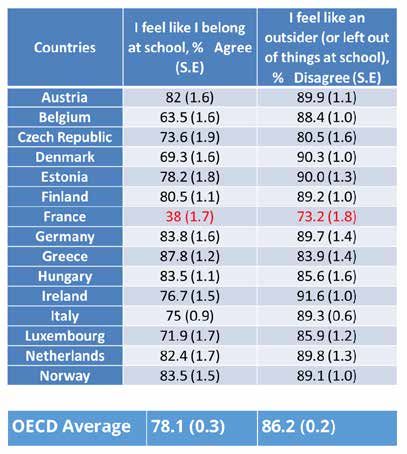
Keynote speeches 21Tab.1
Holistic Systemic Issues: Percentage of Socioeconomically Disadvantaged Students who Agree/
Disagree with the Following Statements: School Belonging and Feeling Like an Outsider (PISA 2012)
(OECD 2012)
Inclusive systems seek a holistic approach which recognises the social, emotional and
physical needs, not simply the academic and cognitive needs, of both children/young
people and their parents. It involves building on strengths to challenge the negative
deficit labelling of vulnerable groups, and seeks to promote growth (both for individuals’
personal and educational development and for system level development) rather than
simply prevent. Representation and participation of marginalised groups in school
structures and processes are another key principle. It is also to be emphasised that
multidisciplinarity approaches are required for inclusion, as a multifaceted response for
students with complex needs. Differentiating needs of students is key for system level
22interventions. A range of actively collaborating professionals is needed to address the
complex, multifaceted needs of marginalised groups. Lifelong learning, from the cradle
onwards, requires a distinct educational focus on active citizenship, personal and social
fulfilment, intercultural dialogue across communities, and additionally on poverty,
social inclusion, and employment. It embraces informal learning, as well as non-formal
and formal education classes relying on active learning methodologies.
A further dimension of the conceptual underpinning of inclusive systems is to interpret
them in terms of relational spaces. This builds on an initial distinction between spatially
structured systems, recognised by Lévi-Strauss’ structural anthropology, based on a
range of observations across diverse cultural contexts, namely, between diametric and
concentric structures. A diametric spatial structure is one where a circle is split in half
by a line which is its diameter, or where a square or rectangle is similarly divided into
two equal halves (see Fig. 1). In a concentric spatial structure, one circle is inscribed in
another larger circle (or square); in pure form, the circles share a common central point
(see Fig. 1-2).
Viewing them as mutually compensatory related systems, Lévi-Strauss observed basic
contrasts between diametric and concentric spatial systems, including that the latter
are more open and interactive with background than the former. He also observed
diametric systems as ones of mirror image reverse symmetry, for example, making
power related distinctions between high/low, good/bad, sacred/profane. While Lévi-
Strauss focused on these spatial structures of relation for understanding myths and
physical structures, the domain of their relevance has been expanded to wider social
systems, including school systems.
A key relative contrast between concentric and diametric spaces was overlooked by
Keynote speeches 23Lévi-Strauss. It is evident that the inner and outer poles of concentric structures are
more fundamentally attached to each other than diametric structures. Both concentric
poles coexist in the same space so that the outer circle overlaps the space of the inner
one, with their shared co-centre. The outer circle surrounds and contains the inner
circle. In contrast, diametric oppositional realms are both basically detached and can be
further smoothly detached from the other. A concentric relation assumes connection
between its parts and any separation is on the basis of assumed connection, whereas
diametric opposition assumes separation and any connection between the parts is
on the basis of this assumed separation. A concentric spatial relation is a structure of
inclusion compared to a diametric spatial structure of exclusion. In Bachelard’s words,
pertinent to diametric space, ‘simple geometrical opposition becomes tinged with
aggressivity’. From this vantage point, promoting inclusive systems is interpreted as
developing concentric spatial systems of assumed connection in and around schools,
it challenges and reconstructs diametric spatial systems of assumed separation and
power based hierarchies, as mirror image reverse symmetry relations in school systems.
Developing a whole school approach for promoting inclusive systems in and around
schools: some issues for eTwinning?
This keynote presentation raises some challenges for eTwinning to develop, as part of
an agenda for promoting inclusive systems in and around schools, relevant for early
school leaving and bullying prevention. eTwinning can play a part in the shift from
diametric spatial systems of opposition, blockage and hierarchy to concentric spaces of
assumed connection. It can help create a more democratic school climate that allows
for a greater variety of identities in school; it offers not only distributed leadership as
multiple opportunities for leadership, but also distributed identities to provide more
opportunities for diverse identities to be recognised in the school environment.
eTwinning can contribute to a shift in power relations across the school, to offer more
scope for students’ and parents’ voices, including marginalised students and parents,
in communication between schools; these voices can be involved in promoting whole
school strategies on themes such as early school leaving and bullying prevention.
eTwinning needs to dismantle the hegemony of a sole majority culture in school to
facilitate diverse voices and cultures.
24A number of issues regarding promotion of inclusive systems as relational spaces may
invite a future role for eTwinning. Loneliness is increasingly being recognized as a
key issue affecting children and young people staying in school. eTwinning may offer
opportunities for students to communicate with a broader range of students in the
other school, to help the student’s understanding of self and other, to foster bridges
to overcome loneliness. It may offer bridges for ethnic minority groups in a school to
connect with students from the other school with a similar background, to foster their
cultural confidence. Research highlights that the teacher plays a key role in inclusion
in the classroom, so that where the teacher displays discrimination against minority
groups, this tends to transfer into bullying of those groups by the students. eTwinning
can help challenge the diametric space of them-versus-us underpinning discriminatory
bullying. It can facilitate concentric spatial-relational networks of assumed connection
between minority student groups for empowerment. Students’ voices and pathways
to communication through eTwinning in school policy development can challenge
diametric us/them spatial hierarchies in the school institutional culture, as a force for
reform. It offers potential for challenging authoritarian teaching for a more positive
school climate that distributes power around the school.
The need for students’ voices in curricular material for bullying prevention is increasingly
being recognised in international research. eTwinning can support this, for example,
through bullying awareness videos developed between schools, that need to include
minorities and migrants voices and networks. Such cross-school initiatives can involve
teacher mutual support in developing positive inclusive school climate and whole
school approaches to prevention of bullying and early school leaving. Inclusive systems
committees in each school, including students and parents, offer a key role in driving
school reform; through such multiple leaders there is a role for eTwinning here for
dialogue between schools in the implementation of such inclusive systems committees.
eTwinning is not a panacea for early school leaving or bullying prevention, but one
aspect within a wider strategy. It is not suited for the chronic needs, Indicated prevention
level which requires multidisciplinary teams for intensive individual support. It is more
suited for universal and moderated risk (selected prevention level, Fig. 3) whole school
approaches and for engaging peer groups of students for meeting the needs of some
students experiencing moderate risk of early school leaving.
Keynote speeches 25Fig. 3. Building on Strengths and Differentiated Levels of Need: Promotion and Prevention Levels
Other project based approaches relevant to early school leaving where eTwinning could
play a role, include transitions from primary to post-primary school, and awareness of
the health and educational importance of sufficient sleep. eTwinning may facilitate
exchange of common strategies between teachers and schools for providing system
supports for transitions. eTwinning can support a whole school approach to sleep
health promotion, for example, through shared project work for younger students for
awareness raising, dialogue between parents on this issue, reflective diaries of students
to raise awareness of their sleep patterns. On the issue of overcoming sleep deficits, this
needs to be actively led by students.
Diametric spatial systems are closed ones. Again eTwinning can challenge such diametric
spaces in the school by helping to develop the school as an afterschool community
lifelong learning centre, where parents and students can be in communication with the
twinned school and wider clusters of schools; marginalised parents could then have a
space to meet for mutual support and to play a role in the development of the school.
eTwinning can potentially help marginalised parent groups, including migrants, for
confidence through bridge building with parents with similar experiences. There is also
the need for visual representation of minority groups in the school environment to
celebrate their identities and eTwinning can contribute to this process.
26Educational Leadership and
school improvement: the role
of principals and teachers in a
distributed model of leadership
Angelo Paletta, Associate Professor, Department of
Management, Università di Bologna
In school organizations, the most valuable human capabilities are those that tend
not to be operated within an approach of “command and control”, but those which
involve autonomy, professional freedom, involvement, and identification of purposes.
Initiative, creativity and passion are valuable qualities that teachers decide to share
in the school environment or keep for them. Connecting leadership practices with
teaching and learning is essential for school improvement. Distributed Leadership is
the basis of the mobilization of teacher professional capacity.
Instructional and transformational leadership
The literature on leadership constructs oscillate between two approaches, which
are characterized, on one hand, by a top-down and strong coordination and control
mechanisms of the teaching and learning processes either by central/regional
authorities or by the headteacher (instructional leadership), and, on the other hand, by
a bottom up approaches, with a strong commitment to sharing, support and intellectual
stimulation of teachers, promotion of the sense of community inside and outside the
school (transformational leadership).
Both of these approaches are always present in school leadership, being more a
question of gradation in the adaptation to the context than a rigid dichotomous
selection between two extremes. Their results also suggest that coexistence of high
levels of transformational and shared instructional leadership (‘integrated leadership’)
are related to high-quality pedagogy and student performance.
The integration between instructional and transformational leadership does not only
concern the ‘what’, that is the different leadership practices, but also the ‘how’ they
Keynote speeches 27are exercised and ‘who’ exercises this leadership. An integrated model of leadership for
learning does not simply reflect the actions of the headteacher, but also the interactions
with teachers and between teachers, configured as distributed, collaborative or shared
leadership.
Although there is no single and precise definition of teacher leadership, generally,
definitions of teacher leaders concern teachers that both maintain responsibility
of teaching in classroom and exercise leadership towards their peers and the school
community as a whole. Leading activities may be carried out from formal leadership
positions or informally. We attempt to measure instructional leadership exercised by
all teachers and not only by those that hold formal leadership positions since we adopt
the distributed leadership perspective which concerns leadership practices that may be
enacted by all organizational members regardless of their formal roles. This perspective
comes from the constructivist approach to leadership where all members of school staff
collaborate in constructing school improvement.
Research suggests that the teacher leaders’ impact on educational practices occurs
through support they give to their colleagues’ professional learning and promotion of
feelings of empowerment and self-confidence. Teacher leadership also supports the
development of professional learning communities at school (Fig. 1).
Fig. 1 - Proposed causal model between transformational leadership, instructional leadership, continuous
professional development and commitment to improvement, considering the effect of perception of
contexts and individual characteristics (standardized coefficients; *p = .004; **p = .000)
28The results of the structural equation model confirm the direct effect of transformational
leadership on the construction of organizational capacity for improvement and
the indirect effect on teachers’ improvement efforts. Continuing professional
development appears to have a direct effect on teacher’s instructional leadership, while
instructional leadership has a direct effect on the commitment to improvement of
teachers themselves. The commitment to improvement is also determined by teachers’
perceptions of the local, provincial and national context, in terms of constraints and
opportunities. In this regard it is significant to underline that the transformational
leadership of the principal has a direct effect on the perception of contexts, which
means that the role of school leaders is very important in building meaning and giving
meaning to the work of teachers.
Teachers leadership
Some teachers, sometimes informally, play an important function on organizational
integration, cross-cutting the professional groups and systematically linking the
functioning of the school, mitigating the lack of homogeneity of teaching, allowing
the recognition and diffusion of innovation, making professional practices “public” and
good practices replicable. In fact, in a context where the school principal is increasingly
encouraged to deal with administrative issues, they can help to supervise the instructional
leadership. The schools, however, are not the same, so that while some figures can be
considered permanent and common (deputy principal, departmental coordinators,
teaching coordinators, responsible for professional development activities, responsible
for evaluation), other figures must be identified by the individual schools according to
present problem specifications in the various contexts and strategies pursued.
The organizational skills of coordination, planning, evaluation, management of
networks, which teachers demonstrate to acquire both with traditional training, but
especially in the field with the daily practice of the profession, should be able to be
recognizable, certifiable and expendable both within the school of belonging is more
widely in favor of the educational system, of the world of work, not least in terms of
importance, as a basic requirement for access to the managerial career in the school.
Actually, the lack of regulation on these intermediate figures with high professionalism,
prevents a stable and cohesive distributed leadership. There being no recognition
for the increased workload, career paths and salary levels sufficiently differentiated,
Keynote speeches 29extrinsic incentives to attract and retain quality figures are lacking. A long and patient
investment on intellectual resources and based in trust relationships, towards these
figures can be dissolved quickly without any possibility for the school communities to
retain key skills that contribute in the stability and the quality of educational practices.
In cases such as digitalization, CLIL, didactics for problem solving skills, etc., the direct
intervention of the school principal is aimed at supervising change by guiding first-
hand strategic projects to bring out innovation from below and in a shared way. These
initiatives are not necessarily planned and are not structured in formal processes. The
principal acts as a first among peers, takes direct responsibility for affirming the sense of
priority and collective commitment, sometimes intervening with advisory and specialist
roles, relying on previous experience and professional background rather than formal
authority. The school principals act from “Leader to leader”.
The organizational behaviors of teachers who occupy formal positions of organizational
and didactic coordination (instrumental functions, coordinators of the educational
segment, department heads, etc.), normally aren’t legible with the typical categories
of “middle management”. These are not liaison officers in the meaning that this word
has assumed in hierarchical structures where intermediate managers have the main
task of facilitating the flow of information from the top down or vice versa, through
communication and control. The collaborators of the principal, widely understood,
exercise a real educational leadership; their role is also that of sensors located inside and
outside the school to disseminate and collect information. Besides this, they intervene in
surveillance, support, coaching, observation and feedback of their colleagues, sharing
of materials and practices, and many other activities of coordination, of teaching and
learning processes that without their contribution would remain out of reach of the
school principal.
30WORKSHOPS
WORKSHOPS
Materials available: http://etwinning.indire.it/etwinning-conference-florence-2016/
Keynote speeches 31The eTwinning School Label
Speaker Donatella Nucci, Italian eTwinning National Support Service
Purposes of the The eTwinning School Label recognises the work of schools
workshop who are deeply engaged in eTwinning and encourages these
leading schools to become proactive in supporting and
become a model for other schools at local and national level.
The workshop intended to present the rationale for this new
eTwinning recognition in relation to European educational
policies and then explore the procedure for requesting the
eTwinning School Label, examining the different criteria for
the obtainment of this recognition.
Workshop The presentation started by reminding the audience that the
activities eTwinning School Label was introduced for the first time in
2017 and the first nominations came in 2018. Recognitions
in eTwinning have always existed – National and European
Quality Labels; eTwinning Prizes -, but all these recognitions
focus on the work of the individual teacher. Especially in
the early years of this Action, it was very frequent that the
participation of schools coincided with the activity of just one
teacher – with the exception of countries like Cyprus, Iceland
and Malta. Now the European average is nearly 3 teachers in
each registered school: this is an average in many cases there
is a higher number of registered teachers belonging to the
same school.
This is an important development in the light of Diffusion of
Innovation theories, bearing in mind that innovation needs
to go beyond the effort of the individual, in order to affect
the entire school system.
A recommendation of the European Commission working
groups on Education and Training 2020 is that schools
32should function as Learning Organisations and an “eTwinning
school” does function as a Learning Organisation.
Management is able to tap on innovation introduced by
teachers and create the necessary conditions in the school
for peer-to-peer training.
The workshop progressed with examining more closely the
process for requesting and issuing the eTwinning School
Label:
• Criteria A - The school must demonstrate activities that
prove teachers’/pupils’ awareness of responsible use of
the internet.
• Criteria B - The school must demonstrate that there
is active collaboration between a group of three or more
teachers in eTwinning activities.
• Criteria C - The school must demonstrate that at least
two groups of pupils in the school are involved in
eTwinning projects.
• Criteria D - The school must demonstrate that two active
eTwinning teachers from the school have participated
in one or more eTwinning educational events and their
contribution to the strategic development of the school.
• Criteria E - The school must publically show its
involvement in eTwinning.
• Criteria F - The school must demonstrate that an
eTwinning promotional activity has taken place within
the school or in the local community in the year of the
award.
Results The participants were informed of the value of the eTwinning
School Label. They had the opportunity to get to know the
procedure to apply and were able to put questions.
Workshops 33Online safety for eTwinning schools:
Building an eSafety eco-system
Speaker Sabrina Vorbau, Project Officer and eSafety Label project
Coordinator Digital Citizenship Team, European Schoolnet
Purposes of Nowadays children and young people are carrying with them
the workshop increasingly powerful access devices and are linking to social
network sites, building their own online communities, and
creating and sharing content. Schools and parents cannot
impose all-encompassing restrictions on the use of technology
in order to protect young people. Hence, online safety plays an
important role when applying to become an eTwinning school.
In this context, and in order to provide practical solutions to
this challenge, European Schoolnet has set up the eSafety Label
project (www.esafetylabel.eu), a European-wide accreditation
and support service for schools. This represents a major step
forward in the drive to develop and maintain high standards of
eSafety.
In this workshop participants learned about the latest trends
and issues when being online and how they can set-up an
effective eSafety eco-system for their school. In addition,
participants received further eSafety advice and guidance and
were introduced to a set of resources, useful for their own
professional development as well as for their pupils.
34Workshop • The workshop started with an introduction to online safety
activities presenting the latest trends and risk online across Europe.
Participants were introduced to a range of resources
such as the Better Internet for Kids (BIK) portal (www.
betterinternetforkids.eu), the Insafe Helpline repository
(www.helplines.betterinternetforkids.eu) and the BIK
Policy Map (www.betterinternetforkids.eu/web/portal/
policy/bikmap).
• Following, participants started discussing in smaller groups
how they can build an online safe eco-system at their
school, developing an according infrastructure, policy and
practices.
• After presenting their group work, the workshop closed
with a presentation of the eSafety Label project (www.
esafetylabel.eu) which provides practical tips and solutions
for schools to set up their eSafety eco-system.
Results • As online safety trends and issues are changing rapidly,
participants realized that there is a clear need to stay up
to date (even if this proofs challenging sometimes), in
order to provide according support to pupils, parents and
other peers. Hence, participants appreciated the range of
resources and tools they have been introduced to during
this workshop.
• Moreover, the workshop provided a great opportunity for
participants to exchange about online safety approaches at
their schools.
• Furthermore, the interactive group work evoked
participant’s interest to further develop their eSafety
infrastructure, policy and practices when back at school.
Workshops 35Treasure your eTwinning school team!
Speakers Laura Maffei, ICS 2 Arnolfo di Cambio, Colle di Val d’Elsa (SI) Silvana
Rampone, Piemonte Regional School Authority
Purposes of The strength and continuity of the eTwinning action in any school
the workshop can be hindered by many factors: staff turnover, bureaucracy, lack
of time, lack of resources.
The workshop aimed at giving teachers and principals instruments
to deal with these issues. Moderators and participants tried to
develop together strategies and tips to successfully maintain,
develop and disseminate the eTwinning outputs and outcomes,
through transmission of skills. That is the magic of the eTwinning
Teams.
Workshop The workshop was structured as a sample eTwinning lesson: as a
activities tuning-in activity participants were introduced to a brainstorming,
where they had to tell in a word what “eTwinning Teams” made them
think of.
After a short introduction by the moderators on the benefits and
characteristics of eTwinning Teams, teachers and principals named
the most common obstacles they met in their eTwinning experience.
Video messages by expert eTwinners and School Directors were
presented, in order to offer different perspectives and inspiration on
how and why working together in eTwinning can improve the quality
of education.
Participants then split into groups and worked together to find
strategies to face the challenges and issues that can have a school
drop out of eTwinning – that is out of a shared European dimension
in education. Eventually, the groups reported their ideas and were
given feedback. They all were surprised at how the beautiful,
yet theoretical words of the warming up activity had turned into
practical ideas that could be put into practice in any school.
36Results Participants found out that the eTwinning School Label is not a
finish line, but a starting point. It is important to give continuity
and stability to the eTwinning action – a goal that can be achieved
only by giving the teachers incentives, training, recognition,
appreciation.
A successful team is made of happy, satisfied individuals. And to
their surprise, participants discovered that it is always possible to
keep the teachers involved and motivated by rewarding them for
the good job they are doing, taking advantage of the opportunities
offered by the eTwinning community (for instance, in terms of
quality training) and those provided by Ministries of Education,
stakeholders, local authorities.
Workshops 37You can also read


