Conservation and development in conflict: regeneration of wild Davidia involucrata (Nyssaceae) communities weakened by bamboo management in ...
←
→
Page content transcription
If your browser does not render page correctly, please read the page content below
Conservation and development in conflict:
regeneration of wild Davidia involucrata (Nyssaceae)
communities weakened by bamboo management in
south-central China
SHENHUA QIAN, CINDY Q. TANG, SIRONG YI, LIANG ZHAO
K U N S O N G and Y O N G C H U A N Y A N G
Abstract Protected areas, including nature reserves and other highly valued trees that share similar life-history chara-
management areas, are established for the conservation of cteristics with D. involucrata.
biological diversity and protection of the associated natural
Keywords Bamboo, China, Conservation effectiveness,
and cultural resources. These objectives, however, are often
Davidia involucrata, forest regeneration, Nyssaceae,
in conflict with socio-economic development. We investi-
protected areas, socio-ecological system
gated the plant communities dominated by the dove tree
Davidia involucrata in a nature reserve on Mount Jinfo,
China, where people intensively manage large areas of bam-
boo stands. We found a significant lack of small-sized main Introduction
stems of D. involucrata (– cm diameter at breast height;
height . . m) and newly emerging sprouts in the reserve.
The height-class distribution showed a unimodal pattern, P rotected areas, including nature reserves and manage-
ment areas, are established for the effective conserva-
tion of biological diversity and protection of the associated
with most individuals (of both D. involucrata and co-occur-
ring species) concentrated in the – m height-class, and natural and cultural resources (DeFries et al., ; Dudley
few individuals in the shrub and sub-canopy layer (.– m). & Stoulton, ). These objectives, however, are often
Existing practices to facilitate the spread of bamboo stands, in conflict with socio-economic development. Although
and the need to develop a local market for bamboo shoots many proposals have been put forward to simultaneously
received little consideration when the nature reserve was es- satisfy human requirements and maintain ecological func-
tablished in to protect D. involucrata. To conserve tions in protected areas (e.g. Daily & Ellison, ), this is
D. involucrata on Mount Jinfo the appropriate authorities not always feasible because of potential conflicts between
and local parties involved in bamboo harvesting need to conservation and socio-economic development (Coggins,
focus on methods that are favourable to the life history of ; Liu et al., ; Ma et al., ; Wang et al., ).
this and other tree species, and strategies for their regener- Human and natural systems are integrated in the sense
ation. These methods will also benefit the conservation of that people interact with nature (Berkes et al., , ;
Liu et al., ). Local people play important roles in the
maintenance of protected areas because of long-standing re-
lationships with these areas (McNeely, ; Newmark et al.,
; Xu et al., ), and effective communication and
SHENHUA QIAN (Corresponding author) Postdoctoral Station of Ecology
knowledge exchange between various parties are important
Chongqing University, Chongqing 400045, China for management and conservation (Gardner et al., ;
E-mail qian@fastmail.com Davis & Ruddle, ; Raymond et al., ). The knowl-
CINDY Q. TANG Institute of Ecology and Geobotany, Yunnan University, edge held by local communities and people involved in
Kunming, China
decision making is not usually the explicit and formalized
SIRONG YI Institute of Medicinal Plant Cultivation of Chongqing, Chongqing, type of knowledge obtained through scientific methods. In
China
China, many protected areas are established and maintained
LIANG ZHAO and YONGCHUAN YANG* (Corresponding author) Faculty of Urban
Construction and Environmental Engineering, Chongqing University,
by a strong top-down, command-and-control authority.
Chongqing 400045, China. E-mail ycyang@cqu.edu.cn This limits the opportunities for policy makers, scientists
KUN SONG School of Ecological and Environmental Sciences, East China Normal and local participants to cooperate, and hinders knowledge
University, Shanghai, China translation and information feedback, possibly leading to
*Also at: Key Laboratory of Three Gorges Reservoir Region’s Eco-Environment, unintended results (e.g. Guan et al., ; Xu et al., ;
National Centre for International Research of Low-carbon and Green Buildings, Zheng & Cao, ).
and Joint International Research Laboratory of Green Building and Built
Environment, Ministry of Education, Chongqing University, Chongqing, China The subtropical evergreen broad-leaved forests of south-
Received January . Revision requested February . central China harbour a rich biological diversity (Myers et al.,
Accepted March . First published online July . ; López-Pujol & Ren, ; Vanderplank et al., ).
Oryx, 2018, 52(3), 442–451 © 2017 Fauna & Flora International doi:10.1017/S003060531700045X
Downloaded from https://www.cambridge.org/core. IP address: 46.4.80.155, on 07 Nov 2021 at 06:32:05, subject to the Cambridge Core terms of use, available at https://www.cambridge.org/core/terms.
https://doi.org/10.1017/S003060531700045X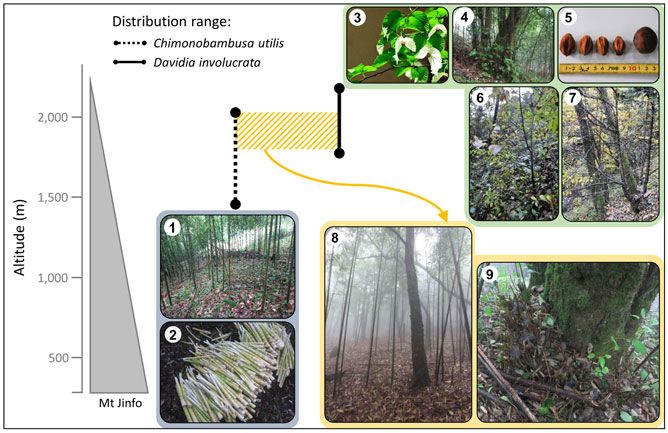
Conservation and development in conflict 443
Many tree species in the region, including Davidia involu-
crata, Tetracentron sinense, Cercidiphyllum japonicum
and Tapiscia sinensis, were once widespread in the
northern hemisphere but are now found only in East Asia
(Manchester et al., ; Tang et al., ). Since na-
tional and provincial nature reserves have been established
in China to prioritize the conservation of these vulnerable
and threatened taxa (Wang & Xie, ; Miller-Rushing
et al., ; Zhang et al., ). Despite the large number
of nature reserves and the significant investment in conser-
vation, many programmes have failed to meet local eco-
logical and socio-economic needs (Ma et al., ; Wang
& Buckley, ; Wang et al., ; Zheng & Cao, ;
Qian et al., ). The increasing rate of habitat loss caused
FIG. 1 The natural distribution of Davidia involucrata in China
by anthropogenic disturbance has led to poor regeneration (shaded area), with the locations of the study sites: Mount Emei
of many threatened plant species (Zhang et al., ), high- in Sichuan Province, and Mount Jinfo and Yintiaoling Nature
lighting a need for more effective in situ conservation prac- Reserve in Chongqing Municipality.
tices. To inform policy makers and improve conservation
programmes, nature reserves need to be studied and moni-
tored, with the aim of developing more effective sustainable
management frameworks, in China and elsewhere. other is in the Yintiaoling Nature Reserve in Chongqing
We investigated plant communities dominated by Municipality (Fig. ). The three sites are all located within
D. involucrata in a forest stand subject to intensive manage- the core distribution range of D. involucrata (Fig. ). The
ment activities in south-central China. Our study site is part two control sites are not in Mount Jinfo National Nature
of a national nature reserve established to protect first-grade Reserve because it is difficult to find D. involucrata commu-
nationally protected trees, including Cathaya argyrophylla nities that are undisturbed by human activities within the
and D. involucrata, and has a history of utilization and man- Reserve. We chose the control sites on the basis that they
agement of the bamboo Chimonobambusa utilis going back are () at similar latitudes to Mount Jinfo National Nature
to the Song Dynasty (–). Current management prac- Reserve (c. °N) and thus their climatic conditions should
tices for bamboo in this area usually involve clearing away not vary substantially from the study site, and () in the core
the underbrush to promote the growth of bamboo shoots distribution range of D. involucrata and comprise natural
and facilitate the spread of existing bamboo stands into ad- and representative D. involucrata communities, based on
jacent vegetation. We examined plant community structure our field observations.
and the regeneration of D. involucrata both in this area and Davidia involucrata, also known as the dove tree, was
at two additional sites where D. involucrata communities first described by the French priest and naturalist Father
are relatively well protected, to examine the influences of Armand David on a trip to China in , and then found
bamboo management on the effectiveness of the conserva- again by the Scottish plant hunter Augustine Henry in the
tion of D. involucrata. Yangtse Ichang gorges. Later, the plant collector Ernest
Henry Wilson was employed to find Henry’s tree, and he
collected a large quantity of seeds and sent them back to
Study area and species England in (Gardener, ). Since the dove tree
has been introduced to Europe and North America, and it is
The study site lies in a forest stand on Mount Jinfo in now a popular ornamental tree in parks and gardens. This
Nanchuan District, Chongqing Municipality (Fig. ). The relict species is endemic to south-central and south-western
area is part of the Mount Jinfo National Nature Reserve, China, where it occurs in scattered stands on isolated moun-
which is a World Heritage site (Ma, ). Within the tain slopes, or in valleys. It was categorized as a first-grade
study site, D. involucrata and C. utilis have an overlapping nationally protected species in the Catalogue of the National
elevational distribution (Li, ; Li et al., ) and the Protected Key Wild Plants of . Of the , known
intensive management practices used by local people angiosperm species in China (Wang et al., ), only
for C. utilis are having an impact on the regeneration of have been categorized as first-grade protected species in
D. involucrata communities. We also selected two addition- the Catalogue of the National Protected Key Wild Plants
al sites, where the plant communities are also dominated by of , with species categorized as second-grade pro-
D. involucrata but are undisturbed by human activities, as a tected species. Although D. involucrata has not yet been as-
control: one is on Mount Emei in Sichuan Province and the sessed for the IUCN Red List, it is reported that the natural
Oryx, 2018, 52(3), 442–451 © 2017 Fauna & Flora International doi:10.1017/S003060531700045X
Downloaded from https://www.cambridge.org/core. IP address: 46.4.80.155, on 07 Nov 2021 at 06:32:05, subject to the Cambridge Core terms of use, available at https://www.cambridge.org/core/terms.
https://doi.org/10.1017/S003060531700045X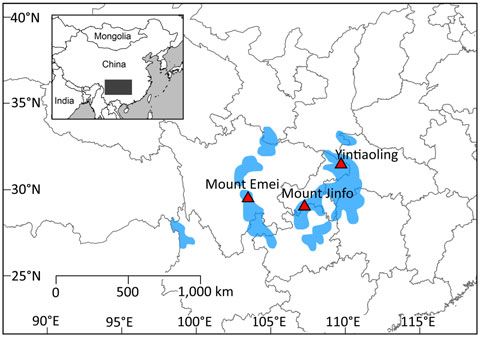
444 S. Qian et al.
FIG. 2 The elevational distribution and
habitats of the bamboo Chimonobambusa
utilis and the dove tree D. involucrata on
Mount Jinfo (Fig. ). () Habitat of C.
utilis, () harvested shoots of C. utilis, (–
) D. involucrata at flowering, adult and
fruit stages, respectively, (–)
D. involucrata saplings, () understorey
conditions in D. involucrata populations
in managed forest stand, () damaged
D. involucrata sprouts. Elevational
distribution ranges of C. utilis and
D. involucrata are based on Li et al. ()
and Li (), respectively. The hatched
area indicates the sites where the
distribution of C. utilis and D. involucrata
overlaps. Photographs , , and were
taken at the study area on Mount Jinfo,
and and were taken in the Yintiaoling
Nature Reserve (Fig. ).
TABLE 1 Habitat characteristics and woody floristic composition of the study site on Mount Jinfo, and the two control sites, on Mount Emei
and in Yintiaoling Nature Reserve, China (Fig. ).
Yintiaoling
Mount Jinfo Mount Emei Nature Reserve
Stand type Managed Natural Natural
Altitude (m) 1,807–1,961 1,620 1,347–1,486
Sampling area (m2) 4,400 5,400 1,500
Mean inclination (°) 35 30 40
Total no. of plant species 30 42 26
Relative basal area (%)*
Davidia involucrata 33.73 23.85 21.00
Tetracentron sinense 14.47 4.42 18.60
Yulania sprengeri 8.69
Acer oliverianum 8.66 3.01
Lithocarpus hancei 4.14
Pterostyrax psilophyllus 3.74 19.45
Lithocarpus henryi 3.70
Castanopsis platyacantha 3.07 0.14
Cerasus dielsiana 2.43
Cladrastis delavayi 2.35
Tapiscia sinensis 2.07 2.99 0.72
Acer sterculiaceum subsp. franchetii 1.87
Acer sinense 1.64
Schima sinensis 1.32
Illicium simonsii 1.21
Padus buergeriana 1.21
Cornus chinensis 0.55 1.08
Styrax hemsleyanus 17.44
Cercidiphyllum japonicum 9.54 4.87
Pterocarya hupehensis 9.50
Padus brachypoda 8.49
Padus avium 6.17 8.87
Staphylea holocarpa 4.31
Rhododendron argyrophyllum 1.90
Aesculus chinensis var. wilsonii 1.18 2.27
Acer flabellatum 1.12
Cornus controversa 0.13 2.55
Platycarya strobilacea 6.19
Oryx, 2018, 52(3), 442–451 © 2017 Fauna & Flora International doi:10.1017/S003060531700045X
Downloaded from https://www.cambridge.org/core. IP address: 46.4.80.155, on 07 Nov 2021 at 06:32:05, subject to the Cambridge Core terms of use, available at https://www.cambridge.org/core/terms.
https://doi.org/10.1017/S003060531700045XConservation and development in conflict 445
Table 1 (Cont.)
Mount Jinfo Mount Emei Yintiaoling
Nature Reserve
Carpinus hupeana 3.02
Diospyros lotus 2.87
Kalopanax septemlobus 1.99
Toxicodendron succedaneum 1.71
Machilus ichangensis 1.56
Quercus engleriana 1.31
*Only species with relative basal area . % are listed. Values in bold indicate dominant species.
regeneration of this species is extremely poor (Ma & Li,
; Zhang et al., ). In addition, there are no indica-
tions that the artificial cultivation of D. involucrata for land-
scaping in cities and botanical gardens has helped this
species recover in the wild (Volis, ), and species distri-
bution modelling has shown that only some areas of the cur-
rent range of D. involucrata would be maintained under
various climate change scenarios (Tang et al., ).
Methods
The characteristics of the plant communities on Mount Jinfo
and in the Yintiaoling Nature Reserve, including size struc-
ture and floristic composition, were investigated following
the patch sampling method (Ohsawa, ). We selected sev-
eral vegetation patches of – m, to include representa-
tive types of vegetation in the study sites. Within each
vegetation patch the species were identified and the height
and diameter at breast height (DBH) of every individual
(woody species $ . m tall) were recorded. On Mount
Jinfo we often found evidence of newly emerging sprouts
(usually , . m) of D. involucrata having been cut and re-
moved (Fig. ); we marked the damaged trees and counted
the number of sprouts cut vs those remaining per individual
to quantify the level of damage. On Mount Emei, plant com-
munities were investigated in a permanent plot of , m ,
as described in Tang & Ohsawa (). Investigations of the
D. involucrata communities on Mount Jinfo and in
Yintiaoling Nature Reserve were conducted in late summer
in , and data on D. involucrata communities on Mount
Emei came from a permanent forest inventory reported in
Tang & Ohsawa (). We included data on D. involucrata
on Mount Emei because, to our knowledge, this site is one of
the few sites where the species is well protected and natural
regeneration from seeds has been observed.
The dominant species in each plant community were de-
termined based on the relative basal area of each species
FIG. 3 Frequency distributions of the diameter at breast height (Ohsawa, ). We used the age–diameter relationship re-
(DBH) class for all D. involucrata individuals of $ . m height ported in Tang & Ohsawa () to estimate the ages of
at the three study sites (Fig. ). main stems or sprouts of D. involucrata when necessary.
Oryx, 2018, 52(3), 442–451 © 2017 Fauna & Flora International doi:10.1017/S003060531700045X
Downloaded from https://www.cambridge.org/core. IP address: 46.4.80.155, on 07 Nov 2021 at 06:32:05, subject to the Cambridge Core terms of use, available at https://www.cambridge.org/core/terms.
https://doi.org/10.1017/S003060531700045X446 S. Qian et al.
FIG. 4 (a) The numbers of
single-stemmed and multi-stemmed D.
involucrata individuals at each study site
(Fig. ), and (b) the mean numbers of
cut and surviving sprouts (newly
emerging sprouts at , . m height) of
D. involucrata adults on Mount Jinfo.
Whiskers indicate variability outside the
upper and lower quartiles, and dots
represent data outliers.
The mean number of stems of cut and surviving sprouts per
adult individual of D. involucrata was compared using a
paired t-test.
Results
The characteristics of the forest stands and plant communi-
ties in the three sites are summarized in Table . The plant
communities were all co-dominated by D. involucrata and
T. sinense. In addition, they share a number of relict compo-
nents; for example, Pterostyrax psilophyllus, the co-
dominant relict deciduous species in the Yintiaoling
Nature Reserve, was also present in plant communities on
Mount Jinfo. Tapiscia sinensis, although not a dominant
species, was recorded in all plant communities in the three
sites. At the two control sites, on Mount Emei and in the
Yintiaoling Nature Reserve, the plant communities con-
sisted of some additional relict trees, including C. japonicum
and Aesculus chinensis var. wilsonii (Table ).
On Mount Jinfo the main stems of D. involucrata were
mostly of DBH – cm (Fig. a). On Mount Emei and
in the Yintiaoling Nature Reserve, however, the DBH of
D. involucrata has a continuous, inverse J-shaped distribution
(Fig. b,c). Small stems of D. involucrata (DBH – cm;
height $ . m) were absent from Mount Jinfo. Based on
the generalized age–diameter relationship (Tang &
Ohsawa, ), the missing smaller stems would have
been c. – years old.
On Mount Jinfo the number of single-stemmed D. involu-
crata individuals was approximately equal to the number of
multi-stemmed individuals. In contrast, on Mount Emei and
in the Yintiaoling Nature Reserve the number of
multi-stemmed individuals was higher than that of
single-stemmed individuals (Fig. a). For newly emerging
D. involucrata sprouts on Mount Jinfo, the number of sprouts
cut per individual was significantly higher than the number of
FIG. 5 Frequency distribution by height-class of D. involucrata remaining sprouts (t = −., P , .; Fig. b).
communities at the three study sites (Fig. ). In (a) the The height-class distribution of the D. involucrata on
co-occurring species do not include C. utilis. Mount Jinfo had a unimodal pattern, with most
Oryx, 2018, 52(3), 442–451 © 2017 Fauna & Flora International doi:10.1017/S003060531700045X
Downloaded from https://www.cambridge.org/core. IP address: 46.4.80.155, on 07 Nov 2021 at 06:32:05, subject to the Cambridge Core terms of use, available at https://www.cambridge.org/core/terms.
https://doi.org/10.1017/S003060531700045XConservation and development in conflict 447
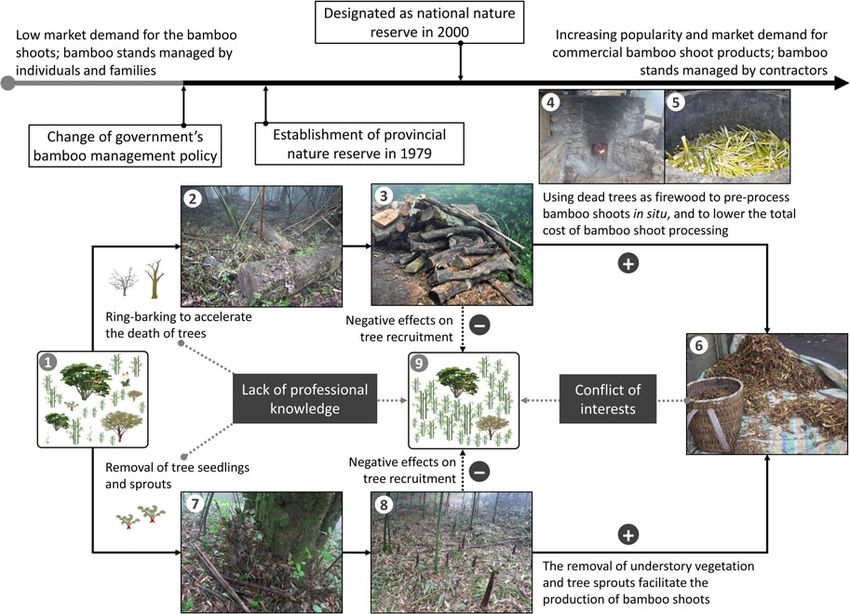
FIG. 6 The current management strategies for bamboo stands and D. involucrata communities on Mount Jinfo (Fig. ). () Relatively
balanced coexistence between bamboo and the D. involucrata communities prior to the change in government policy. (–) The use of
certain measures to accelerate the death of trees other than D. involucrata, which are then used as firewood to boil and pre-process
bamboo shoots in situ before they are dried out: () trunks of dead trees, () firewood made from dead trees, () a brick stove to boil
and process the harvested bamboo shoots, () close-up of the brick stove, () processed and then dried bamboo shoots to be sold to
the market. (–) To promote the growth and production of bamboo shoots and facilitate the spread of existing bamboo stands,
understorey shrubs including young D. involucrata sprouts are intentionally cut and removed. () Current unbalanced coexistence
between bamboo and the D. involucrata communities. The line at the top is a timeline of major events: c. years ago a major,
government-owned forest management centre was established on Mount Jinfo to promote the development and utilization of bamboo.
Since then, bamboo management policy has changed significantly and the market for bamboo shoots has developed rapidly. In
the Mount Jinfo Provincial Nature Reserve was established to protect species, including D. involucrata, in this area, and in this
nature reserve was designated the Mount Jinfo National Nature Reserve.
individuals in the – m height-class (Fig. a). On considerations be reviewed in planning management strategies
Mount Emei and in the Yintiaoling Nature Reserve the (Xu et al., ; Ma et al., ; Wu, ). The missing
height-class distributions were continuous, with the most D. involucrata main stems of – cm diameter at breast height,
abundant individuals (of both D. involucrata and co- aged – years, on Mount Jinfo suggest that the exclusion of
occurring species) in the shrub and sub-canopy layer D. involucrata seedlings and new recruits in this area may have
(.– m height-class; Fig. b,c). begun – decades ago. The size structure of D. involucrata
mirrors the transformation of local economic development
modes, together with a shift in the government’s policy from
Discussion individual-based management of bamboo stands to a
contractor-based management plan (Fig. ; pers. comm. with
Conflict between conservation and socio-economic local workers and residents, August ). Official records show
development that in June a major, government-owned forest manage-
ment centre was established on Mount Jinfo to promote the de-
When establishing protected areas in China, recommendations velopment and utilization of bamboo. Since then, the bamboo
were put forward that both ecological and socio-economic industry in the region has seen rapid development, resulting in
Oryx, 2018, 52(3), 442–451 © 2017 Fauna & Flora International doi:10.1017/S003060531700045X
Downloaded from https://www.cambridge.org/core. IP address: 46.4.80.155, on 07 Nov 2021 at 06:32:05, subject to the Cambridge Core terms of use, available at https://www.cambridge.org/core/terms.
https://doi.org/10.1017/S003060531700045X448 S. Qian et al.
FIG. 7 (a) Regeneration strategies for
relict trees and coexisting evergreen
species in a typical relict plant
community (revised from Tang &
Ohsawa, ). (b) Changes in the effect
of bamboo management intensity on D.
involucrata regeneration; the dotted circle
shows the possible effects of management
activity on the regeneration of D.
involucrata at a medium level of
management intensity, and the dashed
arrow indicates the direction towards
which the effects will change as the
management intensity increases. The
peak of the curve represents the optimum
management intensity for the
regeneration of D. involucrata. As
management intensity increases beyond
the point of intersection between the
dashed line and the curve, the net effects
of human activity on the regeneration of
D. involucrata shift from positive to
negative.
increased intensity of bamboo management. In bamboo policy for conserving D. involucrata requires only that large
products (including bamboo timber and shoots) accounted trees be kept alive. Consequently, contractors and local work-
for an annual revenue of c. USD ,. This increased to ers focus on promoting the growth of bamboo shoots, the
c. USD , in , and USD , in (The spread of existing bamboo stands, and lowering the cost of
Nanchuan Local Chronicle Editorial Committee, ). The bamboo shoot processing. Small seedlings of D. involucrata
harvesting and processing of bamboo shoots on Mount Jinfo are removed and the young sprouts are intentionally cut
has been scaled up to become a major business (the annual (Figs & ). The management of other tree species includes
value of production in was c. USD million), in parallel ring-barking to accelerate their death. The dead trees are then
with the implementation of conservation action for D. involu- used as firewood for boiling and pre-processing bamboo
crata (Nanchuan District People’s Government, ). shoots in situ before they are dried (Fig. ). Such measures
However, the need to develop a local bamboo shoot market are informal, and contribute significantly to the absence of
and the existing intensified in situ management practices re- small trees (D. involucrata and co-occurring species) in
ceived little consideration during the establishment of the plant communities on Mount Jinfo (Figs & ).
Mount Jinfo Provincial Nature Reserve in and the To integrate professional, ecological knowledge with cur-
Mount Jinfo National Nature Reserve in , possibly because rent management strategies for the forests on Mount Jinfo,
a one-size-fits-all strategy was being used for establishing and relevant parties must understand the life-history character-
maintaining national reserves in China (Xu et al., , ). istics of the key plant species. The plant communities on
Bamboo shoot harvesting and processing have become major Mount Jinfo comprise several dominant relict tree species,
sources of income for many local residents, and the local gov- including D. involucrata and T. sinense (Table ), and sprout-
ernment and sponsors in Nanchuan District wish to continue ing is a critical part of their life histories (Tang & Ohsawa,
to develop, and invest in, the bamboo shoot market (Nanchuan ; Tang et al., ). In the absence of seedlings, sprouts
District People’s Government, ). Consequently, the on- are crucial for sustaining the recruitment and regeneration of
going development of the bamboo shoot industry conflicts the species in this forest. The gap in the – cm DBH class
with the goal of conserving threatened species, such as D. invo- for D. involucrata on Mount Jinfo (Fig. a) confirms the sig-
lucrata, in Mount Jinfo National Nature Reserve. nificant lack of recruits from seedlings, and emphasizes the
importance of sprouting for maintaining D. involucrata. As
most of the newly emerging sprouts of D. involucrata are
The importance of sharing knowledge intentionally cut, this forest may be facing a future ecological
crisis of structure and function.
To manage forests in protected areas, various forms of knowl- In the unmanaged forest stands on Mount Emei the abil-
edge must be integrated (Quesada et al., ; Raymond et al., ity of relict deciduous trees such as D. involucrata to sprout
). In Mount Jinfo National Nature Reserve the current and thus adapt to unstable habitats (e.g. scree slopes)
Oryx, 2018, 52(3), 442–451 © 2017 Fauna & Flora International doi:10.1017/S003060531700045X
Downloaded from https://www.cambridge.org/core. IP address: 46.4.80.155, on 07 Nov 2021 at 06:32:05, subject to the Cambridge Core terms of use, available at https://www.cambridge.org/core/terms.
https://doi.org/10.1017/S003060531700045XConservation and development in conflict 449
enables them to avoid competition with coexisting ever- reviewers for their constructive comments which contributed
green trees, which generally establish themselves in stable significantly to improving the quality of the manuscript. This
environments such as on mountain ridges (Fig. a; Tang study was supported by grants from the Key National Research
& Ohsawa, ). Management activities such as selectively and Development Plan Program (YFC) to YY,
cutting neighbouring trees, when carried out at low inten- the Special Funding for Postdoctoral Researcher of
sity, can improve understorey light conditions and thus pro- Chongqing (Xm) and the China Postdoctoral
mote the regeneration of remaining D. involucrata Science Foundation (M) to SQ, the Fundamental
individuals in the plant community. This may explain Research Funds for the Central Universities (Project No.
how, despite the long history of utilizing and managing CDJXY) to LZ, and the National Natural
bamboo on Mount Jinfo, D. involucrata persists. However, Science Foundation of China () to KS.
there is a threshold of intensity of bamboo management
above which increasing management will have negative ef- Author contributions
fects on the regeneration of D. involucrata because of an in-
crease in interspecific competition (e.g. competition YY and SQ designed the study. SQ analysed the data and wrote
between D. involucrata and bamboo for light and below- an initial draft of the article. YY, CQT, SQ, LZ and SY con-
ground resources; Takahashi et al., ; Kisanuki et al., ducted the field work and collected the data. All authors con-
) (Fig. b). Hence, in the long term, control of manage- tributed substantially to the development of the article.
ment intensity would benefit those involved in bamboo har-
vesting whilst minimizing the negative effects of these References
activities on the forest.
B E R K E S , F., C O L D I N G , J. & F O L K E , C. () Navigating Social–
Ecological Systems: Building Resilience for Complexity and Change.
Cambridge University Press, Cambridge, UK.
Lessons learned for tree conservation B E R K E S , F., F O L K E , C. & C O L D I N G , J. () Linking Social and
Ecological Systems: Management Practices and Social Mechanisms
Tang et al. () investigated the structure and regeneration for Building Resilience. Cambridge University Press, Cambridge,
of natural populations of the conifer Metasequoia glyptos- UK.
troboides in Hubei, south-central China and found a sub- C O G G I N S , C.R. () Wildlife conservation and bamboo
stantial portion of the seedlings and small trees were management in China’s southeast uplands. Geographical Review, ,
missing. As in the case of D. involucrata on Mount Jinfo, –.
D A I LY , G. & E L L I S O N , K. () The New Economy of Nature: The
only adults of M. glyptostroboides are officially protected. Quest to Make Conservation Profitable. Island Press, Washington,
Seeds have been collected for sale and seedlings have been DC, USA.
moved to non-native habitats as landscape plants, leaving D AV I S , A. & R U D D L E , K. () Constructing confidence: rational
the understorey space as agricultural land for cultivating skepticism and systematic enquiry in local ecological knowledge
Coptis chinensis, a medicinal herb (Wang et al., ; research. Ecological Applications, , –.
D E F R I E S , R., H A N S E N , A., T U R N E R , B.L., R E I D , R. & L I U , J. ()
Tang et al., ). Although the remaining adults of M. glyp-
Land use change around protected areas: management to balance
tostroboides and D. involucrata may survive in protected human needs and ecological function. Ecological Applications, ,
areas for several decades under current conservation prac- –.
tices, long-term persistence cannot be guaranteed without D U D L E Y , N. & S T O U LT O N , S. () Defining Protected Areas: An
effective reproduction and recruitment. In contrast, popula- International Conference in Almeria, Spain. IUCN, Gland,
Switzerland.
tions of Ginkgo biloba, also endemic to China, have continu-
G A R D E N E R , W.H. () E. H. Wilson’s first trip to China. Arnoldia, ,
ous size and age structures because local traditional beliefs –.
have protected the seedlings, saplings and habitat of this G A R D N E R , T.A., B A R LO W , J., C H A Z D O N , R., E W E R S , R.M., H A R V E Y , C.
speceis (Tang et al., ). Thus, management for mainten- A., P E R E S , C.A. & S O D H I , N.S. () Prospects for tropical
ance of regeneration and recruitment is critical not only for forest biodiversity in a human-modified world. Ecology Letters, ,
–.
the conservation of D. involucrata on Mount Jinfo but also
G U A N , L., S U N , G. & C AO , S. () China’s bureaucracy hinders
for other threatened and highly valued species that may have environmental recovery. Ambio, , –.
similar life-history characteristics to D. involucrata. K I S A N U K I , H., K U D O , T. & N A K A I , A. () Removing aboveground
vegetation facilitates survival but slows height growth of spruce
saplings in a fenced, degraded sub-alpine forest in central Japan.
Acknowledgements
Journal of Forest Research, , –.
L I , Q.-Y., Z H A N G , Z.-W., T AO , J.-P., L I U , J.-H. & Y O N G , X.-H. ()
We thank Qiuping Tan, Ting Li, Mei Pang and Jing Xiao for
Effect of elevation and canopy condition on morphological traits
help with the field work, and Xiaoya Li of the Fauna & Flora and leaf fluctuating asymmetry of a bamboo, Chimonobambusa
International China Programme for helpful discussions, and utilis in Jinfo Mountain Nature Reserve, Southwest China. Sains
Martin Fisher, Cella Carr, Bo Chen and two anonymous Malaysiana, , –.
Oryx, 2018, 52(3), 442–451 © 2017 Fauna & Flora International doi:10.1017/S003060531700045X
Downloaded from https://www.cambridge.org/core. IP address: 46.4.80.155, on 07 Nov 2021 at 06:32:05, subject to the Cambridge Core terms of use, available at https://www.cambridge.org/core/terms.
https://doi.org/10.1017/S003060531700045X450 S. Qian et al.
L I , Y.-X. () Present state and perspectives of biological study on T A N G , C.Q., D O N G , Y.-F., H E R R A N D O -M O R A I R A , S., M AT S U I , T.,
Davidia involucrata. Journal of China West Normal University O H A S H I , H., H E , L.-Y. et al. () Potential effects of climate
(Natural Sciences), , –. [In Chinese, with English abstract] change on geographic distribution of the Tertiary relict tree
L I U , J., D I E T Z , T., C A R P E N T E R , S.R., A L B E R T I , M., F O L K E , C., M O R A N , species Davidia involucrata in China. Scientific Reports, ,
E. et al. () Complexity of coupled human and natural systems. http://dx.doi.org/./srep.
Science, , –. T A N G , C.Q. & O H S AWA , M. () Tertiary relic deciduous forests on
L Ó P E Z -P U J O L , J. & R E N , M.-X. () China: a hot spot of relict plant a humid subtropical mountain, Mt. Emei, Sichuan, China. Folia
taxa. In Biodiversity Hotspots (eds V. Rescigno & S. Maletta), pp. Geobotanica, , –.
–. Nova Science Publishers, New York, USA. T A N G , C.Q., P E N G , M.-C., H E , L.-Y., O H S AWA , M., W A N G , C.-Y., X I E ,
M A , K. () Conservation of world natural heritage should be T.-H. et al. () Population persistence of a Tertiary relict tree
ensured and its contribution to local sustainable development Tetracentron sinense on the Ailao Mountains, Yunnan, China.
promoted. Biodiversity Science, , –. [In Chinese, with Journal of Plant Research, , –.
English abstract] T A N G , C.Q., W E R G E R , M.J.A., O H S AWA , M. & Y A N G , Y. ()
M A , Y. & L I , J. () Population structure of Davidia involucrata in Habitats of Tertiary relict trees in China. In Endemism in Vascular
Mt. Seven-sister Natural Reserve of central China’s Hubei Province. Plants (ed. C. Hobohm), pp. –. Springer, Dordrecht, The
Journal of Beijing Forestry University, , –. [In Chinese, with Netherlands.
English abstract] T A N G , C.Q., Y A N G , Y., O H S AWA , M., M O M O H A R A , A., H A R A , M.,
M A , Z., L I , B., L I , W., H A N , N., C H E N , J. & W A T K I N S O N , A.R. () C H E N G , S. & F A N , S. () Population structure of relict
Conflicts between biodiversity conservation and development in a Metasequoia glyptostroboides and its habitat fragmentation and
biosphere reserve. Journal of Applied Ecology, , –. degradation in South-Central China. Biological Conservation, ,
M A N C H E S T E R , S.R., C H E N , Z.-D., L U , A.-M. & U E M U R A , K. () –.
Eastern Asian endemic seed plant genera and their paleogeographic T A N G , C.Q., Y A N G , Y., O H S AWA , M., Y I , S.-R., M O M O H A R A , A., S U ,
history throughout the Northern Hemisphere. Journal of W.-H. et al. () Evidence for the persistence of wild Ginkgo biloba
Systematics and Evolution, , –. (Ginkgoaceae) populations in the Dalou Mountains, southwestern
M C N E E LY , J.A. () The future of national parks. Environment: China. American Journal of Botany, , –.
Science and Policy for Sustainable Development, , –. T H E N A N C H U A N L O C A L C H R O N I C L E E D I T O R I A L C O M M I T T E E ()
M I L L E R -R U S H I N G , A.J., P R I M A C K , R.B., M A , K. & Z H O U , Z.-Q. () Nanchuan District Annuals (–). China Local Records
A Chinese approach to protected areas: a case study Publishing, Chongqing, China. [In Chinese]
comparison with the United States. Biological Conservation, V A N D E R P L A N K , S., M O R E I R A -M U Ñ O Z , A., H O B O H M , C., P I L S , G.,
http://dx.doi.org/./j.biocon.... N O R O O Z I , J., C L A R K , V.R. et al. () Endemism in mainland
M Y E R S , N., M I T T E R M E I E R , R.A., M I T T E R M E I E R , C.G., D A F O N S E C A , regions—case studies. In Endemism in Vascular Plants (ed.
G.A.B. & K E N T , J. () Biodiversity hotspots for conservation C. Hobohm), pp. –. Springer, Dordrecht, The Netherlands.
priorities. Nature, , –. V O L I S , S. () How to conserve threatened Chinese plant species
N A N C H U A N D I S T R I C T P E O P L E ’ S G O V E R N M E N T () Industrial with extremely small populations? Plant Diversity, , –.
Development of the Bamboo Shoot in Nanchuan District. W A N G , C.-H. & B U C K L E Y , R. () Shengtai anquan: managing
Nanchuan District People’s Government, Nanchuan, Chongqing. tourism and environment in China’s forest parks. Ambio, , –.
Http://www.cqnc.gov.cn/Content/-//content_.htm W A N G , G., I N N E S , J.L., W U , S.W., K R Z Y Z A N OW S K I , J., Y I N , Y., D A I , S.
[accessed December ]. [In Chinese] et al. () National park development in China: conservation or
N E W M A R K , W.D., L E O N A R D , N.L., S A R I KO , H.I. & G A M A S S A , D.-G.M. commercialization? Ambio, , –.
() Conservation attitudes of local people living adjacent to W A N G , L., J I A , Y., Z H A N G , X. & Q I N , H. () Overview of higher
five protected areas in Tanzania. Biological Conservation, , –. plant diversity in China. Biodiversity Science, , –.
O H S AWA , M. () Differentiation of vegetation zones and species [In Chinese, with English abstract]
strategies in the subalpine region of Mt. Fuji. Vegetatio, , –. W A N G , S. & X I E , Y. () China Species Red List. Volume I. Red List.
O H S AWA , M. () Structural comparison of tropical montane rain Higher Education Press, Beijing, China.
forests along latitudinal and altitudinal gradients in south and east W A N G , X., M A , L., G U O , B., F A N , S. & T A N , J. () Analysis on the
Asia. Vegetatio, , –. changes of the original Metasequoia glyptostroboides population and
Q I A N , S., Y A N G , Y., T A N G , C.Q., M O M O H A R A , A., Y I , S. & O H S AWA , M. its environment in Lichuan, Hubei from to . Acta Ecologica
() Effective conservation measures are needed for wild Cathaya Sinica, , –. [In Chinese, with English abstract]
argyrophylla populations in China: insights from the population W U , J. () Landscape sustainability science: ecosystem services and
structure and regeneration characteristics. Forest Ecology and human well-being in changing landscapes. Landscape Ecology, ,
Management, , –. –.
Q U E S A D A , M., S A N C H E Z -A Z O F E I FA , G.A., A LVA R E Z -A Ñ O R V E , M., X U , J., C H E N , L., L U , Y. & F U , B. () Local people’s perceptions as
S T O N E R , K.E., A V I L A -C A B A D I L L A , L., C A LV O -A LVA R A D O , J. et al. decision support for protected area management in Wolong
() Succession and management of tropical dry forests in the Biosphere Reserve, China. Journal of Environmental Management,
Americas: review and new perspectives. Forest Ecology and , –.
Management, , –. X U , J., Z H A N G , Z., L I U , W. & M C G O WA N , P.J.K. () A review and
R A Y M O N D , C.M., F A Z E Y , I., R E E D , M.S., S T R I N G E R , L.C., R O B I N S O N , assessment of nature reserve policy in China: advances, challenges
G.M. & E V E LY , A.C. () Integrating local and scientific and opportunities. Oryx, , –.
knowledge for environmental management. Journal of X U , J.-Y., C H E N , L.-D., L U , Y.-H. & F U , B.-J. () Sustainability
Environmental Management, , –. evaluation of the Grain for Green Project: from local people’s
T A K A H A S H I , K., U E M U R A , S., S U Z U K I , J.-I. & H A R A , T. () Effects responses to ecological effectiveness in Wolong Nature Reserve.
of understory dwarf bamboo on soil water and the growth of Environmental Management, , –.
overstory trees in a dense secondary Betula ermanii forest, northern Z H A N G , J., L I , Z., F R I T S C H , P.W., T I A N , H., Y A N G , A. & Y AO , X. ()
Japan. Ecological Research, , –. Phylogeography and genetic structure of a Tertiary relict tree
Oryx, 2018, 52(3), 442–451 © 2017 Fauna & Flora International doi:10.1017/S003060531700045X
Downloaded from https://www.cambridge.org/core. IP address: 46.4.80.155, on 07 Nov 2021 at 06:32:05, subject to the Cambridge Core terms of use, available at https://www.cambridge.org/core/terms.
https://doi.org/10.1017/S003060531700045XConservation and development in conflict 451
species, Tapiscia sinensis (Tapisciaceae): implications for Biographical sketches
conservation. Annals of Botany, , –.
Z H A N G , L., L U O , Z., M A L LO N , D., L I , C. & J I A N G , Z. () S H E N H U A Q I A N ’s research focuses on population dynamics and the
Biodiversity conservation status in China’s growing protected areas. conservation of biodiversity. C I N D Y Q . T A N G ’S research interests in-
Biological Conservation, http://dx.doi.org/./j.biocon... clude the conservation of relict species and the origins and development
. of subtropical forests. S I R O N G Y I ’s research interests include forest con-
Z H A N G , W., C AO , G.-X., L I U , G.-H. & L I U , X. () Population servation and management. L I A N G Z H A O is interested in the relation-
structure and distribution pattern of Davidia involucrata at Labahe ship between biodiversity and ecosystem functioning. K U N G S O N G ’s
Nature Reserve of Sichuan Province. Journal of Zhejiang Forestry research focuses on the processes and mechanisms structuring the plant
College, , –. [In Chinese, with English abstract] communities in subtropical forests. Y O N G C H U A N Y A N G ’s research in-
Z H E N G , H. & C AO , S. () Threats to China’s biodiversity by terests incorporate many aspects of the conservation of relict species. He
contradictions policy. Ambio, , –. also has a special interest in biodiversity patterns in urban ecosystems.
Oryx, 2018, 52(3), 442–451 © 2017 Fauna & Flora International doi:10.1017/S003060531700045X
Downloaded from https://www.cambridge.org/core. IP address: 46.4.80.155, on 07 Nov 2021 at 06:32:05, subject to the Cambridge Core terms of use, available at https://www.cambridge.org/core/terms.
https://doi.org/10.1017/S003060531700045XYou can also read


