CORPORATE PLAN 2021-2025 - APRA
←
→
Page content transcription
If your browser does not render page correctly, please read the page content below

CORPORATE PL AN
2021-2025
Disclaimer and Copyright
 While APRA endeavours to ensure the quality of this publication, it does not accept any
 responsibility for the accuracy, completeness or currency of the material included in this
 publication and will not be liable for any loss or damage arising out of any use of, or
 reliance on, this publication.

 © Australian Prudential Regulation Authority (APRA)

 This work is licensed under the Creative Commons Attribution 3.0 Australia Licence
 (CCBY 3.0). This licence allows you to copy, distribute and adapt this work, provided you
 attribute the work and do not suggest that APRA endorses you or your work. To view a full
 copy of the terms of this licence, visit https://creativecommons.org/licenses/by/3.0/au/

AUSTRALIAN PRUDENTIAL REGULATION AUTHORITY                                                    2
Contents

Contents                                            3

Chair’s foreword                                    4

Executive summary                                   5

  Protected today                                    5

  Prepared for tomorrow                              6

APRA’s strategic priorities                          7

  APRA’s strategy on a page                          7

  APRA’s purpose, vision and strategic priorities    7

  APRA’s strategic priorities                        8

  Protected today                                    8

  Prepared for tomorrow                             13

  Making it happen                                  15

Appendix A: APRA’s operating context                16

  External environment factors                      16

  Internal environment factors                      19

  Co-operation with others                          20

Appendix B: APRA’s risk management                  21

Appendix C: APRA’s key performance measures         24

AUSTRALIAN PRUDENTIAL REGULATION AUTHORITY           3
Chair’s foreword

2020 will be remembered as a year of disaster and disruption, with the impacts from natural
disasters including devastating bushfires and floods and the COVID-19 global pandemic felt
right across the Australian community.

There is no doubt Australia has demonstrated great strength and resilience in responding to
these events. Australia’s economy rebounded faster than originally expected to the adverse
events of 2020, aided by supportive policy settings, and the financial system has emerged
from a turbulent year in good health. The challenges and uncertainty created by the
pandemic remain, but the financial system appears well-equipped to handle them.

In looking to the future and setting its 2021 – 2025 Corporate Plan, APRA will build on these
strong foundations. In its core prudential supervision role, APRA remains committed to
‘protecting the Australian community today’. In particular, APRA will continue to actively
support COVID-19 response activities where needed, within its broader efforts to promote a
stable, efficient and competitive financial system that the Australian community can have
confidence in. But being a forward-looking supervisor, APRA must also ‘prepare for
tomorrow’. The financial landscape is evolving rapidly, particularly in response to the impacts
of technology and digitisation that are changing society more broadly. APRA will therefore
work in close partnership with its regulatory colleagues and other key stakeholders, both
domestically and internationally, to make sure that the prudential architecture remains fit for
purpose into the future.

APRA is also committed to building on the learnings and significant momentum gained last
year to provide a flexible and adaptive workplace for its staff. APRA will continue to invest in
enabling technologies and infrastructure, support flexible ways of working, and empower its
employees to perform at their very best to deliver on APRA’s purpose and, in doing so, serve
the needs of the Australian community.

It is with this backdrop that, as the accountable authority of APRA, I present APRA’s
2021-2025 Corporate Plan, as required under paragraph 35(1)(b) of the Public Governance,
Performance and Accountability Act 2013. I will report on progress against this plan in APRA’s
2021–2022 Annual Report.

Wayne Byres
Chair

AUSTRALIAN PRUDENTIAL REGULATION AUTHORITY                                                         4
Executive summary

The challenges of 2020 were unprecedented, with natural disasters including devastating
bushfires and floods domestically and the emergence of the COVID–19 pandemic globally. In
an environment of severe economic stress, APRA’s 2020–2024 Corporate Plan narrowed the
organisation’s short-term priorities to focus on three key core objectives:

•    reinforcing the safety and soundness of APRA-regulated institutions;
•    fostering their operational resilience during a period of significant disruption; and
•    enhancing contingency plans to address the increasing risk of failure of one or more
     APRA-regulated institutions.

In looking to the future, COVID-19 remains a dominant influence on the economic and
financial environment. But it is far from the only important influence. As a forward-looking
prudential supervisor, APRA has sought to update its Corporate Plan with a wider perspective
acknowledging that, while the pandemic is yet to be overcome, there are many other factors
that are influencing the shape and risk profile of the financial system, and to which APRA
needs to respond.

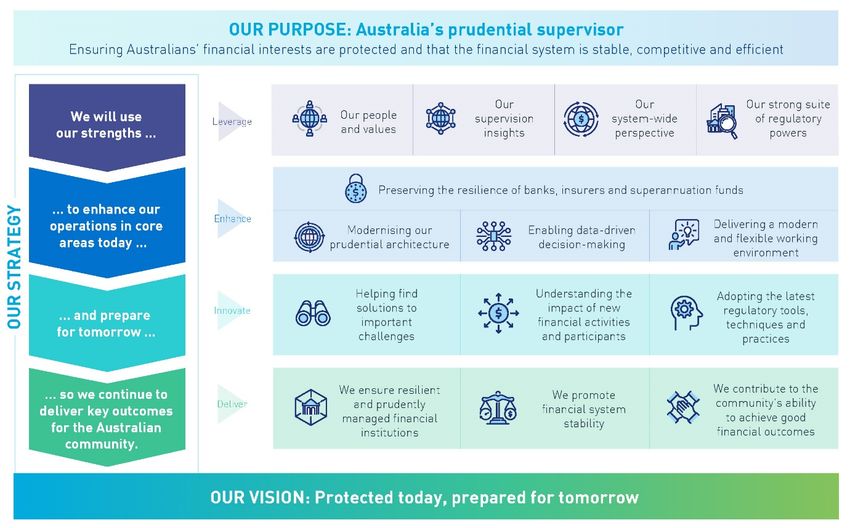
At their heart, APRA’s refreshed strategic priorities remain anchored in its purpose:

    Ensuring Australians’ financial interests are protected and the financial
                 system is stable, competitive and efficient.

To fulfil this purpose, APRA’s 2021–2025 Corporate Plan is focused on two strategic themes:
‘protected today’ and ‘prepared for tomorrow’.

Protected today

A prerequisite for economic activity and prosperity is that Australians have confidence in the
safety and stability of the financial system. APRA must therefore continue to direct a large
proportion of its time and resources to its core role of preserving the financial and
operational resilience of Australia’s banks, insurers and superannuation funds, so that
Australians’ financial interests are protected today. It will do this by:

•    targeting regulatory activities in a risk-based manner;
•    modernising the prudential architecture to ensure it remains fit for purpose;
•    continuing to drive greater data-driven decision-making; and
•    delivering a modern and flexible working environment and maintaining a high-calibre
     workforce capable of responding to new challenges as they arise.

AUSTRALIAN PRUDENTIAL REGULATION AUTHORITY                                                       5
Prepared for tomorrow
The shape and structure of the financial system is rapidly evolving. In response, over the
2021-2025 planning horizon, APRA will work today to ensure the Australian financial system
is prepared for tomorrow by:
• dedicating regulatory attention to the evolving financial landscape in Australia, including
understanding the impact of new financial activities and participants;
• helping to find solutions to important challenges, such as: superannuation retirement
income products; insurance accessibility and affordability for Australians; and the
financial risks associated with climate change; and
• ensuring it continues to adopt the latest regulatory tools, techniques and practices.
Building on strengths
To be successful in its objectives, APRA will leverage its distinctive strengths:
• its people and values;
• its supervision insights,
• its system-wide perspective; and
• its strong suite of regulatory powers.
Further detail on APRA’s purpose, vision, strategic outcomes and priorities is provided below.
AUSTRALIAN PRUDENTIAL REGULATION AUTHORITY 6APRA’s strategic priorities
APRA’s purpose and vision
APRA’s Corporate Plan 2021-25 sets out how APRA will seek to fulfil its purpose, which is
derived from its founding legislation 1:
APRA is the financial sector’s prudential supervisor. Its purpose is to
ensure Australians’ financial interests are protected and the financial
system is stable, competitive and efficient.
APRA seeks to achieve this purpose by, first and foremost, employing a supervision-led
approach. APRA undertakes prudential supervision with a view to (i) identifying risks and
vulnerabilities within the financial system that might jeopardise its purpose, and (ii) acting to
ensure those risks and vulnerabilities are mitigated. By employing a supervision-led
approach, APRA seeks to be forward-looking, risk-based, and outcomes focused –
addressing potential problems before they adversely impact those APRA is tasked to protect.
A supervision-led approach also assists in minimising regulatory burden and facilitating
competition and innovation.
1
APRA’s purpose is formally set out in s8 of the Australian Prudential Regulation Authority Act 1998
AUSTRALIAN PRUDENTIAL REGULATION AUTHORITY 7Reflecting this forward-looking philosophy, APRA’s vision is focused on two strategic themes:
‘protected today, prepared for tomorrow’. These themes are designed to drive organisational
focus on delivering APRA’s purpose and key outcomes for the Australian community so as to:
• ensure resilient and prudently managed financial institutions;
• promote the stability of the Australian financial system; and
• contribute to the community’s ability to achieve good financial outcomes.
In seeking to deliver these outcomes, APRA will leverage its core strengths:
• its people and values. APRA has a highly skilled, committed and experienced workforce,
with strong clarity of purpose and clear values that the organisation seeks to uphold at all
times.
• its supervision insights. As a supervision-led organisation with close and continuous
engagement with regulated institutions, APRA has unique insights into the risks and
vulnerabilities within financial institutions.
• its system-wide perspective. By virtue of its ability to look both deeply into institutions as
well as aggregate these views across the financial sector, APRA is able to bring a
system-wide perspective to the understanding the nature of risks and vulnerabilities
within the financial system as a whole.
• its strong suite of regulatory powers. Recent legislative changes have strengthened APRA’s
powers in a number of important areas, meaning APRA supervisors are well-equipped to
address risks and enforce change where that is required.
APRA’s strategic priorities
Protected today
APRA will continue to direct the majority of time and resources to its core role of preserving
the financial and operational resilience of Australia’s banks, insurers and superannuation
funds, so that Australians’ financial interests are protected today.
APRA will do this by:
• targeting supervisory activities to those issues of greatest risk;
• modernising the prudential architecture to ensure it remains fit for purpose; and
• driving greater data-driven decision-making.
AUSTRALIAN PRUDENTIAL REGULATION AUTHORITY 8Preserve the resilience of banks, insurers and superannuation funds
APRA will enhance its operations by harnessing its newly established Supervisory Risk and
Intensity (SRI) model to derive greater supervisory insights and intelligence, and proactively
keep pace and respond to key risks and vulnerabilities. For this strategic priority, APRA will
target its activities in the key areas outlined below and use its strong suite of regulatory
powers where necessary to achieve desired outcomes.
Banking
• Underpin industry capital strength by completing the implementation of the
Basel 3/’unquestionably strong’ capital reforms.
• Maintain scrutiny of credit risk and liquidity risk at an individual bank and systemic
level - with ongoing focus on negative effects of the COVID-19 pandemic.
• Ensure that banks are operationally resilient, and support the ongoing development of
credible recovery plans by banks.
• Monitor banking industry cohorts by adopting targeted supervisory strategies where
appropriate to foster competition and viability.
Insurance
• Ensure that insurers strengthen governance and risk management practices, including
in response to the lessons learned from COVID-19.
• Work with Government, other Commonwealth agencies and industry stakeholders to
address accessibility and affordability of insurance products for Australians.
• Promote the sustainability of insurance products for the long-term benefit of
consumers, including continued heightened attention on business lines such as
individual disability income insurance and insurance in superannuation.
• Strengthen APRA’s resolution and crisis management capability and ensure credible
recovery plans are in place across the Australian insurance sector, prioritising insurers
facing higher risks and those of greater systemic importance.
Superannuation
• Drive the implementation of Government’s Your Future, Your Super reforms and act on
superannuation entities not meeting the new obligations.
• Ensure the superannuation industry rectifies sub-standard practices by strengthening
prudential standards focused on:
o fitness and governance of superannuation trustees and conflicts of interest;
o risk management and investment governance;
o operational risk management including outsourcing and business continuity; and
o strategic planning and member outcomes.
• Ensure the superannuation industry eradicates unacceptable product performance by:
o conducting the new annual performance test under the Your Future, Your Super
reforms;
AUSTRALIAN PRUDENTIAL REGULATION AUTHORITY 9Preserve the resilience of banks, insurers and superannuation funds
o publishing performance-based heatmaps to support transparency and
accountability for other areas of performance;
o facilitating the resolution/exit of underperforming superannuation products; and
o using prudential powers to take action against superannuation trustees where
warranted.
• Continue to enhance APRA’s data collections to ensure appropriate data is available to
monitor performance of all superannuation products.
Cyber resilience across the Australian financial system
APRA will continue its focus on strengthening operational and technological resilience
across Australia’s financial system. APRA will deliver on its 2020-2024 cyber security
strategy focused on strengthening cyber resilience today and being prepared for
tomorrow’s cyber challenges, including:
• Ensuring expectations for baseline cyber controls, hygiene and cyber-attack protocols
are in place, along with appropriate recovery plans that minimise the disruption to the
operation of critical functions in the event of an attack.
• Enabling boards and executives to oversee and direct correction of cyber exposures.
• Fostering the maturation of supplier cyber assessment and assurance by rectifying
weak links within the broader financial ecosystem and supply chain.
• Working closely with Council of Financial Regulators (CFR) agencies to harmonise
regulation and enhance supervision of cyber across the financial system using a variety
of mechanisms to identify weaknesses including data collection and analysis.
This is an enduring strategic priority for APRA with multi-year programs of work already in
progress.
Transform governance, culture, remuneration and accountability (GCRA) across banks,
insurers and superannuation trustees
APRA will continue to give attention to strengthening (i) governance frameworks and
processes; (ii) a risk culture that supports effective risk management practices; (iii)
remuneration arrangements that reflect a holistic assessment of performance and risk
management, and reduce the incentive for misconduct; and (iv) clear accountability
(individually and collectively) for outcomes achieved across Australia’s banks, insurers and
superannuation trustees. To support these objectives, APRA will continue to deliver on its
GCRA work program with concentrated attention in the following areas:
• Finalising and implementing Prudential Standard CPS 511 Remuneration and
strengthening Prudential Standards CPS 220 Risk management; CPS 510 Governance;
and CPS 520 Fit and proper;
• Rolling out APRA’s new risk culture survey to benchmark and assess trends in risk
culture across regulated industries;
• Improving accountability by working with Government and ASIC to extend the Financial
Accountability Regime across all banks, insurers and superannuation trustees;
AUSTRALIAN PRUDENTIAL REGULATION AUTHORITY 10Preserve the resilience of banks, insurers and superannuation funds
• Following up and evaluating regulated entity actions in response to issues identified
from risk governance self-assessments and regular prudential engagements,
including working to close issues currently resulting in capital overlays or enforceable
undertakings; and
• Sharing more frequent GCRA insights with external stakeholders.
This is an enduring strategic priority for APRA with key work streams already in progress.
Modernise the prudential architecture
As risks in the financial system have changed and evolved, the challenges facing the
financial services industry have broadened and become more complex. To address new
risks and strengthen resilience, APRA has responded by enhancing existing and creating
new prudential standards and guidance where needed. In the past year, for example, APRA
has lifted standards for remuneration practices, instituted changes in its approach to
licencing new entrants, and issued new draft guidance on financial risks associated with
climate change.
Looking ahead, APRA will need to continue to adapt the prudential architecture as risks to
the system continue to evolve, the digitisation of finance accelerates, new participants
enter the industry and business models change. Within this context, APRA will enhance its
operations by initiating a new strategic priority focused on modernising the prudential
architecture for a digital world. Over the 2021–2025 plan horizon, APRA will:
• Modernise the prudential framework to make the prudential standards and guidance
more accessible for industry, reduce burden and encourage innovation in regtech and
suptech.
• Build capabilities to support digitisation and better regulation.
• Adapt the architecture to cater for new and emerging risks from the evolving global
and domestic financial landscape.
The ultimate goal is to build a modern and adaptable prudential framework that provides a
platform to maintain system stability and support innovation, in a changing operating
environment.
AUSTRALIAN PRUDENTIAL REGULATION AUTHORITY 11Enabling data-driven decision-making
Technology and data are key to enabling effective operations and decision-making for the
entities that APRA supervises. To support data-driven decisions by internal and external
stakeholders and as a further step towards better regulation, APRA will enhance its
operations by continuing to invest in and embed data as a core enabler for achieving its
purpose and strategy. To achieve this strategic priority, in the short-term APRA will:
• Deliver APRA’s new data collection infrastructure, ‘APRA Connect’. 2
• Accelerate migration of continuing data collections from APRA’s legacy system (D2A) to
the APRA Connect platform across all regulated industries.
• Implement new data collections designed to collect more granular data which will
meet APRA’s future data needs as well as better manage the reporting burden on
regulated industries.
• Continue to pilot and apply applications of data science analytics techniques.
• Continue to work with other Government agencies on opportunities to collect data once
and share.
Over the longer-term, APRA intends to decommission D2A and further develop advanced
analytical capabilities. APRA also plans to modernise its data publications by investing in
tools to support more extensive external data sharing both publicly and between
Government agencies.
2
APRA Connect will go live in September 2021, delivering baseline infrastructure to support APRA’s
superannuation data transformation program, and will be progressively rolled out across all regulated
industries.
AUSTRALIAN PRUDENTIAL REGULATION AUTHORITY 12Prepared for tomorrow
Over the 2021–2025 plan horizon, APRA will seek to ensure the Australian financial system is
prepared for tomorrow by:
• Dedicating regulatory attention to the evolving financial landscape in Australia including
understanding the impact of new financial activities and participants.
• Helping to find solutions to current challenges, such as: superannuation retirement
income products; insurance accessibility and affordability for Australians; and the
financial risks associated with climate change.
• Adopting the latest regulatory tools, techniques and practices.
Understanding the impact of new financial activities and participants
The global financial landscape is evolving at an increasing pace. New business models are
emerging, new technology is being developed and deployed, and the digitisation of finance
is accelerating. This change is testing traditional regulatory boundaries and approaches
worldwide. Australia’s prudential architecture will need to evolve and adapt: new and
existing players will need the flexibility to innovate and grow, within a regulatory framework
that continues to safeguard financial safety and system stability.
Some of the emerging trends in innovation may represent structural shifts in the market
and some may not. In any scenario, regulatory boundaries will need to be considered, and
adjusted where necessary to provide the appropriate guardrails to support sustainable
financial innovation. Over the 2021–2025 plan horizon, APRA will leverage its system-wide
perspective to consider the implications of the evolving financial landscape in Australia by:
• Scanning the horizon to better understand, and articulate its position, on the impact of
new financial activities and emerging business models, and the wider implications for
system safety and stability that the prudential architecture will need to address.
• Engage closely with peer regulatory agencies domestically and internationally,
particularly on regulatory perimeter and cross-border issues to ensure there are
appropriate frameworks in place for Australia.
• Identify opportunities offered by new technology to improve the way APRA and
regulated industries operate, including the usage of suptech deployed by APRA and
regtech deployed by regulated entities.
AUSTRALIAN PRUDENTIAL REGULATION AUTHORITY 13Help to find solutions to important challenges Superannuation retirement income products APRA will continue to work with Government, other Commonwealth agencies and industry stakeholders to promote and deliver high quality retirement income outcomes for Australians. APRA will leverage its system-wide perspective to pursue the development and implementation of solutions to retirement income challenges and ultimately achieve improved outcomes for retirees as part of a high performing superannuation system. Insurance accessibility and affordability for Australians APRA will leverage its supervision insights and system-wide perspective to provide expert advice on the nature and extent of accessibility and affordability issues and the risks that exacerbate these challenges. APRA will proactively seek to address issues in the affordability and availability of insurance across the general, life and private health insurance sectors, to improve outcomes for Australians. This will require working with key stakeholders in Government, other regulatory agencies and the insurance industry to achieve an appropriate balance between the financial health of insurers and access to affordable and well-designed insurance for consumers. Financial risks associated with climate change APRA will continue its work on improving the understanding and managing of financial risks associated with climate change, to facilitate well-informed decision-making by regulated entities. This includes finalising prudential guidance, conducting climate vulnerability assessments, data gathering and further engagement with Council of Financial Regulator (CFR) agencies, industry bodies, research organisations and global regulatory peers. Adopting the latest regulatory tools, techniques and practices APRA will continue to seek to adopt the latest regulatory tools, techniques and practices, including in areas such as specialist regulatory services, enforcement actions, transparency and resolution, to influence and enable the achievement of prudential outcomes. AUSTRALIAN PRUDENTIAL REGULATION AUTHORITY 14
Making it happen
To support the achievement of APRA’s strategic priorities and the associated outcomes for
regulated entities, the financial system and the Australian community, APRA needs to
maintain a high-calibre workforce, underpinned by APRA’s Values (Integrity, Collaboration,
Accountability, Respect and Excellence), capable of responding to new challenges as they
arise.

As a key enabler, APRA is aiming to deliver a modern and flexible working environment to
support organisational empowerment and excellence and mobilisation for change.

    Delivering a modern and flexible working environment

    Organisational empowerment and excellence
    Building on the response to COVID-19, APRA will continue its strong focus on delivering a
    modern and flexible working environment for its staff by:

    •     Providing an inclusive and diverse workplace culture where every person feels they
          belong and are valued and respected, supported by the rollout of APRA’s refreshed
          Inclusion and Diversity strategy.
    •     Investing in its hybrid ways of working, underpinned by contemporary management
          practices, reliable technologies and adaptive facilities. 3
    •     Improving its operational effectiveness and striving for excellence and better regulation
          by undertaking a strategic review of APRA’s core functions to identify and act on
          opportunities for improvement and establish enhanced frameworks for repeatable
          decision-making, improved tools to measure and promote enhanced productivity, and
          processes for continuous improvement.

    Mobilisation for change
    APRA will identify opportunities to enhance its capabilities with a view to successful
    delivery of APRA’s 2021–2025 Corporate Plan by:

    •     Forming additional strategic partnerships and engaging external strategic advisors and
          experts in selected areas.
    •     Strengthening and embedding portfolio management capabilities to deliver on APRA’s
          strategic portfolio of work; and continuing to mature project management disciplines to
          ensure APRA optimises the use of available resources and capabilities coupled with
          appropriate governance and oversight.

3
        Supporting the effectiveness and efficiency of APRA employees working both in the office and remotely, and
        responding to changes in the external environment with minimal operational disruption.

AUSTRALIAN PRUDENTIAL REGULATION AUTHORITY                                                                           15
Appendix A: APRA’s operating context
APRA has taken the following external and internal environmental factors and co-operation
elements into consideration in setting its 2021–2025 Corporate Plan, together with key risks
included in Appendix B: APRA’s risk management.
External environment factors
Community and Government expectations
• The community expects APRA to ensure Australians’ financial interests are protected
and the financial system is stable, competitive and efficient.
• The Australian community expects APRA to work collaboratively with the Government,
other Commonwealth agencies and industry stakeholders to address shared issues in
the public interest.
• The Australian Government’s expectations of APRA are set out in APRA’s Statement of
Expectations 4 and Statement of Intent 5.
• The Government expects APRA to, in particular, support it’s deregulation agenda 6.
APRA will contribute to the deregulation agenda in four key areas:
o modernising the prudential architecture to ensure it remains fit for purpose, and
reduces regulatory burden;
o rolling out ‘APRA Connect’ across regulated industries, to reduce reporting
burden;
o undertaking a strategic review of APRA’s core functions to identify and act on
opportunities for regulatory improvement; and
o applying the principles of best practice outlined in the Regulator Performance
Guide effective July 2021.
COVID-19 pandemic
• COVID-19 continues to impact the Australian and global economy. Uncertainty remains
with respect to new virus strains, second and third waves, vaccine rollout and efficacy.
A number of economies are continuing to experience periodic shut-downs and border
closures.
• In Australia, there are risks to the domestic recovery from slow global growth; the
success of the vaccine rollout; the withdrawal of monetary, fiscal and regulatory
support; and periodic/prolonged shut-downs.
4
Statement of expectations 2018 | APRA
5
Statement of intent - September 2018 | APRA
6
https://deregulation.pmc.gov.au/about
AUSTRALIAN PRUDENTIAL REGULATION AUTHORITY 16Evolving financial landscape (domestic and international)
• The future of financial services (including the nature of credit) continues to evolve
driven by innovation, technology advancements, open data and disintermediation of the
payments value chain.
• New entrants, platforms, channels, products and services, and use of outsourcing are
gaining momentum and evolving the competitive landscape as alternatives to
traditional offerings.
• New forms of digital currencies, wallets, stored value and payment methods are
challenging the role of financial institutions as intermediaries and increasing access,
speed and ease of fund transfers.
• Data transformation is rapidly accelerating with greater use of Artificial Intelligence (AI)
and technology enabling quicker, more automated, and assisted decision-making.
• Consumers today are empowered with greater choice. There is an increasing
preference towards digital modes of delivery and consumption of financial services.
Industry-specific factors
Cross industry
• Cyber threats continue to be a material prudential risk, with increasing frequency and
sophistication of cyber-attacks having the potential to create significant harms to the
Australian financial system.
• The transformation of governance, culture, remuneration and accountability (GCRA)
continues to be a focus for APRA across all regulated sectors.
• APRA continues its work with regulated industries on assessing and managing the
financial risks associated with climate change.
Australia’s banking industry
• The Australian banking industry continues to be resilient.
• Authorised deposit-taking institutions (ADIs) are well capitalised and funded; in
aggregate, profitability and asset quality are strong and stable.
• Low borrowing costs are contributing to strong housing price growth. APRA and other
members of the Council of Financial Regulators (CFR) continue to monitor associated
risk factors.
• Mergers within the banking industry will continue, reflecting sustainability challenges
for some ADI business models.
AUSTRALIAN PRUDENTIAL REGULATION AUTHORITY 17Industry-specific factors
Australia’s insurance industry
General insurance
• The Australian general insurance industry remains well capitalised.
• Exposure to business interruption (BI) insurance losses remains a key risk in the short-
to-medium-term, as well as generating lessons learnt that warrant consideration
across other business lines.
• The accessibility and affordability of insurance for parts of the Australian community
pose challenges, and without mitigating action are likely to be exacerbated by a variety
of factors including increasing natural catastrophe events.
Life insurance and friendly societies
• The Australian life insurance industry remains resilient from a capital perspective
although the industry continues to be challenged by poor profitability as a result of
product sustainability issues.
• The Treasury-led review will assist in addressing legacy life insurance product
concerns and the review of quality of advice is likely to support enhanced consumer
outcomes.
• Friendly societies pose no immediate concern from a capital perspective, although
there are vulnerabilities such as the low interest rate environment and weaker
consumer demand for products.
Private health insurance
• Australia’s private health insurance industry continues to face sustainability challenges
driven by ageing membership and affordability issues including claims costs rising
faster than premiums.
• COVID-19 has necessitated the establishment of a Deferred Claims Liability (DCL) –
money set aside as a contingency against the likelihood that cancelled or postponed
treatments would be carried out at a later date. The likely pattern of future claims
remains clouded by the sporadic need for ongoing lockdowns in different parts of
Australia.
Australia’s superannuation industry
• The Australian superannuation industry has recovered faster from COVID-19 than
initially expected, with improvements in underlying business and market conditions
leading to year of strong returns to members in 2020/21.
• There remain pockets of poor superannuation product performance, including
sustained underperformance and high fees and costs.
• APRA will need to devote considerable resources to implementing the Government’s
important Your Future, Your Super reforms, which set higher standards for trustees, and
provide APRA with new tools to deal with underperformance.
AUSTRALIAN PRUDENTIAL REGULATION AUTHORITY 18Internal environment factors
Resources and funding
• APRA is funded largely through levies on industries regulated by APRA. A small
number of activities are not levy-funded (costs are recovered by user charges or
Government funding.
• APRA developed its 2021–2025 Corporate Plan based on the approved funding in the
most recent Portfolio Budget Statement (PBS) 7. APRA’s budgeted average staffing level
increased from 738 in 2019–20 to 820 in 2021–22 in the October 2020 budget. This
increase was to respond to heightened risks within the Australian financial system as a
result of the pandemic.
• The 2021–22 Budget included additional funding for a further 9 staff for APRA to
support implementation of the Government’s Your Future, Your Super policy agenda.
Workforce
• To be successful, APRA needs to maintain a high-calibre workforce capable of
responding to new challenges as they arise. The shape of the workforce will need to
adapt and evolve to the changing demands on the organisation.
• APRA continues to provide a flexible and adaptive workplace for its employees by
promoting hybrid ways of working (ie working patterns that involve a mix of working
remotely and within APRA’s offices).
• APRA strives to provide an inclusive workplace, supported by a refreshed Inclusion and
Diversity strategy.
• APRA will continue to regularly assess employee sentiment and well-being to identify
opportunities for enhancement.
Technology and infrastructure
• APRA has accelerated investment in its information and communications technology
(ICT) capabilities. APRA will continue this investment by supporting a hybrid cloud
configuration; enhancing its network infrastructure and application platforms;
upgrading technology in its offices and end user devices; and implementing controls to
mitigate IT/cyber risks.
• APRA will continue to invest in flexible workspaces in all APRA offices to support hybrid
working arrangements and optimise productivity and collaboration.
7
https://treasury.gov.au/publication/portfolio-budget-statements-2020-21
AUSTRALIAN PRUDENTIAL REGULATION AUTHORITY 19Co-operation with others
APRA continues to contribute to COVID-19 whole-of-government response activities, within
its broader efforts to promote a stable, efficient and competitive financial system. APRA is a
member of the Council of Financial Regulators (CFR) 8, the primary coordinating body for
Australia’s main financial sector authorities. The CFR also includes the Reserve Bank of
Australia (RBA), the Australian Securities and Investments Commission (ASIC) and the
Treasury.
APRA works collaboratively with other domestic and international regulators by contributing
to shared regulatory outcomes, minimising duplication of activities and regulatory burden.
APRA has established Memoranda of Understanding (MoUs) and Letters of Arrangement
with many domestic and international agencies to provide a formal framework of cooperation
and exchange of information 9.
8
https://www.cfr.gov.au/
9
MoU’s are available on APRA’s website: Memoranda of understanding and letters of arrangement | APRA
AUSTRALIAN PRUDENTIAL REGULATION AUTHORITY 20Appendix B: APRA’s risk management
The delivery of APRA’s purpose and strategic priorities relies on effective risk management
underpinned by a strong risk culture; clear governance and accountability mechanisms; and
sustainable integration of risk management practices embedded across the organisation.
APRA’s system of risk oversight, management and internal controls are aligned with
Section 16 of the Public Governance, Performance and Accountability Act 2013 (PGPA Act),
including the Commonwealth Risk Management Policy.
Governance
• APRA’s enterprise risk profile is primarily overseen by the following governance
committees:
o Executive Board Risk (EBR);
o APRA’s Executive Committee (ExCo); and;
o APRA’s Audit and Risk Committee (ARC).
• EBR reviews, approves and oversees the operation of APRA’s Enterprise Risk
Management Framework (ERMF), and monitors APRA’s risk profile to ensure that risks
are being managed within APRA’s stated risk appetite, or measures are being taken to
bring risks back within appetite.
• ExCo discusses and provides direction on the operational elements relating to APRA’s
enterprise risk profile and ensures sufficient management attention is given to APRA’s
higher-rated risks, including monitoring the progress of remedial actions.
• ARC provides an independent lens on the operation of APRA’s ERMF, including the
oversight provided by the EBR.
• APRA’s Director of Strategy & Chief Risk Officer provides regular reporting to APRA’s
EBR, ExCo and ARC regarding APRA’s key risks (including risks outside of appetite);
material breaches or incidents; and non-compliance with, or material deviation from,
APRA’s ERMF.
Framework
• The ERMF enables APRA to appropriately identify, assess, manage, and report the key
risks relating to the delivery of APRA’s mandate.
• The ERMF comprises a Risk Appetite Statement (RAS); Risk Management Strategy;
Enterprise Risk Management Policy; Reportable Incident & Escalation Standards;
Compliance Management Policy; Business Continuity Management Framework; and
Fraud and Public Interest Disclosure Policies.
• In addition to APRA’s centralised Risk Management and Compliance team that
administers the ERMF, APRA’s Internal Audit function independently evaluates the
effectiveness of internal controls, risk management and governance processes
throughout APRA. Internal Audit also provides independent challenge and escalation
where required.
AUSTRALIAN PRUDENTIAL REGULATION AUTHORITY 21Key risks
A description of APRA’s key risks and mitigating actions are outlined below, together with their
connection with APRA’s core functions, capabilities and strategic priorities. The key risks
broadly align with APRA’s RAS.
Key risk focus Mitigating actions APRA’s core function,
capability, strategic priority
Risk of a weak or • Robust prudential framework of legislation, Policy (function);
poorly designed standards and guidance that is subject to
prudential regular review to ensure it is fit for purpose. Modernise the prudential
framework • Extensive stakeholder engagement on architecture (strategic priority)
proposed new prudential policy, preparation
of Regulatory Impact Statements where
required and consistency with Office of Best
Practice Regulation requirements.
Risk of inadequate • Active program of prudential supervision and Supervision (function);
supervisory practices quality assurance.
• Risk-based supervision approach designed to Preserve the resilience of
identify and assess areas of greatest risk and banks, insurers and
direct resources accordingly. superannuation funds
• Ability to use the full suite of actions in (strategic priority)
APRA’s toolkit to address identified
risks/issues.
Risk of inadequate • Allocating additional resources to resolution Resolution (function; and
resolution capability activities. strategic priority in APRA’s
• Testing of APRA’s readiness to resolve previous Corporate Plans)
failures and near failures including
administration of the Financial Claims
Scheme.
• Sharing information and co-operating with
other regulators on resolution preparedness.
Risk of failing to • Using available data and specialist expertise Risk intelligence and
maintain strong to support well-founded, risk-based decisions frameworks (capability);
analytical capabilities within structured frameworks and review
and structured processes. Enabling data-driven
frameworks for • Timely and relevant data collected from decision-making (strategic
decision making financial institutions and regular review of priority)
other information sources to draw insights
and support decision-making.
Risk of inadequate • Capability framework based on assessing People and culture
skills, expertise, performance outcomes and desired (capability);
experience or behaviours.
AUSTRALIAN PRUDENTIAL REGULATION AUTHORITY 22Key risks
organisational • Broad range of opportunities for the reward, Delivering a modern and
culture recognition and professional and personal flexible working environment
development of APRA’s people. (strategic priority)
Risk of failing to • APRA’s practices, premises and systems are Organisational Effectiveness
maintain robust and regularly reviewed by the Australian National and Infrastructure (capability);
efficient practices, Audit Office (ANAO) and Internal Audit.
systems and • APRA adopts contemporary practices that Delivering a modern and
premises meet the spirit and intent of relevant flexible working environment
Government policies and frameworks (strategic priority)
AUSTRALIAN PRUDENTIAL REGULATION AUTHORITY 23Appendix C: APRA’s key performance measures
Performance measurement at APRA takes into consideration the Public Governance,
Performance and Accountability Act 2013, the associated PGPA Rule and guidance together
with the recently released Regulator Performance Guide (RPG) outlining the principles of best
practice that underpin the Government’s expectations of regulators and their performance.
A mix of qualitative and quantitative performance measures is used to monitor APRA’s ability
to achieve its purpose. APRA is evolving from evaluating its performance based on activities
and outputs to the measurement of outcomes including establishing performance targets
where appropriate. APRA’s performance against its 2021–2025 Corporate Plan including the
key performance measures outlined below will be reported in APRA’s 2021–22 Annual Report
supplemented by qualitative narrative, case examples and other quantitative information to
provide a cohesive picture of performance.
Key result area Key performance measure Performance target 10
Strategic Performing entity ratio; Money protection ratio Low incidence of
priorities failure 11
Capital ratios for ADIs and insurers Above minimum
prudential
requirements
Reduction in the number of: Measured from
• superannuation members exposed to baseline at beginning
unsustainable funds; of period
• funds with sub-standard practices;
• MySuper and Choice superannuation members
in high fee, poor performing offerings.
Deliverables achieved in line with APRA’s approved Key milestones
strategic programs of work achieved within
planned timeframes
Recommendations from independent reviews Closure within
addressed during the reporting period committed timeframes
10
Performance targets apply to the full period covered by APRA’s 2021–2025 Corporate Plan.
11
APRA seeks to maintain a low incidence of failure of financial institutions while not unnecessarily hindering
efficiency, competition or otherwise impeding the competitive neutrality or contestability of the financial
system. APRA aims to identify likely failures early enough so that corrective action can be promptly initiated or
orderly exit achieved.
AUSTRALIAN PRUDENTIAL REGULATION AUTHORITY 24Continuous Number of changes made to the prudential 100% OBPR
improvement and framework and level of compliance with Office of compliance
building trust* Best Practice Requirements (OBPR) requirements
during the reporting period
Results from specified questions from APRA’s latest >=80% of APRA’s
biennial stakeholder survey. stakeholders agree
Risk-based and APRA is primarily risk-based in its supervision; >=80% of APRA’s
data driven* stakeholder view on the balance between regulatory stakeholders agree
burden and benefit.
Other results from specified questions from APRA’s >=80% of APRA’s
latest biennial stakeholder survey. stakeholders agree
Collaboration and APRA’s supervision and policy priorities are At least annual review
engagement* transparent, and well known in advance by relevant of APRA’s supervision
stakeholders and policy priorities
Results from specified questions of relevance from >=80% of APRA’s
APRA’s latest biennial stakeholder survey. stakeholders agree
Services are delivered in line with APRA’s service Service level targets
charter (once re-published in 2021) achieved
Operational/ Actual versus budget for the reporting period Within budget
administration
efficiency
Percentage of Financial Claims Scheme (FCS) 100% for ADIs
payments paid to account holders within seven days
of an FCS declaration; number of outstanding
claims in the event of an FCS declaration
Notes Data sources: Include APRA’s management information systems; prudential
returns submitted by regulated entities; APRA’s internal performance reports;
APRA’s SRI model; APRA’s superannuation heatmaps; outcomes of business
performance tests for superannuation; APRA’s latest biennial stakeholder survey;
APRA and CFR website; APRA’s financials; collated qualitative/ quantitative
information and case examples.
As noted above, APRA will source additional qualitative and quantitative
information and case examples in addition to the key performance measures
outlined above to provide a cohesive picture of performance against APRA’s 2021-
2025 Corporate Plan.
Methodology: Included in - APRA’s internal procedures; APRA’s reporting form
instructions published on its website; APRA’s internal performance reports; % of
stakeholders that agree or strongly agree/ total stakeholder responses; actual v
budget; APRA’s published Service Charter; manual compilation.
*RPF best practice principle.
AUSTRALIAN PRUDENTIAL REGULATION AUTHORITY 25AUSTRALIAN PRUDENTIAL REGULATION AUTHORITY 26
08-2021You can also read


