L&RS Note Private Members' Bills (PMBs): Admissibility, Government messages and detailed scrutiny (updated Note) - Oireachtas
←
→
Page content transcription
If your browser does not render page correctly, please read the page content below
L&RS Note Private Members’ Bills: Admissibility, Government messages and detailed scrutiny (Updated)   1

   L&RS
   Note
   Private Members’ Bills
   (PMBs): Admissibility,
   Government messages and
   detailed scrutiny (updated
   Note)

  Catherine Lynch, Senior Parliamentary Researcher (Political Sc)
  Darren Lawlor, Senior Parliamentary Researcher (Economics)

                                                                             30 May 2019
Abstract
This L&RS Note is concerned with Private Members’ Bills (PMBs) in
the Houses of the Oireachtas. It outlines the circumstances in which
‘Money Messages’ and ‘Financial Resolutions’ from Government
are required for PMBs to progress and explains the rationale behind
these financial requirements and looks at how similar restrictions are
applied in other parliaments. It explains the purpose and key
changes to process brought about by a Memo of Understanding
between Government and the Dáil (December 2018) concerning the
provision of Money Messages and the undertaking of ‘detailed scrutiny’
of PMBs– a new stage in the PMB legislative process.. A list of the
PMBs currently awaiting Government Messages is set out. An
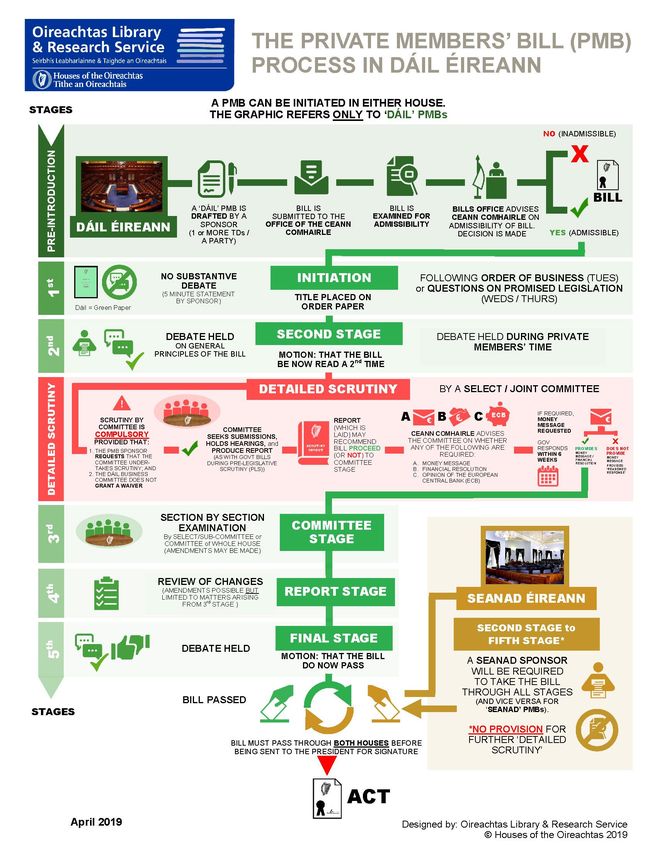
infographic of the PMB process accompanies this Note (Appendix 4).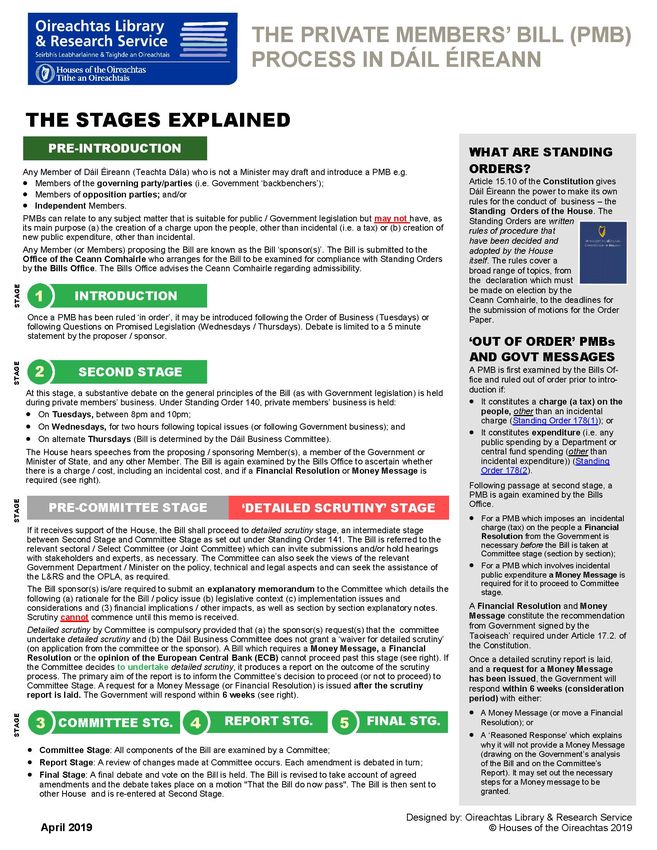
L&RS Note Private Members’ Bills: Admissibility, Government messages and detailed scrutiny (Updated)                                        2

Contents

1. Introduction: Private Members’ Bills and review of process ........................................................... 3
      Review of PMB process ............................................................................................................. 5
2. Financial restrictions on PMBs ..................................................................................................... 6
   2.1 Money Messages and Financial Resolutions....................................................................... 6
      Process of initiating and progressing a PMB ........................................................................ 7
      Examination prior to initiation: is the PMB in order? ................................................................... 7
      Examination following Second Stage: is a Message/Motion from Government required? ........... 9
   2.2 Other financial requirement: opinion of the European Central Bank (ECB) .................... 10
      Admissibility test (ECB) ............................................................................................................ 11
3. ‘Detailed Scrutiny’ of a PMB ........................................................................................................ 13
      ‘Detailed scrutiny’ and procedure before and since the MoU .................................................... 13
      The approach to detailed scrutiny ............................................................................................ 14
      Waste Reduction Bill 2016 ....................................................................................................... 15
      Local Government (Town Council Commission) Bill 2017 ........................................................ 15
Appendix 1: Rationale for the Constitutional provision and comparison with other parliaments ....... 20
Appendix 2: Samples of Financial Resolutions, Money Messages, and ECB Opinions ................... 23
Appendix 3: Detailed Scrutiny Framework (Appendix 1 MoU) ......................................................... 25
Appendix 4: Infographic on the PMB Process in Dáil Éireann.......................................................... 27

Legal Disclaimer
No liability is accepted to any person arising out of any reliance on the contents of this paper. Nothing herein constitutes
professional advice of any kind. This document contains a general summary of developments and is not complete or
definitive. It has been prepared for distribution to Members to aid them in their parliamentary duties. Some papers, such as
Bill Digests are prepared at very short notice. They are produced in the time available between the publication of a Bill and
its scheduling for Second Stage debate. Authors are available to discuss the contents of these papers with Members and
their staff but not with members of the general public.

© Houses of the Oireachtas 2019
L&RS Note Private Members’ Bills: Admissibility, Government messages and detailed scrutiny (Updated) 3
1. Introduction: Private Members’ Bills and review of process
A Private Member’s Bill (PMB) is a draft law which is proposed by a single Member (Teachta Dála or
Senator) or a group of Members, rather than by the Government. PMBs differ from Government Bills
in a number of respects; a Government Bill has prior approval from Cabinet, it is drafted by the
Office of the Parliamentary Draftsman and, in many cases, a draft of the Bill (i.e., the ‘heads’ or
alternatively, the ‘General Scheme’) will have been subject to pre-legislative scrutiny by a
parliamentary Committee.1 Further, while the aim of legislation generally is passage through
parliament and enactment, PMBs can be used for a variety of purposes. For instance, a PMB can be
used as a policy instrument by a Member to initiate debate on legislative and policy change. While
successfully steering a PMB from publication to the statute book is one way of achieving legislative
or policy change, Members use PMBs in different ways and with different objectives, for example:
To encourage the government to change policy/legislative approach to an issue;
To address a gap identified in the law (either through its passage and enactment or
government taking it on board);
To bring new ideas into the legislative process and ensure they get a hearing;
To respond to topical public and media concerns about an issue and, as such, act as a
culmination of the policy debate;
To attract publicity and build a campaign for a proposed change in the law.2
The number of PMBs published has increased quite dramatically since 2011. This is primarily the
outcome of procedural changes introduced in the 31st Dáil which created more plenary time for the
debate of Private Members’ Bills and provided a 5-minute slot for a Deputy to outline the PMB’s
purpose on introduction.3
Figure 1: Number of PMBs published in Dáíl Éireann 2008-2018
120 110
96
100
82 82 85
80 72
64
60
40 34 30
27
22
17
20
0
2007 2008 2009 2010 2011 2012 2013 2014 2015 2016 2017 2018
Number of PMBs published
The distinct effect of the make-up of the 32nd Dáil on Private Members’ Bills has been to increase
the rate at which PMBs pass Second Stage, which signals that the general principle of a Bill is
supported (or, at least, is not actively opposed) by a majority.
1
For a description see Oireachtas Library & Research Service (2014) Pre-legislative scrutiny and parliament
2
Gleaned from discussion in Brazier and Fox ‘Enhancing the backbench MP’s role as legislator: the case for
urgent reform of Private Members’ Bills’ Parliamentary Affairs (2010) Vol.63.1 pp. 205-207
3
See Infographic at the end of this Note for full description of the stages of the legislative process for PMBs.
L&RS Note Private Members’ Bills: Admissibility, Government messages and detailed scrutiny (Updated)                4

While the number of PMBs initiated in the Dáil increased in the 31st Dáil (Figure 1), only 15 PMBs
were agreed at Second Stage4 and only four PMBs were enacted.5 By way of contrast, 99 PMBs
(originating in either House) have been agreed at Second Stage in the 32nd Dáil up to 27 May 2019.6
Of these PMBs, 68 are at ‘referral to Committee’ stage and 55 of these 68 require a Money
Message from the Government before they may proceed to formal, section-by-section examination
at Committee Stage (see Section 2 for discussion). This has also been the effect in the 25th Seanad
which, as of 27 May 2019, had agreed 45 PMBs at Second Stage, including seven PMBs which had
originated in the Dáil (which have subsequently been enacted).7

Table 1: PMBs which have been enacted during the 32nd Dáil
                                                                                                   Originating
Bill Number    Name of Bill                                                      Sponsor
                                                                                                   House

Bill 46 of                                                                       Roisin
               Parental Leave (Amendment) Bill 2017                                                Dáil
2017                                                                             Shorthall
Bill 21 of     Consumer Protection (Regulation of Credit Servicing Firms)        Michael
                                                                                                   Dáil
2018           Bill 2018                                                         McGrath
Bill 26 of
               Intoxicating Liquor (Amendment) Bill 2017                         Billy Lawless     Seanad
2017
Bill 23 of                                                                       James
               Mental Health (Amendment) Bill 2017                                                 Dáil
2017                                                                             Browne
Bill 104 of
               Intoxicating Liquor (Breweries and Distilleries) Bill 2016        Alan Kelly        Dáil
2016
Bill 103 of                                                                      Thomas
               Fossil Fuel Divestment Bill 2016                                                    Dáil
2016                                                                             Pringle
Bill 78 of
               Irish Sign Language Bill 2016                                     Mark Daly         Seanad
2016
Bill 37 of     Petroleum and Other Minerals Development (Prohibition of          Tony
                                                                                                   Dáil
2016           Onshore Hydraulic Fracturing) Bill 2016                           McLoughlin
Bill 8 of
               Competition (Amendment) Bill 2016                                 Ivana Bacik       Seanad
2016
Bill 88 of     Central Bank and Financial Services Authority of Ireland          Pearse
                                                                                                   Dáil
2014           (Amendment) Bill 2014                                             Doherty

The increase in the number of PMBs has been the focus of some criticism in the media, in particular
since the minority government was elected in 2016. On the one hand, critics have blamed high
numbers of PMBs for ‘clogging up the Dail schedule’, including that of its Committees,8 and thereby
slowing up the process of scrutinising and passing legislation. On the other hand, the number of

4
  Agreed at second stage means that the Dáil agrees with the general principles of a Bill and that it should
proceed to Committee stage.
5
  In 2011-2015, even if a PMB passed Second Stage (i.e. if the Government did not oppose it at Second
Stage) Committees had in-built government majorities.
6
  This figure of 99 includes: 2 PMBs with ‘deferred readings; 18 PMBs at ‘order for Committee Stage’;’ 68 at
‘referral to Committee Stage’ in the Dáil’ 1 at ‘Order for Report/Report Stage’ in the Dáil and 10 PMBs which
have been enacted (7 originating in the Dáil and 3 in the Seanad).
7
  45 Bills originating in the Seanad have been agreed at second stage. Of this figure, one has a deferred
reading, 27 are at ‘referral to Committee’ stage, 4 are at ‘order for report /report stage, and 10 are at various
stage of the legislative process in the Dáil. A further 10 have been agreed at second stage in the Seanad and
have been enacted (three of which originated in the Seanad – Table 1).
8
  For example, Irish Times 18 March 2018 Dail returns to its largest in-tray in history; The Journal, 19 March
2017 Findfact:‘One year in: is this really a do-nothing Dáil?’
L&RS Note Private Members’ Bills: Admissibility, Government messages and detailed scrutiny (Updated) 5
PMBs stalled and awaiting Money Messages from the Government, a process explained and
described in Section 2 below, has been criticised, and it has been suggested that a rule designed to
ensure fiscal responsibility should not be used for any other purpose.9
Review of PMB process
The process and the support services for the drafting and scrutiny of Private Members’ Bills have
been under review by the sub-Committee on Dáil Reform. On foot of a report which it commissioned
on the services of the Office of the Parliamentary Legal Advisers (OPLA) (November 2016), a
drafting service has been established to ensure that PMBs are drafted to high standards. Research
for the policy development is offered by the Oireachtas Library and Research Service.
Following discussions during 2017 and 2018, a Memorandum of Understanding (MoU) on Private
Members’ Bills was agreed between the Government and the sub-Committee on Dáil Reform, and
was formally adopted by the Dáil, along with necessary changes to Standing Orders, in December
2018. Its purpose is to put in place a process which supports a Member’s right to propose
legislation, parliament’s duty to scrutinise legislation, and Government’s duty to ensure fiscal
responsibility. It sets out a ‘detailed scrutiny process’ for PMBs, as well as a process through
which the Government will engage with requests for Money Messages. The MoU process has led
to some changes to the legislative process for PMBs, which are described in detail in Section 3
below.
Section 2 explains the rationale for, and the process around, the financial requirements for PMBs.
Section 3 outlines the role of detailed scrutiny (pre-Committee Stage) before and since the MoU.
Section 4 provides data on the status of PMBs in the Houses of the Oireachtas as of 12 April 2019.
This Note is almost exclusively focused on the Standing Orders of the Dáil. However, PMBs
initiated in the Seanad are clearly also subject to this process when they reach the Dáil. As all Bills
must be approved by both Houses prior to becoming law, Bills (including PMBs) which are initiated
in the Seanad must be approved by the Dáil. As the Dáil is supreme in matters financial,10 the
financial requirements for PMBs are provided for in Dáil Standing Orders.
9
See Kieran Coughlan (former Clerk of the Dáil) in Irish Times 26 July 2017 ‘Government relying on little-
known rule to block PMBs’
10
The combined effects of Articles 17, 21, 22 and 28.4 of the Constitution is to give the Dáil, on the
Government’s initiation, a constitutional primacy in the area of State finances. See JM Kelly The Irish
th
Constitution 4 Edition (2003) p.337.L&RS Note Private Members’ Bills: Admissibility, Government messages and detailed scrutiny (Updated) 6
2. Financial restrictions on PMBs
2.1 Money Messages and Financial Resolutions
There are restrictions on PMBs which propose to either incur expenditure or to impose a charge on
the people (raise tax) which can be traced to the Constitution.
Articles 17 and 28.4.4 of the Constitution have been together interpreted as giving the Government
more-or-less exclusive authority to propose what public expenditure should be incurred and what
taxes should be imposed, while giving parliament the right to approve the proposals.
Under the Constitution (Article 17.2), the Dáil may not pass legislation that involves the
expenditure of public monies without a prior recommendation by Government supporting such
expenditure, signed by the Taoiseach.11
Article 28.4.4 provides that the Government must prepare annual ‘estimates of the receipts’ (money
received/raised by the State) and ‘estimates of expenditure’ of the State for each financial year and
present them to the Dáil for consideration. Article 17.1.1 requires the Dáil to consider these
estimates of receipts and expenditure as soon as possible after their presentation by the
Government. Under Article 17.1.2, the legislation required to give effect to the Financial Resolutions
(i.e., the Budget) of each year – i.e., the Finance Bill – should be enacted within that year.12
Box 1: Article 17.2 Bunreacht na hÉireann
The Government shall prepare Estimates of the receipts and Estimates of the
Article
expenditure of the State for each financial year, and shall present them to Dáil
28.4.4:
Eireann for consideration.
17.1.1 As soon as possible after the presentation to Dáil Éireann under Article 28 of
this Constitution of the Estimates of receipts and the Estimates of expenditure of the
State for any financial year, Dáil Éireann shall consider such Estimates
Article 17.1
17.1.2 Save in so far as may be provided by specific enactment in each case, the
legislation required to give effect to the Financial Resolutions of each year shall be
enacted within that year.
Dáil Éireann shall not pass any vote or resolution, and no law shall be enacted, for the
appropriation of revenue or other public moneys unless the purpose of the
Article 17.2
appropriation shall have been recommended to Dáil Éireann by a message from the
Government signed by the Taoiseach.”
A key rationale for restricting the right of financial initiative to Government is that active
legislative bodies (i.e. those with wide powers to control expenditure and revenue) have been found
to be prone to a pro-spending bias.13 One analyst describes the role of parliament in initiating
expenditure as a balancing act “between legislative control of the budgetary process (of expenditure
in general) and a budget that is under control”.14 Parliaments of the Westminster system deal with
this tension by using procedures that severely restrict the power of legislators to initiate Bills (or
amendments to Bills) which incur a charge on the public purse (including amendments to the
11
Under Article 28.6.3 of the Constitution the Tánaiste may sign on behalf of the Taoiseach.
12
Note that Financial Resolutions in the Constitution refers to budget resolutions only. The Financial
resolutions in Standing Orders are different and refer to the resolutions obtained to allow legislation which
involves increases to, or new, taxation to progress. This is explained below.
13
Wehner Joachim (2010) Legislature and the Budget Process Palgrave, MacMillan p. 141.
14
Wehner Joachim (2010) Legislature and the Budget Process Palgrave, MacMillan p. 141.L&RS Note Private Members’ Bills: Admissibility, Government messages and detailed scrutiny (Updated) 7 executive’s budget). A comparative analysis of how provisions with a similar intent are operated by the Standing Orders of other parliaments of the Westminster tradition (Appendix 1) finds that restrictions on proposing and debating Bills which have financial implications are applied similarly in the UK House of Commons and the Australian Federal Parliament, and more liberally in the Canadian House of Commons and the New Zealand Parliament, where there is more scope to progress PMBs which incur expenditure. Below we explain how these provisions are operated via Dáil Standing Orders on non-Government Members’ right to propose legislation (PMBs). Under Dáil Standing Orders 178 and 179,15 TDs who are not Ministers may initiate PMBs which involve expenditure or tax-raising, provided they are incidental to the main purpose of the Bill. However, in the event that such PMBs are approved at Second Stage, the Bill may not be taken at formal Committee Stage without: (a) a ‘recommendation’ from the Government (Money Message) in the case of expenditure, or (b) a Financial Resolution approved by the Dáil on a motion from a Member of the Government, in the case of taxation. The Money Message constitutes the recommendation from Government required by Article 17.2 of the Constitution. The Financial Resolution reflects the purpose of the various constitutional provisions which give the Government the broad right of initiative in relation to financial matters.16 These Standing Orders (178 and 179) affect the process of initiating, and progressing, a PMB. Process of initiating and progressing a PMB17 A PMB, once drafted, is currently examined for compliance with Dáil Standing Orders at two points in the legislative process, the first prior to its introduction, and the second after a PMB has passed Second Stage. The second examination may take place in two stages and, since the MoU, is not complete until after the detailed scrutiny report on the Bill has been laid in the Oireachtas library (provided the detailed scrutiny process has not been waived – see Section 3 below). (See Appendix 4 for detail of stages in the legislative process.) 1. Examination prior to initiation: is the PMB in order? Once a PMB is drafted and submitted to the Office of the Ceann Comhairle, the Bills Office examines it and advises the Ceann Comhairle, who may rule the Bill out of order prior to initiation (first stage in the legislative process) if it contravenes Dáíl Standing Orders. A ruling at this stage means that the Bill cannot be published and printed. A PMB contravenes Standing Orders if one of the conditions (A) or (B) in Table 2 is met. In sum, a Bill is admissible only if the cost (either the proposed charge/tax on the people or proposed expenditure) is incidental to the overall purpose of the Bill (Box 2). 15 All references to Dáil Standing Orders refer to the 2016 edition. 16 See footnote 11 above. 17 An infographic on the PMB process is provided as Appendix 4 of this Note.
L&RS Note Private Members’ Bills: Admissibility, Government messages and detailed scrutiny (Updated) 8
Table 2: Conditions under which a PMB is ruled ‘out of order’ (Standing Orders 178 and 179 and 147)
Conditions Detail
It constitutes a charge (a tax) on the people, other than an incidental** charge
A Charge / Tax
(Standing Order 178(1))
Appropriation of It constitutes appropriation of revenue (any expenditure of public moneys
B Revenue / from either voted moneys (Departmental or State bodies or agencies) or the
Expenditure Central Fund (other than incidental expenditure) (Standing Order 179(1)).
A Bill may not be initiated if it is identical or substantially similar to a Bill which has
already been printed, or for which the Dail has already given leave to introduce
(Standing Order 147(3A)). Where the Ceann Comhairle is examining Bills for
C Substantially compliance with Standing Orders, and finds that two or more Bills are identical or
similar Bill
substantially similar, the Member sponsoring the Bill first received by the Ceann
Comhairle shall be the member permitted to present or move for leave to introduce
it.
**Incidental to the purpose of the Bill’ (see Box 2 below)
Box 2: ‘Incidental’ charges / costs and rulings on admissibility
Costs / charges which are incidental to the main purpose of the Bill generally refer to ‘ancillary’
expenditure or revenue which would arise from the implementation of the proposed legislation. In the case
of expenditure, this concept allows most PMBs to be initiated while precluding Bills where the expenditure
involved is such that it could not be said to be incidental to the main purpose of the Bill. The test here is
whether the expenditure is intrinsic to the achievement of the main purpose of the Bill. The scale of the
expenditure is a factor to be weighed, but is not the sole consideration. Decisions on admissibility of Bills
are, in effect, rulings on the application of general principles in Standing Orders and, as such, they are
applied on a case-by-case basis, based on an assessment of each individual Bill. This process may
involve “fine-drawn lines of distinction” [Ruling 142(a) of the Salient Rulings of the Chair].
Illustrative examples:
For example, a PMB might be ruled out of order on introduction where it proposes a charge such as:
An increase in the TV licence fee for all users
A congestion charge for all motorists
…on the basis that the revenue-raising proposal is not incidental to the Bill’s overall purpose. If it’s
deemed to be incidental, a Financial Resolution would be required prior to Committee Stage (see Second
Examination below).
For example, a PMB may be ruled out of order on introduction where it proposes expenditure such as:
Free Medical Care for children up to 18 years
A Home help package to be provided automatically to all those over 65
…on the basis that the appropriation of revenue or other public moneys is not incidental to the Bill’s overall
purpose (rather, it is the purpose of the Bill). If it’s deemed to be incidental, a Money Message would be
required prior to Committee Stage (see Second Examination below).
Once a PMB is ruled ‘in order’ (admissible) by the Ceann Comhairle, it is placed on the Order Paper
for first stage (introduction). At first stage a Member makes a five-minute speech in favour of
his/her proposed legislation and seeks the permission (leave) of the House to introduce it. Once a
Member has this permission, the Bill is published and tabled for a Second Stage debate, following
which there is a House decision on the general principles (policy) of the Bill.18 Note that it is also
18
A PMB may be listed on the Order Paper for many months before it is scheduled for a Second Stage
debate.L&RS Note Private Members’ Bills: Admissibility, Government messages and detailed scrutiny (Updated) 9
possible for a ‘Parliamentary Group’ to present a PMB under Standing Order 143F(1). This means
that the Group does not need to seek the permission of the House to publish and print the PMB and
it instead proceeds directly to order for Second Stage (provided that it is admissible along the lines
outlined above).19 However, a Group may only have one such PMB on the Order Paper at any one
time. Accordingly, the vast majority of PMBs are introduced by individual Members, rather than
presented by a Group.
2. Examination following Second Stage: is a Message/Motion from Government required?
If the PMB is approved at Second Stage, it is examined to assess whether a Money Message or a
Financial Resolution is required before it may proceed to formal Committee Stage.
Where a PMB involves public expenditure which is incidental to the purpose of the
Bill, a Money Message from Government is required for it to proceed to formal section-
by-section examination at Committee Stage (Standing Order 179, which is intended to
implement the recommendation required under Article 17.2 of the Constitution).
Where a PMB imposes an charge on the people (tax) which is incidental to the
purpose of the Bill, a Financial Resolution ‒ brought forward on a motion proposed by
a Member of the Government and approved by the Dáil ‒ is necessary before the Bill is
taken at formal Committee Stage (Standing Order 178).
Incidental expenses under Dáil Standing Order 179 may include research and consultation on, and
development of a new policy, its implementation and monitoring, a subsequent review process, and
possible enforcement costs.
Table 3: Financial Resolutions and Money Messages
Financial Resolutions Money Messages
Required in cases where a PMB Required in cases where a PMB proposes expenditure of
proposes a charge (tax) on the public moneys from either voted moneys (Departmental or
people including where incidental to State bodies or agencies) or the Central Fund including
the purpose of the Bill. where incidental to the purpose of the Bill.
Proposed on a motion by a member of Provided by the Government and printed on the Order Paper.
the Government ‒on approval by the
Dáil, becomes a resolution.
There are three categories of Money Messages depending on
the fund the cost would be charged to:
Oireachtas Money Messages occur where the expenditure
incidental to the purposes of the Bill proposed by the PMB would
come out of a Department’s voted expenditure (approved
annually by the Dáil);
Central Fund Money Messages occur if the incidental
expenditure proposed is from the Central Fund (non-voted or
Exchequer funding);
Oireachtas and Central Fund Money Messages are a
combination of both of the above.
While a PMB which involves a charge or expenditure cannot proceed to formal Committee Stage
without a Money Message/Financial Resolution from Government, neither is required for a Bill
which passes Second Stage to undergo ‘Detailed Scrutiny’ by the relevant Select or Joint
Committee. In fact, under the MoU (December 2018), this stage is no longer discretionary but aL&RS Note Private Members’ Bills: Admissibility, Government messages and detailed scrutiny (Updated) 10
requirement (with some caveats). It will take place before a request for a Money Message is issued,
and the outcome (the Committee’s report on detailed scrutiny) will be taken into consideration
when making a final determination on the need for a Money Message. The purpose of the
detailed scrutiny stage, which was a focus of the MoU discussions along with the process of
providing Money Messages, is discussed in Section 3 of this Note.
Government decisions on Money Messages
Whether or not to provide a Money Message or propose a motion for a Financial Resolution is a
Cabinet decision and is therefore subject to Cabinet confidentiality. Requests for Money Messages
are processed by the Department of Public Expenditure and Reform (DPER) and requests for
Financial Resolutions by the Department into which the policy area falls. Both liaise with the
Department of the Taoiseach in respect of the Cabinet decision. Standing Orders do not set down a
time-frame within which a Money Message or motion for a Financial Resolution must be either
provided or declined by Government. This has contributed to the growing number of PMBs at
‘referral to Committee Stage’ (on the Order Paper described as at ‘Order for Committee Stage’)
which have yet to receive a response to a Money Message request, and it was a key reason for the
review of the PMB process and the MoU. When the MoU was agreed in December 2018, 69 PMBs
were at ‘referred to Committee Stage’, the vast majority requiring a Money Message to proceed.
The MoU has sought to address this problem by requiring Government to respond to a request
within an agreed timeframe, subject to the Committee having conducted and concluded detailed
scrutiny. The process is described in Section 3 below, after a brief section on one further financial
requirement.
2.2 Other financial requirement: opinion of the European Central Bank (ECB)
Under Article 127(4) of the Treaty on the Functioning of the European Union, national authorities
must consult with the ECB, and give due consideration to its opinion, where it is considered that a
Bill (either initiated by Government or a Private Member) may impact on the ECB’s competencies,
e.g. that it:
Impacts on the role of the Central Bank of Ireland (as a national central bank within the
Euro-system20 which is governed by the ECB); and/or
Relates to rules applicable to financial institutions insofar as they materially influence the
stability of financial institutions and markets.
Article 2(1) of Decision 98/415/EC lists the categories explicitly considered to be within the ECB’s
field of competences21 regarding draft legislative provisions, although this list is not exhaustive:
Currency matters;
Means of payment;
National central banks;
20
The Central Bank of Ireland represents Ireland in the Eurosystem (euro area central banks and the ECB).
The Eurosystem is governed by the ECB, which is responsible for monetary policy (i.e., currency) for the euro
area, comprising 19 Member States of the European Union. The wider European System of Central Banks
(ESCB) comprises the ECB and the national central banks of all EU Member States, whether they have
adopted the euro or not.
21
See: ECB (2015) Guide to consultation of the European Central Bank by national authorities regarding draft
legislative provisions, October 2015.L&RS Note Private Members’ Bills: Admissibility, Government messages and detailed scrutiny (Updated) 11
The collection, compilation and distribution of monetary, financial, banking, payment systems
and balance of payments statistics;
Prudential supervision (Single Supervisory Mechanism – SSM);
Payment and settlement systems; and
Rules applicable to financial institutions insofar as they materially influence the stability of
financial institutions and markets.
In addition, all euro area Member States must consult the ECB on draft legislative provisions
concerning the instruments of monetary policy.
Box 3: Article 127(4) of the Treaty on the Functioning of the European Union
The European Central Bank shall be consulted:
on any proposed Union act in its fields of competence;
by national authorities regarding any draft legislative provision in its fields of competence, but
within the limits and under the conditions set out by the Council.
The European Central Bank may submit opinions to the appropriate Union institutions, bodies, offices or
agencies or to national authorities on matters in its fields of competence in accordance with the procedure
laid down in Article 129(4) of TFEU.
The consultation process is intended to ensure that the national legal framework in general:
a. Contributes to the achievement of the objectives of the ECB and/or the European System of
Central Banks (ESCB);
b. Is compatible with the legal framework of the Eurosystem/ESCB and of the ECB; and
c. Is in line with Eurosystem/ESCB and ECB policies.
How this Treaty requirement is implemented is a matter for each national authority. In Ireland, Dáil
Standing Orders effectively provide that a PMB on which an ECB consultation is required may not
be taken at Committee Stage until that process is complete and the outcome has been reported to
the Dáil. (However, if the ECB does not provide an opinion within the deadline set, that cannot
prevent the progress of the Bill – see below.)
Admissibility test (ECB)22
The assessment as to whether an ECB consultation is necessary is done at the same time as the
admissibility test for PMBs which have passed Second Stage (see page 9 above and Appendix 2).
Following this assessment, the Ceann Comhairle will advise the Bill sponsor on whether an ECB
consultation is required. If it is, the relevant Committee sends the request to the President of the
European Central Bank. The Committee may set out a timeframe within which to receive a response
(as set down in Article 3(1) of the Council decision 98/415/EC); the deadline must be at least one
month from the date on which the President of the ECB receives notification.23 Once the time limit
has expired, the relevant authorities (in this case, the Dáil) can continue the procedure for
considering the draft legislation, which has been suspended during the ECB consultation, i.e. the Bill
may be taken at formal Committee Stage. If the Committee receives an ECB opinion after this date
and when formal Committee Stage has commenced, the opinion is laid in the Oireachtas library.
22
Since January 2019, this process is set out in Dáil Standing Order 148C.
23
The ECB may request an extension of the time limit for up to an additional four weeks and cannot be
“unreasonably declined” by the consulting authority. The time taken, which varies depending on the nature,
complexity and sensitivity of the draft legislative provisions concerned, is on average approximately six weeks
from receipt of notification.L&RS Note Private Members’ Bills: Admissibility, Government messages and detailed scrutiny (Updated) 12
It is important to note that in cases where an ECB opinion is needed, a PMB cannot proceed to
Committee Stage until the ECB consultation has been completed and an opinion has been received
(except where the ECB fails to respond by the agreed deadline). However, national legislators are
not obliged to follow the ECB’s opinion. The requirement is designed to ensure that national
legislation is adopted only after due consideration of the ECB’s opinion. All opinions are also
published on the ECB’s website.24 Under Dáil Standing Order 148C, the Committee should include
the outcome of a consultation with the ECB in its detailed scrutiny report.
Box 4: Summary of admissibility tests for compliance with financial requirements
A PMB may not be initiated in the Dáil (at first stage) if it constitutes a charge on the people (a tax,
levy) or expenditure of public money except, in both cases, where it is incidental to the purpose of the
Bill;
Where a PMB will result in expenditure incidental to the purpose of the Bill, it may proceed to formal
Committee Stage only with a Money Message from Government;
Where a PMB will result in an charge on the people (tax raising) incidental to the purpose of the Bill, it
may proceed for formal Committee Stage only with a Financial Resolution (on a motion from a
Member of the Government agreed by the Dáil);
Where a PMB may impact on the competencies of the European Central Bank, it may proceed to
formal Committee Stage only if the correct procedure for consulting with the ECB is followed.
24
Full detail of the ECB process ECB (2015) Guide to consultation of the European Central Bank by national
authorities regarding draft legislative proposals, October 2015.L&RS Note Private Members’ Bills: Admissibility, Government messages and detailed scrutiny (Updated) 13 3. ‘Detailed Scrutiny’ of a PMB ‘Detailed Scrutiny’– a new stage in the legislative process for PMBs - was introduced in 2016 in response to the increasing numbers of PMBs passing Second Stage and with a view to ensuring that PMBs are subjected to a similar level of scrutiny as are Government Bills (via the pre-legislative scrutiny process introduced in November 2013). Taking place after Second Stage, and prior to formal Committee Stage, ‘detailed scrutiny’ is undertaken even where a Financial Resolution, Money Message or opinion from the ECB is required to proceed to formal Committee Stage. ‘Detailed scrutiny’ and procedure before and since the MoU Prior to the MoU, following approval at Second Stage, a PMB stood at ‘referral to Committee Stage’ in the legislative process and, under Dáil SO 141, it was referred to the relevant Select Committee for ‘detailed scrutiny’. Detailed scrutiny was at the discretion of the Committee (i.e., the Committee decided whether or not detailed scrutiny was necessary), and on conclusion of detailed scrutiny, the Committee would report to the Dáil or to both Houses as appropriate (for role of the Seanad in detailed scrutiny, see Box 5 below). The MoU has introduced two key changes to this process. First, Standing Orders have been amended to make ‘detailed scrutiny’ compulsory, rather than discretionary, provided that: (a) the sponsor of the PMB requests that the Committee undertake detailed scrutiny, and (b) the Business Committee does not grant a ‘waiver for detailed scrutiny’ (on application from the Committee or the sponsor).25 After scrutiny (which may be undertaken by the Joint Committee as per Box 5), the Committee lays its report before the Dáil, followed by a message which makes a recommendation on whether the PMB should proceed to formal Committee Stage. A request for a Money Message (or Financial Resolution) is issued after the scrutiny report is laid. Secondly, once a detailed scrutiny report is laid, and a request for a Money Message has issued, under the MoU, the Government will respond within six weeks with either a Money Message or a ‘reasoned response’ which explains why it will not provide a Money Message (drawing on the Government’s analysis of the Bill and on the Committee’s report).26 It may set out the necessary steps for a Money Message to be granted.27 Yet if the steps set out in a reasoned response would require amendments to the PMB, a Member may have to seek permission to introduce a new (re-drafted) PMB if he/she wishes to progress the initiative. This is because amendments cannot be tabled until formal Committee Stage which itself cannot be taken without a Money Message. For the many PMBs at ‘referral to Committee’ in the Dail for which a Money Message was requested prior to the commencement of the MoU (15 January 2019), it was agreed that the Government would respond in the agreed time-frame as soon as a detailed scrutiny report had been laid. 25 Dáil Standing Orders 148A and 148B (revised edition, 2019) 26 The MoU is silent on Financial Resolutions. 27 Under the MoU, if the Government cannot meet this deadline (for example because of a heavy departmental legislative workload), the Minister will write to the Committee outlining a proposed different time-frame.
L&RS Note Private Members’ Bills: Admissibility, Government messages and detailed scrutiny (Updated) 14
Figure 2: Dáil PMB legislative process (as of January 2019)
1st Stage 3rd Stage
2nd Stage 5th
Initiation Formal
Debate 4th Stage Proceeds
Committee
Introduction and vote Detailed Stage Final to 2nd
Stage(
or on scrutiny Report Stage Stage in
needs MM
presentation general Stage and Seanad
or FR from
principles Vote
Govt)**
** Needs Money Message or Financial Resolution if it involves expenditure or taxation which is incidental to
the Bill’s purpose (if expenditure/taxation is not incidental to the purpose of the Bill, the Bill will already have
been ruled out of order prior to introduction).
Box 5 Joint Committee and detailed scrutiny
Under SO148B(4), detailed scrutiny may be undertaken by a Joint Committee of the Dáil and
Seanad (rather than by the Dáil Select Committee). To date, ‘detailed scrutiny’ has generally been
undertaken by Joint Committees. The Joint Committee then reports to both Houses prior to formal
Committee Stage which is undertaken by the Dáil Select Committee.
There is no provision in Seanad Standing Orders for a similar process of ‘detailed scrutiny’ by
Senators of a ‘Seanad’ PMB. As such, when a Seanad PMB is approved at Second Stage, it
proceeds to formal Committee Stage, a stage which tends to be taken by a Committee of the whole
House. Seanad Standing Order 150 does permit a PMB, on conclusion of Second Stage, to be
"referred to some other Committee" (i.e., other than Committee of the whole Seanad) but this occurs
rarely. If a Seanad PMB passes all stages in the Seanad, it proceeds to Second Stage in the Dáil,
and, at this point, it will follow the same procedure as a Dáil PMB.
The approach to detailed scrutiny
Under revised Standing Orders, a Committee should examine the PMB from a policy, legal and
financial perspective in accordance with guidelines which are set out in a scrutiny framework in the
MoU (Appendix 3).28 In general, a Committee will seek to hear from:
The PMB’s Sponsor (explanatory memos are now mandatory on publication of all Bills);
The relevant Minister and/or his departmental officials;
Other relevant stakeholders and experts who can bring evidence to bear on the PMB.
A Committee will receive assistance in the form of a pre-meeting briefing paper which identifies key
issues for its consideration from the Library and Research Service. A Committee will consult the
Office of the Parliamentary Legal Advisers (OPLA) regarding legal and drafting issues.
The outcome of ‘Detailed Scrutiny’ is a report to the Dáil which is, in effect, a political judgement on
the PMB and the policy underlying it. This report is laid before the House (or Houses in the event
that scrutiny is undertaken by a Joint Committee). The report may refer to topics such as the policy
gap the Bill is attempting to address, the broad legislative and policy context, possible issues with
the Bill which would require amendmentsat formal Committee Stage, and/or possible unintended
legal or policy consequences which should be addressed. It will frequently engage with proposed
Government legislation or other PMBs with similar policy intentions. It is open to the Committee to
consider the possible financial implications of a PMB and, where a PMB might require a Money
28
A draft scrutiny framework, which had been prepared by L&RS and Committee Chairs in April 2017, was
updated and is part of the MoU.L&RS Note Private Members’ Bills: Admissibility, Government messages and detailed scrutiny (Updated) 15 Message, this may, in fact, be useful. Under revised Standing Orders (January 2019) a report should be followed by a message which makes a recommendation on whether or not the PMB should proceed to formal Committee Stage (Figure 2). 4. Status of PMBs before Committees (as of 27 May 2019) As of 27 May 2019, there were 68 PMBs at ‘referred to Committee’ stage in the Dáil. Of these 68, 55 require a Money Message (one of these 55 requires a Financial Resolution). Of the 55, in three cases, Money Messages have been granted, and in two cases, a Money Message has been refused by way of a reasoned response from Government. In 17 of the cases requiring a Money Messages, a ‘detailed scrutiny report’ has been laid by the Committee, and detailed scrutiny is underway in many other cases (Table 3). Given the six-week time-frame for a response to a Money Message request in cases where a detailed scrutiny report has been laid, a response from Government is anticipated shortly for a number of these bills. Fourteen PMBs at referral to Committee Stage do not require a Money Message to proceed. In five of these cases a detailed scrutiny report has been laid (Table 4). The two reasoned responses to money message requests in respect of PMBs published to date are available at the links below: Waste Reduction Bill 2016 Committee report is here; reasoned response is here. An L&RS Note provided an exchequer-cost- estimate analysis of the Waste Reduction Bill 2017 [PMB] and closely related proposals. It can be accessed here. Local Government (Town Council Commission) Bill 2017 Committee report is here, reasoned response is here. All PMBs approved at Second Stage in the Dáil after 15 January 2019 (under the MoU) are at ‘order for Committee Stage’, as well as a number of other earlier PMBs. As of 27 May 2019, there are 18 PMBs at ‘order for Committee Stage.’ These PMBs require an order to be formally referred to Committee. The status of these Bills, including where detailed scrutiny has commenced, is set out in Table 5.
L&RS Note Private Members’ Bills: Admissibility, Government messages and detailed scrutiny (Updated)       16

Table 3: PMBs referred to Select Committee and requiring a Money Message
     Name                                               Money Message    Money        Detailed scrutiny
                                                        Required        Message        report laid (or
                                                        (requested)     Received         otherwise)
1    Anti-Evictions Bill 2018                           Y required         N          Scrutiny underway
2    Bail (Amendment) Bill 2017                         Y 18/09/2018        N          Scrutiny required
3    Banded Hours Contract Bill 2016                    Y 11/09/2017        N        Scrutiny not scheduled
4    Cannabis for Medicinal Use Regulation Bill 2016    Y 20/02/2017        N                 Yes
5    Central Bank (Amendment) Bill 2018                 Y 06/03/2018        N        Scrutiny not scheduled
6    Civil Liability and Courts (Amendment) Bill 2018   Y 19/11/2018        N        Scrutiny not required
7    Civil Liability (Amendment) (Prevention of         Y 23/10/2018        N         Scrutiny underway
     Benefits from Homicide) Bill 2017
8    Consumer Insurance Contracts Bill 2017             Y 03/10/2017        N                 Yes
9    Consumer Protection (Amendment) Bill 2017          Y 18/09/2018        N                 Yes
10   Coroners Bill 2015                                 Y 22/09/2016        N                 Yes
11   Criminal Justice (Aggravation by Prejudice) Bill   Y 03/03/2017        N                 Yes
     2016
12   Criminal Justice (Victims of Crime) (Amendment)    Y 16/11/2018        N         Scrutiny scheduled
     Bill 2018
13   Digital Safety Commissioner Bill 2017              Y 27/03/2018        N         Scrutiny underway
14   Education (Amendment) Bill 2015                    Y 05/10/2016        N                 Yes
15   Electoral (Amendment) (No. 3) Bill 2014            Y 03/03/2017    Y 22/05/19            Yes
16   Employment Equality (Abolition of Mandatory        Y 27/03/2017        N                 Yes
     Retirement) Bill 2016
17   Equality(Miscellaneous Provisions) Bill 2017       Y 09/03/2018        N         Scrutiny concluded
                                                                                        Report not laid
18   Famine Memorial Day Bill 2016                      Y 16/05/2018        N        Scrutiny not scheduled
19   Flood Insurance Bill 2016*                         Y 16/05/2017        N                 Yes
20   Gambling Control Bill 2018**                       Y 12/06/2018        N          Scrutiny required
21   Garda Síochána (Amendment) (No. 2) Bill 2014       Y                   Y        Scrutiny not scheduled
                                                                        08/11/2016
22   Genuine Progress Indicators and National           Y 27/03/2018        N         Scrutiny underway
     Distributional Accounts Bill 2017
23   Harassment, Harmful Communications and Related     Y 09/02/2018        N        Scrutiny not required
     Offences Bill 2017
24   Housing (Homeless Families) Bill 2017              Y 05/12/2017        N         Scrutiny complete
                                                                                        report not laid
25   International Protection (Family Reunification)    Y required          N         Scrutiny completed
     (Amendment) Bill 2017 [Seanad]                                                     Report not laid
26   Irish Human Rights and Equality Commission         Y 25/01/2019        N        Scrutiny not required
     (Gender Pay Gap Information) Bill 2017 [Seanad]
27   Island Fisheries (Heritage Licence) Bill 2017      Y 09/02/2018        N                 Yes
28   Judicial Appointments Commission Bill 2016         Y 23/11/2016        N                 Yes
29   Local Government (Establishment of Town            Y 05/07/2017     N - MM               Yes
     Councils                                                             refused
     (Commission) Bill 2017                                             29/03/2019
30   Local Government (Restoration Of Town Councils)    Y 30/10/2018         N                Yes
     Bill 2018
31   Local Government (Water Pollution) (Amendment)     Y required          N          Scrutiny required
     Bill 2018
32   Mental Health Parity Bill 2017                     Y 03/07/2018        N        Scrutiny not required
33   Microgeneration Support Scheme Bill 2017           Y required          N         Scrutiny scheduled
L&RS Note Private Members’ Bills: Admissibility, Government messages and detailed scrutiny (Updated) 17
34 Mortgage Arrears Resolution (Family Home) Bill Y 03/10/2017 N Yes
2017
35 Multi-Party Actions Bill 2017 Y 05/12/2017 N Scrutiny concluded
report not laid
36 National Famine Commemoration Day Bill 2017 Y 27/04/2017 Y Yes
02/05/2018
37 Online Advertising and Social Media Y 05/02/2018 N Scrutiny underway
(Transparency) Bill 2017
38 Pensions (Amendment) (No. 2) Bill 2017 Y 02/03/2017 N Scrutiny underway
39 Petroleum and Other Minerals Development Y 27/05/2019 N Dáil agreed to
(Amendment) (Climate Emergency discharge requirement
Measures) Bill 2018 to report on detailed
scrutiny 28/03/2019
40 Prisons (Solitary Confinement) (Amendment) Bill Y 20/02/2017 N Yes
2016
41 Protection of Employees (Collective Y 05/07/2017 N Scrutiny not scheduled
Redundancies)Bill 2017
42 Provision of Objective Sex Education Bill 2018 Y 12/06/2018 N Scrutiny not scheduled
43 Public Services and Procurement (Social Value) Y 03/03/2017 N Scrutiny required
Bill 2017
44 Residential Institutions Statutory Fund Y 15/11/2017 N Scrutiny not scheduled
(Amendment) Bill 2016
45 Residential Tenancies (Amendment) Bill 2018 Y 05/02/2018 N Scrutiny required
46 Residential Tenancies (Greater Security of Tenure Y 10/07/2018 N Scrutiny underway
and Rent Certainty) Bill 2018
47 Residential Tenancies (Student Rents, Rights and Y 10/07/2018 N Scrutiny underway
Protections) Bill 2018
478 Sale of Illicit Goods Bill 2017 Y 16/11/2018 N Scrutiny not scheduled
49 Sale of Tickets (Sporting and Cultural Events) Bill Y 20/02/2018 N Yes
2017
50 Shared Maternity Leave and Benefit Bill 2018 Y required N Not scheduled
51 Statute of Limitations (Amendment) Bill 2018 Y required N Scrutiny required not
yet scheduled
52 Urban Regeneration and Housing (Amendment) Y 18/09/2018 N Scrutiny underway
Bill 2018
53 Vacant Housing Refurbishment Bill 2017 Y 11/10/2017 N Scrutiny concluded
report not laid
54 Vulnerable Persons Bill 2015 Y required N Scrutiny required not
scheduled
55 Waste Reduction Bill 2017 Y 18/10/2017 N - MM Yes
refused
21/03/2019
* The Flood Insurance Bill 2016 requires a Central Fund Message** The Gambling Control Bill 2018 requires a
Financial Resolution.***Scrutiny not scheduled generally means that a final decision has not yet been made on whether
scrutiny is required. Note for any Bills agreed at second stage after 15 January 2019, the committee does not have this
discretion.L&RS Note Private Members’ Bills: Admissibility, Government messages and detailed scrutiny (Updated) 18
Table 4: PMBs referred to Select Committee and not requiring a Money Message
Name Date referred Detailed scrutiny Report
laid
1 Central Bank (Variable Rate Yes
Mortgages) Bill 2016
2. Consumer (Credit) Amendment Bill Decision on scrutiny not yet
2018 made
3 Equal Status (Admission to Schools) Decision on scrutiny not yet
Bill 2016 made
4 Ethical Public Investment (Tobacco) Decision on scrutiny not yet
Bill 2017 made
5 Garda Síochána (Amendment) Bill Scrutiny concluded report not
2017 laid
6 Health and Social Care Professionals Yes
(amendment) Bill 2016
7. Maternity Protection Members of the Scrutiny not required
Houses of the Oireachtas Bill)
8 Medical Practitioners (Amendment) Bill Yes
2017
9 Petroleum and Other Minerals Scrutiny concluded report not
Development (Amendment) (Climate laid
Emergency Measures) Bill 2018
10 Ramming of Garda Vehicles Bill 2015 Decision on scrutiny not yet
made
11. Social Housing Bill 2016 Decision on scrutiny not yet
made
12 Thirty-fifth Amendment of the Yes
Constitution (Water in Public
Ownership) (No. 2) Bill 2016
13 Thirty-fourth Amendment of the Yes
Constitution (Presidential Voting) Bill
2014
14 University College Galway Decision on scrutiny not yet
(Amendment) Bill 2017 made
Table 5 Bills at ‘order for Committee Stage’
PMB Sponsor Detailed
scrutiny
1. Housing (Sale of Local Authority Housing) Bill 2016 Barry Cowen Order for
Committee
2 Local Government Reform (Amendment) (Directly Elected John Lahart Order for
Mayor of Dublin) Bill 2016 Committee
3 Local Government (Mayor and Regional Authority of Dublin) Bill Eamon Ryan, Order for
2016 Catherine Martin Committee
4 Nursing Home Support Scheme (Amendment) Bill 2016 Willie O’Dea Order for
Committee
5 Equality (Miscellaneous Provisions) (No. 2) Bill 2017 James Browne, Order for
Jim O’Callaghan, Committee
Fiona O’Loughlin
6 Management Fees (Local Property Tax) Relief Bill 2018 Darragh O'Brien Order for
Committee
7 Comptroller and Auditor General (Amendment) Bill 2017 Dara Calleary Order for
Committee
8 Prohibition of Above-cost Ticket Touting Bill 2017 Noel Rock, Order for
Stephen S. Committee
Donnelly
9. Civil Liability and Courts (Amendment) Bill 2019 Barry Cowen Order for
CommitteeL&RS Note Private Members’ Bills: Admissibility, Government messages and detailed scrutiny (Updated) 19
10. Finance (Office of Tax Simplification) Bill 2018 Michael McGrath Order for
Committee
11. Sex Offenders (Amendment) Bill 2018 Maureen Order for
O’Sullivan Committee
12. Road Traffic (All Terrain Vehicle and Scrambler Motor-cycle) John Lahart, Order for
(Amendment) Bill 2019 John Curran Committee
13. Treatment of Cancer (Advertisements) Bill 2018 Kate O’Connell Order for
Committee
14. Landlord and Tenant (Ground Rent) (Amendment) Bill 2017 Robbie Gallagher Order for
[Seanad] Committee
15 Health (Pricing and Supply of Medical Goods) (Amendment) Bill John Brassil Detailed scrutiny
2018 requested and
underway
16 Control of Economic Activity (Occupied Territories) Bill 2018 Niall Collins Detailed scrutiny
[Seanad] requested and
underway
17 Industrial and Provident Societies (Amendment) Bill 2018 Clare Daly, Joan Detailed scrutiny
Collins, Maureen requested and
O'Sullivan, underway
Catherine
Connolly,
Thomas Pringle,
Mick
Wallace, Thomas
P. Broughan
18 No Consent, No Sale Bill 2019 Pearse Doherty Detailed scrutiny
requested and
underway
nd
In total, Money Messages have been issued in respect of seven Private Members’ Bills in the 32 Dáil:
Table 6: Money Message granted in respect of PMBs in the 32nd Dáil
Bill Current status
Electoral (Amendment) no.3 Bill 2014 Referral to Committee Stage
Intoxicating Liquor (Breweries and Distilleries) Bill 2016 (money message and
Financial Resolution received); Order for Report Stage
Parole Bill 2016 Order for Report Stage
Competition (amendment) Bill 2016 Enacted (See Table 1)
Referral to Committee (see
Garda Siochana (Amendment) (No.2) Bill 2014
Table 3)
Referral to Committee (see
National Famine Commemoration Day Bill 2017
Table 3)
Recognition of Irish Sign Language for the Deaf Bill 2016 Enacted (see Table 1)L&RS Note Private Members’ Bills: Admissibility, Government messages and detailed scrutiny (Updated) 20 Appendix 1: Rationale for the Constitutional provision and comparison with other parliaments A key rationale for restricting the right of financial initiative to Government is that active legislative bodies (i.e., those with wide powers to control expenditure and revenue) are prone to a pro- spending bias.29 One analyst describes the role of parliament in initiating expenditure as a balancing act “between legislative control of the budgetary process (of expenditure in general) and a budget that is under control”. 30 Parliaments of the Westminster system address this tension by using procedures that severely restrict the power of legislators to initiate Bills (or amendments to Bills) which incur a charge on the public purse (including amendments to the executive’s budget). This is the rationale for Article 17.2 of the Constitution. Not all legislatures are restricted in this way in terms of the financial initiative. At the other extreme (e.g., the US Congress), the legislature may revise the budget and make its own revenue and spending decisions. Most parliaments in Europe fall somewhere between the US and the UK extremes; they permit legislators to modify the budget, but do not permit changes to the totals; research has shown that the pro-spending bias which characterises parliaments with strong budgetary powers is reduced where parliament’s power is focused on allocative choices within a ‘hard’ budget.31 In these parliaments, there tend to be no formal restrictions on the proposal of PMBs or amendments to government Bills which may involve expenditure or the raising of revenue. In other words, parliaments with most power to amend the budget have few restrictions on the right to initiate PMBs which involve a charge. Of particular interest to the Irish Parliament is whether parliaments which face similar constitutional restrictions on the financial initiative are permitted to table and progress PMBs which incur either substantial or incidental charges on the revenue. An overview of four such parliaments (Table 5) finds that the restrictions on proposing and debating Bills which have financial implications are applied similarly in the UK House of Commons and the Australian Federal Parliament, and more liberally in the Canadian House of Commons and the New Zealand Parliament, where there is more scope to progress PMBs which incur expenditure. In neither the UK Houses of Parliament nor the Australian Federal Parliament may formal Committee Stage take place without a Money Message or Financial Resolution, where required. In the Canadian House of Commons there is more scope to debate PMBs which propose expenditure; a money resolution from the Government is not required until the PMB has reached its third reading (i.e. after formal Committee and Report stages). In the New Zealand Parliament, 29 Wehner Joachim (2010) Legislature and the Budget Process Palgrave, MacMillan p. 141. 30 Wehner Joachim (2010) Legislature and the Budget Process Palgrave, MacMillan p. 141. 31 Schick Allen (2002) ‘Can National Legislatures Regain an effective Voice in Budget Policy?’ OECD Journal on Budgeting p. 15- 41.
You can also read


