STANDING ROCK NEXT GENERATION PLAN - THE 25 YEAR STRATEGIC PLAN OF THE STANDING ROCK GOVERNMENT
←
→
Page content transcription
If your browser does not render page correctly, please read the page content below
STANDING ROCK
NEXT GENERATION PLAN

2020 – 2045

          THE 25 YEAR STRATEGIC PLAN
 OF THE STANDING ROCK GOVERNMENT
2|Page
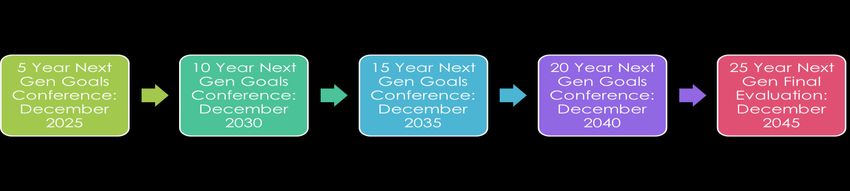
TABLE OF CONTENTS
VISION AND MISSION STATEMENT                    3

STRATEGIC PLANNING COMMITTEE                    4

SECTION ONE: WHAT ARE WE DOING?                 7
       EXECUTIVE SUMMARY                        8

SECTION TWO: HOW ARE WE DOING THIS?             10
       THE STANDING ROCK MODEL                  11
       SWOT ANALYSIS RESULTS                    16

SECTION THREE: STANDING ROCK IN 2045            19

SECTION FOUR: WHAT ARE OUR GOALS?               22
       SUMMARY                                  23

SECTION FIVE: HOW ARE WE GOING TO ACHIEVE IT?   35
       IMPLEMENTATION PLAN                      36
       SAMPLE CONSORTIA COMPOSITIONS            38

                                                     3|Page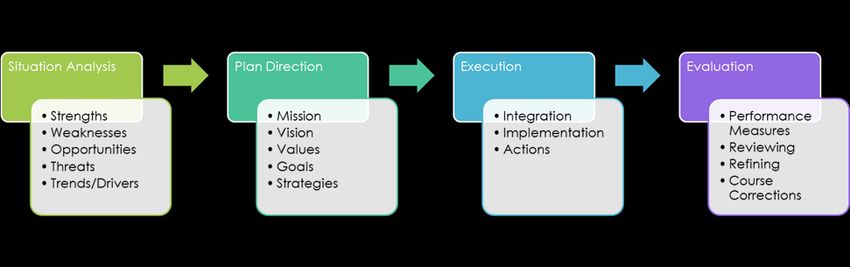
THE STANDING ROCK SIOUX TRIBE

VISION STATEMENT
The Standing Rock Tribal Government strives to be a more effective, efficient and visible
government providing opportunities for our economy to grow through business development
by educating our members to enhance the health and wellness of the people of Standing Rock.

MISSION STATEMENT
The Standing Rock Sioux Tribal Council is a governing body empowered by the Standing Rock
Sioux Tribe Constitution committed to promoting an environment for the self-sufficiency of all
tribal members.

                                                                                      4|Page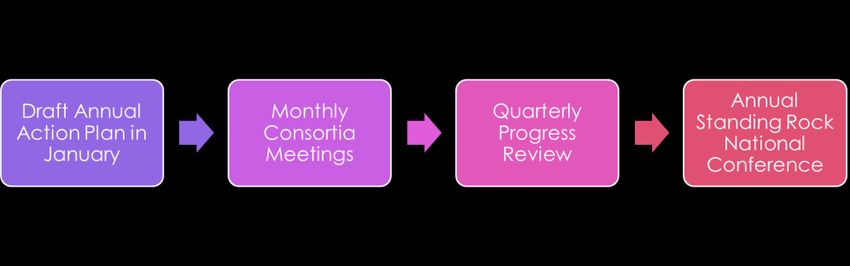
STRATEGIC PLANNING COMMITTEE
SESSIONS FACILITATED BY AND PLAN WRITTEN BY JERL THOMPSON
                                                                         SESSIONS
                                                                        ATTENDED
TRIBAL COUNCIL
MIKE FAITH                     Chairman                                   ******
IRA TAKEN ALIVE                Vice Chairman                              ***
SUSAN AGARD                    Secretary                                  ***
PAUL ARCHAMBAULT               Councilman, At-Large                       *
VERDELL BOBTAIL BEAR           Councilman, Running Antelope District      ******
BEN HARRISON                   Councilman, Porcupine District             **
WAYNE LOOKING BACK             Councilman, Wakpala District               ****
BRANDON MAUAI                  Councilman, Long Soldier District          *
JOHN PRETTY BEAR               Councilman, Cannonball District            ****
CAROLINE THOMPSON              Councilwoman, Rock Creek District          **
CHARLES WALKER                 Councilman, At-Large                       ***
FRANK WHITE BULL               Councilman, At-Large                       ***
JOE WHITE MOUNTAIN JR.         Councilman, Bear Soldier District          **

GOVERNMENT STAFF
DELLIS AGARD                   Administrator, Tribal Court                ******
CYNTHIA ANTELOPE               Tribal Planner                             **
CHARLES BAILEY                 Director, Tribal Gaming                    *
CARMELITA BEAR RIBS            Director, Headstart                        **
TAMI BIRDHORSE                 Director, Alcohol Tobacco Other Drugs      **
EMMA JEAN BLUE EARTH           Director, Tribal Education Department      ******
PETER CAPOSSELA                Attorney                                   **
SUNSHINE CARLOW                Lakota Culture Institute                   ***
JIM CERNEY                     Public Defender, Tribal Court              *
DOUG CROW GHOST                Director, Water Resources                  ***
RACHEL DEO                     Project LAUNCH                             **
ANGELA EAGLE                   Director, Internal Affairs                 ******
DANIELLE FINN                  Director, External Affairs                 ***
MARGARET GATES                 Director, Tribal Health Administration     **
VERNA GONE                     Clerk of Courts, Tribal Court              **
ERIN GREY CLOUD                Acting-Director, Recording Department      **
PETRA HARMON                   Director, Nutrition for the Elderly        ***

                                                                        5|Page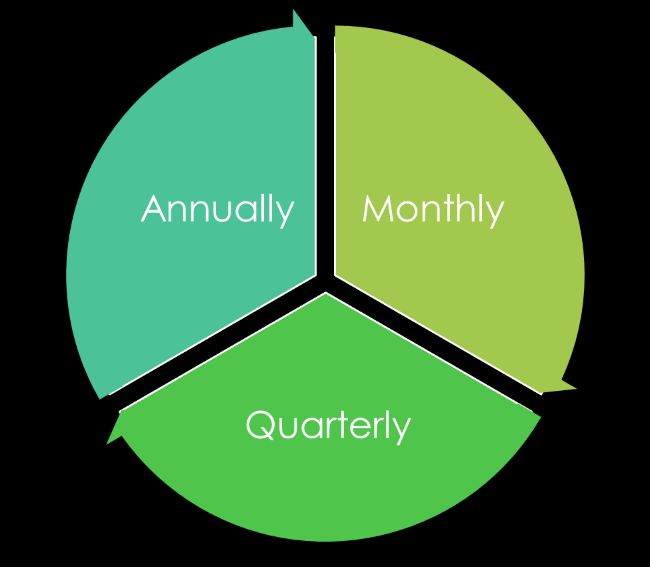
WARREN HAWK                Grants Manager                                ****
MANAJA HILL                Director, Veterans Affairs                    **
MELVIN HILL                Human Resource Manager                        *
RON HIS HORSE IS THUNDER   Director, Transportation                      ******
MARLO HUNTE                Director, Project LAUNCH                      *
JEFF KELLY                 Director, Game and Fish Department            *
KAROL KELLY                Director, ND Tax Department                   ******
JEROME LONGBOTTOM          Chief Finance Officer                         *
JOSEPH MCNEIL              Director, Standing Rock Development Corp.     ***
MONIQUE RUNNELS            Director, Wellness Program                    **
SVEN SCHREIBER             Director, Information Technology              **
DUANE SILK                 Director, Treatment Program                   *
JOSEPH SMITH               Director, Land Operations                     ****
JANET THOMAS               Executive Director                            *****
JERL THOMPSON              Director, Child Support Enforcement Agency    ******
ERNESTINE JANE TUNTLAND    Director, SD Tax Department                   **
SHARON TWO BEARS           Tribal Education Department                   ******
JANAKATE WALKER            Project LAUNCH                                *
ELLIOTT WARD               Director, Emergency Management                ****
FAWN WASIN ZI              Land Operations                               **
GILLARD WHITE              Director, CDBG                                *
SONYA WHITE MOUNTAIN       Director, Natural History Museum              *

COMMUNITY
HELEN ALKIRE               Elder                                         **
WILLIAM BROWNOTTER         Youth                                         *
DESTINY CAMERON            Youth                                         *
GRACEY CLAYMORE            Youth/DLSI Intern                             *
PRESTON COTTONWOOD         Youth                                         *
ALIYA EAGLE                Youth                                         *
DAVID GIPP                 Elder                                         **
PAT HAWK                   Elder                                         *
PATTI KELLY                Elder                                         **
CADEE PELTIER              Youth                                         *
SONDI PHILLIPS             Youth/DLSI Intern                             *
MAYA MONROE RUNNELS        Youth/DLSI Intern                             **
TALYN SHELL TRACK          Youth                                         *
VIRGIL TAKEN ALIVE         Elder                                         *
ANNALEE YELLOW HAMMER      Youth                                         *

                                                                        6|Page
7|Page
SECTION ONE

        WHAT ARE WE DOING?

                      8|Page
EXECUTIVE SUMMARY
The Standing Rock Government is engaging in strategic planning. The Standing Rock
strategic/government planning model differs from traditional planning models in that it defines
25 years as long term goals, 10 and 5 years as mid-term goals and takes into account the unique
dynamics of the reservation and tribal government into its implementation process. This plan
uses the term government to mean the tribal government apparatus, or the tribe’s complex
system of organizing the functions of government through numerous bodies, departments,
programs, and entities of which it exerts a measure of direct control or influence. This
apparatus includes the elected government leadership, tribal departments and programs, and
tribal government and business entities. This plan also seeks to build a bridge of collaboration
with partner entities like schools, as well as community stakeholders like our citizens and area
businesses. This model calls for the “all-hands-on deck” approach that it is going take to
drastically and comprehensively reengineer the future the Standing Rock Sioux Tribe.
“The Standing Rock Next Generation Plan” will define the Tribal Government’s goals for
the next 25 years. The plan will further outline the building of a foundation of 10 and 5 year
goals to ensure our ability to achieve the 25 year goals we set for the next generation of
Standing Rock. Furthermore, the Standing Rock government planning model focuses on building
a structure to institutionalize the implementation of the strategic plan within all aspects of the
government apparatus. Our approach can be thought of in construction terms. The architects
design it. The engineers take that design and figure out how to build it. The construction teams
carry out the building of it, and together they all ensure the successful completion of the
project. This model will successfully marry the term-limited work of the elected-government
leadership (Architects) with the long-term work of the career-government leadership
(Engineers) and to the rest of the government staff (Construction Teams). The Next Generation
9|PagePlan will set the large-scale goals and priorities upon which the energy and resources of the
Standing Rock Government will be focused, and will ensure that all stakeholders agree on our
common goals and intended results.
Numerous tribal programs, departments, entities and communities have already
engaged in strategic planning of their own. The Standing Rock Next Generation Plan will serve
to strengthen and enhance existing strategic plans as well strengthen overall government
operations. The end result is not just a binder of papers left to be forgotten on a shelf. Rather, it
is a living document and implementation structure that will guide the work of the tribal
government through both its elected and career leadership over the next generation.
10 | P a g eSECTION TWO
HOW ARE WE DOING THIS?
11 | P a g eTHE STANDING ROCK MODEL
It was stated during the initial planning sessions that the Tribe has engaged in strategic
planning numerous times in the past and the results were mixed. However, planning in the past
had focused on only the elected-government perspective, and had not been translated down
into the rest of the government organization. The Standing Rock model aims to learn from what
we have done in the past and improve upon it. This model is designed to create
implementation structures that institutionalize the plan into the routine operations of the
government.
The process that we are using is meant to emulate the construction process. The plan is
being designed by architects elected by the people of Standing Rock. The plan is further refined
by our engineers who possess the multi-faceted, technical knowledge and skills to address the
specific logistics of the design. Together, they will build a structure of scaffolding that will
support the construction of the plan’s goals. The plan will then make the transition to our
construction teams of employees, partners and stakeholders to carry it out and change our
future to one of our own design.
Figure 2.1
12 | P a g eThe strategic planning conducted by the Tribe in the past had focused on using
traditional planning models. The standard strategic planning model is very useful for achieving
goals up to five to ten years in a more singularly focused or sectored organization. However,
these models have difficulty translating to the complexity of modern tribal governments.
Moreover, they are further hindered by the unique historical, social, economic and
jurisdictional dynamics of Indian Reservations. Therefore, it is necessary to use a different
approach while retaining some of the basic tenants of good strategic planning.
Government power exists in two overlapping spheres -the decision-making power of the
elected government and the carrying-out power of the career government. When these two
spheres are in harmony, clear lines of communication and concerted action routinely occurs.
However, when these two spheres are in discord, the ability of the government to be effective
and enable progress is hindered. Strategic planning in the past has happened in these two
spheres independent of one another.
Figure 2.2
The missing step has been a plan that recognizes the difference in these spheres of government
and unites them in its design and efforts. The Standing Rock Next Generation Plan aims to
better fuse together the government apparatus and amalgamate all work into engineered and
concerted actions.
13 | P a g eThe Standing Rock model took input from the elected-government leaders, career-
government leaders and community elders and youth leaders. Together, these groups
examined the current state of Standing Rock through a traditional SWOT analysis before using
the analysis, and their perspectives, to create a 25 year outlook. The 25 year outlook paints a
picture of the ideal characteristics we would like to see in our people and environment. Our
model asked three basic questions.
1. What will our families look like in 25 years?
2. What will our communities look like in 25 years?
3. What will our government look like in 25 years?
Once we answered these questions and described the ideal characteristic of these three
pieces of our society, it was time to create some goals. The next step our model took was to
condense the 25 year outlook results into 25 year goals. Once we had our 25 year goals, the
planning committee worked its way from them creating 10 year goals. These 10 year goals
answered the question, “what do we have to accomplish in 10 years to ensure that we can
reach our 25 year goals?” These goals will serve as a benchmark to guide and assess the
government’s progress. The committee next broke down the 10 year goals into 5 year goals.
These 5 year goals answered the question, “what do we have to accomplish in 5 years to ensure
that we can reach our 10 year goals?”
Once we had the steps designed to take Standing Rock where we want it go, the time
came to design a solid foundation and structure for construction. This came in the form of our
implementation plan. The implementation plan is truly the key to success with a plan of this
magnitude and complexity. The Standing Rock model focuses on building an Implementation
Structure. The key for success is collaboration and this model focuses on building a
collaborative structure into the government apparatus to carry out the annual action plans
needed to achieve our goals. Our implementation plan and structure takes into account lessons
14 | P a g ewe have learned from our successes and failures in past plans and past attempts at
organizational structures.
The Standing Rock Next Generation Plan calls for the creation of 4 consortia structures
into the Standing Rock Government Apparatus. These consortia will focus on key sectors of
Standing Rock. The Children and Families Consortium, the Culture and Elders Consortium, the
Education Consortium, and the Economy Consortium. Since it is impossible to assemble any
small, single committee of planners with the breadth and depth of knowledge to draft both the
goals and actions necessary to create the kind of change the Next Generation Plan aims to
accomplish, we must build a structure to do so within the government. These consortia will be
the think tanks of Standing Rock drafting Annual Action Plans based on the prowess of our own
experts to carry out the steps needed to achieve our goals.
Figure 2.3
Furthermore, the consortia will allow for engagement on the plan with the community through
an annual Standing Rock conference. The conference will allow the community to see the work
being done to transform our future and provide input and feedback. This transfers the plan
from a small group of people to all the people needed to move us forward together.
15 | P a g eSWOT ANALYSIS RESULTS
STRENGTHS
Sovereignty Smart Youth
Large Land Base Allies
Leadership Tribal Businesses
Water Resources Casinos
Our People Oyate CDFI
Our Language and Culture Standing Rock CDC
Our Active Youth Education Consortium
Constitution Children and Families Consortium
More Educated Tribal Members Language Revitalization
Facebook/Social Media Codes, Laws and Ordinances
Growing Demographics Artistry of Our People
Partnerships Credit Rebuilding Program
A Lot of Programs Veteran’s Homeless Shelter
Scholarship Program Transit Public
SBC Burial Assistance
Immersion School District Wacipi/Celebrations
Buffalo Strong Women
Kinship/Family Treatment Program
Resiliency Paved Streets
Our History Treaties
Tourism Political Capital (6 Congressional Delegation)
Natural Beauty of Land Self Determination
River Largest Employers Run by Members
International Profile Tribal Court
Native Humor Strong Support from Tribal Government
Humility Public Library
Improvising, Adapting, Overcoming Veterans
Our Elders
16 | P a g eWEAKNESSES
Overlapping Services/Duties Overall Poor Health of Our People
Lack of Trust Job Market
Lack of Leadership Commitment Business Market
Lack of Collaboration Not Utilizing Natural Resources
Silos Are Too Tall Intergovernmental Conflict
Political Continuity/Volatility No Structural Fire Department
Lack of Planning and Vision Adequate Public Transportation
Territorialism No Banks/Lending
Allow ND/SD Divide Dependency
Lack of Accountability Job Readiness
No Adequate (Centralized) Data Personal Sovereignty
Lack of Supports Defining Emergency
Lack of Adequate Training Traditional/Cultural Awareness
Housing Shortage Barriers to Employment
No Structure for Community Engagement Family Support System
Lack of Healthcare Loudest Voices Allowed to Dictate Policy
No Treatment Facilities Entitlement Mentality
No Mental Health No Review of Wasteful Spending
Lack of Facilities and Infrastructure Enforcing Laws and Codes
OPPORTUNITIES
Economy Funding for Higher Education
Name Recognition Tribal Members Off Reservation
Untapped Federal Laws Changing Law and Regulations
8A Hub Zones Status Impact Investors – using our Name
GSA Status Business Capitalization
External Company Partnerships Access to Healthcare
Renewable Energy Market Air Ambulance-Air Medical Services
Data Centers Access to Healthcare Professional Expertise
Mentor Partnership Rail Roads
Local Markets Build Grain Elevator
Contacts –Business (Everything) Access to Foreign Markets
Marketing SRST Off Reservation Defense Contracting
Agriculture Technology
Political Clout Webinars
Educational –State Lost Social Media Tech Market
Human Resources-Jobs Off Reservations
17 | P a g eTHREATS
Loss of Culture Lack of Energy Policy
Mainstream Influence Climate Change - Environment
Federal Funding Water Rights – Army Corps. Of Engineers
Donald Trump Effect of Other Tribes Legal Issues
Fossil Fuel Industry MRI Restrictions – Mainstream Standards
Drug Trafficking Federal and State Courts
State Governments US Supreme Court
County Governments Lack of Education and Understanding
Lack of Treaty Recognition Regional Economy
Not at the Table - Consultation Local Economy
Use of Sovereignty
18 | P a g eSECTION THREE
STANDING ROCK IN 2045
19 | P a g eSTANDING ROCK IN 25 YEARS
OUR FAMILIES IN 25 YEARS
A family on Standing Rock in 25 years will speak Lakota/Dakota as the primary language
in their home. They will have easy access to cultural resources including community elders and
their stories and oral histories. Families will practice Lakota/Dakota customs, kinship protocols,
and encourage their children to embrace and carry-on our Lakota/Dakota way of life. Our
homes will be free from abuse as our families will be sober and physically and emotionally
healthy. Technology will be used to improve both communication and face to face family
interaction. Families will combine the healthy lifestyle attributes shaped by embracing our
Lakota/Dakota culture into their lives along with resources made available through improved
housing, and healthcare by the government via adequate government planning and resource
collaboration. Finally, families on Standing Rock will build their pathways to self-sufficiency
through education and employment. They will also have access to resources allowing them to
live environmentally sustainable lives and break the cycle of dependency and poverty.
OUR COMMUNITIES IN 25 YEARS
The communities on Standing Rock in 25 years will meet the standard of beauty, safety
and comfortability that we set. They will flourish through our culture, volunteerism and full
engagement in our local government. Communities will be able to better serve their residents
with local opportunities, education and health resources. Communities will utilize their local
human and natural resources to gain stability, self-sufficiency and greater autonomy. Finally,
20 | P a g ecommunities on Standing Rock will lead the movement toward local renewable energy
development and independence from fossil fuels.
OUR GOVERNMENT IN 25 YEARS
The government of Standing Rock will more accurately reflect who we are as a people
and still maintain the efficiencies and effectiveness necessary to provide adequate public
service. The government will use contemporary technology to meet our standards of civic
communication, engagement and interaction. The government will look at changes the people
wish to make to its structure and to determinations of enrollment and/or citizenship, and adopt
any voter approved changes. The government will foster an economic environment that
diversifies and emboldens our people’s ability to gain stability and self-sufficiency. Finally, our
government will have the capability to fully act on its inherent sovereignty to ensure the
protection of our people and resources.
21 | P a g eSECTION FOUR
WHAT ARE OUR GOALS?
22 | P a g eSUMMARY
This section contains the goals of the Standing Rock Next Generation Plan that were
crafted from the 25 year outlooks for families, communities and the government. The goals
formed three themes under each sections.
FAMILIES
LAKOTA/DAKOTA FAMILIES
HEALTHY FAMILIES
SOVEREIGN FAMILIES
COMMUNITIES
BEAUTIFUL COMMUNITIES
INVOLVED COMMUNITIES
SOVEREIGN COMMUNITIES
GOVERNMENT
“OUR” GOVERNMENT
VIBRANT ECONOMY
TRUE SOVEREIGNTY
Each one of these nine themes contain the 25 year goals, 10 year goals and 5 year goals
that achieve the intended results of the Next Generation Plan. Each goal is implemented
through the Annual Action Plans of the consortia structure. Each goal is designed to achieve
both a primary linear outcome as well as secondary lateral outcomes that support and enable
the achievement of goals in other sectors of the overall plan.
23 | P a g eLAKOTA/DAKOTA FAMILIES
25 YEAR GOALS
Our families will utilize all language and cultural resources, including elders, to ensure
that Lakota/Dakota is the primary language spoken in the home, that stories and oral
histories are passed to each generation, and that cultural practices are integrated into
daily life
Our families are planned before started by two individuals intending on having children
and maintaining their family
Our families are not engaged in any type of abuse
Our families embrace changing technologies to enhance and advance communication
without sacrificing face-to-face time spent with one another
10 YEAR GOALS
Our families speaking Lakota/Dakota and having integrated our traditional cultural
customs and practices into their daily lives has increased to 20 to 25%
Our families experiencing teen pregnancy has decreased by 20 to 25%
Our families experiencing drug, alcohol and tobacco abuse has decreased by 20 to 25%
5 YEAR GOALS
Our families speaking Lakota/Dakota and having integrated our traditional cultural
customs and practices into their daily lives has increased to 5 to 10%
Our families experiencing teen pregnancy has decreased by 5 to 10%
Our families experiencing drug, alcohol and tobacco abuse has decrease by 5 to 10%
24 | P a g eIMPLEMENTATION
Implementation of these goals will be strategized through Annual Action Plans (AAP),
and carried out through the collaborative work of the Tribal Council, Children and Families
Consortium, Culture and Elders Consortium, Economy Consortium and Education Consortium.
HEALTHY FAMILIES
25 YEAR GOALS
Our families are physically healthy with extended life expectancy
Our families are growing and eating their own traditional foods, and growing and
utilizing our traditional medicines
Our families are mentally and emotionally healthy with access to local mental health
services
Our families are living in healthy, adequate, well-maintained homes and housing
facilities
10 YEAR GOALS
Our families experiencing childhood obesity and diabetes has decreased by 20 to 25%
Our families needing services for mental health has decreased by 20 to 25%
Our families have access to 200 more units of public housing
5 YEAR GOALS
Our families experiencing childhood obesity and diabetes has decreased by 5 to 10%
25 | P a g e Our families needing services for mental health has decreased by 5 to 10%
Our families have access to 50 to 100 more units of public housing
IMPLEMENTATION
Implementation of these goals will be strategized through Annual Action Plans (AAP),
and carried out through the collaborative work of the Tribal Council, Children and Families
Consortium, Culture and Elders Consortium, Economy Consortium and Education Consortium.
SOVEREIGN FAMILIES
25 YEAR GOALS
Our families are college educated and/or trades certified
Our families are self-sustained through employment in Standing Rock and are financially
stable
Our families own their home, assets and land
Our families are living “Green,” environmentally sustainable lives
10 YEAR GOALS
Our families have increased their number of high school graduates to 80%
Our families have a 20% increase in home ownership
Our families have increased recycling and reduced waste by 20%
Our families participate in financial literacy training by 50 to 75%
26 | P a g e5 YEAR GOALS
Our families have increased their number of high school graduates to 60%
Our families have a 10% in home ownership
Our families have increased recycling and reduced waste 10%
Our families participate in financial literacy training by 20 to 30%
IMPLEMENTATION
Implementation of these goals will be strategized through Annual Action Plans (AAP),
and carried out through the collaborative work of the Tribal Council, Children and Families
Consortium, Culture and Elders Consortium, Economy Consortium and Education Consortium.
BEAUTIFUL COMMUNITIES
25 YEAR GOALS
Our communities are clean with well-maintained streets, parks, gardens, playground
equipment and recreation areas for healthy lifestyle activities
Our communities flourish with wellness, arts and cultural centers
Our communities engage in traditional and seasonal practices and customs
Our communities are safe
10 YEAR GOALS
Our communities have a facility dedicated to wakes and funerals
Our communities have a well-maintained park, playground, community garden, and
recreational sporting area
27 | P a g e Our communities have a safety plan and a safety/security officer
Our communities have a Lakota/Dakota Resource Center
5 YEAR GOALS
Our communities have built at least 1 facility for dedicated to wakes and funerals
Our communities have built at least 1 well-maintained park, playground, community
garden, and recreational sporting area
Our communities have developed a Parks and Recreation Sustainability Plan for tax
dollars and have developed local ordinances and policies for their public facilities and
areas
IMPLEMENTATION
Implementation of these goals will be strategized through Annual Action Plans (AAP),
and carried out through the collaborative work of the Tribal Council, Children and Families
Consortium, Culture and Elders Consortium, Economy Consortium and Education Consortium.
INVOLVED COMMUNITIES
25 YEAR GOALS
Our communities thrive through volunteerism, mentoring/tutoring and
intergenerational interaction by active social groups and societies
Our communities have local facilities used for quality education that meets each
communities specific and unique needs
Our communities are active in, and fully participate in, the governance and political
processes of Standing Rock
28 | P a g e10 YEAR GOALS
Our communities have increased voter turnout for all elections by 20 to 25%
Our communities have increased district quorum participation by 20 to 25%
Our communities are utilizing district facilities and/or contemporary technology to meet
its specific and unique educational needs
5 YEAR GOALS
Our communities have increased voter turnout for all elections by 5 to 10%
Our communities have increased district quorum participation by 5 to 10%
Our communities have a Volunteer Community Watch Group
Our communities have a local Language/Culture Group utilizing community elders and
Lakota/Dakota speakers
IMPLEMENTATION
Implementation of these goals will be strategized through Annual Action Plans (AAP),
and carried out through the collaborative work of the Tribal Council, Children and Families
Consortium, Culture and Elders Consortium, Economy Consortium and Education Consortium.
SOVEREIGN COMMUNITIES
25 YEAR GOALS
Our communities have access to adequate healthcare, first responders, and aftercare
Our communities have a contemporary and well-maintained technological
infrastructure
29 | P a g e Our communities are economically self-sustaining by utilizing their land and natural
resources along with local reinvestment by community members
Our communities have energy independent of fossil fuels
10 YEAR GOALS
Our communities have increased homes with direct access to internet by 20 to 25%
Our communities have a community nurse and/or access to a nurse via tele-medicine or
contemporary technology
Our communities have community-based drug/alcohol prevention and outreach
Our communities have 10% of their energy provided by renewable energy
5 YEAR GOALS
Our communities have increased homes with direct access to internet by 5 to 10%
Our communities have increased their use of community land resources by 5 to 10%
Our communities have tele-medicine and drug and alcohol prevention services provided
at all established clinics
Our communities have their community centers powered by either solar or wind turbine
energy
IMPLEMENTATION
Implementation of these goals will be strategized through Annual Action Plans (AAP),
and carried out through the collaborative work of the Tribal Council, Children and Families
Consortium, Culture and Elders Consortium, Economy Consortium and Education Consortium.
30 | P a g e“OUR” GOVERNMENT
25 YEAR GOALS
Our government is structured to align with our traditional practices, is transparent and
accountable and is providing the contemporary functions of public service
Our government does not determine membership/citizenship by blood quantum
Our government empowers all our members/citizens of voting age to exercise their right
to vote in Standing Rock elections
Our government encourages our people’s freedom from reliance on government
10 YEAR GOALS
Our government will have 100% of elected officials and employees educated in cultural
competency
Our government will develop a membership/citizenship determination process that
does not diminish our future generations
Our government has increased the number of mental health professionals and licensed
social workers employed here to at least 10 in each field
5 YEAR GOALS
Our government has implemented a Tribal Language and Culture Code and revised Title
XVIII and other related codes to ensure cultural competency
Our government has held a constitutional convention and adopted voter approved
changes
Our government has equipped each community with technology for interactive
broadcasting of meetings and information
Our government has conducted an impact study of the current tribal enrollment system
31 | P a g e Our government has increased the number of mental health professionals and licensed
social workers employed here to at least 5 in each field
Our government has designed a scholarship program specifically for mental health and
social work with incentives to transition to employment here
IMPLEMENTATION
Implementation of these goals will be strategized through Annual Action Plans (AAP),
and carried out through the collaborative work of the Tribal Council, Children and Families
Consortium, Culture and Elders Consortium, Economy Consortium and Education Consortium.
VIBRANT ECONOMY
25 YEAR GOALS
Our government has fostered an economic environment where private and public
business can thrive by encouraging local and outside investment to diversify the
Standing Rock economy
Our government improves access to employment and eliminates any identified barriers
Our government invests economic gains into a quality education system and youth
internships to ensure continual growth and innovation
Our government provides premium hospital facilities, healthcare and insurance and
elderly care facilities
10 YEAR GOALS
Our government has assessed the number of businesses routinely used by the
government and increased the number of member and/or Native owned businesses
used by 25%
32 | P a g e Our government has identified feasible areas and zoned them for commercial
development and provided utilities and infrastructure to those zones
Our government has developed and invested in tribally owned land for irrigation and
other potential markets to diversify and increase government revenue by 25%
Our government has prioritized allocation of the 25% gain in revenue to investment in
health, education, and family welfare
5 YEAR GOALS
Our government has developed codes and policies to govern the allocation and
spending of tribal funds
Our government has created a Central Data Collection Office with qualified staff and
analysts
Our government has created a multi-jurisdiction Business Advisory Commission
Our government has created tax code incentives to attract and keep businesses in
Standing Rock
IMPLEMENTATION
Implementation of these goals will be strategized through Annual Action Plans (AAP),
and carried out through the collaborative work of the Tribal Council, Children and Families
Consortium, Culture and Elders Consortium, Economy Consortium and Education Consortium.
TRUE SOVEREIGNTY
25 YEAR GOALS
Our government is the regulatory body for all functions of the government service in
place of Federal and state regulations
33 | P a g e Our government is debt free and financially sovereign
Our government and people own 35% of land within the exterior boundaries of the
reservation and are expanding our ownership of original treaty lands
Our government is fully engaged with area governments to enforce its regulations,
agenda and will of the Standing Rock people
10 YEAR GOALS
Our government has standards and procedures for teaching Standing Rock Tribal
Government and Relations curriculum
Our government has access to a financial institution (bank, credit union, etc.) with
facilities within the reservation
Our government has increased the tribal and member/citizen ownership and usage of
land within the exterior boundaries of the reservation by 15%
5 YEAR GOALS
Our government is fully aligned with the Standing Rock Next Generation Plan all
departments, programs, and entities having developed or revised their strategic plans
Our government has achieved and maintains clear audits
Our government has renegotiated the WAPA agreement
Our government has developed a Public Utilities Commission
Our government has developed and enacted a Renewable Energy Code
IMPLEMENTATION
Implementation of these goals will be strategized through Annual Action Plans (AAP),
and carried out through the collaborative work of the Tribal Council, Children and Families
Consortium, Culture and Elders Consortium, Economy Consortium and Education Consortium.
34 | P a g eSECTION FIVE
HOW ARE WE GOING TO ACHIEVE IT?
35 | P a g eIMPLEMENTATION PLAN
Planning at a government level, even at a relatively smaller government level like
Standing Rock, presents numerous complexities. The multi-faceted nature of governments
create a lot of moving parts to the machinery that needs to carryout actions to achieve goals.
Elected leadership holds the decision-making power of the government; however, department
and program directors hold the power of agency. These two pieces of government must agree
and work together. When they do not have a plan to guide them and a means to routinely
collaborate, strategize, and communicate, they become a hindrance to positive progress for the
people the government serves.
It is not enough to create goals at the top level. We also need a structure and
mechanism to transfer those goals throughout the entire government apparatus in order for
them to be translated into actions. Without creating this structure it is impossible to adequately
engage all of the pieces that need to act with concerted effort to achieve the long-term goals.
Our Standing Rock planning model aims to solve this problem by creating an implementation
structure of collaboration within the government. This will take our 25 year plan beyond paper
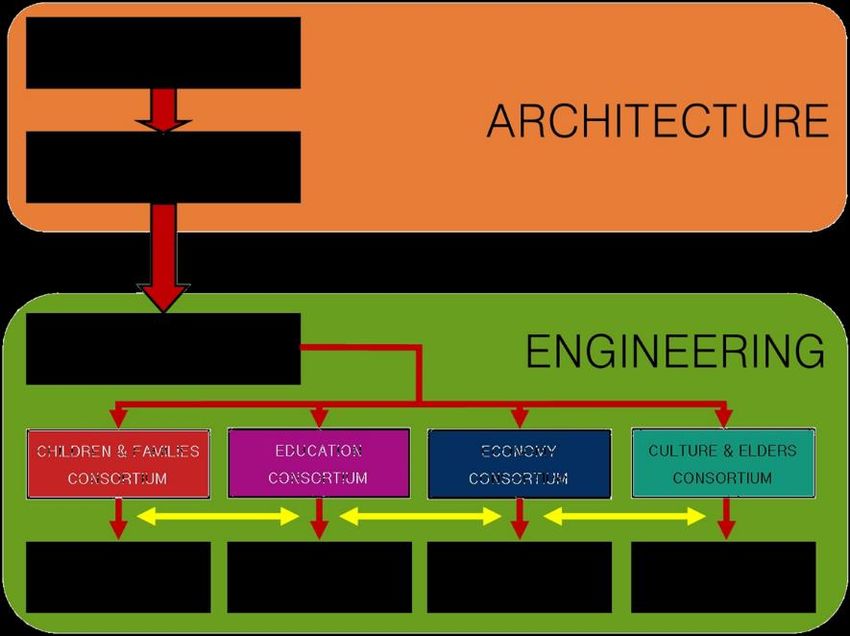
in a binder and into evolutionary integration. As illustrated in figure 5.1, the structure translates
the plan throughout the Standing Rock government apparatus and fully engages all parts that
need to be working in tandem to create our desired outcomes. The implementation structure is
not a governing model, but rather an organizing model designed to institutionalize the
collaboration necessary to create effective government action.
36 | P a g eFigure 5.1
The theme is collaboration. No single person, department or entity holds the power to
solve our problems and achieve our goals through unilateral action. The problems that the Next
Generation Plan aims to solve are a complex, interwoven network of issues much like a web.
Therefore, they must be answered with an interwoven network of problem solvers with their
web of resources. Our problem solvers need a mechanism that allows them to conduct
solutions-based meetings to coordinate steps and actions each year. They also need to be able
to routinely revise and evaluate the outcomes of each year’s work on the Next Generation Plan.
Building this structure and these mechanisms will put the full power, resources and influence of
the Standing Rock Government to use. It is the all-hands-on-deck approach necessary for us to
completely socially engineer the future Standing Rock we want and that our people deserve.
The Standing Rock Next Generation Plan proposes the creation of collaborative
consortia centered on four key sectors of government and society: Children and Families
Consortium (CFC), Culture and Elders Consortium (CEC), Economy Consortium (ECC), and
Education Consortium (EDC). Two of the four consortia have already been created and
organized, the Children and Families Consortium and Education Consortium. The consortia
provide for a structure within the government apparatus for consistent collaboration. Each
37 | P a g econsortia will be comprised of councilpersons, directors, staff, and community members with
expertise in elements of each consortia’s focus to share or learn –but most importantly to
strategize and carryout actions.
Figure 5.2
SAMPLE CONSORTIA COMPOSITIONS
The composition of the consortia can change annually. Programs may also elect to
participate in the annual action plans of multiple consortia. It is the goal of the model that all
departments, entities and programs participate in at least one of the consortia. The model
affords the directors and staff the decision of placing themselves where they believe their
expertise and resources can best assist in achieving the Standing Rock Government’s collective
goals outlined in the Next Generation Plan. Below is a sample composition of the four
implementation consortia.
CHILDREN AND FAMILIES CONSORTIUM
Community Members Juvenile Probation
Tribal Council Juvenile Detention
Chairman & Administrative Appointees Kiddie College
Planning & Grants Staff Lake Oahe Group Home
38 | P a g eAbused Adult Resource Center Opioid Steering Committee
Alcohol, Tobacco and Other Drugs Project LAUNCH
Child Care Assistance School Resource Officers
Child Protections Services School Counselors & Social Workers
Child Support Enforcement Agency Sex Offender Registration & Notification Act
Children’s Court Sioux County Social Services
Community Health Representatives Standing Rock Youth Council
Diabetes Program Treatment Program
Domestic Violence Shelter Title IV-E Foster Care
Early Childhood Tracking Tribal Health Administration
Headstart Wellness Program
Health Education WIC
Indian Child Welfare Act Staff Young Child Wellness Council
Juvenile Advisory Youth Treatment Services
CULTURE AND ELDERS CONSORTIUM
Community Members Elderly Protection
Tribal Council Elderly Nutrition
Chairman & Administrative Appointees Lakota Immersion School
Planning & Grants Staff Lakota Culture Institute
Community Churches Tribal Historic Preservation Office
Community Health Representatives Veterans Services
Lakota/Dakota Cultural Societies Sitting Bull College
Diabetes Program Standing Rock Elders Council
ECONOMY CONSORTIUM
Community Members Low Income Home Energy Assistance
Tribal Council MR&I
Chairman & Administrative Appointees Natural History Museum
Planning & Grants Staff Oyate CDC
Business Equity Loan Fund Paleontology
Community Dev. Block Grant Prairie Knights Casino
Community Options Roads Department
Economic Development Director Rock Telecom
Entrepreneurial Center Short Term Loans
Environmental Health Standing Rock Development Corporation
Environmental Protection Agency Standing Rock Propane
Food Distribution Visitor Center
Game and Fish Department Tax Department
Gaming Tribal Business Information Center
39 | P a g eGrand River Casino Teton Times
Housing Authority Tribal Historic Preservation Office
JTAC Tourism Department
KLND Transportation
Land Management Water Resources
Land Operations Workforce Services
EDUCATION CONSORTIUM
Community Members Missouri River Education Consortium
Tribal Council Rock Creek Grant School
Chairman & Administrative Appointees Selfridge Schools
Planning & Grants Staff Sitting Bull College
Cannon Ball Elementary Sitting Bull School
Headstart Solen High School
Lakota Culture Institute Standing Rock Elementary
Lakota Immersion School Standing Rock Middle School
McIntosh Elementary Standing Rock High Schools
McIntosh Middle School Tribal Education Department
McIntosh High School Wakpala Elementary
McLaughlin Elementary Wakpala Middle School
McLaughlin Middle School Wakpala High School
McLaughlin High School
Each consortia will be tasked with selecting their organizing leadership each year. The
consortia leaders will coordinate meetings and records, as well as ensure each consortia
meeting maintains a standard of solutions-based meetings. They will also coordinate with other
consortia leaders when necessary. Consortia leaders may serve in any necessary capacity to
advise and consult the elected leadership on the issues of their consortium sectors for effective
decision-making by the government. Most importantly, the consortia will be tasked with
drafting Annual Action Plans (AAPs) to carry out the yearly steps and actions necessary in
achieving the goals of the Standing Rock Next General Plan. This will allow our own experts,
working daily in our government, to collaborate and strategize on each step we need to take to
transform the quality of life for our people.
40 | P a g eFigure 5.3
Each consortia will draft an AAP every January. The AAP will outline the immediate
actions, steps and initiatives the government apparatus, in those sectors, will work-on citing the
goals of the Next Generation Plan. The consortia will decide how frequently they want to meet
throughout the year to assess their progress. All councilpersons, programs, departments,
entities, and identified partners should be represented in at least one or multiple consortia. The
Next Generation Plan proposes the creation of an annual Standing Rock conference in
Decembers. The conference will allow the consortia to report-out on and assess the previous
year’s AAP to the community. The conference can take the form of panel discussions,
presentations, roundtable discussion, etc.
The combination of the implementation structure of consortia, Annual Action Plans, and
engagement with the community on the Next Generation Plan will ensure its full integration
into the operations of the Standing Rock government.
41 | P a g eFigure 5.4
This will transform the way in which we work together from static silos into structured and
routine collaboration. This takes the plan beyond paper and turns it into actions. By adopting
the Standing Rock Next Generation Plan we are embarking on the great work of our time to
take control of our future and engineer it to our design.
The life of the plan will take us from plan setup throughout 2019 and into the official
launch in January 2020. Each year we will review our progress and report out to the community
in December. We will review our 10 year progress in 2030 and determine the next set of 5 and
10 year goals to set based upon the results of the first 10 years. The second set of benchmark
goals will bring us through the completion of the Standing Rock Next Generation Plan in
December 2045.
Figure 5.5
42 | P a g eYou can also read


