Covid-19: Global behaviours around face mask use - Report - Imperial College London
←
→
Page content transcription
If your browser does not render page correctly, please read the page content below
Covid-19:
Global behaviours around
face mask use

Report October 2020
Global behaviours around face mask use as of October 2020

How likely are people to wear face masks outside
their homes?
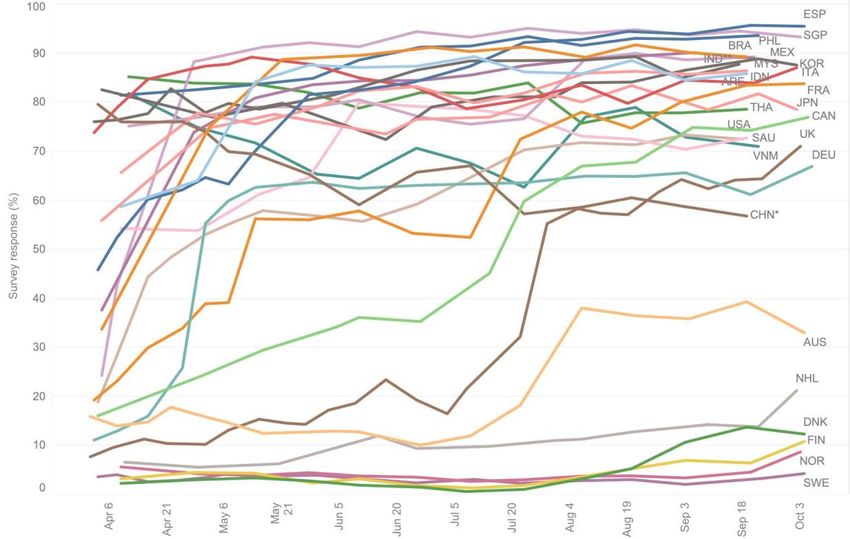
These graphs show how likely people are to wear face masks outside their homes and the country breakdown

Over half of global respondents stated they always wear face masks outside their home to
protect themselves and others from coronavirus (COVID-19). 21% of survey participants
reported that they do not wear facemasks outside the home. Nordic countries have stayed
relatively consistent at the lowest reported level of face mask usage. Most other countries
have seen a large increase in face mask usage since April and now report that at least 70%
of survey participants always wear a face mask outside the house.
Thinking about the last 7 days, how often have you worn a face mask outside your home to protect yourself or others from
coronavirus (COVID-19)? (%)
                                          51%

                                                                                                                                                                21%
                                                                       15%
                                                                                                     10%
                                                                                                                                    4%

                                        Always                    Frequently                    Sometimes                        Rarely                      Not at all

 Country breakdown of respondents who answered “Always” to wearing a face mask outside the home (%).

 *China is representative of the ‘online population’. **India is representative of the ‘urban online population’. All other countries, areas or territories are representative of the national population

 Compare your data with that of 29 other countries, areas or territories on                                                                                   coviddatahub.com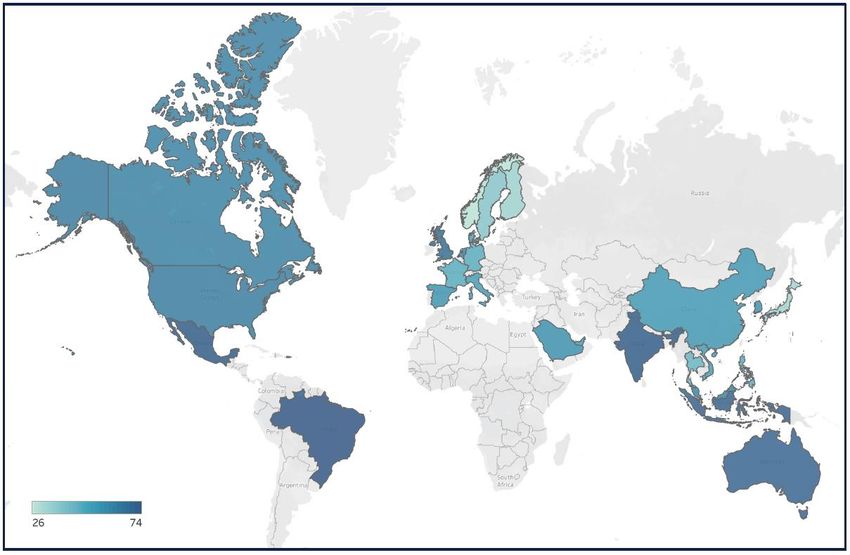
Global behaviours around face mask use as of October 2020

How likely are people to wear face masks at home?

These graphs show how likely people are to wear face masks inside their homes and the country breakdown

Around two thirds of global participants reported not at all wearing a face mask inside
their home. Saudi Arabia and India reported the highest level of face mask usage inside the
home, whereas Finland, Denmark, and Norway reported the lowest.

 Thinking about the last 7 days, how often have you worn a face mask inside your home to protect yourself or others from
 coronavirus (COVID-19)?
                                                                                                                                                                  66%

                                                                                                                                   14%
                                                                                                     10%
                                         5%                            5%

                                      Always                      Frequently                    Sometimes                         Rarely                       Not at all

 Country breakdown of respondents who answered “Always” to wearing a face mask inside the home (%).

 *China is representative of the ‘online population’. **India is representative of the ‘urban online population’. All other countries, areas or territories are representative of the national population

 Compare your data with that of 29 other countries, areas or territories on                                                                                   coviddatahub.com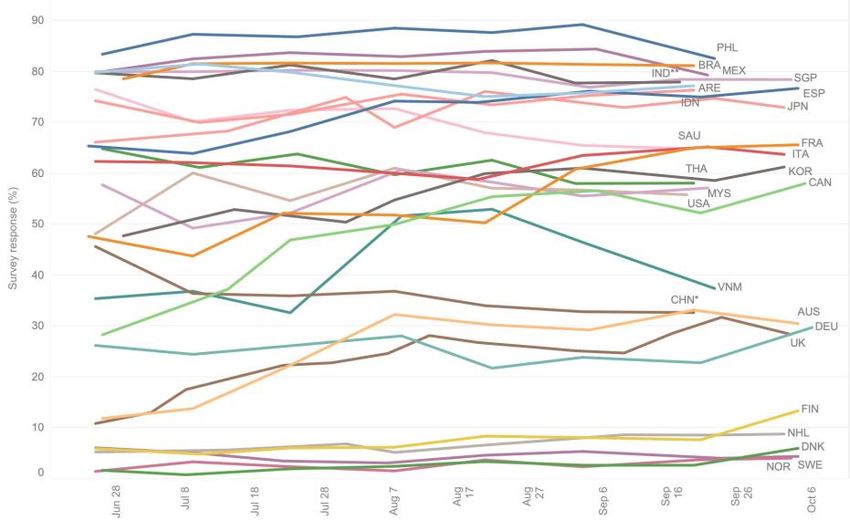
Global behaviours around face mask use as of October 2020

 How likely are people to wear face masks on public
 transport and at work?
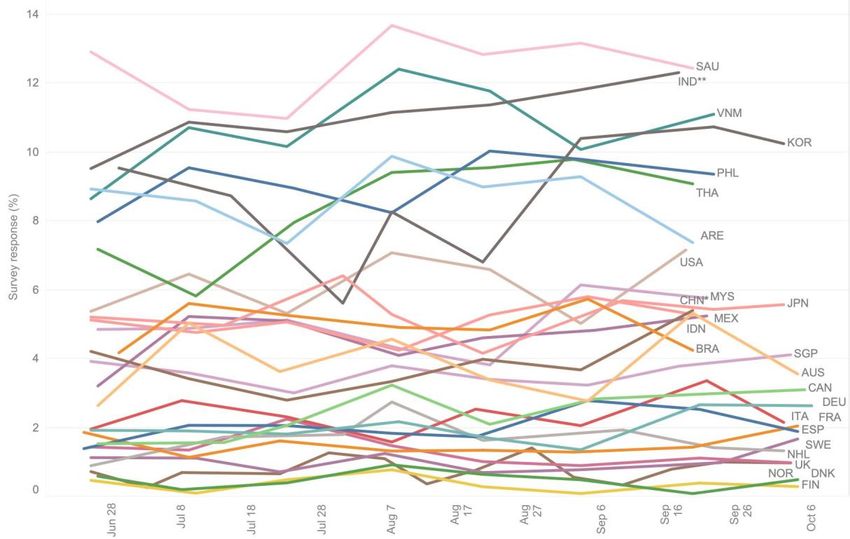
These graphs show responses by countries over time for the likelihood of always wearing face masks on public transport and at work

For most countries, face mask usage on public transport and at work to protect oneself or
others from coronavirus (COVID-19) has stayed relatively consistent since June. However,
the United Kingdom, Canada, Denmark, and Australia have seen significantly increased
rates of face mask usage on public transport and at work.
Thinking about the last 7 days, how often have you worn a face mask on public transportation to protect yourself or others
from coronavirus (COVID-19)? Country breakdown of respondents who responded ‘Always’ (%).

                                                                                                                                                       Respondents in the United
                                                                                                                                                       Kingdom reported the
                                                                                                                                                       largest change in face
                                                                                                                                                       mask use on public
                                                                                                                                                       transport with a 45-
                                                                                                                                                       percentage point increase
                                                                                                                                                       between June and October.
                                                                                                                                                       Spain and Singapore
                                                                                                                                                       reported highest levels of
                                                                                                                                                       face mask use on public
                                                                                                                                                       transportation while
                                                                                                                                                       Sweden reported the
                                                                                                                                                       lowest.

Thinking about the last 7 days, how often have you worn a face mask at your place of work to protect yourself or others from
coronavirus (COVID-19)? Country breakdown of respondents who responded ‘Always’ (%).

                                                                                                                                                       Respondents in Canada
                                                                                                                                                       reported the largest
                                                                                                                                                       change in face mask use
                                                                                                                                                       at work with a 30-
                                                                                                                                                       percentage point increase
                                                                                                                                                       between June and
                                                                                                                                                       October. The Philippines
                                                                                                                                                       and Brazil reported the
                                                                                                                                                       highest levels of face mask
                                                                                                                                                       use at work while the
                                                                                                                                                       Netherlands and Nordic
                                                                                                                                                       countries reported the
                                                                                                                                                       lowest.

 *China is representative of the ‘online population’. **India is representative of the ‘urban online population’. All other countries, areas or territories are representative of the national population

 Compare your data with that of 29 other countries, areas or territories on                                                                                   coviddatahub.com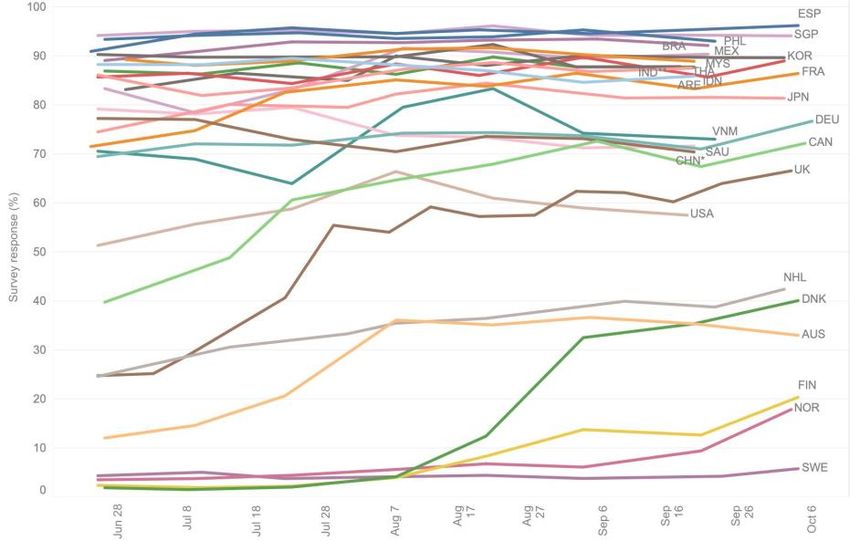
Global behaviours around face mask use as of October 2020

How likely are people to wear face masks in shops?

These graphs show responses by countries over time for the likelihood of always wearing face masks inside shops

Respondents in the United Kingdom, France, and Canada reported the largest increase in
face mask usage in shops. Spain and Italy reported the highest level of respondents who
always wear face masks in shops, while Sweden, Norway, and Denmark, reported the
lowest levels.
Thinking about the last 7 days, how often have you worn a face mask inside a clothing / footwear shop to protect yourself or
others from coronavirus (COVID-19)? Country breakdown of respondents who responded ‘Always’ (%).

                                                                                                                                                             Spain has the highest
                                                                                                                                                             number of respondents
                                                                                                                                                             (97%) who report
                                                                                                                                                             always wearing face
                                                                                                                                                             masks in clothing and
                                                                                                                                                             footwear shops
                                                                                                                                                             between June and
                                                                                                                                                             October. The United
                                                                                                                                                             Kingdom reported the
                                                                                                                                                             largest change in face
                                                                                                                                                             mask use in clothing
                                                                                                                                                             and footwear stores
                                                                                                                                                             with a 61-percentage
                                                                                                                                                             point increase since
                                                                                                                                                             June.
Thinking about the last 7 days, how often have you worn a face mask inside a grocery store / supermarket to protect yourself or
others from coronavirus (COVID-19)? Country breakdown of respondents who responded ‘Always’ (%).

                                                                                                                                                             Spain has the highest
                                                                                                                                                             number of
                                                                                                                                                             respondents (98%)
                                                                                                                                                             who report always
                                                                                                                                                             wearing face masks in
                                                                                                                                                             grocery stores
                                                                                                                                                             between June and
                                                                                                                                                             October. The United
                                                                                                                                                             Kingdom reported the
                                                                                                                                                             largest change in face
                                                                                                                                                             mask use in grocery
                                                                                                                                                             stores with a 67-
                                                                                                                                                             percentage point
                                                                                                                                                             increase since June.

 *China is representative of the ‘online population’. **India is representative of the ‘urban online population’. All other countries, areas or territories are representative of the national population

 Compare your data with that of 29 other countries, areas or territories on                                                                                   coviddatahub.com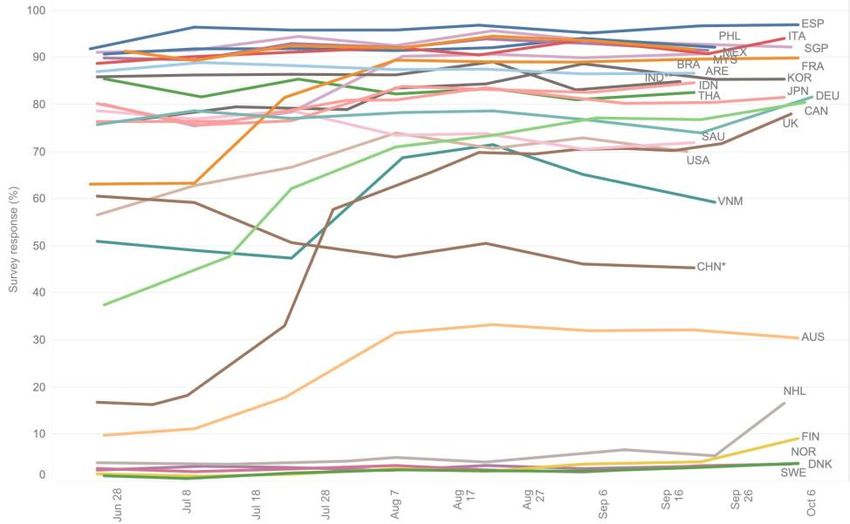
Global behaviours around face mask use as of October 2020

 How able are people to wear face masks?

These graphs show a country breakdown of people’s ability to wear face masks to protect themselves from COVID-19

Over half of global respondents reported it is possible for them to wear a mask in order to
protect themselves from coronavirus (COVID-19). 9% of survey participants reported that it
is not possible for them to wear a face mask. Respondents from the United Kingdom
reported the greatest ability to wear face masks, while those from Japan reported the
least.
To what extent do you agree or disagree that... Wearing a mask to protect me against coronavirus (COVID-19) is not possible for
me (A higher score indicates a higher level of agreement with the question).

        51%

                                        10%                                                            11%
                                                                        8%                                                                                                                            9%
                                                                                                                                       7%
                                                                                                                                                                       4%

          1                              2                               3                              4                                5                             6                               7

Country breakdown of average scoring (out of 7)

                                                                            Japan                                                             4.2
                                                                   Saudi Arabia                                                    3.5
                                                                      Indonesia                                                  3.3
                                                           United Arab Emirates                                                3.2
                                                                     Philippines                                               3.2
                                                                        Thailand                                             3.0
                                                                       Malaysia                                             2.9
                                                                          Finland                                           2.9
                                                                         India**                                           2.9
                                                                         Sweden                                            2.9
                                                                          China*                                          2.8
                                                                        Vietnam                                          2.8
                                                                      Singapore                                         2.7
                                                                           France                                      2.6
                                                                   Netherlands                                        2.5
                                                                         Norway                                      2.4
                                                                       Australia                                    2.4
                                                                         Canada                                    2.3
                                                                              USA                                  2.3
                                                                            Brazil                                2.2
                                                                    South Korea                                2.0
                                                                          Mexico                               2.0
                                                                            Spain                              2.0
                                                                       Denmark                                1.9
                                                                       Germany                               1.9
                                                                              Italy                          1.9
                                                                                UK                           1.9

 *China is representative of the ‘online population’. **India is representative of the ‘urban online population’. All other countries, areas or territories are representative of the national population

 Compare your data with that of 29 other countries, areas or territories on                                                                                   coviddatahub.com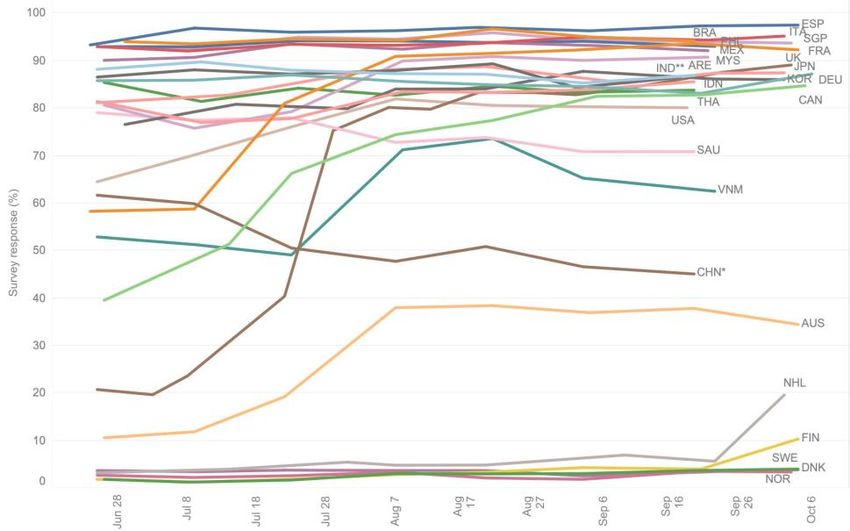
Global behaviours around face mask use as of October 2020

 Do people believe face masks will protect them
 and others?
These graphs show the country breakdown of responses to level of agreement on protection offered by face masks for oneself and others

The Philippines and Indonesia reported the highest level of agreement with the idea that
wearing a mask protects oneself and others against coronavirus (COVID-19). Out of 7, with
7 being the highest level of agreement, both countries had at least an average score of 6.0
for each question. Sweden had the lowest level of agreement with these two ideas,
reporting average scores of 3.0 and 3.9, respectively.

   To what extent do you agree or disagree that... Wearing a                                                      To what extent do you agree or disagree that... Wearing a
   mask will protect others against coronavirus (COVID-19) (A                                                     mask will protect me against coronavirus (COVID-19) (A
   higher score indicates a higher level of agreement with the                                                    higher score indicates a higher level of agreement with the
   question). Country breakdown of average score (out of 7).                                                      question). Country breakdown of average score (out of 7).

           Philippines                                                                           6.3                     Philippines                                                                            6.2
            Indonesia                                                                          6.1                        Indonesia                                                                            6.0
                  Brazil                                                                       6.1                      South Korea                                                                           5.9
             Malaysia                                                                         6.0                          Malaysia                                                                           5.9
          South Korea                                                                         6.0                               Brazil                                                                        5.9
              Vietnam                                                                         5.9                           Thailand                                                                         5.8
                Mexico                                                                        5.9                           Vietnam                                                                          5.8
              Thailand                                                                     5.8                                Mexico                                                                      5.6
                  Spain                                                                    5.8                            Singapore                                                                      5.6
            Singapore                                                                      5.7                 United Arab Emirates                                                                      5.6
                    Italy                                                                5.7                                 India**                                                                    5.5
               India**                                                                   5.7                                  China*                                                                   5.3
 United Arab Emirates                                                                    5.7                                    Spain                                                                  5.3
               Canada                                                                    5.6                                      Italy                                                             5.2
                 France                                                                 5.4                                    France                                                            4.9
                China*                                                                  5.4                                       USA                                                            4.8
                      UK                                                                5.4                                Australia                                                             4.8
             Australia                                                               5.3                                     Canada                                                              4.8
                    USA                                                              5.3                               Saudi Arabia                                                           4.6
                Finland                                                           5.0                                      Denmark                                                         4.3
             Denmark                                                              5.0                                               UK                                                     4.3
             Germany                                                            4.9                                        Germany                                                      4.1
               Norway                                                          4.8                                            Finland                                                3.9
         Saudi Arabia                                                          4.7                                     Netherlands                                                   3.9
         Netherlands                                                        4.5                                                 Japan                                                3.8
                  Japan                                                  4.3                                                 Norway                                               3.5
               Sweden                                                 3.9                                                    Sweden                                         3.0

 *China is representative of the ‘online population’. **India is representative of the ‘urban online population’. All other countries, areas or territories are representative of the national population

 Compare your data with that of 29 other countries, areas or territories on                                                                                   coviddatahub.com
Global behaviours around face mask use as of October 2020 How does life satisfaction vary across countries surveyed? This graph shows the life satisfaction score across all countries surveyed The Cantril ladder serves as a proxy for life satisfaction. Life satisfaction is a powerful measure of the quality of people’s lives. The annual World Happiness Report attributes the differences over time and between countries to good health, income and the quality of social environment. These factors are changing under COVID-19, often in ways we have never experienced before. The YouGov life satisfaction data, collected regularly as the pandemic evolves in each surveyed country, provide a valuable barometer reading of life under COVID-19, reflecting each country’s institutions and policies. Please imagine a ladder with steps numbered from zero at the bottom to 10 at the top. The top of the ladder represents the best possible life for you and the bottom represents the worst possible life for you. On which step of the ladder would you position yourself in? (%) Average Cantril ladder scores reported during the second half of September and the first half of October 2020 show the Netherlands, Denmark and Finland reported the highest life satisfaction, while Japan, China and South Korea reported the lowest. *China is representative of the ‘online population’. **India is representative of the ‘urban online population’. All other countries, areas or territories are representative of the national population Compare your data with that of 29 other countries, areas or territories on coviddatahub.com
Global behaviours around face mask use as of October 2020

How do government responses compare between countries
surveyed?
This map highlights the government stringency score across all countries surveyed.

As of October 22nd, Mexico and India had the most stringent governments, while Norway
had the least stringent. The University of Oxford’s Government Stringency Index is a
measure of the number and severity of measures put in place by the governments to
address the COVID-19 pandemic.

               Mexico                          India                   Brazil           Indonesia     United Kingdom
                  74                             74                     73                 69                68

               Australia                  United States               Canada            Malaysia        Netherlands
                  68                             63                      61                60                58
            Saudi Arabia                      Spain                South Korea            China     United Arab Emirates
                  57                            55                       55                54                53

              Singapore                      Vietnam                   Italy            Denmark          Philippines
                  53                            52                      52                 51                47
               Germany                        France                 Thailand            Sweden           Finland
                   47                           47                      44                 37                32
                Japan                        Norway
                  31                             26
Policy measures and dates are provided by University of Oxford https://bit.ly/34DPZzB
Compare your data with that of 29 other countries, areas or territories on                           coviddatahub.com
Global behaviours around face mask use as of October 2020
Countries included in this report
This table shows the countries included in this report and the dates of the survey
This report looks at all countries surveyed during the second half of September 2020
and the first half of October 2020. The table below indicates the latest survey dates
available and the number of respondents per country. For some questions,
retrospective data was also used.
Country Survey date Number of Participants
Australia 2nd October – 12th October 1000
Brazil 18th September – 25th September 1001
Canada 2nd October – 11th October 1002
China* 18th September – 25th September 1000
Denmark 2nd October – 11th October 1010
Finland 2nd October – 11th October 1002
France 2nd October – 6th October 1005
Germany 2nd October – 7th October 1010
India** 16th September – 22nd September 1008
Indonesia 18th September – 27th September 1003
Italy 2nd October – 5th October 1009
Japan 2nd October – 7th October 499
Malaysia 18th September – 24th September 1004
Mexico 18th September – 26th September 1004
Netherlands 2nd October – 7th October 503
Norway 2nd October – 10th October 1000
Philippines 18th September – 24th September 1002
Saudi Arabia 18th September – 30th September 996
Singapore 2nd October – 10th October 1006
South Korea 2nd October – 14th October 499
Spain 2nd October – 6th October 1001
Sweden 2nd October – 12th October 1014
Thailand 18th September – 27th September 1008
United Arab Emirates 18th September – 28th September 1005
United Kingdom 2nd October – 6th October 1071
United States of America 16th September – 30th September 966
Vietnam 18th September – 24th September 1002
*China is representative of the ‘online population’. **India is representative of the ‘urban online population’. All other countries, areas or territories are representative of the national population
Compare your data with that of 29 other countries, areas or territories on coviddatahub.comGlobal behaviours around face mask use as of October 2020
About this report
Led by Imperial College London’s Institute Professor the Lord Ara
Darzi of Denham
Dr David Nabarro
Co-Director, IGHI
Co-Director, IGHI Special Envoy of WHO Director
of Global Health Innovation (IGHI) and General on COVID-19
YouGov Gianluca Fontana Sarah P. Jones
Operations Director Faculty of Medicine,
and Senior Policy Fellow, IGHI Department of Surgery &
Cancer Research Postgraduate
Melanie Leis Dr Roberto Fernandez Crespo
Director, Big Data Analytics Fellow, BDAU
and Analytical Unit (BDAU), IGHI
Dr Manar Shafat Natalie Melas-Kyriazi
Contributor, BDAU Contributor, BDAU
Contributors to the CovidDataHub.com project Realised by Supporters
Professor John F. Helliwell Professor the Lord Richard Layard Contributors to the Imperial College London - This research is made possible by generous
Co-editor, World Happiness Report Co-editor, World Happiness Report YouGov survey include: Professor Helen Ward, support for the public good
Dr. Christina J. Atchinson, Dr. Benjamin C. from YouGov Plc.
Vancouver School of Economics at the Founder-Director of the Centre for Economics Lambert, and Gavin Ellison
University of British Columbia, Research Performance at the London School of The Imperial College London - YouGov team
Associate of the NBER and Distinguished Economics The Imperial College London - YouGov team gratefully acknowledges the kind support of
Fellow of the Canadian Institute for Advanced Co-founder of Action for Happiness wishes to express their grateful support to Edelman Intelligence for their global social
Research Stephan Shakespeare, Marcus Roberts, Alex listening contribution
Professor Jan-Emmanuel De Neve MacIntosh, Chris Curtis, Eir Nolsoe, Sharon
Co-editor, World Happiness Report Paculor, Lenny Naar, Alice Blencowe, Steve
Professor Jeffrey D. Sachs
Adams from Visual DJ Ltd. and volunteers from
Co-editor, World Happiness Report Director of the Wellbeing Research Centre at Made by Many: Rebecca Foy, Anna Pagan,
University of Oxford Gareth Cozens, Callum Jefferies, Neethu
Director of the Center for Sustainable
KSI Fellow and Vice-Principal of Harris Mathew, Micha Nicheva, Kristof Goossens
Development at Columbia University Director
Manchester College
of the UN Sustainable
Development Solutions Network and SDG
Advocate under Secretary-General António
Guterres
Question for the research team? Get in touch here
Press enquiry? Contact Dr. Justine Alford at j.alford@imperial.ac.ukFor more behavioural data on a global
level, visit coviddatahub.com to explore
our interactive charts
CovidDataHub.com
GitHub siteYou can also read


