COVID-19 guidance and standard operating procedure Urgent dental care systems in the context of coronavirus
←
→
Page content transcription
If your browser does not render page correctly, please read the page content below
Publications approval reference: 001559

VERSION 1, 15 APRIL 2020

COVID-19 guidance and
standard operating
procedure
Urgent dental care systems
in the context of coronavirus

Delay phase
 This guidance is correct at the time of publishing. However, as it
  is subject to updates, please use the hyperlinks to confirm the
    information you are disseminating to the public is accurate.

                    NHS England and NHS Improvement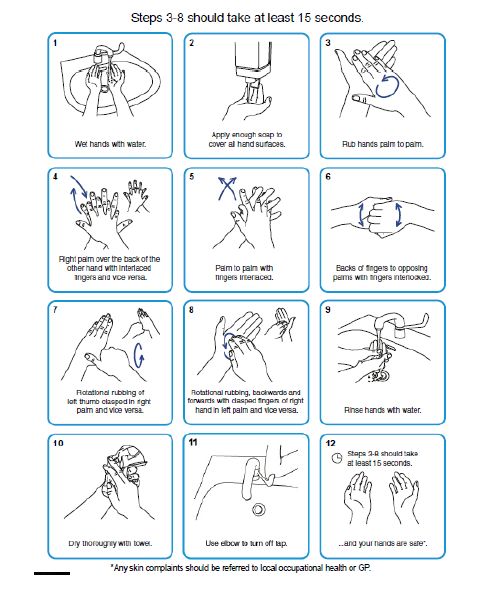
Contents
    1. Scope......................................................................................... 2
    2. Context for UDC systems .......................................................... 4
    3. COVID-19: Guidance for local UDC systems ............................. 7
    4. COVID-19: standard operating procedures for UDC services .. 15
    Appendix 1: Approaches for shielded patients and patients at
    increased risk ............................................................................... 26
    Appendix 2: Patient pathways ...................................................... 28
    Appendix 3: Guidance for infection prevention and control in urgent
    dental care settings ...................................................................... 29
    Appendix 4: Actions for dental services ....................................... 37
    Appendix 5: Remote prescribing protocol .................................... 42
    Appendix 6: Considerations for analgesia.................................... 45
    Appendix 7: Preparation for incident management for unwell
    patients with possible/confirmed COVID-19................................. 46
    Appendix 8: Feedback ................................................................. 47

1 | Contents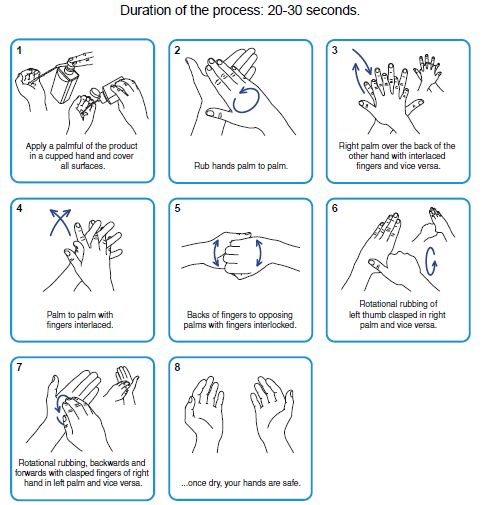
VERSION 1, 15 APRIL 2020

      1. Scope
    This guidance is applicable in England. Dental services operating under contract to
    the NHS in Northern Ireland, Scotland and Wales should refer to guidance and
    standard operating procedures (SOPs) produced by the governing bodies and
    regulators in their devolved administration. This document covers a local systems
    approach to the organisation and operation of urgent dental care (UDC) provision. It
    includes:

         •   system-level guidance: of particular relevance to local commissioning
             teams, local dental networks, local dental committees, managed clinical
             networks, and local PHE dental public health colleagues

         •   standard operating procedures for UDC services – of particular relevance to
             dental providers and dental teams.

    It is appreciated that multiple teams and providers across primary, secondary and
    social care may be working together as part of local UDC systems. Therefore, this
    document should be considered alongside other guidance which may be applicable
    in a particular care context (for example, hospital trust standard operating
    procedures for COVID-19 should be considered if UDC is delivered as part of
    secondary care in a hospital setting).

    It is recognised that communities and health systems vary in size and complexity.
    This document sets out principles for system development and service delivery
    which will need local interpretation according to local structures, geography and
    capacity.

    We trust healthcare professionals to use their clinical judgement when applying
    guidance around patient management in what we appreciate is a highly
    challenging, rapidly changing environment.

    This guidance is applicable to the delay phase of COVID-19 pandemic
    management. Guidance, particularly in relation to risk assessment and service
    provision, is likely to be updated as the pandemic situation develops, depending on
    management phase and the evidence-based national approach.

2 | 1. Scope
VERSION 1, 15 APRIL 2020
We are grateful to the Faculty of Dental Surgery at the Royal College of Surgeons,
and the Faculty of General Dental Practice (UK), for working with NHS England to
develop clinical guidance for dental teams applicable in the COVID-19 context.
3 | 1. ScopeVERSION 1, 15 APRIL 2020
2. Context for UDC
systems
This section sets out the context in which local UDC systems will operate, including
the background on the COVID-19 pandemic, general guidance for the public, and
the key patient groups that need to be considered when developing care pathways.
2.1 Novel coronavirus pandemic
Novel coronavirus may be referred to as:
• severe acute respiratory syndrome coronavirus 2, SARS-CoV-2: this is the
name of the virus
• coronavirus disease, COVID-19: this is the name of the disease.
The coronavirus pandemic has restructured the way that we live and work. We
recognise the stress and worry that we are all going through: we are living in
changing times. The prime minister’s announcement on 23 March directs our entire
population to stay at home and only go outside for food, health reasons or essential
work.
The delivery of urgent dental care will be part of a co-ordinated response to COVID-
19. Due to the escalating numbers of cases in England, and the burden that this is
placing across the health system, we have to develop new ways of working
between NHS 111, primary care, community services and secondary care. To most
effectively meet the needs of our communities in this challenging time, we must
deliver care differently now and plan for how we will best deliver care in the future.
Local systems will need to determine how they can best work collaboratively,
informed by key principles to protect the public, patients and staff.
4 | 2. Context for UDC systemsVERSION 1, 15 APRIL 2020
2.2 Guidance for patients and the public
2.2.1 General information
General information on measures the entire population should take is available
here. People are advised to stay at home unless they need to leave the house for
food, health reasons, or essential work. Further guidance is available including
information about COVID-19 and how to prevent spread, and what to do if people
have symptoms.
2.2.2 NHS 111
NHS 111 has an online coronavirus service, running alongside its standard online
service, which can provide advice to patients with an urgent health concern.
Patients with possible COVID-19 are directed to NHS 111 online for health advice
in the first instance. The NHS 111 telephone service should be used only when
online access is not possible.
2.3 Key patient groups: summary
2.3.1 Patients with COVID-19 and symptoms of COVID-19
Public Health England (PHE) has defined the current case definition for COVID-19,
and provided guidance on testing and case reporting.
Most patients with COVID-19 will have mild symptoms and will be able to care for
themselves at home. There will, however, be a significant number of patients who
contract moderate or severe illness from COVID-19 requiring primary or secondary
care input.
Staff who meet the case definition for possible COVID-19 will need to stay at home
but can work remotely if they are well enough to do so. Plans for testing for NHS
staff are outlined here.
2.3.2 Patients at increased risk of severe illness from COVID-19
Those who are at increased risk of severe illness from coronavirus (COVID-19) are
advised to stringently follow social distancing measures. This includes anyone over
70, anyone under 70 who would qualify for a flu jab on health grounds, and
pregnant women. Full guidance can be found here.
5 | 2. Context for UDC systemsVERSION 1, 15 APRIL 2020
2.3.3 Shielded patients: highest risk of severe illness from COVID-
19
Those at the highest risk of severe illness from COVID-19 are advised to shield
themselves and stay at home for 12 weeks.
This guidance is correct at the time of publishing.
However, as it is subject to updates, please use the hyperlinks to confirm the
information you are disseminating to the public is accurate.
6 | 2. Context for UDC systemsVERSION 1, 15 APRIL 2020
3. COVID-19: Guidance
for local UDC systems
3.1 Introduction
As we are in the delay phase of the coronavirus pandemic, stringent measures
have been put in place to prevent sustained transmission of COVID-19. As part of
this, the provision of all routine, non-urgent dental care including
orthodontics has been stopped in England until further notice.
Therefore, across every NHS region there is a requirement for delivery of robust
and safe services through the provision of NHS regional urgent dental care (UDC)
systems to provide care for urgent and emergency dental problems.
Each COVID-19 UDC system should deliver:
• a clear local message for the public, that routine dental care is not
available during this delay phase of the COVID-19 pandemic and that
advises them what to do if they have a dental emergency
• a remote consultation and triage service whose outcomes are:
– advice, analgesia, antimicrobials where appropriate (AAA), or
– referral, when absolutely necessary and treatment cannot be delayed, to
a designated UDC site for a face-to-face consultation and treatment.
Any referral should specifically identify those patients who are shielded
(those individuals at the highest risk of severe illness from COVID-19
who are advised to shield themselves and stay at home for 12 weeks)
and patients at increased risk, to inform the route for referral in line with
local protocols.
• a face-to-face consultation and treatment service that should only be
accessed following remote triage using a range of providers and locations
7 | 3. COVID-19: Guidance for local UDC systemsVERSION 1, 15 APRIL 2020
supported with appropriate personal protective equipment (PPE) for the
clinical procedures (AGP, non-AGP) to be carried out at the site.
Aerosol generating procedures (AGP) should be avoided unless absolutely
necessary.
Each local UDC system will involve provision of necessary face-to-face treatment at
a number of specific, designated sites in a way that allows appropriate separation
(through physical or temporal measures, eg zones, sessions/appointment times)
and treatment of all patients.
When developing these sites and separation protocols, the following patient groups
should be considered:
1. Patients who are possible or confirmed COVID-19 patients – including patients
with symptoms (new, persistent cough or high temperature), or those living in their
household:
As we are now in the sustained transmission phase of COVID-19, we need to
consider that all patients may potentially have the virus. Therefore, for all patients
attending any face-to-face consultation and treatment at any UDC site, it is
important that there is adequate separation either physically or by spacing
appointments to ensure that risk of potential contamination is reduced.
2. Patients who are shielded – those at the highest risk of severe illness from
COVID-19:
Significant efforts should be made to ensure that shielded patients in
particular are separated from other patient groups. These should be aligned
with local systems and protocols to support shielded patients.
3. Patients who are at increased risk of severe illness from COVID-19.
4. Patients who do not fit one of the above categories.
Similarly, when developing the UDC sites, consideration should be given to the type
of urgent dental care to be provided.
• Sites undertaking only non-AGP procedures will require Level 2 PPE.
• Sites undertaking AGPs will require Level 3 PPE.
8 | 3. COVID-19: Guidance for local UDC systemsVERSION 1, 15 APRIL 2020
• Sites delivering AGP and non-AGP will require Level 2 and Level 3 PPE.
The range of conditions provided for by local UDC systems are likely to include, but
are not limited to:
• Life-threatening emergencies, eg airway restriction or breathing/swallowing
difficulties due to facial swelling
• trauma including facial/oral laceration and/or dentoalveolar injuries, for
example avulsion of a permanent tooth
• oro-facial swelling that is significant and worsening
• post-extraction bleeding that the patient cannot control with local measures
• dental conditions that have resulted in acute and severe systemic illness
• severe dental and facial pain: that is, pain that cannot be controlled by the
patient following self-help advice
• fractured teeth or tooth with pulpal exposure
• dental and soft tissue infections without a systemic effect
• suspected oral cancer
• oro-dental conditions that are likely to exacerbate systemic medical
conditions.
Each patient should be assessed and managed on their own merit, taking into
account the patient’s best interests, professional judgement, local UDC
arrangements and the prioritisation of the most urgent care needs.
Local dental networks, commissioners, managed clinical networks and local dental
committees should work together with local dental public health colleagues to
define and implement a system that meets the principles set out above to meet the
dental needs of their local populations and to appropriately support staff to provide
services safely.
The exact mechanisms, facilities and approaches will need to reflect existing local
arrangements in way that that can be flexed. It will also require the development of
some specific and bespoke arrangements, for those who are being shielded.
9 | 3. COVID-19: Guidance for local UDC systemsVERSION 1, 15 APRIL 2020
3.2 Key principles for local UDC systems
• UDC systems will need to flex and adapt as the COVID-19 pandemic
develops, approaches across the wider health sector change and the level
of service provision varies.
• UDC systems should be organised in an integrated way that reflects
specific local circumstances, which is joined up across primary, secondary
and social care, and which is co-ordinated across the wider regional and
local COVID-19 response arrangements. Particular consideration should be
given to:
– using and adapting existing UDC arrangements within the existing local
integrated urgent care system (eg expanding out-of-hours service
arrangements to cover weekdays).
– managing UDC and referrals effectively between primary and secondary
care; secondary care settings will be particularly affected during
expected COVID-19 surges and this will have implications for certain
areas of UDC provision, eg A&E, oral and maxillofacial surgery, two-
week urgent cancer pathways
– local approaches and the wider primary care operating model to care for
shielded patients and patients at increased risk, especially measures
being taken to reduce travel and contact (eg pharmacy delivery services;
domiciliary and social care arrangements); see Appendix 1
– prioritisation of urgent dental care needs, in line with the wider local
COVID-19 response; it is understood that as the COVID-19 pandemic
develops, there will be times when service capacity across the whole of
health and social care is reduced: therefore, the capacity of the local
UDC system will vary and the most urgent cases will need to be
prioritised accordingly
– collaboration between services, to enable appropriate care provision and
resilience across the system.
• The patient pathway should take account of two stages, a remote stage and
a face-to-face stage if necessary, as set out in the UDC service standard
10 | 3. COVID-19: Guidance for local UDC systemsVERSION 1, 15 APRIL 2020
operating procedure (SOP) in Section 4 below. The pathway is illustrated in
Appendix 2.
• In meeting patient needs, any service (general dental practice, community
dental service, or secondary care provider and A&E) may be appropriate to
provide care as part of the UDC system, depending on patient, urgent care
needs, and PPE requirements. Consideration should be given to:
– using established UDC service providers that are already part of the
existing local integrated UDC system
– patient separation requirements (physical or temporal) between or within
services, taking into account the patient groups listed in Section 3.1: for
example, the local separation approach for shielded patients or patients
at increased risk
– the selection of provider sites with regards to patient access in rural and
urban areas: eg a general dental practice in a remote rural area may be
designated to deliver a particular level of UDC provision to avoid patients
travelling long distances to other UDC sites
– appropriate opening hours that account for in-hours and out-of-hours
access.
• In the preparedness letter of 25 March, all primary care dental services
(general dental practices and community dental services) were asked to
establish (independently or by collaboration with others) a remote urgent
care service providing telephone triage for their patients with urgent needs
during usual working hours, and wherever possible treating with advice,
analgesia and antimicrobial means where appropriate. If the patient’s
condition could not be managed by these means, they would need to be
referred to the appropriate part of the local UDC system for face-to-face
consultation and treatment, as necessary.
As systems develop, it may be that commissioners modify plans for
remote triage provision in line with the wider co-ordinated system
approach: ie telephone triage and remote services may be provided by
primary care dental services as per the original request, or as part of a co-
ordinated approach in the local system (eg only certain services are asked
11 | 3. COVID-19: Guidance for local UDC systemsVERSION 1, 15 APRIL 2020
to provide this remote service, or a local dental helpline is used to centralise
triage for the region or parts of it, or involvement of NHS 111).
– At a system level, access to telephone triage and remote services would
be expected during in-hours and out-of-hours, as would normally be the
case.
• Workforce redeployment is likely to be required to ensure UDC services are
appropriately staffed in a way that best fits local circumstances. NHS
contract arrangements in the current COVID-19 situation (outlined here)
enable this.
– Where there are no existing indemnity arrangements in place, legislation
is now enacted to ensure indemnity is provided for clinical negligence
liabilities arising from NHS activities carried out for the purposes of
dealing with, or in consequence of, the coronavirus outbreak.
– Service resilience and contingency planning should be considered with
regards to potential staff absence due to sickness.
• During periods of widespread community transmission of COVID-19, dental
teams should use PPE to treat patients based on the type of urgent care
they are providing. Therefore, depending on the type of face-to-face care
being provided at a UDC site, the site must have the appropriate PPE, as
set out in Table 1 (further details on infection prevention and control and
PPE are found in Appendix 3).
12 | 3. COVID-19: Guidance for local UDC systemsVERSION 1, 15 APRIL 2020
Table 1: Personal protective equipment (PPE) for
COVID-19 urgent dental care settings
Waiting Dental Dental
room/reception surgery surgery
No clinical Non AGP Treatments
treatment treatment involving
AGPs
Good hand hygiene Yes Yes Yes
Disposable gloves No Yes Yes
Disposable plastic apron No Yes No
Disposable gown* No No Yes*
Fluid-resistant surgical mask Yes Yes No
Filtering face piece (FFP3) No No Yes
respirator**
Eye protection*** No Yes Yes
* Fluid-resistant gowns (or long-sleeved waterproof apron) must be worn during aerosol generating
procedures (AGPs). If non-fluid-resistant gowns are used, a disposable plastic apron should be worn
underneath.
**If wearing an FFP3 that is not fluid resistant, a full-face shield/visor must be worn.
***Eye protection ideally should be disposable. If polycarbonate safety glasses/goggles or equivalent
are used, they should be disinfected in line with manufacturers’ guidance.
• PPE has been ordered and supplied directly via PHE initially. Local
consultants in dental public health have supported NHS regions with the
ordering process. This process is subject to change as PPE delivery
systems are developed.
• PHE has facilitated interim local fit-testing training for FFP3 masks where it
has been requested. Fit testing can also be accessed via any appropriately
trained personnel from other local sources, eg NHS trusts.
13 | 3. COVID-19: Guidance for local UDC systemsVERSION 1, 15 APRIL 2020
• Communications and referral information should be made available to all
teams and providers in the local UDC system and be reflected in the NHS
111 pathways and dispositions.
• Clear information about UDC access and local arrangements should be
made available to patients and the public.
• Clear information about UDC access and local arrangements should be
made available to directory of services (DOS) teams and NHS 111
systems.
– Dental services are asked to support this by informing commissioners of
service status, as outlined in Appendix 4.
• Major regulators have issued guidance to support healthcare professionals
in these challenging circumstances, encouraging partnership working,
flexibility and operating in line with the best available guidance.
• Further information about regulation during the COVID-19 pandemic from
the General Dental Council and General Medical Council can be found on
their websites.
• COVID-19 information governance advice for health and care professionals
can be found here.
• Although these principles for UDC systems will be interpreted according to
local population needs, there are a number of actions which all dental
services should undertake. These are detailed in Appendix 4.
14 | 3. COVID-19: Guidance for local UDC systemsVERSION 1, 15 APRIL 2020
4. COVID-19: standard
operating procedures for
UDC services
The patient pathway for UDC is considered to have two broad stages – remote
management and face-to-face management (see Appendix 2). As far as possible,
patients should be managed remotely and exit the pathway at the end of this stage.
Those patients who cannot be managed remotely will enter the face-to-face stage
of the pathway.
As such, this standard operating procedure has been divided as follows:
1. SOP for remote management stage:
• this SOP is applicable to all services providing urgent dental care (remote
and/or face-to-face care) within the local system.
2. SOP for face-to-face management stage:
• this SOP is applicable only to services receiving patients to provide urgent
care face-to-face.
For each SOP, key principles are listed, with further details set out beneath.
As well as the relevant SOP(s), dental service providers should also ensure they
are undertaking the actions expected of all dental services as detailed at Appendix
4.
4.1 SOP for remote management stage
4.1.1 Key principles
1. Dental teams should be aware of this SOP, the current national and local
COVID-19 guidance (including approaches for managing shielded patients
15 | 4. COVID-19: standard operating procedures for UDC servicesVERSION 1, 15 APRIL 2020
and patients at increased risk – see Appendix 1) and the possible COVID-19
case definition.
2. Keep staff safe through regular risk assessments, following guidance for
employers and businesses, and through the measures set out in the
‘Keeping staff safe’ section of Appendix 4.
3. The service should use information and communications (eg telephone,
website, text) to outline the appropriate UDC access arrangements for
patients, discourage inappropriate access and attendance, and support
efforts to prevent non-essential contact and travel.
4. Remotely (eg by telephone or video link) risk assess and triage those
patients contacting the service for urgent dental care, to determine patient
group (as per Section 3.1), urgency of dental problem and associated UDC
needs.
• Ensure early identification of shielded patients and patients at increased
risk.
5. Wherever possible manage patients with urgent dental care needs remotely
through the provision of advice, analgesia and antimicrobial means where
appropriate.
If the patient’s condition cannot be managed by these means, refer them to
the appropriate part of the local UDC system for face-to-face consultation
and treatment – for example:
• direct referral to a designated dental service providing face-to-face urgent
care, which is suitable for the patient’s needs (this may be the same service
as the patient has contacted, or a different service)
• direct referral to wider parts of the integrated urgent care system, eg
secondary care where necessary
• signposting to a local dental helpline.
Information about patient group and UDC needs will influence the destination
the patient is referred to, and/or the time of their appointment, in line with
local and service-level separation measures for face-to-face management.
16 | 4. COVID-19: standard operating procedures for UDC servicesVERSION 1, 15 APRIL 2020
4.1.1.1 Service information and communications
• Effective communications to patients at an early stage should reduce the
number of patients contacting the service inappropriately. Different
communications routes should be considered (eg telephone, text, website).
• Public-facing materials on COVID-19 are available here and here and may
be downloaded for use as appropriate.
• For services that are not providing face-to-face care, where necessary the
appropriate information should be displayed at service entry points to
signpost patients who may turn up at the premises.
• For services that have been designated to provide face-to-face care,
appropriate information should be displayed or provided to make clear
which patient groups they are receiving, and to control entry to specific sites
and areas, in line with care requirements.
4.1.1.2 Risk assessment
Patient risk assessment should be conducted remotely (eg telephone, video link) to
determine:
• which patient group the patient belongs to
• the associated risk to the patient if they were to contract COVID-19
• whether the patient has COVID-19 related isolation requirements.
This information, together with the degree of urgency of the patient’s dental
condition (see dental triage, Section 4.1.1.3), will be important in determining the
patient management approach.
As part of risk assessment, the following questions should be included, in line with
the case definition for possible COVID-19 and isolation requirements:
– Do you have a new, continuous cough?
– Do you have a high temperature (37.8C or over)?
17 | 4. COVID-19: standard operating procedures for UDC servicesVERSION 1, 15 APRIL 2020
– Does anyone in your household have a new, continuous cough or a high
temperature?
– If you or anyone in your household has tested positive for coronavirus,
are you still in the self/household isolation period?
If the patient answers yes to any of the above, then they belong to the group of
patients who are possible or confirmed COVID-19 patients.
If the patient answers no to all of the above, continue risk assessment to
determine which patient group they belong to:
• patients who are shielded – those at the highest risk of severe illness from
COVID-19
• patients who are at increased risk of severe illness from COVID-19
• patients who do not fit one of the above categories.
Patients who are in the shielded group will have been informed of their shielded
status by their GP.
Patients’ records and taking a good medical and social history will identify those at
increased risk of severe illness (definitions in the links above).
In cases where remote management is not possible, consideration should also be
given to risk assessing persons who may be accompanying the patient to a face-to-
face appointment (eg the parent or carer of a child patient). Patient escorts should
be from the same household as the patient as far as possible.
4.1.1.3 Dental triage
• Dental triage should be conducted remotely (eg telephone, video link) to
determine:
– if the patient has a need for routine non-urgent care (including
orthodontics), which should be deferred
– if urgent dental care needs can be managed remotely (eg patient
requires advice only)
18 | 4. COVID-19: standard operating procedures for UDC servicesVERSION 1, 15 APRIL 2020
– if urgent dental care needs cannot be managed remotely, whether
management can be delayed; if it cannot be delayed, referral to the
appropriate part of the local UDC system will be necessary
– if face-to-face management is required, the most appropriate place and
time for the patient to be seen (in line with patient group and care
requirements)
– prioritisation of patients with the most urgent care needs, in line with the
local UDC system approach to variable workforce capacity issues across
health services.
The Scottish Dental Clinical Effectiveness Programme (SDCEP) has developed
guidance around triage for acute dental problems during the COVID-19 pandemic,
which is found here.
4.1.1.4 Remote patient management
• Each patient should be assessed and managed on their own merit, taking
into account their best interests, professional judgement, local UDC
arrangements and the prioritisation of the most urgent care needs.
• Clinical records should be kept for remote patient consultation. Additionally,
dental services must be able to identify and retrieve patient records
developed as part of the COVID-19 UDC system for evaluation purposes.
• Based on risk assessment and triage outcomes, wherever possible manage
patients who have contacted the practice with urgent dental care needs
remotely through the provision of advice, analgesia and antimicrobial
means where appropriate.
• Further information on remote prescribing protocol can be found at
Appendix 5.
• The Faculty of General Dental Practice (UK) has provided updated
information and guidance on remote prescribing and advice during the
COVID-19 pandemic. This can be found here.
• The GDC has set out guidance for remote consultations and
prescribing here.
19 | 4. COVID-19: standard operating procedures for UDC servicesVERSION 1, 15 APRIL 2020
• The dental antimicrobial stewardship toolkit can be found here.
• SDCEP guidance on drugs for the management of dental problems
during the COVID-19 pandemic is found here.
• Further information around considerations for analgesia during the
COVID-19 pandemic can be found at Appendix 6.
• Where applicable, manage patients in line with local approaches and
arrangements for groups that are shielded or at increased risk (eg there
may be a prescription delivery service rather than patients travelling outside
of home to pharmacies). See Appendix 1.
• If the patient cannot be managed remotely and urgent clinical assessment
and/or treatment is required, the patient should be referred to the
appropriate part of the local UDC system.
– Practice/services should familiarise themselves with any local
signposting or referral arrangements in place to support this (eg specific
referral procedures)
4.2 SOP for face-to-face management stage
Services receiving patients to provide face-to-face care are expected to have also
followed the SOP outlined in Section 4.1, to promote remote management wherever
possible, and in doing so reduce non-essential contact and travel and minimise
cross-infection risk.
4.2.1 Key principles
1. Ensure the SOP as outlined in Section 4.1 has been followed, to promote
remote management and minimise face-to-face contact as far as possible.
2. Dental teams should be aware of this SOP, the current national and local
COVID-19 guidance (including approaches for managing shielded patients
and patients at increased risk – see Appendix 1) and the possible COVID-19
case definition.
20 | 4. COVID-19: standard operating procedures for UDC servicesVERSION 1, 15 APRIL 2020
3. Keep staff safe through regular risk assessments, following guidance for
employers and businesses, and through the measures set out in the ‘keeping
staff safe’ section of Appendix 4.
4. All UDC service providers should have clear protocols for patient care, noting
the requirement for appropriate zoning and separation measures for all
patients. Particular attention should be paid to shielded patients and patients
at increased risk.
5. Where appropriate, repeat risk assessment and dental triage when the
patient arrives at the service (in line with sections 4.1.1.2 and 4.1.1.3) in
case there are changes, the patient is unaware of their risk status, or the
patient accesses a service inappropriately.
• The service should only provide treatment for cases which it has been
designated to receive (eg patients with possible/confirmed COVID-19
should not be accepted at facilities that have not been designated to treat
cases). Where the service cannot accept a patient based on their risk
status and/or care needs, that patient should be referred to the appropriate
part of the local UDC system.
6. When face-to-face assessment and/or treatment is undertaken:
• Each patient should be assessed and managed on their own merit, taking
into account the patient’s best interests, professional judgement, local UDC
arrangements and the prioritisation of the most urgent care needs.
• Manage the patient’s condition with as little intervention as possible to
minimise exposure risk.
– If possible manage patients through advice, analgesia and antimicrobial
means where appropriate.
– If treatment is required, all equipment and materials for treatment should
be assembled in surgery before beginning.
– Aerosols should be avoided wherever possible.
21 | 4. COVID-19: standard operating procedures for UDC servicesVERSION 1, 15 APRIL 2020
– If an aerosol generating procedure is necessary, the use of high power
suction and rubber dam is recommended where possible.
– Treatment should be completed in one visit wherever possible.
• Follow local approaches and arrangements for the management of patients
who are shielded or at increased risk (see Appendix 1).
• Where domiciliary visits are necessary, these should be appropriately risk
assessed and managed. Where patients are shielded or at increased risk,
these visits should be organised in line with the principles of local protocols
for these groups (see Appendix 1).
7. Use robust infection prevention and control procedures in line with
government advice (found here).
8. Follow PPE protocols in line with government advice summarised in Section
3.2, with further detail at Appendix 3.
9. Prepare for incident management.
• Resuscitation Council (UK) guidance on CPR and resuscitation in the
context of COVID-19 is found here.
• Further detail on preparation for incident management for unwell patients
with possible/confirmed COVID-19 is provided at Appendix 7.
4.2.1.1 Patient management: social distancing and separation
• Although it is recognised that dental treatment will require closer contact,
social distancing measures should be applied as far as possible throughout
the service.
• For all patients, physical (eg separate waiting areas and treatment rooms)
and temporal (eg appropriately spaced appointments, sessions for specific
patient groups) separation measures should be employed.
– Consideration should be given to both patient group and the type of
treatment undertaken (ie increased risk associated with aerosol
generating procedures means there are additional PPE and
decontamination requirements).
22 | 4. COVID-19: standard operating procedures for UDC servicesVERSION 1, 15 APRIL 2020
– Appropriate zoning should be undertaken. Sites, areas and facilities
should be demarcated clearly for the specific patient groups they have
been designated to receive (eg to separate patients who are shielded or
at increased risk).
• Additional physical and temporal separation measures should be taken for
shielded groups or groups at increased risk where possible, for example:
– the local care delivery protocols for these groups should be followed,
noting these patients (especially those shielded) should not come into
contact with others unless absolutely necessary
– these patients could be seen in the morning only, allowing maximum
time for air clearance/ventilation overnight
– these patients could be seen in a surgery, which minimises the number
of people passing.
• Practical considerations for the dental service are advised as follows:
– Patient escorts should only be allowed where absolutely necessary (eg
child attending with parent). As far as possible, one escort only should be
allowed per patient, and this escort should be from the patient’s
household to minimise exposure risk.
▪ Consideration should be given to capacity and consent, and
how these can be managed appropriately in a way that
minimises contact risk. For example, for child patients, if a
person with parental responsibility cannot accompany the child
due to social isolation, the child could be brought by a
responsible adult from their household and the person with
parental responsibility contacted by telephone by the dental
team.
– During the remote management stage, if patients plan to travel to the
UDC service by car, they may be advised to wait in their car until the
time of their appointment.
23 | 4. COVID-19: standard operating procedures for UDC servicesVERSION 1, 15 APRIL 2020
– On entering the building, all visitors to the UDC service should be told to
wash their hands or use hand sanitiser
– The number of patients and staff in waiting rooms, reception and
communal areas should be minimised as far as possible.
▪ Waiting rooms, reception and communal areas should allow for
2 metre separation, ideally marked on chairs and flooring.
▪ If staff in reception and communal areas are unable to maintain
2 metre separation with the public, they should wear a fluid-
resistant surgical mask for a session.
– As few staff as possible should be allocated to see patients, particularly
those shielded, to minimise contacts without compromising the safe
delivery of care.
– If face-to-face triage validation is required before treatment begins,
patients should be initially seen in a room large enough to provide social
distancing, and the clinician should wear PPE in line with PHE guidance.
4.2.1.2 Patient management: clinical approaches
• Further information on remote prescribing protocol can be found at
Appendix 5.
• The Faculty of General Dental Practice (UK) has provided updated
information and guidance on remote prescribing and advice during the
COVID-19 pandemic. This can be found here.
• The GDC has set out guidance for remote consultations and
prescribing here.
• The dental antimicrobial stewardship toolkit can be found here.
• Further information around considerations for analgesia during the
COVID-19 pandemic can be found at Appendix 6.
• NHS England has been working with the Faculty of Dental Surgery at the
Royal College of Surgeons to develop pragmatic clinical guidance for
different specialty areas of dentistry which is applicable to dental teams
24 | 4. COVID-19: standard operating procedures for UDC servicesVERSION 1, 15 APRIL 2020
working in UDC systems in the COVID-19 pandemic. This guidance can be
found here.
4.2.1.3 Infection prevention and control and PPE
• Follow robust COVID-19 infection control procedures, as set out in
government guidance for pandemic coronavirus here. This includes
information on PPE, decontamination and waste.
• Key points from this guidance, as they apply in a UDC context, have been
summarised at Appendix 3. This includes detail around PPE requirements
based on the type of urgent care being provided (aerosol generating or
non-aerosol generating procedure).
• Useful contacts:
– Find your NHS regional infection prevention and control team: search
‘infection prevention control + your NHS region’
– Find your local PHE health protection team here
25 | 4. COVID-19: standard operating procedures for UDC servicesVERSION 1, 15 APRIL 2020
Appendix 1: Approaches for
shielded patients and
patients at increased risk
Primary, community and secondary care services will be working in new ways to
shield those at most risk of severe illness from COVID-19, protect those at
increased risk, and manage the ongoing health and care needs of both groups. For
example, dedicated home visiting services may be set up as part of some local
healthcare systems. Dental services should align with local approaches as
appropriate. These patient groups should not come into contact with others or
attend dental settings unless absolutely necessary.
.
• As far as possible, the management of these patient groups should be
carried out remotely and invasive treatment delayed.
• Where remote management is not possible, dental teams should align with
any local arrangements for shielded patients or patients at increased risk
when providing face-to-face care.
– Consult the patient’s GP and/or other dedicated health and social care
professionals as necessary to arrange face-to-face care in a way that
aligns with the patient’s overall care needs and minimises contact risk.
– Where appropriate, urgent dental care may be provided on a domiciliary
visit by a dedicated dental team. If there is limited capacity for domiciliary
care provision, consideration should be given to prioritising patients at
highest risk (ie shielded patients).
– Where a domiciliary visit is not possible or inappropriate, access to a
designated UDC provider that can deliver care in line with the patient’s
specific needs will be required. The provider site chosen must have
appropriate measures in place to separate patients from possible
COVID-19 cases (eg they do not receive possible/confirmed cases).
26 | Appendix 1: Approaches for shielded patients and patients at increased riskVERSION 1, 15 APRIL 2020
• Strict infection prevention and control measures should be followed at all
times for the protection of these patients.
In the event that a dental team identifies a shielded patient or
patient at increased risk as having possible COVID-19
symptoms, refer to a medical practitioner for further
assessment.
27 | Appendix 1: Approaches for shielded patients and patients at increased riskVERSION 1, 15 APRIL 2020
Appendix 2: Patient pathways
28 | Appendix 2: Patient pathwaysVERSION 1, 15 APRIL 2020
Appendix 3: Guidance for
infection prevention and
control in urgent dental
care settings
1. Background
The evidence base on COVID-19 is rapidly evolving. Further updates may be
made to this guidance as new detail or evidence emerges.
This section outlines the infection prevention and control advice for dentists and the
dental team involved in the provision of urgent dental care for patients who are
possible or confirmed case of COVID-19 or whose COVID-19 status is unknown. It
is based on the best evidence available from previous pandemic and inter-
pandemic periods and is considered good practice in response to this COVID-19
pandemic.
This is a summary of the current infection prevention and control guidance on
personal protective equipment which contains full details and should be read by
dental teams. This summary puts some of the content into a dental context for
urgent dental care.
2. Patient placement/assessment for infection risk
Patients must be triaged/assessed for infection risk to ensure they are directed to
the correct urgent dental care site for treatment.
Whenever possible, patients should be treated with advice, analgesia and
antimicrobials where appropriate.
29 | Appendix 3: Guidance for infection prevention and control in urgent dental care settingsVERSION 1, 15 APRIL 2020
3. Clinical settings and care requirements
Waiting rooms and reception areas should allow for 2 metre separation. The care
environment should be kept clean and clutter free. All non-essential items including
toys, books and magazines should be removed from reception and waiting areas.
Urgent dental care falls into two categories depending on whether the treatment
includes aerosol generating procedures (AGPs) or not. AGPs should be avoided
where possible.
Standard infection control precautions
All urgent dental care centres will follow standard infection control precautions
(SICPs) necessary to reduce the risk of transmission of infectious agents from both
recognised and unrecognised sources. In dental settings, there is guidance
from HTM01-05 and NICE describing infection prevention and control measures
that should be used by all staff, in all settings, always, for all patients.
Transmission-based precautions
In addition to SICPs, transmission-based precautions (TBPs) are applied when
SICPs alone are insufficient to prevent cross-transmission of an infectious agent.
TBPs are additional infection control precautions required when caring for a patient
with a known or suspected infectious agent and are classified based on routes of
transmission:
• Contact precautions: used to prevent and control infection transmission
via direct contact or indirectly from the immediate care environment. This is
the most common route of infection transmission.
• Droplet precautions: used to prevent and control infection transmission
over short distances via droplets (>5μm) from the patient to a mucosal
surface or the conjunctivae of a dental team member. A distance of
approximately 1 metre around the infected individual is the area of risk for
droplet transmission which is why dental teams routinely wear surgical
masks and eye protection for treating patients.
• Airborne precautions: used to prevent and control infection transmission
via aerosols (≤5μm) from the respiratory tract of the patient directly onto a
30 | Appendix 3: Guidance for infection prevention and control in urgent dental care settingsVERSION 1, 15 APRIL 2020
mucosal surface or conjunctivae of one of the dental team without
necessarily having close contact.
Interrupting transmission of COVID-19 requires contact, droplet and aerosol
precautions, depending on the procedures undertaken.
Staff considerations, hand and respiratory hygiene
Hand hygiene, washing thoroughly with soap and water, is essential to reduce the
transmission of infection. All dental staff and patients/carers should decontaminate
their hands with alcohol-based hand rub when entering and leaving urgent dental
care services. See Figures 1a and 1b below.
Hand hygiene must be performed immediately before every episode of direct
patient care and after any activity or contact that potentially results in hands
becoming contaminated, including the removal of PPE, equipment decontamination
and waste handling.
Respiratory and cough hygiene should be observed by staff and patients/carers.
Disposable tissues should be available and used to cover the nose and mouth
when sneezing, coughing or wiping and blowing the nose – ‘Catch it, bin it, kill it’.
Any procedures should be carried out with a single patient and only staff who are
needed to undertake the procedure present in the room with the doors shut. Dental
care professionals working in urgent care settings should be trained in all aspects of
infection prevention and control (IPC) and fully familiar with HTM01 05 for
decontamination.
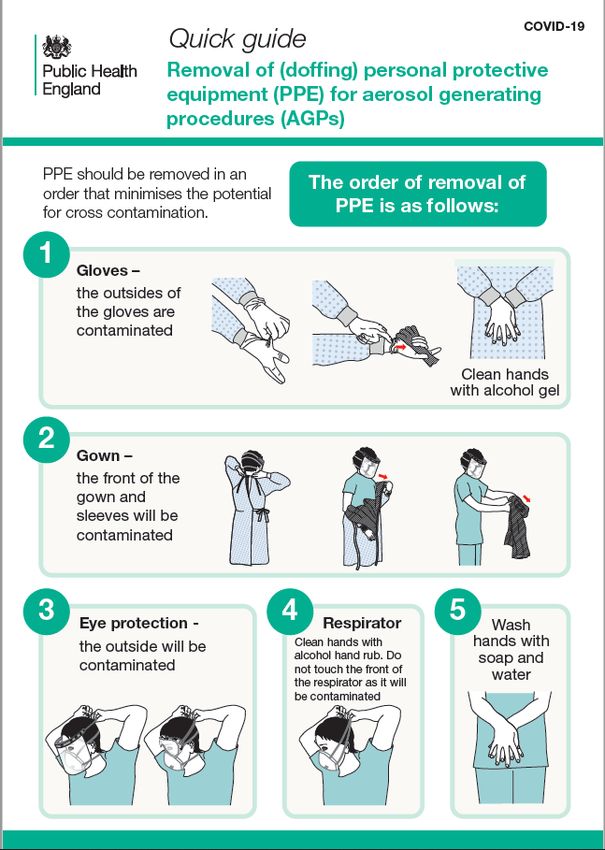
Training should include donning (putting on) and doffing (taking off) PPE. See
Figure 2 below.
Cleaning staff should also be trained in IPC measures.
Personal protective equipment
During periods of widespread community transmission of COVID-19 dentists
should use PPE to treat patients based on the type of urgent care they are
providing. In effect, there is now an assumption that all patients present a risk
of transmission of the virus.
31 | Appendix 3: Guidance for infection prevention and control in urgent dental care settingsVERSION 1, 15 APRIL 2020
1. Non-AGP treatment of all patients involves compliance with standard
infection control procedures. This will ensure there is no contact or droplet
transmission of COVID-19. Eye protection, disposable fluid-resistant surgical
mask, disposable apron and gloves should be worn.
2. For all AGPs, to prevent aerosol transmission, disposable, fluid-repellent
surgical gown (or waterproof long-sleeved protective apron), gloves, eye
protection and an FFP3 respirator should be worn by those undertaking or
assisting in the procedure.
Urgent care, including examination, taking radiographs, using hand instruments,
extractions and suction, are not classed as AGPs so universal precautions should
be used for these.
Operators may be concerned at the ‘splatter’ that is created by dental procedures,
but this is droplet contamination which universal precautions will guard against.
Risk reduction of droplet contamination can be undertaken by using high-speed
suction and use of rubber dam.
All AGPs should be avoided at this time unless essential and only used for
urgent and emergency care.
High-speed dental drills are accepted as AGPs. Using high-speed drills to open an
access cavity or surgical high-speed drills to undertake surgical extraction of a
tooth/root will necessitate use of enhanced PPE.
Particular care should be taken to avoid surgical extractions at this time. Where it is
necessary to remove bone, slow handpieces should be used with irrigation to
reduce the risk.
The use of 3-in-1 syringes, ultrasonic scalers or other pieces of dental
equipment powered by air compressor should be avoided at this time and should
not be the only reason to wear an FFP3 mask. If, however, they are used as an
adjunct to treatment with high-speed drills, staff will already have donned PPE for
AGPs.
This guidance is based on the UK approach to PPE set out here
32 | Appendix 3: Guidance for infection prevention and control in urgent dental care settingsVERSION 1, 15 APRIL 2020
Table 1 shows the application of the guidance to the UDC setting.
Table 1: Personal protective equipment (PPE) for
COVID-19 urgent dental care settings
Waiting Dental Dental
room/reception surgery surgery
No clinical Non AGP Treatments
treatment treatment involving
AGPs
Good hand hygiene Yes Yes Yes
Disposable gloves No Yes Yes
Disposable plastic apron No Yes No
Disposable gown* No No Yes*
Fluid-resistant surgical mask Yes Yes No
Filtering face piece (FFP3) No No Yes
respirator**
Eye protection*** No Yes Yes
* Fluid-resistant gowns (or long-sleeved waterproof apron) must be worn during aerosol generating
procedures (AGPs). If non-fluid-resistant gowns are used, a disposable plastic apron should be worn
underneath.
**If wearing an FFP3 that is not fluid-resistant, a full-face shield/visor must be worn.
***Eye protection ideally should be disposable. If polycarbonate safety glasses/goggles or equivalent
are used, they should be disinfected in line with manufacturers’ guidance.
Filtering face piece (FFP3) respirators for aerosol generating procedures
FFP3 respirators must be:
• fit-tested on all healthcare staff who may be required to wear an FFP3
respirator to ensure an adequate seal/fit according to the manufacturers’
guidance
• fit-checked (according to the manufacturers’ guidance) by staff every time
an FFP3 respirator is donned to ensure an adequate seal has been
achieved
33 | Appendix 3: Guidance for infection prevention and control in urgent dental care settingsVERSION 1, 15 APRIL 2020
• compatible with other facial protection used – ie protective eyewear – so
that this does not interfere with the seal of the respiratory protection; regular
prescription glasses are not considered adequate eye protection
• disposed of and replaced if breathing becomes difficult, the respirator is
damaged or distorted, the respirator becomes obviously contaminated by
respiratory secretions or other body fluids, or if a proper face fit cannot be
maintained; in effect this may mean that FFP3s may be worn once for
dental AGPs and then discarded as clinical waste (hand hygiene must
always be performed after disposal)
• shielded from ‘splatter’ in situations where FFP3s are used for a ‘session’
with a fluid resistant surgical mask or visor to protect the respirator from
droplets; a session ends when the healthcare worker leaves the care
setting/exposure environment; sessional use should always be risk
assessed; PPE should be disposed of after each session or earlier if
damaged, soiled, or uncomfortable.
• FFP3s should be removed outside the dental surgery where AGPs have
been generated in line with doffing protocol.
Decontamination
Decontamination following treatment should follow HTM01 05
In addition, when an AGP has been used, it is recommended that the room is left
vacant with the door closed for 20 minutes in a negative pressure isolation room or
one hour for a neutral pressure room before performing a terminal clean.
Windows to the outside in neutral pressure rooms can be opened. If the room
needs to be put back into use urgently, then it is recommended that the room is
cleaned as in the guidance below.
https://www.gov.uk/government/publications/wuhan-novel-coronavirus-infection-
prevention-and-control/reducing-the-risk-of-transmission-of-covid-19-in-the-hospital-
setting
34 | Appendix 3: Guidance for infection prevention and control in urgent dental care settingsVERSION 1, 15 APRIL 2020
Figure 1: Hand hygiene
1a: Best practice – how to hand wash 1b: Best practice – how to hand rub
35 | Appendix 3: Guidance for infection prevention and control in urgent dental care settingsVERSION 1, 15 APRIL 2020
Guidance on putting on (donning) PPE for aerosol generating procedures (AGPs),
and a video showing how to safely don (put on) PPE specific to COVID-19 for
AGPs and which should be used in conjunction with the quick guide to donning
PPE and local policies - can be viewed here.
Figure 2: Best practice – donning and doffing PPE
36 | Appendix 3: Guidance for infection prevention and control in urgent dental care settingsVERSION 1, 15 APRIL 2020
Appendix 4: Actions for
dental services
All dental service providers are expected to undertake the following actions.
Appointing a COVID-19 lead
Appoint a COVID-19 lead for the co-ordination of activities within a dental service,
training, preparation and implementation of SOPs and any subsequent revisions to
guidance. Ensure communication with the dental team and regular communication
with any other parts of the local UDC system as necessary (eg the commissioning
team or collaborating services).
Keeping staff safe
1. Government guidance for business and employers is found here.
2. All staff should be risk assessed on an ongoing basis to protect them and
keep possible cases, household contacts, staff who should be shielded, or
those at increased risk, away from work.
3. In line with government advice, it is recommended that as part of risk
assessment, dental services review resource requirements for service
operations and commitments. Where appropriate, this should allow staff to
stay at or work from home to avoid non-essential travel and contact; or to
participate in local workforce redeployment efforts in line with local
arrangements.
4. COVID-19 guidance around social distancing and good hygiene practice
should be promoted as far as possible in the workplace.
Staff with symptoms of COVID-19 and household contacts
Staff with symptoms of COVID-19, or who live with someone with symptoms,
should stay at home as per advice for the public. Staff who are well enough to
continue working from home should be supported to work from home.
37 | Appendix 4: Actions for dental servicesVERSION 1, 15 APRIL 2020
If staff become unwell with symptoms of COVID-19 while at work, they should stop
work immediately and go home. Decontamination should be carried out as for a
patient with symptoms of COVID-19 – for further information see here. No
additional precautions need be taken for patient and staff contacts unless they
develop relevant symptoms.
If a staff member tests positive for COVID-19, no additional precautions need be
taken for patient and staff contacts unless they develop relevant symptoms.
Staff exposed to someone with symptoms of COVID-19 in healthcare settings
Staff who have been exposed to someone with symptoms of COVID-19 in
healthcare settings, even if not using adequate PPE, do not need to stay at home
unless they develop symptoms.
Staff at increased risk from COVID-19
The government has issued guidance about stringent social distancing and
shielding for vulnerable groups at particular risk of severe complications from
COVID-19. Staff who fall into these categories should not see patients face to face,
regardless of whether a patient has symptoms of COVID-19 or not. Remote working
should be prioritised for these staff.
Staff support and wellbeing
We recognise the impact that the COVID-19 response is having and will continue to
have on dental teams, and it is important to support them as much as possible
during their continued commitment to patient care.
The following mental health and wellbeing resources are available to staff:
• NHS Employers has resources to support staff wellbeing during the COVID-
19 pandemic here
• The World Health Organization has published WHO Mental Health
Considerations During COVID-19.
• MIND UK and Every Mind Matters have published specific resources in the
context of COVID-19.
38 | Appendix 4: Actions for dental servicesYou can also read


