COVID-19 vaccines for people with cancer
←
→
Page content transcription
If your browser does not render page correctly, please read the page content below
COVID-19
                                vaccines for
                                people with
                                cancer
                                Information for health care
                                professionals
                                People with cancer are high risk for severe COVID-19 infection
                                Available evidence indicates that people with active cancer who developed
                                COVID-19 infection have a high fatality rate from increased risks of developing
                                severe infection. Those people with active haematological malignancies are at
                                the highest risk as they have a limited immune response to control an infection
                                as well as people with lung cancer (1). Similarly, there is emerging evidence
                                that those on certain types of cancer treatment may have an increased risk for
                                fatal outcomes from COVID-19 infection (1). Moreover, some people who do
                                not mount a strong immune response against COVID-19 are likely to shed the
                                virus for a longer time and be a source of continued unintended exposure
                                infecting other persons. These data indicate that all people with: a current
                                cancer diagnosis; those who are on active treatment cancer; and those who
                                are recovering from a recent cancer treatment, would be considered for early
                                access for COVID-19 vaccination.

                                Approved COVID-19 vaccines in Australia
                                Currently, there are two vaccines approved in Australia – Pfizer/BioNTech
                                SARS-Cov-2 vaccine and Astra Zeneca ChAdox1 nCOV-19 vaccine. There are
                                other vaccines currently in clinical trials around the world. Pfizer/BioNTech
                                SARS-Cov-2 vaccine is a m-RNA vaccine. Importantly, the phase 3 trial of this
                                vaccine included 1,395 patients with cancer and 76 patients with leukaemia or
                                lymphoma. These patients responded with similar efficacy as non-cancer
                                patients. Astra Zeneca ChAdox1 nCOV-19 vaccine is a replication deficient
                                adenoviral vectored vaccine and there is no published information on its
                                effectiveness in immunocompromised patients. Common acute side effects
Level 7, Citi Centre Building
11 Hindmarsh Square
                                associated with candidate SARS-CoV-2 vaccines reported to date include
Adelaide SA 5000                low-grade fever, myalgias, headache, nausea, fatigue and soreness/redness at
DX243                           the injection site. These acute side effects were more pronounced after the
T +61 (08) 8226 5791            booster dose (2nd vaccine dose) in some of the trials. Long-term side effects
ceih.sa.gov.au                  have not been defined for SARS-CoV-2 vaccines.
                                It is important to remember that there is limited information on the safety and
                                effectiveness of the vaccines in people with cancer or on active cancer
                                treatment. As the vaccines may have reduced protection, all patients should
                                continue to practice COVIDSafe measures including optimal public health
                                protective measures. Masks and social distancing work in real time to protect

                                                      OFFICIAL                             Let’s put imagination to work
patients with compromised immunity against any strain of SARS-CoV-2. In contrast, COVID-19 vaccines
do not provide immediate protection, and none are 100% effective.
Australia’s COVID-19 national roll-out strategy
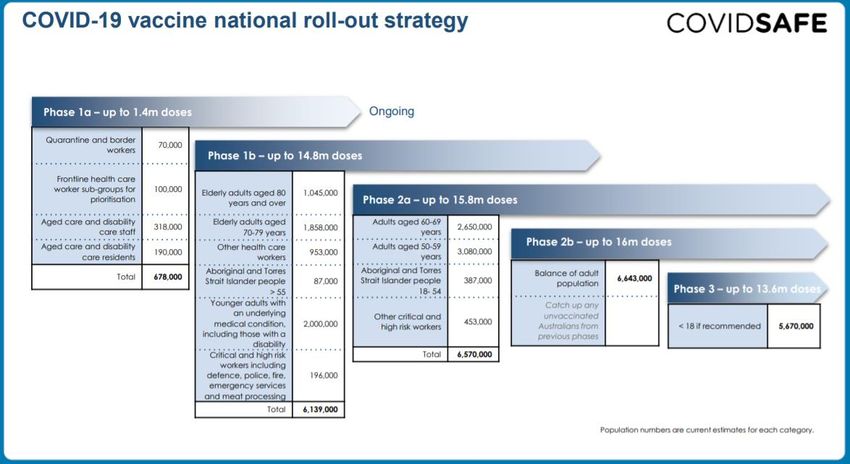
The Australian government has released a COVID-19 vaccination policy and national roll-out strategy (2).
As per this plan, there are three priority population groups – those with increased risk of exposure, those
increased risk of severe disease, or those working in services critical to societal functioning (Figure).
Figure: COVID-19 vaccine roll-out strategy
Who are those adults with an underlying medical condition, including those with a
disability at increased risk for severe COVID?
“These at-risk medical conditions include, but are not limited to, immunocompromised, multiple
comorbidities, chronic lung disease, diabetes, cardiovascular disease and severe obesity” (2)
As per Australia’s COVID-19 vaccine national roll-out strategy, most people with active cancer will be
offered COVID-19 vaccines as part of Phase 1b group (2). Cancer patients on active treatment (except
those only on hormonal therapy and no comorbidities e.g. young people with CML in remission on kinase
inhibitors, young women on adjuvant hormonal therapy without comorbidities) or those not on active
treatment, but with comorbidities or immunosuppressed (e.g. post stem cell transplantation) – fall under
Phase 1b cohort. Those free of cancer/cancer survivors without comorbidities/others such as young people
without comorbidities on adjuvant non-immunosuppressive therapy (e.g hormonal therapy) and had the
diagnosis made more than five years will be offered vaccination in Phase 2a or 2b.
Immunocompromised people and COVID-19 vaccine
The current understanding is that the following immunocompromised people could have attenuated or
absent response to a SARS-CoV-2 vaccine (3):
Immunodeficiencies involving adaptive immunity
Splenectomy or functional asplenia (sickle cell disease)
B cell directed therapies against CD20 or CD22, bispecific agents (like blinatumomab), CD19 or
CD22-directed CAR-T cell therapies and BTK inhibitors
T cell directed therapies (calcineurin inhibitors, antithymocyte globulin, alemtuzumab)
Many chemotherapy regimens
2 OFFICIAL Let’s put imagination to work High-dose corticosteroids (>2 mg/kg/day daily prednisone or equivalent)
Stem Cell Transplant patients - especially within the first 3-6 months after autologous
transplantation and often longer after allogeneic transplantation.
Underlying aberrant immunity (e.g. Graft-vs.-host disease (GVHD), Llw white blood cell counts.
(neutropenia ANCPfizer/BioNTech SARS-Cov-2 vaccine is a two-dose course with the second dose given 3-12 weeks
after the first dose. Astra Zeneca ChAdox1 nCOV-19 vaccine is also a two-dose course with the
second dose given 4-12 weeks after the first dose. The second dose can be timed according to the
above recommendations.
Any precautions for the site of vaccination?
COVID-19 vaccines are generally administered intramuscularly in the deltoid region.
For people with breast cancer – consider administering the vaccine in the opposite arm to the
primary site where nodal clearance was performed.
For people undergoing radiotherapy – consider avoiding the vaccine administration to the arm that
directly drains through the nodes in the radiation field or previously irradiated.
Considerations for imaging?
Enlarged lymphadenopathy can be seen post vaccination. Diagnostic imaging post vaccination –
consider delaying imaging for 6-10 weeks to avoid reactive lymph node enlargement from the
vaccine being confused with cancer growth.
Clinical trial participation?
Those participating in clinical trials (8) – check the treatment protocol for trial specific guidance
regarding the timing of vaccination. In general, avoid the investigational product for at least 2-4
weeks after vaccination if it has any potential to cause cytokine storm.
If the trial involves proven anticancer drugs with known benefits, this delay might be challenging for
patients with progressing advanced cancers, and the risks and benefits of the delay must be
carefully considered with the patient.
It is recommended that patients avoid receiving their vaccine on days of parenteral dosing of the
investigational product (and receive it at a time as distanced as possible from investigational product
dosing) and the dose-limiting toxicity period if administration of the SARS-CoV-2 vaccine is
mandated while the patient is still participating in an early phase trial.
Do health care workers and caregivers require vaccination?
Healthcare workers caring for people with cancer should be prioritised in receiving vaccination to
minimise nosocomial transmission. Healthcare workers will fall under the category of phase 1a or 1b
under the national roll-out plan. It is recommended all health care providers be vaccinated unless
contraindicated due to allergic/anaphylactic reactions.
It is recommended that caregivers and household/close contacts be vaccinated when possible.
However, the caregivers and household contacts may fall under any of the priority groups in the
national roll-out plan; hence they should be vaccinated when they are eligible.
Monitoring and research?
Close surveillance and monitoring of patients with cancer is required after COVID-19 vaccination to
assess potential adverse events and measure clinical outcomes as limited data exists in this
population. Measuring immune response with antibodies will not be routinely performed.
What about children with cancer?
Based on the current data, both vaccines were given to people aged 16 years or more. Hence, the
vaccines are limited only to people older than 16 years of age.
What about COVID-19 and other vaccines?
The safety of multiple vaccines administered simultaneously has not been established. Consider
giving other vaccines (e.g. influenza) at least 2 weeks before or after the COVID-19 vaccines.
4 OFFICIAL Let’s put imagination to workReferences
1. Ribas et al. Priority COVID-19 Vaccination for Patients with Cancer while Vaccine Supply Is
Limited. Cancer Discovery Feb 2021 - DOI: https://doi.org/10.1158/2159-8290.CD-20-1817
2. COVID-10 vaccination policy and national roll-out strategy -
https://www.health.gov.au/sites/default/files/documents/2020/12/COVID-19-vaccination-australian-
COVID-19-vaccination-policy.pdf;
https://www.health.gov.au/sites/default/files/documents/2021/01/COVID-19-vaccination-australia-s-
COVID-19-vaccine-national-roll-out-strategy.pdf
3. American Society of Haematology - https://www.hematology.org/COVID-19/ash-astct-COVID-19-
and-vaccines
4. Cancer Australia repository for cancer vaccine information -
https://www.canceraustralia.gov.au/affected-cancer/COVID-19-and-cancer/health-
professionals/COVID-19-vaccines-and-cancer
5. NCCN: Cancer and COVID-19 vaccination - Preliminary Recommendations of the NCCN COVID-19
Vaccination Advisory Committee – version 1.0 22nd January 2021 - https://www.nccn.org/COVID-
19/pdf/COVID-19_Vaccination_Guidance_V1.0.pdf.
6. UK chemotherapy board - Clinician Frequently Asked Questions (FAQs) and guidance on COVID-
19 vaccine for patients receiving Systemic Anti-Cancer Therapy - https://b-s-
h.org.uk/media/19241/clinician-faqs-and-guidance-on-COVID19-vaccine-for-patients-receiving-
sa_.pdf
7. MSK COVID-19 vaccine guidelines - https://www.asco.org/sites/new-www.asco.org/files/content-
files/2021-MSK_COVID19_VACCINE_GUIDELINES_final_V.2.pdf
8. Yap et al. SARS-Cov-2 vaccination and phase 1 cancer clinical trials. The Lancet Oncology Feb
2021 – advanced online - DOI: https://doi.org/10.1016/S1470-2045(21)00017-6
Additional resources
https://www.health.gov.au/initiatives-and-programs/COVID-19-vaccines
https://www.sahealth.sa.gov.au/wps/wcm/connect/public+content/sa+health+internet/conditions/infe
ctious+diseases/COVID-19/vaccine/COVID-19+vaccinations
https://www.canceraustralia.gov.au/COVID-19-vaccine-and-cancer
www.COVIDvaccine.sa.gov.au
CMI for vaccines
Pfizer vaccine - https://www.tga.gov.au/sites/default/files/cmi-comirnaty-bnt162b2-mrna.pdf
AstraZeneca vaccine - https://www.tga.gov.au/sites/default/files/cmi-approved-COVID19-vaccine-
az.pdf
Acknowledgments
This Document was developed by the State Wide Cancer Clinical Network (SCCN) and endorsed
by the Clinical Advisory Group, COVID-19 Vaccination, DHW. Release Date 12th March 2021.
5 OFFICIAL Let’s put imagination to workYou can also read


