Covid In The Community - Clinical Zoom 27th October 2021 - Pinnacle Practices
←
→
Page content transcription
If your browser does not render page correctly, please read the page content below
Covid In The Community
     Clinical Zoom 27th October 2021
How this will develop

                        First Phases
                        1. Closed Borders
                            Current (22/10/2021)
                            situation. Border with
                            Auckland and parts of
                            the Waikato Closed.
                        2. Expectant Phase
                            Waikato is currently
                            experiencing this phase.
                            Cases are effectively
                            traced and contained
                            but with flare ups.
                        3. Community surge
                            Contact tracing is
                            overwhelmed. Our
                            effort might reduce the
                            steepness of the rise.
                            Auckland is currently in
                            this phase.

                                             2
•   90% adult vaccination rate by Dec 2021.
•   Children ages 12-15 are vaccinated.

                                                     Size of the problem
•   0-11 year olds not vaccinated.
•   Borders are opened 1 Jan 2022.
•   Restrictions remain on travel to some
    countries, but otherwise quarantine-free
    travel is occurring.
•   Assume Delta variant is main issue, medium
    R0 = 4.5 per REF.
•   Assume variation in coverage by community
    around the average vaccination coverages.
•   Vaccine efficacy (Pfizer) against Delta = 88%,
    against severe disease 94%.
•   Assume severity proportions as per REF.
•   Vaccine reduction in transmission - 85%.
•   No further community lockdowns, but case
    isolation and contact tracing e.g. as measles
    is managed now, drops R0 44% .
•   Health care workers at 93% coverage -
    assume other groups slightly lower.
•   M + P have 2.5 and 3x the rate of
    hospitalisation as European/Other.
•   Planned Care will be managed based on
    current occupancy and a decision matrix
•   Some communities in the Midland region are
    particularly vulnerable and will need
    additional resources and support.
Potential forecast – planning scenario - Lakes DHB
Could start sometime in the next 2 months

                                        A potential view, 90% 12+ vaccinated, Lakes DHB
                                                                                                                                                                                                         Steady Surge (3- Peak (4-
                  400
                                                                                                                                          140                                                             state 4 mths) 6 wks)
                  350                                   Peak                                                                                                               Daily cases                          5      27       54
                                                                                                                                          120
                  300                                                                                                                                                      Daily admissions                   0.4       2        6

                                                                                                                                                Hospital admissions/beds
                                                                                                                                          100                              Daily ED attends                     1       4       12
 Cases per week

                  250                                   Surge                                                                                                              Daily ED attends w covid           0.1       0        1
                                                                                                                                          80
                  200                                                                                                                                                      Daily child cases                    1      10       30
                  150
                                                                                                                                          60                               Primary care monitored /day         11      49       98
                                                                                                            Steady state                  40                               Primary care consults / day          3      17       51
                  100
                                                                                                                                                                           Avg occupied beds                    2      11       19
                  50                                                                                                                      20
                                                                                                                                                                           Max occupied                         7      22       22
                   -                                                                                                                      0                                Average ICU                          1       3        5
                        1   3   5   7    9   11    13   15   17   19   21    23    25   27   29   31   33   35   37   39   41   43   45                                    Max ICU                              2       6        6
                                                                            Week                                                                                           Infectious per 1000 pop              1       3        6
                                         Cases (Left axis)        Admissions             Beds occupied           ICU occ
                                                                                                                                                                                 Steady State = Tight Controls
                                                                                                                                                                                 Surge = Looser controls used to size
 Estimated deaths over year: 27 total and 13 Māori (50%)                                                                                                                         Peak = attendance fluctuation of approx 3x surge
 Hospitalisations weight in a similar way – inequitable impact.

                                                                                                                                                                                                                           4
Scope of current planning
•   Identification of cases and initial assessment of best place for care
•   Social and welfare risk stratification
•   Wrap-around services – who what where when and how
•   Clinical Risk stratification
•   Clinical assessment inc. equipment and funding
•   Treatment options
•   Escalation process
•   Palliative care
•   Shared record keeping and notes access
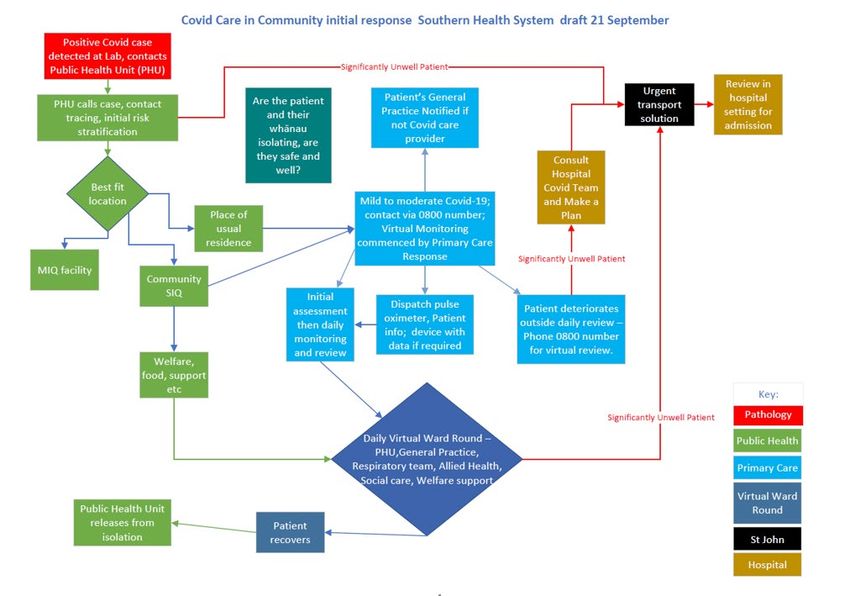
How will care flow ?
Adapted from West Metro Victoria, Australia, by Dr John E, Dr Christine M and then by Ministry of Health Oct 2021
COVID-19 Primary Care Clinical Model
(The model refers to sections in green. Other sections are being developed in parallel and sit outside this scope)
Identification Clinical Care
of People with COVID-19 Of people with COVID-19
Risk Discharge Follow-up
Test setting Notification Assessment Stratification Review Plan Escalation / De-Escalation and check
Clearance
Primary Care / General
Public Health TBC Practice
• Notification of positive test Initial Virtual Consultation Model of Care Level 1: Regular virtual/telehealth health check monitoring,
• Register, inform, assign, referral for other health and social supports
investigate case, create • Clinical assessment risk Clinical
location, link case factors and severity of Low Workforce: Hybrid model integrating with individual/whānau regular or Service
• Provision of isolation and symptoms identified Release General
infection control guidelines • Risk stratification alternative general practice provider with urgent care support, telehealth
Emergency ambulance transfer
Practice /
Primaryand • Contact tracing questionnaire and clinical services, service navigator and kaiāwhina support Primary
community • Assess suitability of isolation at assessment to Care /
home / in community settings Model of Care Level 2: Regular more frequent virtual/telehealth health check
determine care level Telehealth
monitoring and consultation as required, supported by multi disciplinary clinical team
Symptoms
• Notify registered general • Assess whether non Services
practice / PHO, or assign with shared care approach. (In person care may be required for non-covid urgent
COVID-19 health care is
primary care clinical provider if care needs).
being addressed, and
not enrolled social supports are Medium Workforce: Whānau centric MDT includes general practice, telehealth services
Hospital being activated Public
• Liaise with public health, clinical team, urgent care, secondary care specialists and nurses, pharmacists, Health
Provider / Function TBC
Community SIQ as physiotherapists and paramedics (to be regionally determined), service navigator
• Arrange welfare, Release
needed. and kaiāwhina support
accommodation and transport
• Social and welfare needs • Notify community
assessment pharmacist if known
Model of Care: Acute care in hospital setting, or palliative care
• Social and welfare care
coordination with Community High Workforce: Secondary care teams, service navigator and kaiāwhina support
SIQ coordinator
COVID-19 HealthPathways
Telehealth services for COVID-19 enquiries and after-hours clinical advice
Data capture and integrated IT systems
Welfare and social support, accommodation and transport
Shared governance and oversight to support continuous improvement
DRAFT – NOT PUBLIC POLICY – October 2021
Risk Stratification Assessment for Clinical Care of COVID-19 in the Community
                                                   Infant < 1 month old, child aged < 2yr that was born premature (< 37/40), or child any age with co-morbidities?
A detailed assessment tool sits                                                                     NO
underneath this framework                                            Asses the risk of the most vulnerable adult in the ‘bubble’
and will be available through                                                                                                                                                    YES
the COVID-19 Community
                                                                COVID-19 Vaccination course completed more than 2 weeks ago?
HealthPathways
                                                                                                      YES                                            NO
                                                                                          Immunocompromised?                         YES
                                                                                                     NO
                                                                                  Māori or Pacific Island (PI) ethnicity ?
                                                                             NO                                    YES
                  MEDIUM TO HIGH                                                                                                                                           MEDIUM
                       RISK                            YES             >65 years
                                                                                                            > 44 (Māori)
                                                                                                             > 40yr (PI)                     YES                         TO HIGH RISK
                   * High Risk if one or more
                   medical risk or dynamic /                            NO                                         NO
                    complex circumstance                                                                                                                               * High Risk if one
                                                                     Medical risks: Pregnant (or within 6 weeks
                                                                     of pregnancy), BMI >30, Active malignancy                                                         or more medical
                                                                                                                                               YES
                                                                     Co-morbidities ie (HT, DM, IHD, CKD,COPD,                                                         risk or dynamic /
                                                                     Asthma, CVA, Epilepsy)
                                                                     Smoker (tobacco or cannabis)                                                                           complex
                                                                     CPAP                                                                                                circumstance
                                                                                   YES
             Dynamic or complex circumstances (considerations): social isolation, geographically isolated (rural), lack
               of transport, housing insecurity, housing crowded or damp and cold, needs carer support, absence of
            suitable caregiver, disability support required, mental health supports required, addiction support required,                      YES
                                         drug support required, health literacy support required
                                                                             NO
                                                                                               This draft risk stratification tool been developed taking into account the following resources. RPA version: rpavirtual Delta Risk
                                                                      LOW RISK                 Stratification Tool_Version_3.1_06102021.pdf and Ontario Hamilton Family Medicine Assessment , Monitoring and
        DRAFT – NOT PUBLIC POLICY – October 2021                                               Management of COVID https://hfam.ca/clinical-pathways-and-evidence/covid/assessment-diagnosis-and-management-of-covid/
Model of Care
                                  The model of care level is determined by the risk of the most vulnerable/at-risk person within a ‘bubble’ and the intensity of symptoms

A detailed assessment tool sits
underneath this framework
and will be available through                      Low Risk                                                              Medium to High Risk
the COVID-19 Community
HealthPathways

                                                                              SYMPTOMS

                                          mild                     mod                                    mild                      mod                       severe

                                            Level 1                                                   Level 2                                               Hospital

                                                                        DRAFT – NOT PUBLIC POLICY – October 2021
Respiratory Assessment1 :

      1.      Ask the patient to describe the problem with their breathing in their own words and assess the ease and comfort of their speech. Ask open ended
              questions and listen to whether the patient can complete their sentences:

              •   “How is your breathing today?”

      2.      Ask Three Questions:

              •   “Are you so breathless that you are unable to speak more than a few words?”

              •   “Are you breathing harder or faster than usual when doing nothing at all?”

              •   “Are you so ill that you've stopped doing all of your usual daily activities?”

      3.      Focus on change. A clear story of deterioration is more important than whether the patient currently feels short of breath. Ask questions such as

              •   “Is your breathing faster, slower, or the same as normal?”

              •   “What could you do yesterday that you can’t do today?”

              •   “What makes you breathless now that didn’t make you breathless yesterday?”

      4.      Interpret the breathlessness in the context of the wider history and physical signs. For example, a new, audible wheeze and a verbal report of
              blueness of the lips in a breathless patient are concerning.

              •   There is no evidence that attempts to measure a patient’s respiratory rate over the phone would give an accurate reading, and experts do not
                  use such tests. It is possible, however, to measure the respiratory rate via a good video connection. More generally, video may allow a more
                  detailed assessment and prevent the need for an in-person visit.

If they have a pulse oximeter - previously healthy lungs or previously documented normal O2 sat – a new consistent reading of < 92% is a red flag.
If underlying lung disease with documented low normal O2 sat at baseline – a new reading of < 90% is a red flag. If patient on home oxygen normally and
their O2 requirements increase with COVID illness – this is a red flag, If they are having oxygen at home – aim for SpO2 92-96%, If risk of CO2 retention, aim
saturation 88-92%

1
    ( From Trish Greenlagh et al BMJ (https://www.bmj.com/content/368/bmj.m1182)
What Happens to Staff who
are exposed ?Funding ?
Funding in Auckland
Shared IT system
Regional Update
Upcoming opportunities
• https://www.goodfellowunit.org/node/970087
Covid in the home – what primary care needs to know
• WEBINAR: Thursday 28 October 2021, 7.30 - 8.45 pm
You can also read


