DARTS Unified Planning Work Program - FY 2020 - Darts Mpo
←
→
Page content transcription
If your browser does not render page correctly, please read the page content below
DARTS Unified
Planning Work
Program
FY 2020

www.dartsmpo.org
Contents
TITLE VI DISCLAIMER ..................................................................................................................................... 4
What is the Unified Planning Work Program? .............................................................................................. 5
Executive Summary ....................................................................................................................................... 6
RESOLUTION ................................................................................................................................................. 7
DARTS TRANSPORTATION COMMITTEE MEMBERS ...................................................................................... 8
   POLICY COMMITTEE VOTING MEMBERS .................................................................................................. 8
   TECHNICAL COORDINATING COMMITTEE MEMBERS .............................................................................. 9
   TECHNICAL COORDINATING COMMITTEE Non – Voting Members .......................................................... 9
   CITIZENS’ TRANSPORTATION COMMITTEE MEMBERS ........................................................................... 10
DARTS Meeting Schedule ............................................................................................................................ 11
ACRONYMS USED IN THIS DOCUMENT....................................................................................................... 12
INTRODUCTION ........................................................................................................................................ 13
   DARTS MPO BOUNDARY ......................................................................................................................... 13
   Summary of DARTS Metropolitan Planning Organization ............................................................... 13
   Purpose of the UPWP ........................................................................................................................... 14
Planning Factors (23 CFR 450.306) ............................................................................................................. 15
GOAL/LEGISLATION COMPARISON TABLE .................................................................................................. 18
   Overview of DARTS MPO Planning Process, including MPO’s goals and objectives ................... 26
DARTS MPO PLANNING PRIORITIES ............................................................................................................ 27
DARTS Goals and Objectives ....................................................................................................................... 28
   Sub-element 1.1 Program Coordination ................................................................................................. 32
   Sub-element 1.2 Operations and Administration ................................................................................... 33
   Sub-element 1.3 Training/Employee Education ..................................................................................... 35
   Sub-element 1.4 Equipment and Supplies .............................................................................................. 37
   Sub-element 1.5 Contracts/Grants ......................................................................................................... 38
   Sub-element 1.6 UPWP ........................................................................................................................... 39
TASK #2 PUBLIC INVOLVEMENT .................................................................................................................. 41
   Sub-element 2.1 Community Outreach/Education ................................................................................ 41
   Sub-element 2.2 Environmental Justice/Title VI..................................................................................... 43
   Sub-element 2.3 Participation Plan ........................................................................................................ 44
TASK #3 DATA COLLECTION ........................................................................................................................ 45

                                                                                                                                             2|Page
Sub-element 3.1 Socio-Economic Data/EJ Analysis Data........................................................................ 45
   Sub-element 3.2 Land Use Monitoring ................................................................................................... 46
   Sub-element 3.5 System Monitoring ...................................................................................................... 47
   Sub-element 4.3 Intermodal (i.e. airports and ports) ............................................................................. 48
   Sub-element 4.5 Bike/Pedestrian ........................................................................................................... 49
   Sub-element 4.7 GIS Development and Applications ............................................................................. 50
   Sub-element 4.8 Highway Planning ........................................................................................................ 51
   Sub-element 4.10 Freight Planning......................................................................................................... 52
   Sub-element 4.11 Metropolitan Transportation Plan (MTP) .................................................................. 53
   Sub-element 4.12 Transportation Improvement Plan ............................................................................ 54
   Sub-element 4.13 Special Studies ........................................................................................................... 55
TASK #5 TRANSIT PLANNING....................................................................................................................... 57
   Sub-element 5.1 Program Support and Administration 44.21.00 .......................................................... 57
   Sub-element 5.2 Unified Planning Work Program UPWP 44.21.00........................................................ 58
   Sub-element 5.3 Long Range Transportation Planning -System Level 44.23.01 .................................... 59
   Sub-element 5.4 Short-Range Transportation 44.24.00 ......................................................................... 60
   Sub-element 5.5 Transportation Improvement Program 44.25.00 ........................................................ 62
   Sub-element 5.6 Training& Employee Education 44.27.00 .................................................................... 63
   UNFUNDED PROJECTS ............................................................................................................................. 64
   UNFUNDED PROJECTS ............................................................................................................................. 65
SUMMARY BUDGET TABLE ......................................................................................................................... 66
APPENDIX .................................................................................................................................................... 68
Metropolitan Planning Factors to be considered in the 2020 UPWP ......................................................... 69
MPO Self-Certification ................................................................................................................................ 71
DARTS BYLAWS ........................................................................................................................................... 76
COMMENTS................................................................................................................................................. 82
FY 2020 Unified Planning Work Program (UPWP) ...................................................................................... 83
FHWA Comments ........................................................................................................................................ 83

                                                                                                                                               3|Page
TITLE VI DISCLAIMER

DARTS MPO is committed to assuring full compliance with, all civil rights provisions of federal
statutes and related authorities that prohibit discrimination in programs and activities receiving
federal financial assistance. These laws include but are not limited to Title VI of the Civil Rights
Act of 1964 ("Title VI"), the Civil Rights Restoration Act of 1987 (P.L. 100.259), Section 162 (a)
of the Federal-Aid Highway Act of 1973 (23 USC 324) (sex), Americans with Disabilities Act of
1990, Section 504 of the Rehabilitation Act of 1973, and the Age Discrimination Act of 1975, as
amended.
DARTS MPO does not discriminate against persons in the provision of its programs, services or
activities.

                                                                                          4|Page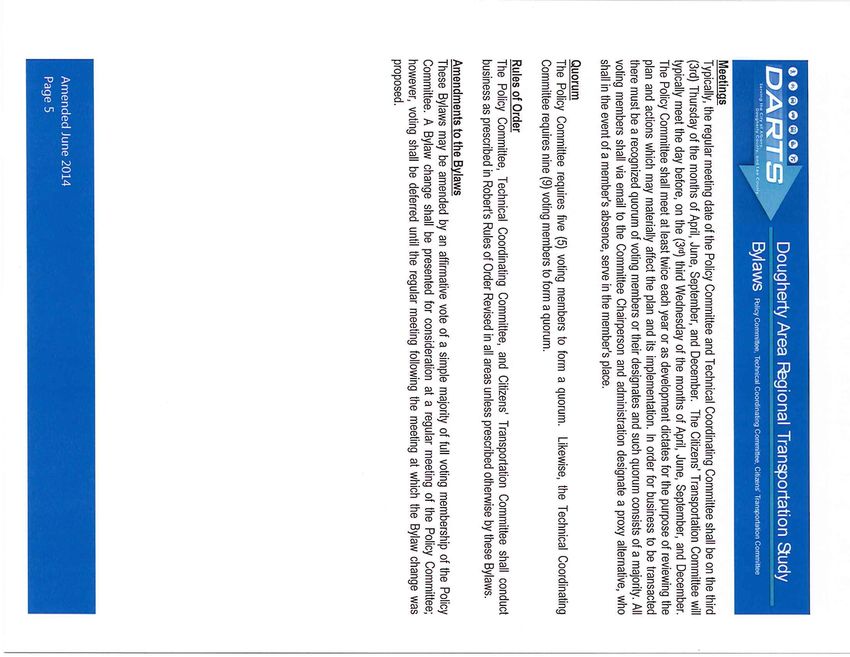
What is the Unified Planning Work Program?

Every year the Dougherty Area Regional Transportation Study Metropolitan Planning Organization
(DARTS MPO) prepares its budget. This budget is known as the Unified Planning Work Program (UPWP)
as it incorporates and describes all transportation planning activities and associated funding for the
MPO.

The FY 2020 UPWP describes the transportation planning activities that are proposed to be conducted
during the period from July 1, 2019 through June 30, 2020. The program is organized with in several
work elements.

The UPWP guides transportation planning activities towards adopted goals and objectives of the
Metropolitan Transportation Plan (MTP). This program continues the transportation planning process
with an emphasis on detailing the plans and programs that have been developed. Areas of the work
program concentrate on developing the information, data, and procedures that are necessary to
maintain a viable and effective transportation planning process.

This year’s program focuses on an update to the Metropolitan Transportation Plan for 2045 to ensure it
meets the federal requirements for Performance Based Planning and Programming (PBPP). The
following pages describe in detail what the DARTS MPO is, the regulations that we must follow as well as
our planned expenditures and the current year’s work.

                                                                                             5|Page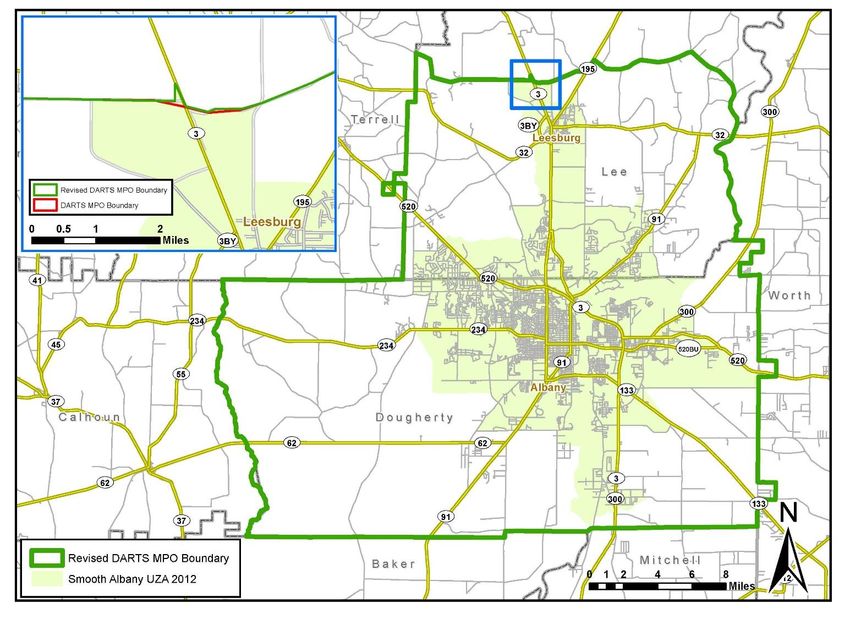
Executive Summary

The Unified Planning Work Program (UPWP) document outlines transportation planning priorities and
work tasks for the Dougherty Area Regional Transportation Study (DARTS) Metropolitan Planning
Organization (MPO) for Fiscal Year 2020 . FY 2020 begins July 1, 2019, and ends June 30, 2020.

Preparation of the UPWP is required by the federal transportation legislation known as Fixing America’s
Surface Transportation (FAST) Act, and the Metropolitan Planning Code of Federal Regulations (23CFR
450.308) of the United States Department of Transportation. The UPWP must present a continuing,
cooperative, and comprehensive (the “3C”) approach to transportation planning activities. The UPWP is
prepared with cooperation and guidance from federal, state, and local agencies, as well as state & public
transportation operators.

In fiscal year 2019, DARTS was able to kick off its update of the 20-year Metropolitan Transportation
Plan (MTP) This endeavor focused heavily on community involvement as well as planning with current
and expected trends. This process also enabled the region to have an updated travel demand model
and new socio-economic data.

The focus for fiscal year 2020 will be an update to the Bicycle and Pedestrian Plan and an update for the
Freight Profile for the region. FY 20 will also see the completion and adoption of the Metropolitan
Transportation Plan.

                                                                                              6|Page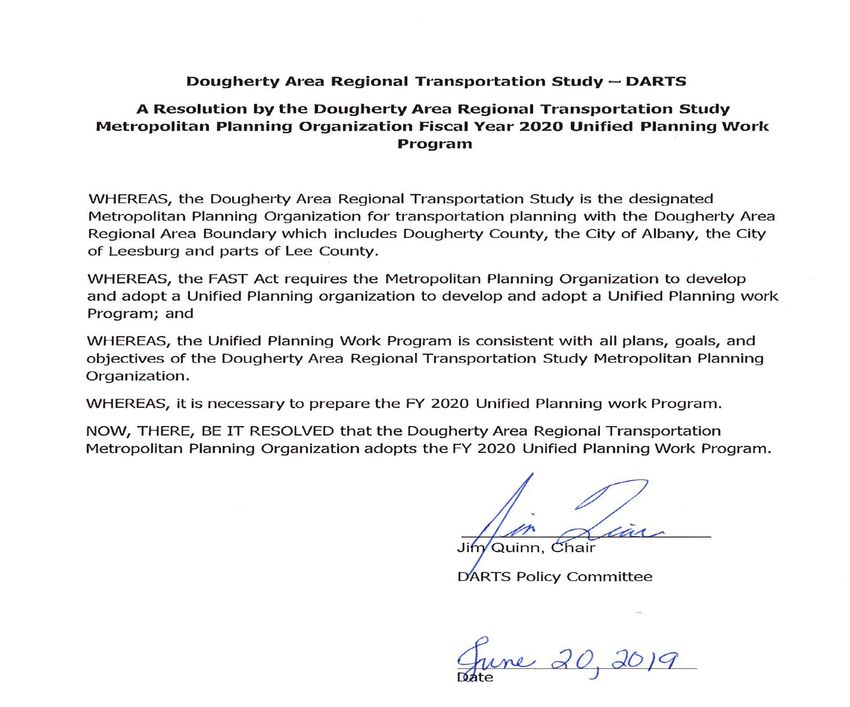
RESOLUTION

             7|Page
DARTS TRANSPORTATION COMMITTEE MEMBERS

POLICY COMMITTEE VOTING MEMBERS
The Policy Committee is the decision making body and is represented by elected
officials from the member jurisdictions and an official from the Georgia Department of
Transportation (GDOT). The committee is responsible for taking into consideration the
recommendations from the Citizen’s Advisory Committee and the Technical Coordinating
Committee when adopting plans or setting policy.

Jim Quinn                              Chair, Mayor, City of Leesburg
Dorothy Hubbard                        Mayor, City of Albany
Michael McCoy                          Dougherty County Administrator
Sharon Subadan                         Albany City Manager
Chris Cohilas                          Dougherty County Commission
Rozanne Braswell                       Vice Chair, Lee County Director of Planning &
                                       Engineering
Billy Mathis                           Lee County Commission
Bob Alexander                          Leesburg City Manager
Russell McMurry                        GDOT Commissioner
Van Mason                              GDOT District Engineer, District 4

* Five (5) voting members are required for a quorum.

Non-Voting Members

FHWA Division Administrator

                                                                             8|Page
TECHNICAL COORDINATING COMMITTEE MEMBERS
The Technical Coordinating Committee membership includes staff from the member
jurisdictions, various federal, state, and local agencies and associations that have a technical
knowledge of transportation or planning. The TCC evaluates transportation plans and projects
based on whether or not they are technically warranted and financially feasible.

Paul Forgey                          Chair, Director, Planning & Development Services
Michael Persley                      Albany Chief of Police
Richard Bramlett                     Public Works Director (City)
Bruce Maples                         Albany Director of Engineering
David Hamilton                       Transportation Director
Don Gray                             Albany Facilities Management Director
Larry Cook                           Dougherty County Public Works Director
Jeremy Brown                         Vice Chair, Dougherty County Engineering Manager
Kenneth Johnson                      Dougherty County Chief of Police
Rozanne Braswell                     Lee County Director of Planning & Engineering
Bob Alexander                        Leesburg Public Works Director
Kimberly Brooks                      Southwest Georgia Regional Commission
Kerrie Davis                         Transportation Planner, DARTS MPO
Gwendolyn McDaniel                   Transit Planner, DARTS MPO
Hunter Hines                         SWGA Regional Airport Superintendent of Operations
Jacqueline Williams                  GDOT Office of Planning, Transportation Planner, Atlanta
Tim Warren                           GDOT Assistant District Engineer, District 4
Ken Breedlove                        Albany Traffic Engineering Manager
Orlando Rambo                        Destiny Tours
Hubert Smigelski                     Marine Corp Logistic Base

* Nine (9) voting members required for a quorum.

TECHNICAL COORDINATING COMMITTEE Non – Voting Members

Mary Teter                           Planning Manager
Charles Ryan Walker                  GDOT Office of Intermodal Programs, Atlanta
Dennis Carter                        GDOT, District 4 Intermodal Programs
Thomas Caiafa                        GDOT, Branch Chief
Ann Marie Day                        U. S. Department of Transportation, FHWA
Sanford Hillsman                     Albany Dougherty Planning Commission
Tommy Gregors                        Citizens’ Transportation Committee Representative
Bob Alexander                        Leesburg Engineer

                                                                                       9|Page
CITIZENS’ TRANSPORTATION COMMITTEE MEMBERS
The Citizens Advisory Committee consists of volunteer members who are interested in
transportation issues. They are appointed by their member jurisdictions. The CAC is
responsible for ensuring that values and interests of the citizens in Dougherty County,
City of Albany, City of Leesburg and a portion of Lee County are taken into
consideration in the transportation planning process.
Dr. Surendra Pandey Dougherty County Appointment
Tommy Gregors Dougherty County Appointment
Glenn “Tyler” Harris Dougherty County Appointment
Vacant Lee County Appointment
Dr. Peter A. Ngwafu Lee County Appointment
Vacant City of Leesburg Appointment
Larry McClain City of Albany Appointment
Vacant City of Albany Appointment
Vacant City of Albany Appointment
Billy Merritt Albany/Dougherty Planning Commission
Appointment
10 | P a g eDARTS Meeting Schedule (All meetings are held quarterly in room 380 at 240 Pine
Avenue, meeting times and dates are subject to change).
• CTC ( Citizens Transportation Committee )…..9:00AM
September 18, 2019
January 15, 2020 (Lee County)
April 15, 2020
June 17, 2020
• TCC ( Technical Coordinating Committee )…..9:00AM
September 19, 2019
January 16, 2020 (Lee County)
April 16, 2020
June 18, 2020
• PC ( Policy Committee )…..10:00AM
September 19, 2019
January 16, 2020 (Lee County)
April 16, 2020
June 18, 2020
11 | P a g eACRONYMS USED IN THIS DOCUMENT
• 3C - Continuing, Comprehensive, Cooperative
• APTA - American Public Transit Association
• APA - American Planning Association
• ATS - Albany Transit System
• CFR - Code of Federal Regulations
• CTC - Citizens Transportation Committee
• DARTS - Dougherty Area Regional Transportation Study
• EPA - Environmental Protection Agency
• FHWA - Federal Highway Administration
• FRA - Federal Railroad Administration
• FTA - Federal Transit Administration
• GDOT - Georgia Department of Transportation
• GIS - Graphic Information Systems
• HPMS - Highway Performance Monitoring System
• HSIP - Highway Safety Improvement Program
• ITS - Intelligent Transportation Systems
• LEP - Limited English Proficiency
• MTP - Long Range Transportation Plan
• MAP-21 - Moving Ahead for Progress in the 21st Century
• MPO - Metropolitan Planning Organization
• NEPA - National Environmental Protection Act
• PBPP – Performance Based Planning and Programming
• PC - Policy Committee
• PEL - Planning and Environmental Linkages
• PL - Planning Funds (Highway) Allocated for the MPO
• RTP - Regional Transportation Plan
• SRTS - Safe Routes to School
• STIP - State Transportation Improvement Program
• SWGRC - Southwest Georgia Regional Commission
• TCC - Technical Coordinating Committee
• TDP - Transit Development Plan
• TAZ - Traffic Analysis Zone
• TE - Transportation Enhancement
• TIP - Transportation Improvement Program
• UPWP - Unified Planning Work Program
12 | P a g eINTRODUCTION
DARTS MPO BOUNDARY
Summary of DARTS Metropolitan Planning Organization
A Metropolitan Planning Organization (MPO) is a federally mandated and federally
funded transportation policy making organization that is made up of representatives
from local government and governmental transportation authorities. The Dougherty
Area Regional Transportation Study (DARTS) was formalized in 1965 as a Continuous,
Comprehensive and Cooperative Process as was initially authorized in the Highway Act
of 1962.
The purpose of the Dougherty Area Regional Transportation Study (DARTS) is to ensure
that federal-aid transportation projects are planned in a continuous, coordinated, and
comprehensive manner. The study area of DARTS, the designated Metropolitan
Planning Organization (MPO), includes the existing urbanized area for the City of
13 | P a g eAlbany, Dougherty County, the City of Leesburg, the southern half of Lee County, and
those areas that are expected to become urbanized over the next 20 years.
Purpose of the UPWP
A Unified Planning Work Program (UPWP) is an annual statement of work identifying
the planning priorities and activities to be carried out within a metropolitan planning
area. At a minimum, a UPWP includes a description of the planning work and resulting
products, who will perform the work, time frames for completing the work, the cost of
the work, and the source(s) of funds.
The UPWP is an MPO’s work program that describes what planning work activities the
MPO will perform during the grant period. It is the management plan for the
metropolitan planning program. UPWP’s are statements of work that:
• Document eligible planning work activities a MPO proposes to undertake with
FHWA and FTA planning funds.
• Detail the estimated costs (Federal and matching funds to perform these
activities.
• Identify who will perform the work
• Include proposed funding by work activity and an overall budget summary that
identify the category of Federal funds and the source of matching funds.
The Fiscal Year 2020 Unified Planning Work Program describes the organization’s
planning goals and activities for the period of July 1, 2019 through June 30, 2020. The
document is organized into the following sections:
• Administration
• Public Involvement
• Data Collection
• System Planning
• Proposed Funding Source By Task
The five sections of the UPWP include information on the parties’ responsible for
carrying out the various planning activities.
14 | P a g ePlanning Factors (23 CFR 450.306)
The UPWP is developed to provide comprehensive, cooperative and continuing transportation
planning (known as the 3-C Process). The FAST Act requires that the metropolitan planning
process consider and analyze the following ten factors for each planning activity. These factors
continue to influence the program of the UPWP. The ten planning activity factors with associated
goals and objectives are show below and are integrated into the UPWP task elements.
• Support the economic vitality of the metropolitan area, especially by enabling global
competitiveness, productivity, and efficiency while promoting consistency among
transportation improvements and state and local planned growth and economic
development patterns.
Goal: Promote Economic Development
➢ Minimize congestion
➢ Enhance freight connection
➢ Provide transportation alternatives
➢ Implement projects to support freight movement
• Increase the safety of the transportation system for motorized and non-motorized users;
Goal: Maintain and improve transportation system safety and security for motorists,
pedestrians and bicyclists
➢ Review traffic crash data to systematically identify potential safety problems on
roadway sections, bridges, and intersections with traffic and develop a list of
projects necessary to eliminate deficiencies
➢ Prioritize and schedule roadway, bikeway, and sidewalk maintenance
expenditures to maintain safe conditions for travel
➢ Provide adequate access for emergency service vehicles throughout the system
➢ Program and carry out safety improvements throughout the TIP process
➢ Assist Albany Transit in continually improving the safety and efficiency of its
active vehicle fleet
• Increase the security of the transportation system for motorized and non-motorized
users.
Goal: Maintain and improve transportation system safety and security for motorists,
pedestrians and bicyclists.
➢ Review traffic crash data to systematically identify potential safety problems on
roadway sections, bridges, and intersections with traffic and develop a list of
projects necessary to eliminate deficiencies
➢ Prioritize and schedule roadway, bikeway, and sidewalk maintenance
expenditures to maintain safe conditions for travel
➢ Provide adequate access for emergency service vehicles throughout the system
➢ Program and carry out safety improvements throughout the TIP process
➢ Assist Albany Transit in continually improving the safety and efficiency of its
active vehicle fleet
• Increase the accessibility and mobility of people and for freight;
15 | P a g eGoal: Provide a transportation system that affords sufficient mobility to accommodate
the travel demands of Dougherty and South Lee County residents and businesses
➢ Expand the transportation system to accommodate a variety of travel modes and
minimize reliance on any singe mode
➢ Design and manage the transportation system to meet a minimum level of
service (LOS) “C” on roadways classified as arterials and collectors
➢ Encourage transportation services that accommodate the needs of the
transportation disadvantaged.
➢ Identify roadway sections and intersections operating or projected to operate at
less than the area level of service standard and develop a list of projects
necessary to eliminate deficiencies
➢ Program and implement transportation improvements through the TIP process.
• Protect and enhance the environment, promote energy conservation, improve the quality
of life, and promote consistency between transportation improvements and State and
local planned growth and economic development patterns.
Goal: Limit and mitigate adverse environmental impacts associated with traffic and
transportation system development through facilities design and system management.
➢ Develop future MTP’s within the context of the Statewide Transportation Plan
(SWTP) to meet federal, state and local air, water and noise standards
➢ Apprise the EPD, EPA and Army Corps of Engineers of transportation system
development projects at the earliest opportunity to identify project related
environmental issues and to ensure compliance with federal and state air water,
wetland and noise standards
• Enhance the integration and connectivity of the transportation system, across and
between modes, for people and freight.
Goal: Provide a multimodal transportation system which offers cost-effective
alternatives to the automobile, supports efficient freight movement, provides for
bicyclists and pedestrians, and encourages continued use and development of air
transportation facilities.
➢ Designate, prepare and maintain a map of the Truck Route System
➢ Consider freight and truck utilization and impacts on adjacent land uses
➢ Proposed transportation projects should consider incorporating features to
enhance freight movement and provide adequate design to accommodate large
freight vehicles
➢ Work with Albany Transit System to provide continued high-quality transit
service to City of Albany residents and businesses and transportation
disadvantaged
➢ Support transit-oriented development through zoning and land-use policy
➢ Design complete streets that include provisions for transit access, including
complementary pedestrian and bicycle facilities
➢ Provide and maintain safe and comfortable transit amenities (i.e. shelters,
benches).
16 | P a g e➢ Provide for interconnected, direct, and area-wide bicycle and pedestrian
circulation system linking recreational areas, schools, shopping areas,
employment centers, and adjacent neighborhoods
➢ Utilize the Proposed Future Bicycle Corridor Map to guide future bicycle
improvements to the Arterial and Collector system
➢ Integrate planning of pedestrian and bicycle facilities into development plan for
determining bicycle and pedestrian facility projects review processes
➢ Utilize Regional Bicycle and Pedestrian
• Promote efficient system management and operation.
Goal: An efficient transportation system
➢ Efficiently manage DARTS resources and priorities through the Transportation
Improvement Program (TIP)
➢ Develop a transportation network that links DARTS subareas and reduces travel
times for area residents and commerce-related trips
➢ Plan and improve routes to increase the efficiency of travel and movement of
goods and services
➢ Use the functional classification system and road standards to guide public
investment, determine funding requirements, and establish conditions for
approval of private development projects
➢ Consider functional Classification in conjunction with land use designations in the
preparation and amendment of both counties Comprehensive Plans
• Emphasize the preservation of the existing transportation system,
Goal: Maintain and preserve the existing transportation system.
➢ Determine the backlog of deferred maintenance and the annual maintenance
➢ requirements of the area roadway system
➢ Determine area-wide roadway system reconstruction needs
➢ Prioritize and carry out maintenance and reconstruction activities through the
annual maintenance and reconstruction program process
➢ When projects are planned, designed, or constructed evaluate the life-cycle costs
and make appropriate decisions at each step to ensure that projects that are built
are as maintenance free as possible
• Improve the resiliency and reliability of the transportation system and reduce mitigation
storm water impacts of the surface transportation
Goal – No stated goal in 2040 Long Range Plan
• Enhance travel and tourism.
Goal: Improve the livability and quality of transportation system.
➢ Select projects that will improve the livability and quality of the area’s
transportation system
➢ Pursue transportation enhancement activity funds for suitable projects
➢ Use community land use policies, plans, and ordinances to support historic
preservation, limit of outdoor advertising, landscaping and other beautification, and
provisions for pedestrian and bicycle facilities
17 | P a g eGOAL/LEGISLATION COMPARISON TABLE
The FAST ACT requires states and local governments to establish transportation plans with specific performance standards, measure their
progress annually in meeting these standards; and periodically adjust their plans as necessary to achieve specific objectives. To align project
selection with the national objectives, DARTS MPO has developed a performance management process in which the focus of federal funding
meets the national performance goals. Utilizing our current Metropolitan Plan the goals from our plan and legislation are outlined below. **Side
Note: This UPWP was put together during the 2045 Metropolitan Plan update and listed goals may or may not change during this process.
FAST Act FAST Act National GA 2040 Current DARTS Current DARTS 2040 MTP Current DARTS 2040 Data Source
National Planning Goals SWTP/2015 2040 MTP Objectives MTP Update Regional
Factors SSTP State Regional Goals Performance
Goals Measures
Increase the To achieve a Relieve Provide a Expand the transportation system to Level of Service Georgia Department of
accessibility and significant reduction in congestion transportation system accommodate a variety of travel modes Transportation
mobility of people and congestion on the and improve that affords sufficient and minimize reliance on any singe
for freight National Highway reliability mobility to mode
System accommodate the
Improve travel demands of Design and manage the transportation
To improve the freight Dougherty and South system to meet a minimum level of
efficiency of the movement and Lee County residents service (LOS) “C” on roadways
surface transportation economic and businesses classified as arterials and collectors
system development
opportunities Encourage transportation services that
accommodate the needs of the
transportation disadvantaged.
Identify roadway sections and
intersections operating or projected to
operate at less than the area level of
service standard and develop a list of
projects necessary to eliminate
deficiencies
18 | P a g eFAST Act FAST Act National GA 2040 Current DARTS Current DARTS 2040 MTP Current DARTS 2040 Data Source
National Planning Goals SWTP/2015 2040 MTP Objectives MTP Update Regional
Factors SSTP State Regional Goals Performance
Goals Measures
Program and implement transportation
improvements through the TIP process.
Promote efficient To achieve a Relieve Efficiently manage DARTS resources Vehicle Miles Traveled Georgia Electronic
system management significant reduction in congestion and priorities through the (VMT) Accident Reporting
and operation congestion on the and improve Transportation Improvement Program System (GEARS) and
National Highway reliability (TIP) Vehicle Hours Traveled Critical Analysis
System (VHT) Reporting Environment
Develop a transportation network that (CARE)
To improve the links DARTS subareas and reduces
efficiency of the travel times for area residents and
surface transportation commerce-related trips
system
Plan and improve routes to increase the
To reduce project efficiency of travel and movement of
costs, promote jobs and goods and services
the economy, and Use the functional classification system
expedite the movement and road standards to guide public
of people and goods by investment, determine funding
accelerating project requirements, and establish conditions
completion through for approval of private development
eliminating delays in projects
the project
development and Consider functional Classification in
delivery process, conjunction with land use designations
including reducing in the preparation and amendment of
regulatory burdens and both counties Comprehensive Plans
improving agencies’
work practices
Protect and enhance the To enhance the Improve the Limit and mitigate Develop future MTP’s within the
environment, promote performance of the Environment adverse context of the Statewide Transportation
energy conservation, transportation system environmental Plan (SWTP) to meet federal, state and
improve the quality of while protecting and impacts associated local air, water and noise standards
life enhancing the natural with traffic and
environment transportation system Apprise the EPD, EPA and Army Corps
Promote consistency development through of Engineers of transportation system
between transportation facilities design and development projects at the earliest
improvements and system management opportunity to identify project related
State and local planned environmental issues and to ensure
19 | P a g eFAST Act FAST Act National GA 2040 Current DARTS Current DARTS 2040 MTP Current DARTS 2040 Data Source
National Planning Goals SWTP/2015 2040 MTP Objectives MTP Update Regional
Factors SSTP State Regional Goals Performance
Goals Measures
growth and economic compliance with federal and state air
development patterns. water, wetland and noise standards
Enhance the integration To achieve a Provide a multimodal Freight: Transit Annual Ridership
and connectivity of the significant reduction in transportation system Designate, prepare and maintain a map Passengers per Revenue Surveys
transportation system, congestion on the which offers cost- of the Truck Route System Hour, Cost per
across and between National Highway effective alternatives Passenger, Percent of
modes for people and System to the automobile, Consider freight and truck utilization population within one half
freight supports efficient and impacts on adjacent land uses mile of a bus stop
To improve the freight movement, Bicycle and Pedestrian
efficiency of the provides for Proposed transportation projects should Percent of roadway network
surface transportation bicyclists and consider incorporating features to with bicycle or
system pedestrians, and enhance freight movement and provide pedestrian facilities (bicycle
encourages continued adequate design to accommodate lanes, routes, sidewalks,
use and development large freight vehicles trails)
of air transportation
facilities. Transit
Work with Albany Transit System to
provide continued high-quality transit
service to City of Albany residents and
businesses and transportation
disadvantaged
Support transit-oriented development
through zoning and land-use policy
Design complete streets that include
provisions for transit access, including
complementary pedestrian and bicycle
facilities
Provide and maintain safe and
comfortable transit amenities (i.e.
shelters,
benches)
Bicycle and Pedestrian:
20 | P a g eFAST Act FAST Act National GA 2040 Current DARTS Current DARTS 2040 MTP Current DARTS 2040 Data Source
National Planning Goals SWTP/2015 2040 MTP Objectives MTP Update Regional
Factors SSTP State Regional Goals Performance
Goals Measures
Provide for interconnected, direct, and
area-wide bicycle and pedestrian
circulation system linking recreational
areas, schools, shopping areas,
employment centers, and adjacent
neighborhoods
Utilize the Proposed Future Bicycle
Corridor Map to guide future bicycle
improvements to the Arterial and
Collector system
Integrate planning of pedestrian and
bicycle facilities into development
review processes
Utilize Regional Bicycle and Pedestrian
plan for determining bicycle and
pedestrian facility projects
Emphasize the TO maintain the Maintain and Maintain and Determine the backlog of deferred Pavement Condition Georgia Department of
preservation of the highway infrastructure preserve the preserve the existing maintenance and the annual Evaluation System Transportation
existing transportation asset system in a state existing transportation maintenance (PACES)
system of good repair. transportation system. requirements of the area roadway National Bridge Inventory
system system ratings
(structurally deficient or
Determine area-wide roadway system functionally
reconstruction needs obsolete)
Prioritize and carry out maintenance
and reconstruction activities through the
annual maintenance and reconstruction
program process
When projects are planned, designed, or
constructed evaluate the life-cycle
costs and make appropriate decisions at
each step to ensure that projects that
21 | P a g eFAST Act FAST Act National GA 2040 Current DARTS Current DARTS 2040 MTP Current DARTS 2040 Data Source
National Planning Goals SWTP/2015 2040 MTP Objectives MTP Update Regional
Factors SSTP State Regional Goals Performance
Goals Measures
are built are as maintenance free as
possible
Increase the safety of To achieve a Improve Maintain and Review traffic crash data to Property, injury and fatal Georgia Electronic
the transportation significant reduction in safety improve systematically identify potential safety crashes per 100 million Accident Reporting
system for motorized traffic fatalities and transportation system problems on roadway sections, bridges, VMT System (GEARS) and
and non-motorized serious injuries on all safety and security and intersections with traffic and Critical Analysis
users. public roads. for motorists, develop a list of projects necessary to Injury and fatal crashes per Reporting Environment
pedestrians and eliminate deficiencies population (CARE)
bicyclists
Prioritize and schedule roadway,
bikeway, and sidewalk maintenance
expenditures to maintain safe conditions
for travel
Provide adequate access for emergency
service vehicles throughout the system
Program and carry out safety
improvements throughout the TIP
process
Assist Albany Transit in continually
improving the safety and efficiency of
its active vehicle fleet
Increase the security of To achieve a Improve Maintain and Review traffic crash data to Property, injury and fatal Georgia Electronic
the transportation significant reduction in safety improve systematically identify potential safety crashes per 100 million Accident Reporting
system for motorized traffic fatalities and transportation system problems on roadway sections, bridges, VMT System (GEARS) and
and non-motorized serious injuries on all safety and security and intersections with traffic and Critical Analysis
users. public roads. for motorists, develop a list of projects necessary to Injury and fatal crashes per Reporting Environment
pedestrians and eliminate deficiencies population (CARE)
bicyclists
Prioritize and schedule roadway,
bikeway, and sidewalk maintenance
expenditures to maintain safe conditions
for travel
Provide adequate access for emergency
service vehicles throughout the system
22 | P a g eFAST Act FAST Act National GA 2040 Current DARTS Current DARTS 2040 MTP Current DARTS 2040 Data Source
National Planning Goals SWTP/2015 2040 MTP Objectives MTP Update Regional
Factors SSTP State Regional Goals Performance
Goals Measures
Program and carry out safety
improvements throughout the TIP
process
Assist Albany Transit in continually
improving the safety and efficiency of
its active vehicle fleet
Support the economic To improve the Improve
vitality of the national freight freight
metropolitan area, network, strengthen the movement and
especially by enabling ability of rural economic
global competitiveness, communities to access development
productivity and national and opportunities
efficiency international trade
markets, and support
regional economic
development.
To achieve a
significant reduction in
congestion on the
national Highway
System
To improve the
efficiency of the
surface transportation
system
Improve the resiliency To maintain the The 2040
and reliability of the highway infrastructure SWTP/2015
transportation system asset system in a state SSTP do not
and reduce or mitigate of good repair currently
storm water impacts of address this
surface transportation To enhance the federal goal.
performance of the
transportation system
while protecting and
23 | P a g eFAST Act FAST Act National GA 2040 Current DARTS Current DARTS 2040 MTP Current DARTS 2040 Data Source
National Planning Goals SWTP/2015 2040 MTP Objectives MTP Update Regional
Factors SSTP State Regional Goals Performance
Goals Measures
enhancing the natural
environment
Enhancing travel and To improve the The 2040 Improve the livability Select projects that will improve the Connectivity and gaps
tourism national freight SWTP/2015 and quality of livability and quality of the area’s between sidewalks and
network, strengthen the SSTP do not transportation transportation system activity centers (parks,
ability of rural currently system. schools, malls, hospitals,
communities to access address this Pursue transportation enhancement etc.)
national and federal goal activity funds for suitable projects
international trade
markets, and support Use community land use policies, plans,
regional economic and ordinances to support historic
development preservation, limit of outdoor
advertising, landscaping and other
beautification,
and provisions for pedestrian and
bicycle facilities
Continue use and Coordinate Southwest Georgia Regional Passenger boarding’s and Georgia Department of
development of air Airport plans with the State Airport deplaning’s Transportation
transportation Plan Air Cargo Volume
facilities.
Coordinate with service providers and
Southwest Georgia Regional Airport to
plan for appropriate future expansion
Review land use policies to examine
compatibility of airport and
complementary uses with adjacent
development
Transportation Support TSM alternatives such as LOS Georgia Department of
System access management and Intelligent Mode Split Transportation
Management (TSM) Transportation System (ITS)
and
Transportation Support formal development of a
Demand DARTS-regional TDM program
Management (TDM)
- Incorporate into the land use planning
Encourage and permitting process provisions for
implementation of review of the impact of specific
24 | P a g eFAST Act FAST Act National GA 2040 Current DARTS Current DARTS 2040 MTP Current DARTS 2040 Data Source
National Planning Goals SWTP/2015 2040 MTP Objectives MTP Update Regional
Factors SSTP State Regional Goals Performance
Goals Measures
TSM and TDM to developments on the transportation
reduce traffic network
congestion and
promote low cost
solutions for road
capacity.
Provide a financially Prepare estimates of the amount of Cost-benefit Local Data
balanced funding that will be available from
twenty-five year federal, state, and local sources
transportation
plan Prepare cost estimates for capital
projects and maintenance of the
transportation system
Ensure the cost of Develop equitable financing Cost-benefit Local Data
transportation mechanisms for existing system
facilities and services maintenance and improvement, and
are borne by those through the development review
who benefit from process, require improvements
them. necessary to accommodate future
growth
Provide transportation services and
facilities in a timely manner according
to funding capabilities.
25 | P a g eOverview of DARTS MPO Planning Process, including MPO’s goals and
objectives
DARTS serves as the designated MPO for the Albany, Dougherty, Lee and Leesburg
Area. DARTS is responsible under Section 134 of Title 23, United States Code for
carrying out a “continuing, cooperative and comprehensive” (3-C) transportation
planning process. The process uses three committees (Policy Committee – PC) – the
decision making body, Technical Coordinating Committee – TCC) – staff members and
agencies with transportation interest and the Citizens Advisory Committee – CAC) – the
public. These committees help to develop and carry out a comprehensive
transportation planning process and to ensure that programs, improvements, and
expenditures are consistent with regional goals, policies and plans.
The following agencies have roles in the development, implementation, approval of
and/or funding of the UPWP:
US Department of Transportation
The Federal Highway Administration (FHWA) and the Federal Transit Administration
(FTA) jointly approve the UPWP. These two federal agencies provide valuable input
into the process leading to the development of this document.
FHWA develops regulations, policies, and guidelines to achieve safety, access, economic
development, and other goals of FHWA programs, and provides federal financial
resources, technical training, education and assistance to state and local transportation
agencies.
FTA provides financial assistance and oversees grants to state and local transit
providers, primarily through its regional metropolitan offices. FTA is responsible for
ensuring that grantees follow federal mandates along with statutory and administrative
requirements.
Georgia Department of Transportation
The Georgia Department of Transportation (GDOT) serves as the liaison between the
MPO, the state and the United States Department of Transportation (USDOT). The
MPO works cooperatively with GDOT on various transportation tasks, which include:
Transportation Improvement Program, Long Range Transportation Plan, and Travel
Demand Modeling. GDOT is the direct recipient of federal planning funds, and the
MPO’s are sub-recipients of these funds. Therefore, GDOT provides grant oversight of
Federal Planning (PL) funds. GDOT also reviews and approves UPWP’s and TIP’s before
requesting concurrency from FHWA and FTA.
26 | P a g eDARTS MPO PLANNING PRIORITIES
Based on a desire to better implement federal planning requirements and to better
illustrate the activities of the DARTS MPO staff, Planning Priorities are identified below
to allow the DARTS MPO to be a more transparent and accountable organization to our
local officials, planning partners (GDOT, FHWA, FTA) and the public.
Planning Priority Tasks How Tasks will be
Accomplished
An accessible • Enhance connectivity • Monitor socio-economic data
transportation system between housing, jobs, for transportation modeling
services, and education • Monitor projects and identify
facilities impacts on regional network
• Integrate local, • Implement identified
regional, and national projects
transportation systems • Continue implementing the
to facilitate movement State’s performance targets
of people and freight as well as completing and
between modes
making available the annual
Systems Performance
Report
An integrated • Improve the internal • Studies to address current
transportation system connectivity of the and future demands on the
transportation network MPO’s infrastructure – this
• Reduce congestion on includes completion of the
major freight and DARTS MPO Metropolitan
passenger routes Transportatin Plan; updating
the Bicycle and Pederstian
Plan and updating the
Freight Profile.
Public involvement • Increase public • Continue to build a list of
involvement public and private
stakeholders or special
interest groups
• Increase accessibility and
information sharing by
keeping electronic means
27 | P a g e(website, email, Facebook,
etc.) viable
• Consider setting up
information booths at the
public libraries and mall to
give information about
upcoming activities and
obtain public opinion
• Review/evaluate and update
its website by posting all
planning related products in
a timely manner
DARTS Goals and Objectives
Efficiency - Maintain an efficient transportation system within Dougherty and South
Lee County for residents and businesses.
• Efficiently manage DARTS resources and priorities through the Transportation
Improvement Program (TIP).
• Develop a transportation network that links DARTS subareas and reduces travel
times for area residents and commerce-related trips.
• Plan and improve routes to increase the efficiency of travel and movement of
goods and services.
• Use the functional classification system and road standards to guide public
investment, determine funding requirements, and establish conditions for
approval of private development projects.
• Consider functional Classification in conjunction with land use designations in the
preparation and amendment of both counties’ Comprehensive Plans.
Safety - Maintain and improve transportation system safety and security for motorists,
pedestrians, and bicyclists.
• Review traffic crash data to systematically identify potential safety problems on
roadway sections, bridges, and intersections with traffic and develop a list of
projects necessary to eliminate deficiencies.
• Prioritize and schedule roadway, bikeway, and sidewalk maintenance
expenditures to maintain safe conditions for travel.
• Provide adequate access for emergency service vehicles throughout the system.
• Program and carry out safety improvements through the TIP process.
• Assist Albany Transit in continually improving the safety and efficiency of its
active vehicle fleet.
28 | P a g eMobility - Provide a transportation system that affords sufficient mobility to
accommodate the travel demands of Dougherty and South Lee County residents and
businesses.
• Expand the transportation system to accommodate a variety of travel modes and
minimize reliance on any single mode.
• Design and manage the transportation system to meet a minimum level of
service (LOS) “C” on roadways classified as arterials and collectors.
• Encourage transportation services that accommodate the needs of the
transportation disadvantaged.
• Identify roadway sections and intersections operating or projected to operate at
less than the area level of service standard and develop a list of projects
necessary to eliminate deficiencies.
• Program and implement transportation improvements through the TIP process.
Environment - Limit and mitigate adverse environmental impacts associated with
traffic and transportation system development through facilities design and system
management.
• Develop the DARTS 2045 MTP within the context of the Statewide Transportation
Plan (SWTP) to meet federal, state, and local air, water, and noise standards.
• Apprise the EPD, EPA, and Army Corps of Engineers of transportation system
development projects at the earliest opportunity to identify project-related
environmental issues and to ensure compliance with federal and state air, water,
wetland, and noise standards.
Enhancement - Improve the livability and quality of transportation system.
• Select projects that will improve the livability and quality of the area’s
transportation system.
• Pursue transportation enhancement activity funds for suitable projects.
• Use community land use policies, plans, and ordinances to support historic
preservation, limit of outdoor advertising, landscaping and other beautification,
and provisions for pedestrian and bicycle facilities.
Multimodal - Provide a multimodal transportation system which offers cost-effective
alternatives to the automobile, supports efficient freight movement, provides for
bicyclists and pedestrians, and encourages continued use and development of air
transportation facilities.
Freight:
• Designate, prepare and maintain a map of the Truck Route System.
• Consider freight and truck utilization and impacts on adjacent land uses.
• Proposed transportation projects should consider incorporating features to
enhance freight movement and provide adequate design to accommodate large
freight vehicles.
Transit:
29 | P a g e• Work with Albany Transit System to provide continued high-quality transit service
to City of Albany residents and businesses and transportation disadvantaged.
• Support transit-oriented development through zoning and land-use policy.
• Design complete streets that include provisions for transit access, including
complementary pedestrian and bicycle facilities.
• Provide and maintain safe and comfortable transit amenities (i.e. shelters,
benches).
Bicycle and Pedestrian:
• Provide for interconnected, direct, and area-wide bicycle and pedestrian
circulation system linking recreational areas, schools, shopping areas,
employment centers, and adjacent neighborhoods.
• Utilize the Proposed Future Bicycle Corridor Map to guide future bicycle
improvements to the Arterial and Collector system.
• Integrate planning of pedestrian and bicycle facilities into development review
processes.
• Utilize Regional Bicycle and Pedestrian plan for determining bicycle and
pedestrian facility projects
Air Transportation - Continue use and development of air transportation facilities.
• Coordinate Southwest Georgia Regional Airport plans with the State Airport Plan.
• Coordinate with service providers and Southwest Georgia Regional Airport to
plan for appropriate future expansion.
• Review land use policies to examine compatibility of airport and complementary
uses with adjacent development.
Transportation System Management (TSM) and Transportation Demand
Management (TDM) - Encourage implementation of TSM and TDM to reduce traffic
congestion and promote low cost solutions for road capacity.
• Support TSM alternatives such as access management and Intelligent
Transportation System (ITS).
• Support formal development of a DARTS-regional TDM program.
• Incorporate into the land use planning and permitting process provisions for
review of the impact of specific developments on the transportation network.
Financial - Provide financially balanced transportation documents.
• Prepare estimates of the amount of funding that will be available from federal,
state, and local sources.
• Prepare cost estimates for capital projects and maintenance of the transportation
system.
Equity - Ensure the cost of transportation facilities and services are borne by those
who benefit from them.
30 | P a g e• Develop equitable financing mechanisms for existing system maintenance and
improvement, and through the development review process, require
improvements necessary to accommodate future growth.
• Provide transportation services and facilities in a timely manner according to
funding capabilities.
System Maintenance - Maintain and preserve the existing transportation system.
• Determine the backlog of deferred maintenance and the annual maintenance
requirements of the area roadway system.
• Determine area-wide roadway system reconstruction needs.
• Prioritize and carry out maintenance and reconstruction activities through the
annual maintenance and reconstruction program process.
When projects are planned, designed, or constructed evaluate the life-cycle costs and
make appropriate decisions at each step to ensure that projects that are built are as
maintenance free as possible.
31 | P a g eTask 1 Administration
Sub-element 1.1 Program Coordination
Objective (Meets DARTS MTP GOAL: Efficiency and Financial)
• Coordinate and conduct the transportation planning activates of the MPO in compliance
with all federal, state and local laws, regulations and requirements
• Regional Planning with neighboring MPO’s, GDOT and the Georgia Association of
Metropolitan Planning Organizations (GAMPO) and transit
Previous Work
• Served on the data collection committee for GAMPO
• Served as an alternate on the Technical Coordinating Committee for AMPO
• Served on the conference review committee for GPA and APA
• Served as facilitatior for Programs for AMPO
FY 2020 Activities
• Work with GDOT and neighboring jurisdictions/agencies to maintain a comprehensive,
coordinated, continuous, regional, mutlti-modal transportation process
• Coordinate/participate with other resource agencies at both state and local level on
various transportation projects and ongoing activities
• Attend local government finance and board meetings to support DARTS actions as
needed
• Continued participation with GAMPO and other state and national organizations on the
role of MPO’s in planning
• Support statewide GAMPO activities through participation in meeting and events
• Serve on committees to help move forward the conversation of transportation planning
Product
• Correspondence, presentations and public information materials
Target Start and 7/1/2019 -6/30/2020 Lead Agency DARTS MPO
End Dates
Funding Source Amount
FHWA (80%) $10,000.00
Local Match $2,000.00
TOTAL $12,000.00
32 | P a g eYou can also read


