Defining the Business Value of Cloud Computing
←
→
Page content transcription
If your browser does not render page correctly, please read the page content below
Defining the Business Value of
                                                                          Cloud Computing
                                                                          Tyson Hartman, Chief Technology Officer

                                                                          Larry Beck, Sr. Director, Cloud Strategy

                                                                           Every executive wonders about possibilities – the “what ifs” – that point them to new
The Business Value of Cloud Computing ....... 1
                                                                           business opportunities. Questions like:
Bringing Clarity out of Complexity .................. 2
The Business Mandate for Cloud Computing . 3                               ►    What if I could be more responsive to my customers’ needs?
Is Cloud Computing the Answer for You? ...... 4
Cloud Strategy ................................................ 5
                                                                           ►    What if I could get my product to market faster, and ahead of the competition?

Own or Outsource .......................................... 6              ►    What if I could enter and exit markets quickly, as opportunities present themselves?
Risks ............................................................... 6
The Avanade Point of View ............................ 8                   ►    What if I could focus more on what my business does best – my specialty?

                                                                           Imagine if you could make these “what ifs” happen. What would it take? While there are
                                                                           many possible answers, three are non-negotiable: agility to sense and respond to
                                                                           challenges, speed in delivering new solutions, and flexibility to adapt to ever-changing
                                                                           requirements. All three are standard issue in a global economy, now made more real
                                                                           through new computing capabilities.

                                                                           Think Cloud Computing

                                                                           The emergence of cloud computing makes it seem like the sky’s the limit when it comes
                                                                           to new opportunities to use technology to improve how business is done. Cloud
                                                                           computing offers companies creative ways to address how they utilize IT, which in turn
                                                                           frees them up to focus on what matters most – their business objectives.

                                                                           Such options will prompt companies of all sizes to consider moving to the cloud. In fact,
                                                                           John Foley at Information Week predicts that the cloud computing market “will grow at
                                                                           healthy rate—10%, 20%, 30%, or more.” i
Defining the Business Value of Cloud Computing Avanade® Point of View
What made the emergence of cloud computing attainable? late 2007, and in a very short period of time it “topped the list of
Several factors. Server virtualization made data center tech buzzwords IT pros are most tired of hearing,” as noted by
consolidation a reality. And technology standards, like web Information Week. ii
services, have been widely adopted. There is also more
Trying to grasp just what the cloud represents can be
computing power available, on demand, and it’s easily
challenging. How it’s defined depends on how wide or narrow
accessible over high-speed networks leveraging open
people see it.
standards. This provides options for solutions that previously
would have been technologically challenging and cost Bringing Clarity out of Complexity
prohibitive.
The key is to bring clarity to the complexity created by this new
As a result, organizations today are taking a hard look at how opportunity. To do this, companies need to know what cloud
they can benefit from cloud computing. In January 2009, computing is, what it does and what it offers.
Avanade commissioned an independent global survey of more
than 500 business and IT leaders in 17 countries on their views Avanade defines cloud computing as enabling and
of cloud computing. In the survey, more than half said that in delivering computing services – compute power,
uncertain economic times they saw technology as “an data storage, network bandwidth, and application
efficiency tool to reduce costs.” And almost three-fourths of
software – over a network on an as needed basis.
them noted that they view cloud computing “as a real Cloud computing serves as an umbrella term. It encompasses
technology option.” Such a response shows that businesses many types of services, including prominently known Software-
see that the technical capabilities offered by the cloud can help as-a-Service (SaaS). It is a way to use computers and software
reduce costs while making them more nimble. that reduces the need for local infrastructure and operational
What cloud computing does is take a process anchored to one management. At the opposite end of the spectrum, “private”
company, one data center and one facility – and frees it. It clouds rely on the use of on-premise data center capacity or
enables businesses to move from working within their own IT applications potentially managed by a third party from a remote
bubble and use the cloud to access technologies they need, location, much like traditional outsourcing. Cloud computing is
when they need them, at the scale they need them. part of a long and powerful trend towards virtualization.
But the hype about cloud computing has helped create some
unrealistic expectations about what cloud can deliver; making
almost unbelievable promises: return on investment will rise;
Virtual
costs will contract; and revenue will improve. Cloud computing, Virtual
Virtual Processes Enterprises
some claim, will make all things possible.
Applications
All of this cloud computing attention creates an aura of Virtual
Networks
excitement and hype. But like the electrically-charged clouds Virtual
that collide in the sky, the hype emanating from cloud Hardware
computing generates a lot of distracting flash and confusing
Clearly defined business benefits can be derived from cloud
noise. More than a third of the cloud computing survey
computing. In the Avanade survey 65% of the respondents felt
respondents in the Avanade research study admitted that
that cloud computing allowed them to focus more on their
cloud computing is confusing and hard to understand. The
business and 70% indicated it would improve their flexibility.
term cloud computing entered the technological lexicon in
© 2009 Avanade Inc. All Rights Reserved. 2Defining the Business Value of Cloud Computing Avanade® Point of View
But cloud computing is not a panacea. Organizations should trailers to theater owners in different global markets. The film
consider the possible challenges and risks as part of pursuing release takes place on different days and times around the
a cloud computing strategy. globe, and runs for a specified time period. The distributor
needs large amounts of computing power to prepare different
Companies need to remain alert to how the cloud is forming,
versions of the many trailers in a variety of formats, including
and reforming, and what steps they can take to capitalize on
for theaters, online viewing, mobile devices, etc. Later, it will
the technology, while protecting themselves. Gartner
need significant bandwidth to distribute the online versions of
recommended that “Clients should evaluate cloud-based
these films. In time, demand will subside and the distributor
offerings (that fit the purpose), starting from the date of initial
would ideally be relieved of the cost and maintenance of the
investment, then availability of the offering, the number of
large network pipeline it once needed. These types of “bursty”
actual references and statistics of relevant growth, and the
iii compute, network, or storage requirements are common in
financial stability of the provider.”
many industries. So, instead of purchasing, installing and
We need only to think back to the 1990s to appreciate such configuring needed infrastructure and software, the distributor
scrutiny. Application Service Providers (ASPs) emerged as a might use the elastic compute, storage and bandwidth
way of purchasing the use of software over the Internet, hosted available on demand, in the cloud.
by a third party. ASPs resembled its modern-day cousin,
Software-as-a-Service. But the ASP was the right idea at the
Being connected
wrong time and it never took off, for several reasons, including This same example shows how a company can be better
the lack of technology standards, bandwidth and end user connected to its partners. The ability to supply movie trailers
comfort in giving up control of the processes and data. through cloud technologies enables the distributor to connect
Cloud computing offers a different way to procure and use and collaborate more effectively with theater chains, reviewers
software and computing services. The continuing evolution of and critics, and online consumers. These partners get access
technology will enable cloud computing to make possible a to trailers quickly and easily. And the partners can work with
complete overhaul in how IT services are provisioned and the distributor to access a film clip that runs a particular length
consumed. Improvements in security, bandwidth, technology of time, and addresses different rating requirements. A theater,
standards and virtualization have seeded the cloud of today. for example, could request a two-minute trailer that appeals to
the local regulatory agencies that categorize and rate the films.
The Business Mandate for Cloud Computing
The studio also benefits from the increased visibility provided
The potential business benefit to cloud computing becomes by the trailers, but at a substantially lower cost. It may even
clearer when you look at what cloud enables—helping make it possible for the distributor to penetrate new markets
companies become more responsive, more connected, and and connect with a theater owner that may have been
more specialized. bypassed in the past because of the higher costs in managing
a larger mix of theatre chains and independent theater owners.
Being responsive
Cloud computing enables companies to be more responsive in Being specialized
a number of situations, such as entering and exiting markets In a business environment filled with an increasing number of
quickly and cost effectively. competitors, companies need to differentiate themselves more
Consider a major film distribution company, for example. After than ever. One way for them to accomplish this involves
the film is produced, the distributor wants to digitally distribute focusing on their core expertise – what they do best.
© 2009 Avanade Inc. All Rights Reserved. 3Defining the Business Value of Cloud Computing Avanade® Point of View
Management consultant Geoffrey A. Moore emphasized the For some, the cloud may offer potential balance sheet benefits
importance of focusing on a company’s “core” in his best- too. For example, by procuring computing power and software
selling book, Dealing with Darwin. In that book, Moore stressed needs on an as-needed, subscription basis, it shifts portions of
how essential it was to understand the difference between core a company’s IT investment from a capital expense to an
and context. For Moore, the core represented whatever a operational expense. In this scenario, companies can reduce
company does better than anyone. Everything else needs to their capital expenses and move to a “pay-per-use” model.
be viewed as “context” and how it can help the core achieve
Companies can also jump off the upgrade treadmill because
and maintain its competitive edge.
they will be licensing what they consume versus having to
Some of what is considered context – things that support a service what they consume. Some see this as a way of
business but do not contribute to its core differentiation – might achieving business continuity by leveraging robust data-
be prime candidates for cloud computing. By sending certain centers that exceed their on-premise capabilities. Clearly there
functions cloud-ward, businesses can focus more on the core – are many potential benefits.
product innovation, customer relationships, strategic business
Is Cloud Computing the Answer for You?
growth initiatives, and more. It can allot more valuable time,
resources and attention to specializing in its core area. Cloud Every company must decide if cloud computing will serve its
makes exploration and entry into new geographic markets and particular needs. In order to do that, they must evaluate the
product segments faster, cheaper and less risky. And potential business value it offers and the challenges involved.
dedicated resources can be shifted from the mundane to focus What’s most important to them? Is it costs? Is it control? Is it
on innovation. scale?
More than two-thirds of the respondents in Avanade’s global Control versus scale
cloud computing survey said the cloud would allow them to
One spectrum on which cloud computing can be evaluated
react more quickly to market conditions and competitors. And
runs from “control” at one end to “scale” on the other.
70% of the survey respondents indicate that cloud would
Positioning yourself at one end of the spectrum or the other
improve their ability to be more flexible.
aren’t the only options. Companies can decide where they are
All this allows a company to focus on what it does well, while most comfortable along the spectrum.
improving technology performance onsite. From a technology
Let’s use transportation as a way of understanding how that
standpoint, cloud computing offers companies new
spectrum might look. We’ll compare what we’ll call “Ground
opportunities. And it allows some of its IT risk to be shared by
Transportation” and “Cloud Transportation.”
a third party.
In Ground Transportation, you use an automobile. The
With cloud computing, on-demand capabilities become automobile transports a quarter ton of freight 20 miles. But it
almost ubiquitous. It offers commodity scale through a travels on a wide network of roads, departs at the time you
broad internet fabric that creates an opportunity to prefer and allows you to take the route of your choice.
leverage existing infrastructure. Instead of bearing the With Cloud Transportation, you travel via freight train. The train
costs with your own data center, you can reduce costs carries one ton of freight 436 miles. It travels from one
through the use of shared computing power in the cloud. particular place to another particular place. It departs twice a
day at specific times and follows a predefined route.
© 2009 Avanade Inc. All Rights Reserved. 4Defining the Business Value of Cloud Computing Avanade® Point of View
The automobile offers a high degree of control, but it provides ► An application that runs on-premise requires that you buy
low economies of scale. You go where, when and how you your own hardware, and manage your own data center.
want. But you pay for this flexibility through financing the That means plenty of control, but low economies of scale
automobile’s upkeep, gas, and repairs. and higher costs.
The train provides a low level of control, but high economies of ► An application that runs at a hosting provider allows you to
scale. You follow a prescribed schedule and route. But you pay share the cost of infrastructure and management services.
only for the trips that you chose to take, and don’t bear the It gives you a mix of control and economy of scale.
entire burden of maintaining the train, rail, and stations. You
► An application that runs as a cloud service offers a lower
pay only for what you want, when you want it.
level of direct control but vastly higher economies of scale.
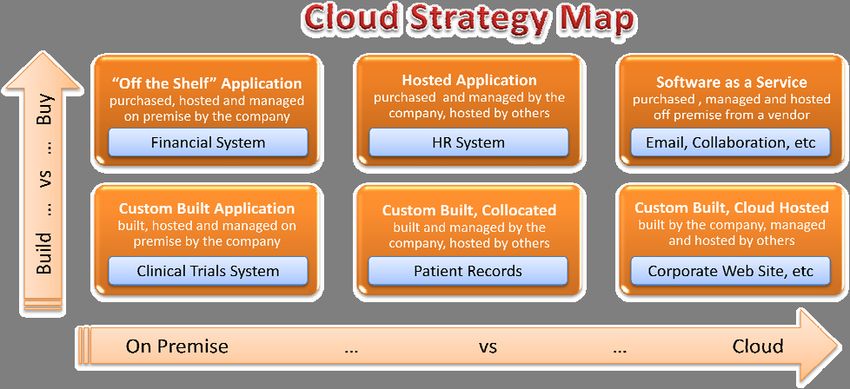
Another way to look at it would be to think about your
Assessing the landscape
applications on premise and the path you might follow toward
iv
the cloud. The cloud strategy map offers a way to see how In addition to understanding the spectrum of control and scale,
you might decide where to host and manage different types of it makes sense for companies to assess the economic,
applications. Which approach is better for your company? It competitive and business landscape ahead.
depends on a number of factors.
Companies must identify what technology investment they
But think about it this way: it’s really nothing more than the require to realize their business objectives for the long term
classic “build versus buy” decision IT has been making for while managing through short-term down cycles.
years. Buy a pre-built ERP system or build your own? The
Consider contract manufacturing. Some companies
decision about cloud is similar. The same assessment an IT
manufacture products that are commodities. They require
manager would make when deciding to build or buy
minimal research and development and involve little
applications applies to the cloud or on-premise decision.
proprietary knowledge. One product operates in much the
On the spectrum of control verses scale, where do you stand? same way as any other. So outsourcing to a contract
Consider the following: manufacturer involves low risk. But a pharmaceutical company,
© 2009 Avanade Inc. All Rights Reserved. 5Defining the Business Value of Cloud Computing Avanade® Point of View
which has highly sensitive intellectual property, faces time, it could be picked up later – quickly, with no upfront
tremendous risk with outsourcing. The product differentiation in capital expense required.
that case is incalculable. Such a company requires greater
Another example is retailing. During a peak period of activity,
control of its information, where it’s stored, and who has
like holiday selling seasons, the retailer will require more
access to it. It also requires measures to keep the data from
compute capacity and bandwidth for transaction processing or
competitors and accessible at all times.
analytics for pricing or fraud detection. Instead of purchasing
Own or outsource the needed technology and having it dormant during non-peak
seasons, the retailer could access it in the cloud, paying only
Companies should see their IT services in a similar manner.
for their actual usage.
They need to determine which of
their technologies should be: In yet another scenario, multiple
Companies can also jump off the organizations within an industry might
► Owned and managed internally,
band together to deliver a shared
► Owned internally but managed upgrade treadmill because they will be
services model in the cloud. Take credit
by a third party, licensing what they consume versus
card processing to illustrate how
► Purchased, managed, and
accessed through the cloud.
having to service what they consume. industry clouds could work. When
someone swipes a card, the credit card
With cloud computing, the burden of creating, developing and company provides a service between the retailer and the bank
sustaining the entire infrastructure unilaterally gets lifted from a to process the purchase. In this fashion retailers need not
company that may be shouldering it unnecessarily. In the worry about having a relationship with every bank that issues
cloud, companies can share the load. And if serious problems credit cards. The credit card company manages that
arise, cloud access provides opportunities that could help the relationship on their behalf. The technology underpinning this
business leverage more affordable and robust disaster trust, relationship, and transaction resides in the cloud.
recovery options.
Risks
Where are some specific areas where companies could use
In spite of all the potential benefits that cloud computing can
cloud computing?
offer, risks exist. Here are some areas that require vigilance:
One way some companies are taking advantage of the cloud is
► SLA management and major outage impact
in using short-term computing power in product development.
► Security concerns and privacy
For example, a company wants to manage a team of software
► Control of IT
developers working on a new product and wants to set up a
► Compliance
test environment for the application. Instead of buying servers,
► Viability
configuring and testing the systems and applications, the
► Integration
company simply taps a cloud service provider for instant
► Skills
access to pre-configured developer workstations as well as
unlimited testing environments. Let’s look at these factors in more detail.
This also offers the opportunity to run programs whenever and SLA management and major outage impact: Service Level
wherever the need arises. Applications could be tested, and Agreements provide a promise of reliability. In order to
tested concurrently on multiple servers in the cloud. And if a minimize risk, companies need to have SLAs even in places
company needs to shut down the project and leave it for a they wouldn’t think they needed them.
© 2009 Avanade Inc. All Rights Reserved. 6Defining the Business Value of Cloud Computing Avanade® Point of View
What happens if there is a major outage in the cloud? Processing (ADP), for example, processes confidential payroll
Outages have occurred with such cloud providers as Amazon data – including employee name, social security numbers, pay
and Google. "Enterprises are right to be cautious about relying levels and benefits information. In many cases this sharing
on such consumer/SME-oriented suppliers for anything occurs over the same network, using the same security
resembling a mission critical application or service. A spate of paradigms that are leveraged by major cloud vendors. The
service outages on the Amazon and Google platforms has difference? ADP has earned the trust of their customers, as
increased enterprise caution about the reliability of consumer- cloud providers will need to do also.
v
market-oriented cloud providers," Ovum warned. With time,
What efforts need to be made to keep company information
however, cloud users will learn how to
private? How can the data about
deal with such outages. And the fact is Cloud and Cost Savings employees, customers, partners and
that most applications don’t require Windows Azure will cost less than the overall the company be kept from prying
better than 99% availability because price of running a server internally. Azure will
eyes? Businesses must be alert to
be pay as you go. But customers can get
companies recognize few things work
discounts by prepaying. With regard to off- the possibilities of criminals and
perfectly all the time. premise pricing, take Exchange Online as an spies accessing their data.
example. It costs $10 per user per month.
Security concerns and privacy: Governments may seek information
Licensing the on-premises version of
Security issues must be weighed as Exchange Server costs users $3 for Exchange stored in the cloud as well. These
well. How will a company make sure Server per user per month. But with additional are all valid security concerns, to be
that confidential information remains
costs (including infrastructure, IT staff, addressed both on-premise and in
licensing and operational costs), Microsoft
protected? Could a company’s estimates it adds up to an average of $18 per the cloud.
proprietary data be accessed by a cloud user per month.
Control of IT: The control of IT
provider, or another cloud user, or even --Doug Hauger, Microsoft General Manager
presents another issue. Companies
worse, a competitor? Source: InformationWeek, Feb. 12, 2009, Microsoft Windows
Azure Pricing Expected Soon can’t depend on third parties to
Security takes on a new dimension in make the changes they may need;
the cloud. And how trust is envisioned may change. “Cloud “… companies will always want to keep some applications in-
services are going to create a new level of trust between end- house, for reasons of security, regulation or simply to maintain
viii
users, providers, and enterprises. There’s no way around it, control,” The Economist wrote in its report on corporate IT.
simply because there are so many moving pieces to a cloud
Portability is a risk. What if you want to bring your CRM
service that are outside our control,” said Alan Murphy in the
application back in-house? There may not be a way to get it
vi
Virtual Data Center blog.
back. Companies need a fall-back. They need to find out if
As with any business relationship, trust is a key factor: “Trust is there’s an exit strategy. Does their application model
at the heart of the resistance that many enterprise customers disconnect? Can they work during downtimes? Knowing the
vii
have with the cloud,” James Urquhart posted on CNET. options is critical to determining when and how to use the
cloud.
How comfortable companies feel in the cloud will determine
their degree of engagement, and what kind of information they Compliance: Compliance raises other questions. Who owns
will share and what services they will contract. Trust, in fact, the data? How is the data affected by being hosted in regional
has always been a factor between organizations. Many locations? What about government efforts to claim ownership
organizations share confidential data about their personnel or access to data stored on a cloud provider? As the internet
externally as part of doing business. Automatic Data became increasingly global, some governments sought to
© 2009 Avanade Inc. All Rights Reserved. 7Defining the Business Value of Cloud Computing Avanade® Point of View
control it through firewalls designed to keep certain content may have on their existing IT skills, and how they’ve
inaccessible. traditionally built and managed systems.
And there’s the issue of how all this may be affected by
The Avanade Point of View
government regulation, such as the Sarbanes-Oxley Act, and
other compliance requirements, as well as the tracking process Where do you go from here?
for regulatory reporting. How will the experience in the cloud The cloud offers companies the opportunity to improve how
allow for fast audits and the ability to respond to government they do business by re-envisioning how they utilize IT. It can
inquiries within mandated timeframes? It helps companies to help companies succeed in three critical areas.
know more about data ownership and government regulations.
► First, cloud enables companies to be more
Viability: Another factor to consider is just how viable cloud responsive. In a fast-paced, rapidly evolving global
computing will be. Who will set the standards? What providers economy, the ability to respond quickly to the needs of
will back up what they promise? Which service providers have customers, markets and opportunities represents a
staying power and resources for long term viability? Study the significant market differentiator.
track record of companies trying to make investments in the ► Second, cloud offers access to technologies that help
cloud. companies connect. This drives deeper and more
effective relationships with partners and customers.
A Gartner report on cloud computing noted the following:
► Third, cloud computing enables specialization. By
“Strategic Planning Assumption: Through 2011, less than one-
tapping technologies available as a service instead of
third of investments that vendors are making in the cloud will
pay off, causing further market consolidation and forcing some owning and managing all IT systems, companies can
providers to go out of business.”
ix invest more of their time and resources in focusing on
what truly differentiates them in the marketplace.
Integration: One factor not often considered when evaluating
cloud computing is ensuring application integration across data When considering how to enter the cloud, Avanade
centers. It’s one thing for an individual or department to recommends that organizations:
subscribe to a cloud service. But that poses significant risk of
► Explore cloud-based offerings – Think of the cloud as
creating technology and business process silos. Some cloud
one of a number of IT options. Consider maintaining
vendors provide for application integration in their offerings,
control of IT that creates competitive advantage, and
others do not. The key point companies must remember is to
assess their ability to integrate both their applications and utilizing cloud technologies for more commodity
business processes around the cloud solutions that they adopt applications. Remember, the journey to cloud is an
on and off premise. evolution.
► Pursue a pilot – take a custom application that leverages
Skills: Last, but not least, companies need to be aware of the
the instant scale, high compute, or bandwidth intensive
skills required to build applications that run in the cloud. In
capabilities of the cloud. Such a pilot can help a company
many cases, developing cloud applications require different
become more familiar and knowledgeable about cloud
technology skills than what companies may have in their IT
computing and how it can benefit them. It might also lay
staff today. When planning for the cloud, companies need to
the foundation for a private cloud infrastructure.
understand and assess the impact that cloud vendor selection
► Investigate costs – evaluate costs associated with
internal IT versus the cost of cloud services. Such cost
© 2009 Avanade Inc. All Rights Reserved. 8Defining the Business Value of Cloud Computing Avanade® Point of View
analysis will help determine if, and what, should be owned There are clear business benefits that can be derived from
and managed internally, and what could be cloud ready. cloud computing. But getting to the cloud and realizing the
► Build a roadmap – assessing your IT portfolio and which benefits of the cloud isn’t a given. It requires a clear plan,
applications or services might benefit the most from cloud sound analysis, and proven methodologies and practices.
computing is step one. Try to align your IT strategy with
As the industry goes through what some analysts believe will
your business needs. Decide how cloud computing can
be significant consolidation with cloud, it makes sense for
prepare you for the road. And find an organization that can
companies to partner with firms that have credentials, broad
spot the potholes and help you steer past the roadblocks.
application platforms and a proven track record in navigating
new and emerging technology platforms and strategies.
This Paper contains statements that may be related to the future development and direction of Avanade Inc. These statements may
represent only current plans or goals of Avanade as of the date of publication and are subject to change without notice based on our
technical and business judgment. Any reference to third party companies does not imply any involvement with or endorsement of or by
Avanade Inc. Other company, product, and service names mentioned in this document are registered trademarks or trademarks of their
respective owners.
About Avanade
Avanade provides business technology services that connect insight, innovation and expertise in Microsoft technologies to
help customers realize results. Avanade’s services and solutions help improve performance, productivity and sales for
organizations in all industries. The company provides unsurpassed Microsoft expertise through a global network of
consultants, and applies the right mix of onshore, offshore and nearshore skills to help deliver results faster, at lower cost and
with less risk. Avanade, which is majority owned by Accenture, was founded in 2000 by Accenture and Microsoft Corporation
and serves customers in more than 20 countries worldwide with more than 9,000 professionals. Additional information can be
found at www.avanade.com
i
“10 Cloud computing Predictions For 2009,” Information Week, Jan. 24, 2009
ii
“10 Cloud computing Predictions For 2009,” Information Week, Jan. 24, 2009
iii
“Predicts 2009: Cloud computing Beckons,” Gartner Research, 17 December 2008 ID Number: G00163522
iv
Source: Microsoft
v
“Ovum: Cloud computing risky for enterprise infrastructure,” The Industry Standard, 12-18-2008
vi
“Cloud Security: A New Level of Trust,” Jan. 6, 2009, Virtual Data Center blog
vii
“The biggest cloud-computing issue of 2009 is trust,” James Urquhart, http://news.cnet.com/8301-19413_3-10133487-240.htm, January 7, 2009 9:56 PM PST
viii
“Let It Rise,” The Economist, Oct. 28, 2008.
ix
“Cloud Predicts 2009: Cloud computing Beckons,” Gartner Research, 17 December 2008 ID Number: G00163522
© 2009 Avanade Inc. All Rights Reserved. 9You can also read


