DEPARTMENT OF PSYCHOLOGY - Monk Prayogshala Working Paper # 2021-02 January, 2021
←
→
Page content transcription
If your browser does not render page correctly, please read the page content below
Monk Prayogshala Working
                                  Paper # 2021-02

                                    January, 2021

HOW TO CATCH ‘EM ALL?
AN INVESTIGATION OF
PERSONALITY AND GAMEPLAY
STYLES IN POKÉMON GO

Hansika   Kapoor

Anirudh   Tagat

Sampada    Karandikar

Arunima   Ticku

                        DEPARTMENT OF
                          PSYCHOLOGY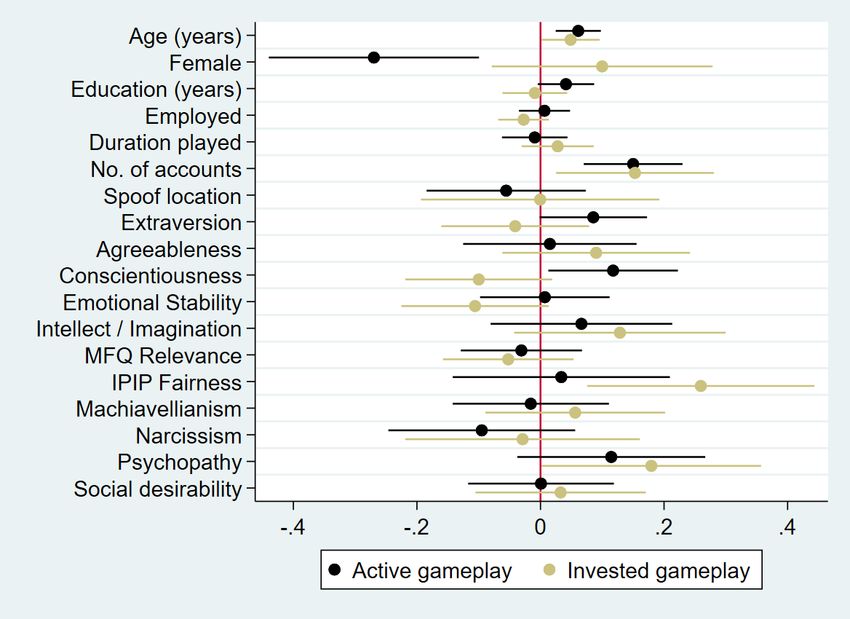
How to Catch ‘Em All? An Investigation of Personality and

                              Gameplay Styles in Pokémon GO

                                          Hansika Kapoor
                      Department of Psychology, Monk Prayogshala, Mumbai, India

                                         Anirudh Tagat
                      Department of Economics, Monk Prayogshala, Mumbai, India

                                       Samapda Karandikar
                      Department of Psychology, Monk Prayogshala, Mumbai, India

                                          Arunima Ticku
                      Department of Psychology, Monk Prayogshala, Mumbai, India

                    Address correspondence to Hansika Kapoor at hk@monkprayogshala.in

The Psychology Working Papers are a series of ongoing research outputs from the Department of Psychology, Monk®
Prayogshala®. The purpose of making these papers publicly available is to initiate dialogue and receive feedback on the
preliminary work presented. The views and opinions expressed therein are those of the authors and do not necessarily reflect
those of Monk Prayogshala, any supporting agencies, or any of its associated entities.

Monk® Prayogshala® is a Section 8 company registered under the Indian Companies Act, 2013. The contents of this
document are the Intellectual Property of Monk® Prayogshala ® (Sec. 25), a company incorporated under the provisions of
the Companies Act, 1956 and having its registered office at 4114, Oberoi Garden Estates, C Wing, Next to Chandivali
Studios, Powai, Mumbai 400 072, India. (C) Monk® Prayogshala®, 2011-2020. All rights reserved. The recipient of this
document is not permitted to copy, make available, sell, disclose, publish, disseminate or otherwise transmit the information
contained in this document without prior permission from Monk® Prayogshala®.

We are thankful to administrators and moderators of r/PokemonGO subreddit for assistance with data collection. This paper
has not been peer-reviewed; it is to be presented as a poster for the 2021 Annual Convention of the Society for Personality
and Social Psychology.
PERSONALITY AND POKÉMON GO 2
How to Catch ‘Em All? An Investigation of Personality and Gameplay
Styles in Pokémon GO
Abstract
Pokémon GO, released in 2016, is an augmented reality video game requiring players to move
around in the real world and catch Pokémon to complete their collection. As multiple self- and
other-beneficial strategies can be used to advance in the game, the present study investigated
personality and behavioral correlates of four kinds of gameplay: independent, social-dependent,
active, and invested. A multinational sample of current Pokémon GO players was recruited (N =
516, Mage = 28.83 years, SD = 9.25) and responded to measures of bright and dark personality traits,
as well as a questionnaire on Pokémon GO gameplay behaviors. Results indicated that older
players and those with multiple accounts were more likely to engage in most forms of gameplay,
whereas women were less likely to be active players. Among personality traits, psychopathy was a
strong predictor of independent, social-dependent, and invested gameplay; agreeableness
explained social-dependent strategies; conscientiousness was associated with being a regular
player; and fairness contributed to spending more money on the game (invested gameplay).
Limitations and suggestions for future research are discussed.
Keywords: augmented reality; Big Five; Dark Triad; gaming; Pokémon GOPERSONALITY AND POKÉMON GO 3
How to Catch ‘Em All? An Investigation of Personality and Gameplay Styles in Pokémon GO
Pokémon GO, a new addition to the Pokémon (short for Pocket Monsters) games, allows
you to participate in a virtually simulated scavenger hunt that takes place in real locations. With a
rating of 4.2 on Google Play Store, and a download count of 1,41,96,493 as of January 2021
(Pokémon GO – Apps on Google Play, n.d.), it has taken the gaming world by a storm. In its first
week, it became the most downloaded app in history (Clark & Clark, 2016). According to Digital
Stat, the game gained 26 million active daily users who use it for longer periods of time than
Facebook, Twitter, and Snapchat combined (Clark & Clark, 2016).
The Pokémon franchise had its inception as a gaming magazine, in the early 1980s in
Japan. This trend was the brainchild of Satoshi Tajiri, the writer, and Ken Sugimore Tajiri, the
illustrator. The logic of the game is that you start out with a single monster, with an aim
encapsulated by the tell-tale tagline of the game: “Catch ‘em all.” The game became widely
popular in Japan and eventually, in other countries. In 2016, Niantic, in collaboration with The
Pokémon Company, developed an augmented reality game based on its preceding storylines.
Pokémon GO can be played on smartphones and tablets, and uses the device’s GPS such that
your real life location is linked with the virtual location of various Pokémon. The device can then
be used to scan one’s surroundings to find a superimposed animation of a Pokémon on the screen.
The players’ aim is to capture the Pokémon into a Pokéball (Madnani, 2016).
Augmented reality games like Pokémon GO have become an important component of
people’s lives; the gaming industry had approximately two billion users worldwide in 2015, and this
number is projected to grow to over three billion users by 2023 (Number of active video gamers
worldwide from 2015 to 2023 (in billions), 2021). With researchers asserting the role of augmented
reality games as “third places,” they are being accepted widely in the forum of research on humanPERSONALITY AND POKÉMON GO 4
behavior. One such study was conducted by Colwell (2007), who suggested that such games
fulfilled the following needs: ‘companionship,’ ‘prefer to friends,’ ‘fun challenge,’ and ‘stress relief.’
Yang and Liu (2017) identified factors that contributed to motivating one to play the game: fun,
escapism, nostalgia, friendship maintenance, relationship initiation, and achievement. These
games are also shown to help players get in touch with their ideal self as it allows one to display
ideal-self characteristics during play (Przybylski et al., 2012).
Moving away from the appeal of the games, research has also addressed their impact on
one’s life, finding that playing Pokémon GO has significant correlations with higher physical
activity levels, more socialization, and better mood on the days of gameplay (Marquet et al., 2017).
Few researchers have also studied the integration of personality and Pokémon GO gameplay. For
example, Tabacchi et al. (2017) found that early users of the game were high on introversion,
agreeableness, and conscientiousness; those highly involved in the collection aspects of the game
(such as catching more Pokémon) were high on extraversion and emotional stability, but less
agreeable; and overall, one’s level of proficiency in the game was linked with openness. While
there is a dearth of research addressing the dark side of personality in the context of Pokémon
GO, few studies have linked the dark triad with problematic online gaming (POG). Specifically,
Kircaburun et al. (2018) found that while the total effect of Machiavellianism and psychopathy on
POG was not significant, the former was indirectly associated with POG via escape, competition,
and fantasy motives and the latter via competition and skill development. Further, narcissism was
linked with using online gaming facilities as a means of escape (Tang et al., 2020).
Prosocial behavior has also been observed in the online space, wherein altruism and
reciprocity play significant roles (C.-C. Wang & Wang, 2008). Some have put the onus of
cooperativeness on game features that induce we-intentions. This can be done by positively
increasing group norms, social identity, joint commitment, attitude towards cooperation, andPERSONALITY AND POKÉMON GO 5
anticipated positive emotions (Morschheuser et al., 2017). On the other hand, cheating is also
observed (Consalvo, 2005), including in Pokémon Go (Paay et al., 2018).
Research has successfully addressed various aspects of online gaming, ranging from topics
such as personality, behavior, and motivation. However, one gap in literature that warrants further
research is the interaction of personality and specific types of gameplay. Whereas previous
research has provided various insightful results regarding gameplay, certain issues remain
unaddressed. First, different personality traits can be associated with and predict different kinds of
gameplay - such as gameplay that involves playing with others, as opposed to playing by yourself.
Second, there is a dearth of research regarding how one’s personality translates to self- or other-
beneficial gameplay. This study also intends to examine the darker side of personality in the
context of augmented reality gaming behavior. The links between personality and gameplay have
been explored, and the existence of self- and other-beneficial gameplay has been established. The
present research is proposed to fill this gap in literature by analyzing the gameplay styles and
personality correlates of Pokémon GO (PoGo) players. This game was selected due to the
diversity and latitude in gameplay that is afforded to its players, wherein individuals with different
social preferences can choose to interact with and continue playing the game without significant
hindrances to progress.
Thus, the current study aims to investigate:
RQ: Which personality factors are related to specific PoGo gameplay behaviors involving other
people versus playing by yourself?
In addition to self- and other-beneficial gameplay styles, we also considered active
(regular) and invested styles; the latter involved behaviors like spending real money to buy in-
game items.PERSONALITY AND POKÉMON GO 6
Method
Participants and Procedure
Data were collected online using multiple-site entry methods (Reips, 2002) via Qualtrics.
Participants were invited from popular forums where PoGo players interact, such as the subreddit
r/pokemongo as well as social networking sites. A total of 516 individuals (208 women, 289 men, 18
gender unspecified; Mage = 28.83 years, SD = 9.25, range: 18–86) from 40 countries participated in
the study (about 54% from the USA). Approximately 74% of all participants reported completing
at least a high school degree, and 54% were currently employed while 26% were currently students.
Participants were required to be over the age of 18 years and current Pokémon GO players; no
other exclusion criteria were applied.
Measures
Pokémon GO Gameplay
Participants answered questions pertaining to the duration for which they had been playing
PoGo, and how many accounts they had. Thereafter, they responded to 34 items describing
various gameplay behaviors and noted the frequency of engaging in each behavior in the past 6
months on a scale of 1 = not at all to 5 = very often (Appendix A). Nine items measured
independent gameplay (e.g., “How often do you raid by yourself?”); twelve assessed social-
dependent gameplay (e.g., “How often do you battle with other trainers?”); seven were indicators
of active gameplay (e.g., “How often do you get your 7-day Research Breakthrough?”); and 3
items were indicators of invested gameplay (e.g., “How often do you spend real money to buy
items from the In-Game Shop?). The scales were internally consistent: independent ɑ = .81; social-
dependent ɑ = .81; active ɑ = .82; and invested ɑ = .75. Composite indicators of independent,PERSONALITY AND POKÉMON GO 7
social-dependent, regular, and invested gameplay were computed and used in subsequent
analyses.
International Personality Item Pool (IPIP)
The Big Five factors of extraversion, agreeableness, conscientiousness, emotional stability,
and intellect/imagination were measured through the IPIP 50-item scale, in its 5-point Likert
format (Goldberg et al., 2006; 1 = very inaccurate to 5 = very accurate). The internal consistency of
the scales was high: extraversion ɑ = .91; agreeableness ɑ = .82; conscientiousness ɑ = .83;
emotional stability ɑ = .89; and intellect/imagination ɑ = .77.
Values in Action - Fairness (VA-fairness; Peterson & Seligman, 2004)
This scale comprised 9 items assessing the extent to which individuals consider justice to
be an important value that can be applied to themselves, assessed on a 5-point Likert scale (1 =
very inaccurate to 5 = very accurate); the scale was internally consistent, ɑ = .74.
Short Dark Triad (SD3)
This 27-item measure (Jones & Paulhus, 2014) was administered to assess the dark
personality traits of narcissism, Machiavellianism, and psychopathy. Participants rated the extent to
which they agreed with the items on a 5-point Likert scale (1 = disagree strongly to 5 = agree
strongly); the scales had good internal consistency: narcissism ɑ = .70; Machiavellianism ɑ = .76;
psychopathy ɑ = .72.
The Balanced Inventory of Desirable Responding Short Form (BIDR-16; Hart et al.,
2015)
This 16-item scale assessed whether participants were responding in a socially desirable
manner, on a 7-point Likert scale (1 = strongly disagree to 7 = strongly agree). The BIDR was
internally consistent, ɑ = .76.
Moral Foundations Questionnaire (MFQ; Graham et al., 2011)PERSONALITY AND POKÉMON GO 8
The MFQ is based on the Moral Foundations Theory (Graham et al., 2013), which
proposes that humans are guided by five universal moral pillars: care, fairness, loyalty, authority,
and purity. In this study, six items pertaining to the Fairness foundation were used to assess the
overall concern of participants towards being fair to others. Three items required participants to
indicate the relevance of certain considerations (e.g., whether or not someone acted unfairly) in
deciding whether something was right or wrong on a 6-point Likert scale (0 = not at all relevant; 5 =
extremely relevant). Three items assessed moral judgments of fairness (e.g., “Justice is the most
important requirement for a society), on a 6-point Likert scale (0 = strongly disagree; 5 = strongly
agree). The moral relevance scale was internally consistent, ɑ = .74, whereas the moral judgements
scale was not, ɑ = .44. Therefore, the latter scale was not used in subsequent analyses.
Results
Table 1 displays the descriptive statistics of the gameplay indices and psychometric
instruments used. Gender differences between men and women indicated that women were more
agreeable, whereas men were more emotionally stable, had higher Dark Triad traits, and were
more likely to be regular PoGo players. Table 2 displays correlations between types of gameplay
and personality/behavioral measures. Multiple hierarchical linear regressions were used to assess
the influence of demographics and personality on various types of Pokémon GO gameplay:
demographics (Step 1: age, gender, education, employment); PoGo characteristics (Step 2:
duration played, number of accounts, falsifying or ‘spoofing’ location); personality (Step 3: Big
Five); and behavior and personality (Step 4: MFQ fairness, VA fairness, Dark Triad, social
desirability); all regressions included country fixed effects to account for any location-specific
differences. Results of the full models are displayed in Table 3.PERSONALITY AND POKÉMON GO 9
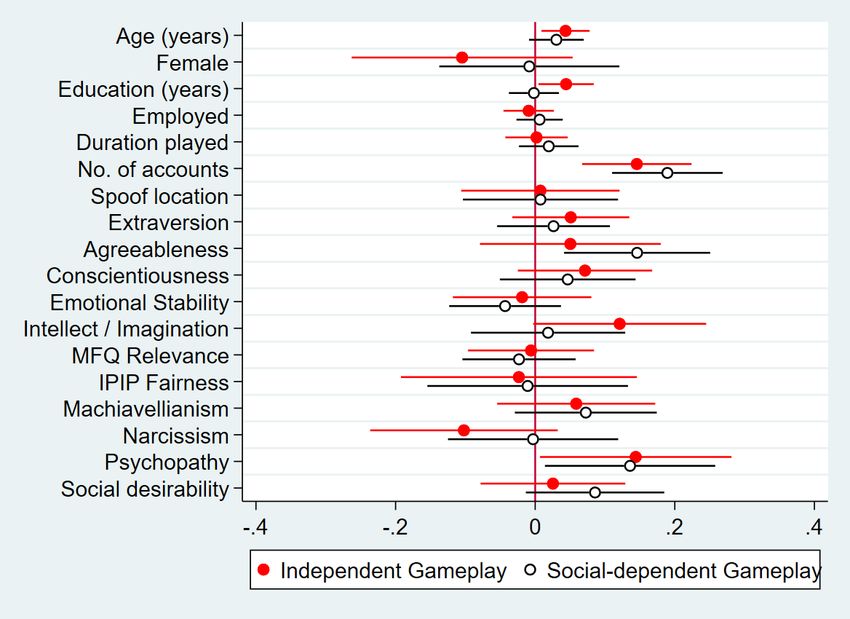
The combination of demographic characteristics and personality-behavior variables
explained about 21% of variance in independent gameplay, about 31% of variance in social-
dependent gameplay, and 23% of variance each in active and invested gameplay. Being older and
more educated predicted playing independently; women were less likely to be active players as
compared to men; but being older predicted more active and invested gameplay. Having more
accounts predicted all types of PoGo gameplay positively. Among personality traits,
agreeableness predicted social-dependent gameplay; conscientiousness contributed to more
active gameplay; and fairness predicted more invested gameplay. Psychopathy explained variance
in all types of PoGo gameplay, except active gameplay, indicating that this may be a consistent
personality trait among PoGo trainers (see also Figures 1 and 2).
Discussion
Pokémon GO is a novel and dynamic game worth examining within personality and
behavioral contexts, in particular on account of it being an augmented-reality (AR) game that
overlays gameplay on the real world. Furthermore, the game allows individuals with diverse
personalities to interact with and presumably enjoy playing the game, in the process accumulating
XP (Experience Points) and levelling up. In terms of the ultimate stated aim of the game (‘Gotta
catch em all,’ referring to having a collection of all unique Pokémon), it is possible that players
benefit from interaction and cooperative gameplay. Indeed, there is no one behavior or strategy
that enables progressing through the game, but various combinations of gameplay that can be
beneficial to oneself or others, sometimes even in equal measure. Although much of the research
on this augmented reality game has been done with reference to impacts on physical activity (e.g.,
Howe et al., 2016; Nigg et al., 2017), the present study examined personality and behavioral
characteristics of PoGo trainers. Specifically, we aimed to understand the contribution of differentPERSONALITY AND POKÉMON GO 10
bright (Big Five, fairness) and dark personality traits (Dark Triad) toward four types of PoGo
gameplay styles.
In general, older players were more likely to play the game independently, actively, and
spend money on the game. This is consistent with research indicating how childhood brand
nostalgia (of the Pokémon brand) can influence intentions to play PoGo as an adult (Harborth &
Pape, 2020). Similarly, nostalgia was a prominent motivator to play Pokémon GO (Yang & Liu,
2017; Zsila et al., 2018). Women were less likely to engage in active and regular gameplay, in line
with earlier work (Zsila et al., 2018). In addition, gameplay in Pokémon GO is largely driven by
registering for and operating a single account, but players may create and use multiple accounts,
potentially each belonging to a different team (notably this is against Niantic’s terms of service;
Niantic, 2019). A greater number of PoGo accounts was associated with a higher likelihood of all
forms of gameplay; multiple accounts were also positively related to cheating in the game, like
spoofing one’s location (see also Paay et al., 2018).
Among personality variables, higher levels of psychopathy were observed among players
who engaged in independent, social-dependent, and invested gameplay. Psychopathic individuals
exhibit traits of callousness, manipulation, deceit, and thrill-seeking. Such individuals are also
impulsive in their actions; however, past research has indicated that impulsivity was not related to
motives to play PoGo (Zsila et al., 2018). Alloway and Carpenter (2020), for example, found that
playing Pokémon GO had no effect on empathy (which is closely linked to psychopathic traits),
on account of the realism the game offers as well as the different styles of gameplay that one
could use to progress through the game. It is also important to note that among gameplay
behaviors involving battling or raiding, psychopathy was strongly and positively correlated with
battling other trainers (r = .13, p = .003, Bonferroni-corrected). This is argued to be one of the
more confrontational aspects of the game where players combat with each other to gain rewards.PERSONALITY AND POKÉMON GO 11
Although it would be misleading to term PoGo as a violent videogame, past literature has
identified associations between psychopathy and aggressive gameplay (e.g., Walther et al., 2012).
Despite the influence of dark traits, agreeableness played an important role in contributing
to social-dependent gameplay. To successfully engage in gameplay that is dependent on others,
one may have to necessarily be more pleasant and friendly, suggesting a dual role of bright and
dark dispositional traits affecting PoGo gameplay. This aspect is underscored by other work on
Pokémon GO that suggests greater interaction with others is central to the gameplay (Aal &
Hauptmeier, 2020; Hamari et al., 2019). For instance, one aspect of social-dependent gameplay is
coordinating with other trainers to organize ‘raids,’ with a powerful Pokémon as a reward
(Baranowski & Lyons, 2020; Bhattacharya et al., 2019). However, organizing more players for a
raid serves a dual purpose: one’s own gain (XP, other rewards), but also that of others. Thus, it is
important to be able to engage effectively with other trainers, particularly as the largest XP
rewards come in the form of upgrading friendship levels and raids (with more difficult raids
requiring more players guaranteeing higher XP and rewards). In terms of being a regular and
active player, conscientiousness contributes to gameplay behaviors like getting streaks and walking
regularly to achieve more in-game rewards. Last, fairness was associated with more invested
gameplay, indicating that some considered spending real money to purchase in-game items as
being an above-board means to progress in the game, as compared to cheating (Internicola &
Thomasen, 2017; Paay et al., 2018). This means that invested gameplay could be perceived as a
fair way to progress through the game, consistent with work on similarly modeled ‘freemium’
games (L. Wang et al., 2020).
Limitations and Future ResearchPERSONALITY AND POKÉMON GO 12
To the best of the authors’ knowledge, this was the first study to examine different
categories of Pokémon GO gameplay that may be associated with different personality and
behavioral characteristics. However, the investigation was not without limitations. First, we were
unable to capture any information about trading within PoGo, which is a primary way to interact
with other players. Future research can assess how specific preferences for trading can be
associated with different personality and behavioral features. Second, the data was collected
between May and July 2020, amidst the COVID-19 pandemic and at a time when the game was
undergoing changes to permit gameplay from home. However, the instructions specifically
required participants to respond on the basis of their regular gameplay experience and not with
reference to the past few weeks. Third, we did not have information on existing and active
communities within which gameplay was coordinated and communicated. For instance, some
cities and districts have PoGo communities on Facebook or Discord to coordinate social aspects
of gameplay. Future research can consider including information on the same to increase the
richness of interpretations drawn from the data.
In sum, considering the significant role played by psychopathy in Pokémon GO gameplay,
it is recommended to examine this trait and its categorizations of primary and secondary
psychopathy in explaining specific gaming behaviors. Understanding the association between
these traits and gameplay may also better situate work on mental health benefits (e.g. lower
anxiety) associated with gameplay in the past.PERSONALITY AND POKÉMON GO 13
References
Aal, K., & Hauptmeier, H. (2020). Pokémon GO: Collaboration and information on the go.
ECSCW 2019 - Proceedings of the 17th European Conference on Computer Supported
Cooperative Work. https://doi.org/10.18420/ecscw2019_ep04
Alloway, T. P., & Carpenter, R. (2020). Gotta catch ‘em all: Exploring the use of Pokémon Go to
enhance cognition and affect. Psychology of Popular Media.
https://doi.org/10.1037/ppm0000283
Baranowski, T., & Lyons, E. J. (2020). Scoping review of Pokémon Go: Comprehensive
assessment of augmented reality for physical activity c hange. Games for Health Journal, 9(2),
71–84. https://doi.org/10.1089/g4h.2019.0034
Bhattacharya, A., Windleharth, T. W., Ishii, R. A., Acevedo, I. M., Aragon, C. R., Kientz, J. A., Yip,
J. C., & Lee, J. H. (2019). Group interactions in location-based gaming: A case study of
raiding in Pokémon Go. Conference on Human Factors in Computing Systems - Proceedings,
1–12. https://doi.org/10.1145/3290605.3300817
Clark, A. M., & Clark, M. T. G. (2016). Pokemon Go and research: Qualitative, mixed methods
research, and the supercomplexity of interventions. International Journal of Qualitative
Methods, 15. https://doi.org/10.1177/1609406916667765
Colwell, J. (2007). Needs met through computer game play among adolescents. Personality and
Individual Differences, 43(8), 2072–2082. https://doi.org/10.1016/j.paid.2007.06.021
Consalvo, M. (2005). Gaining advantage: How videogame players define and negotiate cheating.
Digital Games Research Conference.
Goldberg, L. R., Johnson, J. A., Eber, H. W., Hogan, R., Ashton, M. C., Cloninger, C. R., &
Gough, H. G. (2006). The international personality item pool and the future of public-
domain personality measures. Journal of Research in Personality, 40(1), 84–96.PERSONALITY AND POKÉMON GO 14
https://doi.org/10.1016/j.jrp.2005.08.007
Graham, J., Haidt, J., Koleva, S., Motyl, M., Iyer, R., Wojcik, S. P., & Ditto, P. H. (2013). Moral
Foundations Theory: The Pragmatic Validity of Moral Pluralism. Advances in Experimental
Social Psychology, 47, 55–130. https://doi.org/10.1016/B978-0-12-407236-7.00002-4
Graham, J., Nosek, B. A., Haidt, J., Iyer, R., Koleva, S., & Ditto, P. H. (2011). Mapping the moral
domain. Journal of Personality and Social Psychology, 101(2), 366–385.
https://doi.org/10.1037/a0021847
Hamari, J., Malik, A., Koski, J., & Johri, A. (2019). Uses and gratifications of Pokémon Go: Why
do people play mobile location-based augmented reality games? International Journal of
Human-Computer Interaction, 35(9), 804–819.
https://doi.org/10.1080/10447318.2018.1497115
Harborth, D., & Pape, S. (2020). How nostalgic feelings impact Pokémon Go players–integrating
childhood brand nostalgia into the technology acceptance theory. Behaviour and Information
Technology, 39(12), 1276–1296. https://doi.org/10.1080/0144929X.2019.1662486
Hart, C. M., Ritchie, T. D., Hepper, E. G., & Gebauer, J. E. (2015). The Balanced Inventory of
Desirable Responding Short Form (BIDR-16). SAGE Open, 5(4).
https://doi.org/10.1177/2158244015621113
Howe, K. B., Suharlim, C., Ueda, P., Howe, D., Kawachi, I., & Rimm, E. B. (2016). Gotta catch’em
all! Pokémon GO and physical activity among young adults: Difference in differences study.
BMJ (Online), 355, i6270. https://doi.org/10.1136/bmj.i6270
Internicola, D., & Thomasen, M. (2017). Playing Pokemon GO from the couch. Aalborg University.
Jones, D. N., & Paulhus, D. L. (2014). Introducing the short Dark Triad (SD3): a brief measure of
dark personality traits. Assessment, 21(1), 28–41. https://doi.org/10.1177/1073191113514105
Kircaburun, K., Jonason, P. K., & Griffiths, M. D. (2018). The Dark Tetrad traits and problematicPERSONALITY AND POKÉMON GO 15
online gaming: The mediating role of online gaming motives and moderating role of game
types. Personality and Individual Differences, 135(June), 298–303.
https://doi.org/10.1016/j.paid.2018.07.038
Madnani, M. (2016). A brief history of Pokémon. Livemint.
https://www.livemint.com/Sundayapp/Z7zHxltyWtFNzcoXPZAbjI/A-brief-history-of-
Pokmon.html
Marquet, O., Alberico, C., Adlakha, D., & Hipp, J. A. (2017). Examining motivations to play
Pokémon GO and their influence on perceived outcomes and physical activity. JMIR Serious
Games 2017;5(4):E21 Https://Games.Jmir.Org/2017/4/E21/, 5(4), e21.
https://doi.org/10.2196/GAMES.8048
Morschheuser, B., Riar, M., Hamari, J., & Maedche, A. (2017). How games induce cooperation? A
study on the relationship between game features and we-intentions in an augmented reality
game. Computers in Human Behavior, 77, 169–183. https://doi.org/10.1016/j.chb.2017.08.026
Niantic. (2019). Niantic Terms of Service. https://nianticlabs.com/terms/en/
Nigg, C. R., Mateo, D. J., & An, J. (2017). Pokémon GO may increase physical activity and
decrease sedentary behaviors. American Journal of Public Health, 107(1), 37–38.
https://doi.org/10.2105/AJPH.2016.303532
Number of active video gamers worldwide from 2015 to 2023 (in billions). (2021). Statistica.
https://www.statista.com/statistics/748044/number-video-gamers-world/#:~:text=While
there were almost two,three billion gamers by 2023.&text=The Asia Pacific region is,the
global video gaming industry
Paay, J., Kjeldskov, J., Internicola, D., & Thomasen, M. (2018). Motivations and practices for
cheating in Pokémon Go. MobileHCI 2018 - Beyond Mobile: The Next 20 Years - 20th
International Conference on Human-Computer Interaction with Mobile Devices and Services,PERSONALITY AND POKÉMON GO 16
Conference Proceedings, 1–13. https://doi.org/10.1145/3229434.3229466
Peterson, C., & Seligman, M. E. P. (2004). Character strengths and virtues: A handbook and
classification. American Psychological Association and Oxford University Press.
Pokémon GO – Apps on Google Play. (n.d.). Retrieved February 20, 2020, from
https://play.google.com/store/apps/details?id=com.nianticlabs.pokemongo&hl=en_IN
Przybylski, A. K., Weinstein, N., Murayama, K., Lynch, M. F., & Ryan, R. M. (2012). The ideal self
at play: The appeal of video games that let you be all you can be. Psychological Science,
23(1), 69–76. https://doi.org/10.1177/0956797611418676
Reips, U.-D. (2002). Standards for internet-based experimenting. Experimental Psychology, 49(4),
243–256. https://doi.org/10.1026//1618-3169.49.4.243
Tabacchi, M. E., Caci, B., Cardaci, M., & Perticone, V. (2017). Early usage of Pokémon Go and its
personality correlates. Computers in Human Behavior, 72, 163–169.
https://doi.org/10.1016/j.chb.2017.02.047
Tang, W. Y., Reer, F., & Quandt, T. (2020). The interplay of gaming disorder, gaming
motivations, and the Dark Triad. Journal of Behavioral Addictions, 9(2), 491–496.
https://doi.org/10.1556/2006.2020.00013
Walther, B., Morgenstern, M., & Hanewinkel, R. (2012). Co-occurrence of addictive behaviours:
Personality factors related to substance use, gambling and computer gaming. European
Addiction Research, 18(4), 167–174. https://doi.org/10.1159/000335662
Wang, C.-C., & Wang, C.-H. (2008). Helping others in online games: Prosocial behavior in
cyberspace. CyberPsychology & Behavior, 11(3), 344–346.
https://doi.org/10.1089/cpb.2007.0045
Wang, L., Gao, Y., Yan, J., & Qin, J. (2020). From freemium to premium: the roles of
consumption values and game affordance. Information Technology and People.PERSONALITY AND POKÉMON GO 17
https://doi.org/10.1108/ITP-10-2019-0527
Yang, C. C., & Liu, D. (2017). Motives matter: Motives for playing Pokémon Go and implications
for well-being. Cyberpsychology, Behavior, and Social Networking, 20(1), 52–57.
https://doi.org/10.1089/cyber.2016.0562
Zsila, Á., Orosz, G., Bőthe, B., Tóth-Király, I., Király, O., Griffiths, M., & Demetrovics, Z. (2018).
An empirical study on the motivations underlying augmented reality games: The case of
Pokémon Go during and after Pokémon fever. Personality and Individual Differences, 133, 56–
66. https://doi.org/10.1016/j.paid.2017.06.024PERSONALITY AND POKÉMON GO 18
Table 1
Summary Statistics
Overall Male Female
Variable Mean SD Mean SD Mean SD t-test
Duration played 3.07 1.24 3.10 1.22 3.03 1.27 0.66
No. of accounts 1.35 0.76 1.41 0.84 1.27 0.62 2.01
Spoof location 1.14 0.55 1.15 0.58 1.12 0.51 0.64
Extraversion 2.70 0.91 2.79 0.91 2.57 0.89 2.51
Agreeableness 3.87 0.62 3.76 0.63 4.02 0.58 -4.55***
Conscientiousness 3.37 0.70 3.35 0.69 3.39 0.72 -0.48
Emotional Stability 2.91 0.83 3.10 0.83 2.66 0.77 5.68***
Intellect / Imagination 3.84 0.55 3.85 0.57 3.84 0.53 0.09
MFQ Fairness 5.00 0.79 4.91 0.85 5.11 0.70 -2.65
VA-Fairness 4.13 0.52 4.08 0.53 4.20 0.49 -2.38
Machiavellianism 3.02 0.70 3.14 0.71 2.85 0.65 4.80***
Narcissism 2.56 0.64 2.70 0.63 2.36 0.61 6.07***
Psychopathy 2.08 0.65 2.25 0.63 1.85 0.59 7.25***
Social desirability 4.00 0.77 4.04 0.77 3.94 0.77 1.46
Independent Gameplay 3.76 0.64 3.81 0.63 3.69 0.66 2.07
Social Gameplay 2.68 0.62 2.73 0.65 2.62 0.58 2.04
Active Gameplay 3.96 0.73 4.06 0.70 3.81 0.74 3.92***
Invested Gameplay 1.89 0.82 1.83 0.80 1.99 0.84 -2.13
Observations 497 289 208
Note: Bonferroni corrections applied to p-values, *** p < .002.PERSONALITY AND POKÉMON GO 19
Table 2
Zero-order correlations between gameplay styles and personality/behavior variables
1 2 3 4 5 6 7 8 9 10
1.Duration played 1
2. No. of accounts 0.03 1
3. Spoof location -0.03 0.14*** 1
4. Extraversion 0.07 0.08 0.06 1
5. Agreeableness 0.06 0.01 0.02 0.29*** 1
6. Conscientiousness 0.07 -0.02 -0.06 0.10** 0.18*** 1
7. Emotional Stability 0.08 0.02 0.03 0.20*** 0.07 0.29*** 1
8. Intellect / Imagination 0.03 0.00 0.03 0.29*** 0.28*** 0.18*** 0.09 1
9. MFQ Relevance 0.06 0.01 -0.04 0.07 0.27*** 0.03 -0.09** 0.22*** 1
10. IPIP Fairness 0.07 -0.06 0.03 0.06 0.49*** 0.35*** 0.22*** 0.25*** 0.25*** 1
11. Machiavellianism 0.00 0.05 0.12*** -0.09 -0.30*** -0.15*** -0.18*** -0.11** -0.02 -0.37***
12. Narcissism 0.04 0.08 0.10** 0.64*** 0.09** 0.08 0.21*** 0.27*** -0.07 -0.03
13. Psychopathy 0.03 0.15*** 0.09 0.13*** -0.30*** -0.27*** -0.21*** -0.09** -0.14*** -0.37***
14. Social desirability 0.00 -0.03 -0.04 0.19*** 0.15*** 0.40*** 0.52*** 0.16*** -0.01 0.44***
15. Independent Gameplay 0.04 0.19*** -0.02 0.13*** 0.05 0.10** 0.04 0.16*** 0.02 0.00
16. Social Gameplay 0.08 0.31*** 0.05 0.17*** 0.11** 0.06 0.01 0.07 -0.04 0.06
17. Active Gameplay 0.02 0.18*** -0.07 0.14*** 0.02 0.13*** 0.09** 0.12*** -0.03 0.03
18. Invested Gameplay 0.09 0.21*** -0.01 0.02 0.11** -0.002 -0.09** 0.10** 0.04 0.11**PERSONALITY AND POKÉMON GO 20
11 12 13 14 15 16 17 18
1.Duration played
2. No. of accounts
3. Spoof location
4. Extraversion
5. Agreeableness
6. Conscientiousness
7. Emotional Stability
8. Intellect / Imagination
9. MFQ Relevance
10. IPIP Fairness
11. Machiavellianism 1
12. Narcissism 0.21*** 1
13. Psychopathy 0.55*** 0.33*** 1
14. Social desirability -0.38*** 0.11** -0.33*** 1
15. Independent Gameplay 0.06 0.06 0.10** 0.07 1
16. Social Gameplay 0.05 0.15*** 0.15*** 0.12*** 0.52*** 1
17. Active Gameplay -0.01 0.07 0.05 0.10** 0.74*** 0.54*** 1
18. Invested Gameplay -0.02 0.00 0.05 0.01 0.25*** 0.34*** 0.27 1
Note. *** p < .001, ** p < .01, *p < .05PERSONALITY AND POKÉMON GO 21
Table 3
Hierarchical regression analysis with personality and behavioral variables predicting gameplay styles
Gameplay Style
Social-
VARIABLES Independent Dependent Active Invested
Age (years) 0.0435* 0.0304 0.0611** 0.0488*
(0.0176) (0.0199) (0.0186) (0.0239)
Age2 -0.000422 -0.000283 -0.000699** -0.000409
(0.000222) (0.000269) (0.000226) (0.000317)
Female (Gender) -0.105 -0.00843 -0.270** 0.0998
(0.0805) (0.0656) (0.0865) (0.0909)
Prefer not to say (Gender) -0.0278 -0.243 -0.322 -0.0773
(0.214) (0.168) (0.209) (0.305)
Other (Gender) 0.0838 0.0789 -0.291 0.104
(0.190) (0.192) (0.224) (0.240)
Education (years) 0.0443* -0.00181 0.0412 -0.00907
(0.0201) (0.0182) (0.0232) (0.0267)
Employment -0.00933 0.00635 0.00650 -0.0273
(0.0184) (0.0169) (0.0210) (0.0209)
Duration Played 0.00195 0.0195 -0.00933 0.0279
(0.0227) (0.0217) (0.0270) (0.0297)
No. of accounts 0.146*** 0.189*** 0.150*** 0.153*
(0.0399) (0.0403) (0.0407) (0.0649)
Spoof location 0.00746 0.00760 -0.0555 -0.000489
(0.0577) (0.0565) (0.0655) (0.0981)
Extraversion 0.0510 0.0263 0.0855 -0.0409
(0.0426) (0.0411) (0.0442) (0.0609)
Agreeableness 0.0504 0.146** 0.0152 0.0902
(0.0659) (0.0532) (0.0714) (0.0773)PERSONALITY AND POKÉMON GO 22
Conscientiousness 0.0714 0.0466 0.118* -0.0999
(0.0489) (0.0495) (0.0534) (0.0605)
Emotional Stability -0.0187 -0.0431 0.00706 -0.106
(0.0504) (0.0407) (0.0533) (0.0607)
Intellect / Imagination 0.121 0.0185 0.0663 0.129
(0.0630) (0.0562) (0.0748) (0.0871)
MFQ Fairness -0.00596 -0.0232 -0.0309 -0.0522
(0.0459) (0.0412) (0.0499) (0.0538)
VA-Fairness -0.0234 -0.0108 0.0337 0.260**
(0.0860) (0.0731) (0.0894) (0.0935)
Machiavellianism 0.0588 0.0725 -0.0157 0.0562
(0.0576) (0.0517) (0.0643) (0.0740)
Narcissism -0.102 -0.00303 -0.0950 -0.0289
(0.0683) (0.0620) (0.0769) (0.0966)
Psychopathy 0.144* 0.136* 0.115 0.179*
(0.0698) (0.0620) (0.0774) (0.0903)
Social desirability 0.0254 0.0858 0.000837 0.0326
(0.0527) (0.0504) (0.0600) (0.0701)
Constant 0.763 -0.286 1.715** -1.513
(0.825) (0.577) (0.612) (0.866)
Observations 454 454 454 454
R-squared 0.206 0.306 0.228 0.227
Robust standard errors in parentheses
*** p < .001, ** p < .01, *p < .05PERSONALITY AND POKÉMON GO 23 Figure 1. Predictors of independent and social-dependent gameplay.
PERSONALITY AND POKÉMON GO                              24

Figure 2. Predictors of active and invested gameplay.
PERSONALITY AND POKÉMON GO                                                                    25

                              Appendix: Pokémon GO Questionnaire

     1. Please select how long you have been playing Pokémon Go in years and months:
            a. Range from 0 to 4 years
            b. Range from 1 to 12 months
     2. How many Pokémon Go accounts do you have?
            a. 1
            b. 2
            c. 3
            d. 4
            e. 5
            f. 6
            g. 7
            h. 8
            i. 9
            j. 10 or more

     3. With respect to how you play Pokémon Go, how often do you…
(Respond to these questions as per your regular gameplay experience in the past six months, not
just during the past month or week).

1 = Not at all, 2 = Rarely, 3 = Sometimes, 4 = Often, 5 = Very Often

Item No.     Item Statement                                            Gameplay Type

1            Raid by yourself                                          Independent

2            Battle with Team Leaders                                  Independent

3            Battle in gyms                                            Independent

4            Get your 7-day Pokémon Catch streak                       Independent / Active

5            Get your 7-day Pokémon Spin streak                        Independent / Active

6            Get your 7-day Research Breakthrough                      Independent / Active

7            Complete Field Research Tasks                             Independent / Active

8            Take down opposing teams’ gyms by yourself                Independent

9            Feed berries to your Pokémon in gyms                      Independent

10           Feed berries to others’ Pokémon in gyms                   -
PERSONALITY AND POKÉMON GO 26
11 Walk at least 5km per week Active
12 Walk at least 25km per week Active
13 Walk at least 50km per week Active
14 Set up lure module(s) -
15 Raid with other trainers Social
16 Raid with other trainers by actively Social
organizing/leading raids
17 Exit an ongoing raid lobby to help other trainers in a Social
new lobby
18 Take down opposing teams’ gyms with other Social
players
19 Take down opposing teams’ gyms to get coins for Social
other trainers
20 Take down opposing teams’ gyms to get coins for Social
your alternate account
21 Battle with other trainers Social
22 Participate in Trainer Battle Tournaments (e.g. Social
organized locally by Silph)
23 Trade with other trainers Social
24 Add new friends Social
25 Send gifts to friends Social
26 Open gifts from friends Social
27 Coordinate to use a lucky egg before friendship -
level ups
28 Become new friends to lower stardust cost for an -
upcoming trade
29 Spend real money to buy items from the Shop. How Invested
much money do you spend on a weekly basis
(approx. USD)?
30 Spend own money to buy items from the Shop Invested
31 Spend others' money to buy items from the Shop. If Invested
yes, how much money is this on a weekly basisPERSONALITY AND POKÉMON GO 27
(approx. USD)?
32 Spend others' money to buy items from the Shop. If Invested
yes, whose money is this?
33 Spoof your location -
34 Use third party apps to boost gameplay experience -
(e.g., Defit)
Note. Items 10, 14, 27, 28, 33 and 34 were not included in computations of gameplay styles as they
were either infrequent or irrelevant behaviors. The response to Item 33 constituted whether players
reported spoofing their location in the game.
Independent: gameplay behaviors that can be carried out individually without coordination or
support from other players
Social-dependent: gameplay behaviors that rely on interacting with others (either virtually or
physically)
Active: gameplay behaviors that indicate frequent and regular gameplay, often independent in
nature
Invested: gameplay behaviors that involve spending money on in-game itemsYou can also read


