IUCN SSC BAT SPECIALIST GROUP (BSG) RECOMMENDED STRATEGY FOR RESEARCHERS TO REDUCE THE RISK OF TRANSMISSION OF SARS-COV-2 FROM HUMANS TO BATS AMP: ...
←
→
Page content transcription
If your browser does not render page correctly, please read the page content below
IUCN SSC Bat Specialist Group (BSG) Recommended Strategy for Researchers to
      Reduce the Risk of Transmission of SARS-CoV-2 from Humans to Bats
                                      AMP: Assess, Modify, Protect
                       Living Document Version 2.0 Released 2nd July 2021
Authors v. 2.0 update: Tigga Kingston, Winfred Frick, Rebekah Kading, Stefania Leopardi, Rodrigo
Medellín, Ian H Mendenhall, Paul Racey, Julie Teresa Shapiro, Amanda Vicente-Santos, Luis
Víquez-R, Lisa Worledge.
Authors v 1.0: Germán Botto Nuñez, Andrew Cunningham, Eric Moise Bakwo Fils, Winfred Frick, Md Nurul Islam,
Tracey Jolliffe, Rebekah Kading, Andrzej Kepel, Tigga Kingston, Stefania Leopardi, Rodrigo Medellín, Ian H Mendenhall,
Stuart Parsons, Paul Racey, Danilo Russo, Julie Teresa Shapiro, Amanda Vicente-Santos, Luis Víquez-R, Thong Vu Dinh

                                                    Overview
In May 2020, the IUCN Species Survival Commission Bat Specialist Group convened a global panel
of scientists with expertise ranging from bat ecology to virology to assess the scientific evidence
for the potential of human-to-bat transmission and efficacy of risk mitigation strategies. It was the
opinion of the panel that there is a credible risk of human-to-bat transmission of SARS-CoV-2 and
the resulting Strategy (v.1.0, released in June 2020) recommended actions to reduce this risk
through “MAP: Minimizing contact with bats, Assessing the potential risk that the researcher
poses to bats and not handling or working with bats if exposure risk is high, and Protecting bats by
adopting good field hygiene practices -- using masks and gloves when handling bats, and regularly
disinfecting equipment that comes in contact with bats, and minimizing time and personnel in
contact/proximity with bats.
The panel recognises that our understanding of SARS-CoV-2 has been changing rapidly and has
continued to convene throughout 2020 and 2021. Key developments since v1.0 of the guidelines
include:
    (1) It is now known that humans can transmit SARS-CoV-2 to other animals and the
        consequences can be devastating. In at least 11 countries across Europe and North
        American, SARS-CoV-2 was transmitted to mink on farms, spread through these
        populations, and may have even been transmitted back to farm workers [1,2]. This led to a
        massive cull of millions of minks [1,2,3]. Detection of SARS-CoV-2 in free-ranging mink may
        put wildlife at even further risk [4,5]. Humans have also transmitted SARS-CoV-2 to
        domestic dogs, cats, and ferrets [6], and to zoo animals including captive gorillas, tigers,
        lions, snow leopards and puma [6].
    (2) Since the last version of this document in June 2020, laboratory studies have shown that
        Egyptian fruit bats (Rousettus aegyptiacus) can be infected by SARS-CoV-2 [7] while big
        brown bats (Eptesicus fuscus) cannot [8]. We do not currently know how susceptible any of
        the other 1400+ bat species are to SARS-CoV-2, although modelling-based analyses suggest
        that the virus could potentially infect the cells in at least three genera of bats [9].
    (3) Vaccines have become available that (a) reduce the risk of contracting COVID-19, (b)
        reduce symptoms in those who do contract COVID-19 despite being vaccinated --
        “breakthrough cases” -- and (c) may reduce spreading in breakthrough cases [10, 11, 12].

Bat Specialist Group - AMP to prevent human-bat transmission of SARS-CoV-2 Researchers v 2.0
                                                                                                                     1
However, we are still learning how long vaccines are protective and how protective they
are against new variants of SARS-CoV-2.
(4) Infection and vaccination rates around the world are increasingly diverging. This presents
different and changing levels of risk among and within countries.
(5) It is now understood that COVID-19 transmission is primarily airborne [13] via aerosols and
that face masks play a critical role in reducing viral transmission [14].
The panel continues to recognize that there is a low but credible risk of human-to-bat
transmission of SARS-CoV-2 and that this risk can be reduced using mitigation strategies, which
now also include vaccination. However, because of rising infection rates in some countries, and
accelerating vaccination rates in others, the unequal distribution of vaccines worldwide, the
emergence of variants, and uncertainties regarding the need for vaccine boosters, the distribution
of risk is geographically and temporally variable. The panel also recognizes the need for bat
research to safely resume wherever possible whilst being mindful of relevant governmental
guidance.
To this end, in our Guidelines and Recommendations v2.0 we have re-ordered and updated core
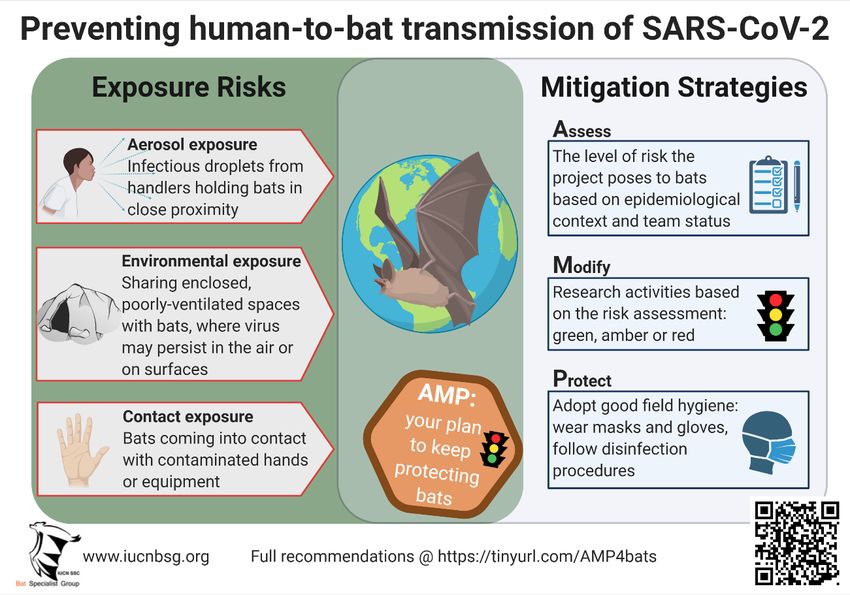
actions of the MAP strategy. We invite researchers to adopt the BSG Assess, Modify, Protect
strategy to “AMP” up the return to bat research while minimizing the risk of human-to-bat
transmission:
1. Assess the level of risk the project poses to bats based on epidemiological context and
team status.
2. Modify research activities based on risk assessment in (1).
3. Protect bats by adopting good field hygiene practices -- wearing masks and gloves when
handling bats, regularly disinfecting equipment that comes in contact with bats, and
minimizing time in contact/proximity with bats.
Bat Specialist Group - AMP to prevent human-bat transmission of SARS-CoV-2 Researchers v 2.0
2BSG Mitigation of Human-to Bat Transmission Strategy: Assess, Modify, Protect
(AMP)
(1) ASSESS the probability that you or your team might expose bats to SARS-
CoV-2 during the project.
1.1 Assess project risk category based on epidemiological context.
We ask researchers to use a traffic-light system to characterize the overall risk of any given project
as high (red), medium (amber) or low (green). Assessment should be based on the epidemiological
context and team-level vaccination status. Researchers should consult national and local
information sources about epidemiological context (some tools are provided below) and query
their team (both researchers and any support staff).
Example epidemiological tools:
• Johns Hopkins University -- International Comparison of Positivity Rates and Tests Per
Capita https://coronavirus.jhu.edu/testing/international-comparison
• University of Oxford -- https://ourworldindata.org/coronavirus
• 91-DIVOC allows interactive visualization of data from either Johns Hopkins, University of
Oxford, or both -- https://91-divoc.com/pages/covid-visualization/
We recognize there are many caveats around completeness and accuracy of reporting, but
nonetheless researchers should work to answer as many of the following questions for which data
are available, and as are needed to develop a clear perception of risk. We do not give absolute cut-
offs for high, medium, and low risk, but give examples of extremes at the time of document
preparation (June 2021).
Risk
Questions and Indicators
High Medium Low
(1) What is the epidemiological status of the research
teams’ home country or region?
(a) Indicators of COVID-19 circulation rates in the population
country include:
(i) Infection rate
High Medium Low
For example: daily (or weekly) average number of new
cases/100,000 inhabitants over a rolling time period.
e.g., Daily new confirmed cases based on a rolling 7-day
average/100,000 inhabitants as of 24 June 2021 -- highest
rates were ~ 40--143 cases/100,000 inhabitants. At peak, the
United Kingdom >88, France >83, United States >76, Germany
~30, India >28, whereas Australia ~2. (Source:
Bat Specialist Group - AMP to prevent human-bat transmission of SARS-CoV-2 Researchers v 2.0
3Risk
Questions and Indicators
High Medium Low
https://ourworldindata.org/coronavirus. Note many countries
report the 7-day incidence which is the total of the last week).
(ii) Positive-test rate
High Medium Low
For example: daily (or weekly) average share of COVID-19 tests
that are positive.
e.g., Daily positive share based on a 7-day rolling average at
peak Ukraine 50%, UK 30%, USA 20%, India 22%. Researchers
might also explore the trajectory of infection rates over time
to determine if a country is in a peak (“wave”) or decline.
(iii) Other possible indicators of epidemiological status include
Hospitalization rate High Medium Low
Fatality rate
(b) Proportion of population vaccinated
e.g., As of 24 June 2021, >40% of the US and UK population are Low Medium High
fully vaccinated, but in many nations this is < 5%.
(1) Overall rating for epidemiological risk (home) High Medium Low
(2) What is the epidemiological status of the research
country or region?
If research country or region is the same as home country or
region (1) repeat selections made in (1) here.
(a) Indicators of current COVID-19 circulation rates in the
population country include:
(i) Infection rate
High Medium Low
For example: daily (or weekly) average number of new
cases/100,000 inhabitants over a rolling time period.
(ii) Positive-test rate High Medium Low
For example: daily (or weekly) average share of COVID-19 tests
that are positive.
(iii) Other possible indicators of epidemiological status include High Medium Low
Hospitalization rate
Fatality rate
Bat Specialist Group - AMP to prevent human-bat transmission of SARS-CoV-2 Researchers v 2.0
4Risk
Questions and Indicators
High Medium Low
(b) Proportion of population vaccinated Low Medium High
(2) Overall rating for epidemiological risk (research site) High Medium Low
(3) How many members of the research team are fully None or Some All
vaccinated? a few
Fully vaccinated means completed the vaccination series and
the period to full vaccine protection has been reached.
Research team refers to people who will be in direct contact
with bats.
(4) How many of the support staff are fully vaccinated? None or Some All
a few
Fully vaccinated means completed the vaccination series and
the period to full vaccine protection has been reached.
Support staff includes field assistants, laborers, porters, field
station support etc, who will be in direct contact with the
research team.
OVERALL RISK
Based on assessments of the 4 categories: (1)
epidemiological context -- home; (2) epidemiological
context -- research site; (3) vaccination status -- research
team; (4) vaccination status -- support staff.
LOW
If 4/4 green -- LOW RISK, but measures to PROTECT bats RISK
still required. (ALL
GREEN)
HIGH
If 3 or 4 of the 4 categories are red -- HIGH RISK, adopt RISK (3
MAP strategy or 4 RED)
If 2 or less red (e.g., all amber, or 2 red + 2 green) -- RISK RISK
(1 or 2
that can be mitigated, proceed with caution.
RED)
Bat Specialist Group - AMP to prevent human-bat transmission of SARS-CoV-2 Researchers v 2.0
51.2 Regularly assess the probability that you may be shedding SARS-CoV-2 and
avoid contact with bats when infected or potentially exposed to SARS-CoV-2
All personnel (researchers, technicians, students etc.) at high risk for infection with SARS-CoV-2
should avoid any activity with bats. This includes:
● Any personnel diagnosed with COVID-19 in the last 14 days.
● Any personnel showing symptoms typical of COVID-19, such as fever above 37.5 °C /
98.6°F, cough, fatigue or anosmia (loss or reduction of the ability to smell and taste) in the
last 14 days. Additionally, runny nose and sore throat are reported symptoms of the Delta
variant.
● Any personnel with known contacts with people diagnosed with COVID-19, or people
showing typical symptoms, within the last 14 days.
● Where available, periodic screening of personnel for the shedding of SARS-CoV-2 should be
implemented to minimize the likelihood of transmission during activities and to eventually
detect possible exposure of animals, should a person be found positive within 14 days of
activities with bats.
● If traveling to the field significantly elevates exposure risk, personnel should take rigorous
steps to minimize exposure from other people wherever possible and get tested for SARS-
CoV-2 upon arrival. Alternatively, avoid fieldwork for 14 days following arrival at the field
site. Personnel should carefully self-monitor for symptoms.
(2) MODIFY research based on project and individual risk category.
Based on the traffic-light risk category identified in (1) ASSESS, researchers should consider
modifying their program as follows.
2.1 RED: High risk adopt the full MAP strategy and Minimize research through delay and replace
activities involving contact with bats with those that do not, such as acoustic surveys, emergence
counts, observational studies, or environmental samples for pathogen surveillance. If contact
projects are essential for the conservation of bats, work to reduce contact with bats by:
● Reducing the number of sites and individual bats involved in each study to the minimum
needed for valid statistical inference. Ad hoc sampling of bats, capture of bats for teaching
purposes etc., should be discouraged.
● Reducing the size of the team (including researchers, students, and other supporting
personnel) to the minimum required for the purpose of the study.
● Reducing the duration of close contact with bats may also reduce the probability of
exposure of the bats to an infectious dose of the virus.
2.2 AMBER: Risk that can be mitigated. Proceed with caution:
● Work to reduce contact with bats as above (2.1).
Bat Specialist Group - AMP to prevent human-bat transmission of SARS-CoV-2 Researchers v 2.0
6● Avoid starting new projects that require continuity of sampling.
● Fully implement PROTECT measures (see below).
● Regularly ASSESS the epidemiological context and status of individual team members.
● If possible, conduct regular antigen tests to properly assess the epidemiological risk in your
team, and follow up with PCR tests as needed (see CDC Guidance on Antigen Testing for
SARS-CoV-2).
● Avoid social contact outside the research team in the week before fieldwork, and for the
duration of fieldwork.
● Prepare exit strategies, should the risk category change to RED.
2.3. GREEN: Low risk.
● Projects resume/start.
● Fully implement PROTECT measures.
● Regularly monitor and ASSESS the epidemiological context and status of individual team
members.
● If possible, conduct regular antigen tests to properly assess the epidemiological risk in your
team.
● Have contingency strategies for any change to AMBER (or even RED) risk category.
(3) PROTECT bats by adopting practices that reduce bats’ exposure.
Several precautions can be taken to reduce animal exposure to human respiratory pathogens
(including SARS-CoV-2) during fieldwork, including:
● Avoid contact when possible: Handling time should be minimized. Whenever handling is
not required, personnel should maximize distancing from animals.
● Wear a face covering: The use of face masks should be mandatory either when handling
bats; in proximity (< 2m) to bats; or in any restricted, closed environments. [see BOX 2:
FACE COVERINGS]
● Do not blow on bats: To examine nipples, fur coloration or to break bites, use alternatives
such as blunt-ended dissecting scissors to part fur, or wash bottles with a fine nozzle to
blow air (https://en.wikipedia.org/wiki/Wash_bottle).
● Practice hand hygiene: Wash and disinfect hands before starting work, including before
touching equipment that will come into contact with the bats, and at the end of work.
● Use nitrile or latex gloves when handling bats or equipment that will come into contact
with bats. Change or disinfect gloves regularly [See BOX 3: DISINFECTANT]
Bat Specialist Group - AMP to prevent human-bat transmission of SARS-CoV-2 Researchers v 2.0
7IN PRACTICE: CHANGING or DISINFECTING GLOVES. The purpose of wearing gloves is to
protect the bat from you, specifically from contaminants on your hands. Contaminants come
from your breath, face, mask. Use common sense and self-awareness to evaluate the trade-off
between glove changes/disinfection and timely treatment of bats in nets/traps and awaiting
processing. Adjusting a face covering, touching your face, sneezing, coughing etc., can transfer
contaminants to your gloves, so it is advisable to then change or disinfect.
● Avoid touching your face: Avoid touching the face or mask/face covering during work. If
this does happen, carefully wash and disinfect hands afterwards (even in the presence of
gloves), to prevent contamination of hands (or gloves) and equipment, thus minimizing
transmission to the bat.
● Disinfect equipment: All reusable equipment including nets, containers, bags or calipers
that have been in direct contact with bats should be disinfected between uses to promote
good field hygiene [BOX 1: FIELD HYGIENE; BOX 3: DISINFECTANTS].
IN PRACTICE: CRITICAL ACTION: Clearly track all activities and the personnel involved in the
research, to have clear information on sites and bats that could have been exposed to the
pathogen, should a researcher be diagnosed with the disease.
IN PRACTICE: Field Hygiene and Personal Protective Equipment (PPE) protect you from
possible exposure to bat-borne pathogens. These guidelines focus on protecting bats from
SARS-CoV-2 borne by people, but they also provide a foundation for protecting researchers from
bat-borne pathogens. At a minimum, researchers should use gloves when handling bats, use face
coverings when in proximity, follow field hygiene practices and have dedicated field clothes [BOX
1].
BOX 1: BEST PRACTICES FOR FIELD HYGIENE
Field hygiene represents a set of best practices using standard, simple measures to minimize
the risk that research activities result in pathogen pollution, the human-facilitated moving or
transferring of pathogens between species and sites (Cunningham et al. 2003). Pathogen
pollution to new species or regions can cause severe population declines and threaten species
with regional or global extinction. For example, chytridiomycosis has been estimated to have
caused the decline of 501 amphibian species worldwide, including 90 extinctions (Scheele et al.
2019), while in North America estimates of population declines in bats caused by white-nose
syndrome (WNS) have been over 90% for some species (Cheng et al. 2021). Impacts of deadly
pathogens on wildlife have raised awareness of the importance of field hygiene for researchers
to ensure that our activities do not cause unintended harm. Research conditions are context-
dependent, and our guidance represents general and basic best practices for field hygiene
for standard bat survey work involving capture and handling of bats. Special
considerations and needs should be developed with your institutional guidance on environmental
health and safety protocols.
Before Fieldwork:
● Check with your institution regarding animal care and use protocols, permits, and
develop a field safety and hygiene protocol
Bat Specialist Group - AMP to prevent human-bat transmission of SARS-CoV-2 Researchers v 2.0
8BOX 1: BEST PRACTICES FOR FIELD HYGIENE
● Become familiar with the region where you will be conducting fieldwork, and if any
special considerations have to be taken into account regarding risks and threats to and
from bats (e.g., WNS in North America, Nipah in south and southeast Asia, etc.).
● Field safety and hygiene protocols specific to bat research should include up-to-date
vaccinations and titers for rabies and vaccinations for SARS-CoV-2. Be aware that
vaccination schemes may take months to implement, plan accordingly.
● Recommended basic field hygiene supplies for bat research include:
○ Spray bottle with 70% ethanol for cleaning gear and surfaces.
○ Containers for disposal of gloves, sharps, or other contaminated materials.
● Basic PPE considerations for capture and basic handling of bats include:
○ Gloves (leather gloves for large bats, nitrile for small bats and non-handling
hand). Disinfect leather gloves that are too large to fit under nitrile gloves. Helpful
tip: Black nitrile gloves are a better color for photos. Nitrile gloves are more
resistant than latex gloves.
○ Face coverings to reduce respiratory transmission. Best practices include FFP3,
FFP2, N95 and KN95 facial masks. When these options are unavailable, surgical
masks can be used as they provide comparable protection for the bats (but lower
protection for the researchers). Dual-layer cloth masks or face covers (covering
the mouth and nose) can be substituted for surgical masks in countries or
situations where respirators or surgical masks are not available. Materials used
as a filter should allow unobstructed breathing, should not saturate with moisture
easily and not extrude fibers or other materials that might be inhaled. DO NOT
USE VALVED MASKS. The valve is allowing the exhalation of unfiltered breath.
○ Dedicated field clothes (long-sleeve shirt and pants/trousers)
Activities such as preparing specimens, taking blood or tissue samples, entering caves
require additional PPE, safety and field hygiene practices.
During Fieldwork:
Basic* field hygiene considerations include:
● Separate your spaces: Do not eat, drink or smoke in the proximity of bats or on the
same surfaces where you are handling bats.
● Designate a field member to be the “field hygiene monitor”, and make sure everyone in
the team understands the field protocol.
● Do a daily symptom check with all staff prior to handling bats.
● Do not handle animals if you are feeling ill.
● Only trained personnel with up-to-date SARS-CoV-2 and rabies vaccinations should
handle bats.
● Disinfect surfaces and equipment used to process bats with 70% ethanol or equivalent
as often as possible [see BOX 3].
● Wash or sanitize your hands as often as possible: before and after using gloves, before
and after bathroom visits, and during breaks.
● Avoid touching your face with your gloves.
● Do NOT eat while wearing gloves.
● Correctly put on, remove, and dispose of any PPE (gloves, masks, etc). Guidance is here
for: gloves, masks, full PPE.
● Place bats individually in bags.
Bat Specialist Group - AMP to prevent human-bat transmission of SARS-CoV-2 Researchers v 2.0
9BOX 1: BEST PRACTICES FOR FIELD HYGIENE
*Activities such as preparing specimens, taking blood or tissue samples, entering caves
require additional PPE, safety, and field hygiene practices.
Post Fieldwork:
● Disinfect your field and personal equipment at the end of a research expedition and
before moving between field sites, regions, countries, and continents [See BOX 3].
● Properly dispose of biohazard waste (materials contaminated with blood, urine and/or
feces, used gloves, and sharps) following local government guidelines.
Literature Cited
Cheng et al. 2021 The scope and severity of white-nose syndrome on hibernating bats in North
America. Conservation Biology. https://doi.org/10.1111/cobi.13739
Cunningham et al. 2003. Pathogen pollution: defining a parasitological threat to biodiversity
conservation. Journal of Parasitology 89 (Suppl.) pp S78-83.
Scheele et al. 2019. Amphibian fungal panzootic causes catastrophic and ongoing loss of
biodiversity. Science 363:1459-1463. https://doi.org/10.1126/science.aav0379
Useful References:
CDC Guidance on PPE: https://www.cdc.gov/hai/pdfs/ppe/ppe-sequence.pdf
BOX 2: FACE COVERINGS TO REDUCE RESPIRATORY TRANSMISSION.
Best practices include FFP3, FFP2, N95 and KN95 facial masks.
When these options are unavailable, surgical masks could be used as they provide comparable
protection for the bats (but lower protection for the researchers). Dual-layer cloth masks or face
covers (covering the mouth and nose) could be used in substitution of surgical masks, in
countries or situations where respirators or surgical masks are not available, to reduce exposure
to the bats.
Materials used as a filter should allow unobstructed breathing, should not saturate easily with
moisture and not extrude fibers or other materials that might be inhaled.
DO NOT USE VALVED MASKS. This valve is allowing the exhalation of unfiltered breath.
To be efficient, respirators such as N95 and FFP3 require proper fitting.
Useful References:
Leung, N.H.L., Chu, D.K.W., Shiu, E.Y.C. et al. Respiratory virus shedding in exhaled breath and
efficacy of face masks. Nat Med 26, 676–680 (2020). https://doi.org/10.1038/s41591-020-0843-2
World Health Organization advice and technical guidance on fabric face mask use:
https://www.who.int/emergencies/diseases/novel-Coronavirus-2019/advice-for-public/when-and-
Bat Specialist Group - AMP to prevent human-bat transmission of SARS-CoV-2 Researchers v 2.0
10how-to-use-
masks?gclid=Cj0KCQjwz4z3BRCgARIsAES_OVcnx_86KIf0myAISrkQGgXJN2z39ttRnr52vMTp
8QxX-q3DuyWgffAaAtIrEALw_wcB
BOX 3. DISINFECTANT RECOMMENDATIONS
Cleaning and disinfecting skin, clothes and equipment are necessary to minimize exposure of
bats and humans to pathogens. Disinfection agents should be broadly effective, acting against a
wide spectrum of microbes, be non-irritant to skin, and be applied/used according to
manufacturer’s instructions.
Prior to handling bats, researchers should ensure that all equipment has been disinfected. The
tables below are not an all-inclusive list of available disinfectants, but represent
recommendations from the Government of Western Australia (Department of Biodiversity,
Conservation and Attractions SOP Managing Disease Risk in Wildlife Management) and the
United States Fish and Wildlife Service White Nose Syndrome decontamination protocols. There
are several additional resources on disinfectants listed at the end of this document.
(1) Skin and gloves (external use only)
Name of agent Concentration Usage Concern
Alcohol-based hand 70-90% Rub on hands May dry skin and
rubs and sprays irritate open wounds
F10 SC veterinary 1:100 dilution in Spray on
disinfectant (liquid or water hands/gloves and rub
gel) for >30 seconds
Povidone iodine Comes as 10% Apply to skin Eye irritation
(Betadine) concentration
Dilute Chlorhexidine Use according to Less effective on
(Savlon or Hibitane) manufacturer’s bacteria and
instructions ineffective in
presence of organic
material
(2) Submersible clothing and equipment e.g., bat bags, mist nets, harp trap bags.
Mist nets: Disinfect nets for 10 minutes, rinse in water, and hang dry
Name of agent Concentration Usage Concern
Virkon 1:200 Soak for >10
minutes, then rinse in
water and dry
Bat Specialist Group - AMP to prevent human-bat transmission of SARS-CoV-2 Researchers v 2.0
11BOX 3. DISINFECTANT RECOMMENDATIONS
F10 SC veterinary 1:250 dilution in Soak clothes for 30
disinfectant (liquid or water minutes, then rinse in
gel) water and dry
Bleach (hypochlorite 10% bleach (1 part Soak for 10 minutes, Corrosive at high
bleach) bleach: 9 parts then rinse in water concentrations. Do
water) and dry not mix with ammonia
compounds.
Launder items Keep clothing in Difficulty maintaining
water with detergent temperature if hand
that is > 50°C or washing
122°F for >20
minutes
(3) Non-submersible equipment (calipers/rulers/field tables/harp traps)
If possible, clean surfaces with soap and water first before disinfecting. Harp traps: clean lines,
soak parts in disinfectant (if possible) for 10 minutes, then rinse and dry
Name of agent Concentration Usage Concern
3% Quaternary 1:128 ratio in water Contact time based Irritant
ammonium (Lysol) on manufacturer
recommendations.
Rinse with water,
then air dry
Virkon 1% solution (1:100 Contact time based Don’t expose metal
with 10g to 1L water) on manufacturer items for greater than
recommendations. 10 minutes. May
Rinse with water, leave slight pink color
then air dry on plastic items
Bleach (hypochlorite 10% bleach (1 part Contact time based Corrosive at high
bleach) bleach: 9 parts on manufacturer concentrations. Do
water) recommendations not mix with ammonia
(>10 minutes compounds.
preferred). Rinse
with water, then air
dry
Ethanol 70-90% With ethanol as a Flammable
disinfectant, the
contact time is
important and the
higher the %, the
faster it will
evaporate
Bat Specialist Group - AMP to prevent human-bat transmission of SARS-CoV-2 Researchers v 2.0
12BOX 3. DISINFECTANT RECOMMENDATIONS
World Health Organization: Cleaning and disinfection of environmental surfaces in the context of
COVID-19
https://www.who.int/publications/i/item/cleaning-and-disinfection-of-environmental-surfaces-
inthe-context-of-covid-19
Centers for Disease Control: Chemical Disinfectants-Guidelines for Disinfection and
Sterilization in Healthcare Facilities
https://www.cdc.gov/infectioncontrol/pdf/guidelines/disinfection-guidelines-H.pdf
Environmental Protection Agency (EPA), USA: List of disinfectants for use against SARS-CoV- 2
https://www.epa.gov/pesticide-registration/list-n-disinfectants-use-against-sars-cov-2-covid-19
Additional Research and Recommendations on the Risk of Human-to-Bat
Transmission of SARS-CoV-2
USGS report: https://pubs.er.usgs.gov/publication/ofr20201060
Cook, J.D., Grant, E.H.C., Coleman, J.T., Sleeman, J.M. and Runge, M.C., 2021. Evaluating the risk of
SARS-CoV-2 transmission to bats using a decision analytical framework. [Preprint] Available from
bioRxiv https://doi.org/10.1101/2021.05.28.446020
Olival, K.J., Cryan, P.M., Amman, B.R., Baric, R.S., Blehert, D.S., Brook, C.E., Calisher, C.H., Castle,
K.T., Coleman, J.T., Daszak, P. and Epstein, J.H., 2020. Possibility for reverse zoonotic transmission
of SARS-CoV-2 to free-ranging wildlife: A case study of bats. PLoS Pathogens, 16(9), p.e1008758.
https://doi.org/10.1371/journal.ppat.1008758
EUROBATS recommendation: https://www.eurobats.org/node/2602
Wildlife Health Australia:
https://www.wildlifehealthaustralia.com.au/Portals/0/Documents/FactSheets/Public%20health/N
ovel_coronavirus-2019.pdf
https://www.wildlifehealthaustralia.com.au/Portals/0/Documents/ProgramProjects/COVID-
19_Aust_bat_carers_researchers_12May2020.pdf
Cox-Witton, K., Baker, M. L., Edson, D., Peel, A. J., Welbergen, J. A., & Field, H. (2021). Risk of SARS-
CoV-2 transmission from humans to bats–An Australian assessment. One Health, 13, 100247.
https://doi.org/10.1016/j.onehlt.2021.100247
Brazilian Society for the Study of Bats (Sociedade Brasileira para o Estudo de Quirópteros)
recommendations (PT): https://12f39ab0-4181-55ad-362e-
ca03f322a37e.filesusr.com/ugd/053d6e_93f7a050336e44b8a16011a2bde5cc25.pdf
Bat Specialist Group - AMP to prevent human-bat transmission of SARS-CoV-2 Researchers v 2.0
13Literature Cited
[1] Fenollar et al. 2021. Mink, SARS-CoV-2, and the Human-Animal Interface. Frontiers in
Microbiology. https://www.frontiersin.org/articles/10.3389/fmicb.2021.663815/full
[2] Oreshkova et al. 2020. SARS-CoV-2 infection in farmed minks, the Netherlands, April and May
2020. Eurosurveillance. https://doi.org/10.2807/1560-7917.ES.2020.25.23.2001005
[3] Enserink. 2020. Coronavirus rips through Dutch mink farms, triggering culls. Science.
https://doi.org/10.1126/science.368.6496.1169
[4] Shriner et al. 2021 SARS-CoV-2 exposure in escaped mink, Utah, USA. Emerging infectious
Diseases. https://doi.org/10.3201/eid2703.204444
[5] Aguiló-Gisbert et al. 2021. First description of SARS-CoV-2 infection in two feral American mink
(Neovison vison) caught in the wild. Animals. https://doi.org/10.3390/ani11051422
[6] World Organisation for Animal Health (OIE). 2021. Events in Animals.
https://www.oie.int/en/what-we-offer/emergency-and-resilience/covid-19/
[7] Schlottau et al. 2020. SARS-CoV-2 in fruit bats, ferrets, pigs, and chickens: an experimental
transmission study. The Lancet: Microbe. https://doi.org/10.1016/S2666-5247(20)30089-6
[8] Hall et al. 2020. Experimental challenge of a North American bat species, big brown bat
(Eptesicus fuscus), with SARS‐CoV‐2. Transboundary Emerging Diseases.
https://onlinelibrary.wiley.com/doi/10.1111/tbed.13949
[9] Luan et al. 2020. Spike protein recognition of mammalian ACE2 predicts the host range and an
optimized ACE2 for SARS-CoV-2 infection. Biochemical and Biophysical Research Communications.
https://doi.org/10.1016/j.bbrc.2020.03.047
[10] Richterman et al. 2021. Indirect protection by reducing transmission: ending the pandemic
with SARS-CoV-2 vaccination, Open Forum Infectious Diseases.
https://doi.org/10.1093/ofid/ofab259
[11] Thompson et al. 2021 Interim estimates of vaccine effectiveness of BNT162b2 and mRNA-
1273 COVID-19 vaccines in preventing SARS-CoV-2 infection among health care personnel, first
responders and other essential and frontline workers -- eight US locations, December 2020-March
2021. MMWR Morb Mortal Wkly Rep 2021. http://dx.doi.org/10.15585/mmwr.mm7013e3
[12] Shah et al. 2021 Effect of vaccination on transmission of COVID-19: an observational study in
healthcare workers and their households. [Preprint] Available from MedRxiv
https://doi.org/10.1101/2021.03.11.21253275
[13] Zhang, R et al. 2020. Identifying airborne transmission as the dominant route for the spread of
COVID-19. Proceedings of the National Academy of Sciences.
https://doi.org/10.1073/pnas.2009637117
[14] Chu et al. 2020 Physical distancing, face masks, and eye protection to prevent person-to-
person transmission of SARS-CoV-2 and COVID-19: a systematic review and meta-analysis. The
Lancet. https://doi.org/10.1016/S0140-6736(20)31142-9
Bat Specialist Group - AMP to prevent human-bat transmission of SARS-CoV-2 Researchers v 2.0
14You can also read


