Design and Technology of Instrumentation - Post-MSc programme - STAN ACKERMANS INSTITUTE
←
→
Page content transcription
If your browser does not render page correctly, please read the page content below
3TU. School for Technological Design STAN ACKERMANS INSTITUTE

            Design and Technology
            of Instrumentation
            Post-MSc programme
Giorgia Tani        ‘DTI trainees make a good connection between theory and
                                              Trainee
                                              DTI programme
                                                                  practice and have the proper drive and motivation.’

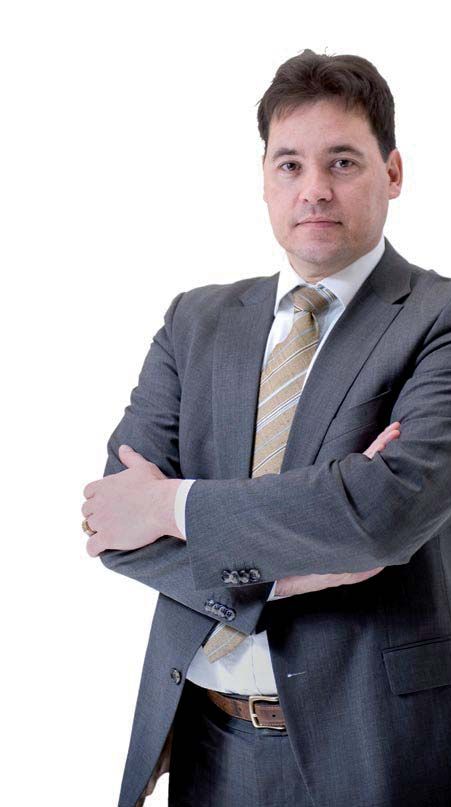
                                                                  ‘My background is an MSc in Mechanical Engineering at Eindhoven
                                                                  University of Technology. A few years after my graduation, I settled down
                                                                  in the family business Bradford Engineering B.V. We are a prominent
                                                                  supplier in the aerospace market, specialized in attitude-control/
                                                                  -measurement systems and propulsion units for satellites. Recently we
                                                                  were acquired by Moog and changed our name to Moog Bradford. In my
                                                                  current position as General Manager of Moog Bradford, I am still in touch
                                                                  with Eindhoven University of Technology on a regular basis. Several years
                                                                  ago, DTI asked if Bradford Engineering could host a trainee. We said ‘yes’
                                                                  and never have regretted this decision. Since then, we have hosted five
‘The DTI programme offers a bridge between                        DTI trainees; two of them are currently employed by Moog Bradford.
your university studies and the labour market’
                                                                  DTI trainees are more experienced and mature than
‘While I was looking for a job after my Master Biomedical         MSc students; they are engineers in their own right.
Engineering at the university Campus Bio-Medico in Rome,          I see that they can handle setbacks better and have
I bumped into the SAI website. The Design and Technology of       better presentation skills. In projects at Moog
Instrumentation (DTI) designer programme seemed to be what        Bradford we teach the trainees the value of
I wanted: the possibility to broaden my knowledge, work on        ‘soft skills’: working as a team, accepting and
my personal development and taste the working environment         taking responsibility, communication and
abroad. What could I ask more? I applied immediately.             management skills.
It turned out to be exactly what I was looking for! I like the
fact that after a long time of studying I could finally get       In my opinion, another great asset is DTI’s
practical. As a trainee, you have to operate in different         selection method. The demands are high
environments. First, during the curricular part, you are          and that is a big plus for DTI.
involved in one mini-project in industry. In my case I worked     The trainees we get make a good
for Philips in the area of magnetic biosensors. After that,       connection between theory and
during my one-year project, I worked for a hospital in            practice and have the proper drive
Eindhoven in modelling the glucose levels in diabetes. In the     and motivation. They often have a
final stage of the programme you will do a three months           new perspective on engineering,
internship abroad, very often in the USA. I am going to work      conceive out-of-the-box ideas
for Phonak in Zurich, a world leader company in hearing aids.     and provide new solutions.
                                                                  That is what I like about
The DTI programme offers a bridge between university studies
                                                                  supervising DTI trainees: we
and the labour market. It’s very dynamical, you gain a lot of
technical experience and communication skills. An important
                                                                  always learn something new too.’
lesson I learned so far is that presenting your work is half of
your work. Also, you have to clearly define your project plan
before you get into the technical stuff. Last but certainly not
least: research is continuously frustrating: it’s not about                        Raoul Voeten
finding a solution to a problem, but about understanding why                       General Manager of
that solution is not working.’                                                     Moog Bradford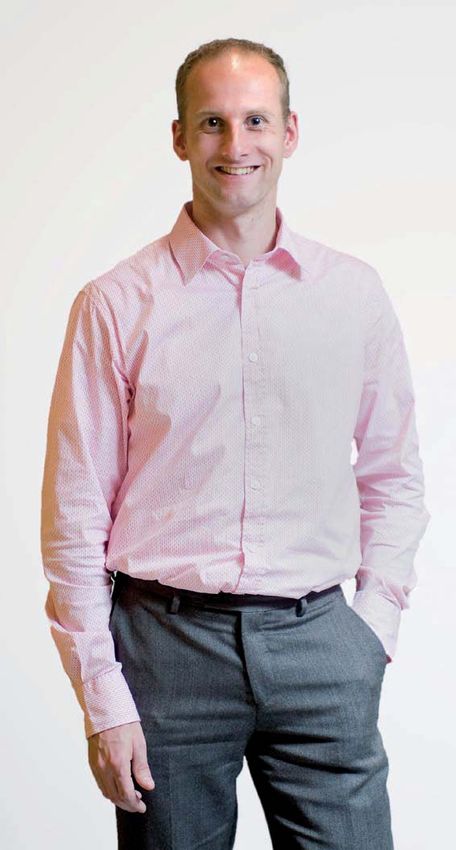
Design and Technology of Instrumentation

From Physics to Industry

Physics Master of Science graduates have both theoretical          Second phase in industry: design project
knowledge and experimental experience. Putting these               In the design project you work for twelve months in industry
skills into practice to solve real industrial problems is a        on a challenging and innovative technological design task
different matter. Translating knowledge into practical,            – a real problem that needs to be solved. You’ll be supervised
operational tools is no easy task. The multidisciplinary           by a designer from industry as well as by a staff member of
Design and Technology of Instrumentation (DTI)                     Eindhoven University of Technology in order to keep you
programme focuses specifically on this aspect in training           focused on solving the problem. The DTI staff stays also
you as a creative technological designer. After the two-           involved and coaches you. The design project is typically
year programme, you’ll be able to make a ‘flying start’ as          a very challenging, but also rewarding time.
a technological designer in industry.                              Companies offer a limited choice of project topics. The type
                                                                   of design project you work on depends on the type of projects
Fast track to a higher level                                       offered by our industry partners. As a PDEng trainee you may
During the DTI programme you are exposed to technologies,          need to move to another region for a year if the project is not
and will be actively involved in applying these, on a level that   near Eindhoven.
would never be possible if you had a regular job in industry
immediately after your Master’s. To gain the same experience
would take many more years in industry.

The DTI programme is unique: dedicated courses, industrial
assignments, management team members with extensive
experience in industry. As a trainee you will receive a salary
of about E 1700 gross per month (2014). After successfully
completing our programme, you will be granted a ‘Professional
Doctorate in Engineering’, the PDEng degree.

First phase at university: courses and assignments
During the first phase of nine months of the DTI programme
you will have a personal menu of courses, scientific as well
as on management level, which broadens and deepens your
existing knowledge. You will be executing the first assignment
in industry by doing a ‘mini-project’, which confronts you
with the on-going R&D real-life developments in industry.
Non-technical courses include project management and
professional development.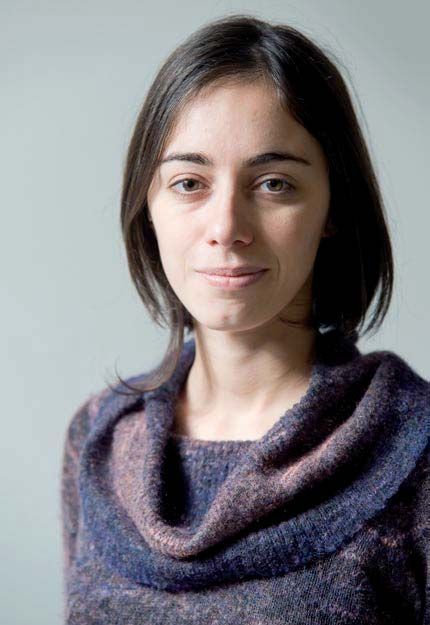
Final assignment: international internship
The last part of the programme is an international internship
of three months. In this final project, you apply the
experience gained during the design project in a short period
of time and in a different company on a completely new
subject. Companies can be anywhere in the world from the
United States to New Zealand, from Switzerland to Argentina.

And much more
Other parts of the program include group assignments on
modelling, purchasing equipment including a visit to an
industrial fair, monthly meetings with all trainees, workshops
with experts from industry and a company visit.

Application
The programme is open to university MSc graduates in Physics,
Electrical or Mechanical Engineering, Biomedical Technology
or similar disciplines, with a high grade for their MSc-research
project. Experimental experience gained in laboratory work is
important. The candidate must be fluent in English, in writing
and speaking.

The multidisciplinary DTI programme functions under the
responsibility of the Department of Applied Physics of
Eindhoven University of Technology.
‘I didn’t want to be a scientist who tries
                                     to understand the world; I wanted to be an engineer
                                     who tries to change the world.’

                                     ‘I studied Applied Physics at Delft University of Technology. After
                                     finishing my Master, I have travelled through Spain for two months
                                     to exercise my favourite hobby: climbing. During my first job at a
                                     multinational in the chemical industry, I heard about the designer
                                     programme DTI. This was exactly what I was looking for: research and
                                     development in an industrial setting. I didn’t want to be a scientist
                                     who tries to understand the world; I wanted to be an engineer who
                                     tries to change the world.

                                     After my design project of twelve months at Philips Research, I continued
                                     my work at Philips on a PhD-on-design. A research in which patents,
                                     prototypes and products constitute the most important output.
                                     I developed an innovative actuation principle for micro fluids (the
                                     magneto-capillary valve), starting with an idea on paper and ending
                                     with a functional prototype.

                                     A DTI trainee switches from university research to research and
                                     development in an industrial setting. In my opinion, that is a lot of
                                     added value provided by the programme. Whereas in the world of
                                     science it is all about making discoveries and publishing papers, in the
                                     industrial world one solves an actual problem. What is very important
                                     and what one learns as trainee is to have an overall view and not to
                                     work out one particular aspect to perfection. The result is as strong as
                                     the weakest link, so it won’t work if you are paying too little attention
                                     to particular matters. At the same time there is no time figuring out
                                     everything down to the last detail, so this means making the right
                                     decisions: when will I go into details and when will I choose for an
                                     existing solution? What will I do myself and what can I board out?
                                     Therefore you learn to switch quickly between details and overview.

                                     The three months of foreign internship was the icing on the cake.
                                     For a while I was completely detached from home and family and this
                                     gives a lot of focus and energy. I have been in Colorado for three
Remco den Dulk                       months and I have worked at a high-tech start-up. It was a very dynamic
Alumnus DTI                          environment where everything was possible. For me it was like heaven
PhD student Molecular Diagnostics,   on earth: because of the proximity of the Rocky Mountains I was able
Philips Research                     to climb a lot.’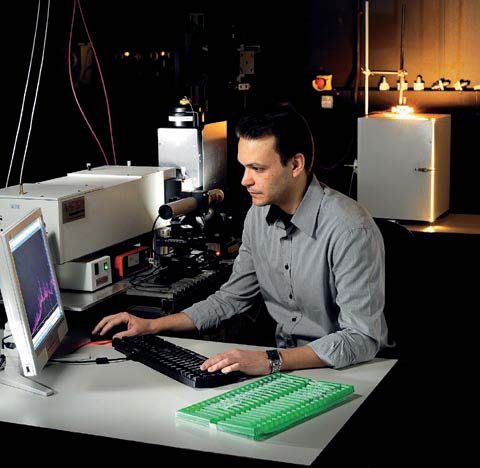
www.3tu.nl/dti

Is Design and Technology of Instrumentation the right
programme for me? What does it look like?
How can I apply for a place in the programme?
Will I be admitted with my prior education?
For the answers to these and many more questions,
visit: www.3tu.nl/dti.
Or contact us directly: sai.dti@tue.nl.

Eindhoven
The Eindhoven region located in the southeast of the Netherlands is internationally
recognized as a center for advanced technology and is characterized by knowledge
and creativity. Eindhoven holds a strategic position as one of Western Europe’s                                              University
                                                                                                                             of Twente
leading technology centers. Many global companies have established research,
                                                                                                 Delft
development and production facilities near Eindhoven.                                            University of
Eindhoven is a modern city with extensive cultural and sports facilities, good                   Technology
restaurants and lots of pubs. And it has much to offer for people with a                                     Eindhoven
                                                                                                             University of
technological focus. Eindhoven can be reached easily by public transport, has its                            Technology
own international airport and has an excellent train connection direct into the
departure hall of Amsterdam Schiphol Airport. You can find more information
about Eindhoven at www.eindhoven.eu.

The 3TU.School for Technological Design, Stan Ackermans Institute offers two-year     Contact
postgraduate technological designer programmes. The institute is a joint initiative   Eindhoven University of Technology
of the three universities of technology in the Netherlands: Delft University of       Department of Applied Physics
Technology, Eindhoven University of Technology and University of Twente.              Design and Technology of Instrumentation
                                                                                      Den Dolech 2
sai@3tu.nl                                                                            5612 AZ Eindhoven
www.3tu.nl/sai                                                                        the Netherlands

                                                                                      Tel.: +31-(0)40-2474868
                                                                                      Email: sai.dti@tue.nl
You can also read


