Introduction to CHEF, DPU, AU - Susan Wright - LEAD2 project
←
→
Page content transcription
If your browser does not render page correctly, please read the page content below
Introduction
to CHEF, DPU, AU

   Susan Wright
 suwr@edu.au.dk
Danish School of Education (DPU)
             Aarhus University
Location: Copenhagen

Departments:
Department of Educational Theory and
Curriculum Studies
Department of Education Studies
Department of Educational Psychology     Research programmes
Department of Educational Sociology      ENGAGE - (Dis)engaging children and young
Department of Educational Philosophy     people
and General Education                    Future Technology, Culture and Learning
Department of Educational Anthropology   Inclusion and exclusion – in society, educational
                                         institutions and educational practice
                                         LISO - Learning, innovation and sustainability in
                                         organisations
                                         Early childhood: Education and Care in everyday
                                         life
                                         ReForM - Rearticulating the Formation of
                                         Motivation
                                         Policy Futures
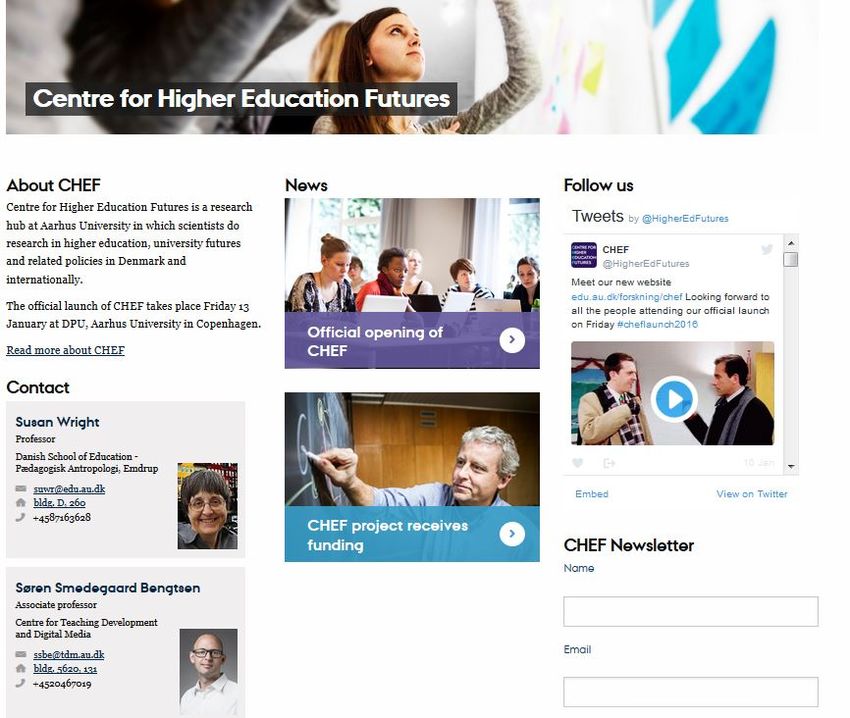
CHEF: Centre for Higher Education Futures
                                            www.edu.au.dk/chef

Founded                  January 2017

Director             Sue Wright (DPU) suwr@dpu.dk
Vice Director        Søren Smedegaard Bengtsen
(CUDiM) ssbe@tdm.au.dk

Membership
70 at AU
200 elsewhere in Denmark and international
13 agreements to collaborate with international ‘sister
centres’

Three themes and coordinators:
1. Universities’ and higher education’s role and
positioning in the world
Jakob Williams Ørberg (DPU) and Sarah Robinson
(CUDiM)
2. University organization and inner life
Søren Smedegaard Bengtsen (CUDiM) and Laura Louise
Sarauw (DPU)
3. Future universities and higher education
Susan Wright (DPU) and Rikke Toft Nørgård (CUDiM)
Future
                   Universities
                   and Higher
                    Education

             New dialogues between
              academics and with
                policy community

Universities’                         University
Positioning in                       Organization
 the World                           and Inner Life
Universities’ Positioning in the World

Context:
• Universities are located in complex         Projects:
    relationships with private and public     • Universities in the Knowledge Economy (UNIKE)
    agencies (rankers, accreditation              (EU Marie Curie project). Collaborative book
    agencies, foundations, entrepreneurs          project between14 PhDs and Post Docs
    etc.).                                        (Berghahn New York) on the implications of their
• They play an increasing role in ‘soft’          research results for future universities Susan
    diplomacy,.                                   Wright, Rebecca Lund eds)
• International agencies and
    governments promote universities as       •   Economy or ecology? Conceptualising the
    drivers of knowledge economies and            university’ as operating in a knowledge
    as crucial for creating prosperous            economy or an interactive ecology.(Susan
    futures for students and society.             Wright)
                                              •   Promoting a Culture of Entrepreneurship
Main research questions:                          (PACE): (Sarah Robinson and iCare, BSS/AU)
1.    How to conceptualise and analyse
      the new mandate for universities        •   Universities and soft diplomacy: Sino-Danish
      and the ‘space’ in which universities       Partnerships (Jie Gao and Susan Wright)
      are operating?
2.    How are universities negotiating        •   European Universities: Critical Futures
      with and being reshaped by these            CHEF is leading a consortium of 17 European
      diverse interests?                          Higher Education research centres (Susan
                                                  Wright)
University Organization and Inner Life
Context: Projects:
• Extensive reforms to governance and • Gender and University Leadership (Susan Wright, Rebecca Lund,
management, research strategies and Tampere Univ., Kirsten Locke, Auckland Univ, Jill Blackmore,
the very concept of education. Deakin Univ.) .
• Academics are faced with changing • Practicing research integrity (Lise Degn, Laura Louise Sarauw,
expectations about their work and
identity, often embedded in new Jakob Williams Ørberg, Susan Wright, Rachel Douglas-Jones, IT
performance criteria and human Univ.)
resource management
• The Danish Study Progress Reform and the ideal student. (Laura
• Students are figured in conflicting ways, Louise Sarauw)
as consumers, with quick throughput,
engaged in deep learning , focused on • Collective academic supervision (Helle Merete Nordentoft,
employability, and active citizens. Kristina Mariager-Anderson, Pia Baggesen, Anne Smedegaard) .
Main research questions: • International Students Transitioning to a Post-PhD Career in
1. How are students, academics and Denmark. (Tijana Maksimovic)
leaders understanding these changes ?
• Doctoral experience of becoming (or not) an academic. (Søren
1. How are their responses and initiatives
changing the internal life of universities? Bengtsen et al. at Helsinki, Oxford, Karolinska.
• Mobility in doctoral education (Lisbeth Walakira, Susan Wright,
Corina Balaban, Manchester Univ., Pavel Zgaga, Ljubljana Univ.,
Brigitte Bonisch-Brednich Victoria Univ, NZ).Future Universities & Higher Education
Context:
• Faced with financial crises, climate change, Projects:
disparities between rich and poor, global population • Trust university (Susan Wright, Davydd
movements, conflicts and threats to democracy, Greenwood, Cornell University, and UNIKE’s 25-
universities are called upon to renew the public member network on reforming public higher
purpose of education and research, their orientation education in the US and Europe).
towards society and their inner organization in order
to play a central role in creating more equitable, • Establishing a Cooperative University in UK
democratic and peaceful futures. (Participating in a working group led by
• There are numerous historical and new experiments Cooperative College UK)
in creating alternative universities.
• IT offers opportunities for developing universities’ • Go-IT: Global Online Inter-University Teaching.
education and for new ways of interactiing with (Rikke Toft Nørgård and Gwyneth Hughes,
students and society. IOE/UCL).
• Creating open-ended and playful universities.
Main research questions: (Rikke Toft Nørgård and House of Game//Play
1. How can CHEF use results from the first two focal with Andrew Burn, John Potter, Nicola Whitton,
areas and ideas from a wide range of alternatives to Alex Mosely)
debate, model and build future universities?
• University Futures: New mandates, new
2. How can CHEF provide students, faculty, formats. Working on a Marie Curie ETN
administrators, leaders and higher education policy application with Bristol U., KU Leuven, UofPorto
makers with an internationally linked and reflexive and UofLjubljana. (Susan Wright and Jakob
space for exploring sustainable and liveable higher Williams Ørberg)
education futures?New Dialogues Between Academics
and Policy Community
• Dialogue with policy makers (Seminar at • Teaching and graduate research
Ministry; Panel debate at DPU) To address the opportunities. CHEF will contribute to
current gap between critical higher education DPU/ARTS’ master degree programmes,
research and policy processes nationally and notably the MA in Anthropology, Education
internationally. and Globalisation
• ‘Rapid response’ (coffee meetings) to engage • Develop new formats for structured
academics and policy makers in discussion of graduate research opportunities and
emerging issues. integrated research and teaching (e.g. online
PhD ‘master class’ with Deakin; student
• Public dissemination placements with CHEF).
Active presence in Danish
and international media • Summer school. (funding permitting) to
• Maintain an open door network researchers, international experts
to CHEF’s activities and stakeholders to explore how universities’
through its website, new mandates are unfolding and create a
newsletters, a working critical and constructive dialogue with all
paper series, and being concerned.
active on social media • The aim is to make this summer school a
platforms. highly anticipated annual event on the
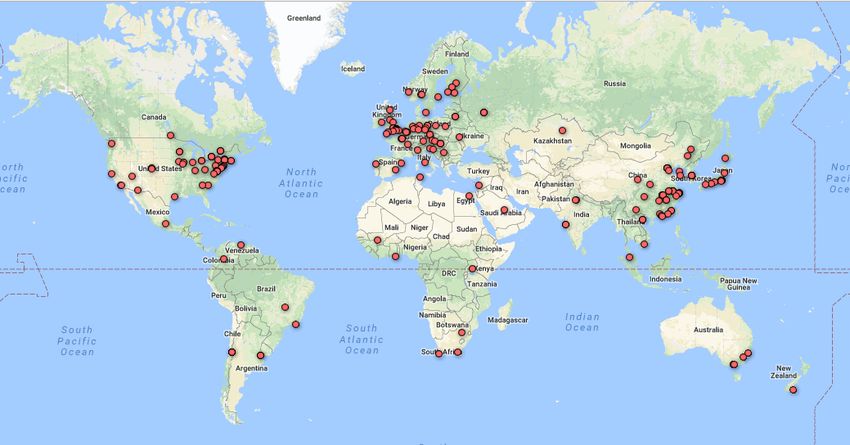
international calendar.Worldwide Higher Education Research Centers
(2018)Projects Relevant to LEAD2
• Danish University Reform from an Ethnographic Perspective (longitudinal study over 12 years)
.
Enacting the University (Springer forthcoming)
• Gender and Leadership in Higher Education (Denmark and New Zealand)
with Kirsten Locke, (Auckland) and Rebecca Lund (Tampere, Finland)
• Audit Culture (UK, New Zealand, Australia, Denmark)
With Cris Shore (Goldsmiths London)
o Wright , S. and Shore , C. (eds) 2015 ‘Governing by numbers: audit culture, rankings and the new world
order’ special issue of Social Anthropology 23(1).
o Wright , S. and Shore , C. 2015 ‘Audit Culture Revisited: Rankings, Ratings, and the Reassembling of
Society’ Current Anthropology 50(3): 421-431.
o Wright , S. 2014 ‘Knowledge that Counts: Points Systems and the Governance of Danish Universities’ in
Smith, Dorothy and Griffith, Alison (eds) Under New Public Management: Institutional Ethnographies
of Changing Front-line Work. Toronto: University of Toronto Press, pp. 294-337.
o Wright , S. and Shore , C. 2000 ‘Coercive accountability: the rise of audit culture in higher education’ in
M. Strathern (ed.) Audit Cultures. Anthropological Studies in Accountability, Ethics and the Academy .
London: Routledge, pp. 57-89.
with Julie Rowlands, Deakin
Performance management in Denmark and Australia
• Higher Education and Soft Diplomacy (China and Denmark)
with Jie Goa (Freya) DPU, Aarhus University
• Alternative forms of university management and governance
With Davydd Greenwood, Cornell USA)
Past projects: UNIKE – Universities in the Knowledge Economy (Europe and Asia-Pacific Rim).
URGE – Universitty Reform: Europeanisation and Globalisation
Wright , S. and Shore , C. (eds) 2017 Death of the Public University? New York: Berghahn Books.Main Roles in LEAD2 • Contribute to: T2.3. Conduct Comparative study on university governance and academic leadership in China and the EU • Host: T2.2D Preparation and implementation 4th Series of blended training (MOOC and workshop & peer learning (Young Academic leaders Workshop in Aarhus, Denmark)
Tak for jeres opmærksomhed!
You can also read


