Historically Disadvantaged Institutions Sibusiso Bengu Development Programme (SB-DP) - March 2021 - Diku
←
→
Page content transcription
If your browser does not render page correctly, please read the page content below
1

DEPARTMENT OF HIGHER EDUCATION AND TRAINING

Historically Disadvantaged Institutions

      Sibusiso Bengu Development
           Programme (SB-DP)
Presentation for Norwegian Partnership for Global
        Academic Cooperation (NORPART)

                 March 2021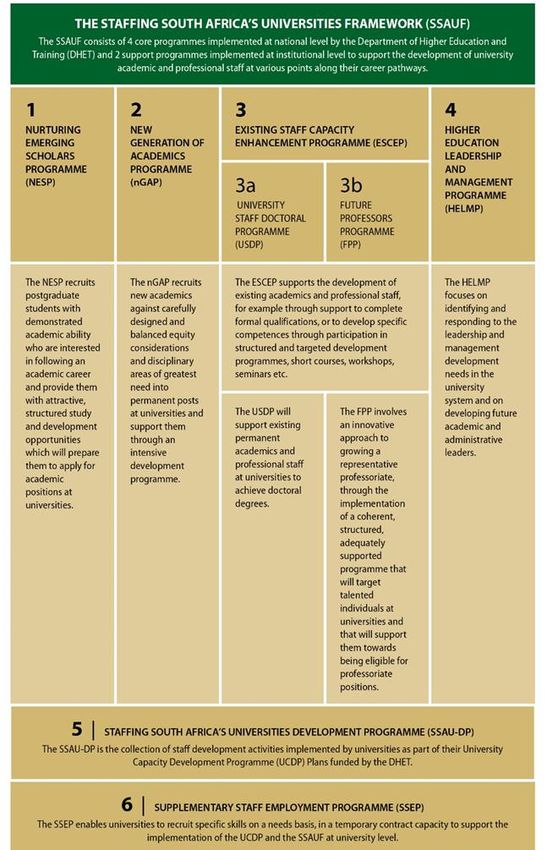
2

         What are the Historically Disadvantaged Institutions?

• The Historically Disadvantaged Institutions (HDI’s) are
  universities which were established as non-white universities
  following the recommendations of the Eisleen Commission in
  1959, by the extension of the University Education Act of 1959
  which specifically prohibited racially integrated education except
  in exceptional/ extraordinary cases approved by the then
  Apartheid government (Meyer, 1974).

• The democratic South African government established a
  committee to review the funding of universities across the country
  in 2013 with an aim to redress past injustices.
3

         What are the Historically Disadvantaged Institutions?
• The Report of the Ministerial Committee for the Review of the
  Funding of Universities, produced in October 2013, identified 8
  contact universities as Historically Disadvantaged Institutions
  (HDIs) from 2015/16 onwards, namely:

   •   University of Fort Hare;
   •   University Limpopo;
   •   University of Venda;
   •   Walter Sisulu University;
   •   The University of the Western Cape;
   •   University of Zululand;
   •   Mangosuthu University of Technology; and
   •   Sefako Makgatho Health Science University
4

         What are the Historically Disadvantaged Institutions?

• Due to the historic injustices, HDIs in their nature, are not
  financially well off as they have not generated sufficient reserves
  to ensure that they sustain themselves fully, therefore, they are
  highly reliant on state funding for their survival.

• This necessitated the South African government to establish a
  special earmarked grant to enable the 8 designated universities to
  receive additional support to implement their strategic priorities
  which are aligned to government policies.
5
What are the Historically Disadvantaged Institutions?
• With the creation of the earmarked grant, there is still a need for
additional funding to ensure that the universities are fully
resourced and can compete with their affluent counterparts in
South Africa, that brain drain is avoided and the universities are
able to recruit and retain their academic staff.
• The geographic locations of the universities also contributes to
the need for additional funding as the universities tend to battle to
retain their academics and researchers due to where the
institutions are located.6
What are the Historically Disadvantaged Institutions?
• The South African government, through the Department of Higher
Education and Training (DHET) and the Department of Science
and Innovation (DSI) has embarked on a strategy to assist the
HDIs in increasing their research capacity through bilateral
engagements.
• The strategy will also enable the HDIs to increase their global
footprint within the research environment and compete with the
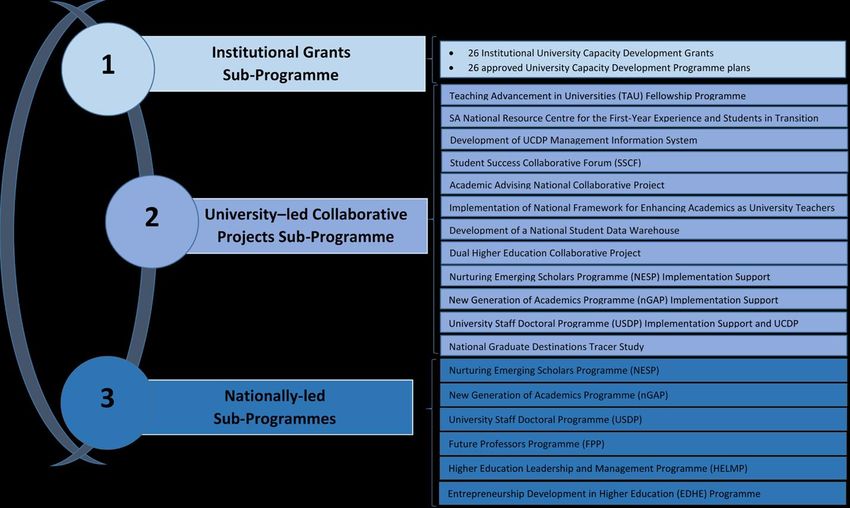
best universities in the world.The University Capacity Development Programme
(UCDP)
78 The Staffing South Africa’s Universities Framework (SSAUF)
9

     Staffing South Africa’s Universities Framework (SSAUF) HDI’s

• It is widely recognized that the South African university system as
  a whole is currently experiencing severe challenges in relation to
  the size, composition and capacity of its academic staff more so
  the HDIs

• The Staffing South Africa’s Universities Framework (SSAUF) is a
  national, sector response towards addressing these challenges.
10
Staffing South Africa’s Universities Framework (SSAUF) HDI’s
• The SSAUF takes as its starting point the urgent imperative to
recruit, support and retain black academic staff to address their
very serious under-representation at all levels in the sector, the
HDIs also participates in the programme to assist them to produce
world class researchers and academics.
• The SSAUF intends to make possible a rapid increase in the
number of people likely to enter the academic profession and is
designed also to have a significant systemic effect through its
emphasis on multi-faceted, phased development.11
Staffing South Africa’s Universities Framework (SSAUF) HDI’s
• SSAUF intends to:
• identify and nurture academic talent early in the academic
development trajectory, at senior undergraduate level or early
postgraduate level; and
• support newly recruited academics to acquire doctoral degrees
(or Master’s Degrees in selected fields); develop teaching
expertise; develop research skills, including scientific
publication skills; provide development opportunities for
academic staff at all levels; and enable the recruitment of
supplementary staff to enhance and strengthen teaching and
research at universities.12
Establishment of the Development Grant
• The HDI grant is an earmarked grant meant to support
development initiatives of the HDIs , allocated for a 5-year period.
The overall purpose of these funds is to put in place systems and
mechanisms in place to develop and ensure the sustainability of
the institutions through financial health, safety and security,
infrastructure development, third stream income development,
governance and staff and student development.
• It is also established to enable the universities to strengthen their
academic enterprise and fully realise their potential by taking up a
sustainable position within a differentiated higher education
system.13
Purpose of the Development Programme
The purpose of the Sibusiso Bengu Development Programme (SB-
DP) is to decisively redress the inequalities that have impacted the
development and sustainability of the HDIs and to contribute to their
further development as strong universities, in a diversified system,
which are socially embedded and responsive, are highly regarded and
valued, including by the communities from which their students are
drawn, and which produce both graduates and new knowledge that
can make a contribution to socio-economic development in local,
national, regional and international contexts.14
The Development Programme
SB-DP seeks to work with the high-level priority areas, proceeding
from the premise that, if these priorities are decisively addressed,
multiple secondary and tertiary issues would then also be addressed.
It is recognised that there are a range of other cross-cutting
imperatives not specifically described, but which cut across the
priority areas described above and which universities are responding
to. These include, but are not limited to:
• Decolonisation in higher education;
• Indigenous knowledge systems;
• The Fourth Industrial Revolution (4IR) and digitisation;
• Blended learning;
• Entrepreneurship development; and
• Environmental sustainability.15
Strategic Priorities of the Development Programme
1. Institutional management and governance: Establish and/or strengthen and
capacitate institutional management and governance structures, systems and
processes, including student governance.
2. Institutional infrastructure and facilities: Improve teaching infrastructure, research
infrastructure, student housing, information and communications technology (ICT)
and digital infrastructure, and sports infrastructure.
3. Student experience: Enhance student experience through a focus on student life
and student success, and through the creation of safe environments.
4. Staff development and support: Enable effective staff recruitment, retention and
progression, including through improving staff qualifications, creating a supportive
staff environment, having attractive and reasonable work conditions, and providing
effective teaching, research and professional development opportunities for staff.16
Strategic Priorities of the Development Programme
5. The academic enterprise: Ensure responsive qualifications, programmes and
curricula, as well as streamlined PQMs that reflect the university’s individual
identity and the role it plays, or seeks to play, in a diversified higher education
landscape.
6. Research and innovation: Identify and develop research-focus areas that
characterise the identity and aspirations of the institution, and build innovation
and technology transfer capacity that enables the research to impact on society,
industry and the economy.
7. Relationships and partnerships: Leverage local, regional, national and international
collaboration and partnerships to support the development of the university whilst
at the same time contributing to the development of localities and communities,
possibly through adopting an anchor-institution approach as a means of aligning
with the district-development approach being advanced by government17
Resourcing the Development Programme
The main resource for the SB-DP is the Sibusiso Bengu
Development Grant (SB-DG), which takes the form of an annual
earmarked grant. The SB-DG will be allocated to universities based
on the plans that have been approved by the Minister of Higher
Education Science and Innovation. The assumption is that, on
average, each of the universities benefits by an equal amount, this
must articulate in an equitable manner considering the shape and size
of the respective universities.
The DHET will create a suitably capacitated and staffed programme-
implementation unit within the University Education Branch which
will support the implementation of the SB-DP.18
Resourcing the Development Programme
The SB-DP will be implemented in five-year cycles, with the first
year of the first cycle being 2021/22, commencing on 1 April 2021.
Each university will develop a five-year plan to be approved by the
Minister of Higher Education, Science and Innovation.
The development of the university’s SB-DP Plan has to take place
within the context of the university’s defined vision, mission and
mandate and within a broader university strategic plan designed to
give effect to its vision, mission and mandate.
These three planning levels will be completely aligned with one
another and with the university’s SB-DP Plan nested within its
medium- to long-term strategic plan, which, in turn, is nested within
its broader vision, mission and mandate.19
District Development Model
Cabinet recently adopted the District Development Model, which is
intended to advance service delivery in order to reach the people. All
government policy, planning and initiatives are required to be
spatially referenced to the local context. This includes the role that
public education institutions and all universities must play in
resolving a number of challenges afflicting society.
In this context, the role of higher education and of higher education
institutions is critical. Universities and colleges play a central role in
educating and training the individuals who will drive and determine
the social, economic and industrial base of the future. They also play
a critical role in producing knowledge and driving innovation, in
solving local challenges, and in building on local knowledge so as to
create new possibilities for development, which are often also linked
to global concerns.20
District Development Model
In the case of the HDIs, they must have a local footing and a national
and global outlook. This is important so as not to be seen to be
confining their education to matters of the local economy. This
aspect is clearly stated in the framework.
This means that these institutions should think of ways in which they
can participate at district level to ensure sustainability and yet remain
nationally and globally relevant.
The DHET continuously develops and reflects on policy
interventions in support of both specific and broad government
priorities, and all DHET policy frameworks are intended precisely to
contribute to national development.21
NORPART
NORPART shall enhance the quality of higher education in Norway
and selected partner countries in the Global South through academic
cooperation and mutual student mobility
We look forward to having our HDIs as part of the partnership that
will bring about a fruitful and mutual benefit by capacitating the
HDI’s to produce more academics and researchers who will bring
about an effective change at these institutions.22 Thank you
You can also read


