MICROSERVICES - IS IT THE HOLY GRAIL? - A PERSPECTIVE FROM A DEVELOPER - SUSE
←
→
Page content transcription
If your browser does not render page correctly, please read the page content below

Microservices – Is it the Holy Grail?
A Perspective from a Developer
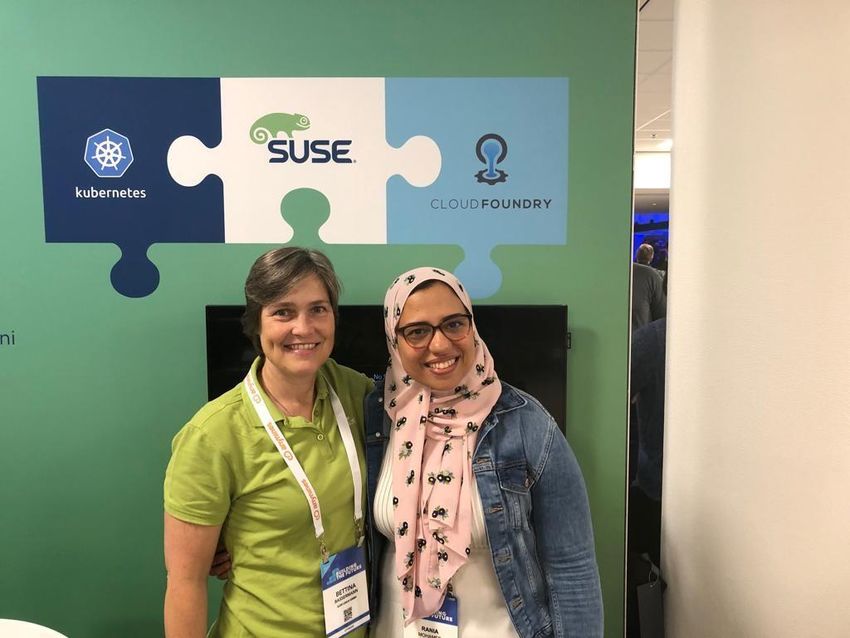
Bettina Bassermann                        Rania Mohamed
Product Sales Specialist Cloud & DevOps   Solution Architect, Services Consulting
Bettina.Bassermann@suse.com               Rania.Mohamed@suse.com
                                                                               2
Who is SUSE?

• Founded in 1992

• Largest independent open source
  vendor as of March 2019

• Technology company

• Our Mission is to help customers
  to master the digital
  transformation through Open
  Source technology

• Innovating with Partners and
  communites

• Enterprise-Grade Support
                                     3
Series about modern Application Development
•    Software Development, Microservices & Container Management,
     a SUSE webinar series on modern Application Development
•    Please find all SUSE Webinars here
                   https://www.suse.com/de-de/events/webinars

                          Container and
                                                  Why           About making
Microservices             Cloud Native
                                               Kubernetes?        Choices –
– Is it the Holy         Technologies –
                                              A Deep Dive in     CaaSPv4 as
   Grain? A                Why do we
                                                 Options,          SUSE‘s
Perspective of           need them and
                                               Benefits and     empowering of
 a Developer             what is so great
                                                Usecasese        Kubernetes
                            about it?

    ....stay tuned for the 2020 sessions with the Chamelion

                                                                                4
Agenda
• Evolution of Software and App Development
• What is Microservices and what not?
• Microservices vs Container
• Microservices vs SOA
• Microservices vs Cloud Native Applications
• Benefits and Challenges – in Business and
  Technology
• How to overcome Microservices challenges?
• When to go Microservices and when not to go for
  Microservices?

                                                    5
Evolution of Software and Application
Development

Software
Development started
by big monolithic
applications, growing
into beasts

                                        6
What is Monolithic App?

                          7
Evolution of Software and Application
Development - Monolithic App

    •   A big fat application
    •   Self contained.
    •   No separation of concerns ( business context and technical
        context)
    •   All one unit
    •   Structure programing.
    •   Interconnected and interdependent (tightly coupled)
•       Originated by mainframe apps.
•       Hard to maintain, manage and test.

                                                                     8
Software Development
Modern Techniques

                       9
Evolution of Software and Application
Development - Modern Techniques
• Application modularity
• Object oriented – OO
• Better governance
• Better maintainability
• A bit of Separation
of Concerns
But it is still mono!
10Evolution of Software and Application
Development - Modern Techniques
• Multi-tier application architecture
• Mono is broken into small components based Architecture
(modules and tiers)
• Service oriented architecture (SOA)
• Flexible design principles
• De-coupling the services
• Reusability (no code redundancy)
• Well defined contracts (APIs centric)
• Service discoverability
• Autonomous
But complex, expensive, hard to scale & maintain
11Component based application example
Client Side Server Side
(Frontend) (Backend)
Database
Cluster
Client Device
Load Balancer
Load Balancer
Client Device
12Evolution of Software and Application
Development
• High agility
• High scalability
• High adaptability
• Digitalization Business
Micro & Nano Development Approaches
13What is Micro & Nano
Software Development?
14What is Microservices?
15Evolution of Software and Application
Development – Microservices
• Smallest deployable unit that can go by itself
• Self-contained
• Finest grained unit (business and technical)
• Highly loosely coupled
• Independent from the external world.
• Serves a fine business needs
• Doesn’t deliver business
• Deliver business by orchestration.
• Enables/implements decentralization
• Single source of truth for a fine business feature.
it doesn’t care if the whole external world is in
war and down☺ 16MSA example
Application Hosting Runtime
MSA1
Client Device Load Balancer
MSA2
MSAn
Client Device
17What is Microfunctions?
18Evolution of Software and Application
Development - Microfunction
• Serverless development • Much more smaller in its
• No dedicated server/platform footprint
to run it • A very short lifetime from an
• Not always running but execution and processing
always available perspective.
• Instance gets available as • No database
per the need. • May communicate with
• Cost is by actual database and datastores.
calls/invocation to the • Stateless
function ☺. • Event based architecture
(Complex Event Processing)
• Helps in digitalizing
business.
Scales to zero instances if no requests are sent to the
function ☺, it is the magic of serverless 19What is Cloud Native
Development?
20Evolution of Software and Application
Development – Cloud Native Development
• Is a Microservice (but not the other way around ☺)
• Portable & Agile
• Natively consuming the underlying cloud platform
• Runs on PaaS offering runtime
• Stateless
• Polyglot
• Event driven architecture
• Enable smooth integration
• High SLA
“I want to write my code, and run it in the cloud, I
don’t care how ☺.”
21Evolution of Software and Application
Development - Summary
Multi-tier Service
App App
Big (Separation (SOA)
Monolithic of Concern centric
App technical •Not Mono
Anymore
(mainframe) wise) •Complex in
Micro-
•Hard to •Better from management Functions
maintain/manage/ Maintenance •Expensive
support •Still Mono, •Loosely
(Serverless
•Very expensive expensive to scale couple )
Modular Component Micro- Cloud-
Monolithic based services Native-
App (Modules and (MSA) Applicati
(Separation tiers) App •Ease of on (CNA)
of Concern (Separation of efficient
scalability
business Concerns •High agility
wise) technical and
•Better from business wise)
Maintenance
•Broken the mono into
•Still Mono, components a but not
expensive to scale granular
•Still tightly coupled
•Expensive to scale and
test
22What is MSA and What is
not MSA?
23What is Microservices and what not? – MSA
main Design/Architecture Principles
• Owns its data storage
• Independent on others (data & APIs).
• May be stateful or stateless
• State must be properly persistent and managed.
• Fine grained (actually the finest ☺)
24What is Microservices and what not? – MSA
Example
25When to go Microservices and when not to go
for Microservices? – Misunderstandings for
MSA
• 12 factor app, is not MSA
• Not an SOA alternative
• Not an SOA app
• Not just breaking up an app into a set of services.
• Not just API-centric architecture
• Not DevOps
• Virtualizing (VM) the app Running code is not MSA
• Containerizing the app is not an MSA
• Using API gateway is not MSA
26What is Microservices and what not? – Non
MSA Example
27Microservices versus
Container
28Microservices Vs Containers
Containers MSA
• Lightweight standalone app • MSA can be developed as a
+ its dependencies set of containers or not
• Smaller footprint than a VM • Usually hosts the database
• Very minimal Operating and storage as a backing
system service
• May embed the app • Uses Events for Integration
database and storage • Uses Service brokers for
• Required orchestration backing service provisioning
engine such as K8s.
• Integration more using the
services offered by
orchestration engine.
29Microservices Vs Containers
Containers MSA
30Microservices versus SOA
31Microservices Vs SOA
SOA MSA
• Complex • Simple
• More driven by services • More driven by business
• More into coarse grained capabilities
services • More fine grained apps
• API centric architecture • More into event driven
• Expensive architecture
• Hard to scale horizontally • Cost efficient
• Solves integration and • Ease to scale horizontally
orchestration/ choreography • Solves business agility and
problems scalability
• Centralized architecture • Decentralized architecture
• Hard to implement resiliency • Resiliency is indented by design
for failure principle
MSA is not replacing SOA, they solve different problems 32Microservices versus
Cloud Native Applications
33Microservices Vs Cloud Native Applications
CNA MSA
• Must be in the cloud • May be hosted in the cloud or
• Is an MSA not
• Doesn’t care for the app • May or may not be a CNA
runtime • May host its own runtime
• No embedded storage → • May hosts its own data
backing service storage
(dependency) • May be stateful or stateless.
• Must be stateless
• Must uses to underlying
Cloud natively for handling
an event (e.g., failure of a
function)
• May be used to build SaaS
34Microservices Vs Cloud Native Applications
35Benefits and Challenges –
in Business and
Technology
36MSA Benefits
• Ease of Development & • Enables business and
Maintenance technical innovation
• Ease of Scale out/in • Enables Real time apps
• Better handling to variable • Supports time to market
load • Enables rapid Business
• Cost Efficient resources services Growth
• Designed and distributed • Enhance quality
around business capabilities • Enables high SLAs
• Agility • Improves development
• Consistency productivity
• Autonomous
• High Resiliency/ Fault
isolation
• Enables self healing
37MSA Challenges
• Design MSA
• MSA Integration and Collaboration
• Integration Testing
• Managing & Monitoring (an app can have 400+ MSA)
• Implicit Cyclic dependencies
• Fault Tolerance
• Data Synchronizations
• Security
• Discovery
• Logging
• Business Troubleshooting
• Governance
38How to overcome
Microservices challenges?
39How to overcome Microservices challenges?
• Always design for failure
• 100% Automation
• Integrate DevOps (CI/CD/CD)
• Use Central logging and Monitoring
• Implement service mesh for governance
• Implement log analytics and system analytics → high
responsive and proactive system
• Implement MSA known design patterns when needed (e.g.,
service discovery, data versioning, eventual consistency…)
• Implement integration patterns (e.g. aggregator, circuit
breaker) using orchestrator and event processing systems
• Use Function as a service for integration and in conjunction
with MSA to deliver the E2E solution.
• Use API Gateway for securing MSAs
40When to go Microservices
and when not to go for
Microservices?
41When to go MSA and when not to go for
MSA?
Go To MSA Don’t Go to MSA
• Variable Load • Load is predictable
• Frequent changes are • No changes in the business (it
required is mostly stable)
• Time to market is an objective • No integration with the
• It is already complex external world
• Building a PaaS or a SaaS • Simple or moderate
application
• Targeting multi-cloud
• Targeting Digital
Transformation
Don’t build a Rocket to drive you home from the office ☺
42SUSE: Underpinning Digital Transformation
Business-critical Machine Internet of Business High Performance Traditional IT
Applications Learning Things Analytics Computing & Applications
Application Delivery
Container Management Platform as a Service
SUSE CaaS Platform SUSE Cloud Application Platform
Software-defined Infrastructure
Services
Private Cloud / IaaS
SUSE OpenStack Cloud SUSE Global
Infrastructure
& Lifecycle Services
Management Compute Storage Consulting
Virtual Machine SUSE Enterprise
Networking Services
SDN and NFV Public Cloud
SUSE Manager & Container Storage Select Services
Premium Support
SUSE Cloud
Multimodal Operating System Services
Service Provider
SUSE Linux Enterprise Server Program
Physical Infrastructure: Multi-platform Servers, Switches, Storage
Open, Secure, Proven
43Q&A
44Thank you
45Unpublished Work of SUSE LLC. All Rights Reserved.
This work is an unpublished work and contains confidential, proprietary and trade secret information of SUSE LLC.
Access to this work is restricted to SUSE employees who have a need to know to perform tasks within the scope of their
assignments. No part of this work may be practiced, performed, copied, distributed, revised, modified, translated,
abridged, condensed, expanded, collected, or adapted without the prior written consent of SUSE.
Any use or exploitation of this work without authorization could subject the perpetrator to criminal and civil liability.
General Disclaimer
This document is not to be construed as a promise by any participating company to develop, deliver, or market a
product. It is not a commitment to deliver any material, code, or functionality, and should not be relied upon in making
purchasing decisions. SUSE makes no representations or warranties with respect to the contents of this document, and
specifically disclaims any express or implied warranties of merchantability or fitness for any particular purpose. The
development, release, and timing of features or functionality described for SUSE products remains at the sole discretion
of SUSE. Further, SUSE reserves the right to revise this document and to make changes to its content, at any time,
without obligation to notify any person or entity of such revisions or changes. All SUSE marks referenced in this
presentation are trademarks or registered trademarks of Novell, Inc. in the United States and other countries. All third -
party trademarks are the property of their respective owners.
47
47You can also read


