Künstlerischen ENTSTEHUNG EINER - kuratorische praxis und kunstvermittlung
←
→
Page content transcription
If your browser does not render page correctly, please read the page content below
Call for applications
                                                      ENTSTEHUNG
                                                            EINER
                                                     künstlerischen
                                                                      TATSACHE
     Position     Artist (f/d/m)
                  with interest in Artistic Research

     Project      »Genesis of an Artistic Fact«
                  Arts & Science Residency
                  at TRAFO Jena
                  with subsequent exhibition
     Duration     Attendance 19.07.—01.08.2021
                  sowie 20.09.—03.10.2021
                  (2 × 2 weeks)
     Payment      1.000 €
                  DESCRIPTION

                  The project »Genesis of an Artistic Fact« brings together scientists and artists
                  by opening scientists to the artistic process and artists to scientific knowledge.
                  Thereby, the artists create a piece of art that can serve as a starting point for a
                  social discourse on optical detection methods in research. In the end, a joint
                  exhibition by all five participating artists (collectives) will show the results of the
                  transdisciplinary dialogue.
                  The project is aimed at artists who deal with the method of artistic research. An
                  engagement with scientific topics and techniques is desirable. For this Arts &
                  Science Residency, the TRAFO with its 400 m² is both working and an exhibi-
                  tion space. The TRAFO is a new innovation laboratory for contemporary art
                  forms and media in Jena (known as the city of light due to its historical import-
                  ance in optics). In keeping with the historical and contemporary research focus
                  in the city, the project takes photonics and optics as core themes. Supported
                  by our cooperation commitments from the Leibniz Institute for Photonic
                  Technologies (IPHT) and the German Optical Museum Jena (D.O.M.), the focus
                  is on optical technologies and their application in diagnostic processes and
                  the life sciences. Through the residency, the laboratory becomes the studio
                  and the studio becomes the laboratory, so that the forms and processes of
                  both disciplines can be experienced by the participating artists and scientists,
                  and the public.
                  Both the exhibition and the process leading to it will be documented in the
                  form of text, photographs and video. A printed documentation and a reflective
                  workshop in the Applied Innovation Lab Vienna (AIL) are in the planning stage.

1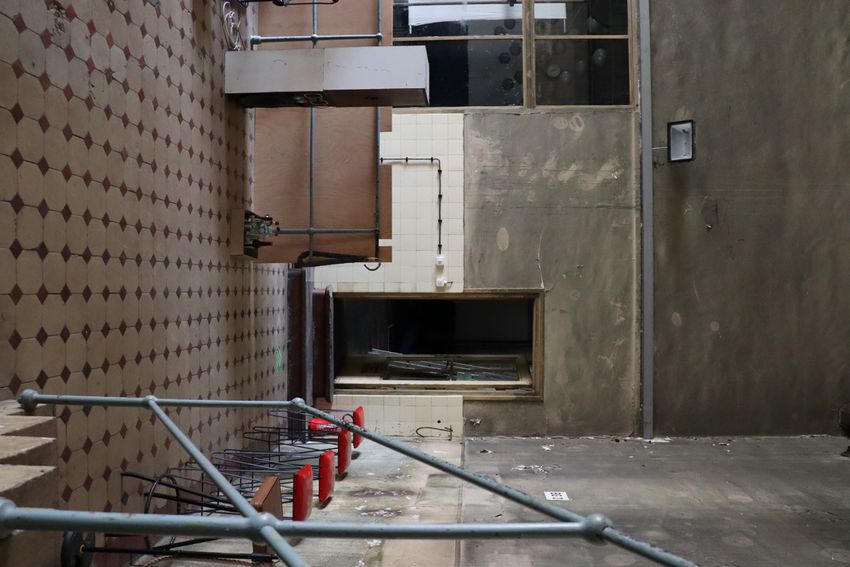
Location
TRAFO
For several years now, the association IN’s NETZ has been establishing a
forgotten transformer station in the center of Jena as the new cultural
venue TRAFO. For this purpose, innovative cultural formats are developed
and cooperation partners and helpers are acquired in order to develop a
long-term operating concept. TRAFO is the new Jena innovation laboratory
for contemporary art forms and media. It offers an experimental space for
different forms of participation, in which members and participants,
neighbors and cultural actors can develop their own formats and events.
The Genesis of an Artistic Fact is such a project and will find a home in
TRAFO. It will thus enter the city‘s cultural scene as a new player, which
does justice to Jenas scientific history, and acts as a much-needed bridge
between disciplines.
The venue offers space for up to five artists in residence and also has
enough space to carry out various participation formats with sufficient
distance.
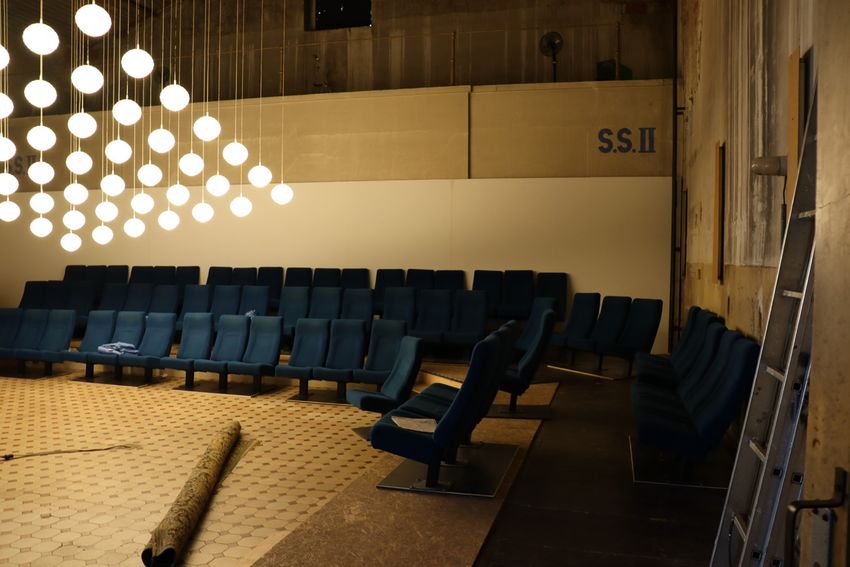
Already, TRAFO has become a central place for culture in Jena. Following
Room atmosphere in the TRAFO new trends in urban development, we make it possible to expand the
functionality of the place, to condense it and thus to create synergies
between neighbors, art, culture and science. Located in the heart of the
city, the Arts & Science Residency could build bridges between contempo-
rary art and science. Genesis of an Artistic Fact should be the prelude to a
long-term use of the machine hall and thus meaningfully complement the
existing offer in the TRAFO. Through repeated use, a cycle of exhibition and
residency is to be created. The location TRAFO thus provides a contribu-
tion to sustainable urban development through the meaningful use of the
building.
WORK ROOMS
In addition to the accommodation on site, we provide you with a studio.
One floor in the TRAFO is completely available for artistic activity. Its heart
forms a large room with skylights (Oberlichtsaal), in which you can ex-
change ideas with the other artists. A hallway leads from this Oberlichtsaal
to your individual work space (approx. 20 m²). In addition to this work space,
there are other rooms that can be used and explored. Overall, the TRAFO
offers a usable area of approx. 400 m².
More photos of the TRAFO at
www.kuenstlerische-tatsachen.de Event hall in the TRAFO 2Setup
ACCOMMODATION AND MEALS
We will organize a room for you in an apartment close to TRAFO in Jena.
There is a kitchen in the TRAFO where you can cater for yourself. We want
to set up a second kitchen on site by the start of the project. Parties are not
possible in the TRAFO’s premises.
FEE / BUDGET
We give you 1,000 € which you can use for your catering and project
implementation. We do not have an additional budget for material costs.
We will be available to help organize everything you need and provide a
contact person during the attendance phases.
CORONA
The event will be implemented in careful compliance with the currently
valid hygiene regulations to avoid infections with the coronavirus. To ensure
the highest possible safety for all participants, rapid antigen tests will be
performed at the beginning of each day of the event. We also provide
sufficient FFP2 masks. But still, ultimately, only that contact will be possible
which the infection situation allows.
TIMELINE
APRIL
Design of concept
Invitation to artists and scientists
MAY
Open Invitation
JUNE
Production
JULY
The artists are present
Participation formats
PHASES OF THE PROJECT Postprocessing
Facilitation
The residency in presence will focus on the last two weeks of July
(19.07.2021 - 01.08.2021) and the last two weeks of September AUGUST
(20.09.2021 - 03.10.2021). Independent work
Facilitation
1. Orientation phase SEPTEMBER
Presentation of topic-related research results of the participating Support
scientists with the involvement of the public. You will move into your Facilitation
studio and you will have the opportunity to interview scientists. Kommunication
2. Exchange Digita participation
You work intensively on an interpretation of the research results Exhibition design
with regular consultations with scientists. Participation formats
Vernissage
3. Reflection / Feedback OKTOBER
You will be invited to present the results and be interviewed by Documentation
scientists. Postprocessing
Open Exhibition
4. Closing NOVEMBER
We open the exhibition together.
Open Exhibition
DECEMBER
3 Open ExhibitionShort video clips of our partners at COOPERATIONS AND INSTITUTES
www.kuenstlerische-tatsachen.de
In Jena we are in contact with numerous scientific institutes. The main
topic is life sciences and diagnostics.
At the Hans Knöll Institute with the FungiNet researchers, the focus is on
fungi. For example, Aspergillus fumigatus, whose infection can lead to
sepsis in some cases, will be examined in detail. The researchers believe
that nanometer-sized extracellular vesicles are key to understanding the
mechanism, and image their activity. In another laboratory, Candida
albicans is under observation, which again is not actually harmful, but in
certain constellations can upset the intestinal flora. Live experiments are
used to investigate the effects and develop medication against the
condition. Those are carried out in the mouse laboratory under the highest
ethical standards. If new substances are developed from this research,
they will be tested for purity and suitability in the laboratory of the knowled-
ge transfer group. But to arrive at these findings, hours of microscope
images often have to be evaluated for the first time. In order for this to be
done automatically, there are the experts in bioinformatics, who use various
data processing techniques to analyze and quantify images.
At the Leibniz Institute for Photonic Technologies e.V. (Leibniz IPHT), the
focus is on life science imaging techniques. Bacteria, for example, are
examined for their dangerousness, and new methods for diagnostics are
developed. This can be seen in cubes for microscopy, the development of
new optical fibers or the combination of infrared radiation with laser
technology.
The Jena School for Microbial Communication (JSMC) also focuses on the
nearly invisible. On the site itself, there is a greenhouse and a plant labora-
tory. The individual research projects focus on the surface life of individual
plants as well as classical questions of plant genetics.
The Electron Microscopy Center of the University Hospital Jena (EMZ) is
the place to go when conventional imaging techniques cannot uncover
what needs to be seen. With its various electron microscopes, the EMZ has
the equipment it needs to determine the smallest structural level, opening
up completely new landscapes of microworlds.
At the same time, the development of microscopy, and how imaging
techniques have evolved over the centuries from the first lenses to high-
tech devices, can be seen in the historical collection of the German Optical
Museum (D.O.M.). Its exhibits can still be used with due care and caution.
TEAM
Project Management
ENRIQUE TORRES
Project Management
MARIE NIEDERLEITHINGER HOW CAN YOU GET INVOLVED?
Project Assistant · Support Artists · Social Media
We are looking for artists who want to visit the labs and engage with the
research of the scientists. This exchange should then lead to concrete art
VINCENT MAURER
according to your ideas. This working time will be accompanied by an
Project Assistant · Cooperation · Data Visualization
opening event as well as smaller lectures, workshops or similar events. You
KILIAN RÜSS
should be prepared to participate in these activities too. Experience in the
Project Assistant · Communication design · field of Arts & Science is desired. We would be happy if you stay in contact
Cultural mediation
with the scientists during the month of August (no classroom) and of
GABRIEL DÖRNER course if you share the project through your channels.
Deadline: 13.06.2021
After the Application: We will get in touch and send you additional informa-
tion on the project and the scientific practice. Then you may suggest
preferences and first ideas for your work. We will then select the artists
Send your application via taking into consideration the feasibility of the proposal as well as the
info@kuenstlerische-tatsachen.de quality and originality. You will receive our final response latest 23.06.2021. 4You can also read


