Digital Health in Sri Lanka - 1998-2017 'Sustainable Implementation of Digital Health Solutions through
←
→
Page content transcription
If your browser does not render page correctly, please read the page content below
Digital Health
         in
     Sri Lanka
‘Sustainable Implementation of
Digital Health Solutions through
    Local Capacity Building’

        1998-2017
Digital Health in Sri Lanka

The development of Digital Health in Sri Lanka is a joint effort of the
Ministry of Health (MoH); Information and Communication
Technology Agency (ICTA) of Sri Lanka; the Specialty Board in
Biomedical Informatics, Postgraduate Institute of Medicine,
University of Colombo (PGIM); and the Health Informatics Society
of Sri Lanka (HISSL).

This booklet was compiled and published by the HISSL to
showcases some of the key Digital Health initiatives in Sri Lanka. Sri
Lanka would be happy to share its experience and expertise in
implementing these systems with other countries.

                 This Booklet was compiled by the
               Health Informatics Society of Sri Lanka
                        http://www.hissl.lk
                            info@hissl.lk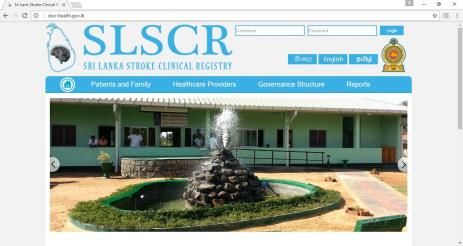
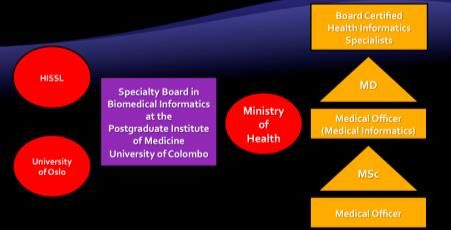
Table of Contents
The Health Informatics Society of Sri Lanka ............................................... 1
Human Resources for eHealth in Sri Lanka ................................................. 3
Strategic Planning for eHealth in Sri Lanka................................................. 7
PHN and MPI Personal Health Number & Master Patient Index ........ 9
eIMMR Electronic Indoor Morbidity and Mortality Register ............ 10
HHIMS Hospital Health Information Management System................ 13
HIMS Hospital Information Management System ................................. 15
DNMS District Nutrition Management System ....................................... 19
Electronic Patient Information Management System of the National
Programme for Tuberculosis and Respiratory Disorders .................. 21
eRHIMS electronic Reproductive Health Information Management
System ..................................................................................................................... 22
eNCD electronic Non Communicable Diseases System ....................... 24
Registering and Verification of the Electronic Health Information
Systems in Sri Lanka .......................................................................................... 25
"Suwasariya" Telehealth Programme ......................................................... 27
Sri Lanka Stroke Clinical Registry ................................................................ 30
Essential Drug Stock Alert Tracker .............................................................. 32
SLJBMI Sri Lanka Journal of Bio-medical Informatics .......................... 39
A Short History of Health Informatics in Sri Lanka and the Health
Informatics Society of Sri Lanka (HISSL) .................................................. 40
The Health Informatics Society of Sri Lanka

The Health Informatics Society               Medical Association with Dr.
of    Sri    Lanka      (HISSL)              Shyam Fernando in the Chair
[http://www.hissl.lk] is the                 and Prof. Tissa Vitharana,
professional association of all              Advisor to the Minister of
those in the field of eHealth in             Science and Technology, as the
Sri Lanka. The inaugural                     Chief Guest. The meeting was
meeting was held on 15th                     attended by 75 people. The
November 1998 at 0900 hrs at                 constitution of the Society was
the       Lionel       Memorial              adopted.
Auditorium of the Sri Lanka

The picture shows from left to right Dr. Vajira H. W. Dissanayake (Founder
Secretary), Prof. Tissa Vitharana, the late Prof. MTM Jiffry and Prof. Shyam
Fernando (Founder President) lighting the oil lamp at the start of the inaugural
meeting.
The primary objectives of                    1. To promote the use of
HISSL are:                                      computers         and
                                        1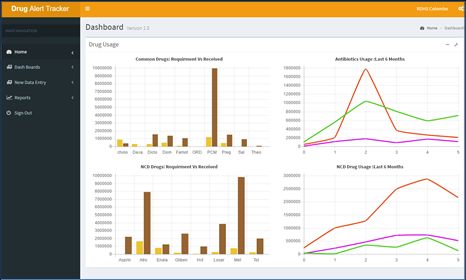
information technology in                4. To improve and facilitate
   teaching,           learning,               continuing     professional
   research and delivery of                    development of members.
   care in the field of health.             5. To improve and facilitate
2. To improve computer and                     research and development
   information       technology                in health informatics.
   literacy of health care                  6. To foster collaboration
   professionals.                              with national, regional and
3. To improve the access by                    international      medical,
   health care professionals                   informatics             and
   to computer hardware,                       professional associations.
   software and information                 7. To     foster    fellowship
   technology services.                        among members.

The picture shows a section of the audience at the inaugural meeting held at the
Lionel Memorial Auditorium of the Sri Lanka Medical Association on 15
November 1998. In the front row from right to left are three Presidents of HISSL
– Prof. Vajira H. W. Dissanayake (Current President), Prof. Resvi Sheriff
(Immediate Past President) and the late Prof. MTM Jiffry.

                                        2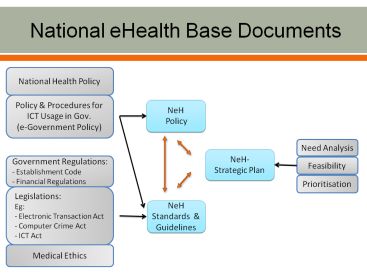
Human Resources for eHealth in Sri Lanka
The strategy of developing           This is done through the MSc
Human Resources for eHealth          course      in    Biomedical
in Sri Lanka is two-fold.            Informatics       of         the
                                     Postgraduate Institute of
The first strategy is the            Medicine,     University      of
creation of a group of ICT           Colombo (PGIM). The curse is
competent doctors who can            aimed     at   producing       a
work as the interface between        generation of leaders in
the    medical     and     ICT       eHealth in Sri Lanka who can
profession to spearhead the          spearhead                   the
planning,        development,        implementation of ICT in the
implement, monitoring and            health sector in Sri Lanka
evaluation of ICT projects in        working hand in hand with the
the Health Sector in Sri Lanka       administrators and policy
working in close collaboration       makers at the highest level.
with Medical Administrators.

           The stakeholders of the MSc and MD courses

The course was initiated in          between the University of
2007 as a joint project              Colombo, Sri Lanka and the
                                 3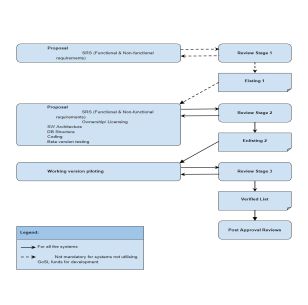
University of Oslo, Norway by              Informatics, University of Oslo
Prof. Vajira H. W. Dissanayake,            with the support of Prof. Resvi
the current President of HISSL,            Sheriff, the Director of the
and Prof. Sundeep Sahay,                   PGIM, who was at that time
Professor, Department of                   also the President of HISSL.

The first batch of MSc graduates with the Members of the Director PGIM and the
            Members of the Specialty Board in Biomedical Informatics

The course was supported by a              Informatics course in January
NOMA grant funded by Norad                 2017. This would enable the
and     managed     by     the             successful    graduates       to
Norwegian      Center       for            become board certified as
International Corporation in               specialists     in        Health
Higher Education (SIU). How                Informatics in Sri Lanka. This
the stakeholders partner to                would make Sri Lanka one of
produce specialists for Sri                the few countries in the world
Lanka is shown in the figure in            to have such specialists.
the previous page.
                                           The second strategy is the
So far 90 graduates have                   development of ICT awareness
graduated from the course.                 and literacy among the health
They are deployed across the               workforce. This is done
public health sector in Sri                through various workshops,
Lanka both at central and                  seminars and conferences
regional level. The PGIM                   organized by the HISSL and
commenced the MD in Health                 the Ministry of Health. The
                                      4
Major eHealth Conferences ones listed below.
organized by the HISSL in the
past few years include the
2010: eHealth Sri Lanka 2010 Conference [http://www.hissl.lk]
2012: eHealth Symposia were held in Colombo, Galle, Kandy, and
Jaffna as part of the 125 th Anniversary Celebrations of the Sri
Lanka Medical Association
2014: eHealth Sri Lanka 2014 Conference [http://www.hissl.lk]
2015: eHealth Asia 2015 Conference [http://www.ehealthasia.org]
with the Minister of Health Honorable Dr Rajitha Senaratne
as the Chief Guest.
2016: 24th Triennial Conference of the Commonwealth Medical
Association 2016 on Digital Health for Health and Wellbeing
[http://www.cma2016.org] with the President of Sri Lanka
His Excellency Maithripala Sirisena as the chief guest
5The following upcoming conferences will be hosted by HISSL in Sri
Lanka:
2017: 2nd Commonwealth Digital Health Conference – 10 to 12
October
2018: Asia Pacific Association of Medical Informatics 2018 – 9 to
12 October
6Strategic Planning for eHealth in Sri Lanka
Strategic planning for eHealth Champika Wickramasinghe
in Sri Lanka began with the who succeeded him in 2013,
establishment of the National the National eHealth Technical
eHealth Steering Committee Committee has developed the
in the Ministry of Health in following national eHealth
June 2010. Working under the Base Documents.
directions of this committee - National eHealth Policy
and Dr. S.R.U. Wimalaratne, - National eHealth Standards
Director (Information), and Guidelines
Ministry of Health, and Dr. - National eHealth Strategy
The national eHealth Policy Its mission is to facilitate
articulates the guiding adoption of ICT solutions
principles for eHealth in the appropriately in the
healthcare sector of Sri Lanka. healthcare sector of Sri Lanka
Its vision is to streamline the to improve the quality,
adoption and use of ICT in the efficiency, patient safety, and
Healthcare Sector of Sri Lanka. cost effectiveness of health
7care thus contributing to is the acceptance of a uniform
achieve the goals set out in the personal health number
National Health Policy. (PHN) to be used across the
The Standards and Guidelines health care services to identify
and the Strategic Plan are patients. The PHN has now
aimed at achieving this vision been officially endorsed.
and mission. A parallel process
8PHN and MPI
Personal Health Number & Master Patient Index
The Health Ministry is in the Health Number (PHN). This
process of implementing the will allow the Ministry to
National Healthcare Recipient capture the true disease
Identification System to burden of the country as
enable it to consolidate all the opposed to the individual
interactions of a particular incidences that are being
person with the healthcare captured now.
system to his/her Personal
The format of the PHN
The MoH has also taken steps benefit to the healthcare
to introduce a Master Patient recipient, where all his/her
Index (MPI) at district level medical records are in one
initially with the intention of place. These initiatives are
scaling it up to national level. aimed at ensuring
This would further enhance interoperability among
the development and use of electronic health record
Personal Health Records in the systems within the country.
future, which would be a great
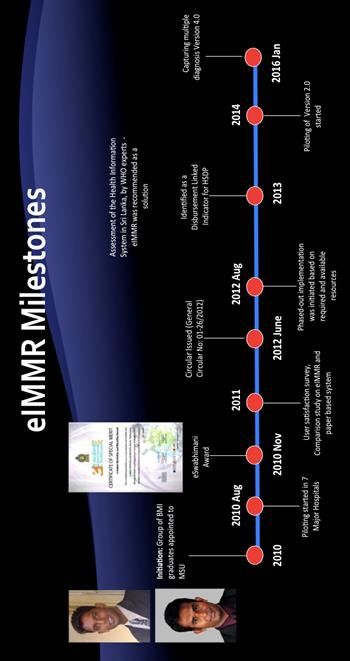
9eIMMR
Electronic Indoor Morbidity and Mortality Register
The first system approved for country wide implementation in the
Health Sector in Sri Lanka
Collection of nationwide real Health for nationwide
time data on indoor morbidity deployment. It is currently
and mortality (IMMR) is implanted in over 400 (63%)
challenging. The eIMMR health care institutions (out of
system developed by Dr. a total of 635 secondary and
Nadish Kariyawasam and Dr. tertiary care institutions).
Buddika Dayaratne is now These institutions account for
making this possible in Sri approximately 70% of the
Lanka. total nationwide hospital
admissions in Sri Lanka. There
Initially developed as an MSc are 1738 user accounts. The
student project in 2009 with a database now contains over
grant of Rs. 50,000/- from the 15 million records. It is hoped
HISSL. It has now been taken that all institutions will use the
over by the Ministry of Health. eIMMR system for reporting
It is the first software tool their statistics by the end of
approved by the Ministry of 2017.
Web interface of the eIMMR
1011
HHIMS
   Hospital Health Information Management System

                                         The Main objective of this
                                         government funded project is
                                         to improve quality, safety,
                                         efficiency      and      patient
                                         centeredness       in    service
                                         delivery of the Sri Lankan state
                                         health sector using ICT. This
Many        developed       and          focuses on improving the
developing countries around              quality and efficiency of the
the world have realized the              health care services provided
advantages of incorporating              by the government hospitals
Information                 and          in Sri Lanka by implementing
Communication Technology                 electronic medical records
(ICT) into the health sector. Sri        systems in 300 government
Lanka is also looking into               hospitals      covering      the
development of electronic                National Hospital, Teaching
health solutions for the                 Hospitals, Provincial and
preventive      and     curative         District General Hospitals,
healthcare sectors of the                Base Hospitals and selected
country. The Information and             divisional             hospitals
Communication Technology                 throughout the country by the
Agency of Sri Lanka (ICTA,               end of 2018.
currently operates under the
Ministry                       of        The Digital Health project
Telecommunication           and          promotes Electronic Health
Digital Infrastructure) with             Records (EHR). EHRs are the
the intention of making Digital          next step in the continued
empowered nation, initiated              progress of healthcare that can
“Digital     Health     Project”         strengthen the relationship
collaboration with Ministry of           between patients and doctors.
Health.                                  The data, the timeliness and its

                                    13
availability will enable software solution. It was
providers to make better developed in PHP 5.5.9 with
decisions and provide better Codeigniter v2.0.1 framework
service to the Sri Lankan which requires Apache 2.4.7
health sector stakeholders environment. If it is a local
including decision makers. deployment ICTA propose a
The ICT Agency of Sri Lanka, server with 8 GB memory and
developed the ‘Hospital Health 1 TB hard drive in latest
Information Management Ubuntu server distribution.
System’ (HHIMS) on the
request of medical HHIMS software is being used
practitioners and successfully in several state
administrators of the sector hospitals like National
government health sector Hospital of Sri Lanka-Accident
back in 2010. It is a free and service (premier trauma care
open source software solution institute in Sri Lanka), Base
(FOSS). It includes an Hospital-Avissawella , District
Electronic Medical Record, Hospital Dompe, Base
Patient Admission, Hospital-Panadura and
Appointment and Queue General Hospital-Ampara.
Management, Clinic HHIMS was implemented in
Management, Laboratory Karawanella BH in 2011 as
Information System (LIS), HHIMS version 1.0 where
Pharmacy Stock management, ICTA took the initiative to fund
Notification, OPD and proceed with the project
Management, Questionnaire, with all aforementioned
Report, Ward Management, features. Then HHIMS was
User Management, Permission implemented in Dompe DH
and PACS modules and other (2011, V1.1), Avissawella BH
modules as in the figure below. (2013, V1.3 customized) and
Performance management Panadura BH (2014, V1.3).
dashboard is also included in ICTA has selected 3 major
HHIMS. government hospitals -
Homagama BH, Horana BH
HHIMS is a web based and Galagamuwa BH to
13implement and pilot the latest from government health
version (v2.7) of HHIMS with sector. Final outcome of this
facilitating Wi-Fi enabled project is to improve quality
network infrastructure. and efficiency in service
Homagama and Horana BH delivery, governance,
systems were started in mid of accountability and effective
2016 which currently use of resources of the
operational in all sections of government hospitals. As
OPD setup with enhanced result of that availability of
usability and user friendliness updated, accurate information
from the lessons learnt from for patient care will be found.
initial implementations and That helps improve the
resource personnel. capacity of health authorities
This project aims to increase to detect emerging and re-
the EHRs coverage of the emerging diseases and take
selected hospitals up to 80% necessary preventive actions
from the total patients who in future.
access the health services
14HIMS
Hospital Information Management System
Development and implemented in four hospitals
implementation of Hospital at the moment. The laboratory
Information Management module of the HIMS is
System (HIMS) for the large deployed at the National
hospitals in the state health Cancer Institute Maharagama
care was initiated in 2013. The and it is in initial stages of
solution focused on enhancing implementation in other
service delivery, streamline hospitals.
the information management, Computer resource centres
sustainability and cost (IT training centres and
effectiveness. Requirements of Computer maintenance units)
key stakeholders were taken were established with
into consideration in the capacity to provide the
development process and the necessary training to users
solution adopt agile and maintenance of
development methodology equipment to ensure smooth
enabling accommodating end operation of the system. Its
user needs. The scope of the mandate is to maintain the
HIMS project includes LAN and end user training to
development of Hospital ICT improve the ICT literacy. The
infrastructure, improvement developers who are stationed
of end user ICT literacy and at the National Cancer
implementation of the HIMS. Institute Maharagama carry
Further, improvement of out further improvement of
software system, building the software and perform
hospital capacity to maintenance.
maintenance the system and
ICT infrastructure were also The software development
considered. Core modules of was a collaboration between
the HIMS (Master Patient the Ministry of Health and the
Index, Ward Management University of Kelaniya. The
Module & MRO module) were software was designed in a
15modular way and initially capture a PHN issued from
focused on inpatient care at other hospitals. The system is
the hospital. Admission/ completely interoperable with
discharge and clinic the eIMMR system, the official
registering module was indoor morbidity and
developed initially and mortality reporting system of
implemented as the base the Ministry of Health, thus
module. HIMS is capable of allowing automatic transfer of
issuing unique patient IMMR data from HIMS to
identifier, Personal Health eIMMR.
Number (PHN), and it can
.
The components of HIMS
Three developers provide required by different hospitals
around the clock maintenance are also being addressed by
service of the HIMS. They are the same developers.
also involved in development Implementing hospitals are
of other modules. They are not bearing any cost for the
being stationed at the IT software and the source code
laboratory of the National of the software is the property
Cancer Institute Maharagama. of the Ministry of Health.
The Ministry of Health and two Knowledge of the end users to
international donors provided adopt a computer based
the funds required for the system and proper change
project. Minor customizations management are very
16important aspects in HIMS provided to the direct users of
implementation and the system. Implementing
sustainability. HIMS is having many positive
impacts on the health system.
With the implementation of
the Master Patient Index time
taken for patient registration
will be minimized and patients
who are already registered in
the system need not submit
personal details on
subsequent admissions. At the
end of the care process an
A nurse updating clinic records indoor mortality and
morbidity report (IMMR) is
All hospitals adopted gradual generated for each and every
implementation process inward patient at the Medical
allowing users to familiarize Records Office (MRO).
with the software. After period
of successful parallel running With the implementation of
of both systems, manual and MRO module of the HIMS the
digital system, a compressive system utilises the patient
evaluation was carried out information entered at various
before shifting to the digital care points to generate the
system. The Ministry of IMMR. The IMMR generated
Health’s requirement to keep with the ICD 10 code can be
paper base documents was automatically transferred to
replaced with printouts the eIMMR system of the
generated from the system. Ministry of Health. In the
future the Ministry of Health is
Training programmes are gearing up to adopt using the
being carried out on basic PHN to identify IMMR records
computer skills covering all thus minimizing errors and
categories of staff and duplications. With the
software specific training is introduction of the laboratory
17management module patient being carried out at the
investigation reports will be implementing hospitals.
saved to the patient profile. This sustainable model
adopted by the project team
Sri Lanka spends about 2% of allowed the Ministry of health
the GDP on Health. The to own a Hospital Information
government absorbs a huge Management System with a
cost to provide free health care very minimal cost. The
services. The software Ministry need not fund each
development model that was and every hospital to purchase
adopted has saved millions of software. Furthermore
rupees to the government. For maintenance is carried out by
the last three years the cost of staff members who are
software development was already in the health sector
only Rs. 3.5 million rupees. with no additional burden to
Since the source code belong the national health budget.
to the Ministry of Health any
government hospital that is
willing to implement the
software will get it free of
charge and the necessary
modifications and
maintenance support will be
provided free of charge.The
method adopted to develop
trained personal to maintain
the network and the hardware
is unique. The Ministry of
Health with the help of
University of Moratuwa
trained selected staff from the
hospitals to carry out above
functions and the necessary
tools were also provided.
Training of hospital staff is
18DNMS
District Nutrition Management System
Sri Lanka is monitor
seen as a children in
model for their areas.
delivery of The second
high quality component
health care in a was a web
low resource application to
setting. The enable
nutrition healthcare managers to
indicators of children monitor the nutrition status
however give a different of children across the country.
picture. The government of The third component alerted
Sri Lanka decided to address different government
this issue with a national agencies in the health sector,
action plan coordinated at the social services sector, and
highest level of government – agriculture sector to take
the Presidential Secretariat. personalised interventions
The Health Informatics aimed at households that had
Society of Sri Lanka (HISSL) malnourished children using
was invited to develop the risk factor data gathered by
District Nutrition Monitoring public health midwives, and
System to support the multi- enabled them to monitor the
sector action plan for effectiveness of the
nutrition. interventions.
The system consisted of three The software backbone of the
components. The first system was DHIS 2. The
component was a smart financial support came from
phone app to be used by Unicef. The first phase of
public health midwives that implementation commenced
enable them to track and in June 2016. This involved
19deploying the system in 3 nutrition-monitoring-system-
districts – Nuwara Eliya, dnms/]. WSA has been
Matale, and Polonnaruwa. 604 initiated in 2003 in the
public health midwives were framework of the UN World
trained and they commenced Summit on the Information
using the system. A post Society (UN WSIS). It
implementation evaluation contributes to the UN
and a field level review is SUSTAINABLE
currently underway to further DEVELOPMENT GOALS
strengthen implementation AGENDA by recognizing local
activities. The Project Team digital content with an impact
lead by Dr. Roshan on society, demonstrating the
Hewapathirana and Dr. richness and diversity of
Pamod Amarakoon won the innovative applications.
award for the best early stage
app in South Asia at the
mBillionth awards of the
Digital Empowerment
Foundation in New Delhi,
India in July 2016; the
Commonwealth Digital Health
Awards in October 2016, the .
eSwabhimani National ICT The team accepting the
Awards in November 2016, mBillionth Award
and the World Summit Award
2016 after having been placed
first among entries from 178
countries at the World
Summit Awards (WSA)2016.
[https://www.worldsummita
wards.org/winner/district-
20Electronic Patient Information Management System
of the National Programme for Tuberculosis and
Respiratory Disorders
The Electronic Patient TB case surveillance. Hence,
Information Management funded by the GFATM, the
System for Tuberculosis is a system is moving towards
successful programme-wide being developed into a
DHIS2 implementation. The comprehensive, integrated
National Programme for solution for respiratory
Tuberculosis Control and disease management and
Chest Diseases (NPTCCD) reporting. The project is
commissioned the coordinated by Dr. Pramil
implementation in 2013 for Liyanage and it received the
Tuberculosis aggregate Commonwealth Award for
reports. Currently it has Application of eHealth to
evolved into both aggregate Reach SDGs with Special Jury
and individual records and has Mention at the
been designed to encompass Commonwealth Digital Health
TB and other respiratory Awards in 2016.
diseases such as
COPD/Asthma and Lung
Cancers. Data is captured
through the chest clinics and
at field levels. With the
emergence of multi-drug
resistant TB, the WHO and the
Global Fund (GFATM) have
highlighted the importance of
21eRHIMS
electronic Reproductive Health Information
Management System
The Reproductive Health will be expanded to capture all
Management Information public health information
System (RHMIS) is the main required by the Family Health
source of data for national Bureau, the main government
health indicators in maternal agency involved in
and child health, family coordinating maternal and
planning, adolescence and child health care in Sri Lanka.
women’s health. The System will be expanded to
electronic Reproductive capture other public health
Health Management data such as special
Information System (eRHMIS) surveillance data.
was designed to replace the
paper-based system which eRHMIS has now been fully
consists of nearly 25 data implemented island wide with
collection formats. all MOH offices in the country
reporting their statistics
The system is planned to be electronically.
developed and implemented
in a phased out manner.
During the phase 1, Maternal
and Child Health (MCH) data
will be captured at Medical
Officer of Health (MOH) level
in aggregated format. It is
planned to capture data at
Public Health Midwife (PHM)
level where the services are
provided as disaggregated
data of individuals. eRHMIS
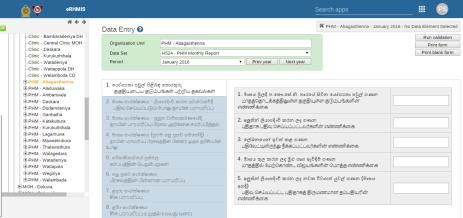
22The Data Entry Screen of eRHMIS
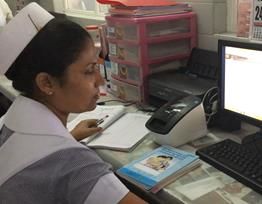
An eRHMIS User Training Workshop
23eNCD
electronic Non Communicable Diseases System
This DHIS2 based system capturing is done at Mobile
implementation was NCD Clinics, Healthy Lifestyle
implemented to support the Clinics and NCD clinics in
Non-Communicable Disease preventive care institutions.
Unit of the Ministry of Health.
From 2014 to 2016 the system The next phase of the project is
was able to replace the paper expected to incorporate Road
based data gathering on Traffic Accidents Surveillance.
Diabetes, Hypertension and It is also planned to enable
Cardio-Vascular Diseases in mobile supported data
the community. The data capture at mobile NCD clinics.
Handing over of the system by the development team to the Minister of
Health Honorable Maithripala Sirisena (the current President of Sri
Lanka) on 24 January 2014 by Prof. Vajira H. W. Dissanayake. Dr. Deepal
Wijesooriya who led the team that developed the system is also in the
picture.
24Registering and Verification of the Electronic Health
Information Systems in Sri Lanka
Most of the Health Information electronic Health Information
Systems in Sri Lanka are Systems of the State
currently being computerized. Healthcare Sector that covers
This is meant to improving the one or more of the following
efficiency, reliability and areas:
meeting expectations of the ● Systems that manage
stakeholders. Many software Personally Identifiable
are being developed, piloted Data of healthcare
and implemented in the state recipients.
healthcare sector. Sometime ● Clinical information
there is duplication of effort. systems.
The “National eHealth ● Systems managing medical
Guideline & Standards equipment and/ or
(NeGS)” which is applicable medical supplies.
for electronic Health ● Systems handling
Information Systems of both aggregated data of one or
the state and private more medical conditions
healthcare sectors is now in including risk factors and
effect. The state healthcare outcomes of the
sector has now recognized the condition(s).
requirement for a mechanism The process will address the
to ensure adherence of the issues arising in emerging
electronic health information electronic health information
systems to the NeGS and other systems early in their life
legal and ethical requirements cycle, ensure that the systems
to ensure interoperability, cater to the requirements, and
legality and sustainability of identify overlapping systems
these systems. catering to the same scope and
The scope of this initiative is to facilitate comparing such
create a registry of the systems which in tern would
25facilitate the implementation to be accepted and to
of the NeGS. The processes and responded online.
the formats were presented at Furthermore the paper based
technical level forums for system will be continued in
suggestions and critical parallel till the web based
analysis. The way forward mechanism is streamlined. A
include the further hand book will be prepared on
improvement to the formats/ the process to guide the
processes according to the researchers, developers,
suggestions, the implementers and other
recommended version to be stakeholders of electronic
National eHealth Steering health information systems.
committee for approval, pilot
testing of the process,
development of the web based
system to enable the proposals
26"Suwasariya" Telehealth Programme
Instantaneous access to free information. Its services
medical advice or health aimed for empowering and
information on disease details mobilizing communities for
as well as disease prevention the improvement of their
from qualified medical quality of life through health
professionals or from a promotion principles.
recognized institute is a vital Implemented as a tri-lingual
factor in community health health education information,
promotion. Electronic media is advice and guidance service by
now frequently used as a tool the Health Education Bureau
for health-related information from which Sri Lankans within
and communication in recent the country and abroad can
years. Sometimes medical access and seek help in the
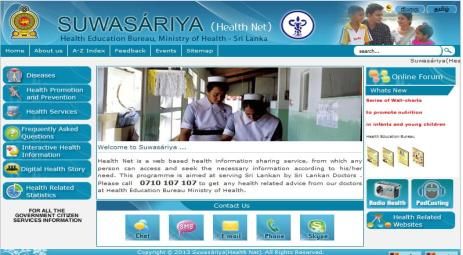
care seekers appear to be language of their choice.
using the Internet to enhance Suwasariya has two main
their own medical care by components, a health
using the information online educational web site
to diagnose a problem. (http://suwasariya.gov.lk/)
and a 24/7 health related help
Identifying above situation seeking call centre (Hot line-
and needs, Suwasariya +94710107107, email and
(Healthnet) was designed and SMS).
developed as a national Following types of health
programme to educate and educational services are
promote health of Sri Lankan provided by Suwasariya web
people by Health Education site and call center.
Bureau (HEB) which is the ➢ Provide guidance to
center of excellence in Sri resolve non-emergency
Lanka for health education, medical issues.
health promotion and ➢ Education on personal
publicity of health conditions needing
27discussion with a doctor. face with a doctor.
➢ Providing information ➢ Provide services to who
about disease prevention are abroad working or
and treatment. travelling and in need to
➢ Provide clarifications on discuss health issue with a
health publication and Sri Lankan doctor in his or
other communications . her mother tongue.
➢ Personalized advice on Services are provided by
Nutrition, Healthy consultant community
Lifestyle, and Personal physicians and medical officers
Hygiene. who are well experienced in
➢ Education and guidance preventive and curative sectors
on Sexual problems in Sri Lanka. It is supported by a
difficult to discuss face to group of other government
health institutes.
2829
Sri Lanka Stroke Clinical Registry

Stroke is the third leading              Association of Sri Lanka,
cause of hospital death                  Association of Sri Lankan
worldwide. It is the main cause          Neurologists, Ministry of
of adult disability. Effective           Health, Health Informatics
management of strokes is                 Society of Sri Lanka and other
hindered by many factors and             healthcare providers.
one of the most important
issue is lack of reliable                The SLSCR provides individual
epidemiological             data,        and health related information
indicators, prevalence pattern           of patients, generates real-
leads to reduced quality of              time data from the patient
care given in acute, chronic             records         for      health
and rehabilitative phases of             management         at   various
the      affected       patients.        administrative levels, and
Therefore the need to develop            facilitate clinician to access
a Stroke Clinical Registry was           accurate patient information.
crucial to improve the
management, treatment, and               The           implementation
rehabilitative care. Hence the           commenced with a detailed
objective of this initiative was         requirement analysis and an
to design, develop and pilot             architectural design for the
the web based Sri Lanka                  electronic Health Information
Stroke     Clinical     Registry         Management System and
(SLSCR) for the management               creating data components.
of Stroke patients. The project          The system was developed
was     funded      by     World         using Free and open source
Federation of Neurology and              software such as PHP and
World                     Stroke         MySQL in order to minimize
Organization through Ministry            cost and was piloted at Stroke
of Health. The core team                 Unit of National Hospital, Sri
included professionals from              Lanka. During the pilot phase
the       National        Stroke         software underwent testing
                                    30
for any issues of system data. The system was
functionalities, Graphical User introduced to the Colombo
Interphase, data entry and South Teaching Hospital
analysis reports were (Kalubowila), Mulleriyawa
documented and resolved. Base Hospital, and the
Teaching Hospital Batticaloa.
After successful Upto February 2017, data of
implementation at the Stroke more than 5300 stroke
Unit of the National Hospital of patients were captured in to
Sri Lanka, the system was the system. It is planned to
introduced to the Teaching introduce the system to all the
Hospital (TH) Kandy, TH Stroke units, Tertiary Care
Karapitiya, TH Jaffna and Hospitals and all District and
District General Hospital Provincial General Hospitals
(DGH) Chillaw. Nursing by the end of 2017.
officers were trained to enter
31Essential Drug Stock Alert Tracker
The health status in Sri Lanka each institution is not
is well above the regional available at the RMSD or at the
health indicators and it clearly regional and provincial health
reflected in the heath offices. Therefore they are not
indicators. However lack of able to take steps to replenish
pharmaceutical supplies in stocks in a timely manner. As a
government healthcare result most of the shortages of
institutions is a major pharmacy items in health care
complaint from the general institutions are not due to the
public. shortage of drugs at RMSD or
MSD but due to this poor
The Medical Supplies Division communication between
(MSD) issues pharmacy items RMSD and health institutions
for the region to their Regional or unequal distribution of the
Medical Supplies Division items from the RMSD. As drug
(RMSD). Ministry of Health stocks are maintained in a
institutions receive pharmacy manual drug stock register,
supplies directly from the there is no active alert
MSD. Provincial health care mechanism to make alert the
institutions receive their head of the institution or
pharmacy supplies from officer in charge of the drugs
RMSD and there is a Divisional store to low stock early and
Pharmacist in the RDHS office inform the RMSD to supply
to monitor and regulate this stocks in a timely manner.
process.
To overcome these problems a
Each health institution simple web based application
maintains their drug stock was developed to establish a
within their own drug store. timely information flow. This
However with the present Essential Drug stock alert
manual system, real time drug tracker was developed and
stock status information of integrated to the Provincial
32Health information System system in the Colombo district
(PDHIS). (2015/8/21) 16.24% of items
were at zero stock level and
Each health care institution only 55.56% items were at
was given a user name and satisfactory stock level. By
password to log into the January 2017 zero stock level
system. The Officer in charge had reduced to 0.4% and
at the drug store can log into satisfactory stocks level had
the system and enter the increased up to 85.4%. The
pharmacy items received from Zero stock level in Kalutara
the RMSD and items issued district showed a decline of
from the drug store to the 23.42% which was the highest
wards, clinics and OPD during reduction compared to the
the week. Each institutions other two districts. However
average daily usage is entered satisfactory stock level had
into the system and from that only indicated an increase of
their reorder level is 19% by January. The success
calculated. There is a color of the system was recognized
code system implemented and by the Commonwealth
the user dash board visualize Medical Association (CMA)
the available stock with the and the South Asian Digital
color code. This system was Empowerment Foundation
deployed in all regional (DEF) by awarding this system
hospitals in the Colombo a Commonwealth Digital
district (2 base Hospitals and 9 Award and Manthan Award
divisional hospitals) from respectively in 2016.
August 2015. It was extended
to the hospitals in the The team: Dr A L Fareed -
Gampaha and Kalutara Provincial Director of Health
districts in October 2015. Services, Western Province,
Currently there are 42 health Dr Anil Samaranayake -
institutions in the Western Deputy Provincial Director of
Province using the system. At Health Services, Dr Vajira
the commencement of the Nanayakkara – Consultant
33Community Dental Surgeon, Mohamed Rikaz Sheriff –
Dr Lasantha Ranwala - Chief (Formerly) Medical Officer
Designer and (now Registrar Health Informatics, Dr Sandun
in Health Informatics and De Silva – District Registered
formerly) Medical Officer Medical Officer ,Office of
Health Informatics, Office of Regional Director of Health
Regional Director of Health Services, Colombo
Services, Colombo, Dr
34SLJBMI
Sri Lanka Journal of Bio-medical Informatics
The Sri Lanka Journal of Bio- Dr. B. J. C. Perera with Prof.
medical Informatics (SLJBMI) Vajira H. W. Dissanayake, Prof.
published jointly by the Jayantha Weerasinghe, Dr.
Postgraduate Institute of Rohana Marasinghe, and Dr.
Medicine of the University of Roshan Hewapathirana
Colombo and the Health serving as Executive Editors.
Informatics Society of Sri
Lanka is the only Sri Lankan It is a peer-reviewed open
journal in the field of access journal available freely
Biomedical Informatics. The on the Sri Lanka Journals
fist issue of the Journal was online platform at the URL:
published in January 2010. It http://www.sljol.info/index.p
is published quarterly. The hp/SLJBMI
Editor in Chief of the Journal is
The journal ceased publication after its second issue of the fourth
volume in 2013. It is expected to be revived soon.
39A Short History of Health Informatics in Sri Lanka
and the
Health Informatics Society of Sri Lanka (HISSL)
In January 1997, a group of
doctors met at the head HISSL was incorporated as a
quarters of the Sri Lanka nonprofit company in Sri
Medical Association (SLMA) to Lanka in the year 1999. HISSL
discuss the formation of a became a member of the Asia
committee on medical Pacific Association of Medical
informatics. The meeting Informatics (APAMI) in 1999
ended with the appointment and a member of the
of a committee with Dr. Shyam International Medical
Fernando as the Chairperson Informatics Association
and Dr. Vajira H. W. (IMIA) in 2011. Dr. Vajira H. W.
Dissanayake as the Secretary. Dissanayake attended the
The objective of the committee APAMI meeting in Hong Kong
was to increase awareness in 2000 and read a paper, Dr.
about medical informatics Kumara Mendis served in the
among doctors. The main steering committee of the
activity of the committee was APAMI meeting in 2003 in
the publication of an South Korea, and Dr. Roshan
electronic newsletter called Hewapathirana represented
MediInfo that was emailed to HISSL when it was admitted as
members of the SLMA. The a member of IMIA at the IMIA
archive of this electronic General Assembly in Oslo on
newsletter, which can be 28 August 2011.
accessed at
http://www.infolanka.com/o The main activity of HISSL
rg/mediinfo/, provide during its first decade of life
interesting insights in to the was scientific meetings that it
medical informatics scene in organized on its own and in
Sri Lanka at that time. collaboration with other
40professional medical colleges that he continues to hold up to
and associations. The date. Under Dr. Vajira H. W.
inaugural scientific meeting of Dissanayake’s leadership,
the HISSL was held on 4 April HISSL has grown from
1999, and thereafter meetings strength to strength. The
were held in March 2003 and foundation for this success
in June 2004. In between many came in the form of a chance
smaller meetings and introduction of Prof. Sundeep
symposia were held in Sahay, Professor, Department
collaboration with other of Informatics, University of
professional medical colleges Oslo, Norway to Dr.
and associations. The Dissanayake by Dr. Rohan
Presidency of HISSL passed on Jayasuriya of the University of
to the Late Prof. M.T.M. Jiffry in New South Wales, Australia in
2003 and to Dr. Kumara 2007. Prof. Sahay who has
Mendis in 2004. In these early been involved in developing
years some of the prominent health informatics in many
personalities who visited Sri countries offered his support
Lanka and helped and for Sri Lanka to do so. In June
encouraged us were Prof. Ian 2007 Prof. Sahay visited the
Purves from the UK, Prof. K. C. University of Colombo and at a
Lun from Singapore, Prof Yun meeting at the Postgraduate
Sik Kwak from South Korea, Institute of Medicine (PGIM) of
and Prof Yu-chuan Jack LI the University of Colombo,
from Taiwan. Among them, facilitated by HISSL, at the
Prof. Lun’s influence on HISSL office of Prof Rezvi Sheriff,
was very prominent. who at that time, in addition to
being the President Elect of
In January 2008, Prof. Rezvi HISSL, was also the Director of
Sheriff was elected President. the PGIM, it was decided to
He held this position until start a Masters Course in
September 2009 when Dr. Biomedical Informatics. After
Vajira H. W. Dissanayake was the meeting Dr. Dissanayake
elected President, a position and Prof. Sahay worked on
41submitting a grant application laid the foundation to creating
to the Norwegian Center for a generation of leaders in
International Co-operation in health informatics who would
Higher Education (SIU) for work with medical
funding to start the course. administrators hand in hand
They were successful in to spearhead the deployment
securing a grant of over a of health informatics in Sri
million dollars that supported Lanka. The Ministry of Health
the course until 2014. Today granted two years paid leave
the course has become self- for medical doctors and dental
financing and annually upto surgeons to follow the course.
30 students are taken into As a result, the course was
follow the course. The grant, in very popular. So far there have
fact, came from Norad under been 89 Sri Lankan graduates
its Norwegian Masters from the course in 5 batches
(NOMA) programme that was and 50 more are currently
managed by SIU. Dr. following the course. One of
Dissanayake was requested to the graduates was a
spearhead this project at the Vietnamese student who went
PGIM. By August 2008, back to Vietnam after
curriculum development was graduation.
completed, a specialty board
in Biomedical Informatics was The graduates have been
set up to administer the course appointed as Medical
with Dr. Dissanayake as Officers/Dental Surgeons in
Founder Chairperson and Dr. Health Informatics in various
Roshan Hewapathirana as the institutions of the Ministry of
Course Manager, and Health and have been
advertisements had been spearheading the
placed to recruit students for development of health
the course. The first batch of informatics in their
students started their training institutions. This has resulted
in May 2009. The in rapid development of health
commencement of the course informatics in Sri Lanka with
42exponential growth expected graduates of the masters
in the next few years. The course at its annual
success of the course and the conferences that have now
impact it has had on the health taken an international
sector in Sri Lanka resulted in dimension. The first in this
Health Informatics being series of conferences - eHealth
recognized as a board Sri Lanka 2010 was held in
certifiable medical specialty in October 2010; thereafter the
Sri Lanka in 2015. The conferences have been
graduates of the masters eHealth Sri Lanka 2013;
course can now follow a two- eHealth Asia 2015
year Doctor of Medicine (MD) (ehealthasia.org); and Digital
course in health informatics Health for Health and
and after two more years of Wellbeing in collaboration
post MD training, of which one with the Commonwealth
year is in an overseas country, Medical Association in 2016
they become eligible to be (cma2016.org). These
Board Certified in Health conferences have resulted in
Informatics. The entire Sri Lanka becoming a hub for
programme is funded by the eHealth/mHealth and Digital
Ministry of Health. MD Health activities. In
students, like the MSc recognition of this fact the
students, are granted paid Commonwealth Medical
leave to follow the course full Association (CMA) invited
time. The first batch of twenty- Prof. Vajira H. W. Dissanayake
two MD students was selected to take on the Presidency of
in November 2016, and they the CMA with the view to
will go on to become the first leading a Commonwealth wide
batch to be board certified in Digital Health initiative. This
the year 2020. resulted in the launch of the
Commonwealth Digital Health
In this background HISSL has Network and the Annual
been showcasing its activities Commonwealth Digital Health
and the achievements of the Awards in October 2016 in
43Colombo. These initiatives are November 2013, when the
being driven with the World Health Organisation’s
technical assistance of HISSL. South East Asian Regional
Office (SEARO) adopted a
In January 2010 HISSL joined Regional eHealth Strategy at a
up with PGIM to launch the Sri High Level Ministerial Meeting
Lanka Journal of Biomedical in Bangkok, Thailand,
Informatics as an outlet for President of HISSL, Prof. Vajira
showcasing Sri Lanka case H. W. Dissanayake was
studies in the field of Health requested by the government
Informatics. It was a peer of Sri Lanka to represent the
reviewed open access journal country and be the signatory
published quarterly online for Sri Lanka. HISSL has also
(http://sljbmi.sljol.info). Dr. been working as partners with
BJC Perera served as its international development
founding editor in chief. The organisations such as such as
journal has had many the UNICEF and Bloomberg
challenges and ceased Philanthropies to implement
publication in 2013. It will be major health informatics
re-launched in 2017. projects in Sri Lanka. The
District Nutrition Monitoring
Today HISSL is the major System App developed by
technical partner of the HISSL with funding from
Ministry of Health, Sri Lanka UNICEF, which is used by field
for ICT implementation in the level public health staff in Sri
country. The Sri Lankan Lanka to monitor the nutrition
government has recognized status of children, won the
the role played by HISSL. prize for the best early stage
HISSL is represented in the app in the South Asian region
national eHealth Steering at the mBillionth Awards
Committee of the Ministry of Ceremony in New Delhi in July
Health and the Country 2016. This has been one of the
Coordinating Mechanism of major milestones in the
the Global Fund. In fact in transformative process that
44the Health Informatics sector
in Sri Lanka has been
undergoing as a result of the
work that HISSL has been
doing since 1998. It is
noteworthy that the driving
force for this change has been
the medical professionals
themselves.
In November 2016 the
government of Sri Lanka took
a major step forward for
Digital Health in the country
when the Cabinet of Ministers
accepted a proposal by Prof.
Dissanayake to set up a Sri
Lanka Institute of Digital
Health. The institute will be
established within the next
two years. The opening of the
institute in 2018 would be the
culmination of a 20-year long
journey by HISSL to promote
and facilitate Medical
Informatics, Health
Informatics, eHealth, mHealth
and now Digital Health in Sri
Lanka and the region
45Published by the Health Informatics Society of Sri Lanka
You can also read


