Digital labels as the next step for informed consumer decisions - experiences from an EU field trial - TU Dresden
←
→
Page content transcription
If your browser does not render page correctly, please read the page content below
This project has received funding from the European
                                                                                                                                                         Union’s Horizon 2020 research and innovation
                                                                                                                                                        programme under grant agreement No 696081

        Digital labels as the next step for informed consumer decisions - experiences from
                                                                            an EU field trial
                                      ENERDAY 2019 - 13th International Conference on Energy Economics and Technology 12th April 2019
The sole responsibility for the content of this presentation lies with the authors. It does not necessarily reflect the opinion of the European Union.
Neither the EASME nor the European Commission are responsible for any use that may be made of the information contained therein.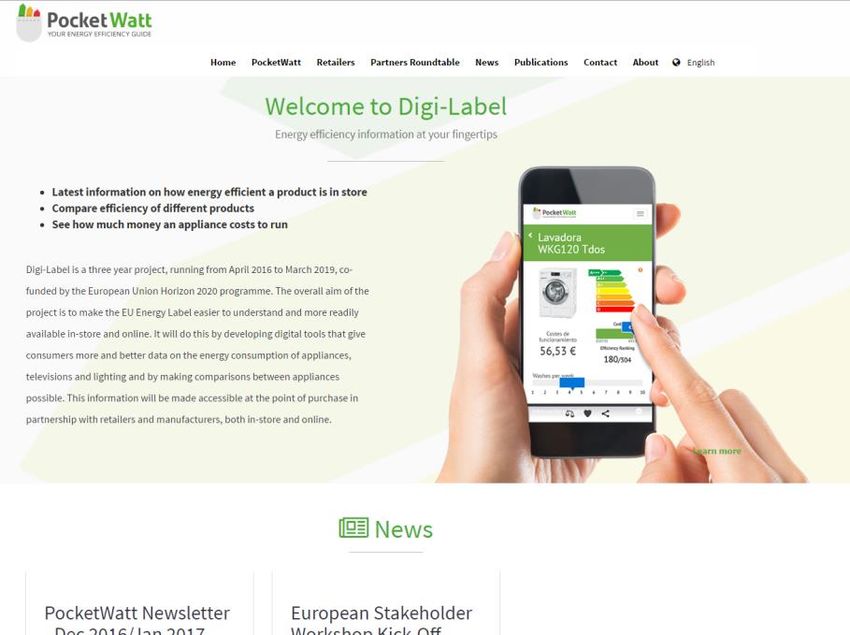
Motivation
• The European energy label for household appliances has the aim to promote
more energy-efficient appliances.
• Energy label is positively received by many consumers and also well-known.
However, a significant number of consumers admits that they do not
understand all elements on the energy labels.
Digital labelling tools have the potential to solve this issue.
www.newenergylabel.eu
The sole responsibility for the content of this presentation lies with the authors. It does not necessarily reflect the opinion of the European Union.
Neither the EASME nor the European Commission are responsible for any use that may be made of the information contained therein.
2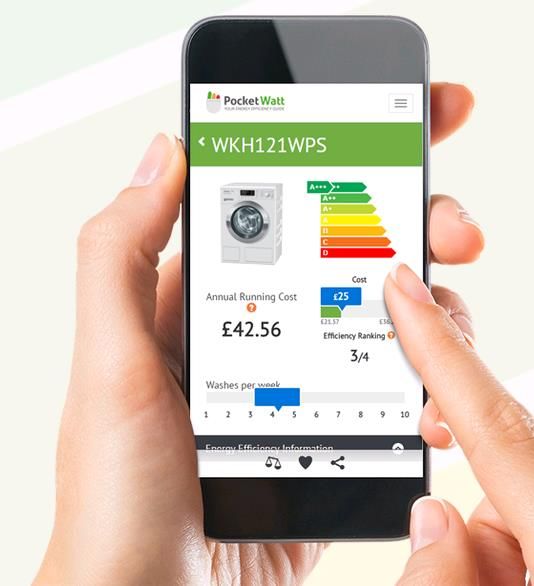
The Digi-Label project
         •       Overall aim of the project: To make the
                 EU Energy Label easier to understand and
                 more readily available in-store and online.
                    –      Developing digital tools (‘PocketWatt’)
                           that give consumers more and better data
                           on the energy consumption of appliances
                           by making comparisons between
                           appliances possible.
                    –      Evaluation of the process and outcome of
                           the tool

         •       Project coordinator: Energy Saving Trust
         •       Running from April 2016 to March 2019
         •       Co-funded by the European Union
                 Horizon 2020 programme.

The sole responsibility for the content of this presentation lies with the authors. It does not necessarily reflect the opinion of the European Union.
Neither the EASME nor the European Commission are responsible for any use that may be made of the information contained therein.
                                                                                                                                                         3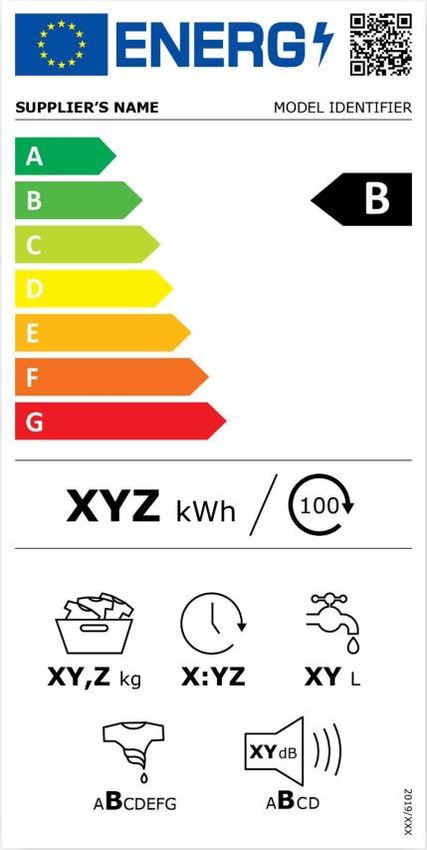
The PocketWatt tool
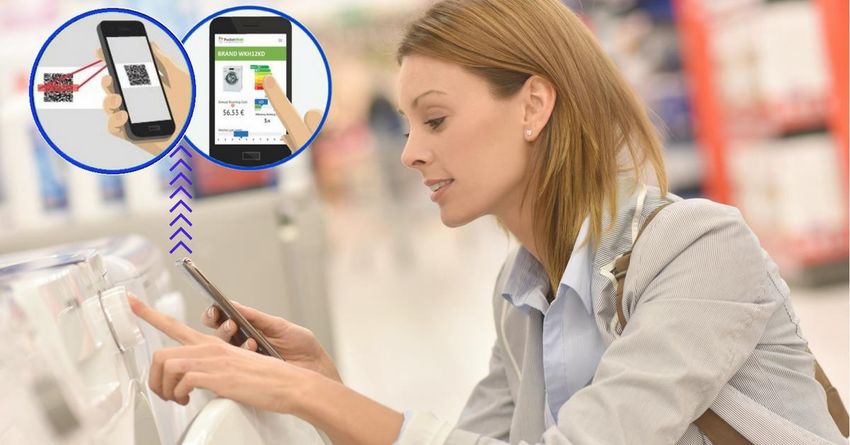
         •       PocketWatt: website and online application, designed to be used on a smartphone or
                 similar devices during shopping.
         •       Contains relevant product information for appliances with energy labels on a model-by-
                 model basis.
         •       Tool was implemented in selected shops in several EU countries (QR code attached to
                 appliance in store and implementation of widget in some online shops).

                                                                                                                                                         Rollout phase
                                                                                                                                                • Czech Republic,
                                                                                                                                                  Germany, Italy, Spain,
                                                                                                                       Pilot phase                UK.
                                                                              www.pocketwatt.eu

                                                                                                                       • Spain + UK             • Additional appliances,
                                                                                                                                                  including clothes
                                                                                                                       • Focus on refrigeration
                                                                                                                                                  dryers, dishwashers
                                                                                                                         products and washing
                                                                                                                                                  and air conditioners,
                                                                                                                         machines.
                                                                                                                                                  were included.
                                                                                                                       • Completed in 2017
                                                                                                                                                • 2018 /2019

The sole responsibility for the content of this presentation lies with the authors. It does not necessarily reflect the opinion of the European Union.
Neither the EASME nor the European Commission are responsible for any use that may be made of the information contained therein.
                                                                                                                                                                           4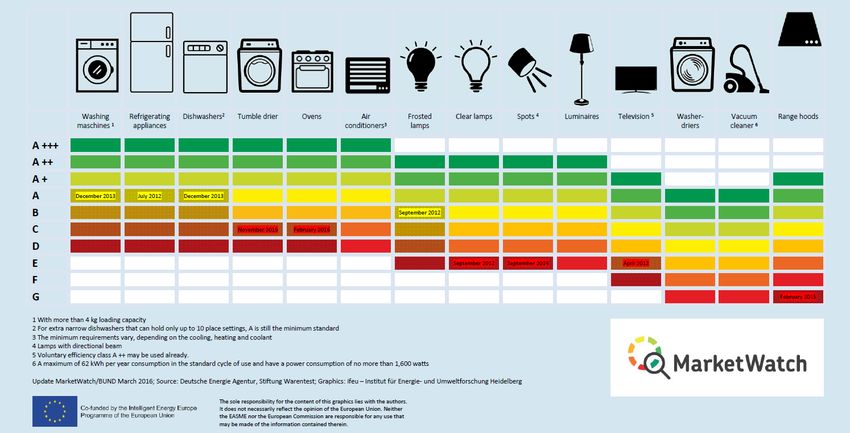
Overview of the evaluation
                                                                                                Evaluation
                                                                                           during pilot & roll-out

                                                           Quantitative part                                                          Qualitative part

                                                     Assess possible impact                                                          Assess attention,
          Aim:
                                                      of tool on changes in                                                              usability
                                                               sales                                                                 and satisfaction

                                                                                                                                   Customer survey,
          Method:                                           Sales data analysis
                                                                                                                                consumer workshops &
                                                             & tool utilization
                                                                                                                                    staff interviews

                                                                                          Impact of PocketWatt

The sole responsibility for the content of this presentation lies with the authors. It does not necessarily reflect the opinion of the European Union.
Neither the EASME nor the European Commission are responsible for any use that may be made of the information contained therein.
                                                                                                                                                         5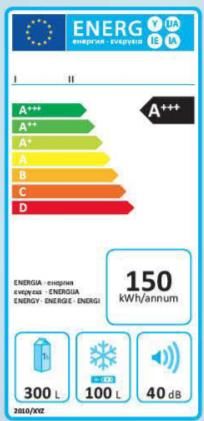
Qualitative analysis
                                                                                                Evaluation
                                                                                           during pilot & roll-out

                                                           Quantitative part                                                          Qualitative part

                                                     Assess possible impact                                                          Assess attention,
          Aim:
                                                      of tool on changes in                                                              usability
                                                               sales                                                                 and satisfaction

                                                                                                                                   Customer survey,
          Method:                                           Sales data analysis
                                                                                                                                consumer workshops &
                                                             & tool utilization
                                                                                                                                    staff interviews

                                                                                          Impact of PocketWatt

The sole responsibility for the content of this presentation lies with the authors. It does not necessarily reflect the opinion of the European Union.
Neither the EASME nor the European Commission are responsible for any use that may be made of the information contained therein.
                                                                                                                                                         6
Approach for the qualitative evaluation in
the rollout
Customer perspective: variety of sources
• Customer surveys at the point of sale (standardized interview questionnaire for approx. 5 min) (only Spain,
n=53)
• Additional data sources:
– Short online-based customer surveys in the tool and on social media (reduced version of customer
survey questionnaire) (cross-country and UK, n=21 / n=22)
– Short customer surveys for participants of a fair (reduced version of customer survey questionnaire)
(Italy, n=119)
– Additional customer workshop: group discussion with customers at the point of sale (Germany, n=7)
Knowledge Purchase Re-
Awareness Usability
increase behavior commendations
Retailer perspective
• Interviews with shop employees
(interview guideline with open questions) (Germany, UK, Spain, Czech Republic; n=19)
Promotion of Customers Customers Purchase Re-
tool awareness acceptance decision commendations
The sole responsibility for the content of this presentation lies with the authors. It does not necessarily reflect the opinion of the European Union.
Neither the EASME nor the European Commission are responsible for any use that may be made of the information contained therein.
7Results for the customer perspective
Knowledge Purchase Re-
Awareness Usability
increase behavior commendations
Overall evaluation of PocketWatt: Results from the additional data sources Customer workshop:
0% 10% 20% 30% 40% 50% 60% 70%
'Works
immediately [...]
1=Extremely useful
No mistakes in it,
clean app. Works.'
2
3 'Sure, great at first
sight. Very user-
4 friendly.'
5=Not at all useful ‘...a few more
arguments have to
UK customer survey (n=22) Italian customer survey (n=119) be added. But
Online survey in the tool (n=21) Customer workshop in Germany (n=7) that's a solid basis.'
Note: Due to the very small sample sizes, especially at the customer workshop, the percentage values are for
comparison only, but not to be generalised
The sole responsibility for the content of this presentation lies with the authors. It does not necessarily reflect the opinion of the European Union.
Neither the EASME nor the European Commission are responsible for any use that may be made of the information contained therein.
8Results for the customer perspective
Knowledge Purchase Re-
Awareness Usability
increase behavior commendations
How did PocketWatt influence the (planned) Results from customer survey in Spain were
purchase decision? confirmed by the other surveys.
Results from the customer surveys Expected influence on the purchase decision
(Spain, n=53) discussed in more detail in customer
workshop:
Confirmed original preference 21% Household appliances are not bought as
often and are used for a long time
Chose or now prefer another purchase is well considered, variety of
45% information sources is used.
more energy efficient product
PocketWatt can act as orientation guide in
Chose or now prefer another
5% purchasing process by simplifying the
product for other reasons
research process.
Not at all 17%
'I wouldn't buy [the appliance] at that
moment either, but I think that
Undecided 12% simplifies the research process for the
purchase. You just have everything
together, [...]'
The sole responsibility for the content of this presentation lies with the authors. It does not necessarily reflect the opinion of the European Union.
Neither the EASME nor the European Commission are responsible for any use that may be made of the information contained therein.
9Results for the retailer perspective
Promotion of Customers Customers Purchase Re-
tool awareness acceptance decision commendations
• Staff supports customers • Positive customer • People perceive it as not • No feedback from
in using the tool (4) feedback: Easy to official (1), are not familiar customers / not aware of
understand and to use (2) with it (2) any
• Customers understand it,
are interested (3) • No feedback from • Preference for personal
customers / not aware of advice (1)
• 5-20/25% of customers any (2)
use the tool (4), 80% need • Little interest in energy
help (1) • No Wifi and poor signal in efficiency (1)
store, therefore tool cannot
• Older customers would be used (1). • Customers notice the QR
not use tool as they are codes, but some believe
not internet savvy (2). they are price labels (1).
• Tool is party perceived as
impractical because of
many steps necessary to
use it (1)
The sole responsibility for the content of this presentation lies with the authors. It does not necessarily reflect the opinion of the European Union.
Neither the EASME nor the European Commission are responsible for any use that may be made of the information contained therein.
10Results for the retailer perspective
Promotion of Customers Customers Purchase Re-
tool awareness acceptance decision commendations
• Increase retailer engagement:
• More training and support for the retailers (e.g. printing the QR codes etc.) to implement the tool
• Increase customer awareness and acceptance for the tool:
• Advertise PocketWatt (e.g. in mass media or social media), highlight QR code visually
• Improve the tool (include more features like break-even analysis, runtime of the appliances or more
filtering options)
• Link PocketWatt und EU Energy Label more closely:
• Integrate energy efficiency class in the QR code to understand reference to energy efficiency
• Integration of PocketWatt in EU Energy Label and make PocketWatt mandatory
• Change names of PocketWatt to something EU related to create official and familiar character
The sole responsibility for the content of this presentation lies with the authors. It does not necessarily reflect the opinion of the European Union.
Neither the EASME nor the European Commission are responsible for any use that may be made of the information contained therein.
11Conclusions from the qualitative evaluation
• Tool is perceived positively and useful by customers, in particular, if they receive assistance in
accessing and using the tool.
• For the majority of customers using the tool leads to an increase of knowledge, that means,
the tool has achieved its objective by complementing the conventional energy label and
making it more useful for consumers
The tool has thus the potential to have an impact on the purchase decisions of customers
• The interviewed staff personnel was more sceptical...
– because energy efficiency is not a top priority for many customers
– because the technical requirements (smartphone, internet connection and QR-code scanner) can
make the use of the tool difficult
– because promoting the use of the tool in the shop requires effort
... however, the majority is convinced of PocketWatt and believes it should be more
advertised
Cautious assumption: Considerable energy savings could be achieved in case of a wide
deployment
The sole responsibility for the content of this presentation lies with the authors. It does not necessarily reflect the opinion of the European Union.
Neither the EASME nor the European Commission are responsible for any use that may be made of the information contained therein.
12Conclusions from the quantitative
evaluation
All product groups:
• Trend towards more efficient classes from reference to roll-
out
• Exception: Reversible and cooling conditioners
• General trend towards less consumption
• Reduction in average absolute consumptions: The averages in terms of
consumption per fridge/freezer for the rollout is approximately -9.4
kWh/a or about 4 % lower than in the reference case.
• Refrigerators increase despite slight improvement in efficiency classes;
cooling conditioners decrease despite slight deterioration in classes
The sole responsibility for the content of this presentation lies with the authors. It does not necessarily reflect the opinion of the European Union.
Neither the EASME nor the European Commission are responsible for any use that may be made of the information contained therein.
13Outlook
• New regulation for energy labelling
framework in the EU published in 2017:
European Product Database for Energy
Labelling (EPREL).
• Data stored in EPREL could serve to feed
PocketWatt or related tools in the future.
• Revision and re-calibration of energy
efficiency classes.
• New labels suggested also include QR code
that will offer additional information.
The sole responsibility for the content of this presentation lies with the authors. It does not necessarily reflect the opinion of the European Union.
Neither the EASME nor the European Commission are responsible for any use that may be made of the information contained therein.
14Thank you
Uta Burghard
Simon Hirzel
Elisabeth Dütschke
Fraunhofer ISI
uta.burghard@isi.fraunhofer.de
The sole responsibility for the content of this presentation lies with the authors. It does not necessarily reflect the opinion of the European Union.
Neither the EASME nor the European Commission are responsible for any use that may be made of the information contained therein.
15You can also read


