Digital Press Conference - Health Update Dr K Cloete - Western ...
←
→
Page content transcription
If your browser does not render page correctly, please read the page content below
Digital Press Conference

                                               Health Update

                                                 Dr K Cloete

                                                     8 July 2021

© Western Cape Government 2012 |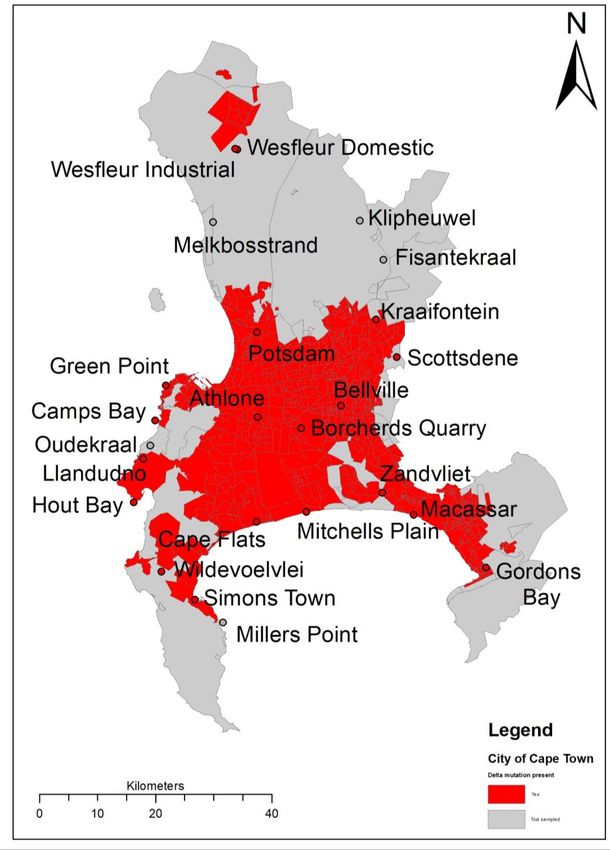
Overview

1. Surveillance & Response Update

2. Expectations for the 3rd wave

3. Triggering the third wave response

4. Vaccine Implementation update

5. Conclusions

Surveillance & Response Update
Integrated testing, case, hospitalisation and mortality trends

             © Western Cape Government 2012 |
Current reproduction number (Western Cape)

Reproductive number >1 for 2 months – currently ~1.2

                                                       Approximated based on smoothed doubling times, cases by date of reporting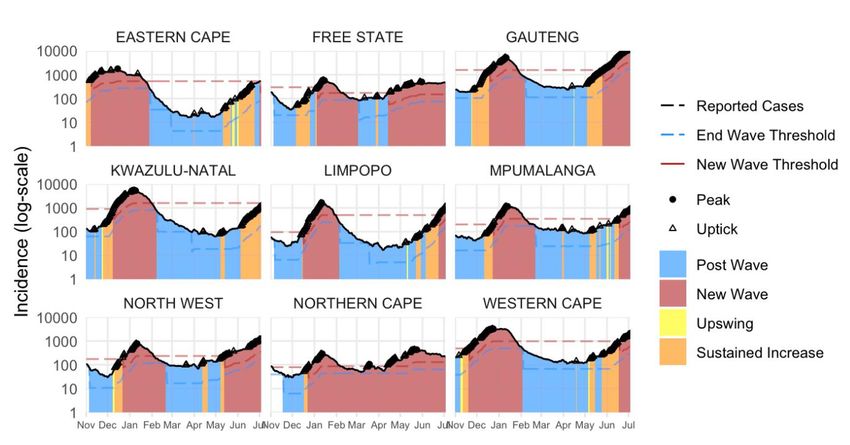
National trends

• All provinces except KZN are in
  a 3rd wave.
• Gauteng: Early sign of decrease in
  cases but need to watch closely

                                       7-day moving average of new cases by province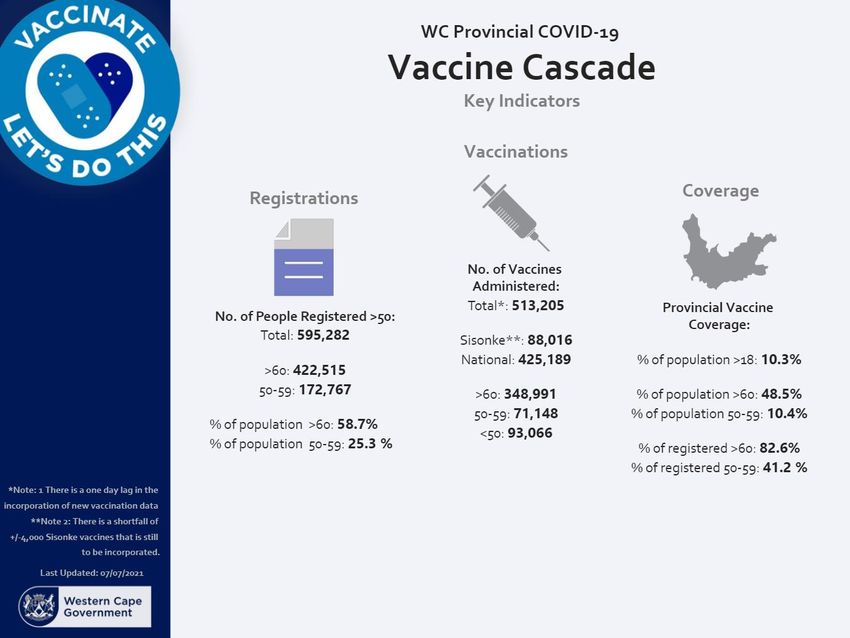
29% in last wk
             (25 June – 2 July 2021)

                         24% in last wk                              72% in last wk
                 (25 June – 2 July 2021)                     (25 June – 2 July 2021)

             •    Case numbers are continuing increase, and we are currently seeing an
                  average of 1969 new diagnoses each day.
             •    Restricted public sector testing criteria will artificially lower public sector case
Provincial        numbers. Also as the absolute numbers of cases rise, the percent increases
                  become smaller.
Overview     •    The proportion positive has also increased markedly to an average of 32%.
             •    Admissions are increasing with an average of 170 new admissions per day.
                  Deaths have also increased now, with around 35 deaths each day.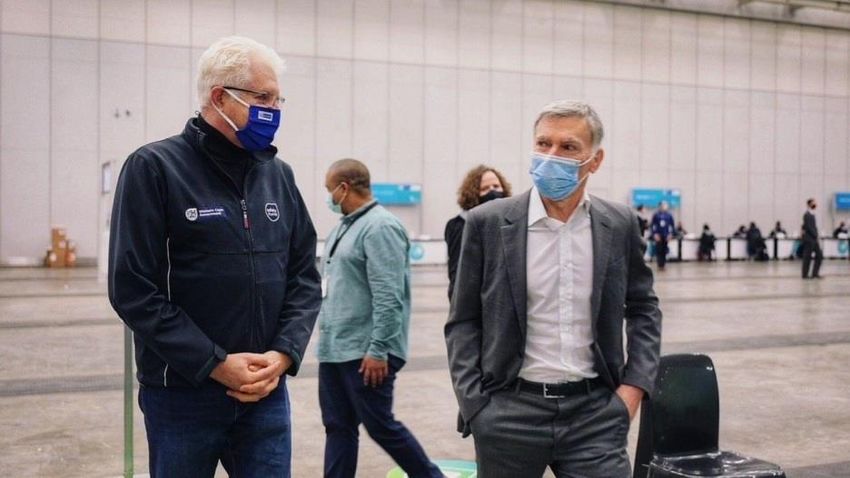
96%
                                                                                 19%

                         28% in last wk
                 (25 June – 2 July 2021)
      5%
                                                                                 44%

      15%             44%                          40%                           33%

                  •   Overall, there is a 28% week on week increase in cases in the Metro.
                  •   All the sub-districts are seeing a marked increase in cases.
Metro Overview    •   Increasing proportion of cases from the public sector in the Metro in the last
                      week.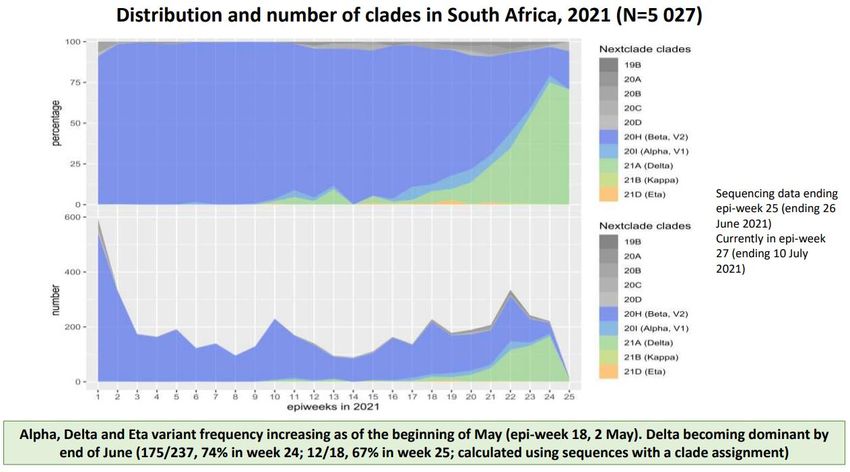
46%

                         30% in last wk
                 (25 June – 2 July 2021)

    1%

    67%          7%                          28%

                  • The number of new cases in Rural is also increasing, with all districts
                    showing increasing case numbers.
Rural Overview    • Private cases still dominate in Cape Winelands, while the rest of Rural has a
                    mix of both public and private.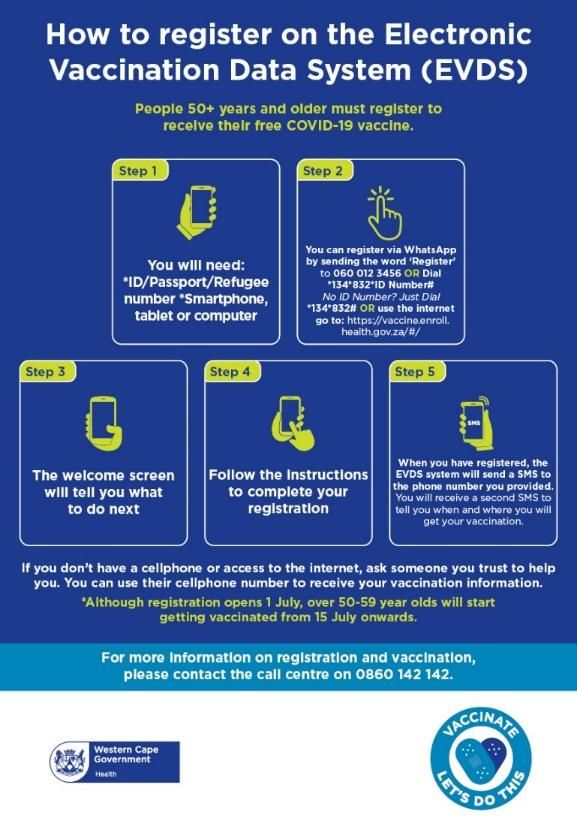
There are currently 24 010 active infectious cases.
This is 6402 more active cases (36%) in the last week.
                                                         10
Currently • The week on week increases in current admissions have been admitted above 20% for more than a week. patients • Currently 2 283 patients are admitted with COVID-19.
Western Cape and
Cape Town Metro
now breached
upper bound of
expected deaths.
5 July 2021
Surveillance
Huddle Notes

Increasing case
numbers make it
difficult to identify
clusters

- shifted to widespread
community
transmission and
mitigation
Comparing the 3 waves   • 3rd wave possibly slightly slower than
                          2nd wave now, but could be earlier
                          testing restrictions
                        • Have exceeded the peak of 1st wave
                        • Continue to see different wave patterns
                          in different Metro sub-districts – in
                          keeping with previous seroprevalence
                          results

                                                                    14
Triangulating with wastewater
WEEK 26
SAMRC COVID- 19 AND WASTEWATER EARLY WARNING SYSTEM 2021
City of Cape Town, Breede Valley AND Overberg
Breede
Valley
Metro:
SARS-CoV-2 >500
copies/ml (category 2 or
higher) at 87% of
treatment plants
(same as last week)
10 plants had increased
SARS-CoV-2 viral load vs
Breede Valley:
previous week
SARS-CoV-2 viral load remains in category 5 in Rawsonville,
but decreased in De Doorns and Worcester.
8 Treatment plants at
category 4/5
Theewaterskloof:
↑ to category 2 in Grabouw.
All other treatment plants ↓ or unchanged (category 2).Tested wastewater from treatment plants
with SARS-CoV-2 >2000 copies/ml for
presence of delta variant using PCR test
that identifies 2 delta mutations.
Delta present:
• 19/23 treatment plants in Metro
• All 4 plants in Breede Valley
(Worcester, Rawsonville, Touws River &
De Doorns)
• Both plants in Theewaterskloof with
SARS-CoV-2 >2000 copies/ml
(Bot River & Villiersdorp)
Currently doing full sequencing to confirm PCR
results
Looking at historic specimens to assess when
delta emerged
Viral particles in wastewater
NOT infectiousUpdate on delta variant nationally
Delta dominant variant for all provinces with sequence data for mid-June onwards (GT, KZN, WC, EC, LP, NW)
© Western Cape Government 2012 | 17Update on delta variant in routine surveillance in WC
• Delta dominant variant (70-80%) of routine surveillance specimens in WC
from mid-June onwards.
• Global prevalence of delta increasing rapidly – what is happening in SA is
happening everywhere.
© Western Cape Government 2012 | 18Expectations for the Third Wave
SA COVID-19 Modelling consortium currently updating
third wave expectation to take delta into account
Short term predictions from SACMC – new cases

Still forecasting rising numbers of cases but at a slightly slower rate than before

                                                          Black line:
                                                          previous cases

                                                          Grey line:
                                                          forecast for this week
                                                          Dots:
                                                          actual cases

                                                          Red line:
                                                          Prediction for next week
Short term predictions from SACMC – new admissions Expecting ~500 new admissions per day by mid-July
Triggering the Third Wave Response
Western Cape 3rd wave advisory
Principle: Transparent pre-defined triggers for whole of society response to reduce transmission
and prepare health services. Note: Metrics in bold met

 Indicator             Example of Resurgence Metric
 First warning:                 Large ↑ daily cases (increase for ≥ 1 week of ≥ 20%)
 ↑ health service               Overall test positivity >7% for ≥1 week
 demand in 14-21d
                                >15% of hospitals have >10% of beds occupied by COVID-19 patients
                                >50% ↑ in pre-COVID-19 hospital O2 use
 Second warning:                Overall test positivity 10-15% for ≥1 week
 ↑ health service               >15% week-on-week increase in 7dma of current admissions
 demand in 7-14d
                                >40% of hospitals have >10% of beds occupied by COVID-19 patients
                                >75% ↑ in pre-COVID-19 hospital O2 use
 Third warning:                 >20% week-on-week increase in 7dma of current admissions
 ↑ health service               >50% of hospitals have >20% of beds occupied by COVID-19 patients
 demand in 2-7d
                                >50% of high care, intensive care & HFNO2 COVID-19 beds occupied
                                >100% ↑ in pre-COVID-19 hospital O2 use
 Health service                 >2800 current COVID-19 inpatients
 capacity threatened            >80% of high care, intensive care & HFNO2 COVID-19 beds occupied
                                >200% ↑ in pre-COVID-19 hospital O2 use                             23
Approaching 3rd warning indicator
Indicator Recommended action
First warning Strong public messaging about ↑ cases and need for stricter NPI adherence
indicator. Publish ceilings of 2nd warning indicators with restriction expectations
↑ in health ↑ testing capacity, contact tracing, isolation
service demand Prepare to mobilize resources for a substantial surge
in 14-21 days.
↑ vaccination
Targeted sequencing of virus
Recommend restrictions: gatherings, travel
Second warning Continue public messaging, vaccination, viral sequencing as above
indicator. Publish ceilings of 3rd warning indicators with restriction expectations
↑ in health Limit testing not absolutely necessary
service demand Mobilize resources to support a substantial surge within 7 to 14 days
in 7-14 days.
Recommend further restrictions: gatherings, curfew
Third warning Continue public messaging, vaccination, viral sequencing, testing limits as above
indicator. Publish potential increase of restriction expectations if systems overwhelmed
↑ in health Further mobilize resources to support a substantial surge within 2-7 days
service demand Recommend restrictions: gatherings, curfew, alcohol
in 2-7 days. 24Adjusted level 4 restrictions
1. Gatherings:
a) No gatherings.
b) Funerals ≤50 people; max duration of 2 hours.
2. Curfew:
a) Time: 21:00-04:00
b) Closing times: 20:00
3. Alcohol: All sales and transport prohibited
4. Restaurants: Take-away service only
5. Early school closure
6. No leisure travel to/from Gauteng
© Western Cape Government 2012 |Google mobility data – percentage change in mobility in relation to restrictions Some evidence of ↓ workplace & ↑ residential mobility since Level 4 introduced. No major change in other mobility indicators
In the midst of the Mitigation Paradigm

                          Community Behaviour, at this point, becomes even more
                                     important as individual risk increases.
                         This will inevitably translate into how the wave progresses
                         and whether we, as a collective, can flatten the height of it.

                       Trigger Points for titrating response

    Outbreak
response shifts
    focus to
protecting high
 risk COVID-19
    patients

                                                                                          Note: Trigger Points are
                                                                                           actively monitored in
                                                                                            order to titrate the
                              During the wave 3 period we will be asking of our staff     response to the COVID-
                               to manage increasing COVID-19 cases and a Phase 2           19 wave and achieve
                             vaccine programme over and above their normal clinical        balance for COVID-19
                                duties. This additional burden will stretch our staff.      and comprehensive
                                                                                             service capacity.
Acute service platform – current picture
1. Currently 2 283 COVID patients in our acute hospitals (963 in public hospitals & 1320 in private
hospitals). This excludes PUIs and cases in specialised hospital settings.
2. The Metro hospitals have an average occupancy rate of 87%; George drainage area hospitals
at 60%; Paarl drainage area hospitals at 78% & Worcester drainage area hospitals at 67%.
3. COVID & PUI cases currently make up 16% of all available acute general hospital capacity in
both Metro and Rural Regional Hospital drainage areas.
4. COVID inter-mediate care – the Brackengate Hospital of Hope currently has 133 patients (3 859
cumulative patients), Freesia & Ward 99 has 0 patients, Mitchell Plain Hospital of Hope has 47
patients and Sonstraal currently has 39 patients.
5. The Metro mass fatality centre has capacity for 240 bodies; currently 17 decedents (cumulative
total of 1 513 bodies) admitted. The overall capacity has been successfully managed across the
province.
© Western Cape Government 2012 |Current Acute Bed Utilisation per Drainage Area
Operational Bed = an inpatient bed available for inpatient use that is staffed and equipped.
© Western Cape Government 2012 |Date Lockdown Alcohol
Period Level Regulation Curfew
16 Offsite sale
June - restriction
27 Mon-Thurs
June Adjusted 10-00- 22:00-
2021 Level 3 18:00 04:00
>28 Complete
June Adjusted prohibition 21:00-
2021 Level 4 of sale 04:00
During the first week following the complete
alcohol ban from a partial alcohol ban we see week
on week trauma presentations decrease by ~25%
and weekend trauma burden decrease by ~33%.
This is in the context of a baseline restricted
alcohol availability, initial remaining stock on hand
and expected end-of-month increase in trauma
presentations. 21-06-2021 to 27-06-2021 28-06-2021 to 04-07-2021Oxygen utilisation – general comments
1. The combined public-private utilisation is now 47.20 tons/day or 67.4% of the
maximal production capacity (70 tons/day) at the Afrox Western Cape plant.
2. The public sector total average bulk oxygen consumption is 23.6 tons/day. This
equates to around 33.72 % of the daily bulk consumption of the Afrox WC plant
for the 7-day period ending 30th April 2021. This is compared to 51 tons/day in
the first week of January.
3. Both public and private sectors are addressing some of the capacity challenges
at facility level, as identified during the 2nd wave, in preparation for the 3rd wave.
4. We will continue to monitor the utilisation of oxygen over the coming weeks, with
an undertaking from Afrox to be able to scale up the provision as required for a
3rd wave.
© Western Cape Government 2012 |Preparing and Caring for our People – 3rd Wave
CTICC Appointments Finalised:
Workforce Planning:
Status PNs SNs NAs Pharm Pharm Admin Interns
Appointed 833 staff additional for COVID Assist
Appointed 775 HCW and support staff as well as 359
interns for the Vaccination Drive Appointed 29 15 10 1 1 15 40
Further contract extensions and re-allocation of staff in (18 more
response to 3rd wave to be
filled)
753 applicants can still be appointed, if needed
General Work Stores House Keep Sup. Cleaners
Appointments for Athlone Mass Vaccine Site: In progress 1 1 5
Full Orientation and On-boarding of newly appointed staff at CTICC taking place 5-6 July
(CM and PM teams are facilitating this)
Vaccination Training: 67 new registered vaccinators
5923 registered vaccinators on health platform
3954 trained vaccinators to date 12 additionally trained vaccinators
Capacitating Managers for Healing Journey (Story of
Well-being and Safety: Hope)
Onsite Counselling Clinics (Employee Wellbeing Programme)
PPE provision and improving OHS Practices
Communicating practical ways for our staff to be safe at Continued training on PPE use
work
Resilience and Hope: 67,27%
vaccine
Stories of Hope and engagements to encourage vaccine coverage
uptake amongst HCWs
Internal Health Comms Series to motivate staff during 3rd
wave (mitigate anxiety)
Fostering a Culture of Healing & Collaborative Learning
© Western Cape Government 2012 |Breakthrough Infections – WCGH staff (PERSAL)
“Breakthrough Infection” - Contracting Covid-19 28 days or later after vaccination
Recovery
Rate:
Vaccine Allocation Hospitalisation: 94%
• 311 = received J&J 7 cases admitted (COVID-related)
• 9 = received Pfizer (first dose) • General Ward (none in ICU)
In the 23 235
vaccinated
staff, 320 No deaths
breakthrough
Infections
(1.4%)
Key Message of Hope:
• Vaccines works! it remains our best intervention, together with
NPI’s to protect our workforce
• The vaccines are safe
• High recovering rate, where breakthrough infections occur
© Western Cape Government 2012 |Vaccine Implementation update
Vaccine update: Phases and Prioritisation Groups

                                                Phase II
 Phase I                                                               Phase III
 • Health Care Workers :
                                                •Older than 60 Years   • Older than 18 years
   • Public & Private Health                    • Essential Workers
     Sectors                                    •Clients in
   • Care Workers                                 congregate
   • CHWs                                         settings
   • Health Science students                    •40 – 59 Years
   • Traditional Healers
                                                                       • Estimated target :
 • Estimated target:
                                                •Estimated target :
                                                                         • 2,6 m
   • 132 000                                     • 2,3 m

                       © Western Cape Government 2012 |
Phase 2 and Phase 3: NDoH Timelines and Target Population
▪ Phase 2 commenced on 17th May 2021 and will overlap with the mop-up of healthcare
workers who have not been vaccinated as part of the Sisonke Programme.
▪ Registration for the age band 50 – 59 years opened on 01 July 2021. Scheduled appointments
and vaccinations of this age band have commenced. The next band will be 40-49yrs.
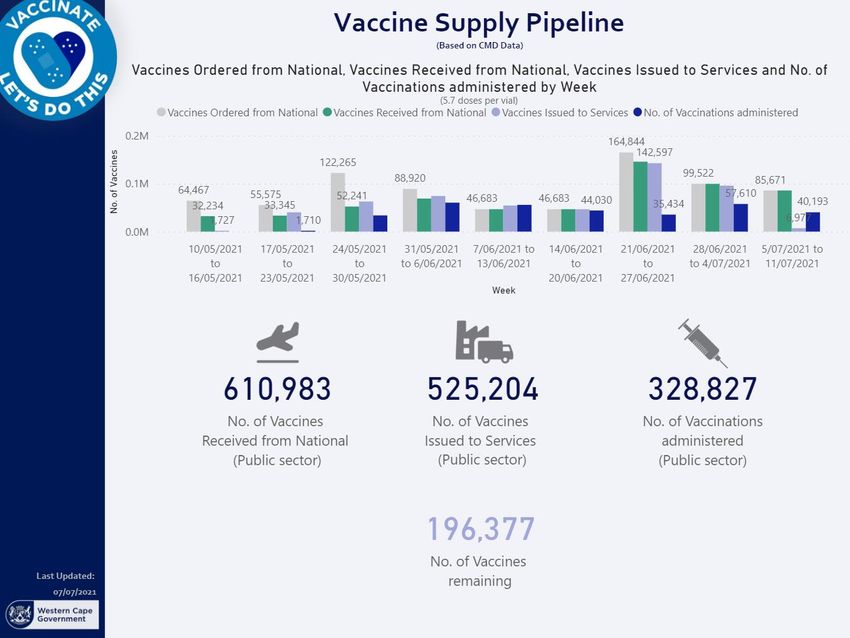
© Western Cape Government 2012 | 39Updated W Cape Public Sector Vaccine Supply Pipeline
Strategy
Date Received Number of doses Type of Vaccine Provincial
Received Received Cumulative Total
14 May 2021 33 930 Pfizer 33 930
22 May 2021 35 100 Pfizer 69 030
24 May 2021 29 250 Pfizer 98 280
27 May 2021 25 740 Pfizer 124 020
03 June 2021 72 540 Pfizer 196 560
10 June 2021 49 140 Pfizer 245 700
18 June 2021 49 140 Pfizer 294 840
22 June 2021 26 400 J&J 321 240
(for educators only)
25 June 2021 191 880 Pfizer 513 120
29 June 2021 28 800 J&J 541 920
(for educators only)
05 July 2021 58 500 Pfizer 600 420
06 July 2021 26 400 J&J
(for educators and designated 626 820
groups only)
08 July 2021 58 500 Pfizer 685 320
16 July 2021 58 500 Pfizer 743 820
© Western Cape Government 2012 |Planned Public Sector Sites: Metro & Rural for Phase 2
District Sub-structure # of Planned # of Active Sites
Vaccination Sites 05 – 09 July 2021
Southern/Western 19 19
Klipfontein/Mitchell’s Plain 15 13
City of Cape Town
Khayelitsha/Eastern 28 23
Northern/Tygerberg 21 18
Sub-total: Metro 83 73
Overberg District 44 24
Garden Route District 37 35
Rural Districts West Coast District 60 20
Cape Winelands District 53 45
Central Karoo District 13 9
Sub-total: Rural 207 133
TOTAL 290 206
• Public Sector Sites have come on line in a phased manner from 17 May onwards.
• 3 additional Mass sites (Metro) – 1st operational, 2nd CTICC (7 July); 3rd Athlone Stadium – beginning August
• 63 Private sector sites (46 Metro, 17 Rural) and Workplace sites are added sequentially.
• There are weekly updates on active sites per geographic area.
• Roving teams will visit satellite clinics. Members of the public to check with local health contacts to confirm
days of operation.
© Western Cape Government 2012 | 41Private Sector Sites as at 06 July 2021
Metro Rural Total
Discovery 3 3
Medscheme 1 1
Clicks Pharmacies 17 11 28
Dis-Chem Pharmacies 3
58 3
Pick ‘n Pay Pharmacies 3 1 4
Independent Pharmacies 5 4
Active9
Netcare Hospitals 2 Sites2
Mediclinic Hospitals 5 (44
1 in Metro;
6
Life Hospitals 1 14 in Rural)
1
Momentum/Metropolitan 1 1
Old Mutual 1 1
Medirite Pharmacies 2 2
Vital Care Pharmacies 2 2
TOTAL 46 17 63
© Western Cape Government 2012 | 42Vaccines Administered: Phase 1b and Phase 2
Vaccinations Administered: 17 May - 07 Proportion Vaccines
Administered: Public and
July 2021: 448 981 Private Sectors
73279 75060
71245
68212
60477
54475
Private
22%
35906
10327
Public
78%
Week 1: 17Week 2: 23Week 3: 31Week 4: 07Week 5: 14Week 6: 21Week 7: 28Week 8: 05
- 22 May - 30 May May - 06 - 13 June - 20 June - 27 June - 04 July - 07 July
June
Cumulative Total = 91 732 (Sisonke) + 448 981 = 540 713 vaccines administered.
[Disclaimer: Data displayed in this graph contains records not yet captured on EVDS (17 – 31 May 2021). Totals will be
adjusted as back-capturing and data validation is done.]
© Western Cape Government 2012 | 43Performance: Week 1 to Week 4
Week 4:
Week 2: Week 3:
Vaccine supply limited
Week 1: We need to We need to target to 70 000 for this
reach a reach a week.
We reached
minimum of minimum of We have capacity to
10 000
30 000 60 000 reach a minimum of
(2 000/day) (12 000/day) 100 000/week
(6 000/day)
or more (20 000/day, by 1st
or more week in July.
Achieved: Achieved: Achieved: Achieved:
10 327 35 906 68 212 73 279
[Disclaimer: Data displayed in this graph contains records not yet captured on EVDS (17 – 31 May 2021). Totals will be
adjusted as back-capturing and data validation is done.]
© Western Cape Government 2012 |Targets: Week 5 to Week 8
Week 8
Vaccine supply
expected to increase
Week 5: Week 6: Week 7: (Pfizer supply increase)
Target 60 000 Target 50 000 Target 80 000
(supply (supply (supply We will have capacity
constraint) constraint) increase) to reach a minimum of
120 000/week
(24 000/day), by 2nd
week in July.
Achieved: Achieved: Achieved: Projected:
60 477 54 475 71 245 >100 000
[Disclaimer: Data displayed in all tables, graphs and dashboards only contains records captured on EVDS and excludes
vaccination records captured on paper. Totals will be adjusted as back-capturing and data validation is done.]
© Western Cape Government 2012 |Vaccination of Educators
1. The Western Cape received a consignment of 26 400 Johnson & Johnson vaccines
to commence with the vaccination of educators on 22 June 2021.
2. Rollout of this process commenced on 23 June 2021 at the EMS Vaccination Site in
Pinelands, where Minister Debbie Schäfer launched the programme.
3. A further 28 800 doses had been received on the 29th June and this has allowed us
to continue the vaccination of the educators
Educator Vaccination: 26 027
4500
4050
4000
3551 3560
3500 3110 3178
2967 2900
3000
2500 2130
2000
1500
1000
463
500
60 58
0
23-Jun 24-Jun 25-Jun 28-Jun 29-Jun 30-Jun 01-Jul 02-Jul 03-Jul 05-Jul 06-Jul
[Disclaimer: Data displayed in all tables, graphs and dashboards only contains records captured on EVDS and excludes
vaccination records captured on paper. Totals will be adjusted as back-capturing and data validation is done.]
© Western Cape Government 2012 |Rollout of Essential Worker Programme in the Public Sector
Public Sector - sectoral Vaccination Projects identified by NDoH:
Sector Responsible for Vaccination
Basic Education Sector Provincial Department of Health
Dept. of Defence and Military Veterans South African Military Health Services
(SAMHS)
South African Police Service Polmed and Service Provider
Dept. of Correctional Services TBC
Social Development Sector (incl. Provincial Department of Health
ECD/SASSA)
Dept. of Home Affairs TBC
Department of Justice TBC
National Prosecuting Authority TBC
Public Agencies TBC
© Western Cape Government 2012 | Go to Insert > Header & Footer > Enter presentation name into footer field 47Mass vaccination sites in the Cape Metro
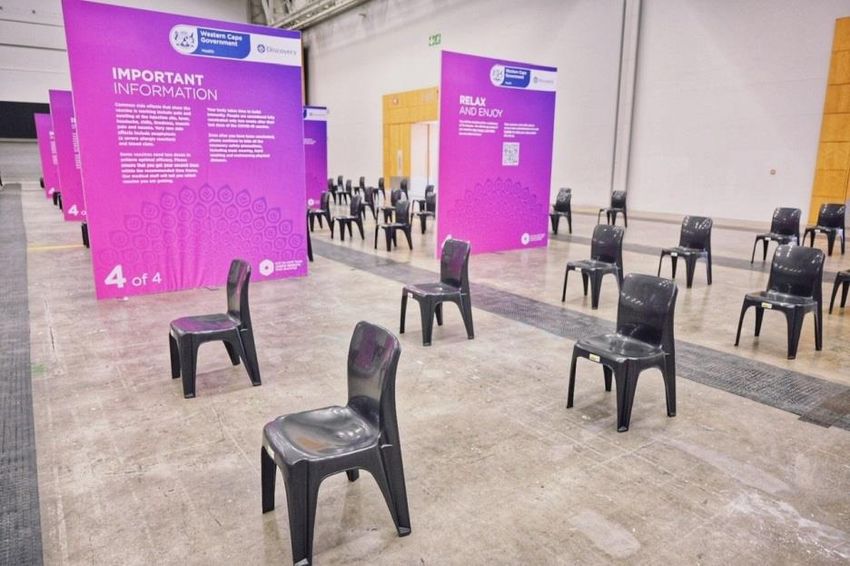
1. The Western Cape Government, in partnership with the City of Cape Town and
Discovery will start vaccinations at the CTICC mass vaccination site on 07 July 2021:
– An oversight visit was conducted on 06 July 2021, attended by the Premier
Alan Winde, Provincial Minister of Health, Dr Nomafrench Mbombo, Mayor of
Cape Town, Dan Plato, Community Services & Health MMC in the City of Cape
Town, Councillor Zahid Badroodien, Discovery Group Executive, Adrian Gore
and Discovery Health CEO, Dr Ryan Noach.
– A virtual tour was also conducted with the public and the media, who joined
online, to help create awareness.
– The site will be operational until December 2021, and is expected to administer
over 750 000 vaccinations.
– At maximum capacity, the site will be able to vaccinate 4 000 people per day.
© Western Cape Government 2012 |CTICC (Vaccination Centre of Hope)
© Western Cape Government 2012 | Go to Insert > Header & Footer > Enter presentation name into footer field 49Mass vaccination sites in the Cape Metro
2. Assessments have been carried out at the Athlone Sports Stadium. This site will be
able to accommodate a mix of fixed vaccination stations and drive-through
stations. It is likely that this site will be brought on board as a mass site 5 – 6 weeks
after CTICC.
3. The successful go live and functioning of these sites will depend upon receiving an
adequate supply of vaccines from the NDOH.
© Western Cape Government 2012 |Supply Pipeline
Overall
Vaccines
Vaccine Cascade Ordered
Vaccines
Received
Vaccines
Issued
Individual Vaccinee Cascade
Population Actual Vaccinations
registered administered
Vaccine Coverage
•By age group and by •Per site (rolled up to of Population
subdistrict subdistrict/district)
•Per day
Predicted
Daily Operational
Vaccine Vaccination
Throughput Capacity
Total
Vaccine
Stations
Total Sites
Total Sites
Active
© Western Cape Government 2012 | Inactive© Western Cape Government 2012 | Go to Insert > Header & Footer > Enter presentation name into footer field 52
© Western Cape Government 2012 | Go to Insert > Header & Footer > Enter presentation name into footer field 53
© Western Cape Government 2012 | Go to Insert > Header & Footer > Enter presentation name into footer field 54
© Western Cape Government 2012 | Go to Insert > Header & Footer > Enter presentation name into footer field 55
Key Lessons from the first 6 weeks

1. The importance of equity:

   a) Access in the Metro versus rural districts and towns

   b) Public sector versus private sector sites and access

   c) Access for insured versus uninsured people

   d) Access for >60yrs versus other groups

2. The importance of stabilising the systems:

   a) EVDS

   b) Vaccine supplies and distribution – public and private

3. The importance of communication:

   a)   What to expect?

   b)   Importance of being vaccinated – counter misinformation & hesitancy

                  © Western Cape Government 2012 |
EVDS Registrations
EVDS Registrations: >50 years as at 7 July 2021

                 Western Cape: 42.9% (601 413)
              26% (50yrs to 59yrs) and 58.9% (60yrs+)
                    RURAL                                                        METRO
                                                                                   50yrs
                         50yrs                             Sub-
                                                                         Total      to     60yrs+   50yrs+
District    Total         to         60yrs+       50yrs+   District
                                                                                   59yrs
                         59yrs
                                                           Eastern       63629     29,7%   56,5%    43,4%
Cape
            66513        22,1%        55,2%        38,2%   Khayelitsha   14699     14,2%   40,0%    25,2%
Winelands

Central                                                    Klipfontein   32794     26,1%   66,7%    45,1%
            4929         13,2%        41,6%        29,8%
Karoo                                                      Mitchells
                                                                         24252     13,7%   35,3%    23,6%
                                                           Plain
Garden
            69267        24,3%        66,1%        47,6%
Route                                                      Northern      53594     36,0%   51,3%    44,8%

Overberg    34883        24,5%        86,6%        57,3%   Southern      80802     35,3%   67,9%    52,9%

                                                           Tygerberg     53181     23,3%   48,6%    36,0%
West
            34082        19,3%        66,3%        41,0%
Coast                                                      Western       68588     39,6%   70,0%    56,4%
                    © Western Cape Government 2012 |                                                    58
Towns with large older populations by low registration on
7 July 2021
% registered % registered % registered
Metro Towns Registered 50yrs+
50yrs to 59yrs 60yrs+ 50yrs+
Philippi 2460 4,9% 9,4% 6,9%
Delft 5177 12,3% 18,0% 14,9%
Blue Downs 6045 13,8% 26,8% 19,9%
Blackheath 2004 9,0% 20,0% 14,2%
Macassar 2476 12,4% 28,7% 20,3%
Eerste Rivier 2253 18,0% 22,3% 20,1%
Mfuleni 1355 11,9% 22,1% 16,3%
Nomzamo 473 3,0% 9,4% 5,7%
Crossroads 556 6,1% 17,8% 11,1%
Fistantekraal 193 3,9% 10,0% 6,7%
% registered % registered % registered
Rural Towns Registered 50yrs+
50yrs to 59yrs 60yrs+ 50yrs+
Thembalethu 1304 13,1% 29,6% 20,4%
Khayamandi 708 9,6% 17,0% 12,9%
Zweletemba 834 7,3% 38,9% 21,2%
Bridgeton 678 8,0% 30,5% 18,0%
KwaNonqaba 738 10,0% 38,1% 22,6%
Tulbagh 787 14,8% 38,4% 26,7%
Bongolethu 304 3,8% 19,2% 10,6%
Klapmuts 625 12,2% 36,4% 23,1%
Dysselsdorp 613 9,3% 40,5% 23,2%
Sand Bay 512 11,2% 27,9% 22,2%
© Western Cape Government 2012 |Communications
© Western Cape Government 2012 |Small gatherings – “Securing our Bubbles”
“It’s in the air” messages

                                                                                                                          62
          © Western Cape Government 2012 |   Go to Insert > Header & Footer > Enter presentation name into footer field
Updated Vaccination material: over 50 yrs
63
© Western Cape Government 2012 | Go to Insert > Header & Footer > Enter presentation name into footer fieldVisitor notice, 2nd dose message & C-19 infection waiting
period
64
© Western Cape Government 2012 | Go to Insert > Header & Footer > Enter presentation name into footer fieldWhat to expect – 1st & 2nd dose of Pfizer >60yrs & 1st dose >50yrs
1. People >60yrs who received their first dose of Pfizer vaccine, become eligible for a
second dose after a minimum of 42 days. This commenced on 27th June 2021.
2. After the 42 days interval the EVDS system will automatically prioritise these clients
and schedule an available slot for vaccination. The system will generate these
messages 3 days prior to vaccination, at sites closest to the person.
3. The portal for the National population-based vaccination programme has been
adjusted to accept registrations >50 years, as from 1 July 2021.
4. This means that there are now 3 streams for EVDS to assign appointments for
registered people, via SMS notification:
a) People >60yrs that are registered for their 1st Pfizer doses
b) People >60yrs that are registered for their 2nd Pfizer doses
c) People >50yrs that are registered for their 1st Pfizer doses
5. Walk-ins are allowed (>60yr old will be prioritised), but this is tightly managed to
avoid super-spreader events and over-crowding at vaccination sites.
© Western Cape Government 2012 |Conclusions
© Western Cape Government 2012 |Concluding remarks 1. We are in a steep 3rd wave, driven by the Delta variant and urge everyone to adhere strictly to protective behaviours, as a key drive to contain it. 2. We anticipate that the 3rd wave could be as high as the 2nd wave. We await revised modelling from the SACMC, to re-calibrate our response. 3. We are revising our preparation for the 3rd wave, with clearly identified trigger points for an appropriate health platform and societal response. 4. We require a concerted whole of government and whole of society response to flatten the 3rd wave, to protect the health system. 5. We have scaled up our Phase 2 vaccination capacity to administer vaccines over the past 8 weeks, in a sequential manner in each geographic area. We have the capacity to scale up rapidly, as we receive more vaccines. 6. We need to continue to mobilise and assist everyone >50 years to be registered on the EVDS for Phase 2, and to be vaccinated.
Thank you

     © Western Cape Government 2012 |
You can also read


