DISTRICT OF OA19!'BAY - Oak Bay
←
→
Page content transcription
If your browser does not render page correctly, please read the page content below
DISTRICT OF

                          OA19!‘BAY
 REPORT TO:                  Council

 FROM:                       Christopher Paine, Director of Financial Services
 MEETING DATE:               April 23, 2020

 RE:                         COVlD—19Financial Plan Risk and Financial Hardship
                             Mitigation Measures
STAFF RECOMMENDATIONS
THAT Staff be directed to establish an Alternative Tax Collection Scheme Bylaw, should direction
for financial hardship mitigation measures and associated deadline adjustments not be
forthcoming from the Provincial Government, to extend the payment due date for property taxes
to August 4, 2020 to align with the date the District is required to pay property taxes levied on
behalf of the Capital Regional District, the Capital Regional Hospital District, BC Assessment, the
Transit Authority and the Municipal Finance Authority;
THAT Staff be directed to amend the draft 2020-2024 Financial Plan as presented at the March
12, 2020 Committee of the Whole meeting to reduce the tax funded portion of the proposed 2020
budget increase by 1.2% through:
1) deferring the funding for, and hiring of, the Manager of Infrastructure and Facilities position
    until 2021,
2) using New Development Taxation revenue to offset infrastructure funding, and
3) incorporating all other budget deliberation direction provided from the Committee of the Whole
    as of March 12, 2020 including increasing efforts to renew infrastructure particularly in water,
    waste water, transportation and facilities, in order to achieve sustainable service delivery for
    the next 50 to 75 years;
AND FURTHER, THAT the Mayor, on behalf of Council, advocate to the Provincial Government
to:
1) increase amounts for Homeowner Grants, and create a new category of grant applicable to
    persons who have lost income due to the pandemic, and
2) reinstate the Financial Hardship Deferment Program and extend the program to commercial
    properties as well as residential home owners.
EXECUTIVE SUMMARY
This report recommends a number of strategies to Council that the District may undertake in order
to assist ratepayers who are experiencing financial hardship as a result of COVlD-19, while
maintaining local government business continuity and reserve balances as currently considered
in the draft Five Year Financial Plan. This report also highlights current budget risks and potential
mitigation strategies for Counci|’s consideration during these uncertain times resulting from the
pandemic.

Staff consider the recommended focus on financial hardship mitigation measures to be consistent
with the approach that the Provincial and Federal governments are seen to be taking in response
to COV|D—19, by directing financial hardship mitigation measures to those who are in need in the
shorter term.
Staff are recommending that Council consider reducing the tax funded portion of the proposed
budget by 1.2% (from 8.1% to 6.9%), from the direction provided at the March 12, 2020 Committee
of the Whole meeting. This reduction can be achieved by deferring the funding for, and hiring of,

COVID-19 Financial Plan Risk and Financial Hardship Mitigation Measures             Page 1 of 12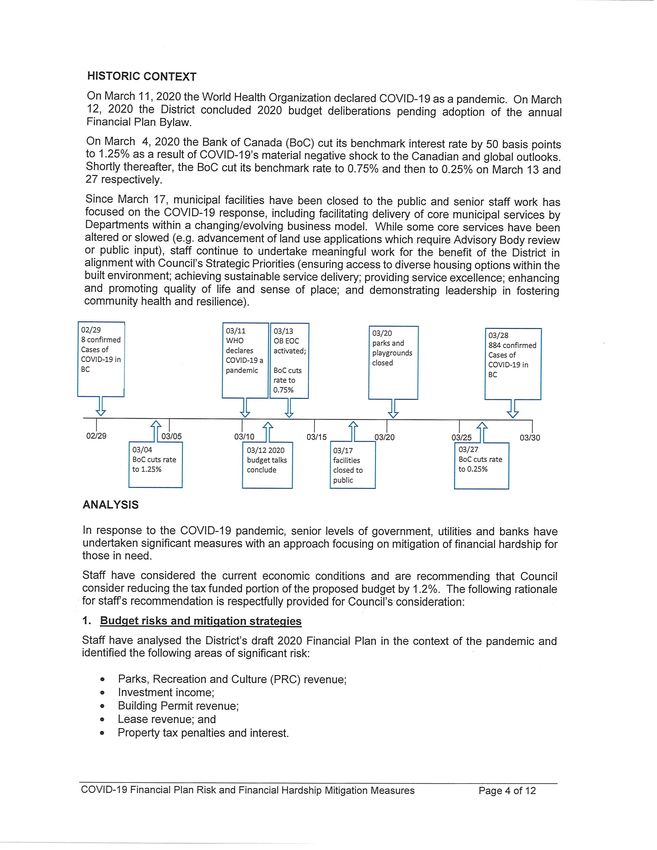
the Manager of Infrastructure and Facilities until 2021 and by using New Development Taxation
    revenue to offset infrastructure funding.
 Further, staff are recommending that Council consider “staying the course” with the other
           initiatives and funding endorsed by Council on March 12, 2020. This recommendation
    proposed
is linked to consideration of business recovery and continuity once the pandemic has passed.
Additionally, this approach creates resiliency in the operating budget for potential responses to the
pandemic that may be required in the future but that are not currently anticipated.
While some capital projects currently scheduled for initiation/completion in 2020 may not be
achieved given staffs focus on COVlD—19response, deferring these projects is not likely to result
in a reduction in 2020 taxation because the majority of these projects are funded from existing
reserves established for such undertakings. For example, the Municipal Hall renovation is fully
funded from a project specific reserve, so a deferral of this project would not have any impact on
2020 taxation.

Throughout the changing conditions associated with the pandemic, the District is committed to
recovering in an operationally enhanced status. Opportunities to achieve this status include
technology and ef?ciency implementations, development of shelf ready projects for potential
stimulus packages that other levels of government may provide, consideration of borrowing at
historically low rates for some capital projects, and more. District staff will stay vigilant for
opportunities that Council may wish to consider in support of the endorsed “better than before
pandemic” approach that the District is adopting.

The tax increase options contained in this report for Council’s consideration are as follows:

    Tax increase                                 8.1%           6.9%            5.4%            3.9%
    Average monthly cost to median              $20.00         $17.00          $13.00          $10.00
    household (rounded)

BACKGROUND
Staff have provided the recommendations contained in this report founded on the principles that
Council:
o     wishes to mitigate the financial hardship that municipal taxation may represent to some citizens
      and businesses (as permitted under legislation) during this time of pandemic through a variety
      of possible means;
0     wishes to continue with infrastructure replacement, striving for sustainable service levels,
      maintaining reserve balances over the longer term, and delivering on the numerous other
      services and priorities detailed in the 2020 budget process and the draft Five Year Financial
      Plan;
0     wishes staff to continue with significantly increasing efforts to renew infrastructure (particularly
      in water, waste water, transportation and facilities), in order to achieve sustainable service
      delivery for the next 50 to 75 years;
c     supports the proposed staffing levels contained in Appendix A to this report, in order to better
      facilitate an expeditious return to the course of normal business for the District once the
      Provincial State of Emergency ends and the District’s Emergency Operations Centre (EOC) is
      deactivated;
o     intends to have the District recover from COVlD—19at an operationally enhanced status, once
      demobilization of the EOC occurs and recovery from the pandemic is complete by maximizing
      opportunities within approved budget that may present during the EOC planning stages; and
o     acknowledges that the current pandemic, while having profound and wide spread impacts,
      may be a relatively shorter term challenge when considered in the context of the overall Five
      Year Financial Plan.

COVlD~19 Financial Plan Risk and Financial Hardship Mitigation Measures                  Page 2 of 12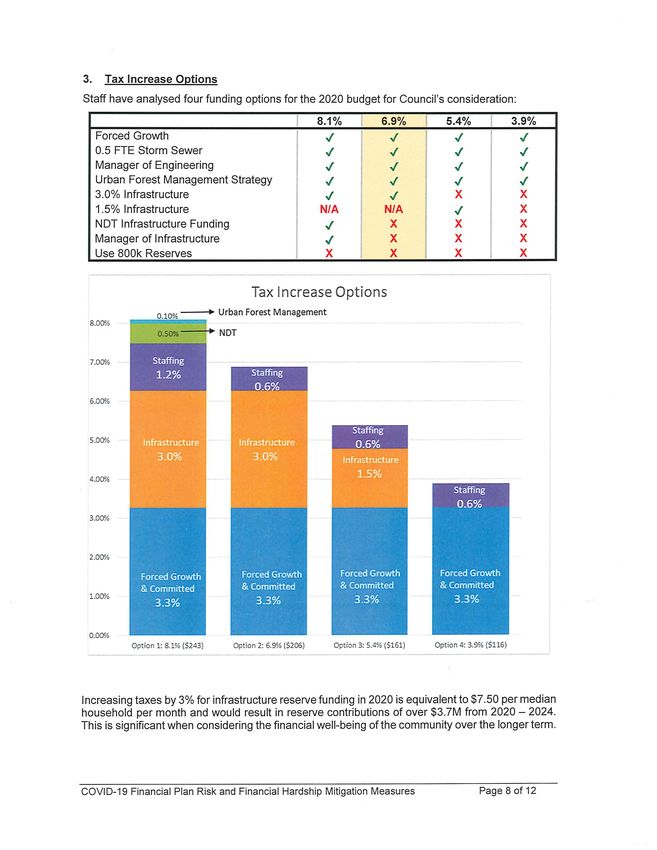
Staff are requesting Council provide alternate direction, should any of the premises above not be
 reflective of Council’s position.
  Staff consider the recommended focus on ?nancial hardship mitigation measures contained in this
  report to be consistent with the approach that the Provincial and Federal governments are seen
 to be taking in response to COVlD-19, by directing financial hardship mitigation measures to those
 who are in need in the shorter term. At time of this report writing, local governments are awaiting
 potential direction from the Provincial government on financial hardship mitigation measures and
 associated deadline adjustments. Should the Provincial government not provide such measures
 over the coming weeks, Council has some authority to undertake District initiated financial
 hardship mitigation measures and deadline adjustments as detailed below.

Staff   recognize that while some local governments are reducing or negating tax increases for 2020
 in response to the uncertainties associated with the pandemic, the economic realities across the
 region vary greatly. Some unique attributes of the District include:
 1) The District’s tax base is primarily residential (94%). This provides a stable tax base but means
      there is very little non-residential tax base available to mitigate costs to residents.
2) The District is already an overly lean organization, in terms of staf?ng numbers, for the levels
      of service that the District provides.
3) The District has an older demographic and a higher percentage of residents employed in
      sectors not currently experiencing significant job losses when compared to the Provincial
      average (Source 2016 Census).
                       —

4) The District operates a high quality Parks, Recreation and Culture department. The size and
      scope of this department is unique for a municipality of the District’s size. The high quality
      services provided by this department are supported by high cost recovery ratios. This means
     that in economically difficult times, recreational revenues can fall sharply.
5) The District is a ‘built-out’ community, meaning that there is very little undeveloped land. This
     fact, combined with the low rate of development, means the District does not have signi?cant
      New Development Taxation revenue available to reduce the impact of annual taxation
      increases. Many other communities in the region benefit in the short term from fast growth and
     associated significant New Development Taxation revenue.
6) Oak Bay was incorporated in 1906 and much of its infrastructure is aging. A significant
     inventory of infrastructure is under the District’s care including over 270km of pipe. The amount
     and age of infrastructure is unusual for a municipality of the District’s size in the Capital Region.
7) The District’s pace of achieving funding for, and sustainably delivering on, infrastructure
     replacement is unique. Few communities in B.C. are increasing infrastructure funding at a
     pace comparable to the Districts, as per Counci|’s Strategic Priority of achieving sustainable
     service delivery.
8) The Provincial Government’s Municipal Wastewater Regulation requires all BC municipalities
     to have separate storm water and sanitary sewer systems. The District is one of the few BC
     municipalities, and the only local government in the Capital Region, to have a combined storm
     and sanitary sewer system. This system must be separated as part of the Core Area Liquid
     Waste Treatment program. This separation project represents significant cost implications to
     the District.
9) The District staffs both a Municipal Police force and a 24/7 career Fire Department. The
     District’s protective services are highly respected in the region. There is only one other similar
     sized municipality in the region with both a Municipal Police force and a career Fire
     Department.
For the reasons noted above, staff observe that a “one size fits all” approach to local government
tax rate adjustments resulting from the pandemic is unworkable. The District is recognized as
being unique from other local governments in the region by its challenges, amenities, assets and
service levels.

COVlD—19Financial Plan Risk and Financial Hardship Mitigation Measures                  Page 3 of 12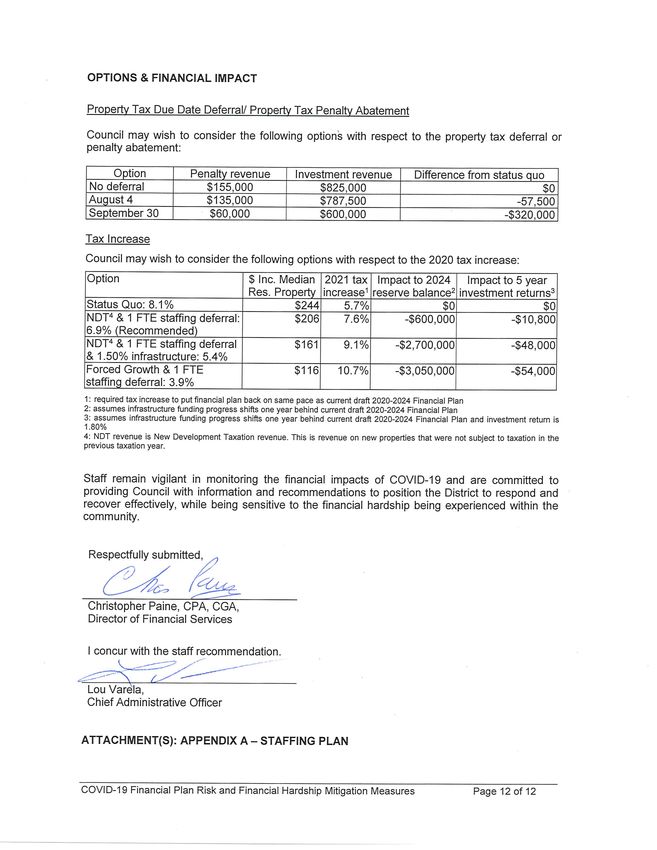
HISTORIC CONTEXT
 On March 11, 2020 the World Health Organization declared COV|D—19 as a pandemic. On March
 12, 2020 the District concluded 2020 budget deliberations pending adoption of the annual
 Financial Plan Bylaw.
 On March 4, 2020 the Bank of Canada (BoC) cut its benchmark interest rate by 50 basis points
 to 1.25% as a result of COVlD—19’smaterial negative shock to the Canadian and global outlooks.
 Shortly thereafter, the BoC cut its benchmark rate to 0.75% and then to 0.25% on March 13 and
 27 respectively.
Since March 17, municipal facilities have been closed to the public and senior staff work has
focused on the COV|D—19 response, including facilitating delivery of core municipal services by
Departments within a changing/evolving business model. While some core services have been
altered or slowed (e.g. advancement of land use applications which require Advisory Body review
or public input), staff continue to undertake meaningful work for the benefit of the District in
alignment with Council’s Strategic Priorities (ensuring access to diverse housing options within the
built environment; achieving sustainable service delivery; providing service excellence; enhancing
and promoting quality of life and sense of place; and demonstrating leadership in fostering
community health and resilience).

02/29                              03/11         03/13                03/20
8 confirmed                        WHO           OB EOC
                                                                                              03/Z8
                                                                      Parksand                884 confirmed
Cases of                           declares      activated;           P[3YB"0U”d5             Cases of
COVID-19 in                        COV|D—19 a
                                                                      closed                 COVI13-19 in
BC                                 pandemic     BoC cuts
                                                                                             BC
                                                rate to
                                                0.75%

 02/29                                                        03/15                                   03/30
              03/04                      03/122020                                  03/27
              BoC cuts rate              budget talks                               3°C CW5 rate
              to 1.25%                   conclude                                   to 015%

ANALYSIS

In response to the COV|D—19 pandemic, senior levels of government, utilities and banks have
undertaken significant measures with an approach focusing on mitigation of financial hardship for
those in need.
Staff have considered the current economic conditions and are recommending that Council
consider reducing the tax funded portion of the proposed budget by 1.2%. The following rationale
for staffs recommendation is respectfully provided for Council’s consideration:
1. Budget risks and mitigation strategies
Staff have analysed the Districts draft 2020 Financial Plan in the context of the pandemic and
identi?ed the following areas of significant risk:

          Parks, Recreation and Culture (PRC) revenue;
          Investment income;
          Building Permit revenue;
          Lease revenue; and
          Property tax penalties and interest.

COV|D—19      Financial Plan Risk and Financial Hardship Mitigation Measures                Page 4 of 12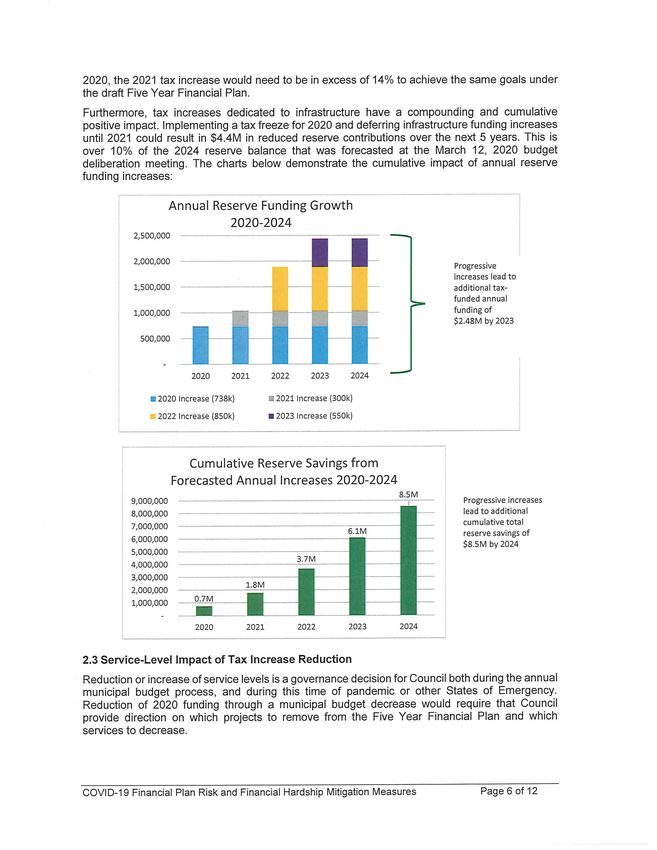
The District’scurrent strategy to mitigate the impact of these risks is to: defer hiring of 250 auxiliary
    staff; to defer the funding for, and hiring of, 1 full time equivalent employee (FTE); to defer the
    hiring of a number of existing vacancies in departments with reduced service levels; to use the
    2019 surplus; and, to reduce current year transfers to reserve. Should revenue decline into
    subsequent ?nancial periods, the budget gap would need to be addressed through increased
    taxation or decreased services. Staff commits to bringing financial risks, resulting from changing
    circumstances as the pandemic evolves, to Council for their consideration and direction.
    2. Reduction of Tax increase
    Staff have considered the current economic conditions and are recommending that Council
    consider reducing the tax funded portion of the proposed 2020 budget increase by 1.2%.
    2.1 Effectiveness of Tax Increase Reduction
    it is anticipated that a substantial tax decrease in the municipal portion of the tax billwill not likely
    have a signi?cant impact on many taxpayers in Oak Bay; staff estimate that municipal property
    taxes account for approximately 0.3% and 0.43%1 of household expenditures. For example,
    reducing the proposed 8.1% tax increase to 0% would save the median residential property
    approximately $20 per month in the short term but would negatively impact the District’s long term
    financial sustainability and future tax rates. Staff are instead recommending a more effective,
    focused approach for those experiencing ?nancial hardship.
    Approximately 44% of the municipal tax bill represents taxes collected on behalf of other taxing
    authorities. None of these taxing authorities have indicated there will be a deferral in due dates or
    reduction in tax rates (except the school tax rate business and industry class properties).
 The response to COVID-19 includes numerous ?nancial hardship relief mechanisms to address
 the more significant components of household expenditures and income loss. Some of these
 mechanisms are noted in the table below:
    Income Support - The Federal government has implemented the Canada Emergency
                      Response Bene?t which provides $2,000 a month for workers who have
                     stopped working due to COVID-19.
                   0 Additionally, the Federal government is providing a 75% wage subsidy to
                     qualifying businesses.
    Shelter        o Most financial institutions are providing mortgage deferral options.
                   - The Office of the Superintendent of Financial Institutions announced that it
                     will not count mortgage deferrals as arrears for banks.
                   o The Province of BC has introduced a new rental supplement program.
                   - Utilitybilldeferral programs and credits are available for those experiencing
                     financial hardship.
    TFanSP0l't8’ii0n Gas prices have fallen approximately 25% since COVID-19 was declared a
                   0

                     pandemic by the World Health Organization.
                   - lCBC has introduced a 90-day payment deferral program.
                   c Free bus fare has been implemented by BC Transit.

2.2 Long Term Ratepayer impact of Tax increase Reduction:
A municipal tax decrease in response to COVlD-19 would not reduce the overall long—termtax
impact to a ratepayer in the District, if Council stillwished to achieve its goals as stated throughout
the 2020 budget deliberations. if the District was, for example, to implement a 0% tax increase for

1
 Based on: (1) “Living Wage for BC’s Capital Region” published by the Community Social Planning
Council and (2) the Survey of Household Spending published by the Province of British Columbia.

COVID-19 Financial Plan Risk and Financial Hardship Mitigation Measures                   Page 5 of 12
2020, the 2021 tax increase would need to be in excess of 14% to achieve the same goals under
the draft Five Year Financial Plan.
Furthermore, tax increases dedicated to infrastructure have a compounding and cumulative
positive impact. Implementing a tax freeze for 2020 and deferring infrastructure funding increases
until 2021 could result in $4.4M in reduced reserve contributions over the next 5 years. This is
over 10% of the 2024 reserve balance that was forecasted at the March 12, 2020 budget
deliberation meeting. The charts below demonstrate the cumulative impact of annual reserve
funding increases:
if if
22
charisma‘.riegerv;.;:.;;.diiagémi
2020-2024
..,,._ ,..,_ _. 2...
..._ - _.
...,.__ .2.
__ ......2__.,..
...._ .. _. ._
2,000,000 v
— —— —~—— -«
.
Progressive
increases lead to
1,500,000 additional tax-
funded annual
1,000,000 —--~—-~—
V ~
funding of
$2.48M by 2023
2020 2021 2022 2023 2024
I 2020 Increase (738k) E 2021 Increase (300k)
I 2022 Increase (8S0k) I 2023 Increase (550k)
Cumulative Reserve Savings from
Forecasted Annual Increases 2020-2024
~—~§'~iV|———~
9,000,000 —~——~——————~—v ~—~~———~~—-—~»~——~—«—~—-r—~~~-~—--~——~
——
Progressive increases
3,000,000 lead to additional
cumulativetotal
reserve f savings 0
6'0o0'000 $8.5M by 2024
$000300
QOOODOO
&OOQ00O
LOOQ000
LOOQOOO
2020 2021 2022 2023
2.3 Service-Level Impact of Tax Increase Reduction
Reduction or increase of service levels is a governance decision for Council both during the annual
municipal budget process, and during this time of pandemic or other States of Emergency.
Reduction of 2020 funding through a municipal budget decrease would require that Council
provide direction on which projects to remove from the Five Year Financial Plan and which
services to decrease.
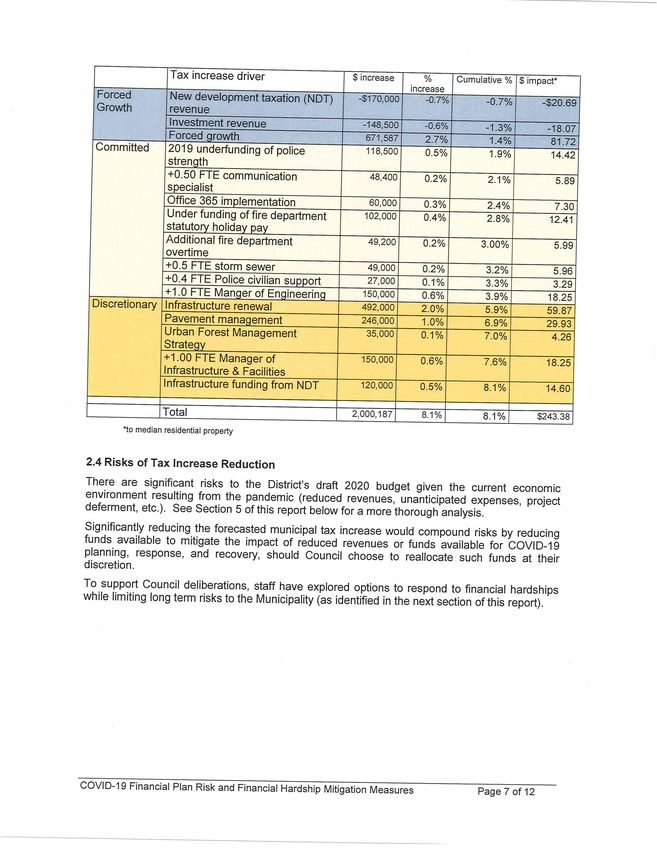
COVID-19 Financial Plan Risk and Financial Hardship Mitigation Measures Page 6 of 12Tax increase driver $ increase % TCumulative
% $ impact*
increase 4
Forced New development taxation (NDT) -$170,000 -0.7%
L
-0.7% -$20.69
Growth revenue
Investment revenue 448,500
Forced growth 671,587 2.7% 1.4% 81.72
Committed 2019 underfunding of police 118,500 0.5% 1.9% 14_42
stre_n_g?1
+0.50 FTE communication 48,400 0.2%‘ 2.1% 5.89
specialist
~_Of?ce 365 implementation 60,000 0.3% 2.4% 7.30
A
Under funding of fire department 102.000 0.4% 2.8% 12.41
statuto_ry_holicl3y_pay _
Additional?re department 49,200 0.2% 3.00% 5.95
overtime
+0.5 FTE storm sewer 49,000 0.2% Jr 3.2%T 5.96
_+o.4 FTE Police civilian supgart ”
27,000 0.1% 3.3%; 3.29
.0 FTE Mner of Enineerin 150,0000.697 7
Total 2,000,187 8.1% 8.1% $243.38
*to median residential property
2.4 Risks of Tax Increase Reduction
There are significant risks to the District’s draft 2020 budget given the
current economic
environment resulting from the pandemic (reduced revenues, unanticipated expenses, project
deferment, etc.). See Section 5 of this report below for a more thorough analysis.
Signi?cantly reducing the forecasted municipal tax increase would compound risks by
reducing
funds available to mitigate the impact of reduced revenues or funds available
for COVID-19
planning, response, and recovery, should Council choose to reallocate such
funds at their
discretion.
To support Council deliberations, staff have explored options to respond to
?nancial hardships
while limitinglong term risks to the Municipality(as identifiedin the next section
of this report).
COVID-19Financial Plan Risk and Financial Hardship Mitigation Measures Page 7 of 123. Tax Increase Options
Staff have analysed four funding options for the 2020 budget for Council’s consideration:
Forced Growth
0.5 FTE Storm Sewer
Manager of Engineering
Urban Forest Management Strategy
3.0% Infrastructure
1.5% Infrastructure
NDT Infrastructure Funding
Manager of Infrastructure
Use 800k Reserves
Tax Increase Options
———> Urban Forest Management
8.00‘/o
NDT
7.00% — — —
Staffing
0.6%
6.00%
Staf?ng
5-00% Infrastructure Infrastructure 0.6%
3.0% 3 .O% Infrastructure
4.00%
1.5%
3.00%
2.00%
Forced Growth Forced Growth Forced Growth Forced Growth
& Committed & Committed & Committed & Committed
1.00%
3.3% 3.3% 3.3% 3.3%
Option 1: 8.1% ($243) Option 2: 6.9% ($206) Option 3: 5.4% ($161) Option 4: 3.9% (5116)
Increasing taxes by 3% for infrastructure reserve funding in 2020 is equivalent to $7.50 per median
household per month and would result in reserve contributions of over $3.7M from 2020 2024. -
This is signi?cant when considering the ?nancial well-being of the community over the longer term.
COVID-19 Financial Plan Risk and Financial Hardship Mitigation Measures Page 8 of 124. Financial Hardship Mitigation Strategies for District Residents in Need
a. UtilityBilling Penalty Abatement
At the March 16, 2020 Special Council meeting, Council passed the following resolution: “That
Staff be directed to prepare bylaw amendments such that penalties and interest on utility bills
are indefinitely suspended for bills due on or after March 16, 2020”. Staff have prepared a
draft Amendment Bylaw that is included in the agenda for the April 23 Special Council meeting
and are requesting three Readings and adoption of the Amendment Bylaw.
b. Property Tax Deferral —
Alternative Tax Collection Scheme
Section 235 of the Community Charter empowers the District to establish an Alternative Tax
Scheme Collection Bylaw. Such a bylaw may establish tax due dates, penalties and set terms
and conditions in relation to payments. Should Council wish to consider extending the property
tax due date, staff recommend an August 4 due date.
As noted above, the Provincial Government has indicated they are working on a financial
package for local governments and are awaiting potential direction on financial hardship
mitigation measures and associated deadline adjustments. Should the Provincial
Government not provide such measures over the coming weeks, Council has some authority
to undertake District initiated financial hardship mitigation measures and deadline
adjustments.
Extending beyond August 4 carries significant risk unless other taxing authorities also adjust
their due dates. The District is responsible for collecting taxes for a variety of taxing
authorities: Provincial School Tax, Capital Regional District, Capital Regional Hospital District,
BC Transit Authority, BC Assessment and the Municipal Finance Authority. Collections for
these authorities exceeded $20M in 2019. The District must in most cases remit funds to
these taxing authorities on the first day of business in August each year. If the District was to
implement a tax due date after August 4 in 2020, the District would need additional cash flow
to remit these taxes while waiting for payments from Oak Bay taxpayers.
Under normal circumstances, using the current established due dates and penalties, the
District has the financial capacity and cash flow to maintain operations and advance capital
projects without borrowing short—term. While the possibility of short-term borrowing exists
through the Municipal Finance Authority if a revenue anticipation bylaw is enacted in this time
of pandemic, the Municipal Finance Authority has indicated that they are unable to lend to
every municipality in BC who may need short term loans to cover property taxes.
Deferring the property tax due date beyond August 4, or reducing the penalty for late payment,
would likely significantly impact District cash flow. Impacts to cash flow must be considered
during this time of pandemic when the District is experiencing decreased recreation revenues;
a significant portion of the District’s annual budget.
c. Solid Waste Billing Deferral
Historically, the solid waste user fee has been billed on the annual property tax bill and is a
charge that does not qualify for the deferral program. Staff are recommending that the solid
waste user fee be billed on the utility bill instead of the usual practice and be deferred until
the fourth (4th) quarter of 2020, with the potential for further assessment at that time. This
approach would help ratepayers defer approximately $275 in payments until the Fall of 2020;
an expense that would normally be collected in July. This approach does not significantly
impact cash ?ow for the District.
d. Parking Enforcement Focus
Parking patterns have changed significantly as a result of government mandated isolation,
physical distancing measures and business closures. The District is currently focusing efforts
COVlD—19Financial Plan Risk and Financial Hardship Mitigation Measures Page 9 of 12on education and compliance around parking regulations, with a reduced focus on fines.
Ticketing with financial penalties (?nes) will still be used for repeat offenders to encourage
long term compliance with parking regulations. Note beyond this general approach, “no
—
parking” restrictions in the area of Willows Beach will be enforced through ticketing given the
need to reduce congestion and better enable physical separation on the beach.
Advocate to the Provincial Government
Staff are recommending that the Mayor advocate, on behalf of Council, to the Provincial
Government to:
0 increase amounts for Homeowner Grants, and create a new category of grant applicable
to persons who have lost income due to the pandemic, and
o reinstate the Financial Hardship Deferment Program and extend the program to
commercial properties as well as residential home owners.
The Provincial tax deferment program is a low interest loan program that allows taxpayers to
defer paying all or part of their annual property taxes (excluding utilities that are included on
the tax bill or outstanding balances from previous years). The loan is registered as a lien on
the property. The Province has been building a new online tax deferment portal for launch in
2020. This portal will allow customers to apply for property tax deferral online. This program
may be a solution for individuals who are experiencing a temporary reduction in income and
who also maintain the required minimum equity in their home.
Currently this deferral program is only offered to owners who are at least 55 years of age or
to owners who ?nancially support children under the age of 18. The Province previously
offered a financial hardship deferment program which has since been eliminated.
Deposits & Securities
The District collects deposits and securities from developers for various reasons. These
securities ensure that required works and services are completed to the appropriate standard.
Under normal circumstances, the District would not refund these securities until works and
services are completed in their entirety. However, the District has changed its practice in the
short term to provide partial refunds as work is completed in phases in order to better enable
customers to have quicker access to needed cash ?ow during the COV|D—1 9 pandemic.
5. 2020 Budget Risks and Mitigation Strategies
Staff have analysed the Districts draft 2020 Financial Plan in consideration of the COVlD—19
pandemic, and identified areas of significant risk. Moving fon/vard, staff will continue to monitor
economic conditions and recommend Financial Plan amendments as necessary for Counci|’s
decision making. Revenues that will likely be detrimentally impacted as a result of the pandemic
are identified as follows:
a. Parks, Recreation and Culture (PRC) revenue —
The District’s Parks, Rec and Culture
operating budget is approximately $13.6M in 2020. This budget is funded by $8.9M in
program revenues and $4.7M in taxation. A significant decrease in program revenues would
increase the need for tax funding.
Note PRC has experienced a significant revenue decrease as a result of the pandemic, with
—
facilities continuing to be closed to the public. Much of this revenue decrease is mitigated by
a corresponding decrease in variable program costs. |t’s dif?cult to forecast the impact to the
2020 budget without knowing the duration of the current COVID-19 crisis, but ?nancial
forecasts until the end of August anticipate a $2M net revenue loss.
Building Permit revenue -Forecasted Building Permit revenue in the draft 2020 Five Year
Financial Plan is $750,000. Staff expect a signi?cant decrease in revenues while economic
conditions associated with the pandemic remain.
COVID-19 Financial Plan Risk and Financial Hardship Mitigation Measures Page 10 of 12c. Investment income The Bank of Canada has dropped
-
its benchmark interest rate by 1.50%
since 2020 Financial Plan deliberations began. Staff
anticipate a
Guaranteed Investment Certificates and Money Market Fund returns. corresponding fall in
have not yet dropped proportionately. Furthermore, Yields, though volatile,
portfolio is invested in Guaranteed Investment
approximately 20% of the District’s
Certi?cates with a rate of return exceeding
2019’s investment performance.
cl. Lease revenue Approximately$50,000 in the
—
District’slease revenue is linked to the ?nancial
performance of one of our tenants. This tenant has
recently closed their doors in response to
ProvincialOrders related to the pandemic.
e. Property tax penalties and interest -Should Council implement the financial hardship
measures that staff are recommending, there will be a measurable impact
to the District’s
penalty revenue. The District’sinterest revenue is also expected
to fall by 20% based on the
Bank of Canada benchmark rate reductions.
Should revenue decline into subsequent financial periods, the budget
gap would need to be
addressed through increased taxation or decreased services. At a
minimum, staff will prepare
quarterly budget reports and bring forward Financial Plan Bylaw
amendments as necessary for
Council’s consideration and direction.
STRATEGIC PRIORITYSUPPORTED
Recommendationsin this report mainly support two strategic priorities: (1) achieving sustainable
service by integrating the asset management program within a long—termfinancial plan, and (2)
providing service excellence by optimizing effectiveness and fostering public
public engagement
engagement. Note —
would be “consult” as per lAP2 noted below.
IAP2 FRAMEWORKENGAGEMENT(INDICATE WITH X)
INFORM X CONSULT INVOLVE COLLABORATE
In addition to the public engagement conducted throughout the 2020 strategic
planning and budget
process, the public is being provided with this report 10 days in advance
of the electronic Special
Council meeting scheduled to be held April 23, 2020 in order to allow time
for comments to be
submitted to the District via email, letter or phone.
TIMELINE/PROCESSINEXT
STEPS
Staff will bring fon/vard a number of bylaws for adoption based on Council
direction:
1) Five Year Financial Plan Bylaw 4) Tax Rates Bylaw
2) Boulevard Frontage Tax Bylaw 5) Water Rates Amendment Bylaw
3) Refuse Collection and Disposal Bylaw 6) Sewer User Charges Amendment Bylaw
7) Alternative Tax Collection Scheme
Bylaw
COVID-19 Financial Plan Risk and Financial Hardship Mitigation Measures
Page 11 of 12OPTIONS & FINANCIAL IMPACT
Property Tax Due Date Deferrall Property Tax Penalty Abatement
Council may wish to consider the following options with respect to the property tax deferral or
penalty abatement:
Option Penalty revenue Investment revenue Difference from status quo
No deferral $155,000 $825,000 $0
August 4 $135,000 $787,500 —57,500
September 30 $60,000 $600,000 -$320,000
Tax increase
Council may wish to consider the following options with respect to the 2020 tax increase:
Option $ lnc. Median 2021 tax Impact to 2024 Impact to 5 year
Res. Property increase‘ reserve balancez investment returns?’
Status Quo: 8.1% $244 5.7% $0 $0
NDT4& 1 FTE staffing deferral: $206 7.6% -$600,000 —$10,800
6.9% (Recommended)
NDT4& 1 FTE staffing deferral $161 9.1% —$2,700,000 —$48,000
& 1.50% infrastructure: 5.4%
Forced Growth & 1 FTE $116 10.7% —$3,050,000 -$54,000
staffing deferral: 3.9%
1: required tax increase to put ?nancial plan back on same pace as current draft 2020-2024 Financial Plan
2: assumes infrastructure funding progress shifts one year behind current draft 2020-2024 Financial Plan
3: assumes infrastructure funding progress shifts one year behind current draft 2020-2024 Financial Plan and investment return is
1.80%
4: NDT revenue is New Development Taxation revenue. This is revenue on new properties that were not subject to taxation in the
previous taxation year.
Staff remain vigilant in monitoring the financial impacts of COVID-19 and are committed to
providing Council with information and recommendations to position the District to respond and
recover effectively, while being sensitive to the financial hardship being experienced within the
community.
Respectfully submitted,
0
/as
/
Christopher Paine, CPA, CGA,
Director of Financial Services
I concur with the staff recommendation.
Lou Varéla,
Chief Administrative Of?cer
ATTACHMENT(S): APPENDIX A —
STAFFING PLAN
COVID-19 Financial Plan Risk and Financial Hardship Mitigation Measures Page 12 of 12Appendix A —
COVlD-19FinancialPlan Risk and FinancialHardship Mitigation
Measures
STAFFING PLAN
Position Status Risk Note
Deputy Director
of Corporate
SeWlCeS
.
0 Currently posted
Posting closes
April 9
Essential to
business
No impact to 2020
budget as the general
continuity and consulting budget was
- Hiring anticipated in recovery proportionately
the immediate short reduced
term
Deputy Director 0 Posting for this
Essential to
of Engineering Currently approved in
position is business principle for full
& Public Works anticipated prior to continuity and funding in core budget
Summer 2020 recovery $150,000
o if the position is not
filled in 2020, the
Director proposes to
use the allocated
funding for short
term engineering
consulting support
as required
Manager of 0 Based on the above Though risks Funding for this
Asset hires and current related to facilities position will be
Management & workloads, staff do remain as briefed delayed in the
Facilities not have the during the 2020 Financial Plan until
additional capacity Financial Plan 2021, unless Council
to manage the hiring process, delaying provides direction to
process for this the hiring of this establish the position
position. Therefore, position until 2021 funding in 2020
it is recommended is considered
that this hiring be manageable
delayed until 2021
Water & Sewer o Posting for these Essential to Currently approved in
positions is achieving principle for full
anticipated prior to necessary funding in core budget
Summer 2020 infrastructure Total FTE 4.0
maintenance in ~/ 3.5 FTE
order to ensure utility funded
sustainable $500,000
service levels for J 0.5 FTE taxation
water and sewer funded
$49,000
Building & Vacancies not being Not essential to Currently part of core
Planning filled in 2020 unless existing business budget
Department the current service continuity during , _
Currently 2
levels change pandemic N°t.r.'mngthese
vacant
The Department focus _ will
positions create
will be on the Housing Further review of flexibilitywithin the
positions: Plans these positions will
Framework and current year’s
Examiner and form part of operational budget
related initiatives,
Building & recovery planning without reducing 2020
while addressing a
Planning Clerk taxation
reduced number of
applicationsYou can also read


