Dr. Axel U. J. Lode Junior group leader for ultracold atomic systems - mctdh-x
←
→
Page content transcription
If your browser does not render page correctly, please read the page content below
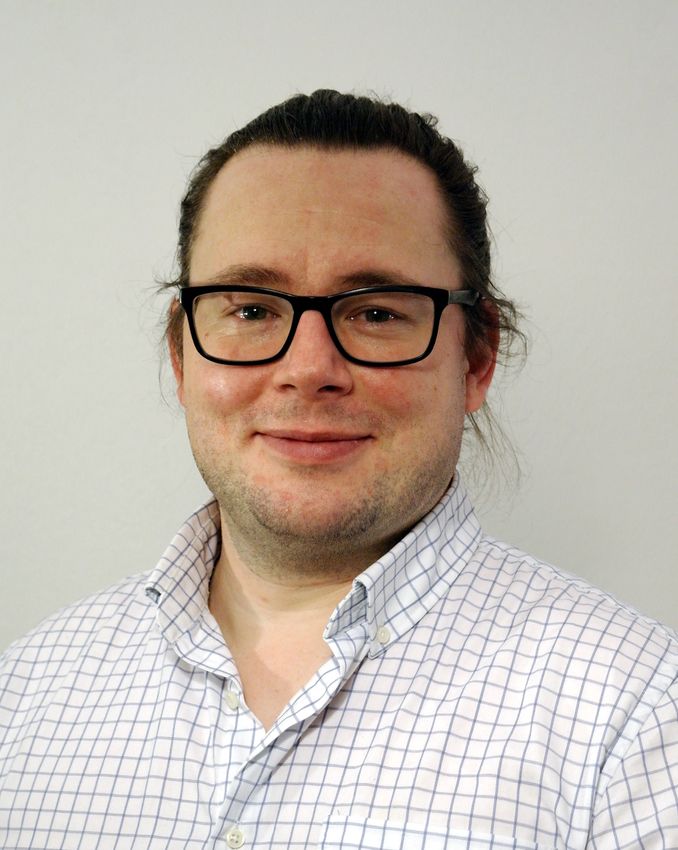
Dr. Axel U. J. Lode

                                Junior group leader for ultracold atomic systems

           Personal details:    Mission statement My aim is to contribute to the pivotal contemporary
          Dr. Axel U. J. Lode
          Pronouns: he/him      technological advances in the field of quantum science, technology, and
                                engineering. To this end, driven by curiosity for fundamental quantum
                   Contact
  email: axel.lode@physik.
                                physics and the concepts behind many-body dynamics, I strive to develop,
          uni-freiburg.de       apply, teach, and provide reliable and directly applicable computational
                        web:
http://ultracold.org/axel       and machine learning tools for modeling quantum states, quantum de-
                                vices, and analog quantum simulators made of ultracold atoms as well as
   Condensed Matter Theory
         Institute of Physics   their readout in quantum measurements.
      University of Freiburg
            79104 Freiburg
                   Germany

                                Education
                                2009–2013: Ph.D. in physics
                                  ◦ Thesis: Tunneling Dynamics in Open Ultracold Bosonic Systems
                                  ◦ Group: Theoretical Chemistry, Heidelberg University, Germany
                                  ◦ Supervisor: Prof. Lorenz S. Cederbaum
                                  ◦ Date of defense: 3rd of June, 2013
                                  ◦ Grade: Magna cum laude (Very good)
                                2002–2008: Diploma in physics
                                  ◦ Thesis: Exact Dynamics of Few-Boson-Systems decaying by Tunneling
                                    through a Barrier
                                  ◦ Group: Theoretical Chemistry, Heidelberg University, Germany
                                  ◦ Supervisor: Prof. Lorenz S. Cederbaum

                                Employment record
                                since 10/2019: Junior group leader
                                  ◦ Project: Numerical Models for Many-Body Physics and Single-Shot Im-
                                     ages
                                  ◦ Host group/institution: Prof. Michael Thoss, Theoretical Condensed
                                     Matter Physics Group, Institute of Physics, University of Freiburg,
                                     Germany
                                  ◦ Supervision of Master’s students
                                  ◦ PhD student Miriam Büttner (since 03/2020)
                                01/2019–09/2019: Principal Investigator
                                  ◦ Project: Numerical Models for Many-Body Physics and Single-Shot Im-
                                    ages
                                  ◦ Host group/institution: Prof. Jörg Schmiedmayer, Prof. Norbert J. Mauser,
                                    Wolfgang Pauli Institute and Atominstitut, Vienna University (of Tech-
                                    nology), Vienna, Austria
7/2017–12/2018: Senior Postdoc at the Wolfgang Pauli Institute and
Atominstitut, Vienna University (of Technology), Austria
◦ Research: Numerical modeling of Schrödinger dynamics in direct col-
laboration with experimental cold-atom setup
◦ Supervision of Bachelor student
◦ Advisors: Prof. Jörg Schmiedmayer, Prof. Norbert J. Mauser
9/2014–10/2014,
Personal details: 8/2015–9/2015: Research and teaching visits
Dr. Axel U. J. Lode
Pronouns: he/him ◦ Lecture: A Layman’s Guide to the Multiconfigurational Time-Dependent
Hartree for Bosons
Contact
email: axel.lode@physik.
◦ Research: Many-body physics and quantum turbulence
uni-freiburg.de ◦ Hosts/Institution: Prof. Vanderlei S. Bagnato and Dr. Marios C. Tsatsos,
web:
http://ultracold.org/axel Group of Optics, University of São Paulo, São Carlos, Brazil.
Condensed Matter Theory 11/2013–6/2017: Condensed Matter Theory & Quantum Computing
Institute of Physics Group, University of Basel, Switzerland
University of Freiburg
79104 Freiburg ◦ Research: Development and applications of software for many-body
Germany
dynamics of ultracold bosons
◦ Supervision of a Masters project work and a Masters thesis
◦ Advisor: Prof. Christoph Bruder
4/2012–7/2012: Research visit
◦ Research: Benchmarking of the MCTDHB package
◦ Funding: Minerva Short Term Research Grant
◦ Host/Institutions: Prof. Ofir E. Alon, Haifa University and Technion,
Haifa, Israel.
Awards and Scholarships
08/2014: Springer Thesis Prize for Ph.D. Thesis
◦ Publication of Ph.D. Thesis as book in the Springer Theses series (see
list of publications)
◦ Awarding institution: Springer International Publishing
◦ EUR 0.5k
6/2013: DAAD-funded “RISE” fellows
◦ funding of a three-month research visit of Storm E. Weiner from UC,
Berkeley and Tomos Wells from Imperial College, London
◦ research fellowship resulted in three publications
4/2012: Minerva Short Term Research Grant
◦ Funding for a three-month research visit to Prof. Ofir E. Alon, Haifa,
Israel
◦ Awarding institution: Minerva foundation of the Max Planck Society
12/2011: Dr. Sophie-Bernthsen Award for Diploma Thesis
◦ Awarding institution: Heidelberg University, Heidelberg, Germany
◦ EUR 0.6k
12/2008: Ph.D. Scholarship
◦ International Graduiertenkolleg 710, Complex Processes: Model-
ing, Simulation and Optimization
◦ Awarding institution: Interdisciplinary Center for Scientific Com-
puting, Heidelberg University, Heidelberg, GermanyGrants
since 1/2019: Standalone grant from the Austrian Science Fund (FWF)
◦ Project title: Numerical models for many-body physics and single-shot
images
◦ Amount: EUR 390k
Personal details: since 6/2013: Grant for computation time
Dr. Axel U. J. Lode
Pronouns: he/him ◦ Project title: The multiconfigurational time-dependent Hartree for in-
distinguishable particles high-performance computation project
Contact
email: axel.lode@physik.
◦ Host/Institution: national German supercomputing center in Stuttgart
uni-freiburg.de (HLRS)
web:
http://ultracold.org/axel ◦ Amount: EUR ∼100k per year (renewed several times since 2013)
Condensed Matter Theory
Institute of Physics
University of Freiburg
79104 Freiburg
Germany
Research Interests
◦ Quantum many-body dynamics
◦ Quantum optics, AMO physics
◦ Quantum simulation – emulating condensed matter with AMO physics
◦ Numerical and machine learning methods
◦ Software development, optimization, and parallelization
Teaching
◦ 1 Bachelor’s thesis supervision
◦ 2 Master’s theses’ supervision (1 ongoing)
◦ 1 PhD student supervision (ongoing)
◦ 18 researchers coached in usage of developed software
◦ 130+ registered users of developed open-source software
◦ 4 tutorials
◦ 2 teaching assistances (1 ongoing)
◦ 1 journal club (started 1/2021)
◦ 2 lectures (3rd upcoming)
(Co-)Organization of Events
5/2018; 4/2018; 11/2017; 3/2017:
(Co-)organization of several mini-symposia
◦ Titles (in reverse chronological order):
◦ MCTDH-X: Many-body physics of interacting atoms in cavities
and fermions with spin
◦ Multiconfigurational time-dependent Hartree methods for multi-
species and multi-component many-body systems
◦ Many-body excitation spectra: Linear response of the multiconfig-
urational time-dependent Hartree method for indistinguishable
particles
◦ MultiConfiguration TimeDependent Hartree Boson (MCTDHB)
◦ Host/Institution: Wolfgang Pauli Institute, University of Vienna, Vi-
enna, Austria12/2019: Organization of mini-symposium
◦ Title: Machine learning and many-body physics
◦ Host/Institution: University of Freiburg, Freiburg, Germany
Software
Lead developer
Personal details: ◦ MCTDH-X: the multiconfigurational time-dependent Hartree for indis-
Dr. Axel U. J. Lode
Pronouns: he/him tinguishable particles software, see http://ultracold.org
◦ UNIQORN: the universal neural-network interface for quantum ob-
Contact
email: axel.lode@physik.
servable readout from N -body wavefunctions, see
uni-freiburg.de https://gitlab.com/UNIQORN and http://ultracold.org
web:
http://ultracold.org/axel Contributor
Condensed Matter Theory ◦ OpenMCTDHB package, see http://OpenMCTDHB.uni-hd.de
Institute of Physics ◦ MCTDHB package, see http://mctdhb.org
University of Freiburg
79104 Freiburg
Germany
Ten Key Publications
◦ Detecting One-Dimensional Dipolar Bosonic Crystal Orders via Full
Distribution Functions,
B. Chatterjee, J. Schmiedmayer, C. Lévêque, and A. U. J. Lode,
DOI: https://doi.org/10.1103/PhysRevLett.125.093602,
Phys. Rev. Lett. 125, 093602 (2020).
◦ Colloquium: Multiconfigurational time-dependent Hartree approaches
for indistinguishable particles: Wave-packet dynamics of many-body
systems,
A. U. J. Lode, C. Camille Lévêque, L. B. Madsen, A. I. Streltsov, O. E.
Alon,
DOI: https://doi.org/10.1103/RevModPhys.92.011001,
Rev. Mod. Phys. 92, 011001 (2020).
◦ MCTDH-X: The multiconfigurational time-dependent Hartree method
for indistinguishable particles software,
R. Lin, P. Molignini, L. Papariello, M. C. Tsatsos, C. Lévêque, S. E.
Weiner, E. Fasshauer, R. Chitra, and A. U. J. Lode,
DOI: https://doi.org/10.1088/2058-9565/ab788b,
Quantum Sci. Technol. 5, 024004 (2020).
◦ Pathway to chaos through hierarchical superfluidity in a cavity-BEC
system,
R. Lin, P. Molignini, A. U. J. Lode, and R. Chitra,
DOI: https://doi.org/10.1103/PhysRevA.101.061602,
Phys. Rev. A 101, 061602(R) (2020).
◦ Parametric Excitation of a Bose-Einstein Condensate: From Faraday
Waves to Granulation,
J. H. V. Nguyen, M. C. Tsatsos, D. Luo, A. U. J. Lode, G. D. Telles,
V. S. Bagnato, and R. G. Hulet,
DOI: https://doi.org/10.1103/PhysRevX.9.011052,
Phys. Rev. X 9, 011052 (2019).
◦ Fragmented superradiance: Correlations in a Bose-Einstein Conden-
sate in an Optical Cavity beyond the Dicke Model,
A. U. J. Lode and Christoph Bruder,
DOI: https://doi.org/10.1103/PhysRevLett.118.013603,
Phys. Rev. Lett. 118, 013603 (2017).◦ The multiconfigurational time-dependent Hartree method for bosons
with internal degrees of freedom: Theory and composite fragmentation
of multi-component Bose-Einstein condensates,
A. U. J. Lode,
DOI: https://doi.org/10.1103/PhysRevA.93.063601,
Phys. Rev. A 93, 063601 (2016).
◦ The multiconfigurational time-dependent Hartree for fermions: Imple-
Personal details:
mentation, exactness and application to few-fermion tunneling to open
Dr. Axel U. J. Lode space,
Pronouns: he/him
E. Fasshauer and A. U. J. Lode,
Contact DOI: https://doi.org/10.1103/PhysRevA.93.033635,
email: axel.lode@physik. Phys. Rev. A 93, 033635 (2016).
uni-freiburg.de
web: ◦ How an interacting many-body system tunnels through a potential
http://ultracold.org/axel
barrier to open space,
Condensed Matter Theory A. U. J. Lode, A. I. Streltsov, K. Sakmann, O. E. Alon, and L. S. Ceder-
Institute of Physics
University of Freiburg baum,
79104 Freiburg DOI: https://doi.org/10.1073/pnas.1201345109,
Germany
Proc. Natl. Acad. Sci. USA 109, 13521 (2012).
◦ Numerically exact quantum dynamics of bosons with time-dependent
interactions of harmonic type,
A. U. J. Lode, K. Sakmann, O. E. Alon, L. S. Cederbaum, and A. I.
Streltsov,
DOI: https://doi.org/10.1103/PhysRevA.86.063606,
Phys. Rev. A 86, 063606 (2012).You can also read


