Dream Team Children's pediatric cancer specialists get aspiring soccer star back in the game - Children's Hospital
←
→
Page content transcription
If your browser does not render page correctly, please read the page content below

W I N T E R 2 018

                            A Physician Resource from Children’s Hospital of Pittsburgh of UPMC   •   www.chp.edu

                    Special Page 4 Feature

                    Dream
                    Team
                    Children’s pediatric cancer
                    specialists get aspiring
                    soccer star back in the game

                    Liver Transplantation
                    Program expands to Florida

                    Andy’s INSIGHTS
                    Transitioning care for
                    young adult patients

                    Studying
                    Telemedicine
                    Exploring new uses
                    for technology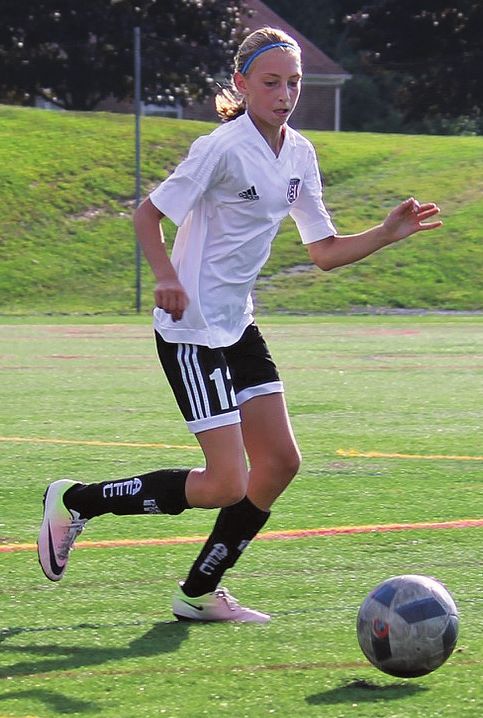
WINTER 2018

Inside this issue

1            Liver transplantation expands

2            News you need

3            Health Informatics

4            Feature Story
             Dream Team
                                                            The WINTER 2018 issue of Pediatric INSIGHTS
                                                            Cover story: The Adolescent and Young Adult Oncology Program at Children’s
7            Andy’s INSIGHTS
                                                            Hospital of Pittsburgh of UPMC brings together all of the specialists and services
                                                            young people need to battle common and rare diseases. For Reese Aquilio, Children’s
                                                            physicians teamed up with an adult-focused surgeon to remove a carcinoid lung
8            Laurels for our staff
                                                            tumor more common in adults and help get her back to playing the sport she loves.
                                                            Read about it on page 4.

9

             Studying telemedicine
             Heart Institute accredited
                                                            In addition:

                                                            > Children’s Hospital has created the new Division of Health Informatics, that will
                                                               leverage technology to enhance innovation and patient safety and outcomes.
                                                               Learn more on page 3.
EDITOR
Lisa Clark                                                  > On page 7, Andy Urbach, MD, medical director for Patient Experience and
                                                               Development, highlights the ways Children’s Hospital is working to improve the
CONTRIBUTORS
Maggie Bray, Mary Kukovich, Kate Lindholm, Marc                transition for young adults who are shifting from pediatric- to adult-focused care.
Lukasiak, Andrew Urbach, MD
                                                            > On page 9, learn about a recent study that explores new ways to enhance
DESIGN
                                                               Children’s Telemedicine service, which currently offers outpatient care at seven
Jim Zahniser
                                                               convenient locations in western Pennsylvania.
PHOTOGRAPHY
Tom Gigliotti, Annie O’Neill, UPMC Media Services           We welcome your feedback, thoughts, and story suggestions. Please share them with
Pediatric INSIGHTS is published four times a year
                                                            one of our physician liaisons, whose contact information you can find on page 7.
for physicians and friends of Children’s Hospital of
Pittsburgh of UPMC, which is an equal opportunity
employer. It is the policy of Children’s Hospital of
Pittsburgh of UPMC to admit and to treat all patients
without regard to race, color, religion, national origin,                   Physician Referral Service

                                                                               412-692-PEDS
ancestry, sex, or disability. Children’s Hospital of
Pittsburgh of UPMC is a public charity under 501(c)
(3) and 170(b) (1) (A) of the Internal Revenue Code.
Contributions are deductible to the extent permitted
by law. We do not sell or trade our mailing list.                                        (7337)
To submit comments or story suggestions, email
Kate Lindholm at kathleen.lindholm@chp.edu.
                                                                           To refer a patient to any of Children’s Hospital of Pittsburgh
                                                                                     of UPMC’s clinical services, please call our
Learn more about Children’s Hospital of Pittsburgh
of UPMC by visiting www.chp.edu.                                               Physician Referral Service at 412-692-PEDS (7337).

MC17160 LC/JZ 1/2018 10K BP ©2018 UPMC
                                                                                 Visit the Referring Physicians section of Children’s
                                                                                        website at www.chp.edu/physicians.
N E W S F R O M T R A N S P L A N TAT I O N

Liver Transplant Program Expands
Pittsburgh Specialists Partner With Florida Hospital for Children

In order to make lifesaving liver transplants available
throughout central and north Florida, Florida Hospital for
Children is partnering with Children’s Hospital of Pittsburgh
of UPMC to develop a comprehensive pediatric liver
transplant program. The program, which started to accept
patients in January, is the first of its kind in Orlando and
the second in Florida.
    Florida Hospital is one of the largest not-for-profit
hospitals in the country. The organization’s range of
nationally and internationally recognized services includes
transplant, pediatrics, cardiology, and advanced surgical
programs. Florida Hospital for Children’s flagship hospital
in Orlando is the heart of a children’s network that includes
primary care pediatricians, specialty clinics, emergency
departments, and Kids Urgent Care.                                   ABOVE: The program, which started to accept patients in January, is the
    “There is a critical need for children across our state to       first of its kind in Orlando and the second in Florida. (Photo courtesy Florida
have access to a liver transplant program that is close to           Hospital for Children.)

home,” says Regino Gonzalez-Peralta, MD, director of Pediatric                   chief of Pediatric Transplantation at Children’s. “Our extension
Gastroenterology, Hepatology, and Liver Transplantation with                     of expertise will provide the best possible care and make
Florida Hospital for Children. “This partnership brings the experience           transplant a life-saving treatment for local families and help
of one the nation’s best pediatric liver transplant programs to central          them to achieve a better quality of life.”
Florida. The Florida Hospital and Children’s Hospital partnership is                 In 1981, Children’s Hospital opened the country’s first
not only a win for our patients, but all of Florida.”                            comprehensive     pediatric transplant center under the guidance of
    The teams will work in partnership with Florida Hospital’s                   transplant pioneer Thomas E. Starzl, MD, PhD. According to the 2017
Transplant Institute, which offers kidney, liver, kidney/pancreas,               data released by the Scientific Registry of Transplant Recipients, the
lung, and heart transplants.                                                     pediatric liver transplant program at Children’s ranks number 1 out
    “Florida Hospital has been committed to saving lives through                 of 62 pediatric liver transplant centers in the United States for one-
our transplant programs for more than 40 years, and it is our                    year overall patient and graft survival when comparing hazard ratio
goal to provide the same level of advanced and compassionate                     estimates. The program remains at the leading edge of expertise,
care to infants and children in our community in need of liver                   innovation, and patient- and family-centered care for transplant
transplants,” says Thomas Chin, MD, director of the Florida                      patients from all over the world.
Hospital Transplant Institute’s liver transplant program. “We are                    Members of the transplant team from Children’s Hospital will
honored to partner with Children’s Hospital and bring our world-                 participate in the management of patients in Florida. Transplant
class programs together.”                                                        surgeons, medical specialists, and nurses from Florida and Children’s
    In order to offer these transplants to families in the Florida               Hospital will perform pediatric liver transplant surgeries together at
area, the hospital will work with the Hillman Center for Pediatric               Florida Hospital for Children.
Transplantation at Children’s Hospital, which has performed more                     The pediatric liver transplant partnership with Florida
than 1,800 pediatric liver transplants — more than any other                     Hospital is the second program of its kind for Children’s Hospital.
center in the United States, according to the United Network for                 In 2016, Children’s Hospital became the first and only pediatric
Organ Sharing, with patient survival rates consistently higher than              liver transplant program to expand the geographic reach of its
national averages.                                                               expertise through a partnership with the University of Virginia
    “We are grateful for this opportunity to now expand our                      Children’s Hospital in Charlottesville. Today, Children’s pediatric
services and expertise in pediatric liver transplantation to                     liver transplant network extends from Pittsburgh to Virginia, and
families in the Florida area,” says George V. Mazariegos, MD,                    now Florida. •

                                                                                                                       Pediatric INSIGHTS • Winter 2018   1
NEWS YOU NEED

New Children’s Webinar Series                                                                  What an impact we
Free CME Credit Available                                                                      have made together.
                                         Children’s Hospital of Pittsburgh of UPMC             With the help of many,
                                         offers a lunchtime webinar series for pediatric
                                                                                               we’ve changed lives
                                         providers. The Pediatric Insights Webinar Series
                                         features Children’s Hospital specialists presenting   for the better.
                                         on challenging topics that pediatricians, family
                                         practitioners, and other pediatric providers may
                                         face in their practices.
     Currently the webinars are held monthly. This frequency may increase in 2018.
     Continuing medical education (CME) credit is available for viewers who
participate in the live broadcast. Past webinars are available to view, however,
credit is unavailable.
     Each webinar is worth 1 CME credit (0.1 CEU for other health care professionals). In
order to receive credit, participants must provide their full name, credentials, and the
last five digits of their Social Security number when requested. Credit is granted through
the University of Pittsburgh Center for Continuing Education in the Health Sciences.
     Visit www.chp.edu/webinars to view and register for upcoming
webinars. Have a topic you’d like to see covered? Email us at
mdrelations@chp.edu with your suggestions. •

New Division Chief Appointed
                   A leading expert in evaluating and treating children with                   The 2017 Children’s Hospital of Pittsburgh of
                   cholestatic liver disease, Andrew Feranchak, MD, recently                   UPMC and Children’s Hospital of Pittsburgh
                   joined Children’s Hospital of Pittsburgh of UPMC as chief                   Foundation Community Report takes a look back
                   of the Division of Pediatric Gastroenterology, Hepatology,                  at a year of innovation and impact in all aspects
                   and Nutrition and professor of Pediatrics at the University                 of the work that we do here, from excellence in
                   of Pittsburgh School of Medicine.                                           clinical care, to breakthroughs in the research
    Previously, Dr. Feranchak served as chief of the Division of Pediatric                     setting, to creative ways of healing.
Gastroenterology and professor in the Department of Pediatrics at the                              Visit www.chp.edu/communityreport and
University of Texas Southwestern Medical Center in Dallas, where he                            you can:
also held the Willis C. Maddrey, MD Chair in Liver Disease. A native of                        > Meet some of the big thinkers at Children’s
Pittsburgh, Dr. Feranchak received his medical degree from the University of                     Hospital, who are developing new and
Pittsburgh School of Medicine, and he completed his pediatric residency at                       improved vaccines, helping kids get healthier,
Children’s Hospital, followed by fellowship training in gastroenterology and                     and doing important work in the community
hepatobiliary transport at the University of Colorado Health Sciences Center.
                                                                                               > Look back at some of the heroes who make
    Dr. Feranchak’s clinical and research expertise involves cholestatic liver
                                                                                                 this work possible, by donating their time
diseases, bile formation, hepatobiliary transport mechanisms, and membrane
                                                                                                 and treasure
ion channels. Dr. Feranchak’s NIH-funded research focuses on understanding
the basic mechanisms of bile formation, which may serve as the basis for                       > Make a secure online donation to support
therapeutic strategies for the treatment of cholestatic liver disorders.                         the life-changing work we do every day
    To make a referral or for more information, contact the Division of                           If you’d like a hard copy of the 2017
Pediatric Gastroenterology, Hepatology, and Nutrition at Children’s                            Community Report, email Kate Lindholm at
Hospital of Pittsburgh of UPMC at 412-692-5180. •                                              kathleen.lindholm@chp.edu. •

2    CHILDREN’S HOSPITAL OF PITTSBURGH OF UPMC • www.chp.edu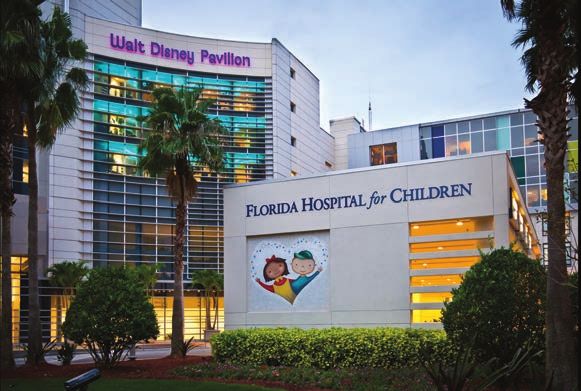
N E W S F R O M P E D I AT R I C S

New Division Created for Health Informatics
Leveraging Technology to Enhance Innovation and Patient Safety and Outcomes

Since the implementation of its electronic medical record in 2002,                                                           By 2019, Dr. Suresh
Children’s Hospital of Pittsburgh of UPMC has been recognized as                                                          anticipates that the
                                                                              Key Partnerships:
a leader in digital technologies for pediatric medicine. More than                                                        division will be staffed
a decade later, Children’s Hospital continues to the lead the way in          > Department of Biomedical                  with up to seven
health information technology and patient safety with the creation               Informatics, University of Pittsburgh    faculty members
of a new Division of Health Informatics.                                      > Department of Industrial                  including physicians
    “I’m excited to announce the development of a new division in                Engineering, University of               with expertise in
the Department of Pediatrics, the groundbreaking Division of Health              Pittsburgh                               clinical informatics, a
Informatics,” says Terence Dermody, MD, chair of the Department of                                                        biomedical scientist
                                                                              > Heinz College of Information
Pediatrics at the University of Pittsburgh School of Medicine, and                                                        from the University’s
                                                                                 Systems and Public Policy, Carnegie
physician-in-chief and scientific director at Children’s. “Our goal is                                                    Biomedical Infor-
                                                                                 Mellon University
to harness the power of technology and join forces with leaders in                                                        matics department,
information science — from industry to academia and medicine —                > Center for Machine Learning               and a tenure stream
to substantially improve safety and outcomes for all patients while              and Health, Carnegie Mellon              researcher who
lowering health care costs from emergency care to the operating                  University                               will lead Children’s
room, starting with primary care services.”                                   > UPMC Enterprises                          bioinformatics
    The Division of Health Informatics is a collaborative effort                                                          core. Positions that
between the Department of Pediatrics, the University of Pittsburgh            Current Collaborations:                     currently make up
School of Medicine, and Children’s. Its mission is to drive the delivery      > Children’s Hospital Association           the division include a
of pediatric health care into a new era of high-value care and data-                                                      data scientist, clinical
                                                                              > Solutions for Patient Safety Network
driven outcomes through innovation and new partnerships.                                                                  pathway coordinator,
                      The division is led by Srinivasan Suresh, MD, MBA.      > Improving Pediatric Sepsis Outcomes       systems analysts,
                    Dr. Suresh will continue to serve as the hospital’s                                                   and nurse education
                    chief medical information officer, a position he’s                                                    specialists.
                    held since 2014. As a board-certified physician in         Current clinical projects include an early warning sign for
                    the new specialty of clinical informatics,             clinical deterioration of acute care patients; the System for
                    Dr. Suresh is passionate about the application         Hospital Adaptive Readmission Prediction and Management
of business intelligence tools and advanced data analytics in              (SHARP) that calculates readmission risk; and the cardiac
improving child health and patient and provider satisfaction.              warning index (C-WIN) that predicts the need for invasive
    Dr. Suresh is also board-certified in pediatric emergency              procedures in CICU patients. Projects on the horizon include
medicine and will continue to provide clinical care in Children’s          the Personalized Medicine Initiative (PMI), which is a national
Emergency Department. Additionally, he is a professor of Pediatrics        study on precision medicine, and Dr. Dermody’s Pittsburgh
at the University of Pittsburgh School of Medicine.                        study, which will investigate correlates of health in Allegheny
    Key goals of the Division of Health Informatics are to                 County children.
integrate clinical, operational, and financial data; to create a               The division has received funding through several grants
comprehensive pediatric predictive analytics platform; and                 totaling nearly $4 million, including a Beckwith Foundation
to apply information-enabled tools to transform health care                Grant for the dissemination of an electronic health record-based
delivery in pediatrics.                                                    child abuse clinical decision support system toolkit, a grant for
    Over the next year, Dr. Suresh and his team will develop and           the SHARP project, and support from the Children’s Hospital of
refine clinical pathways (to standardize care, improve quality             Pittsburgh Foundation to create the Starzl Network for Excellence
outcomes, and lower costs), build newer clinical decision support          in Pediatric Transplantation.
tools, and enable dashboards for measurement. The division will                For more information about the Division of Health
also focus on population analysis and risk-stratification models of        Informatics, please contact Dr. Suresh at 412-692-6303 or
Children’s patient population.                                             suresh@chp.edu. •

                                                                                                                   Pediatric INSIGHTS • Winter 2018   3
FEATURE STORY

                                                                Dream
                                                                Team
                                                           Children’s pediatric cancer
                                                             specialists get aspiring
                                                          soccer star back in the game.
                                                              The pain was overwhelming. It had come and gone in Reese Aquilio’s chest and back
                                                              for several months when she played soccer, but during this big match it was much
                                                              more intense. Later that night, the pain became unbearable. “She couldn’t breathe
                                                              and her chest was really tight. She was up all night in pain,” her mother Lesley Aquilio
                                                              says through tears, recalling that night. “I knew something was wrong.”
                                                                  At 13, there was little reason to suspect a dangerous carcinoid cancer more
                                                              commonly found in adults was slowly growing in Reese’s lungs, choking the life out
                                                              of her. Once it was discovered, pediatric specialists at Children’s Hospital of Pittsburgh
                                                              of UPMC employed first-ever technology and a comprehensive team approach to
                                                              remove the tumor and help Reese return to the sport she loves.
                                                                  As an avid athlete and year-round soccer player, the Norwin Middle School
Reese Aquilio (top and above center) has
worked hard to overcome carcinoid cancer                      student was accustomed to pushing her body to the limit. So, when an initial x-ray
with specialized treatment at Children’s                      in November 2016 showed a diagnosis of pneumonia, she took it in stride — using
Hospital of Pittsburgh of UPMC and support                    antibiotics prescribed by her primary care physician and resting until she felt
from her parents, Tony and Lesley Aquilio.
(Top photo submitted.)
                                                              better. When she returned to her soccer workouts, the pain came back, too.
                                                                  Following that night of unbearable pain in March 2017, Reese’s
                                                              grandmother took her back to the primary care physician, who
                                                              suggested a second x-ray. “As soon as I got home from work I took her
                                                              for the x-ray. I just felt like something was not right. Call it mother’s
                                                              intuition,” says Mrs. Aquilio.

4   CHILDREN’S HOSPITAL OF PITTSBURGH OF UPMC • www.chp.edu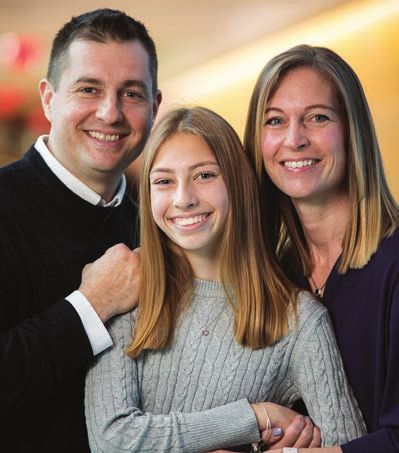
“The next day her pediatrician called and said, ‘This is not
pneumonia. I don’t know what it is, but I’m calling Children’s Hospital
to get her in for an appointment as soon as possible,’” she says.
    At Children’s she underwent a computed tomography scan of
the chest on April 18, and there it was: a mass in the lung, on the
right main bronchus, a major airway.

                                                                            Fertility Preservation Program
                                                     LEFT: Pediatric        Pediatric cancer rates are on the rise, and with that more
                                                     oncologist Louis       survivors are living into adulthood and interested in having
                                                     Rapkin, MD, was
                                                                            children. But chemotherapy and radiation treatments for
                                                     part of the team
                                                     of specialists who     cancer and other conditions can damage fertility and reduce or
                                                     treated Reese.         eliminate a patient’s ability to have children.
                                                     Pictured (left to          Children’s Hospital of Pittsburgh of UPMC participates in
                                                     right) are Lesley
                                                     Aquilio, Dr. Rapkin,   the Fertility Preservation Program of Pittsburgh, along with
                                                     and Reese and          Magee-Womens Research Institute and the Center for Fertility
                                                     Tony Aquilio.          and Reproductive Endocrinology at Magee-Womens Hospital of
                                                                            UPMC. These services are critical particularly for patients in the
                                                                            hospital’s Adolescent and Young Adult (AYA) Oncology Program,
                                                                            but also are accessible by younger patients.
Age-appropriate care
                                                                            Fertility care services available for children or adults include:
Carcinoid tumors, made up of neuroendocrine cells, rarely occur in the
lungs of children, but are more often found in adults with lung cancer.     > Semen cryopreservation
“If caught early enough it is very survivable, but late-stage disease       > Embryo cryopreservation
is incurable,” says Louis Rapkin, MD, clinical director of Oncology at
                                                                            > Oocyte cryopreservation
Children’s. “If the tumor blocks the bronchial tube, the mass can cause
pneumonia and other damage to the lung. If it spreads, there is little      > Testicular tissue freezing (with approval of the Institutional
chemotherapy or other treatments can do to cure it.”                          Review Board of the University of Pittsburgh)
     The Adolescent and Young Adult Oncology Program in                     > Ovarian tissue freezing (with approval of the Institutional
Children’s Division of Hematology/Oncology offers specialized                 Review Board of the University of Pittsburgh)
oncology and support services to meet the needs of children
in their teens through young adults up to age 26. The program               The Fertility Preservation Program of Pittsburgh is committed to:
features a comprehensive approach to care that enables patients             > Educating patients and their physicians about the
to be treated by pediatric oncologists in collaboration with                  reproductive consequences of chemotherapy and
adult-focused oncologists, when appropriate. Rather than simply               radiation treatments for cancer or other conditions
requesting a consultation via telephone or computer, additional
                                                                            > Providing state-of-the-art reproductive technologies to
experts can be brought to Children’s Hospital in Lawrenceville.
                                                                              preserve fertility and treat infertility
     “We are better geared to treat adolescents and young adults
because we also take into account their developmental stage to              > Pioneering new reproductive technologies to preserve
make the experience more manageable for the patient. Even                     fertility and treat infertility
young adults are still developing in terms of their ability to cope         > Rapidly translating these new technologies to the clinic
with trauma. We account for their physical and psychological
                                                                            > Training the next generation of clinicians and
needs,” says Dr. Rapkin.
                                                                              researchers in the rapidly evolving discipline of fertility
     Reese’s team of physicians included Dr. Rapkin and Stefan
                                                                              preservation
Scholz, MD, PhD, a general and thoracic pediatric surgeon and
Director of Minimally Invasive Surgery at Children’s. To give her           For more information, visit fertilitypreservationpittsburgh.org
the best chance possible, they collaborated with Inderpal Sarkaria,                                              Continued on page 6
                                                                            or email fertilitypreservation@upmc.edu.
                                                  Continued on page 6

                                                                                                              Pediatric INSIGHTS • Winter 2018   5
FEATURE STORY

MD, a thoracic surgeon at UPMC Hillman Cancer Center who has
experience treating adult patients with carcinoid lung cancer.
   “It was a very tricky mass requiring high-end thoracic surgery,”
says Dr. Scholz. “The ability to bring in someone who has a lot of
experience with carcinoid lung cancer was a great asset.”

Pioneering radiology
On April 27, Reese’s rare diagnosis was confirmed by something
even rarer: positron emission tomography (PET) imaging using a
Gallium 68 dotatate injection. The radioactive diagnostic agent is
a less-invasive alternative than biopsy to help pinpoint carcinoid
tumors. Although it has been used in other parts of the world
for many years, it wasn’t approved by the U.S. Food and Drug
Administration until June 2016. Reese became the first patient at
Children’s Hospital — and the first pediatric patient in the nation
— to undergo a dotatate PET scan.
    “We were nervous about Reese being the first child to have           ABOVE: Reese attends a follow-up visit at Children’s Hospital with her parents
the dotatate PET scan, certainly as anyone would be scared, but          and one of her surgeons, Stefan Scholz, MD, PhD.
we knew we needed to have the right diagnosis and we wanted
to avoid an invasive biopsy. We needed the team of doctors to            with a “negative margin” of healthy surrounding tissue, the key
                                    have the most up-to-date and         factor for a good long-term prognosis.
                                    accurate information possible.            Reese did very well following the procedure and was
“Everyone we                        So we were willing to do             discharged from the hospital six days after surgery, determined

  encountered                       whatever it takes to make sure
                                    everything went well for Reese,”
                                                                         to get back on track with soccer. Within a month, she started
                                                                         speed and strength conditioning. After two months, she began
 in the hospital                    says Mrs. Aquilio.                   one-on-one footwork training with her coach. She joined her
and at all of the                        “After the test, the            soccer team for its first practice of the season in August. “She’s

 appointments                       technician handed Reese a
                                    stuffed animal and said to
                                                                         still working to get back to the skill level she had prior to the
                                                                         diagnosis. She is determined not to let this hold her back,” says
    has been                        her, ‘Not only are you helping       her mother.
nothing short of                    yourself, you are helping many            “If you take out the lower and middle lobes of the lung, initially

  spectacular.”                     other children.’ I think that made
                                    her feel powerful to know she
                                                                         you feel it,” says Dr. Scholz. “But in the eight weeks after surgery, Reese
                                                                         trained herself to approach the level of activity that she had before.”
             ...                    was helping others by being the           In Reese’s case, chemotherapy and radiation treatments were
         Lesley Aquilio             first child to undergo the scan,”    not necessary. Doctors will monitor her progress over the next
                                    Mrs. Aquilio adds.                   five years with visits every four to six months that include physical
                                                                         examinations, chest x-rays, and pulmonary function tests.
Bilobectomy                                                                   Lesley Aquilio and her husband, Tony Aquilio, who live in North
While doctors carefully planned Reese’s surgery, she fought              Huntingdon with Reese and her two younger sisters, Alyssa and
through the pain in order to try to find a sense of normalcy. She        Natalie, credit the medical professionals at Children’s Hospital
continued to play soccer, participated in a chorus concert, and          for the high level of care and attention the whole family received
attended her school picnic at Kennywood amusement park. On               during Reese’s treatment. “We felt like we were living a true
June 2, everything was ready.                                            nightmare, and everyone at Children’s made this process much
    Doctors had hoped to remove only one of the three lobes              easier,” says Mrs. Aquilio. “Our only option was to put our trust
of the right lung. “The mass was located at the root of the right        and faith in the professionals working with Reese. Everyone we
lung at and within the division of the main bronchus to the              encountered in the hospital and at all of the appointments has
middle and the lower lobes,” says Dr. Scholz. During the four-hour       been nothing short of spectacular.”
surgery, doctors made the decision to remove the two lobes — a                To make a referral for the Adolescent and Young Adult
bilobectomy — in order to assure complete removal of the tumor           Oncology Program at Children’s Hospital, call 412-692-5055. •

6   CHILDREN’S HOSPITAL OF PITTSBURGH OF UPMC • www.chp.edu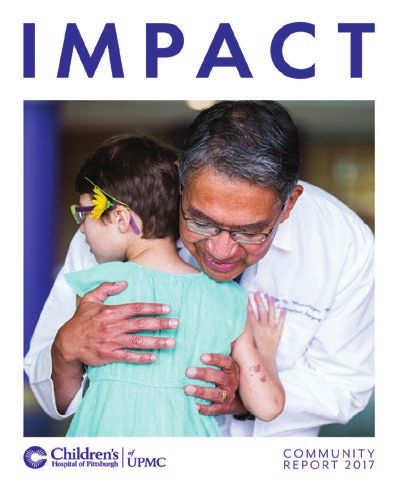
PERSPECTIVE

                        ,
                    Andy s                                                     physicians, nurses, social workers, administrators, and
                                                                               community stakeholders.

                                                                               Bridges Transition Pediatric to Adult Clinic
                                                                               Dr. Matheo also leads our weekly Bridges Transition Pediatric
                                                                               to Adult Clinic in Lawrenceville. This multidisciplinary clinic of
The transition from pediatric to adult subspecialty care
                                                                               physicians, social workers, and psychologists augments the work
can be a medical, logistical, and emotional rollercoaster
                                                                               of existing transition efforts at Children’s through its programs
for young adults with complex health conditions.
                                                                               on reproductive and behavioral health. It also supports the
How can we give them the skills, knowledge, and
                                                                               development of new and emerging transition programs.
confidence to make this critical move?
                                                                                   The clinic evaluates individual readiness while slowly preparing
Pediatric patients with complex or chronic medical conditions                  AYAs to assume a greater role in their health care. They learn to
often grow up at Children’s Hospital of Pittsburgh of UPMC,                    understand their illness more deeply, how to advocate for their
spending years in our care. Many are medical pioneers, too, living             health and talk with adult specialists, and even schedule their
longer and healthier lives than ever before.                                   own appointments and reorder prescriptions. Patients can discuss
    The successful transition from pediatric care is a highly per-             sensitive topics such as sexuality, peer pressure, and drug use with
sonalized process that can take months or even years, based on                 trusted professionals. The clinic coordinates with adult providers
the needs of both patients and parents. Conversely, the successful             to ensure the smooth transfer of care.
transfer to adult-oriented providers requires a well-planned and
orchestrated “passing of the baton” that gives new caregivers the              Other notable Initiatives
succinct and meaningful documentation they need.                               Sometimes, there are no adult subspecialists qualified to care for
    Here are a few of the ways Children’s is working to make                   survivors of certain pediatric-onset illnesses. Each year, my office
transition and transfer seamless processes for patients and their              receives nearly 100 requests for Children’s to provide continued care
families — and their new subspecialists.                                       for these patients. All requests are considered and approved on an
                                                                               individual basis.
Task Force 13                                                                      We’re also fortunate to have Reed van Deusen, MD, and Alda
The mission of Task Force 13, an interdisciplinary workgroup, is to help       Gonzaga, MD, of UPMC General Internal Medicine. Their transitional
adolescents and young adults (AYA) become more self-sufficient and             care clinic, the Progressive Evaluation and Referral Center, offers
improve their long-term outcomes. Many of our departments have                 longitudinal primary care and care coordination, particularly for
extensive measures in place for pediatric-to-adult care transition. Task       patients with cognitive or developmental issues.
Force 13 aims to learn from these best practices while also developing             Andy Urbach, MD, is medical director for Patient
resources to support transition needs hospital-wide.                           Experience and Development at Children’s Hospital. He
   Loreta Matheo, MD, a specialist in adolescent medicine,                     welcomes your comments and questions. Please send an
recently took over leadership of Task Force 13, which includes                 email to MDrelations@chp.edu. •

At Your Call                                   CO N N E C T W I T H C H I L D R E N’ S H O S P I TA L O F P I T T S B U R G H O F U P M C

VISIT NAVIGATION                                             PHYSICIAN LIAISONS
Our outpatient visit coordinator helps manage                Our team serves as liaisons between
the complexities of scheduling multiple medical              physicians in the community and our
appointments for patients who need to return                 pediatric specialists. Contact them with
to Children’s Hospital of Pittsburgh of UPMC                 questions, comments, and concerns.
three or more times within the same month.
                                                                                                          Judi Morris-Feinberg      Monica Reisz
For more information, contact Visit Navigation at
                                                                                                          412-692-5428              412-692-5376
visitnavigation@chp.edu or 412-692-5687. Erinn                                                            judi.feinberg@chp.edu     monica.reisz@chp.edu
Kasubinski, RN, BSN, is the Visit Navigation manager.

                                                                                                                       Pediatric INSIGHTS • Winter 2018   7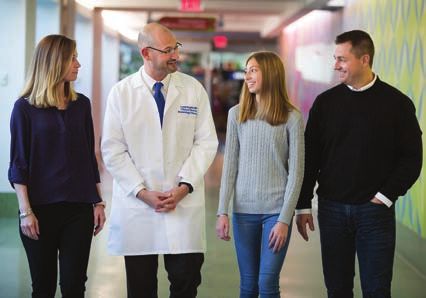
Laurels
These Children’s Hospital staff members recently received recognition in their fields.

                         Children’s Hospital of Pittsburgh
                         of UPMC has been recognized with
                         titanium status in the 2017 Hospital and
                                                                         Patient Satisfaction Awards
Healthsystem Association of Pennsylvania (HAP) Donate Life               Congratulations to the 27 Children’s Hospital physicians who
Hospital Challenge that encourages Pennsylvania hospitals to             recently received the Patient Satisfaction Award for Outstanding
increase organ donation awareness and designations within their          Achievements in Patient Care. Physicians were rated based on
hospital and community. To reach the titanium level, hospitals           Press Ganey survey questions, which focus on areas like being
engaged in unprecedented levels of clinical and community                a good listener, showing dignity and respect, and providing
activities, aimed at encouraging new donor signups.                      understandable information in a friendly manner.

                                                                         Sonika Bhatnagar, MD, MPH        Susan Miller, MD
              Rachel Berger, MD, MPH, chief, Division of Child
                                                                         Aimee Biller, MD                 Radhika Muzumdar, MD
              Advocacy, and president, Children’s Hospital medical
                                                                         James Cooper, MD                 Christina Rae Nguyen, MD
              staff, has received a grant from the Patient-Centered
                                                                         Alexander Davit, MD              Andrew Nowalk, MD, PhD
              Outcomes Research Institute for her project titled,
                                                                         Stacey Drant, MD                 Evelyn Reis, MD
              “Disseminating Child Abuse Clinical Decision
                                                                         Jason Edinger, DO                Arthur Ritchey, MD
Support to Improve Detection, Evaluation, and Reporting.”
                                                                         Erika Friehling, MD              Timothy Shope, MD, MPH
                                                                         Angela Garcia, MD                Arvind Srinath, MD
               Juan Celedon, MD, DrPH, chief, Pulmonology,
                                                                         Kristin Hannibal, MD             Kishore Vellody, MD
               Allergy, and Immunology, has received a grant from
                                                                         Tyler Harris, MD                 Katherine Watson, DO
               the National Institutes of Health to support social
                                                                         Alicia Haupt, MD                 Jacqueline Weinberg, MD
               epigenomics research in health disparities. He will
                                                                         Daniel Kietz, MD, PhD            Randy Windreich, MD
               lead research on “Exposure to Violence, Epigenetic
                                                                         Ingrid Libman, MD                Matthew Zinn, DO
Variation, and Asthma in Puerto Rican Children.”
                                                                         Scott Maurer, MD

                            Two Children’s Hospital physicians
                            in Pulmonary Medicine, Allergy,
                                                                                            These Children’s Hospital staff won Poster
                            and Immunology were honored
                                                                                            Presentation Awards during Children’s
                            recently with teaching awards from
                                                                                            Hospital of Pittsburgh of UPMC’s observance
                            the University of Pittsburgh School
                                                                                            of HealthCare Quality and International
of Medicine. Jonathan Finder, MD (left), professor, Pediatrics,
                                                                                            Infection Prevention Week in October:
received the 2017 Sheldon Adler Innovation in Medical Education
Award. Daniel Weiner, MD (right), associate professor, Pediatrics,    > FIRST PLACE – “The Impact of Pre-Transplant Psychosocial Risk
received the 2017 Award for Outstanding Mini-Elective.                  Factors and Post-Transplant Correlations” by Christina Nguyen,
                                                                        MD, Beth Ann Logan, PhD, and Jada Epps.
               Elizabeth Hartigan, MPH, RN, CRM, clinical
                                                                      > SECOND PLACE – “Emergency Department Triage: Changing the
               research manager, Pulmonary Medicine, Allergy,
                                                                        Culture” by Jeff Beveridge, Dave Rausch, and Zachary Clayton.
               and Immunology, was selected to receive the 2017
               University of Pittsburgh Chancellor’s Staff Award in   > THIRD PLACE – “A Feeding Protocol at the Children’s Hospital
               the Research Support category.                           Rehabilitation Unit” by Unoma Akamagwuna, MD, and
                                                                        Elizabeth Guzek, PA-C.
               Amy Houtrow, MD, MPH, PhD, chief, Pediatric
               Medicine and Rehabilitation, was recently elected to   > PEOPLE’S CHOICE AWARD – “IROC: Improving Blood Pressure
               the Board of Governors of the American Academy of        Control for Kidney Transplant Recipients” by Noel Thompson
               Physical Medicine and Rehabilitation.                    and Michael Peduzzi.

8   CHILDREN’S HOSPITAL OF PITTSBURGH OF UPMC • www.chp.edu
NEWS YOU NEED
Study Focuses on Pediatric Telemedicine Heart Institute
Technology Enhances Access to Subspecialty Care Named Accredited
Patients and their families
Center of Care
have embraced the The Heart
Telemedicine Program Institute at
at Children’s Hospital of Children’s
Pittsburgh of UPMC. Now Hospital of
a new study shows how Pittsburgh
innovations in telemedicine of UPMC has
could further enhance the been named
patient experience and an accredited center of care by the
accessibility of pediatric Children’s Cardiomyopathy Foundation
subspecialty care. Above: Children’s is exploring new ways to improve (CCF), a national nonprofit organization
The study, published in access to health care with telemedicine. Pictured during
committed to improving the health
a telemedicine visit are patient Joseph LaRocca (left) and
the October 2017 issue of Stacy Gibson, MSN, RN, CPN. outcomes and quality of life for children
Telemedicine and e-Health, with cardiomyopathy, a chronic heart
is titled “Family Perspectives on Telemedicine for Pediatric Subspecialty Care.” The team of disease that affects how the heart
researchers from Children’s Hospital of Pittsburgh of UPMC, the University of Pittsburgh pumps blood through the body.
School of Medicine, University of Pittsburgh Graduate School of Public Health, and Harvard Children’s Hospital received this
Medical School interviewed patient families from six counties in western Pennsylvania. recognition for consistently providing
“We know there are lots of barriers to specialty care. There’s a limited number high-quality cardiac care and
of specialists, long wait times, and often long distances to travel to see them,” says specialized disease management to
lead researcher Kristin Ray, MD, MS, General Academic Pediatrics, Children’s Hospital. children with the disease.
“Telemedicine has grown to assist with those issues, but we wanted to see how else “Cardiomyopathies are a variety
patients thought telemedicine could improve their access to care.” of serious conditions that can lead
Children’s Hospital’s Telemedicine Program facilitates subspecialty care with two- to heart failure and death,” says Brian
way audio/video and specialized equipment that allows doctors to hear a patient’s Feingold, MD, MS, medical director,
heartbeat, view x-rays, and share information with patient families in real time. In Heart Failure and Transplantation
addition to consultation for pediatric inpatients at hospitals throughout the world, the Programs, Children’s Hospital. “At
Telemedicine Program bridges the distance for outpatient care at seven convenient Children’s, we have a strong tradition
locations in western Pennsylvania. of excellence in care for all forms of
“It’s important to look at telemedicine as a tool to deliver care more effectively this complex disease. Accreditation by
for families, and it is important to listen to families so we can find the best ways to the CCF is welcome recognition of our
meet their needs,” says Dr. Ray, director of Health Systems Improvements, Children’s world-class pediatric cardiomyopathy
Community Pediatrics. program, including our success
The study found that “families love the idea of reducing travel time with telemedicine in caring for infants, children, and
visits, but there are definitely more ways to benefit from it beyond replacement of traditional adolescents across the entire spectrum
in-person visits,” Dr. Ray says. Suggestions from patient families included the use of of cardiomyopathies.”
telemedicine for pre-visit triage to schedule the patient with the correct subspecialist and As a leader in treating children with
with the appropriate level of urgency; and communication with subspecialists after in-person heart failure, the Heart Institute’s heart
visits for follow-up questions, care coordination, and to discuss changes in health status. failure and recovery program and its
Same-day scheduling options, continuity of care with trusted providers, and clear guidelines dedicated cardiomyopathy clinic helps
on when to use telemedicine were also important to participants, according to the study. pediatric patients and their families on
“Based on this study, we are exploring ways to develop telemedicine services that both an inpatient and outpatient basis.
are even more responsive to patient’s interests and needs,” Dr. Ray says. Centers meeting specific criteria are
To learn more about the Telemedicine Program at Children’s Hospital of designated as a CCF-accredited center
Pittsburgh of UPMC, call 412-692-8633 (TMED) or visit CHP.edu/telemedicine. • of care for a two-year period. •
Pediatric INSIGHTS • Winter 2018 9NON-PROFIT ORG
US POSTAGE
PAID
One Children’s Hospital Drive PITTSBURGH PA
4401 Penn Ave. PERMIT NO 2102
Pittsburgh, PA 15224
www.chp.edu
National experts.
Close to home.
Naldyshka
living-donor
liver transplant
Parents and families can feel secure knowing how close they are to the world-class pediatric care of
Children’s Hospital of Pittsburgh of UPMC. Because the care and some of the same great doctors who
treat kids in Pittsburgh are available in locations all around the region. So there is often no need to
take a trip to Pittsburgh to see Children’s Hospital’s experts in specialties like cardiology,
pulmonology, and more. And one less long car trip makes everyone feel better. So whether you
live in the north, south, east, or west, you’ll get access to the nationally ranked pediatric expertise
you trust. To learn more, visit chp.edu/everywhere.You can also read


