Dueling evolutionary forces drive rapid evolution of salamander coloration - Phys.org
←
→
Page content transcription
If your browser does not render page correctly, please read the page content below
Dueling evolutionary forces drive rapid
evolution of salamander coloration
13 April 2021

                                                         hundreds or thousands of years, but in reality, the
                                                         evolutionary processes at play in a system can
                                                         influence each generation of animals," said Sean
                                                         Giery, Eberly Postdoctoral Research Fellow at
                                                         Penn State and leader of the research team. "In
                                                         this study, we resurveyed ponds that were originally
                                                         studied in the early 1990s, which gave us a unique
                                                         opportunity to explore the evolutionary processes
                                                         that shape the frequencies of the two egg mass
                                                         color types, or morphs, that we see today."

                                                         Giery resurveyed a network of 31 ponds in central
                                                         Pennsylvania, noting the color of salamander egg
                                                         masses as well as environmental characteristics at
                                                         each pond. The ponds were originally surveyed in
Spotted salamanders are a widespread species across 1990 and 1991 by then Penn State Professor of
the eastern United States that return to temporary ponds Biology Bill Dunson and his students. The new
in the spring to breed. Credit: Sean Giery, Penn State   study appears April 14 in the journal Biology
                                                         Letters.

                                                         The research team found that salamander
Two opposing evolutionary forces explain the             population sizes and pond chemistry remained
presence of the two different colors of spotted          stable over the last three decades. When averaged
salamander egg masses at ponds in Pennsylvania,          across the region, the overall frequency of each
according to a new study led by a Penn State             egg color morph also remained the same—about
biologist. Understanding the processes that              70% white egg masses in both 1990 and 2020—but
maintain biological diversity in wild populations is a   in many cases the frequency within individual
central question in biology and may allow                ponds changed drastically.
researchers to predict how species will respond to
global change.                                         "At the scale of individual ponds, it's an extremely
                                                       dynamic system," said Giery. "They don't just reach
Spotted salamanders (Ambystoma maculatum) are one frequency and stay there. By focusing on
a widespread species that occur across the             individual ponds rather than just the region as a
eastern United States and return to temporary          whole, we could tease apart what is driving these
ponds in the spring to reproduce. Female               changes in population frequencies. In this case, we
salamanders lay their eggs in clumps called egg        found two opposing evolutionary
masses, which are either opaque white or               processes—selection and drift."
completely clear. Females lay the same color egg
masses throughout their life, but it is unclear what
causes the different coloration, or if either of these
colors confers an advantage to the eggs—for
example if one color is less obvious to predators.

"We usually think of evolution operating over

                                                                                                      1/3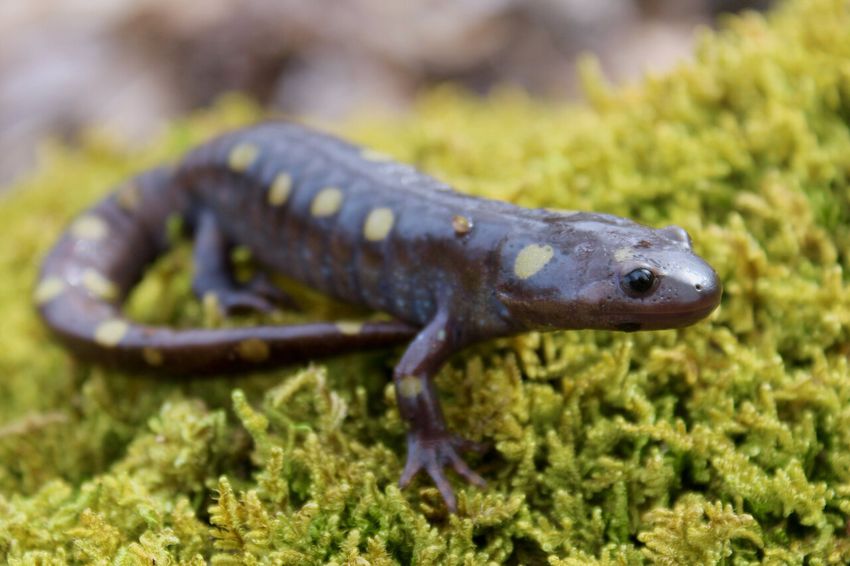
the actual color—has an advantage, which would
                                                        lead to the rare morph becoming more common.
                                                        Another possibility is that the white morph has an
                                                        advantage in some ponds while the clear morph
                                                        has an advantage in others, and movement of
                                                        salamanders between the ponds leads to the
                                                        persistence of both morphs.

                                                        "Ultimately we found a tension between these two
                                                        evolutionary processes, with genetic drift potentially
                                                        leading to a reduction of diversity in this system,
                                                        and balancing selection working to maintain it," said
                                                        Giery.

                                                        The researchers are currently surveying egg
                                                        masses in ponds outside of Pennsylvania to
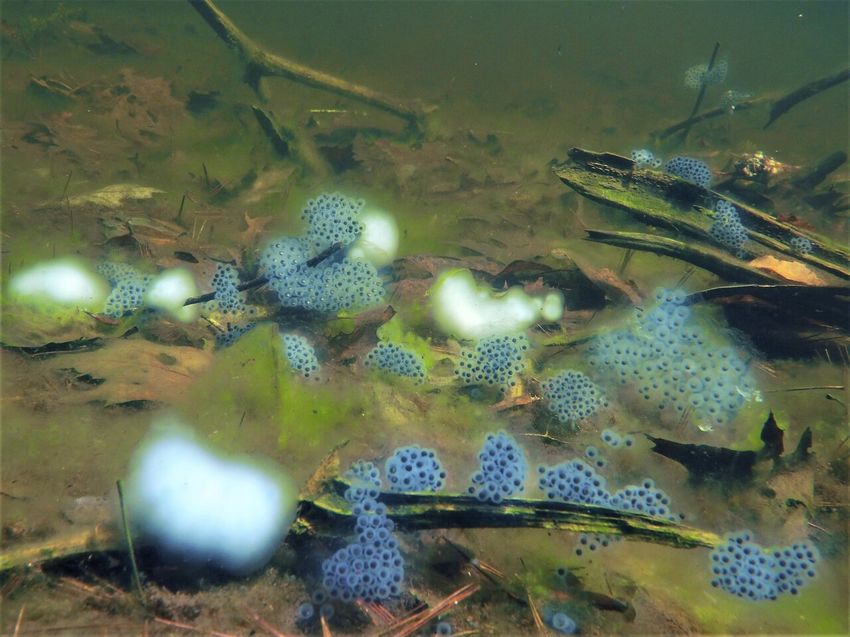
Two opposing evolutionary forces help explain why we    explore if morph frequencies differ in other regions
see two different colors of spotted salamander egg      and whether these evolutionary processes operate
masses in ponds in central Pennsylvania, according to a in the same way over a larger scale.
new study. Egg masses are either completely clear or
opaque white. Credit: Mark Urban, University of       "Although we did not see a relationship between
Connecticut
                                                      egg mass color and environmental characteristics
                                                      in this study, it's possible that environmental
                                                      characteristics at a larger scale might drive an
                                                      optimal frequency for each region," said Giery. "By
The researchers uncovered strong signatures of an
                                                      looking at a much larger scale, we can get a better
evolutionary process called genetic drift, which can
                                                      idea of whether there are regional optimums and
result in morph frequencies changing due to
                                                      how they are maintained. Understanding the
chance. In small populations, drift is more likely to
                                                      processes that maintain biological diversity may
have a major effect, for example with one of the
                                                      ultimately help us predict how wild animals will
morphs disappearing entirely. As expected due to
                                                      adapt in our changing world."
drift, the researchers found that the frequencies of
each morph changed more dramatically in ponds
                                                        More information: Balancing selection and drift in
with fewer egg masses.
                                                      a polymorphic salamander metapopulation, Biology
                                                      Letters, royalsocietypublishing.org/doi …
"However, none of the ponds completely shifted to
                                                      .1098/rsbl.2020.0901
one morph or the other, which suggests something
else might also be going on," said Giery. "We found
that ponds at the extremes in the 1990s—with a high
frequency of clear or a high frequency of white egg
                                                        Provided by Pennsylvania State University
masses—became less extreme, shifting toward the
overall mean for the region. This supports the idea
that 'balancing selection' is operating in this
system."

Balancing selection is a type of natural selection
that can help preserve multiple traits or morphs in a
population. According to Giery, one possible
explanation for balancing selection in egg mass
color is that the rare morph in a pond—regardless of

                                                                                                       2/3
APA citation: Dueling evolutionary forces drive rapid evolution of salamander coloration (2021, April 13)
                                   retrieved 17 April 2021 from
                                   https://phys.org/news/2021-04-dueling-evolutionary-rapid-evolution-salamander.html

                                   This document is subject to copyright. Apart from any fair dealing for the purpose of private study or research, no
                                   part may be reproduced without the written permission. The content is provided for information purposes only.

                                                                                                                                                3/3

Powered by TCPDF (www.tcpdf.org)
You can also read


