Education and Development in North Korea: Institute for ...
←
→
Page content transcription
If your browser does not render page correctly, please read the page content below
Issue Brief
                                                                                              February 11, 2021

Education and Development in North Korea:
The Push for a “Science-Based Economy” Under Kim Jong Un
Gianluca Spezza

This Issue Brief analyzes the development of education in North Korea with particular focus on the
Kim Jong Un era and the recent government’s emphasis on scientific development. Once considered the
flagship of the regime’s welfare system, education has shown signs of inadequacy before the mid-1990s
crisis. Under the Kim Jong Un rule, the DPRK extended its schooling system to 12 years, pushing for
faster and broader developments in ICT and STEM. However, the reform has not solved the problems
left by the collapse of socio-economic structures in the 1990s. Private education has risen in parallel
with grassroots marketization; the distance between Pyongyang and the provinces has widened, and the
government may be unable to deliver on its promises of a prosperous future powered by technological
advancements.

Introduction                                                    began to spiral downwards since the late 1970s
                                                                due to myopic economic strategies and invasive
Over the past two decades, the ever-growing presence            ideological indoctrination.
of North Korea in international news has brought
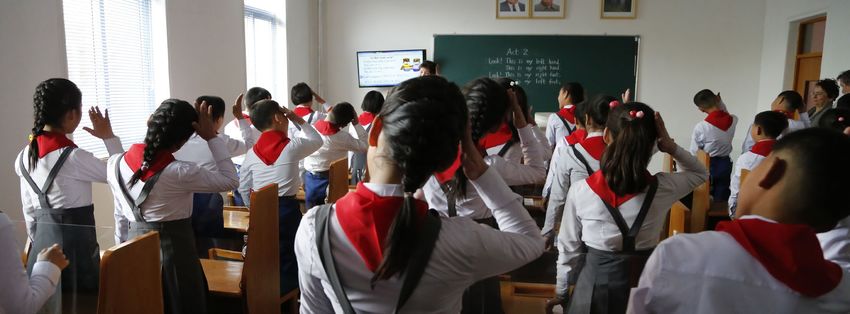
Pyongyang classrooms in front of the camera.1               • Second, during and after the 1990s crisis, the
Media are eager to present images of schools where             government tried to revitalize the education
pupils marching in uniforms and school textbooks               sector. Pyongyang appealed for international
are filled with political indoctrination, but we get           aid and prioritized niche sectors in science,
little scholarship in proportion. This paper highlights        information, and technology. However, the
three intertwined issues.                                      prolonged socio-economic malaise caused the
                                                               education system to implode and rely on private
• First, education served for long as the flagship of          initiative to survive, much like the collapse of
   the DPRK government - whereby this claimed                  the Public Distribution System (PDS) caused the
   to offer a superior socio-economic model to                 rise of the Jangmadang (market) economy.
   that of South Korea; however, the system slowly

                                                                                                                  1
Issue Brief
February 11, 2021
• Third, in the Kim Jong Un era (2012-present), Korean students since 1945 were the first to receive
scientific education is at the forefront of an education shaped by a new national identity
government’s priorities; however, it is unsure using their own language exclusively.3 The first major
whether North Korea will be able to graft updated reform of this period addressed compulsory primary
knowledge and information upon an outdated education (1945–1956).4 The implementation of this
economic system. The emphasis on scientific reform was initially scheduled to begin in 1949 but
modernization may increase – under certain suffered delays until 1956–1958 due to the Korean
conditions - chances for the future economic War. North Korean graduate students were sent
viability of North Korea among neighboring abroad - mainly to the Soviet Union and occasionally
countries that are far more prosperous and to China - for the first time after being forced to
technologically advanced; a more substantial migrate to Japan during colonial times.
international cooperation remains decisive to
this end. Before the Korean War broke out, governmental
efforts focused on eradicating widespread illiteracy
and eliminating what North Korea saw as vestiges of
The Trajectory of North Korean the colonial past through mass literacy campaigns.5
Education before the Kim Jong Un Era These campaigns had political motivations - as
Even before it proclaimed itself an independent an illiterate population would have been unable
state in 1948, North Korea began to lay grounds to absorb the tenets of the ideology - but they did
for an education system that provided free tuition, constitute a stepping stone towards educational
preschool care, and learning supplies to the children improvements. War damages forced North Korea
of working-class families, peasants, the military, to start over after 1953, and like in 1948, national
and other groups, ranked according to the Songbun human resources - students included - were directed
system.2 Four primary cycles, parallel to socio- towards reconstruction. The later stages of this period
economic developments, can be identified to explain saw the introduction of education policies to balance
North Korea’s education trajectory before its last the acquisition of foreign knowledge - mainly Soviet
reform in 2012. - and the construction of national identity.6
From 1959 to 1972
The government In the aftermath of the Korean War, North Korea
emphasized technical went through its most prolific years for industrial
education in order output and infrastructure building. Noteworthy
has been North Korea’s ability to rebuild the entire
to overcome acute pre-wartime school infrastructure in a few years
and increase the number of educational facilities
shortages of technicians that hosted the first generation of graduates under
who could adequately a new political system. The number of junior high
schools went from 217 in 1946 to 1,013 in 1954 and
develop the North Korean up to 3,217 in 1965. Additionally, between 1946 and
industrial complex. 1965, the number of students and teachers increased
tenfold.7
From 1945 to 1958 Two significant reforms began in this period: one
for compulsory secondary education (1958–1967),
North Korea was under direct Soviet influence, and the other for a nine-year technical education system
education underpinned the task of nation-building (1967–1972).8 The government emphasized technical
after forty years of Japanese colonial rule. North
2Issue Brief
February 11, 2021
education in order to overcome acute shortages of From 1995 to 2011
technicians who could adequately develop the North
Korean industrial complex. In-classroom teaching In parallel with rising democratization in South
was tightly linked to work practices, as technicians Korea, the DPRK witnessed a crisis of its socio-
and engineers were required to study during the economic institutions. Before the 1990s, welfare
day and work overnight to speed-up production.9 provision in the DPRK was based on a “security
In the 1960s, the ideological gap between the trade-off” sufficiently extensive to encapsulate social
DPRK, the Soviet Union, and China widened. and human security aspects.13 The trade-off meant
North Korea gradually lowered the number of its that North Koreans would relinquish individual
students in Moscow; it modified the curriculum of rights to adopt a system of collective duties and rights
special schools where most of the Soviet diplomats - participating in the system of collectivism driven
and workers in Pyongyang enrolled their families, by mass mobilization campaigns and accepting
making Korean language mandatory, and further that, in return, the state would provide housing,
discouraged Soviet and other foreign students from food, health care, and education, among other
attending classes in North Korean universities. services.14 This provision of welfare maintained a
seemingly “egalitarian” component, identified by the
government as an immediate reaction to centuries of
From 1973 to 1994 inequalities under the Joseon dynasty and decades
The last major reform before the Kim Jong Un rule of colonial occupation.15The government understood
began in 1972; the 11-year education system was fully education to be a crucial part of this national welfare
implemented by 1975, and remained in place until provision that enhanced political legitimacy.
2012 when a 12-year education system substituted
it.10 Despite the reform, the 1970s and 1980s saw
North Korea drop out of its own developmental
In schools, teachers and
path, as its socio-economic institutions fell from students alike had to fend
stagnation into decline.
for themselves in order to
Education, and in general the knowledge-
technology-development nexus, suffered continuous
secure food and heating
setbacks. The regime adopted an ambivalent strategy material during winter.
for education, coupling ideological commitment to
self-reliance with repeated calls for the acquisition of The famine of the 1990s brought the North Korean
foreign knowledge and technological innovation.11 social institutions to a halt; however, the quality of
In other words, the DPRK government spearheaded education began to implode earlier, when scientific
increasing ideological orthodoxy while advocating for necessities were superseded by the overgrowing top-
a series of improvements within the education system down demand for ideological commitment. This
that - if implemented - would require less ideological phenomenon was more visible in the higher levels
commitment, if not its complete dismantlement. of the educational ladder than in primary and
This strategy was pursued to the detriment of factual secondary education.16 The 1990s famine meant two
innovation vital to the regime’s ability to sustain things: disruption of learning on the institutional
economic growth. While not expressed by virtue level and prolonged effects on brain capacity
of a unitary declaration or in a single historical and pupils’ development on a human level. With
occurrence, this decision parsed through nearly diminishing amounts of food, the effectiveness of
every single official statement, propaganda materials, the Public Distribution System (PDS) that regulated
or contribution to international cooperation projects the allocation of basic goods decreased gradually,
that the DPRK produced over the last four decades.12 forcing the population to seek for alternative means
of subsistence.17
3Issue Brief
February 11, 2021
In schools, teachers and students alike had to particularly South Korea, with compulsory education
fend for themselves in order to secure food and from age 5 to 17.21
heating material during winter. At the same time,
UN agencies (UNICEF in particular) repeatedly The 2012 reform moves along two lines: first, it
warned that years of malnutrition might affect redesigns education so to increase compatibility with
an entire cohort of younger North Koreans, with international requirements. North Korea subscribes
consequences being far from fully understood at to all UN frameworks for the development of
present. The DPRK government focused on securing education since adhering to the first EFA (Education
humanitarian aid for educational institutes in the for All) declaration in 1990. Second, the reform
decade of the crisis (1995-2005); afterward, it began strengthens ICT instruction at secondary and
to sow the seeds of distance education as a long-term academic levels, intending to establish a “powerful
solution to educational issues. country based on the knowledge economy” as
stipulated in Article 46 of the Constitution,
amended in 2019.22 North Korea’s higher education
The issue is not about law was initially proposed on 14 December 2011 as
mere institutional capacity decree number 2036 of the Standing Committee
of the Supreme People’s Assembly. The new system
but rather the ability came fully into effect since April 2014.23 With the
to separate education underlying goal that technological advances would
revive the economy, the major shift is the return to
from ideology. a more practical approach to education, a sort of
modernized version of North Korea’s emphasis on
The Kim Jong Un Era: technical education and the knowledge-productivity
Emphasis on Scientific and nexus of the 1960s.
Technological Advancement
Today, North Korea’s education system is divided
On the surface, the change to the 12-year system into four categories: preschool education (pupils
during the Kim Jong Un regime constitutes a aged 3 and 4), primary and secondary school
reasonable first step in enhancing an outdated education (5–17), higher education, including post-
education system. When Kim Jong Un took doctoral degrees (18–25), and adult/vocational
power, pundits debated whether his years of foreign education. The education system comprises lower
education could influence his worldview and and upper kindergarten, primary school, secondary
governance.18 school, universities, graduate schools, and research
institutions.24 Parallel to full-time schooling, there is
While there may be truth to the assumption that an on-the-job study system (e.g., schools adjunct to
“the education that Kim received in Switzerland factories, farms, and fisheries); finally, vocational and
presented a very different worldview to the one he adult education takes place at university-affiliated
experienced in North Korea”,19 correlation does night courses and communication departments
not imply causation. Kim Jong Un spent only five while all institutions are expanding through distance
years in Europe (1993-1998), and it took another learning. The issue is not about mere institutional
14 years before he rose to power in the DPRK. He capacity but rather the ability to separate education
has certainly experienced international education in from ideology and gear it towards useful practices
the Swiss curricula, but there is no way to establish for economic development.
whether his high school experience later prompted
him to enact reforms in North Korea.20 In any event,
the system now resembles Western counterparts,
4Issue Brief
February 11, 2021
Today’s Challenge: today, in cohorts of students that produce seek to
Overcoming Decades of Stagnation launch North Korea’s own version of biotechnology,
by Reviving Technical Education software, nano-industry, videogames, and online
learning platforms.27
Why did North Korean education decline and
how can it be revitalized? The education-ideology- New and Persisting Issues:
productivity nexus functioned insofar as ideology Covid-19, Social Inequalities, Lack of
allowed sufficient space for useful educational International Recognition, Academic
practices within the domestic labor market and for Isolation, and Outdated Materials.
as long as the government could maintain at least a
minimal provision of welfare in return for manpower Through three leaders and numerous reforms in
and political loyalty.25 While this is something that the education sector, North Korea has not altered
the government cannot admit to, the 2012 reform its social welfare system. The 2012 reform does
and subsequent additional measures on improving not modify the educational ladder, which is
education correlate with government declarations designed to resemble and perpetuate the Songbun
and actions aimed at reviving the economy through social structure, where members of different social
different drivers of production: science-based rather backgrounds are channeled through a specific type
than ideology-based. of school (technical, artistic, etc.) in view of their
future occupational status.28
Whereas the mid-1970s saw ideology overshadowing
technical issues, under Kim Jong Un, the government
is clearly looking to invert this course, as the latest Despite these technical
educational measures rebuild a direct link between improvements in the state
the years that a generation spends in classrooms
and the ability to acquire updated knowledge and sector, private education
improve labor productivity. A look at the past reveals
that the initial economic success of North Korea
is now both illegal and
did not happen in a void; rather, it was intrinsically in high demand.
related to education policies that emphasized
vocational training and technical skills. In North Throughout the decades and various changes in this
Korea’s own assessment, the nine-year technical system, North Korea maintained a tiny group of elite
compulsory education was “an advanced education schools and academies at the system’s zenith. These
system, in which all the new generation of working- have access to better materials, facilities, and teachers;
age could be trained to become talents with wide however, their students are recruited exclusively
general knowledge and more than one technique by among the elite’s highest ranks to guarantee political
combining general education with basic technical stability among younger generations; this facet
education and education with production”.26 has not changed with the 2012 reform.29 Granted,
the rise of Donju and the Jangmadang economy
The two-year vocational school system made it created a new class of wealthy citizens; however,
possible to complete the secondary general education these nouveau riches are largely from the Songbun
and give modern basic technical knowledge in classes that had already the opportunity to engage in
specific fields in a relatively short time. Yesterday trade by dint of political affiliation, military rank or
and today, the government saw the advantage of personal connections; their ability to create wealth
technical and vocational schools confirmed by facts: appears disconnected from the climbing of the
in the 1960s through the growth of a post-war educational ladder.30
managerial class that propelled economic growth;
Changes to the education system resemble other
5Issue Brief
February 11, 2021
aspects of the greater socio-economic sweep brought isolation of North Korean academic researchers –
by the famine. To start with, the distance between and the school system at large. For decades, North
the capital and the provinces widened, as did Korea has been absent from nearly any international
the urban and rural divide in each region.31 The test, competitions, and other events related to
government tried to tackle this issue by reinforcing educational developments; with the exception of
online education, not only because it is fully some results in math competitions in recent years,
controllable and scalable but also because it lowers the overall performance of North Korean students
the overall cost and timing of delivering education against international benchmarks is unknown,
nationwide.32 Despite these technical improvements and the country has not made any impact in world
in the state sector, private education is now both publications.38 However, there are recent signs of
illegal and in high demand, like the Jangmadang change on this front. The push for scientific education
products and services that replaced de facto state- initiated by Kim Jong Il and carried out under
driven economic activities.33 Some of the gendered Kim Jong Un seems to bear its first fruits as North
effects of North Korea’s marketization also apply Korea today counts nearly 85,000 indexed articles
to education. Having the lion’s share of black- in Scientific, Technological, and Medical (STM)
market activities, women who managed to become journals, though the majority are only available
successful entrepreneurs can finance their husbands’ through North Korean websites.39 Two recent
higher education hence securing an official position bibliometric pieces of research indicate a surge in
in the state apparatus and opportunities for their published articles starting in 2015–2016. This “may
career advancement.34 Meanwhile, as the Donju rise, represent the recent efforts by the North Korean
those who can secure a study abroad place for their government to emphasize scientific research and
children do - mainly in China, some beyond. development. It is anticipated that the productivity
of North Korean researchers in terms of publications
in international journals will increase dramatically
The overall performance [...] although the publication baseline is very low”.40
of North Korean students The second problem - and a corollary of the larger
against international isolation issue - is the lack of integration between
North Korean educational credentials, international
benchmarks is unknown. degrees and academic standards. Technically, the
basic conditions for North Korea to pursue a fuller
The latest challenge to education in the DPRK integration with international education are in place.
is the Covid-19 emergency. Schools have suffered The DPRK has entered into bilateral agreements
prolonged closure and delays, although the extent with a number of countries regarding recognition of
of the damage brought by the pandemic is hard diplomas and degrees.41 The majority of agreements
to estimate, as North Korea continues to claim no are with non-OECD countries, somehow reflecting
deaths among and nearly no infection among the the diplomatic relations of North Korea; China is
local population while allowing no controls nor any the most important educational partner, followed by
foreign visit in the country.35 In the early months of a number of countries in the former Eastern Bloc
the pandemic, it appeared that the regime chose to (Bulgaria, Czechia), or the wider socialist camp
tighten the grip on social control and indoctrination (Cuba).42 North Korea is also a party to a number
in schools.36 By late September 2020, UNICEF of international treaties and bodies dedicated to
reported the DPRK among the only three countries education and scientific development.43 More
in Asia-Pacific to have gradually reopened schools.37 importantly, the DPRK has actively participated
in the EFA (Education for all), MDG (Millennium
Aside from the impact of Covid-19, three issues Development Goals), and SDG (Sustainable
remain unsolved, the first being the prolonged Development Goals) frameworks since the UN set
6Issue Brief
February 11, 2021
these, reporting some significant achievements for these relate to the cyber-military complex.48 Import
general education, particularly at primary levels.44 of nearly any IT device, technological components
or any machinery or materials that could potentially
What is missing - in spite of government proclaims be used for military purposes has been fully banned
of “renewed efforts to expand scientific progress” after the latest round of international sanctions in
is a substantial effort to (i) bring North Korean 2017.
educational institutions and practices in line with
the standards of the largest education systems (the
EU, the UK, and the U.S.), and (ii) measuring the The nature of the North
educational offer and the students’ performance Korean system cast
against international benchmarks, such as the PISA
test.45 doubts over the viability
Here, two key factors stand in the way. First, North
of educational and
Korean curricula at the same time lack certain scientific assistance.
cultural components that are now mandatory in the
West (gender education, religious pluralism, critical Future Outlook
thinking, social media awareness), and they contain
elements that are either incompatible with - or have On the surface, the benefits of a modernized North
been dismissed from - the international system, Korea finally able to join the East Asian regional
namely an excessive emphasis on ethnic pride, economy are hard to ignore, particularly for Seoul.
nationalism, traditional gender roles and stereotypes, Education and scientific development are key
and the belligerent tones in educational contents.46 elements to this end, and in the past, they have
Second, North Korea has not fostered any real, two- offered non-politicized grounds for international
way knowledge share process (i.e: a full exchange organizations and regional partners to extend their
of students, faculty, curricula, each absorbing from cooperation with the DPRK.49 However, multilateral
the host country) but rather opted for unilateral aid institutions (more than academic ones) have been
knowledge transfer – that is, selectively incorporating increasingly reluctant to deliver “pure” developmental
parts of foreign curricula, scientific methods and assistance to Pyongyang given its track record of
materials, into an otherwise unchanged education economic unreliability and belligerent rhetoric in
system; there has not been any real inspection and foreign policy. Recurrent moral interrogatives (“can
evaluation of North Korean educational institutions we help North Korea modernize, should we, and if
by international accreditation agencies. so under what conditions?”) and the nature of the
North Korean system cast doubts over the viability
The last issue is the access to modern educational of educational and scientific assistance.
supplies and technologies. This problem is not only
rooted in North Korea’s prolonged economic decline The DPRK’s acceptance and implementation of
(recently worsened with international sanctions); international rules and regulations have historically
it is intertwined with North Korea’s (mis)use of been partial and conditional. Nearly every aid
international development assistance - when this or cooperation project, be it knowledge transfer,
was available before the 2000s – as the international attempting to open foreign institutions in the
community identifies IT education and technological country, or developing commercial ventures,
developments as potentially harmful.47 In recent encountered issues of territorial access, coordination
years North Korean students have made headlines with national and local authorities, and lack of
by beating U.S. ivy-league peers (Stanford) in coding accountability on the North Korean side. After
competitions, raising curiosity about the real IT decades of attempts, donors and potential partners
capabilities of North Korean elite schools and how seem to suffer from “assistance fatigue” and a degree
7Issue Brief
February 11, 2021
of disillusion that outside help may effectively deliver
meaningful improvements in North Korea.
About ISDP
The Institute for Security and Development Policy is a
Stockholm-based independent and non-profit research and
Authors - Dr. Gianluca Spezza is assistant professor of
policy institute. The Institute is dedicated to expanding un-
international relations at KIMEP University in Almaty, derstanding of international affairs, particularly the inter-
Kazakhstan and a senior researcher at KIMEP’s DPRK relationship between the issue areas of conflict, security and
Strategic Research Center. Dr. Spezza earned his PhD in 2018 development. The Institute’s primary areas of geographic
from the University of Central Lancashire where his research focus are Asia and Europe’s neighborhood.
focused on the cooperation between UNICEF and the DPRK
www.isdp.eu
in education and childcare.
The opinions expressed in this Issue Brief do not necessarily
reflect the views of the Institute for Security and Development
Policy or its sponsors.
© The Institute for Security and Development Policy, 2020.
This Issue Brief can be freely reproduced provided that ISDP
is informed.
8Issue Brief
February 11, 2021
Endnotes
1. CNN, Exclusive look into North Korean Schools: https://www.youtube.com/watch?v=GJgS2im_40M&feature=emb_title
2. The Songbun system refers to the social system of North Korea, a class stratification whereby people are ranked by political
loyalty, through generational ties. The system rewards family ties and political loyalty over meritocracy. Helen Hunter writes
that the negative implications of Songbun through the decades, “in terms of the educational level and the experience of the
top leadership, are overwhelming”. See: Hunter, H. L, (1999), Kim Il-song’s North Korea, Westport: Praeger, 3-11; also: Col-
lins, R, (2012), Marked for life: Songbun. North Korea’s Social Classification System, Washington DC: HRNK.
3. Lankov, A. (2005), “Crisis in North Korea: The Failure of De-Stalinization”, 1956. University of Hawai’i Press, 177. Japanese
language was superimposed over Korean during the colonial period, while Chinese served as the medium of studies during
the Choson Dynasty, before 1910.
4. Kim, H. C. (1969), “Ideology and Indoctrination in the Development of North Korean Education”, Asian Survey 9(11): 831-
841.
5. Kim, H. C. (1969), p. 833-4; Also: National Commission of the DPRK for UNESCO. (2008). National Report on the De-
velopment and State of the Art of Adult Learning and Education in the DPRK., Pyongyang: Ministry of Education: 4; Sik,
C. S.; Hun, H. J. (1980). Cultural Policy in the Democratic People’s Republic of Korea, Paris: UNESCO.
6. Lankov, A., (2000) “Continuity within Change. Soviet Influence on North Korean Education”, Acta Koreana 3: 57-75.
7. Kim, H. C, “Human Remolding in North Korea. A Social History of Education”, University Press of America, NY, 2005.
8. Lee, Y. B, (1986), “Education in the DPRK”, Pyongyang: Foreign Language Publishing House.
9. Kim, H. C, “Human Remolding in North Korea”: 86.
10. Ordinance of DPRK SPA on Enforcing Universal 12-Year Compulsory Education Promulgated. Pyongyang, September 25,
2013 (KCNA) on: www.kcna.kp
11. These calls found echo in a number of international publications, frameworks for cooperation, and development projects by
the UN agencies that began working with the DPRK government on issues of education and training since the late 1970s,
namely UNESCO, UNIDO, UNILO and the UNDP. This documentation unanimously suggests that while UN agencies
were well disposed towards the DPRK government, they also noticed how North Korea requested to participate in programs
of international assistance to bridge a technology-knowledge gap that - if and when it was addressed by the government - was
presented by North Korea since the early 1980s as the result of temporary setbacks or unfavorable contingencies. UN experts
however identified the issue as stemming from numerous political restrictions and ideological limitations imposed against for-
eign knowledge influx in nearly all fields, from language education to the digitalization of education, to the training of factory
workers and medical staff.
12. See; Cho, J. A. (2006). “North Korea s Human Resource Development System”, Seoul: KINU, pp. 24-27. Also: Kim, H. C.
(2005). “Human Remolding in North Korea. A Social History of Education”, Lanham: University Press of America. In 1962,
at the start of what is acknowledged to be the best decade for the North Korean economy, the DPRK bet decisively on tech-
nical and vocational information. Secondary school subjects were divided as follows: languages studies occupied 15.5% of the
curricula, political ideology covered 7.7%, natural sciences accounted for 33.7% whereas polytechnic education received the
lion’s share with 38.9%. Through a slow but steady tilting in favor of ideology over the next four decades, by the year 2001
technical education shrunk to a mere 6% whereas ideology grew to 22.5%. By comparison, curricula in East Germany during
the cold war assigned 36.6% to language studies in 7th grade, and 28.6% to natural sciences, while reserving 8.7 of the pro-
grams for political education. Similarly, curricula in the Soviet Union by the end of the 1980s also had political studies and
ideology limited to 8.7% of the total amount of study hours, while natural sciences and technical studies received respectively
35.9% and 18.6%. In view of these facts one could still debate whether the North Korean education system (and its human
capital) spiraled down starting from the 1980s - or, by some indications, a decade earlier. There is little doubt however that
9Issue Brief
February 11, 2021
this decline was largely Pyongyang’s own fault and that it came rather unexpectedly to outside observers, given that North
Korea presented better socioeconomic indicators than the South for over fifteen years after the Korean War.
13. Smith, H. (2005a). “Hungry for Peace”, Washington DC: USPI Press. Hungry for Peace has since 2005 set the framework
for analyses of North Korean socioeconomic changes that eschew the limits of military concerns, expand traditional security
outlooks, and move beyond strategic considerations.
14. Smith, H. (2005b). “Disintegration and reconstitution in the DPRK”, in: Chesterman, S., Ignatieff, M., and Thakur, R.C.
(eds.) “Making States Work: State Failure and the Crisis of Governance”, Tokyo: United Nations University Press: 167-192.
15. UNESCO-DPRK National Commission (1984, 1986, 1990). International Conference on Education. Report of the Delega-
tion of the DPRK on National Education. Geneva: UNESCO; United Nations-DPRK National Committee on the Rights of
Children (1996) Initial report of the DPRK, New York: UN.; Cho, M. C., Zang, H. (1999), North Korea’s education system.
Draft prepared for the World Bank, Seoul: KIEP.
16. Cho 2006, Lim, Y. I. (2004). “The Technology-Institutions-Productivity Nexus in the DPRK”, in: Cho, L., Ahn, C., Kim,
C. N. (Eds), “A Changing Korea in Regional and Global Contexts”: 439-589, University of Hawaii Press; DPRK National
Education Commission (2015), Final report on “Education for All”, Pyongyang: UNESCO: 18-19.
17. UNICEF (2003). Early Child Development. Advocacy publication for the DPRK. Pyongyang: UNICEF; see also Katona-
Apte, J. and Mokdad, A. (1998). “Malnutrition of Children in the DPRK”, The Journal of Nutrition 128 (8), 1315-1319.
18. Powell, B. (2012), “Is Kim Jong Un Preparing to Become North Korea’s Economic Reformer?”, Times, April 19, at: https://
bit.ly/3sj2o7n, Cha, V (2012), “Kim Jong Un Is No Reformer”, Foreign Policy, August 21, at: https://bit.ly/39uLdXQ; Pak, J.
(2018), “The Education of Kim Jong Un”, Washington DC: Brookings Institution, at: https://brook.gs/3qhxnPi
19. Fifield, A. (2019/6/12) “Kim Jong Un’s undercover adolescent years in Switzerland”, Politico, at: https://politi.co/3bAfrLV
20. The seeds of the last education reform and the introduction of online education date back to the last years of Kim Jong Il
in power while the push for scientific development and the acquisition of foreign knowledge started in the early 1980s. It is
likely that Kim Jong Un simply implemented plans that were years in the making.
21. Ordinance of DPRK S.P.A. on Enforcing Universal 12-Year Compulsory Education Promulgated Pyongyang, September
25, 2013 (KCNA) on: www.kcna.kp ; See also: Park Young-ja et Al., (2018), “Eight Changes in North Korean Economy and
Society under the Kim Jong Un Regime”, Seoul: KINU.
22. Government of the DPRK (2019), Socialist Constitution, Articles 43 – 46: Retrieved from http://www.naenara.com.kp/
23. On the basis of the law adopted in the 6th Session of the 12th Supreme People’ s Assembly of DPRK held in September 25,
2012, following the introduction of universal 11-year compulsory education from 1975. See: DPRK National Education
Commission (2015), Final report on “Education for All”, Pyongyang: UNESCO.
24. Kim, H. C. (2005), Op. Cit.
25. Lim, Y. I. (2004). Op. Cit.
26. DPRK National Education Commission (2015), Final report on “Education for All”, Pyongyang: UNESCO: 18-19.
27. Spezza, G. (2013), “Google Goes To North Korea: Why Not?”, NK News, January 9 at: https://bit.ly/3iaNATC; and (2013)
Juche 2.0: “How North Korea Uses The Web To Promote Its Ideology”, NK News, April 2, at: https://bit.ly/35Ceyyi; See
also: Kretchun, N., Kim, J. (2012). “A quiet opening. North Koreans in a Changing Media Environment”, Washington DC:
Intermedia; Seliger B Schmidt S., (2014), “The Hermit Kingdom Goes Online: Information Technology, Internet Use and
communication Policy in North Korea”, North Korean Review 10(1): 71-88.
28. Lee, C.J, (2003) 북한 교육 체제의 특성과 기능 연구 (A Study on the Characteristics and Functions of Education in
the DPRK), Seoul: KEDI; Han, M. G; Yoon, J.H; Lee, J.K (2001), “North Korean education, the school life of students,
teacher’s social status, educational ideology”, Seoul: KEDI.
29. Lee, C.J, 2003, pp.21-26; Also: Cho, M.C (2002), “North Korea’s education policy and system and external cooperation
10Issue Brief
February 11, 2021
with international organizations”, Journal of Asia-Pacific Affairs, 3: 73-11.
30. See: Park Young-ja et al., (2018), “Eight Changes”, Op. Cit.
31. Park Young-ja et Al., (2018); See also: UNFPA-DPRK Central Statistics Bureau, (2014), SDHS Survey 2014, Pyongyang:
UNFPA, and UNICEF, (2018) Multiple Indicator Cluster Survey report for the DPRK, Pyongyang: UNICEF.
32. https://kcnawatch.org/?s=distance+education&sort=recent; KCNA Watch is a news aggregator developed by the website NK
News, to scan the KCNA database through keywords and dates, something that is often not possible to do on North Korean
websites.
33. The Economist, Private tutors are illegal in North Korea, but thriving, December 12, 2019; Shim, E., “North Korea elites de-
voting money to private education for children”, UPI, July 6, 2012; also: Radio Free Asia, (2016) North Korean Parents Catch
“Private Education Fever”.
34. Soh, E.J. (2017), “Informal Life Politics of Marketisation in North Korea”, in: Morris-Suzuki, T.; Soh, E.J. (Eds), “New
Worlds from Below, Adelaide”: ANU Press: 240.
35. As of January 17, North Korea restricted travel for 352 days, tested 25244 samples (13259 people), with zero confirmed
cases, over 32000 citizens quarantined and an equal amount of people released (of which 382 foreigners, all quarantined then
released). See the NK Pro Covid-19 Tracker, at:https://bit.ly/2XOEpyY ; The NK Pro Coronavirus tracker aggregates news
from North Korean, South Korean and international media on any aspect of life affected by the Coronavirus in the DPRK.
36. Bennet, B, Myers, D. (2020), “North Korea: Denying COVID-19”, RAND report, April 2: https://bit.ly/38QTqqh ; Radio
Free Asia, (2020) “North Korea Ramps up Ideology Lessons Amid COVID-19 School Closures”, March 24: https://bit.
ly/38POcew ; United States Institute of Peace (2020) “The Impact of Coronavirus on North Korea”, April 14: https://bit.
ly/2LVvGZ1
37. Reliefweb, (2020) UNICEF EAPRO Education COVID-19 Response Update – September 29: https://bit.ly/3nTAgnQ
38. DPRK students seem to perform particularly well in online match contests. See: International Mathematical Olympiad
(2019), Individual and Team scores for the DPRK: https://bit.ly/3nN73uJ
39. Jeong, G. H., & Huh, S. (2017a). Bibliometric analysis of publications from North Korea indexed in the Web of Science
Core Collection from 1988 to 2016, Science Editing, 4(1): 24-29, and Jeong, G. H., & Huh, S. (2017b). Bibliometric and
content analysis of medical articles in the PubMed database published by North Korean authors from 1997 to July 2017. Sci-
ence Editing, 4(2): 70–75.
40. Jeong, G. H., & Huh, S. (2017a). Bibliometric analysis: 3
41. UNESCO (2000) Regional Convention on the Recognition of Studies, Diplomas and Degrees in Higher Education in Asia
and the Pacific. Bangkok, Thailand, 10 November: 4, 52-53.
42. Embassy of the PRC in the DPRK, A brief account of the educational exchanges between the PRC and the DPRK: https://
bit.ly/2LZ6Uah ; the North Korean website “Mirae”, specializing in Sci-tech developments within the DPRK reports MOUs
or other institutional agreements with educational counterparts. See: https://bit.ly/3c3Qzw9
43. Among others: the International Organization for Standardization (ISO) since 1954, the international Bureau of Education
(IBE) since 1975, the United Nations Industrial Development Organization (UNIDO) since 1981, UNESCO since 1974.
Moreover, the DPRK has signed and approved the Regional Convention on the recognition of studies, diplomas, and degrees
in higher education in Asia and the Pacific in 1983 and 1989 respectively, and has acceded the International Covenant on
Economic, Social and Cultural Rights in 1981.
44. DPRK National Education Commission (2015), Final report on “Education for All”, Pyongyang: UNESCO; UNICEF
(2010). MDG report. Summary results matrix of country programme for the DPRK, Pyongyang: UNICEF; UNFPA-DPRK
Central Statistics Bureau, (2014), SDHS Survey 2014, Pyongyang: UNFPA, and UNICEF, (2018) Multiple Indicator Clus-
ter Survey report for the DPRK, Pyongyang: UNICEF.
11Issue Brief
February 11, 2021
45. This sort of exhortation is not new at all; North Korean documents produced by government authorities or jointly with
UN agencies since the 1980s adopt the same language, however, in stating its goals the government seems to postpone
them indefinitely. See, for instance, the minimal change of tone across decades in: National EFA Assessment group of the
DPRK (1999). The implementation of the World Declaration on Education for All. Pyongyang; Ministry of Education
of the DPRK (2004). National report on the development of education. Pyongyang; Government of the DPRK (2014).
The Socialist Constitution of the Democratic People’s Republic of Korea, Pyongyang: Foreign Language Publishing
House; DPRK National Education Commission (2015), Final report on “Education for All”, Pyongyang: UNESCO.
These document are replete with declarations of intents but lack much in resource allocation and budget details for
implementation. Very recent news about educational plans have not brought any significant change. Around the time
of its most recent party congress (January 2021), North Korea’s media reported ‘new’ measures to expand education,
improve facilities and quality of educational services. On the surface, these news, the reference to two distinct university
tiers (research-type and field-type universities) and recurrent announcements of scientific goals (or achievements) hint
at a constant push for science-based developments in the economy. However, for decades now, the government has been
unable to deliver on its promises, due to economic difficulties, and shortages of all kinds. In spite of policy commitments
for a sustained, the reality of educational practices is subject to economic downturns much as any other set of institu-
tions; it also suffered from a discrimination between a few, privileged institutes and the majority of schools, nurseries and
even kindergartens in the country. If there are resources available, these are allocated in a top-down fashion, and there is
very little trickle-down, at least since the 1990s: “Different educational institutions received their funds and goods from
different sources. The majority of them did not use cash to pay for their supply, and most of them – in fact nearly all of
them at pre-school and primary levels, were dependent on the often reduced regional budgets”. See; Cho, M. C., Zang,
H. (1999), North Korea’s education system. Draft prepared for the World Bank (12-99). Seoul: KIEP. In other words,
what outsiders can see as factual developments in Pyongyang, are unlikely to find an equivalent in other provinces, par-
ticularly in more remote areas.
46. Here “international system” stands for a set of values and norms enshrined in educational curricula and theories that
shape schooling in most western liberal democracies and are espoused by the UN at large; there are numerous exceptions
to this practices worldwide, of course.
47. In particular, projects, tenders and procurement projects from UN agencies for the DPRK aimed at developing ICT
capacities have come under some scrutiny after it was established that the DPRK used CNC machines towards military
developments.
48. Kasulis, K. (2017) North Korean college coders beat Stanford University in a 2016 competition. Here’s why that mat-
ters, MIC.com: https://bit.ly/3imkbpI
49. Institute for Far Eastern Studies, Kyungnam University (2013), 북한의 개발역량 강화를 위한지식공유: 성과 및
향후전망 (Capacity Building and Knowledge Sharing with North Korea: Past successes and Future Prospects). Confer-
ence Proceedings and Papers. Seoul: IFES; Heikkilä, J. P., Wainwright, T., Et. Al. (2018). Co-Creating Knowledges and
Institutional Space. Introducing Entrepreneurship to North Korea, 6th Annual International Conference on Innovation
and Entrepreneurship (IE 2016) pp. 42-49; Wainwright, T., Et. Al. (2018). Elite Entrepreneurship Education. Translat-
ing Ideas in North Korea, Environment and Planning 50(5): 1008-1026; Seo, H. and Thorson, S. (2010). Academic
Science Engagement With North Korea. Academic Paper Series on Korea. Korea Economic Institute Volume 3, Park, J.;
Jung, S. (2007). Ten Years Of Knowledge Partnership With North Korea, Asian Perspective 31 (2), 75-93.
12You can also read


