ENABLING TRANSFORMATION - Sustainability Report 2020 - Tetra Pak
←
→
Page content transcription
If your browser does not render page correctly, please read the page content below
ENABLING TRANSFORMATION
Sustainability Report 2020
INTRODUCTION   FOOD.   PEOPLE.   FUTURES.                                                         SUSTAINABILITY REPORT 2020 | 02

TABLE OF
                                            INTRODUCTION   03   From our President & CEO
                                                           05   Facts & figures

CONTENTS
                                                           06   Good governance
                                                           07   Promoting positive change
                                                           08   Our approach
                                                           09   Our highlights
                                                           10   Our focus

                                            FOOD.          12 Food safety & quality
                                                           14	Food availability

                                            PEOPLE.        17 Diversity & inclusion, flexibility & development
                                                           19	Safe & healthy workplaces
                                                           20 Responsibility & transparency

                                            FUTURES.       22	Low-carbon circular economy solutions
                                                           26	Enhancing sustainability across the value chain
INTRODUCTION   FOOD.   PEOPLE.   FUTURES.                                                                                                                                                      SUSTAINABILITY REPORT 2020 | 03

MESSAGE
                                            Sustainability has long been at the heart of our          meeting our goals, continuing our history of              our products and operations on the climate. This has
                                            business strategy and our operations. It is embodied      sustainability and environmental reporting that           been in sharp focus with various legislative initiatives,

FROM OUR
                                            in our brand promise – PROTECTS WHAT’S GOODTM             extends over more than two decades.                       such as the European Green Deal.
                                            – which is brought to life by protecting food,
                                            protecting people and protecting futures.                 As we reflect on last year, we must necessarily begin     The second is to advance the circular economy,

PRESIDENT
                                                                                                      with the COVID-19 pandemic, an unprecedented              which includes eliminating waste and ensuring
                                            Our sustainability approach encompasses all three         event that has affected, and continues to affect,         end-of-life use for packaged products. Again,
                                            areas. We work with our customers and partners to         communities worldwide. In this context, our               this is already being driven by legislation around
                                            make food safe and available, everywhere through          commitment to protecting what’s good has never            the world, with a strong focus on single-use plastics.

& CEO
                                            our innovative and market-leading food processing         been more vital – and our sense of purpose has never      The third is to protect biodiversity, an issue that
                                            and packaging solutions. We constantly strive             been stronger. Throughout this crisis, our priorities     has been highlighted by the recent wildfires in
                                            towards safeguarding our own employees and                have been to protect people – keeping our own             Australia, Brazil and California.
                                            supporting communities where we operate,                  employees safe and those of our customers and other
                                            and protecting the future of our planet and               stakeholders – as well as to protect food, by helping     All three areas are key to initiatives that we have been
                                            the long-term success of our customers.                   our customers maintain continuous food supplies.          pursuing for some time. In fact, they are inextricably
                                                                                                                                                                interlinked. In addressing climate change, we cannot
                                            Our brand promise motivates us every day as we            The full impact of COVID-19 is yet to be seen and         ignore the materials sector and the role that
                                            continue to make rapid progress on a sustainability       it will take a while for normalcy to resume. But our      packaging can potentially play. Nor is it enough
                                            journey that began many years ago. It’s an ongoing        commitment towards sustainability will continue,          to focus only on “reduce, recycle and reuse” when
                                            drive that includes helping to ensure food security,      and our investment will remain at the same level,         promoting circularity: we must take into account the
                                            securing a responsible value chain, promoting             as we continue forging ahead in this area.                climate impact of the materials that are used in the
                                            diversity and inclusion, contributing to a low-carbon                                                               first place. Consequently, we believe in a low-carbon
                                            circular economy, and more.                               Addressing global challenges                              circular economy that drives a shift from high-carbon,
                                                                                                      As the leading provider of processing and packaging       fossil-based materials to low-carbon, renewable
                                            Our brand promise also ensures that sustainability        solutions, we are mindful of our responsibility           materials, which can also help to protect biodiversity.
                                            remains an integral component of the decisions we         to address the challenges faced by our industry
                                            make, and the actions we take, right through the          as a whole. We have a long history of working             This is why our view is that the ideal package of the
                                            value chain. To help those decisions, we are guided       in partnership with our customers and other               future should be made solely from renewable or
                                            by the UN Sustainable Development Goals, which            stakeholders to that end, helping drive positive          recycled packaging materials, 100% recyclable and
                                            provide a common framework for organisations              change in the sustainability arena. We believe the        supportive of a low-carbon circular economy.
                                            across industries to work together for a better future.   need for concerted action is particularly urgent today.
                                            This guidance builds on our ongoing commitment                                                                      In 2019 we accelerated our efforts towards this goal,
                                            to the UN Global Compact, to which we have been           Over the course of 2019, we saw awareness and             restructuring our developmental initiatives and
                                            a signatory since 2004.                                   expectations around the environment reach a new           significantly ramping up our R&D budget. We are
                                                                                                      high, among customers, consumers, media, NGOs and         already making great progress. For example, we are
                                            Additionally, we leverage our biennial materiality        regulators alike. Taking a broad view of the world’s      the first packaging company to launch paper straws in
                                            assessments, which help us identify and prioritise        environmental challenges, we see three focus areas.       Europe. We are also now beginning a field test of our
                                            those aspects of our business which have the greatest                                                               first ever aseptic package with an alternative to the
                                            positive stakeholder impact. This report is a key         The first is to address climate change, where we as       aluminium barrier. Our goal is to field test an aseptic
                                            means of sharing our approach and our progress in         an industry need to minimise the overall impact of        package made fully from renewable sources by 2022.
INTRODUCTION   FOOD.   PEOPLE.   FUTURES.                                                                                                                                                      SUSTAINABILITY REPORT 2020 | 04

                                            To complement our packaging innovations, we are           climate goal: to cap emissions at 2010 levels despite      Finally, we are committed to protecting people.
                                            also driving resource efficiencies with our Equipment     business growth. In fact, we are ahead of our target       That includes our own employees, by providing
                                            and Services, focusing on minimising water use,           and have actually reduced total emissions by 11%.          a dynamic and productive workplace, with adequate
                                            food waste and carbon footprint in our customers’         Looking to the future, we want to ramp our efforts         opportunities for learning and development.
                                            operations, helping them on the journey towards           further with an even more ambitious goal: to achieve       Equally importantly, it means driving diversity in our
                                            achieving their own sustainability targets.               net zero greenhouse gas emissions (GHG) in our own         workforce and fostering an inclusive culture, through
                                                                                                      operations by 2030, with a similar ambition across key     several actions encompassing training, recruitment
                                            A value chain approach                                    areas of the value chain by 2050. We strongly believe      and talent development. It also includes protecting
                                            In parallel with this important development work, we      that tangible steps such as these are necessary to         the communities where we and our suppliers operate,
                                            have continued our efforts to enhance sustainability      ensure that we drive growth while minimising the           working in partnership to ensure that human and
                                            across the value chain. That means ensuring our own       impact on the planet.                                      labour rights are respected, driving transparency and
                                            operations are a global benchmark, driven through                                                                    active communication across the value chain.
                                            initiatives such as World Class Manufacturing and         As mentioned in the beginning, our sustainability
                                            investing in renewable power and “green buildings”.       approach extends beyond the environment. It also           Enabling transformation
                                                                                                      includes protecting food, which is expressed in our        While we have made significant progress in
                                            Furthermore, it includes our supply chain, where          vision as “We commit to making food safe and               protecting food, people and futures, we aspire to do
                                            we work with our suppliers to promote renewable           available, everywhere”. Faced with the COVID-19            much more. That is why, for example, we have set out
                                            materials, minimise emissions and protect biodiversity    pandemic, that vision is more important than               such an ambitious new climate goal and ambition,
                                            and fresh water. To help further these aims, in           ever. But the way we go about delivering it                which is a reflection of our sustainability commitment.
                                            partnership with our long-term supplier Braskem,          is changing, due in particular to the rise of              First, to lead by example, through our own activities,
                                            we became the first company in our sector to obtain       digitalisation and connectivity. These trends offer        innovation and expertise. And second, to lead
                                            Bonsucro Chain of Custody certification for our           new opportunities to make food safety and quality          through partnership.
                                            plant-based polymers, ensuring full traceability          even better, while increasing production flexibility,
                                            from plantation to product.                               efficiency and sustainability.                             In 2019, we launched our new Strategy 2030, which
                                                                                                                                                                 will guide our company over the next decade. One
                                            We also work closely with our customers, providing        In addition, we have long worked to increase the           of its central pillars is to “Lead the sustainability
                                            them with the solutions they need to achieve their        world’s access to safe food. For decades, we have          transformation”, which comprises two goals: “Lead
                                            own sustainability ambitions, such as maximising          participated in the development of school feeding          with low-carbon circular economy solutions” and
                                            production efficiency and minimising energy use,          and nutrition programmes, working with partners            “Enhance sustainability across the value chain”.
                                            waste and emissions. Through partnerships with a          worldwide. In the last year alone, these initiatives       Again, this is a clear demonstration of our
                                            wide range of stakeholders, we drive collection and       reached some 68 million schoolchildren, not only           commitment and our ambition, to drive positive
                                            recycling – a key enabler of a low-carbon circular        delivering improved nutrition and better educational       change both as a company, and as one of many
                                            economy. In 2019, we helped forge a number of key         outcomes, but also supporting local agriculture            industry stakeholders. Hence the title of this report,
                                            partnerships to further develop recycling and             and promoting economic development. More                   “Enabling transformation”, signifying a new stage of
                                            circularity, including the innovative 3R Initiative and   recently, we have developed our Dairy Hub model            our ongoing journey. I very much welcome your
                                            the 4evergreen alliance, in addition to various local     to secure a long-term supply of locally produced           feedback on this report and our performance.
                                            initiatives in the countries that we operate in.          quality milk, without increasing the cost of collection,
                                                                                                      and helping to improve the livelihoods of many             Adolfo Orive
                                            A particularly notable result of all these efforts is     thousands of smallholder farmers.                          President & CEO, Tetra Pak
                                            our progress towards achieving our main 2020
INTRODUCTION FOOD. PEOPLE. FUTURES. SUSTAINABILITY REPORT 2020 | 05
FACTS &
FIGURES
EUROPE &
CENTRAL ASIA
28%
A round-up of key numbers from across AMERICAS
26%
our global business operations in 2019. ASIA PACIFIC
35%
GREATER MIDDLE
EAST & AFRICA
11%
25,555
employees Net sales by category
€11.5 billion
5 89 6 90,350 net sales in 2019 Liquid Dairy
Products
Juice &
Nectar
R&D centres sales offices Customer processing units in operation 57.9% 14.8%
Innovation Centres
55 31 8,770 11 50 billion Dairy
Alternatives
7.7%
Food
5.8%
production plants market companies packaging machines Technical Training Centres of our cartons recycled in 2019
in operation
170 plants
Wine & Spirits Still Drinks
2.4% 10.2%
190 billion
Tetra Pak® packages sold in 2019
worldwide where our cartons are recycled
INTRODUCTION   FOOD.   PEOPLE.   FUTURES.                                                                       SUSTAINABILITY REPORT 2020 | 06

                                                      Providing a solid framework                       of companies in our industry category. For
                                                      By providing the foundation for our strategy      more information on these ratings and our
                                                      and approach to leadership, good governance       work to drive responsible sourcing and
                                                      ultimately helps us fulfil our vision to commit   continuous improvement with our suppliers

GOOD
                                                      to making food safe and available, everywhere.    generally, see pages 20 and 27.
                                                      Our governance framework helps us deliver on
                                                      our brand promise and comply with relevant        A matter for everyone
                                                      regulations and legislation, as well as guiding   All employees, at all levels of the company,
                                                      us to behave ethically and responsibly.           are responsible for complying with the

GOVERNANCE
                                                                                                        governance framework in their everyday
                                                      The Global Leadership Team is responsible         decisions and actions. Details of the
                                                      for implementing the framework, supported         framework are available on our intranet and a
                                                      by the Corporate Governance Office and a          mandatory eLearning programme is in place.
                                                      network of local governance, risk and
                                                      compliance officers. As signatories to the UN     Anyone in the company can anonymously
We equate good governance with good business: we      Global Compact, we are committed to the           report actual or suspected breaches of our
                                                      implementation, disclosure and promotion of       Code of Business Conduct or any other
do well by doing good. Good governance is essential   its ten principles on human rights, labour, the   unethical behaviour directly to either the
to building a sustainable business, delivering on     environment and anti-corruption. We submit        Corporate Governance Officer or the

our brand promise – protects what’s good™ – and
                                                      a Communication on Progress every year.           Head of Audit, without being penalised
                                                                                                        in any way. Every case of a breach of our
safeguarding our reputation.                          To build trust and transparency with our          Code of Conduct is handled individually
                                                      customers and as part of our approach to          and investigated appropriately.
                                                      responsible sourcing across our supply chain,
                                                      we work with leading sustainability assessment    Communicating about our responsible
                                                      platforms, including the Supplier Ethical Data    business practices and performance is very
                                                      Exchange (Sedex), EcoVadis and CDP.               important to us. We have been publishing
                                                                                                        environmental reports since 1999, and we
                                                      In 2019, we were rated as a leader by CDP for     have been reporting on broader sustainability
                                                      our climate action and for driving sustainable    issues since 2005.
                                                      sourcing in our supply chain – the fourth year
                                                      in a row we have made CDP’s A List. We
                                                      were also rated by EcoVadis in the top 1%
INTRODUCTION   FOOD.   PEOPLE.   FUTURES.                                                                                                                              SUSTAINABILITY REPORT 2020 | 07

PROMOTING
POSITIVE                                                                                                                  Materials and the

CHANGE
                                                                                                                          circular economy                           •	For these strategies to be viable,
                                                                                                                          In 2019, we commissioned a report             there is a need for a new policy
                                                                                                                          from Material Economics, a consultancy        agenda. Current policy approaches
                                                                                                                          firm that specialises in sustainability       will not be enough to meet climate
                                                                                                                          and resource strategy topics, to              targets. Materials emissions are
                                                                                                                          explore the relationship between              hard to reduce, and current climate
We have a long history of working with governments                                                                        the production of raw materials and           policy focus on energy efficiency
worldwide on policy issues related to sustainability,                                                                     climate change. It found the following:       and low-carbon electricity does
                                                                                                                                                                        not address most of the emissions.
food packaging and healthy diets.                                                                                         •	Raw materials (such as cement,             There is a need to enable not
                                                                                                                             steel, pulp and paper, and plastics)       only clean production, but also
                                                                                                                             are a major unaddressed climate            improvements by stakeholders
                                                                                                                             challenge, accounting for high             throughout the major materials-
                                                                                                                             emissions that risk rising to levels       using value chains.
We advocate for progressive,              •	Climate policies that are aligned    How we work                                that go directly counter to climate
evidence-based policy to address             with the highest level of ambition   •	In partnerships and through             objectives. Emissions from the          •	There is a clear link between
societal challenges on a number of           in the Paris Agreement to reach         industry and trade associations         production of materials used               a circular and a low-carbon
different topics. From a sustainability      net-zero GHG emissions by               that share these same objectives        for packaging alone are larger             economy. Addressing the issue
perspective, we advocate for:                2050. We also advocate for              (for some examples, see page 37).       than global aviation or shipping,          of emissions from materials is,
                                             packaging policies to promote                                                   especially plastics, which account         in fact, indispensable to climate
•	National recycling regulations such       low-carbon materials.                • By taking part in policy events.         for 60% of this total.                     objectives. Conversely, circular
   as extended producer                                                                                                                                                 economy policies will affect
   responsibility (EPR) to improve        •	Responsible sourcing                 •	Where possible, by directly          •	Reducing emissions from materials          materials handling in fundamental
   recycling and reduce waste,               requirements for primary raw            engaging with national governments      requires a wide range of strategies,       ways. Therefore, there is much to
   supporting a circular economy.            materials, such as our work with        including ministers, department         including materials efficiency,            gain from aligning the two agendas
                                             FSC™ and Bonsucro (see page 28).        heads and members of parliament.        materials recirculation, substitution      in an integrated policy framework.
                                                                                                                             with lower-CO2 materials, and              Correspondingly, failing to do so
                                                                                                                             clean production.                          risks ineffective or inefficient policy.
INTRODUCTION   FOOD.   PEOPLE.   FUTURES.                                                                                                                               SUSTAINABILITY REPORT 2020 | 08

OUR                                                                     FOOD.
                                                                                                                                                                      Our commitment to the UN SDGs

APPROACH                                                                We commit to making food safe and available, everywhere. This is our vision: the goal that
                                                                        drives our organisation. By working with our customers and partners to achieve this vision
                                                                        through our innovative and market-leading food processing and packaging solutions,
                                                                        we are contributing to SDGs 2 and 12. Moreover, by working to build sustainable
                                                                        value chains, such as through our participation in school feeding programmes and our
Our approach to sustainability encompasses our entire value chain.      Dairy Hub model, we are further contributing to these two SDGs. See page 11 for more.
We take this approach because we recognise that we can only

                                                                        PEOPLE.
create a more sustainable future by addressing the interconnected
nature of the environmental, social and economic challenges we                                                                                                        Our commitment to the UN SDGs
face. Our solutions work because they are joined up. To organise
and communicate our priorities, we use protecting food, people
                                                                        We protect and enable our employees, promoting growth and development for all, and
and futures as the pillars of our sustainability story, which           driving actions to ensure a diverse workforce and an inclusive culture. This contributes to
underpins our brand promise: protects what’s good™.                     SDGs 4, 5 and 8. We also work to protect and support communities where we and our
                                                                        suppliers operate, including securing a responsible value chain that protects human and
                                                                        labour rights, further contributing to SDG 8. See page 16 for more.
In addition, we use the UN Sustainable Development Goals (SDGs)
to help us prioritise our sustainability efforts and we have assigned

                                                                        FUTURES.
the most relevant to each pillar. This focus on the SDGs builds on                                                                                                    Our commitment to the UN SDGs
our ongoing commitment to the UN Global Compact and its ten
principles, to which we have been a signatory since 2004.
                                                                        We work to protect the sustainable future of our planet and the long-term success of our
                                                                        customers, as well as our own business. Our strategic goals are to lead with low-carbon
                                                                        solutions for a circular economy, and to enhance sustainability across the value chain,
                                                                        from sourcing to production to the end of life of our products. This includes minimising
                                                                        emissions and waste, protecting biodiversity and ecosystems, maintaining fresh water
                                                                        availability, and promoting recycling and circularity. Through these activities, we are
                                                                        contributing to SDGs 6, 7, 9, 12, 13 and 15. See page 21 for more.

                                                                        All three of our sustainability pillars share a common commitment to SDG 17: Partnership
                                                                        for the goals. We know that it is only by working together with our customers, suppliers
                                                                        and other stakeholders that we can lead the sustainability transformation and drive the
                                                                        most meaningful positive change.
INTRODUCTION FOOD. PEOPLE. FUTURES. SUSTAINABILITY REPORT 2020 | 09
OUR HIGHLIGHTS
We made strong progress in advancing our commitments to protecting food, people and futures in 2019.
Here are some of our most significant achievements.
FOOD. 68 million
children received milk or other
nutritious products in Tetra Pak®
56
countries in which we participated
in school feeding programmes
36,420
smallholder farmers reached
by Dairy Hubs
389,470
litres of milk per day collected
from Dairy Hub smallholder farmers
packages in schools
PEOPLE. +14% -8%
rise in women in top
management
reduction in lost time
accidents in our
66%
of employees utilising
flexible working, now
750
leaders trained in
inclusive leadership
148
new participants
enrolled in our
93%
of respondents in our
Employee Engagement
manufacturing sites available in all countries global Future Talent survey say they fully
with 50+ employees, say programme support Tetra Pak values
they are more productive
FUTURES. 4
years running we have
made the CDP A List. We
#1
packaging company to
launch paper straws in
69%
of renewable energy
in our operations
10 million 2
tonnes of CO2e saved
across the value chain
Tetra Pak factories received
World Class WCM status
50 billion
Tetra Pak® packages
were recycled
were rated A for our efforts Europe. We were also the over the past decade
against climate change and first F&B company to offer
to protect forests packaging with Bonsucro-
certified Chain of Custody
for plant-based polymers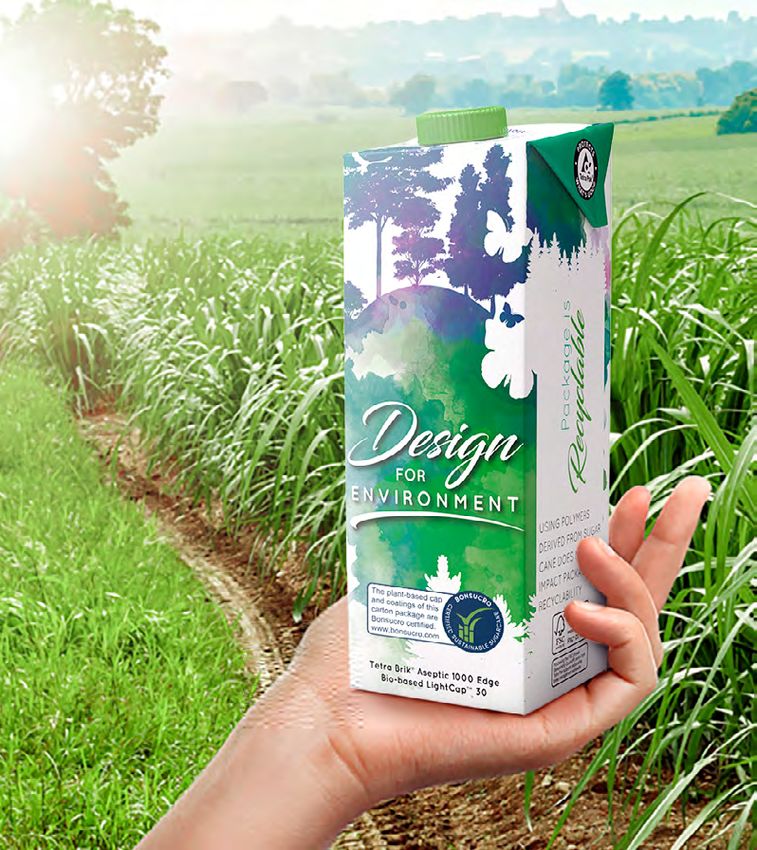
INTRODUCTION FOOD. PEOPLE. FUTURES. SUSTAINABILITY REPORT 2020 | 10
OUR FOCUS
A systematic approach The update identified ten material aspects. These Definition & verification
As part of our sustainability approach, we undertake 1. We identified and prioritised stakeholders are shown in the matrix below, which positions Our sustainability work and focus areas are defined
a materiality assessment every two years. This upstream across the supply chain, downstream the aspects according to priority and relevance to by our Sustainability Forum, which comprises ten
ensures that we keep up to date with changing and within Tetra Pak. Tetra Pak and to external stakeholders, and in the senior leaders from across Tetra Pak who represent a
sustainability priorities and that we continue to table opposite, which identifies where in the value wide range of areas of responsibility. Sustainability is
focus on the areas that deliver the greatest positive 2. We identified and prioritised social and chain they occur. also embedded as a pillar of our Strategy 2030: Lead
impact for our customers, our business, society and environmental topics applicable to the food and the sustainability transformation.
the environment. processing and packaging industry, taking into
account the voices of all stakeholders. Verification is essential to our sustainability process. Our
We conducted our most recent materiality assessment practices and performance are externally verified and
update in 2019. This involved a three-stage process: 3. We applied our own expert trend analysis and our GHG emissions data is externally audited. As a
forward-looking perspective to map topics against partner to this report, we will publish a GRI Standards
relevance to Tetra Pak and to external stakeholders. Content Index later in the year. Our GHG emissions and
other data will also be published on our global website.
Food processing,
Upstream Tetra Pak
Pillar Material aspects
supply chain operations
packaging & Consumption Post consumption Food safety
distribution & availability
Food safety
Food
& availability
Contributing to
a low-carbon
Securing a society
Protecting
responsible value chain
biodiversity & Promoting
Promoting OHS & ecosystems recycling &
employee wellbeing circularity
People
Promoting
diversity & inclusion
Maintaining Transparency/active
Transparency/active fresh water communication in the
communication in the value chain availability Securing value chain
Contributing to a
a responsible
low-carbon society value chain
Promoting
recycling & circularity
Futures Securing a solid Promoting
Protecting governance diversity &
biodiversity & ecosystems framework Promoting inclusion
OHS & employee
Maintaining wellbeing
fresh water availability
NEW AND FURTHER
Securing a solid REMAIN IN FOCUS INCREASED VISIBILITY ENHANCED ASPECTS
Governance
governance framework
This table lists the ten material aspects identified in our latest materiality assessment and shows where in the value chain each one occurs. This matrix visualises the top material aspects according to their relevance to Tetra Pak
(horizontal axis) and to external stakeholders (vertical axis), and also their level of priority
and timeliness (remain in focus/increased visibility/new and further enhanced aspects).INTRODUCTION FOOD. PEOPLE. FUTURES. SUSTAINABILITY REPORT 2020 | 11
Helping to feed the world
We commit to making food safe and available,
everywhere. Now, faced with the COVID-19
pandemic, our vision is more vital than ever. But at
the same time, our means of achieving it is changing,
thanks to the rise of digitalisation and connectivity.
These trends offer new opportunities to make food
safety and quality better than ever, while increasing
production flexibility, efficiency and sustainability.
Our packaging protects food without the need for
preservatives or refrigeration, saving energy, and helping
make safe, nutritious and flavoursome products available
to more of the world’s rapidly growing population, even
in remote areas with no cold chain. Our solutions also
help to prevent food loss and waste across the value
chain, from the efficiency of our processing equipment
in production, to the right-sizing and functionality of
our packaging at consumption.
Furthermore, by working to build sustainable value
FOOD.
chains, such as through our participation in school
feeding programmes and Dairy Hubs, we are helping
to end hunger, achieve food security, improve nutrition,
and promote sustainable agriculture and production.
Our material aspects
Food safety and availability
Our commitment to the UN SDGsINTRODUCTION FOOD. PEOPLE. FUTURES. SUSTAINABILITY REPORT 2020 | 12
FOOD SAFETY
& QUALITY
“We challenged ourselves to
set really ambitious goals
to redesign the traditional
JNSD line: to develop a more
sustainable solution while
also helping our customers to
ensure food safety. The success
Food safety has always been at the heart of what we do. It is
of the project is a result of team
embedded in our vision to commit to making food safe and effort, with many dedicated
available, everywhere. Now, faced with the COVID-19 pandemic, people at Tetra Pak involved.”
that vision is more important than ever – and our means of fulfilling
Maria Norlin, Subcategory
it has never been more innovative and effective. Manager, JNSD & Other
Beverages
Pioneering food solutions recognised high standards set out in EU, US
Since launching the Tetra Classic ® Aseptic and now Chinese legislation. Assessment of
carton in 1961, we have created hundreds of all food contact safety aspects and issuing
new packaging solutions that protect food of certificates is managed by our dedicated
without the need for a cold chain, saving Food Packaging Safety & Interaction
energy use and minimising food waste. organisation, based in Stuttgart.
Our Food Safety Policy commits us to Safety through innovation
maintaining internationally recognised We are also pioneers in food safety
leading standards of safety. Our ambition technologies such as juice pasteurisation
is to help customers achieve full product and UHT treatment. We are continually
traceability through the entire food finding new ways to help our customers
processing and packaging value chain. respond to market conditions and consumer
demands around the world.
We back this commitment in a number of
ways, including through the development In 2019, we received the prestigious IFU
of automated solutions such as Tetra Pak® Innovation Award for our long-term project
PlantMaster, a factory-wide control system to develop a new sustainable JNSD line. This
that fully and seamlessly integrates groundbreaking development – which can
intelligence from each unit of the dairy reduce energy and water consumption by
production line. 67% and 50% respectively, while maintaining
very high levels of safety and quality
We are committed to Food Safety assurance – has been launched in 2020.
Certification for all our food contact
materials, adhering to the internationally CLICK HEREINTRODUCTION FOOD. PEOPLE. FUTURES. SUSTAINABILITY REPORT 2020 | 13
DIGITALISATION
& CONNECTIVITY
Driving the industry forward connected package offers end-to-end
Digitalisation and connectivity is changing the traceability to improve production, quality
food and beverage industry as we know it. It control and supply chain transparency. For
offers unprecedented opportunities both consumers, it means the ability to access vast
to improve food safety and quality, and to amounts of information such as where the
increase production flexibility and efficiency. product was made, the farm that the
ingredients came from and where the
In 2019, we unveiled our vision of the “factory package can be recycled.
of the future”, in which digitalisation
revolutionises the way food manufacturing We followed up these new launches with a
plants operate, continuously increasing the series of technical thought leadership papers
speed of production, reducing errors and to help our customers benefit from Industry
minimising product waste. 4.0 in such key areas as food safety and
quality, productivity and flexibility. We also
Developed with a number of technology launched a dedicated website called
partners, our factory of the future utilises “Connecting the food industry”.
Industry 4.0 technologies such as big data
and advanced analytics, artificial intelligence CLICK HERE
and the Industrial Internet of Things. It builds
on our existing digitalisation measures, such
as Tetra Pak® Plant Secure and condition
monitoring, which predicts and prevents
system breakdowns before they occur.
New levels of transparency
Also in 2019, we launched our connected
packaging platform (see right), which
transforms our cartons into interactive
information channels, full-scale data carriers
and digital tools. For our customers, theINTRODUCTION FOOD. PEOPLE. FUTURES. SUSTAINABILITY REPORT 2020 | 14
We have long worked to increase the world’s access to safe food. Since
1962, we have participated in the development of school feeding and
nutrition programmes, working with partners worldwide. In recent years,
we have developed our Dairy Hub model to secure a long-term supply
of locally produced quality milk without increasing the cost of collection.
Sustainable value chains control. Through collaboration and
We believe that the most effective way to tackle partnerships, for example with UN agencies,
global food security and nutrition challenges is governments, NGOs and international aid
to build sustainable food value chains. For more agencies, we share knowledge and best
than 57 years, we have proven the value to practice drawn from programmes worldwide.
society and individuals of participating in the
development of school feeding and nutrition We have a strong background in supporting
programmes around the world. our customers in developing and launching
new fortified and nutritious beverages for
Such programmes have been shown to be programmes. Environmental education and
effective in delivering improved nutrition and best practice in recycling carton packages also
better educational outcomes, supporting form an important part of the support we offer.
local agriculture and promoting economic
development. According to the UN World Helping schools worldwide
Food Programme, they are making a For example, a new school milk programme
significant contribution to the UN SDGs, launched by the government of Sri Lanka is
in particular SDGs 1, 2, 4, 5, 8 and 10. raising awareness of environmental issues,
including recycling, at the same time as
Effective practical implementation is key tackling child malnutrition and promoting
growth in the local dairy sector.
FOOD
to achieving the best possible results. In
those parts of the world that face significant
challenges in infrastructure and logistics, our In 2019, 68 million children in 56 countries
food processing and packaging technology received milk or other nutritious beverages
plays a vital role in ensuring that children in Tetra Pak packages in their schools.
AVAILABILITY
can access safe nutrition in schools.
Click to find out more about the new school
An experienced partner feeding programme in Sri Lanka and other
We offer our customers and partners recent initiatives.
technical assistance and practical support in
implementation and evaluation, and advise
on best practices for food safety and quality CLICK HEREINTRODUCTION FOOD. PEOPLE. FUTURES. SUSTAINABILITY REPORT 2020 | 15
DAIRY HUBS
School feeding programmes
Tackling the milk shortage
Global demand for milk is set to
overtake supply within the next
produced globally, 360 million
tonnes are produced by
smallholder farmers. Much of that
increase their stable supply of
locally produced quality milk.
This helps them to grow their
68
million children
56
countries
9.4
decade. In the long term, the milk is not formally processed, business and increase profitability
dairy industry is facing a and is lost, thus limiting their by creating a more efficient
persistent gap between supply access to market. local supply chain (see graphic
billion Tetra Pak® packages
and demand – a supply deficit below for how this works). At
fuelled by population growth and Through our Dairy Hub model, the same time, thousands of
rising prosperity and urbanisation, we help to build sustainable value smallholder farmers gain access
particularly in Africa, Asia and chains by linking smallholder to market for their milk, improving
Latin America. farmers with dedicated their livelihoods.
processors in a selected area.
As nearly 1 billion people live on Tetra Pak and Tetra Laval then Three new Dairy Hubs were set
dairy farms, smallholdings or in provide technical assistance and up in 2019, in Albania, Tanzania
landless households keeping “hands-on” practical knowledge and Uganda, bringing the total
one or a few animals, the dairy transfer through our international number of smallholder farmers
industry holds huge potential dairy experts. reached by the programme to
to create jobs and increased
incomes right the way along More access for smallholders
36,420. This represents a 27%
increase compared with 2018.
Dairy Hubs
14 3 36,420
the value chain. By providing smallholder farmers
with training and setting up Click to find out more about these
According to the International appropriate cooling infrastructure new Dairy Hubs and others.
Farm Comparison Network, of and technology, dairy processors
the 867 million tonnes of milk in developing markets can CLICK HERE
Dairy Hub projects new Dairy Hub smallholder farmers reached in 2019
since 2013 projects in 2019
+27%
Dairy Hub projects since 2013
389,470
litres of milk per day collected from
Dairy Hub smallholder farmers in 2019
Smallholder farmer Village milk collection centre Milk collection & advisory centre Dairy plantINTRODUCTION FOOD. PEOPLE. FUTURES. SUSTAINABILITY REPORT 2020 | 16
All about our employees
Our biggest asset is our people. We believe that
becoming a more modern and attractive employer
is key to attracting and retaining the talent we need
to achieve our Strategy 2030 ambitions. To that end,
we are driving actions to ensure a diverse workforce
and an inclusive culture, where all employees can
thrive; to enable flexible working; and to promote
learning and development.
We safeguard our employees, promoting OHS and
wellbeing, as we work towards our ultimate goal of
zero accidents and work-related ill health. This goal
is more important than ever in the current COVID-19
pandemic, as we take extraordinary measures to
ensure we can continue to deliver on our promise
to protect what’s good.
From inside to outside
We also work to protect and support people in the
communities where we and our suppliers operate.
That includes securing a responsible value chain which
protects human and labour rights. We are also driving
transparency and active communication. To that end,
we are ensuring third-party certification and beyond
PEOPLE.
for key suppliers, and enhancing reporting and
knowledge exchange around sustainability topics,
sharing both achievements and challenges.
Our material aspects
Securing a responsible value chain
Promoting OHS and wellbeing
Promoting diversity and inclusion
Transparency/active communication in the value chain
Our commitment to the UN SDGsINTRODUCTION FOOD. PEOPLE. FUTURES. SUSTAINABILITY REPORT 2020 | 17
Creating an inclusive and growth via our Diversity Dashboard and
work environment Inclusion Index. On our Diversity Dashboard,
We recognise the value of diversity and we we are seeing some positive trends in gender
strive to ensure an inclusive work environment diversity: the number of women in leadership
and equal opportunities for all. As we work to positions continues to increase; the
achieve this ambition, we focused on three percentage of women hires is trending up;
key areas in 2019: and participation of women in learning is high.
We are also seeing the number of women in
Building awareness and skills our talent pools slowly growing. Work is still
e trained 750 leaders in inclusive leadership
W needed, though, to bring about a step
and we will continue this in 2020 to ensure change, not least as the talent pool of women
that all our leaders have been reached. in sciences generally remains small.
Feedback from participants was very positive.
On our Inclusion Index, which is based on the
Driving D&I actions results of our Employee Engagement survey
All our business organisations have built (see next page), we have not seen the
specific action plans around diversity and progress that we had hoped for.
inclusion (D&I). Many of these focus on closing
gaps in the area of women in leadership and Questions and comments from respondents
DIVERSITY &
providing growth opportunities for all. point to a number of areas where we need to
Clusters and market companies are also now increase our focus in order to create an even
systematically focusing on D&I to ensure that more respectful environment. Consequently,
any local issues are addressed. we have identified six actions to address these
areas going forward (see also next page).
INCLUSION,
Measuring D&I
We measure our progress towards achieving
an environment that supports development
FLEXIBILITY & 14% 750
DEVELOPMENT increase in women in
top management
leaders trained in
inclusive leadershipINTRODUCTION FOOD. PEOPLE. FUTURES. SUSTAINABILITY REPORT 2020 | 18
87%
Flexible working arrangements Hiring and developing future talent
We continued to roll out flexible working Our Future Talent graduate leadership programme
arrangements (FWA) throughout 2019 and we now continued in 2019. We hired our third annual cohort,
have policies in place in all countries with more than with 148 participants joining us around the world,
50 employees, nearly doubling the previous total. bringing the total to 487.
Overall, employee reaction is highly positive: 51% Since the programme began in 2017, 268 participants participation rate for our
have requested FWA in the last 12 months, with have completed the programme and are continuing Employee Engagement
flexible time and place being top of the list, and their journey of growth at Tetra Pak; only 30 have left survey – our highest ever
66% of FWA workers report a boost in productivity. us. We are now using the programme to continue to
strengthen both our national and gender diversity and
The most frequently cited benefits are better work/ our fourth round of recruiting for 2020 has started.
life balance and less time spent on commuting (see
video below for some user comments). However, Employee engagement
while the Employee Engagement survey is positive, Having engaged and productive employees is key
comments show there is room for improvement in for us, especially as we work towards achieving our
our support of FWA and in mitigating some of the Strategy 2030 ambitions. In 2019, we conducted
potential negative consequences, such as long hours our biennial Employee Engagement survey, which
and difficulty “switching off”. generated a number of pleasing results, including:
Learning and development • A participation rate of 87%, our highest ever.
for all employees • Our overall engagement score remains stable
With the creation of Strategy 2030, our learning at a high level.
focus has increased, as building the right capability • Employees continue to believe in our values
to deliver moves centre stage. Accordingly, we did (see opposite). Employee engagement survey results: our values are our strength
the following: • Improvements in career development and
93% 90% 92% 90%
performance management.
• Built a new set of leadership behaviours – Create
Dynamism, Drive Productivity, Build Capability However, we are concerned with issues in areas such
– in order to enable future success. as speed of change, process and customer focus, “I fully support the “When I am at work, “I believe Tetra Pak “Tetra Pak provides a working
• Started work on a comprehensive leadership especially as these are key to Strategy 2030. We values for which Tetra Pak is committed is environmentally environment that is accepting
development portfolio. addressed and communicated action items quickly Tetra Pak stands” to ensuring my health responsible” of differences in cultural
• Completed our onboarding programme, which and will run two shorter electronic “Pulse” surveys and safety” background or lifestyle”
is now available to all newcomers. in 2020 to check that these actions are working
• Launched LinkedIn Learning to all employees, and to correct our course if needed.
which exceeded expectations with 56% take-up
and an average 90 minutes of usage. Six actions to improve inclusion based on survey responses
• Our pilot of driving a continuous feedback 1. Monitor KPIs and drive gap closure
culture to support learning was successful 2. Communicate and engage on inclusion
and the approach has now been launched 3. Build inclusive skills and behaviours
to the whole organisation.
4. Expand growth and development opportunities
5. Attract diverse external talent
6. Secure local focus, as requiredINTRODUCTION FOOD. PEOPLE. FUTURES. SUSTAINABILITY REPORT 2020 | 19
SAFE &
Driving a culture change 2. Life-Saving Rules (LSR)
In May 2019, we launched the Occupational Health These nine rules (see graphic below) have been
and Safety Culture Change Programme. This developed from the major hazards that employees
HEALTHY
is built around the following three elements and has in our manufacturing, services and project
been rolled out across the whole organisation: organisations are most likely to be exposed to.
1. A Fair & Just (F&J) culture 3. “STOP! Are you in the danger zone?”
WORKPLACES
This aims to build an environment of trust and Because we cannot cover everything in nine rules, the
fairness where it is safe to report and learn from F&J culture and LSR are accompanied by a campaign
mistakes, errors and system flaws, but where to raise awareness of any and all potential risks.
violations of safety rules are not tolerated. F&J
places more responsibility on all employees, from
workshop operators to managers.
In the face of COVID-19, protecting our people is more
important than ever. In addition to measures to ensure this,
we made good progress towards our ultimate goal of zero
accidents and work-related ill health.
COVID-19 response These include ongoing rollout of the Culture Change
The COVID-19 outbreak has been an unprecedented programme, a new project focused on chemical
event, affecting communities worldwide. In this safety, and improved training and awareness.
context, extraordinary measures have been needed
to ensure we can continue to deliver on our promise In 2019, 1,300 employees took the “field force basic
to protect what’s good. This includes making OHS training”. The remaining 3,000 employees
changes in our own facilities and in our operations working at customer sites will complete the course in
with customers, and leveraging our resources to 2020, and more than 800 project and site managers
support the supply of safe and nutritious food will attend the Project Managers course.
(see video on the left for more).
Health & wellbeing
Safety performance We appointed Laura Mohomed as our new Global
Compared with 2018, lost time accidents fell by Health & Wellbeing Manager. Her priority is to roll
8.5% across the global organisation and by 33% out our Global Mental Wellbeing Programme to new
in our manufacturing sites. Lost time accidents countries beyond the 14 already participating.
involving contractors fell by 44%. However, there
was an increase in lost time accidents for employees Travel security
working at customer sites, particularly in Services. We appointed Shaun Taylor as Global Travel Security
Manager. The COVID-19 outbreak and recent security
A number of initiatives are under way aimed at issues in the Middle East have shown us just how
ensuring that there are fewer accidents in 2020. important this area is.INTRODUCTION FOOD. PEOPLE. FUTURES. SUSTAINABILITY REPORT 2020 | 20
Responsible sourcing is the right thing to do as a business, and it is a
strategic objective for our procurement organisations. All our centrally
and locally managed suppliers must endorse the Tetra Pak Code of
Business Conduct for Suppliers and comply with its requirements. We
regularly check performance against these commitments through desk-
based assessments and on-site audits, followed up by improvement
activities. We also expect our suppliers to demonstrate continuous
This is the fourth year in a improvement in their own operations and across their supply chains.
row we have been rated as These activities are part of our procurement processes and our
a leader by CDP’s annual Corporate Governance Framework. In 2019, they comprised:
environmental disclosure
and scoring process, widely
recognised as the gold We enhanced partnerships with
• provide expert support in the areas
standard for corporate third parties, such as Sedex and of sustainability, compliance and
environmental transparency. EcoVadis, to optimise the coverage risk management.
of assessments across our supplier
We are one of 179 base, using a risk-based approach. We embedded our mandatory
•
companies – just 2% of the requirements for responsible
many thousands scored – We increased collaboration with
• sourcing in our “Sourcing Critical
recognised as a leader for suppliers in follow-up activities to Terms” guidance, which ensures
actions to cut emissions, ensure that they take any necessary that they are covered in all supply
mitigate climate risk and actions identified, thereby driving contract negotiations.
develop the low-carbon continuous improvement.
economy. We are also one We improved our criteria for
•
of just eight companies We selected a new system for
• selecting suppliers that we assess,
RESPONSIBILITY
identified as a leader in supply chain risk management that building on both category and
preventing deforestation integrates third-party data, such country risk, as well as supplier
in supply chains via as from EcoVadis, with artificial dependency and strategic
sustainable sourcing. intelligence and media screening. importance. Going forward, we will
& TRANSPARENCY
This allows continuous monitoring, further strengthen our category
We were also in the top strengthening our responsible approach, to ensure we address
1% of companies assessed sourcing and supplier risk the most relevant risks and
by EcoVadis in its management activities. opportunities with our suppliers.
Manufacturer of Special
Purpose Machinery industry We created a central governance
• We updated our mandatory
•
category; in the top 1% in function as part of the training for responsible sourcing,
Our commitment to protecting people extends beyond our own and our customers’ Environment; in the top 1% transformation of our Supplier included in the Tetra Pak Academy
operations to include the communities where we and our suppliers operate. We work in in Sustainable Procurement; Management organisation, which is for the attention of all employees
partnership with our suppliers to minimise human and societal, as well as environmental, and in the top 4% in Labour working alongside purchasing involved in procurement.
risk, while also driving transparency and active communication across the value chain. and Human Rights. categories to set strategies andINTRODUCTION FOOD. PEOPLE. FUTURES. SUSTAINABILITY REPORT 2020 | 21
Two important goals for tomorrow
We are working to support the sustainable future of our
planet and the long-term success of our customers, as
well as the success of our own business. These ambitions
are embedded in two of our Strategy 2030 goals: to lead
with low-carbon circular economy solutions; and to
enhance sustainability across the value chain.
Our approach begins with our commitment to a low-
carbon circular economy. To that end, we have worked for
years to reduce the environmental impact and increase
the renewability of our packages. Now we are accelerating
our efforts as we pursue our vision of the ideal beverage
carton: a fully renewable and recyclable package.
At the same time, we are contributing to a low-carbon
society by striving to minimise impact across our
entire value chain. We are working to protect
biodiversity, and establishing water stewardship,
by working with our suppliers and through third-party
verification. We are also working to optimise our own
operations and, through our solutions and services,
those of our customers. And finally, we are promoting
recycling and circularity, through our own activities and
through partnerships worldwide.
FUTURES.
Our material aspects
Contributing to a low-carbon society
Promoting recycling and circularity
Protecting biodiversity and ecosystems
Maintaining fresh water availability
Our commitment to the UN SDGsINTRODUCTION FOOD. PEOPLE. FUTURES. SUSTAINABILITY REPORT 2020 | 22
LOW-CARBON
Taking circularity further In a low-carbon circular economy,
In a circular economy, manufacturers the whole value chain is optimised
design out waste, reuse and recycle for minimum climate impact. This
CIRCULAR
materials and regenerate natural systems means operations that are powered
to reduce impact on the environment. by renewable energy, manufacturing
processes that are highly efficient
We believe that this approach is an and logistics that reduce fuel use.
ECONOMY
essential part of sustainability today.
That’s why in 2019, we signed the Ellen It also takes into account the positive
MacArthur Foundation (EMF) New impact of plant-based renewable raw
Plastics Economy Global Commitment, materials, which can reduce carbon
SOLUTIONS
which is founded on circular economy emissions as they grow and are reused
principles (see left for our commitments.) and recycled. For example, a 2016
EU Bioeconomy Report estimates that
However, we believe that this approach European forests and the forest-based
needs to go further. It is not enough to bioeconomy could capture 25% of
think about issues such as waste and current CO2 emissions within the
climate in isolation; we must look at them coming two to three decades with
Our sustainability strategy is founded on our commitment to a low-carbon together. This is why we are committed the right policy incentives.
circular economy. We believe that such an economy should take into account to a circular economy that also has a low-
not just recycling and reuse, but also the climate impact of raw materials and carbon focus: one that takes into account Thinking positive
manufacturing, as well as impacts on biodiversity and fresh water availability. not just recycling and reuse, but also Indeed, we believe that everything a
the carbon impact of manufacturing business does should have a positive
and, particularly, raw materials. impact on our planet. So in 2019, we
launched our Planet Positive initiative.
Our New Plastics Economy Global Commitment It’s a new way of thinking that inspires
business to take sustainability much
• We have already fulfilled our first • We will incorporate a minimum further, so that our collective actions
commitment by launching a paper of 10% recycled plastics content add up to solve some of our greatest
straw in 2019. We expect to on average across our beverage environmental challenges.
industrialise production on a scale cartons sold in Europe by 2025,
Planet Positive guides our approach
to meet global demand by 2025. subject to suitable food-grade
to forming the partnerships and
recycled plastic being technically
EXPLORE
collaborations which are now so vital
• We will increase recycling for and economically available.
to bringing about meaningful change.
PolyAl – the non-fibre components It is also highly practical. Through our
of a beverage carton – both when • We will use recycled plastics sustainable end-to-end offering, we
they are recycled as a blend and for secondary packaging and CLICK HERE
support our customers as they work
when they are recycled separately. distribution material. Planet Positive to transform their business and realise
In 2019, we published a hands-on guide to their own sustainability ambitions.
CLICK HERE helping our customers transform their
business sustainably in four steps. Click above
to find out more about our Planet Positive
sustainability offering.INTRODUCTION FOOD. PEOPLE. FUTURES. SUSTAINABILITY REPORT 2020 | 23
OUR PORTFOLIO Fully renewable package:
Tetra Rex® Plant-based
• First beverage carton package in the market
made only from renewable packaging materials
We have worked for many years to reduce the environmental impact and increase • Up to 35% reduction in CO2 emissions, compared
the renewability of our packages, and to promote collection and recycling worldwide. with standard Tetra Rex® package
As a result, our low-carbon circular portfolio is already strong. • Multi-award winning
In July 2019, we became the first carton
packaging company to launch paper straws
in Europe, fulfilling our first EMF New
Plastics Economy Global Commitment.
Average package Tetra Brik®Aseptic 1000
• 72% materials from Edge with Plant-based
renewable sources LightCap™ 30
(average based on total • First aseptic carton package
purchased materials) certified for surpassing 80%
• 100% paperboard from renewable materials
FSC™-certified and • Up to 23% reduction in
controlled sources CO2 emissions compared
• Lower carbon footprint with a standard Tetra Brik®
than alternative packaging Aseptic package
(IFEU LCA meta-analysis)
• Recyclable and increasingly
being recycled at more
than 170 sites worldwideYou can also read


