Equality Action Plan 2019 2022 - Fermanagh & Omagh ...
←
→
Page content transcription
If your browser does not render page correctly, please read the page content below
Equality Action Plan
                   2019 - 2022
Contact Officers:
Margaret McMahon (Head of Policy and Strategic Services)
Finbar Maguire (Policy Officer)

Contact Details:
Policy and Strategic Services
Fermanagh and Omagh District Council
Townhall
2 Townhall Street
Enniskillen
County Fermanagh
BT74 7BA
Contents
                                    Page Number

Purpose                                2

Strategic Context                      2

Profile of the Council                 3

Appendix 1: Equality Action Plan       4

Appendix 2: Comprehensive
Statistics for the District            9

                                                  1
Purpose of Fermanagh and Omagh District Council’s Equality Action Plan
The Council’s Equality Action Plan will provide a framework to guide our actions until 31
March 2022.
The Equality Action Plan not only contributes to the Council’s compliance with Section
75 of the Northern Ireland Act 1998, but it also sets out how the Council plans to
address key inequalities as it strives to create a District where people chose to live,
work and visit.
Strategic Context:
Community Planning
Fermanagh and Omagh District Council is the lead partner for the District’s duty for
Community Planning. The Council is responsible for establishing the process of
community planning and for ensuring the development and implementation of the
District’s first Community Plan – Fermanagh and Omagh 2030
The ‘Fermanagh and Omagh 2030’ Community Plan has been drafted by combining the
collective knowledge, expertise and resources of a wide range of partners across the
public, private and community / voluntary sectors - all working towards a single agreed
vision for the area. The Community Plan was informed through a co-design process and
has been informed by a series of public engagement events.
The vision for the Fermanagh and Omagh District for 2030 is to create:
      ‘…a welcoming, shared and inclusive Fermanagh and Omagh District, where
      people and places are healthy, safe, connected and prosperous, and where our
      outstanding natural, built and cultural heritage is cherished and sustainably
      managed.’
The ‘Fermanagh and Omagh 2030’ Community Plan contains eight outcomes, which
are attributed to three Key Themes. These Themes are:
   1. People and Communities.
   2. Economy, Infrastructure and Skills.
   3. Environment.

                                                                                          2
Profile of the District
A comprehensive ‘Profile of the District’ can be found on page 10 (Appendix 2),
however some of the key figures are:
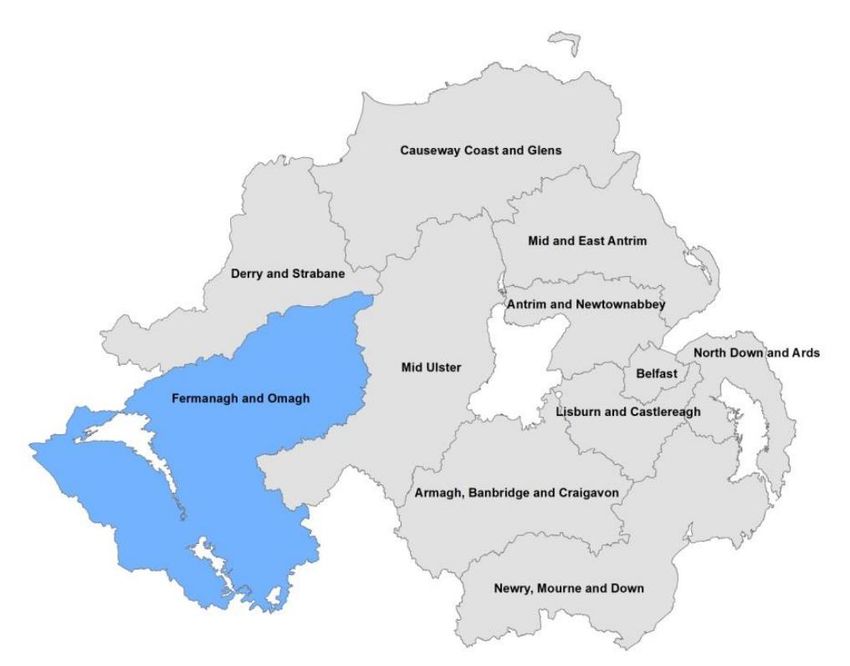
   •    The District is spans approximately 3,000 km2 and is home to approximately
        116,289 people.
   •    The District is the largest in Northern Ireland in terms of land mass and the
        smallest in terms of population – the population density of the District is
        approximately 38 people per square kilometre.
   •    The District borders on four counties within the Republic of Ireland – Donegal,
        Cavan, Monaghan and Leitrim.
   •    46% of the population live in ‘open countryside’.
   •    30% of the population live in the two main towns of Omagh and Enniskillen.
   •    7% of the population live in the five local towns of Carrickmore, Dromore,
        Fintona, Irvinestown and Lisnaskea.
   •    The remaining 17% of the population live within the villages and small
        settlements of the County.
Equality Action Plan Layout
Five strategic themes have been identified, including:
   1.   Equality of Opportunity.
   2.   Accessible Services.
   3.   Spoken, written and signed language forms.
   4.   Equality Monitoring and Data Collection.
   5.   Employees and Elected Members

Each of the Actions contained within the Equality Action Plan (2019-2022), also
compliment the Community Plan for the District (Fermanagh Omagh 2030) and the
Corporate Plan for Fermanagh and Omagh District Council primarily:
        Community Plan Theme 1 – People and Communities
        Aim: To improve the wellbeing of all our citizens and develop thriving rural and
        urban communities
              Outcome 2: Older people lead more independent, engaged and socially
              connected lives
              Outcome 3: Our Communities are safe, resilient and empowered.
              Outcome 4: Our people have the best start in life with lifelong
              opportunities to fulfil their potential
        Corporate Plan Update (2017 – 2019)
        Priority: Strong, safe, shared and inclusive communities
              Action 3.2 - Implement Equality Scheme Actions

                                                                                           3
Appendix 1: Equality Action Plan 2019-2022

               Actions                       Performance Measure                Timeframe         Responsibility
                                                Equality of Opportunity
                                      The Equality Action Plan will be
                                                                              September and
                                      reviewed following the outcome of
                                                                              October 2019.
Undertake a consultation process on the consultation process.                                     Policy Officer
the 2019-2022 Equality Action Plan    A final Equality Action Plan will be                         (Equality)
                                      approved by Elected Members for        November 2019.
                                      the period 2019-2022.
                                      Annual Progress Report will be
Report on the progress of the                                                                     Policy Officer
                                      submitted to the Equality              August (Annually).
Equality Action Plan for 2019-2022                                                                 (Equality)
                                      Commission for Northern Ireland.
Ensure that Equality and Good
Relations is embedded to all key      Single action to be achieved in the
                                                                                                  Policy Officer
Council documents – i.e. Corporate development of each strategic                 Ongoing.
                                                                                                   (Equality)
Plan (2019-2023), Community Plan, document.
etc.
                                      Review the draft Disability Action
                                                                              September and
Undertake a consultation process to Plan following the outcome of the
                                                                              October 2019.
develop a new Disability Action Plan consultation process.                                        Policy Officer
for the Council, for the period 2019- A Disability Action Plan will be                             (Equality)
                                                                             November 2019.
2022.                                 approved by Elected Members for
                                      the period 2019-2022.
                                      Report annually to Council.             July (Annually)
Deliver a Disability Action Plan for   Report annually to the Equality
                                                                             August (Annually)    Policy Officer
the Council which considers the        Commission for Northern Ireland.
                                                                                                   (Equality)
Disability Discrimination Act
                                       Report bi-annually to the Council’s
                                                                                 Bi-annual
                                       Disability Advisory Group

                                                                                                                   4
Actions                         Performance Measure                 Timeframe          Responsibility
                                         Reviewing the current scheme.          June-October 2021
                                         Obtaining Elected Member approval                           Head of Policy and
                                         for the adoption of a new Equality      November 2021       Strategic Services
Review and develop a new Equality
                                         Scheme.
Scheme for the Council (2022-2027)
                                         Presenting the approved Equality                              Policy Officer
                                         Scheme to the Equality Commission        January 2022          (Equality)
                                         for Northern Ireland.
                                         Screening documentation will be
                                         presented to Committee alongside           Ongoing
All new, and revised, policies will be
                                         the relevant policy.                                          Policy Officer
subject to screening for Equality of
                                         All screening processes undertaken                             (Equality)
Opportunity.                                                                    Ongoing (every six
                                         by the Council will be published for
                                                                                    months)
                                         comment every six months.
Deliver a Good Relations Action                                                                       Good Relations
                                         Annual reports to Council.                 Ongoing
Plan                                                                                                   Team Leader
                                    Organising events, and initiatives,
Raising the profile of
                                    targeting specific Section 75 Groups
underrepresented Section 75                                                                          All Directors and
                                    and the issues facing these                     Ongoing
Groups (and other protected groups)                                                                  Heads of Service.
                                    individuals/groups (e.g. Civic
within the District
                                    Receptions, Programmes, etc).
                                                    Accessible Services
                                         Reviewing Section 75 Monitoring
                                         Forms of key consultation processes
Review the Council’s consultation
                                         to develop a baseline. This can then                          Policy Officer
processes, ensuring they are open                                                September 2020
                                         be used to improve consultation                                (Equality)
and accessible to all.
                                         processes, and participation, going
                                         forward.
                                         Identifying new and appropriate                                Policy Officer
Scope the development of inclusive
                                         methods of communications which                               (Equality) and
communication channels to meet                                                      Ongoing
                                         could improve Council venues,                                relevant Head of
the needs of various individuals,
                                         facilities and services.                                          Service

                                                                                                                         5
Actions                          Performance Measure               Timeframe          Responsibility
particularly those with additional
needs.
                                   Organise training and awareness
                                   raising initiatives to improve
                                                                                    Ongoing         Head of Policy and
                                   employee knowledge and
Develop guidance for Council                                                                        Strategic Services
                                   confidence.
employees who may work or interact
                                   The development of a guide, or
with LGBTQ+ customers                                                                                 Policy Officer
                                   protocol, for Gender Identity
                                                                                December 2020          (Equality)
                                   following detailed consultation with
                                   relevant groups and individuals.
                                        Spoken, Written and Signed Language Forms
                                         Undertake an audit of what is
                                         currently available (internally) for   September 2020
Ensure a consistent approach to the      Council services to avail of.                                Policy Officer
provision of translation and
                                         Collate a set of procedures for all                           (Equality).
interpretation services.
                                         Council Services in relation to         January 2020
                                         translation and interpretation.

                                         Number of meetings/events
Ensure, where required, that                                                        Ongoing
                                         facilitated.
meetings and events have                                                                              Policy Officer
appropriate interpreters and/or other                                                                  (Equality)
assistance as in attendance.             Annual Progress Report                 August (annually)

                                         Public consultation on Irish
                                                                                December 2019
Development of the Irish Language        Language                                                   Head of Arts and
Policy and Action Plan                   Development of a new Policy and                               Heritage
                                                                                   May 2020
                                         Action Plan

                                                                                                                       6
Actions                       Performance Measure                Timeframe        Responsibility
                                      Undertake a review of the Ulster                          Head of Arts and
Commence a review of the current      Scots Policy and Action Plan with                            Heritage
                                                                               March 2022
Ulster Scots Policy and Action Plan   the results being reported to                            Head of Community
                                      Committee.                                                   Services
                                           Monitoring and Data Collection
                                      Equality Monitoring process to be       September -
                                      completed.                              October 2019
To create a report outlining the      Report to be presented to the Policy                       Policy Officer
Section 75 breakdown of the           and Resources Committee for            November 2019        (Equality)
Council’s Elected Members.            consideration.
                                      Review, and update, the data
                                                                             September 2021.
                                      collected after two years.

                                      Equality Monitoring process to be
                                                                                May 2020
Update the pre-existing Section 75    completed.                                                 Policy Officer
records for Council employees.                                                                    (Equality)
                                      Report to be presented to SMT             July 2020

Review of monitoring information                                                               Head of Policy and
being collected by Council, to        Report to be presented to SMT and                        Strategic Services
identify any potential gaps, or       a subsequent Policy and Resources        June 2020
development opportunities to          Committee                                                  Policy Officer
capture additional monitoring data.                                                               (Equality)
                                          Employees and Elected Members

Increase the awareness of Elected     Development of a Learning and                            Head of Policy and
                                                                               March 2020
Members in relation to Equality of    Development programme.                                   Strategic Services

                                                                                                                  7
Actions                        Performance Measure              Timeframe      Responsibility
Opportunity, Good Relations and                                                            Head of Democratic
Disability.                            Participation and attendance figures                     Services
                                                                               Ongoing
                                       for each event.                                       Policy Officer
                                                                                               (Equality)
                                       Develop a Learning and                              Head of Policy and
                                                                              March 2020
Increase the awareness of Council      Development programme.                              Strategic Services
employees in relation to Equality of   Participation and attendance figures                 Head of Human
                                                                               Ongoing
Opportunity, Good Relations and        for each event.                                         Resources
Disability.                            Participation of new employees at                     Policy Officer
                                                                               Quarterly       (Equality)
                                       Corporate Induction sessions
Development of a communications
                                       Improved awareness of Equality and
programme on Equality and Good                                                               Policy Officer
                                       Good Relations responsibilities and     Ongoing
Relations for Elected Members and                                                             (Equality)
                                       concerns.
employees.
Attendance of Diversity Champion at    Attendance at events and feedback
                                                                                           Head of Policy and
training and networking events, as     which could include the sharing of      Ongoing
                                                                                           Strategic Services.
required.                              good/best practice.

                                                                                                              8
Appendix 2: Statistics
Fermanagh and Omagh District – A Profile

   •   The Fermanagh and Omagh District is Northern Ireland’s largest in terms of land
       mass (3000km2) and smallest in terms of population density (38.8 people per
       km2).
   •   The District is primarily rural:
          o 46% of the population live in ‘open countryside’.
          o 30% of the population live in the two main towns of Omagh and
             Enniskillen.
          o 7% of the population live in the five local towns of Carrickmore, Dromore,
             Fintona, Irvinestown and Lisnaskea.
          o The remaining 17% of the population live within the villages and small
             settlements of the County.
Council Representatives
The Council consists of 40 Elected Members, representing seven District Electoral
Areas (DEAs) within the District.
                 DEA        Population        DEA           Population
              Enniskillen     18,150        Omagh             18,088
              Erne East       15,134       Mid Tyrone         17,053
              Erne North      14,675       West Tyrone        16,215
              Erne West       13,846
                                         (Statistics taken from the 2011 Census)

                                                                                         9
Political Representation of Fermanagh and Omagh District
Council
Cross Community Independents
Labour Alternative 4
1
Alliance
1
Democratic Unionist Sinn Féin
Party 15
5
Social Democratic and
Labour Party
5
Political Representation of Fermanagh Ulster Unionist Party
and Omagh District Council following the 9
Local Government Elections in May 2019
Population Trend – Fermanagh and Omagh
10The Fermanagh and Omagh District accounts
for 6.21% of NI's total population
Fermanagh
and Omagh
Northern
Ireland
Population Projections (by age group)
Population Change (FODC)
80,000 73,703 71,428
70,000
60,000
50,000
40,000 2016
26,754 2030
30,000 23,473 21,680
18,623
20,000
10,000
0
0-14 15-64 65+
Whilst the population of the District is estimated to increase by just over 3% by the year
2030 (to 119,900 individuals), there will be a significant increase amongst the older age
groups. For example, the number of individuals over the age of 65 years is expected
to rise by 43.66% (to 26,754 individuals) by 2030.
11The age profile for the Fermanagh and Omagh District is estimated as:
Age Group Population
0-15 years 25,356 This
represents a
16-39 years 33,949 population
40-64 years 37,953 increase of
5.8% since
65+ years 19,577
2007
(Mid-year population estimates for 2018)
Gender breakdown
49.93% 50.07%
Religious Beliefs
The population of Fermanagh and Omagh identifies as:
70.00% 64.23%
60.00%
50.00%
40.00% 33.08%
30.00%
20.00%
10.00%
2.69%
0.00%
Roman Catholic Protestant No Religion / Other
12Racial Background (of Fermanagh and Omagh)
99.16% identifies as ‘white’
(including Irish Traveller).
0.84% identifies as being from an
ethnic minority background.
The Fermanagh and Omagh District is increasingly becoming more diverse. 4.55% of
the population was born outside of the United Kingdom and Ireland and for
approximately 3,200 people English is not their first language.
Disability
20.75% identifies as having a long-term health
problem, or disability, that limits their day-to-day
activities.
In 2016, there were 14,250 individuals in receipt of
Disability Living Allowance.
Two of the most common health issues within the
District are: Hypertension and Obesity.
Marital Status
Marital Status District Profile (%)
Divorced 4.04
Single 35.76
Married 50.14
Separated 3.23
Widowed 6.78
Same-sex Civil Partnership 0.05
Sexual Orientation
1.7% of the Northern Ireland population identifies as
either ‘Lesbian, Gay or Bisexual’ (ONS report, 2016)
13Dependency
11.02% identifies as providing unpaid
care to a family member, friend or
neighbour.
Families in Households with, or without, dependent children:
(with no dependent (with one dependent (with two dependent (with three or more
children) child) children) dependent children)
14,962 families 5,571 families 5,068 families 3,871 families
The Economy of the Fermanagh and Omagh District
Wage Levels
£21,891
(Fermanagh and
Omagh)
£25,704
(NI Average) (Annual Survey of Hours and Earnings 2018 [all
jobs, annual gross pay, mean])
14Economic Activity
62.4% of those aged 16 years and over are deemed to be economically active.
73% of the population aged between 16 years and 64 years are deemed to be
economically active.
60.2% 72.8%
Northern Ireland averages are:
16 years + 16 years - 64 years
Education Attainment (for those aged between 16 and 64 years of age)
26.7%
NVQ Level 4 or above
(NI Average: 29.9&)
14.9%
‘No Qualifications’
(NI Average: 16.5%)
Number of Registered Businesses within the District:
Total:
7,690 businesses
7,620 small businesses
(less than 50 employees)
60 medium businesses
(50-249 employees)
5 large businesses
(250+ employees)
15Deprivation
The five areas within the Fermanagh and Omagh District which were highest rated in
terms of overall deprivation are:
1. Devenish (ranked 44th overall in Northern Ireland [out of 890 SOA areas]).
2. Lisanelly 2 (ranked 46th overall in NI).
3. Lisanelly 1 (Ranked 47th overall in NI).
4. Newtownbutler (ranked 112nd overall in NI).
5. Rosslea (ranked 114th overall in NI).
Furthermore, the Fermanagh and Omagh District has 11 Super Output Areas which
feature within the top 200 Super Output Areas within Northern Ireland (890 in total).
Other measures of deprivation include:
Income Deprivation
• Rosslea ranked 14th in NI.
• Lisanelly 1 ranked 21st in NI.
• Devenish ranked 28th in NI.
• Newtownbutler ranked 31st in NI.
• Belleek and Boa ranked 37th in NI.
A further four Super Output Areas (within FODC) feature
within the top 100: Lisanelly 2 (61st), Donagh (69th),
Irvinestown (74th) and Fintona (99th).
Employment Deprivation:
• Lisanelly 1 ranked 52nd in NI.
• Lisanelly 2 ranked 55th in NI.
• Devenish ranked 62nd in NI.
16Health Deprivation and Disability
There are four Super Output Areas within the District which
appear in the top 100 most deprived areas of Northern Ireland
in relation to ‘Health and Deprivation’:
1. Lisanelly 2 (ranked 24th in NI).
2. Devenish (ranked 69th in NI).
3. Lisanelly 1 (ranked 84th in NI).
4. Gortrush (ranked 97th in NI).
There are a further five areas which appear in the top 200
SOAs in Northern Ireland, namely: Strule, Camowen,
Killyclogher, Fintona and Erne.
Access to Services
In relation to ‘Access to Services’, the District is features particularly highly – there are
23 Super Output Areas within the District which appear in the top 100 most deprived
areas in Northern Ireland in relation to Access to Services.
Furthermore, there are five areas which appear in the ‘top 10’ most deprived areas in
Northern Ireland, namely:
1. Belcoo & Garrison (2nd overall in Northern Ireland).
2. Rosslea (5th overall in Northern Ireland).
3. Trillick (7th overall in Northern Ireland).
4. Sixmilecross (8th overall in Northern Ireland).
5. Owenkillew (9th overall in Northern Ireland).
17You can also read


