EUROPEAN ELECTIONS REVIEW 2019 - NEW IN THE JANUARY ISSUE - Fipra
←
→
Page content transcription
If your browser does not render page correctly, please read the page content below
EUROPEAN
ELECTIONS REVIEW
            2019
                     NEW IN THE
                  JANUARY ISSUE

                         NEW POWER DYNAMICS
                   We dive deep into the new power
             dynamics that we are likely to see after
              May’s elections and make sense of the
                decline of traditional political parties;

                              EPP, S&D AND ALDE
             We take a look at the latest updates on
                                   EU political groups;

                                  MEPS TO WATCH
              We consider departures and arrivals of
          key Members of the European Parliament;

                                      OUR EXPERTS
    Our experts and colleagues from Fipra Germany,
   France, Italy, Spain, Netherlands, Czech Republic,
    Hungary, and Slovakia give us a run-down of the
        latest developments in their Member States.

                                     JANUARY 2019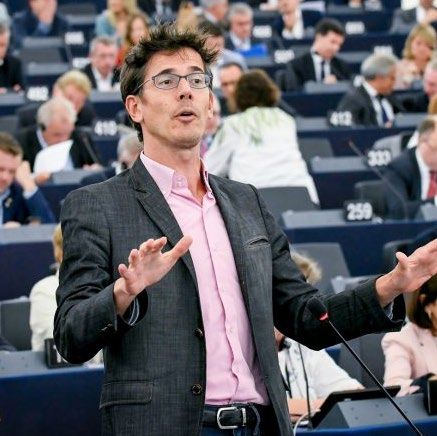
Page 2

NEW POWER DYNAMICS
EPP-S&D losing their majority

        As the golden era of the coalition of the centre-right European People’s Party (EPP) and of the
        centre-left Party of European Socialist (S&D) comes to an end, the next European Parliament
        elections will be a battle over the future shape of the EU.

The EPP and S&D are currently the European Parliament’s largest force, and together hold a

little over half of the chamber with 408 seats. If public opinion polls are correct, the EPP and

PES will wake up on May 27th with 180 and 136 seats in the European chamber, respectively,

which would leave their combined strength 34 seats short of a majority in the newly reconfigured

705-seat Parliament.

Their long-lived romance however might be set for a rocky start, as comments from S&D Group Leader Udo Bullman this

month hinted at a potential shift in their relationship, which could complicate future plans for building a coalition. The S&D

has put forward Dutch social democrat Frans Timmermans in hope of “changing Europe” and ending the 15 years of

centre-right rule over the European Commission. But after the centre left’s disappointing results in France, Germany, Italy

and the Netherlands, Timmermans has little chances of securing the top Commission job.

                EUROPEAN PARLIAMENT ELECTIONS 2019 - JANUARY 2019 PREDICTIONS

                217

                                                                                                                       2014 RESULTS
                            189
                                                                                                                       2019 RESULTS
                      180

                                  136

                                             95

                                                            74
                                        66
                                                       60        59        58
                                                                      52                  51
                                                                                45             44
                                                  37                                 38
                                                                                                         33

                                                                                                              18

                                                                                                     0             9

                                                                                                               NEW

Source: Pollofpolls.eu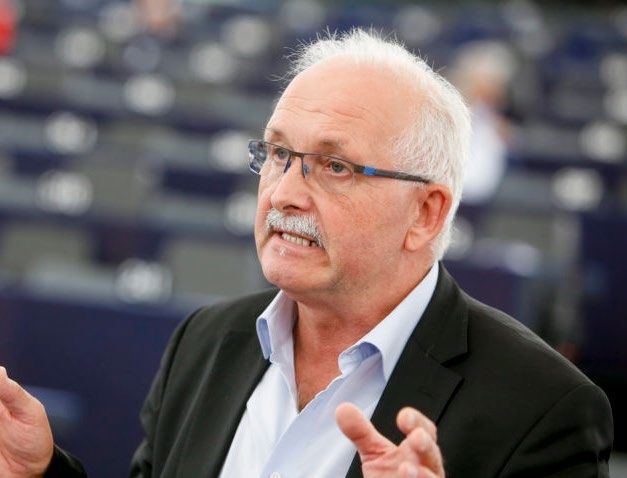
Page 3

KINGMAKERS

       The decline of the traditional political parties opens the way for an increasingly important role
       for smaller groups. The European Liberals (ALDE) are expected to gain around 95 seats,
       positioning them as the third-largest force in the chamber, while smaller parties like the
       European United Left/Nordic Greens Left (GUE/NGL) and the European Greens are expected
       to gain 53 and 44 seats respectively.

Two parties in particular are expected to play a kingmaker role in the next legislature: ALDE and The Greens. They will play a

crucial role in trying to form a grand liberal coalition, and will force the EPP and S&D to compromise as they seek alliances.

On this point, the Green lead candidate Bas Eickhout said that the next Parliament will be obliged

to work under a four-party coalition of EPP, S&D, ALDE and The Greens. While the ALDE Group

was already included last-minute, in the EPP and S&D agreement in 2014 for a “stable and pro-

European majority”, the allied party La République En Marche and their leader French President

Emmanuel Macron is a new factor.

While the current entente between conservatives, social-democrats and liberals is set to remain, fragmentation of the European

Parliament will slow policy making. A grand liberal coalition would give ALDE and The Greens a stronger voice in promoting

the fight against climate change and for promoting the preservation of democratic processes inside and outside the Union.

The first litmus test in the new and fragmented political landscape of the European Parliament in 2019 will be the formation

of the next European Commission, which could see a number of liberal and Green MEPs be appointed as Commissioners.

          ON THIS POINT, THE GREEN LEAD CANDIDATE BAS EICKHOUT
            SAID THAT THE NEXT PARLIAMENT WILL BE OBLIGED TO
          WORK UNDER A FOUR-PARTY COALITION OF EPP, S&D, ALDE
                               AND GREENS.

Image credit 1: European Union. Image credit 2: Genevieve Engel / European Union
Page 4

EUROSCEPTICS JOIN FORCES TO RESHAPE THE PARLIAMENT

       Early in January, Italian far-right deputy Prime Minister Matteo Salvini and the leader of the
       Polish far-right Law and Justice party, Jaroslaw Kaczynski, announced the formation of a new
       parliamentary group.

Kaczynski’s party currently sits in the European Conservatives and Reformists group (ECR),

while Salvini’s Lega is part of the Europe of Nations and Freedoms (ENF). The 74-seat strong

ECR will suffer from the exit of UK Conservative Members of the European Parliament (MEPs)

who will no longer sit in the chamber, and the ENF lose two major parties to the newly born far-

right group: the French Rassemblement National and the Dutch Party for Freedom. This could

effectively make the new alliance the main far-right Eurosceptic force and one of the largest

groups in the next European Parliament. If Austria’s far-right Freedom Party, already approached

by Salvini, was also to join, the new group could gain around 140 MEPs at the May Elections,

making it the third largest in the European Parliament.

Meanwhile, Italy’s other deputy Prime Minister Luigi Di Maio is planning to form a new parliamentary group. Di Maio is the leader

of the populist Five Star Movement, which is sitting in the EFDD. With Brexit taking the Eurosceptic UKIP out of the EFDD, it

is not clear whether the group and its current 45 seats will survive. After being rejected by the Greens because of his national

government alliance with Salvini, Di Maio approached the leaders of Poland’s right-wing Kukiz’15, Croatia’s populist Zivi Zid and

Finland’s liberal Liike Nyt, to form an alliance. Given the very small size of their new allies, the Five Star Movement could dominate

a new group.

The French Yellow Vests movement, also approached by Di Maio to be part of the new group, announced at the end of January

that it would run candidates in the upcoming elections. However, after initially declining to join, it remains unclear whether they

will be part of the Five Star Movement’s new group.

Image credit 3: Marcin Obara / PAP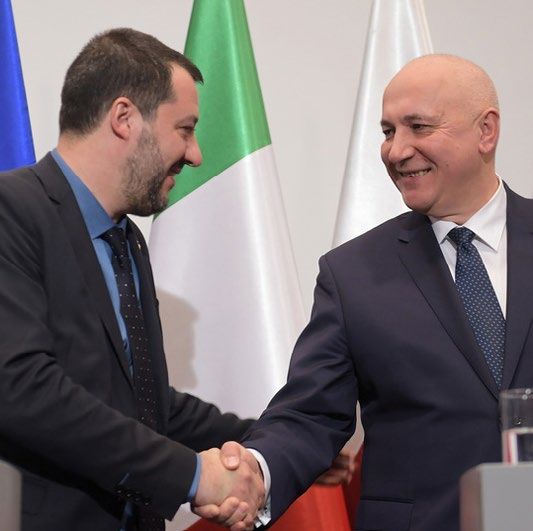
Page 5

UPDATES FROM BRUSSELS
European People’s Party

      Is the European People’s Party guaranteed another Commission Presidency or will the
      Spitzenkandidat system flop?

At the EPP Conference in November 2018, Manfred Weber was elected as the centre-right

Spitzenkandidat. At the time of its introduction during the 2014 European Elections, the

Spitzenkandidat system was hailed as a true step towards democratising the selection process

for the European Commission Presidency. From the beginning of the race however, it was

clear that Former Luxembourgish PM Jean Claude Juncker held the upper hand, and his

appointment as Commission President came as no surprise.

This time around the race for the Commission’s top job might not be so predictable. Even if the EPP gains the most seats in the

chamber at next May’s elections, Weber’s road to the presidency faces a number of fundamental challenges.

Weber’s position is in fact being questioned by all fronts. His opponents are taking advantage of his lack of executive experience

and deem him unfit to fill such a large position, while a senior Member of the European Parliament went so far as to deem him

uninspiring and unprepared for the challenges of the next Commission. Weber will have to keep his friends close but his enemies

closer, as the EPP has no chance of achieving a majority without a grand coalition of three or more parties.

The Spitzenkandidat process itself is also under fire. Once hailed as the future of the EU elections, it now faces a rejection from

ALDE and its alliance partner La République en Marche, which togeter are predicted to be the third largest force in the chamber.

The New Liberal coalition is refusing to put forward a Spitzenkandidat nomination, deeming it undemocratic. The European

Council has also been vocal against the process, as it would take agency away from their appointment of a president.

Weber is reaching out to voters on a European listening tour and will use the input he receives to draft the EPP’s Electoral

Manifesto which will take the party to the next elections. But will it be enough to convince voters, the Council, and any potential

coalition partner that Weber has what it takes to be the next president of the European Commission?

KEY DATES

          4-5 FEB                  21 MARCH               LATE MARCH                  8-9 APRIL                23-26 MAY
         EPP Political             EPP Summit              EPP Manifesto              EPP Political             European
          Assembly                                           Published                 Assembly                 Elections
Page 6

Alliance of Liberals and Democrats of Europe

      ALDE have already adopted their manifesto “Freedom, opportunity,
      prosperity”, outlining the liberals’ vision for the Europe 2024. However,
      will a still-in-the-making leadership be able to fill the space left by
      weakened traditional political blocks?

Having distanced themselves from the Spitzenkandidat system, ALDE will propose a team of “liberal leaders” for the campaign.

Initially expected at the party’s electoral congress in Berlin on 9 February, the presentation of the team has be delayed.

The German Free Democratic Party (FDP) Group, meanwhile, has been gathering the attention of political geeks and analysts

in Brussels, as the party held its annual reception in the European capital in January. The presence of EU Commissioner for

Competition Margrethe Vestager as a special guest has fuelled speculations about her as a post-Guy Verhofstadt leader. Initially

seen as a solid profile for the post, Commissioner Vestager appears to lack political support from her home country’s Government.

ALDE’s seems to be developing a double approach. Talks are continuing between Verhofstadt, along with prime ministers

from the same political family, and French President Emmanuel Macron’s La République En Marche (LREM), while national

delegations from both the EPP and S&D are also flirting with the liberals. Should that unfold positively, it could render the party

a true kingmaker in the post-election game of alliances.

KEY DATES

              1 FEB                   9 FEB                 10 MARCH                23-26 MAY               JUNE 2019
            Deadline for          Campaign launch          D66 Congress               European              Extraordinary
            nominations             and electoral                                     Elections              ALDE Party
                                      meeting                                                                 Council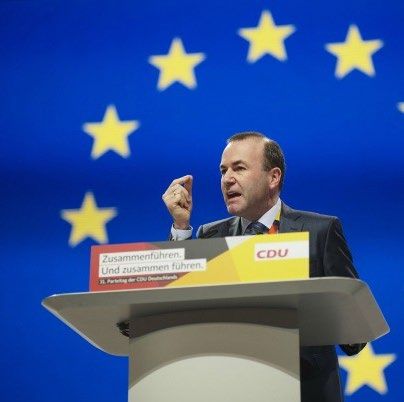
Page 7

Party of European Socialists

      On 7 to 8 December, the Party of European Socialists (PES) met in Lisbon
      for its 11th Annual Congress. The Congress marked the beginning of
      the socialists’ campaign.

The main event at the PES Congress was the adoption of eight resolutions that will form the basis of the party’s election

manifesto to be published in the spring. The resolutions are wide in scope and, unsurprisingly, cover classic social-democratic

issues like Social Europe, gender equality and a shift to a more progressive economy.

The threat of nationalism and the rise of the extreme right will also influence the focus of the Socialist party, which sees itself

as the only force able to stand against the populist wave. The opposition to nationalist and populist forces will likely drive a rift

between the Socialists and the Conservatives (EPP), considered ‘unreliable partners’ given their association with authoritarian

leaders like Viktor Orbán.

Another highlight of the Congress was the official, although unsurprising, endorsement of Frans Timmermans as PES’s

Spitzenkandidat.

The main challenge for PES in the coming months will be to present a centre-left platform which clearly distinguishes it from

other European parties (like Macron’s liberal alliance) which are eager to present themselves as Europe’s centre-progressive

alternative, and then to effectively communicate this message across all EU countries.

KEY DATES

                         23 FEB                               SPRING                               23-26 MAY
                                                            Party Election                           European
                       PES Election
                                                            Manifesto to be                          Elections
                        Congress
                                                              published
Page 8

MEPS TO WATCH
     As of end-May 2019, half of the current legislature is predicted to be renewed, which will feature
     heavyweights leaving the EU arena and arrivals of ambitious new joiners. In this section, we
     therefore anticipate departures, re-election and arrivals of key MEPs.

DEPARTURES

    RENATE SOMMER (EPP, DE)           INÉS AYALA SENDER (S&D, ES)               KRIŠJANIS KARINŠ (EPP, LV)             KARL HEINZ FLORENZ (EPP,DE)
   The EPP Group food safety          Three times elected as an MEP,           The Latvian MEP has recently          The conservative MEP and former
  expert, MEP since 1999, has         the Spanish Coordinator of the         been nominated as the new prime         chairman of the ENVI Committee is
   announced her retirement.         S&D Group is bowing out in 2019.        Minister of Latvia and will leave his    not standing as an MEP in 2019.
                                                                                          MEP seat.

RE-ELECTION

   KARIMA DELLI (GREENS, FR)         CRISTIAN SILVIU BUSOI (EPP, RO)             ANDRUS ANSIP (ALDE, EE)                  ESTEBAN PONS (EPP, ES)
      The chair of the TRAN           A Romanian MEP with leading            The current Digital Commissioner          The Spanish Conservative is the
 Committee has been listed in the    role in Health issues, he will be a      will run in the EP elections, with     favourite candidate to lead the EPP
 French Green party list for 2019.    key player under the Romanian           European AI, Cybersecurity and           group as of next year (if Weber is
                                                Presidency.                    data flows at his core project.       appointed Commission Preisdent).

KEY FIGURES

    LUIS GARICANO (ALDE, ES)            KATARINA BARLEY (S&D, DE)                   NICOLA BEER (ALD, DE)               JORDAN BARDELLA (EFN, FR)
 The Spanish MP and economist,       he Current Federal Justice Minister     The Secretary General of the FDP         The 23 years old spokesperson
   will lead the Ciudadanos list,    will lead the SPD list, with a strong   will lead the party list in May 2019,       was appointed head of list
  which will give him a prominent       focus on data protection and         with Climate change and Defence           for the anti-immigration party
   role in the next ALDE group.             platform accountability.         policy at the core of its programme.        Rassemblement National.
Page 9

NEWS FROM THE MEMBERS STATES

                                                    INGA KARTEN
                                                    FIPRA GERMANY
                                                    + 49 30 2887 6590
                                                    inga.karten@fipra.com

SYMBOLIC TREATY, THE POPULIST DREAM OF DEXIT AND A DEFINITE BROXIT

      On January 22nd 2019, French President Emmanuel Macron and German Chancellor Angela
      Merkel signed the Treaty of Aachen to deepen the French-German friendship and cooperation.

Symbolically signed on the 56th anniversary of the Elysee Treaty, which was pivotal for the reconciliation of the two

countries after World War II, Germany and France agree to intensify their partnership in many areas, including further

alignment on European, foreign and security policies, as well as greater coordination on policies related to the environment

and climate change.

Despite a positive overall perception of the Treaty as illustrating the countries’ joint perspective on the future of the EU post

Brexit, critics say the new Treaty lacks ambition. In Germany, it is frequently seen as a missed opportunity for Merkel to

use the political momentum for domestic reforms and to provide an adequate response to Macron’s EU reform proposals.

Furthermore, different philosophies are thought to complicate the intended intensified cooperation on all things military, whilst

the nitty gritties of tax and insolvency law risk hampering further harmonization in this field.

Meanwhile, the right-wing populist Alternative für Deutschland (AfD) adopted a program, which is more radical in its opposition

to the EU than expected by its lead candidate Jörg Meuthen: The party now strives for the abolition of the European Parliament

as well as the EURO, and sees ‘Dexit’ (exit of Germany from the EU) as a last resort, if reforms of the European institutions

do not take place soon.

Finally, Elmar Brok MEP, the longest serving member of the European Parliament and pillar of the EPP on foreign policy

matters, declared that he would no longer run in the EU elections after having failed to gain sufficient support of his fellow

Christian Democrats in North-Rhine Westphalia (NRW), for a safe position on the CDU-NRW list.
Page 10

                                                   LAURENT MONJOLE
                                                   FIPRA FRANCE
                                                   + 33 1 83 62 39 87
                                                   laurent.monjole@fipra.com

THE YELLOW VESTS RESHAPE THE FRENCH LANDSCAPE

      The Yellow Vest movement that came to the attention of the wider public in November has
      partly reshuffled the dynamics of the European elections in France.

They have certainly proved to be a spanner in the works of Emmanuel Macron’s party, LaREM, which was originally the

favourite bet to win in May and then pursue the President’s ambition to change the European Union from the inside. So far,

Macron has still to deliver on his promise to get personally involved in the European campaign, since domestic concerns have

naturally taken precedence to date. However, his strategy of placing himself as the only alternative to chaos and populist

parties is slowly making its way and could allow him to repeat his success of the Presidential elections.

Some of the Yellow Vests have decided to present a list for the European elections, betting on the popularity of the movement.

However, there is a question mark to that because of the heterogenous nature of the movement and its anti-establishment

rhetoric which has provoked disputes within the movement on the legitimacy of an electoral list. A Yellow Vests list could

hinder the success of the well-established populist parties, especially on the far-right, which usually exploit the discontent of

the population to seduce electors.

One thing is certain: the turning down of traditional parties such as Les Republicains (Conservative party) and Parti Socialiste

(Socialist Party) which are plummeting in polls month after month. Having faced great difficulties since Emmanuel Macron’s

election, they have also been rather reluctant to support the Yellow Vest movement and were torn between their role as

members of the opposition and their inability to grasp the different components of the movement.

According to the most recent opinion polls, LaREM has taken back the lead from the far-right party RN (EFDD group) in the

run-off to European elections, with 23% against 21% of intention votes respectively. They are followed by LR (EPP group) and

LFI (GUE/NGL group), each with around 10% of intention votes. The other parties (Greens, Socialist Party, Communist Party,

Center-Right, Far-Left and Nationalists) are below 10% and are likely to bounce back and forth in the following months. Still,

one can note that the aftermath of the Yellow Vests movement has allowed some marginal parties to gain visibility and are

thus still well ranked in the opinion polls.
Page 11
MATTEO VITTORI
FIPRA INTERNATIONAL
+ 32 2 613 2828
matteo.vittori@fipra.com
SALVINI’S MULTIPLE TRACKS, 5 STAR’S SEARCH FOR FRIENDS
Four months ahead of the European Parliament elections, Matteo Salvini’s League is
consolidating its position as the rising political force in Italy.
Polls suggest the party could hit a record high at 32% in May, while the 5 Star Movement is holding on around 26%. But
beyond forecasts, it is on their strategy where the League seems to have an edge over the 5 Star.
Having avoided an open confrontation with the European Commission over the budget, the Italian government’s coalition
partners are now repositioning themselves in the run up to the European elections. Interior Minister Salvini is portrayed as a
potential candidate to lead the campaign of the nationalist-populist front.
The League is said to be in talks with fellow right-wing parties for a possible collaboration after the elections, including French
Rassemblement National, Hungarian Fidesz and Polish Law and Justice Party. However, the League is also be sought after
by the leader of centre-right Forza Italia, Silvio Berlusconi, and Salvini himself hasn’t ruled out a post-election alliance with the
European People’s Party (EPP).
The 5-star movement (5SM) appears to be less in-demand. A term spent in the same political group as Nigel Farage’s UKIP
appear to have dented the party’s reputation in Europe.
Attempts to talk the French ‘yellow vests’ movement into a collaboration appear to have proved unsuccessful thus far. The
leader Luigi Di Maio recently met with lesser-known parties, such as Poland’s right-wing Kukiz’15 and Croatia’s populist Zivi
Zid, assessing common ground around topics such as direct democracy and the reduction of the EU spending.
Meanwhile Lazio Governor Nicola Zingaretti is the favourite candidate to take over the leadership of the Democratic Party (PD),
as the party prepares to hold its congress on 3 March 2019, with former Minister for Economic Development Carlo Calenda
seeking to re-engage and unite disaffected progressive Italians with a pro-European PD manifesto.Page 12
FERNANDO GOLMAYO
FIPRA SPAIN
+ 34 91 794 2223
fernando.golmayo@fipra.com
UPDATES FROM THE SPANISH POLITICAL SCENE
Prime Minister Pedro Sánchez is pushing for Foreign Minister Josep Borrell to be the standard-
bearer for the Spanish socialists in the European elections.
While Borrell, a former president of the European Parliament, might be willing to return to Brussels, his relationship with
Sánchez is currently tense as result of how the President handled the Catalan crisis.
Pablo Casado, president of the centre-right Partido Popular, is yet to disclose the identity of his candidate for the European
elections, who is expected to succeed Commissioner Miguel Arias Cañete as head of the party´s candidate list. Sources agree
that the list will include Esteban González Pons, vice-president of the Spanish European Parliament´s Popular Party Group.
Albert Rivera, president of the liberal party Ciudadanos, has appointed Luis Garicano as a candidate for the European
elections but Rivera’s decision is subject to approval by the party members. Garicano, who is the favourite candidate and
leads the party economic policy, has been vice-president of the European Liberal Party (ALDE) since 2016. MEP Javier Nart
will also feature in the list while Carolina Punset, the MEP who last October left the party, will not run.
Pablo Bustinduy was expected to head the list of the left-wing coalition formed by Podemos, Izquierda Unida (IU) and Equo
but after the recent departure of Iñigo Errejón, a Podemos’ leader, the candidate will probably change. For the moment, the
list will include MEP Miguel Urbán (Podemos), senator Idoia Villanueva (Podemos), Sira Rego (IU), MEP Ernest Urtasun (En
Comú), Gerardo Pisarello (En Comú), and MEP Florent Marcellesi (Equo).
Oriol Junqueras, president of the Catalan nationalist party ERC, will head the list for the joint candidacy of the left-wing pro-
independence parties of Catalonia (ERC), the Basque Country (EH Bildu) and Galicia (BNG). Junqueras and Raül Romeva,
both MEPs between 2009 and 2012, are currently in jail awaiting trial on the charges of rebellion and sedition. The list will
include Romeva’s wife, Diana Riba and MEPs Josu Juaristi and Ana Mirada.Page 13
BAS BATELAAN
FIPRA NETHERLANDS
+ 31 703 046 499
bas.batelaan@fipra.com
THE LATEST ON DUTCH PARTIES
VVD – LIBERAL CONSERVATIVES (ALDE)
The current leader of the Liberal Conservatives Hans van Baalen will not return to Parliament. MEPs Nagtegaal-van Doorn and
Huitema have been given place two and three on the candidate list of the Liberal Conservatives.
D66 – LIBERAL DEMOCRATS (ALDE)
The Liberal Democrats have also published their election programme which pleads for significant European cooperation to battle
climate change and to offer a solution for the current migrant streams. Second, the programme reads that the Lib Dems want to work
together with progressive parties in the middle of the political spectrum, such as En Marche and Ciudadanos.
GROENLINKS - (GREENS/EFA)
Bas Eickhout will be the leader of the Greens for the upcoming European Parliament elections. Current Senator Tineke Strik is
second. The focus of the election programm is on the climate crisis, regulating major companies and the protection of people from
the conseque nces of globalisation.
SOCIALIST PARTY – (GUE/NGL)
MEPs de Jong and Mineur will not return to Parliament after upcoming elections. The new leader of the Socialists for the EP elections
is Arnout Hoekstra. Hoekstra has been active as local politician and as a staff worker of the Socialists in the Dutch Parliament.
PVDA - SOCIAL DEMOCRATS (S&D)
MEPs Jongerius, Tang and Piri are listed on the Social Democrats draft candidate list. Frans Timmermans was officially chosen as the
Spitzenkandidat of the S&D political group on December 8th. The Social Democrats still have to publish their election programme.
In its draft election programme, the Labour Party addresses issues such as sustainability, migration and terrorism. Interesting for a
European election, however, is the explicit notion that Europe today only adds up to seven percent of the world population and that
Europe should give space to, and respect, other powers.
50PLUS (SENIOR PARTY)
50PLUS is a Dutch political party specifically aiming at the vote of Dutch senior citizens. Former MEP Toine Manders is 50PLUS’s
leader for the upcoming European elections, Manders is a controversial choice, since he has been convicted for tax evasion. Manders
has been the national chair of the Dutch Libertarian Party in the past. In its draft programme, 50PLUS unsurprisingly pleads that the
EU should spend more attention to the elderly, a special Commissioner should be appointed for problems that come with the aging
of the European population.Page 14
PETR PLECITY
FIPRA CZECH REPUBLIC
+ 420 721 917 150
petrplecity@fipra.com
A STRONGER CENTRE AMONG THE VISEGRAD
The political landscape of the Czech Republic is varied with no less than nine parties fighting
for the voters’ approval and seeking to pass the 5 percent threshold.
Leader of the polls is ANO2011, a populist centrist movement led by prime minister Andrej Babiš. Estimates range from 25 to
30 percent, which means that the movement could even top its results of the 2014.
Runner-up in the polls is the Czech Pirate Party, estimated at 20 percent. Although currently not in the European Parliament,
the popularity of the Czech Pirates is increasing with the party looking to become the driving force in the political opposition.
Also in opposition in the Czech Parliament, the ODS (centre-right party founded by former President Klaus, currently affiliated
with the European Reformist and Conservative Group) is estimated at 15 to 18 percent with a rising tendency. TOP09, also
on the centre-right, but very pro-European party, is polling at around 10 percent. Popularity of TOP09 is going down but its
voters are more likely to participate in the European Parliament elections than voters of the other parties.
There are three parties polling at just over five percent: Communist KSČM (communist) at five to nine percent, and anti-
immigration movement Přimá demokracie Tomia Okamury and Christian-democratic KDU-ČSL with estimated ranging from
5 to 7 percent.
The junior party in the current coalition government, social-democratic party ČSSD, looks like the great loser in the forthcoming
EU election. While it currently is represented by four MEPs in the European Parliament it is doubtful that it will attain the
necessary five percent threshold in May.
A further surprise element is provided by the populist List of Jaromír Soukup, a media owner and host of many investigative
TV shows, watched by supported of ANO2011, KSCM, CSSD but also Přimá Demokracie Tomia Okamury.Page 15
TAMÁS SÁRDI
FIPRA HUNGARY
+36 1 354 1159
tamas.sardi@fipra.com
A HIGHER TURNOUT FOR ORBAN
Government parties Fidesz (Alliance of Young Democrats) and KDNP (Christian Democratic
Peoples’ Party) are predicted to do even better than in the 2014 European Parliament elections
and may win 14 of the 21 seats reserved for Hungarian MEPs.
Furthermore, polls predict a higher turn-out than the previous 29 percent. With smaller parties traditionally profiting more from
low participation, this has led a number of them to discuss the possibility of a joint list to pass the five percent threshold.
The top spot on the list of Fidesz-KDNP alliance has gone to László Trócsányi, the current minister of justice, who will also be the
party’s nominee for the European Commission. Mr. Trócsányi is well embedded in European politics, has diplomatic experience
as former ambassador and is also an internationally recognized professor of law. Many of the following spots have gone to
Fidesz’s current MEPs, such as Fidesz founders József Szájer and Tamás Deutsch or EPP vice-president Kinga Gál, but there
are many newcomers who can also point to some Brussels experience. These include Enikő Győri, former MEP and minister
of state for EU affairs, who serves the current ambassador of Hungary in Spain; Balázs Hidvéghi, communications director of
Fidesz, who used to work for the Hungarian EPP delegation; or Edina Tóth, a long-standing adviser to the EPP group.
The current opposition comprises a multitude of parties, including Socialist MSZP, Jobbik, formerly on the far right, radical leftist
DK (Democratic Coalition) of ex-prime minister Ferenc Gyurcsány, PM (Dialogue for Hungary), LMP (Politics Can Be Different),
Mozgalom (Momentum Movement) and MKKP (Two-Tailed Dog Party). DK, the radical leftist party of has two MEPs can expect
one or two seats in the next European parliamentary term. Jobbik is likely to lose two of its three seats in the EP. Socialist MSZP
is running together with PM on a joint list; the socialists have two MEPs who are well-known in Hungary, but might not be re-
elected. PM has a single MEP, Benedek Jávor, who is one of the most well-known politicians of his party and is very active in
the EP, but it is uncertain that he can run again for the next term. As a result, Javor launched a movement (Common Europe
Initiative) to push opposition parties to cooperate during the campaign and possibly launch a joint list.Page 16
TOMAS BERETA
FIPRA SLOVAKIA
+421 2 5443 6001
tomas.bereta@fipra.com
THE ELECTIONS IN SLOVAKIA
The 2019 elections will be full of personal changes for Slovakia. First and foremost, Maros
Sefcovic probably leaves EU politics since he’s decided to run for presidential election in March
2019 and currently tops the polls.
Among MEPs, only Ivan Stefanec has confirmed to re-candidate. Many others either decided not to run again, such as Richard
Sulik (ECR), Eduard Kukan (EPP), Boris Zala (S&D) or have fallen victim to generational change within their domestic party –
namely Anna Zaborska (EPP), Miroslav Mikolasik (EPP) and Branislav Skripek (ECR). In the last days, however, Zaborska and
Skripek announced a new Christian-oriented political party by means of which they want to run for elections anyway.
Current polls suggest two places for neo-Nazi ĽSNS who are openly for leaving the EU, so the topic of immigration and
‘the dictate of Brussels’ is still important for some. While some candidates may join in this discussion, others focus their
campaigns mainly on the future of employment, ageing population and rising cyber threats. However, due to the general lack
of interest in European politics and the upcoming presidential elections, there is little focus on on MEP campaigns. Candidacy
lists are expected be finalized by the end of February 2019.
The last variable to potentially sway the election results is turnout rate. At 13 percent, Slovakia had the lowest turnout rate in
2014 elections (especially among the youth) which finally inspired many to launch various information campaigns. While some
urge through the necessity to protect country from the ‘external threat’, majority tries to shed light on the EU’s functioning
and its impacts on domestic politics. Despite rising popularity of extremists, we should be still able to maintain a pro-Western
orientation rather than succumbing to the undemocratic trends in the Visegrad region.Page 17 NOTES
JANUARY 2019
You can also read


