CITY OF SUNNYVALE Council Election Outreach Plan
←
→
Page content transcription
If your browser does not render page correctly, please read the page content below
Final | December 20, 2018

                  CITY OF SUNNYVALE
                               Council Election Outreach Plan

ORANGE COUNTY • NORTHERN CALIFORNIA • SACRAMENTO • CENTRAL COAST • LOS ANGELES • INLAND EMPIRE • SAN DIEGO
COUNCIL ELECTION COMM UNITY ENGAGEM ENT AND OUTREACH PLAN
CITY OF SUNNYVALE
Table of Contents
A. INTRODUCTION .......................................................................................................................... 1
B. OBJECTIVES AND GOALS ............................................................................................................ 1
C. PROJECT BACKGROUND ............................................................................................................. 2
D. TARGET AUDIENCE ..................................................................................................................... 3
E. PUBLIC INPUT PROCESS OVERVIEW ........................................................................................... 4
Phase 1: Getting the Word Out and Public Input on Charter Measure Decision........................ 4
Phase 2: District Map Creation................................................................................................... 5
F. ENGAGING UNDERSERVED COMMUNITIES ............................................................................... 5
G. CITIZENS ADVISORY COMMITTEE............................................................................................... 6
H. PUBLIC INPUT STRATEGIES......................................................................................................... 7
I. DETAILED SCOPE OF WORK........................................................................................................ 9
Phase 1: Getting the Word Out and Public Input on Charter Measure Decision........................ 9
Phase 2: District Map Adoption............................................................................................... 13
J. SCHEDULE ................................................................................................................................ 14
K. COSTS ....................................................................................................................................... 15
PLACEWORKS iCOUNCIL ELECTION COMM UNITY ENGAGEM ENT AND OUTREACH PLAN CITY OF SUNNYVALE ii
COUNCIL ELECTION COMM UNITY ENGAGEM ENT AND OUTREACH PLAN
CITY OF SUNNYVALE
A. INTRODUCTION
This Community Engagement and Outreach Plan (the “Outreach Plan”) describes tools and strategies to solicit
input from Sunnyvale voters and potential voters on amending the City’s Charter to change the existing at-
large system with numbered seats for electing City Council members to a district-based election system.
The City Council directed staff to prepare an outreach plan on September 5, 2018 with the goals of addressing
potential issues related to the City’s Council election system and the California Voting Rights Act (“CVRA”),
soliciting community input on whether to submit a charter amendment to voters to address the CVRA by
changing to a district-based system for City Council elections, and ensuring broad community input given the
significance of this fundamental governance issue. After that direction, the City received a letter alleging
racially polarized voting in the city with respect to Asian voters in violation of the CVRA. The City Council’s
direction to staff remains to proceed with the Outreach Plan to educate the community about the
requirements of the CVRA and seek the community’s input on several key issues related to a charter
amendment to change to district-based elections.
The Outreach Plan includes two main components:
Public Education and Outreach intended to “get the word out” about the change to a district-based
election system and seek input on key issues including the timing of placing the charter amendment
on the ballot, number of districts, and related election issues; and
Public input on and drawing the district maps.
This Plan relies on multiple strategies for participation to allow as many members of the public as possible to
learn about district-based elections and participate in the district map development process, regardless of
their technological abilities or previous levels of civic engagement.
This Outreach Plan describes the objectives and goals of the outreach process, the target audience for
community outreach, the public input process, methods to engage underserved communities, the final
synthesis of the results of the public engagement when it is complete, the process for final district map
adoption, and the overall schedule and cost for the project.
B. OBJECTIVES AND GOALS
The desired outcomes for the Council election system public engagement process are twofold: First, to
educate Sunnyvale residents about the requirements of the CVRA as the driver for the proposed change to
district-based elections; and second, to have robust and diverse community participation in the process for
drawing district maps for future Council elections. The Outreach Plan’s primary goals are:
Solicit input from a wide range of Sunnyvale residents, reflecting the range of opinions within the
community as well as the City’s demographics.
Utilize a variety of outreach tools to make it easy for community members to provide input.
Involve traditionally underrepresented and marginalized communities in the process, including ethnic
minorities and low-income communities for whom language and cultural differences and lack of
access to technology may otherwise preclude or discourage involvement.
PLACEWORKS 1COUNCIL ELECTION COMM UNITY ENGAGEM ENT AND OUTREACH PLAN
CITY OF SUNNYVALE
Design public workshop formats to be as inclusive and open as possible, providing a variety of ways in
which individuals can participate and contribute ideas.
Proactively seek participation and input, rather than waiting for individuals and groups to come
forward to participate.
The outreach tools identified below present a series of strategies to achieve these goals.
C. PROJECT BACKGROUND
This section describes the legal and policy background driving the potential change from an at-large Council
election system to a district-based Council election system.
The CVRA, signed into law in 2002, allowing local at-large election systems to be challenged if there is evidence
that they impair the ability of members of a protected class to elect candidates of their choice or influence the
election outcome. A “protected class” is a class of voters who represent a racial, ethnic, or language minority
group, as defined by the federal Voting Rights Act of 1965 (FVRA). Plaintiffs must prove the existence of
“racially polarized voting,” a situation in which there is a difference in candidate or electoral preferences
between voters of a protected class and those of the remaining voters in the electorate. Prior to the passing of
the CVRA, only 28 of California’s 482 cities had by-district election systems. Today, close to 100 cities have
transitioned to a by-district system, with many more in transition or litigation to resolve the issue.
Currently, Sunnyvale’s electoral system specified in Section 601 of the City Charter provides for at-large
elections, with candidates running for one of seven specific seats on a citywide basis. Council members
appoint the mayor and vice mayor from among themselves; these are largely ceremonial positions because
the Chief Executive Officer of the City is the City Manager (Sunnyvale City Charter section 802).
To date, no city has prevailed in defending its at-large system against a claim filed by any individual or group
under the CVRA. Most agencies that have been challenged under the CVRA have settled the cases by
switching to district-based elections, and those that have litigated have lost. The risk of litigation is not just
requiring a change in a city’s election system, but also liability for substantial attorney fees if a city loses. For
example, Santa Clara, a neighboring city with a similar Charter provision for an at-large, numbered-seat
election system, was sued by the South Asian Law Alliance 1 claiming the system violated the CVRA by diluting
Asian votes. The Santa Clara County Superior Court judge agreed with the plaintiffs and ordered Santa Clara to
shift to district-based elections in November 2018, which the City promptly appealed. As of mid-October, it
appears that the case could cost the City almost $5 million in legal fees and court costs, with $4.17 million
requested by the plaintiffs and at least $580,000 spent by the City for its own bills. 2
With the Santa Clara example in mind, the Sunnyvale City Council directed City staff on September 5, 2018 to
consider a potential amendment to the City’s Charter to switch to a by-district election system, including
conducting a public outreach process to educate the community about the issue and placing a Charter
Amendment on the ballot.
1
The named plaintiffs in the Santa Clara case were Ladonna Yumori Kaku, Wesley Kasuo Mukoyama, Umar Kamal, Michael
Kaku, and Herminio Hernando.
2
Silicon Valley Voice. “Santa Clara on the Hook for $5 Million in Voting Rights Case City Lost.” October 15, 2018. Accessed
November 15, 2018. https://www.svvoice.com/santa-clara-on-the-hook-for-3-million-in-voting-rights-case-city-lost/
2COUNCIL ELECTION COMM UNITY ENGAGEM ENT AN D OUTREACH PLAN
CITY OF SUNNYVALE
However, following that direction the City received a demand letter on October 9, 2018 from the law firm of
Goldstein, Borgen, Dardarian & Ho on behalf of Samir Kalra, alleging City’s at-large election system creates
racially polarized voting in violation of the CVRA. On November 20, 2018, the City Council took the first step in
addressing that letter by adopting a resolution of intent to transition to district-based elections, a procedural
step under Elections Code Section 10010 that provides a “safe harbor” period of 90 days during which the City
cannot be sued. Preparation of this Outreach Plan was directed by the City Council on September 5 and
reaffirmed in the November 20 resolution, and implementation will be a key step in the City’s efforts to
address the CVRA’s requirements. Although this Outreach Plan outlines a public engagement process that
continues beyond the 90-day safe harbor, to date the City has indicated that timeline is acceptable to the
Council. Furthermore, the Outreach Plan provides a defined timeline for outreach during winter and spring
2019, with a decision point in June 2019 for making a determination on when a charter measure will be placed
on the ballot.
D. TARGET AUDIENCE
The target audience for the Outreach Plan includes Sunnyvale voters and potential voters, with a particular
goal of engaging those in the broader community who might not otherwise participate in civic engagement
processes. This Outreach Plan presents a variety of outreach and input strategies, with the understanding that
multiple avenues for both outreach and input will provide greater exposure and participation.
According to the 2010 US Census, the population of Sunnyvale was 140,000, though recent estimates from the
US Census Bureau’s 2016 American Community Survey (ACS) suggest the population has grown to just over
148,000. 3 The two most populous demographic groups are Asian, about 42 percent, and Non-Hispanic White,
33 percent. Hispanic/Latino, mixed race, and Black represent the remainder of the population, at 17 percent, 3
percent, and 1 percent, respectively. The Asian population is predominantly comprised of Indians and Chinese,
with smaller percentages of Filipinos, Vietnamese, and Koreans. 4 Data from the California Department of
Education for the 2017-18 school year indicates Spanish is the most common first language among English
Language Learners at 18 percent. 5 Chinese, Hindi, Telugu, and Hebrew are all between 1 and 2 percent for
other monolingual students.
Under the most recent estimates from the ACS, approximately 52 percent of eligible voters in Sunnyvale are
members of a minority group. The remaining 48 percent of eligible voters identify as Non-Hispanic White.
Minority groups identifying as Asian, Hispanic/Latino, and Black comprise half of the eligible voting population,
at 33 percent, 14 percent, and 3 percent, respectively. 6 In the 2016 General Election, there were
approximately 60,000 registered voters, with 83 percent casting a ballot. Participation from voters with an
Asian surname was about 21 percent of voters, while 11 percent had a Spanish surname. 7
3
US Census Bureau. 2012-2016 American Community Survey 5-Year Estimates.
4
Zip Atlas. Sunnyvale, California Zipcode Map & Detailed Profile. Accessed on November 10, 2018.
http://zipatlas.com/us/ca/sunnyvale.htm
5
California Department of Education. District Summary Sunnyvale. Accessed on November 10, 2018. http://www.ed-
data.org/district/Santa-Clara/Sunnyvale
6
City of Sunnyvale. Summary of 2016 General Election.
7
City of Sunnyvale. Summary of 2016 General Election.
PLACEWORKS 3COUNCIL ELECTION COMM UNITY ENGAGEM ENT AND OUTREACH PLAN
CITY OF SUNNYVALE
E. PUBLIC INPUT PROCESS OVERVIEW
The focus of this Outreach Plan is to gather public input regarding a switch from at-large with numbered-seat
City Council elections to district-based Council elections, with an emphasis on developing and reviewing
proposed district maps. PlaceWorks proposes to implement the Outreach Plan in two phases as described
below. PlaceWorks will track the number of people that participate in the outreach process and collect
voluntary, self-reported demographic data to measure whether the outreach approach is successfully securing
input from all segments of the population.
PHASE 1: GETTING THE WORD OUT AND PUBLIC INPUT ON
CHARTER MEASURE DECISION
Phase 1 of the community outreach process has two primary goals: (1) educating the community about the
CVRA, district-based elections, and city demographics; and (2) seeking input from the community on key issues
related to the decision and process for transitioning to district-based elections.
EDUCATION GOALS
The goal of the education component of Phase 1 is for community members to learn and understand:
The requirements of the California Voting Rights Act and the process to move to Council district-based
elections.
The existing demographics of the community including age, socio-economic status and race/ethnicity.
PlaceWorks will cite multiple sources for demographic data including data from the City’s Housing
Element, US Census, School District, and other sources.
Legal issues associated with the change to district-based elections, including risks and costs of CVRA
litigation compared to a voluntary switch to district-based elections.
Potential remedies in CVRA cases, such as court-ordered district elections and district boundaries
determined by the court rather than the City if a case proceeds through litigation.
When possible, this information will be presented as a slideshow. When a slideshow is not the appropriate tool
to distribute the background information, the same information will be summarized on poster boards and/or
handouts. In addition, the project website, described below, will include all available background information.
The website will be updated as new data becomes available.
PUBLIC INPUT GOALS
The goal of the public input component of Phase 1 is for community members to provide feedback to the City
Council on the following issues:
Preferred timeline for submitting a charter measure proposing a change to district-based Council
elections to the voters, with options of March 2020 (first district elections to occur in November
2020), or November 2020 (first district elections to occur in November 2022);
Preferences related to number of districts, with options of seven districts, six districts with one at-
large mayor, or some other composition;
Pros and cons of directly electing the mayor;
4COUNCIL ELECTION COMM UNITY ENGAGEM ENT AN D OUTREACH PLAN
CITY OF SUNNYVALE
Criteria and standards important to the community for establishing district boundaries; and
Other related information or election considerations of interest or importance to City voters, such as
education and input on other electoral systems that satisfy the CVRA and, including preferences
related to future redistricting.
Through this component, community members will be introduced to the process of drawing district maps and
will have the opportunity to identify their definition of “community of interest.” The City will employ a
combination of both public workshops and pop-up events, including events designed to target ethnic and
racial minorities and socio-economically disadvantaged groups, to engage the full community in the district
mapping process.
At the conclusion of Phase 1, the City anticipates the following actions by the City Council:
A determination about when to place a charter amendment measure on the ballot in either March
2020 or November 2020;
Direction on the substance of the ballot measure, particularly the number of districts, and possibly
additional changes related to the election system including a method for future redistricting; and
Articulation of standards that are important to the community in developing district boundaries.
PHASE 2: DISTRICT MAP CREATION
The purpose of Phase 2 is to develop the electoral district maps to be used in future elections. 8
The City will coordinate with a demographer and use the information provided by community members to
inform the drawing of district lines. Community members will have the opportunity to draw their own
proposed maps using online and/or paper tools. The final recommended district map will be based on
demographer and public input and adopted by the City Council.
F. ENGAGING UNDERSERVED COMMUNITIES
A major goal of this Outreach Plan is to ensure that all segments of the community have the opportunity to
participate in the outreach process. It will be important to target outreach opportunities at traditionally
underrepresented groups, including disadvantaged/low-income communities for whom language and cultural
differences may preclude or discourage involvement.
To engage underserved communities, the City and PlaceWorks will implement a variety of strategies that can
be applied to all forms of both “getting the word out” and “public input strategies” that are described below:
Special Outreach. It will be important to perform in-person outreach at local venues where
underserved communities congregate, including churches, ethnic markets, and other community
gathering places. Specifically, City staff will post flyers and PlaceWorks will solicit opinions before or
after faith-based services at locations such as:
8
District boundaries are required to be redrawn each new US Census period. If the first district elections are in November
2020, the districts adopted will apply for that election and will then be reevaluated and redrawn following release of the 2020 US
Census data.
PLACEWORKS 5COUNCIL ELECTION COMM UNITY ENGAGEM ENT AND OUTREACH PLAN
CITY OF SUNNYVALE
o Spanish-language Sunday mass at St. Cyprian’s CatholicEpiscopal Church
o Sunnyvale Hindu Temple and Community Center
o Chung Tai Zen Center of Sunnyvale
o Sunnyvale International Church
o 1st Morning Light Chinese Christian Church
o Samoan First Assembly of God Church
o Iranian Christian Church
o Believers Korean Baptist Church
o Martin Parish
In addition, City staff will post flyers at markets in Sunnyvale that provide service to ethnic minorities
such as Madras Groceries, Felipe’s Market, Grocery Outlet, Taj Mahal Fresh Market, Western Pacific
Filipino Grocery, and Mi Ranchito Produce. PlaceWorks will also target outreach at the 13 mobile
home parks, including Casa De Amigos Mobile Park, El Dorado Mobile Home Park, Mary Manor, and
Rancho La Mesa.
Ethnic Media. The City will place an ad and news article about the project in ethnic newspapers such
as El Observador, a bilingual weekly newspaper that serves the nine Bay Area counties; Calitoday, a
Vietnamese-language newspaper based in San Jose; World Journal, a global Chinese newspaper;
and/or India West, a popular weekly newspaper catering to Indians in the US. The ads and news
articles will alert readers about the project and direct them to the project website for more
information.
Translation and Interpretation. All meeting materials will be translated into Spanish, Chinese, and
Hindi. Meeting materials include workshop and CAC presentations, workshop and CAC handouts,
meeting agendas, posters and flyers, and the citywide newsletter. PlaceWorks will provide translation
for Spanish, Mandarin, and Hindi at all public workshops.
Childcare. Members of underserved communities often have young children, and lack resources to
find care for these children if they want to engage in a civic process. Therefore, events will include fun
side activities that kids can undertake so parents can give feedback without distraction. PlaceWorks
assumes the City will be responsible for coordinating and providing childcare at the community
workshops.
Food. Offering substantial food can be a draw to bring people to a meeting or event, particularly if
they are coming straight from work or just need an impetus to attend. Some of the most successful
meetings involving underserved communities began with serving light snacks. Therefore, PlaceWorks
will provide refreshments at all public workshops.
G. CITIZENS ADVISORY COMMITTEE
The Citizens Advisory Committee (CAC) will play an advisory role for the City Council district election outreach
process. The CAC will consist of seven or nine Sunnyvale residents with appropriate knowledge regarding
outreach, diversity, and election formats and that represent the geographic, ethnic, and social diversity of the
City. Members will be responsible for understanding the potential conversion to district-based elections to the
6COUNCIL ELECTION COMM UNITY ENGAGEM ENT AN D OUTREACH PLAN
CITY OF SUNNYVALE
community, and encouraging participation of community members about both district-based elections and the
Outreach Program. Additionally, the CAC will:
Report on any issues regarding the potential conversion to district-based elections and the Outreach
Program that may arise in the community.
Provide comment on the Outreach Plan final report at the end of Phase 1 before it is submitted by
staff and PlaceWorks to the City Council.
Formation of the CAC will be carried out as follows:
The Mayor will appoint three members of the City Council as a Subcommittee to oversee CAC
formation.
With assistance from Subcommittee members, the City Manager’s office will conduct a process to
solicit applications from appropriate members of the community eligible to vote in Sunnyvale
elections, and will then propose a group of candidates to serve on the CAC.
The Subcommittee will review the proposed slate of candidates, make changes as necessary, and
forward the recommendation to the City Council.
The City Council will make the final appointments at a regular Council meeting.
Additional criteria for selection of individuals to serve on the CAC may include, but is not limited to:
Ability to be impartial;
Appreciation for Sunnyvale’s diverse demographics, geography, and similar characteristics;
Relevant analytical skills;
Consideration of individual qualifications in conjunction with the goal of achieving a makeup
reasonably representative of the City’s diversity, including, but not limited to, racial, ethnic,
geographic, economic, and gender diversity; 9 and
Ability and willingness to promote outreach to the broad community and perform commission
member duties in a manner that is impartial and that reinforces public confidence in the integrity of
the process.
H. PUBLIC INPUT STRATEGIES
This section describes five separate public input strategies that will be implemented as part of the public
engagement process. Providing different methods to provide input will give members of the public multiple
opportunities to participate, thereby increasing the number of people involved in the process. The input
strategies include:
Community Workshops. Community workshops allow residents and other stakeholders to gather
together and share input and ideas about a topic or issue. These face-to-face events provide an
invaluable opportunity to find common ground when opinions differ and to find compromises that
9
This is not suggesting that formulas or specific ratios will be used or even considered, only that qualifications should also
be considered in the context of other factors related to diversity goals, consistent with the goals of the CVRA related to
representation reasonably reflective of voter interests.
PLACEWORKS 7COUNCIL ELECTION COMM UNITY ENGAGEM ENT AND OUTREACH PLAN
CITY OF SUNNYVALE
appeal to most community members. Community workshops will be held in different geographies of
the city at familiar and easily accessible facilities to capture all demographics of the population. All
community workshops will be captured on video and a link to the video will be posted on the project
website. In addition, simultaneous translation will be available in Spanish, Chinese, and Hindi. All
meeting materials will be made available in English, Spanish, Chinese, and Hindi. To attract the most
participants, workshops will be held in the evenings or on the weekends. PlaceWorks will provide food
and beverages. The City and PlaceWorks will advertise this workshop using some combination of the
outreach tools identified in the Task 1.1 Community Outreach section.
Community Outreach. City staff and PlaceWorks will build interest about the project using a
combination of outreach efforts described in Task 1.1 Community Outreach section. The community
outreach campaign will be implemented in Phase 1 to build interest for future events.
Pop-Up Events. Although most Sunnyvale residents might have thoughts about district-based Council
elections, it is not always enticing enough to draw busy citizens to share their ideas at an evening or
weekend workshop. While community workshops can be effective tools, it is important to go where
people are rather than asking them to come to us. Engaging residents who are already attending
another event, such as the weekly Farmers’ Market or church services, with activities such as quick,
on-the-spot surveys are other venues to hear residents’ input and market larger community-wide
outreach events. Each interaction also provides an opportunity for the participant to learn more and
sign up for the project mailing list.
Citizens Advisory Committee. As discussed above, the Citizens Advisory Committee will act as
community ambassadors for the project. All meetings will be open to the public with public comment
opportunities consistent with the requirements of the Brown Act. Meetings will be noticed on the
City’s and project websites. All CAC meetings will be captured on video and a link to the video will be
posted on the project website.
Online Engagement. Today, in our fast-paced, plugged-in world, it is not enough simply to hold a
typical workshop in a local community center and expect to get meaningful and broad-based input
from residents and businesses. Public outreach has to work the way people work. Like everyone,
Sunnyvale residents are busy with families, after-school activities, sports teams, volunteer
organizations, and demanding jobs. Providing the option of online engagement can capture input that
might otherwise be unvoiced. Online engagement tools will connect residents with information,
decision-makers, and other residents in a professionally facilitated community discussion that builds
public awareness of and trust in the project process, without constraints on the time, place, or
method of public input.
8COUNCIL ELECTION COMM UNITY ENGAGEM ENT AN D OUTREACH PLAN
CITY OF SUNNYVALE
I. DETAILED SCOPE OF WORK
PHASE 1: GETTING THE WORD OUT AND PUBLIC INPUT ON
CHARTER MEASURE DECISION
1.1 COMMUNITY OUTREACH
The City and PlaceWorks will provide educational materials and meeting information to neighborhood
associations, public schools, and other relevant cultural and community organizations regarding the district
election project to:
Build interest in the project;
Educate people about the need to change to district-based elections; and
Encourage participation in Phase 2 district mapping events and process.
Digital outreach efforts will include colored flyers containing text and infographics, background summaries of
the project, and meeting dates and locations. PlaceWorks will translate meeting materials into English,
Spanish, Chinese, and Hindi. Meeting materials include workshop and CAC presentations, workshop and CAC
handouts, meeting agendas, posters and flyers, and the citywide newsletter.
Digital outreach and advertising opportunities include:
Project Website. PlaceWorks will create a project website that will include:
o Background information and meeting materials
o Calendar of outreach events and public hearings
o Frequently Asked Questions
o Links to video recordings of public workshops, Citizens Advisory Committee meetings, and
Council hearings
o Contact information for City staff
o Instructions on how to submit public comment including a comment box
o Sign-up for email list
A link to the project website will be highly visible on the homepage of the City’s website. The project
website will be published at least one month in advance of the first public workshop.
Social Media. The City will utilize its Facebook, NextDoor, and Twitter accounts for the project. City
staff and PlaceWorks will make regular posts on these accounts to update the public about the project
including posting meeting dates and sharing background information about the project. Visibility will
be “boosted” through paid advertising on these sites. Meeting information will be posted as soon as
the meeting date is set with reminders posted one week in advance of the meeting and on the day of
the meeting.
Emails. The City and PlaceWorks will distribute information electronically to neighborhood
associations and community organizations for inclusion in their newsletters, as well as to individuals
who added themselves to the project email list at public events or through the online engagement
portal described below.
Posters and Flyers. PlaceWorks will prepare posters and flyers for the City to print and distribute to key
businesses, libraries, community centers, and community groups throughout the City, with a
particular focus on businesses or destinations frequented by underserved communities, including
specialty markets and delis, cafes, grocery stores, recreation centers, and other destinations that
serve a broad cross-section of the community. The City may also provide digital and printed formats of
PLACEWORKS 9COUNCIL ELECTION COMM UNITY ENGAGEM ENT AND OUTREACH PLAN
CITY OF SUNNYVALE
the flyers to cultural and community organizations that serve the targeted communities of interest.
The posters and flyers will educate residents about district elections, the process of drawing district
maps, and identify ways to get involved in the project.
Voluntary Demographic Survey. PlaceWorks will prepare a voluntary demographic survey that will be
administered at all outreach events as well as online. The survey results will be used to assess the
effectiveness of the outreach program in reaching all Sunnyvale demographics.
Neighborhood Association Emails and Newsletters. PlaceWorks will distribute advertisements
regarding upcoming meeting dates and engagement opportunities in digital format to neighborhood
associations to include in their newsletters and email groups.
Presentations. PlaceWorks will prepare a PowerPoint presentation containing pertinent background
information about the project and dates of upcoming outreach events. PlaceWorks will use this
presentation at the community workshops and at pop-up events to be held at Neighborhood
Associations, PTAs, and churches and temples.
Earned Media. PlaceWorks will prepare up to three press releases that could lead to publication of
unpaid news stories in the Sunnyvale Sun, a weekly publication covering local news, sports, business,
and community events in Sunnyvale, and The Mercury News, a Bay Area newspaper.
Paid Print Advertising. The City will place paid advertisements in publications targeting specific
demographic groups historically underrepresented, such as ethnic and racial minorities. These may
include, but are not limited to, Calitoday, a Vietnamese-language newspaper; World Journal, a
Chinese newspaper covering global issues with a San Francisco-based office; and India West, a popular
Indian newspaper.
Citywide Newsletter. PlaceWorks will write an article for the City to place in the March 2019 Citywide
newsletter (Horizons), which will be mailed to every home in Sunnyvale. The article will be published
in English, Spanish, Chinese, and Hindi. The purpose of the article will be to inform residents about the
project, provide a link to the project website, and publish initial outreach dates for the CAC and
community workshops.
Project Mailing List. The City and PlaceWorks will send out periodic project updates, including
information about upcoming public meetings, to subscribers of the project mailing list.
1.2 EDUCATIONAL COMMUNITY WORKSHOPS
Once the outreach work is complete, Phase 1 will include two identical public education workshops.
PlaceWorks will facilitate all workshops and will present information on district-based elections, including the
financial and legal considerations prompting the City’s recommendation for a Charter amendment and how
the district system will impact representation of communities in Sunnyvale. These meetings are meant to
educate residents, provide a platform for comments, build interest in the issue, and encourage people to think
about areas for input on this process.
The City and PlaceWorks will advertise the workshops a minimum of two weeks in advance of the workshops
through the project website, City and project email lists, social media posts, and paid and earned media
notices.
1.3 CITIZENS ADVISORY COMMITTEE #1
PlaceWorks will facilitate a kick-off meeting with the CAC at the outset of the project. At this meeting, the CAC
will work to develop a list of community contacts that should receive notice of each workshop and public
10COUNCIL ELECTION COMM UNITY ENGAGEM ENT AN D OUTREACH PLAN
CITY OF SUNNYVALE
meeting so that the outreach efforts target a diverse audience. The list will contain both postal and email
addresses of stakeholders, plus, in the case of agencies, businesses, and organizations, the names and role of
key contact people. As the project unfolds, the list will expand over time as City and PlaceWorks receive
feedback during Phase 1 and Phase 2 outreach events and hearings. The first CAC meeting is also an
opportunity to identify talking points for workshops and meeting materials. Following the meeting, PlaceWorks
will prepare a meeting summary.
1.4 COMMUNITY INPUT WORKSHOPS
Three identical public workshops will occur throughout the city: one each in the northern, central, and
southern areas of the city. PlaceWorks will facilitate all workshops. Through facilitated small group discussions,
community members will be invited to share ideas about:
Preferred timeline for submitting a charter measure proposing a change to district-based Council
elections to the voters, with options of March 2020 (first district elections to occur in November
2020), or November 2020 (first district elections to occur in November 2022);
Preferences related to number of districts, with options of seven districts, six districts with one at-
large mayor, or some other composition;
Pros and cons of directly electing the mayor;
Criteria and standards important to the community for establishing district boundaries, which may
include exercises involving coloring on physical maps the areas that define their community; and
Other related information or election considerations of interest or importance to City voters, including
preferences related to future redistricting.
Community members will leave the public workshop with an understanding of how their input will be used by
the Council in determining ballot measure timing and content, and final district map development.
The City and PlaceWorks will advertise the workshops a minimum of two weeks in advance of the workshops
through the project website, City and project email lists, social media posts, and paid and earned media
notices.
1.5 POP-UP EVENTS
PlaceWorks will conduct a total of 10 “pop-up” events at various community activities. There will be at least
three pop-up events that will target participants who speak Spanish, Chinese, and Hindi.
There will be two types of pop-up events: Type 1 and Type 2 as described below.
Type 1 pop-ups will occur at larger organized events, such as faith-based events or the Sunnyvale Farmers’
Market, as well as smaller informal events, such as youth sports events where community members can
quickly provide input on the key questions. While visiting the pop-up station, community members will be able
to learn background information about the project, and/or describe their definition of community. They will
also obtain a link to the online engagement website described below if they prefer to participate online. Pop-
ups are meant to educate residents in a more informal setting and encourage participation at the future
workshops. Type 1 pop-up events may occur at:
Sunnyvale Saturday Farmer’s Market
Sunnyvale Public Library
PLACEWORKS 11COUNCIL ELECTION COMM UNITY ENGAGEM ENT AND OUTREACH PLAN
CITY OF SUNNYVALE
Magic of Sunnyvale & Wine Stroll (mid-May)
Spring Craft Fair
Hands on the Arts Festival
Fit & Fun Fair and other family events offered at Columbia Neighborhood Center
Faith-based community events
o International Dinner at Sunnyvale International Church, the last Friday of every month
o Preeti Bhoj at Sunnyvale Hindu Temple and Community Center, a community feast every
Saturday, Sunday, and First Friday of the month
PTAs Meetings
Youth sports events
Afternoons and weekends at popular parks such as Washington Park, Lakewood Park, Las Palmas Park,
Sunnyvale Community Center Park, and Ponderosa Park
Type 2 pop-up events will be a full replication of the Community Input Workshops where community members
will hear the same presentation and work through the same small group exercise. Type 2 pop-up events may
occur at:
Neighborhood Association meetings
Mid-Peninsula Housing Project Recreation Centers
Mobile Home Parks
Churches and temples
1.6 ON-LINE ENGAGEMENT
In addition to live, person-to-person interactions at public workshops, pop-up events, and City Council
meetings, PlaceWorks will augment the project website to allow the public to engage in the Council district-
based election planning process via the internet. The project website will be augmented to include online
engagement tools which will include:
Online Comment and Discussion Forums. Community members will be asked to define the qualities
and physical characteristics of their community. Community members will also be able to leave
general comments that can be viewed by all members of the public.
Survey. Community members will be asked questions to help inform the future ballot measure.
Potential questions could include seeking input on the number of Council districts to be formed and
the process for electing the Mayor.
Community of Interest Mapping. PlaceWorks will use its proprietary online engagement platform to
create a web app that allows users to draw what they consider to be their own community of interest.
Online District Mapping. The City’s demographer will create a web-based platform to allow users to
build and comment on potential district maps, which PlaceWorks will include as a part of the project
website. PlaceWorks is available to help to create this tool (at an additional cost) if necessary.
12COUNCIL ELECTION COMM UNITY ENGAGEM ENT AN D OUTREACH PLAN
CITY OF SUNNYVALE
1.7 FINAL OUTREACH SYNTHESIS REPORT
PlaceWorks will prepare a report that summarizes all input received during the outreach events, meetings, and
online engagement in Phase 1. The report will include a brief background of the project, outreach goals,
outreach results and comments on the four key input areas identified above, and maps and graphics to
illustrate participation rates and responses across the city.
1.8 CITIZENS ADVISORY COMMITTEE #2
PlaceWorks will present the findings of the outreach synthesis report. The CAC will review and comment on
the report before it is presented to the City Council. Following the meeting, PlaceWorks will prepare a
meeting summary.
1.9 CITY COUNCIL MEETING
PlaceWorks will present the findings of the Outreach Report at a City Council meeting. PlaceWorks will present
the community’s input on the preferred timing for submitting a charter measure, preferences related to the
number of districts, criteria and standards for creating district boundaries, and other relevant information.
PHASE 2: DISTRICT MAP ADOPTION
2.1 MAPPING INTRODUCTION AND TRAINING SESSION
The City’s demographer will conduct an introduction to the district mapping process and a training for online
and paper-based tools that residents may use to participate in the district drawing process. Tips for providing
effective public comment may also be discussed. A representative from PlaceWorks will attend this meeting
for project continuity.
2.2 INTRODUCTORY PUBLIC HEARINGS
The City will hold two public hearings within 30 days to introduce the district mapping process, review the
community priorities for mapping developed in Phase 1, and receive further input from the community
regarding composition of districts. A representative from PlaceWorks will attend these meetings for project
continuity.
2.3 COMMUNITY MAP DRAWING MEETINGS
PlaceWorks will conduct at least three meetings in different geographical areas of the City for the community
to provide input on maps and district boundaries. The City’s demographer will prepare and publish in advance
of the first meeting one to three sample maps based on previous community input developed during Phase 1
on “communities of interest” and the community priorities for mapping, and will describe the methodology
used for boundary development. Attendees will be allowed to testify about the sample maps, create their own
maps, or to submit anonymous written comment cards. All maps will be placed on the project website.
The City and PlaceWorks will advertise the workshops a minimum of two weeks in advance of the workshops
through the project website, City and project email lists, social media posts, and paid and earned media
notices.
PLACEWORKS 13COUNCIL ELECTION COMM UNITY ENGAGEM ENT AND OUTREACH PLAN
CITY OF SUNNYVALE
2.4 CITIZENS ADVISORY COMMITTEE #3
PlaceWorks will facilitate a Citizen’s Advisory Committee public meeting at which the demographer will
present a summary of public input from the map drawing meetings. The CAC will provide comment to the
demographer for use in developing the draft map(s) to be presented to the City Council. Following the
meeting, PlaceWorks will prepare a meeting summary.
2.5 CITY COUNCIL HEARINGS AND DISTRICT MAP ADOPTION
The City Council will hold a minimum of three public hearings for the purpose of discussing and adopting
district maps. Following the map drawing meetings, the City’s demographer shall prepare at least one draft
map responsive to community input from the community map drawing meetings, which the City will publish a
minimum of seven days before the first City Council hearing along with the potential sequence of the elections
if Council members will be elected in their districts at different times to provide for staggered terms of office.
PlaceWorks will facilitate two Council hearings to present draft district map(s) within a 45-day period. At the
first meeting, the demographer will present an overview of the mapping meetings, a summary of community
input received at those meetings, and the draft map(s). At the first and second meetings, the Council and the
public may provide comment regarding the content of the draft map or maps and the proposed sequence of
elections. The Council may also provide instructions for changes to district boundaries.
The City’s demographer will update the district map to incorporate City Council direction, and if a draft map is
revised at or following a hearing, it shall be published and made available to the public for at least seven days
before being adopted. At the third Council meeting, PlaceWorks will introduce the map for Council to consider
for adoption. It is possible that the Council will need more than three hearings to adopt the final district map.
This scope of work will be adjusted as necessary.
J. SCHEDULE
The proposed schedule for completion of the Outreach Plan is shown in Table 1. As shown in the schedule, we
anticipate that the final district map can be completed by Winter 2019.
TABLE 1 PROJECT SCHEDULE
Task Timing
Phase 1: Getting the Word Out & Public Input January – May 2019
Council determination of election date, ballot
content, and community priorities for district June 2019
drawing
Phase 2: District Map Drawing July – December 2019
10 March 2020 or November 2020
Charter Amendment Vote
11
First By-District Council Election November 2020 or November 2022
10
To be determined by Council in June 2019 at the conclusion of Phase 1.
11
Dependent on Council action.
14COUNCIL ELECTION COMM UNITY ENGAGEM ENT AN D OUTREACH PLAN
CITY OF SUNNYVALE
TABLE 1 PROJECT SCHEDULE
Task Timing
K. COSTS
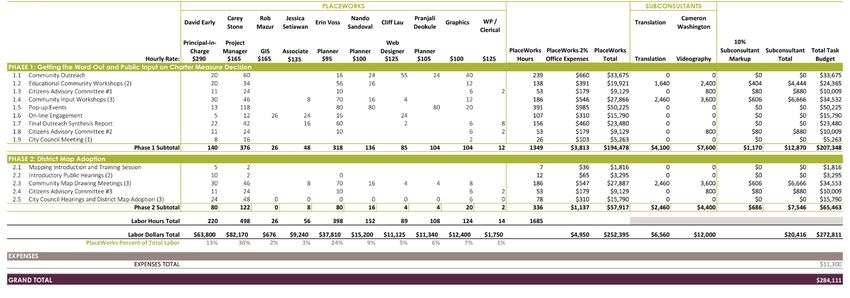
PlaceWorks proposes to complete the Council Election System public engagement process for a cost not-to-
exceed $284,111, as shown on Table 2.
PLACEWORKS 15COUNCIL ELECTION COMM UNITY ENGAGEM ENT AND OUTREACH PLAN
CITY OF SUNNYVALE
TABLE 2 COST TABLE
PLACEWORKS 13COUNCIL ELECTION COMM UNITY ENGAGEM ENT AND OUTREACH PLAN CITY OF SUNNYVALE This page left intentionally blank. 14
You can also read


