Exeter Education Incubator Café Online 2021 - Project Catalogue Monday 5th July - Friday 16th July 2021
←
→
Page content transcription
If your browser does not render page correctly, please read the page content below
Exeter Education
 Incubator Café
  Online 2021

 Project Catalogue
Monday 5th July — Friday 16th July 2021
Welcome to the Incubator Café Project Catalogue!
To attend Incubator Café sessions, you can sign up here. We are
looking forward to you joining us between July 5th—16th via Microsoft Teams.
This project catalogue contains summaries of over 40 Incubator projects run in
2020/21 as well as 2021/22 projects that are about to start. Projects include our
Provost-funded Student-Led Anti-Racism, Erasmus+ funded Communities and
Students Together, and RIEG-funded Research-Based Community-Engaged
Projects, as part of our new Education Innovation Lab.
This catalogue reflects the incredible effort they have all put in during this year.
To help ensure that the café sessions run as smoothly as possible, we ask that
you read the project summary before attending the session. This will allow you to
have the maximum time for questions and discussion about projects. The café is a
space for conversation and discussion about projects and ideas. Please start these
discussions about your sessions through the Incubator Café 2021 Padlet here.
This is our second online Café event and builds on the Café last year, offering
more flexible sessions spread over two weeks to give you more opportunity to learn
and discuss projects and network with like-minded peers and students. To help us
continue to improve the format, we will send out feedback forms to all attendees after
the event, so please keep an eye on your emails.
We want to extend a huge thank you to staff and student fellows who have worked
with us in 2020/21 and those who will be joining us in 2021/22 — we love working
with you.

If you need to speak to us before the event, or want to ask any questions, the best
way to reach us is at educationincubator@exeter.ac.uk.
University Sessions
We have used the online format of the Incubator Café to invite teams from across the
University to deliver sessions from their areas that will benefit you, and enhance what we
can offer. We hope to increase this in future years, so if you would like to deliver a session
on a non-Incubator project you are working on that will benefit colleagues and students,
please contact us at the educationincubator@exeter.ac.uk.

This year, we are pleased to offer sessions from the Academic Development Team, the
Challenges Online (Grand Challenges) Team discussing online delivery, and the ASPIRE
Team discussing the Education Toolkit, which you can read more about in the catalogue.

                      Café Project Catalogue Key
We have split the projects in this catalogue into different themes. The following key will help
you easily navigate the current and future Incubator projects.

         Student-Led Anti-Racism Projects 2020/21, funded by the Provost Commission
         and part of our new Education Innovation Lab

         Research-Based Community-Engaged Projects 2020/21, funded by RIEG and
         part of our Education Innovation Lab

         Current year-long Education Incubator Projects (2020/21)

        University Department Café Sessions

         Community-Engaged Learning Projects, run as part of the CaST (Communities
         and Students Together) piece of work, sponsored by Erasmus+

         Upcoming year-long Education Incubator Projects (2021/22)
Student-Led Anti-Racism (SLAR) Projects
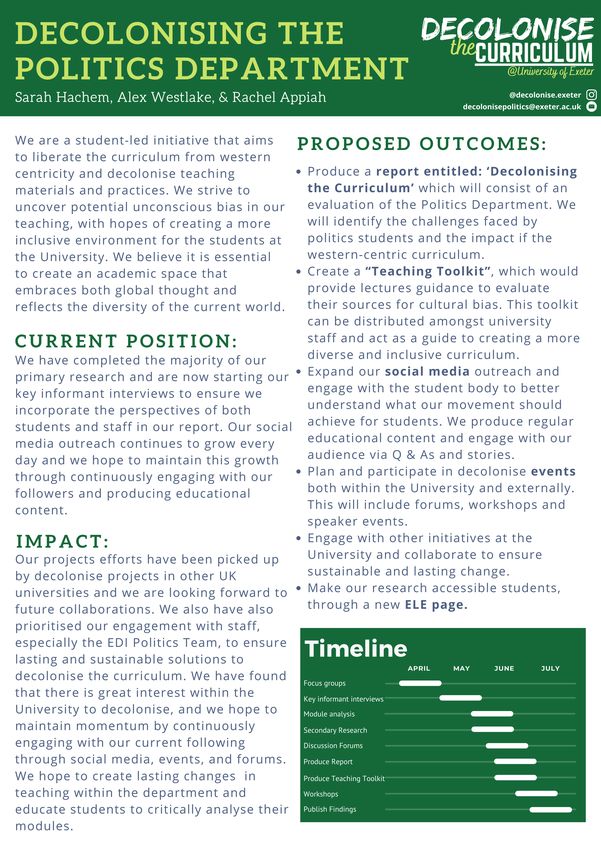
      Decolonising the Politics Curriculum
 1
      Alexandra Westlake, Rachel Appiah, and Sarah Hachem

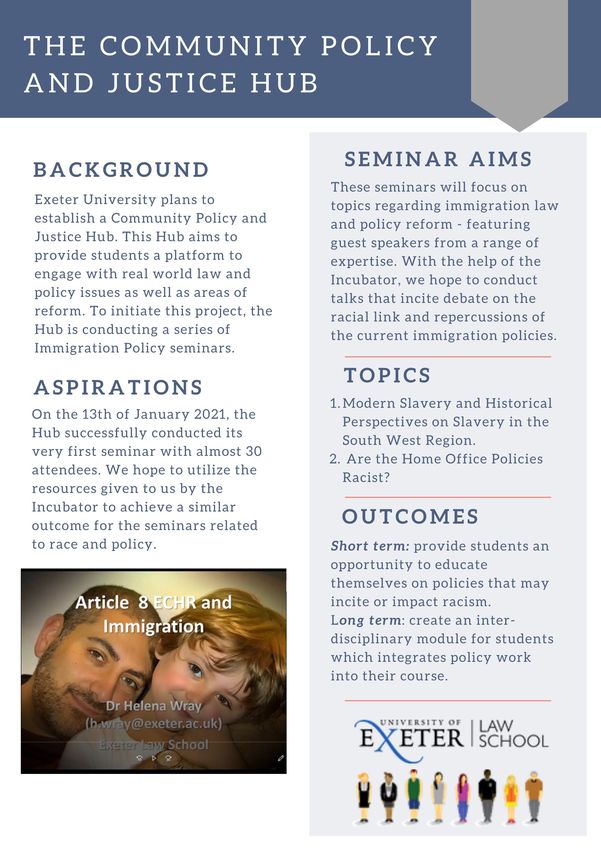
      Exeter Policy Clinic
 2
      Sundus Quereshi and Emma Marshall (Law)

      Creative Switch Exeter
 3
      Hanife Hursit and Andrea de Jong

      Active Together
 4
      Rhianna Garrett, Nina Cunningham, and Manan Shah

      The Roots Resistance
 5
      Asha Ali, Clara El-Akiki, Mishaal Javed, Roman Ibrahim, and Arthur Dart

      Recommended by Who?
 6
      Sharlene Asmah, Herbie Mensuoh, Jennifer Mellot, Asha Abdi, and Yasmine
      Fosu

      For the few and the many: Enhancing PGRs experience
 7
      Mengya Zhao and Tom Lewis

Research-Based Community-Engaged Projects
      Community Partnerships: A Policy Clinic for social change
 8
      Tia Matt and Abi Dymond (SSIS)

      Bridge to the future
 9
      Maria Rosaria Marsico (CEMPS)

      Encompass: Decolonising STEM
10
      Layal Hakim, John Bruun, Caitlin Kight, Tina Verhaeghe, Beth Pitcher, Corrina
      Cory, Avalon Cory, Houry Melkonian, Barrie Cooper, Sharon Strawbridge, and
      Helen Smith (CEMPS)

      Consent Culture
11
      Angelica Bas Gomez, Elizabeth De Lusignan, Hazel Mycroft, and Helen Foster-
      Collins (CLES)

      'Let's talk about Service Learning...'
12
      Christine Robins (HUMS)

      Exploring the potential of peer mentoring in online courses
13
      Lisa Harris, Beth Kewell, and Rose Leach
Learning with others beyond the University
     Transcultural Devon
14
     Alice Farris, Danielle Hipkins (Modern Languages and Cultures), and Valentina
     Todino (Italian Cultural Association - Exeter)

15
     Cultural Community Mentoring Project
     Sana Rizvi, Malcolm Richards, and Helen Knowler (GSE, REEN)

     Connected Classrooms - Teaching and Learning across Continents
16
     Nandini Chatterjee, Gajendra Singh, and Rebecca Williams (HUMS)

     Crowd Obtained Research and Learning (CORAL) Exeter
17
     Adam Porter and Jamie Stephens (Biosciences)

     Learning Mathematics Through Art at Primary School Level
18
     Houry Melkonian (CEMPS)

        Conversations that foster mutual
       understanding of success and value
     What Does Good Online Learning Look Like?
19
     Karen Walshe, Sharon Morgan, and Sara Venner (GSE)

     Improving Student Experience and Employability through Cloud
20
     Technologies in the Computer Science curriculum
     Matt Collison, Achim Brucker (CEMPS), and James Bingham (Exeter IT)

     The development of a pre-registration online module to facilitate the
21
     transition of Chinese Masters students to the English educational system
     Kirsty Brock and Alan Barker (SHS)

     The Playful University
22
     Maarten Koeners (CMH) and Stephanie Comley (TEL)

Academic Development and ASPIRE Sessions
     Personal Values in Education
23
     Caitlin Kight (Academic Development)

     ASPIRE Education Toolkit
24
     Tamsin Kilner, Cat Bailey, Matthew Green, and Katie Steen

     Challenges Online (Grand Challenges)
25
     Anka Djordjevic
Empathy and play—developing the emotions of learning
      Mathematics without Tears and Fears: Pedagogical Games which teach
 26
      Mathematics Principles across Academic Disciplines
      Layal Hakim, Weihan Ding, and Pascal Stiefenhofer (CEMPS)

      Serious Play, Serious Fun, Serious Skills: Developing a Serious Play and
 27
      Gaming Pedagogic Community across the University of Exeter
      Holly Henderson (UEBS), Martin Robson (SSI), and Caitlin Kight (Academic
      Development)

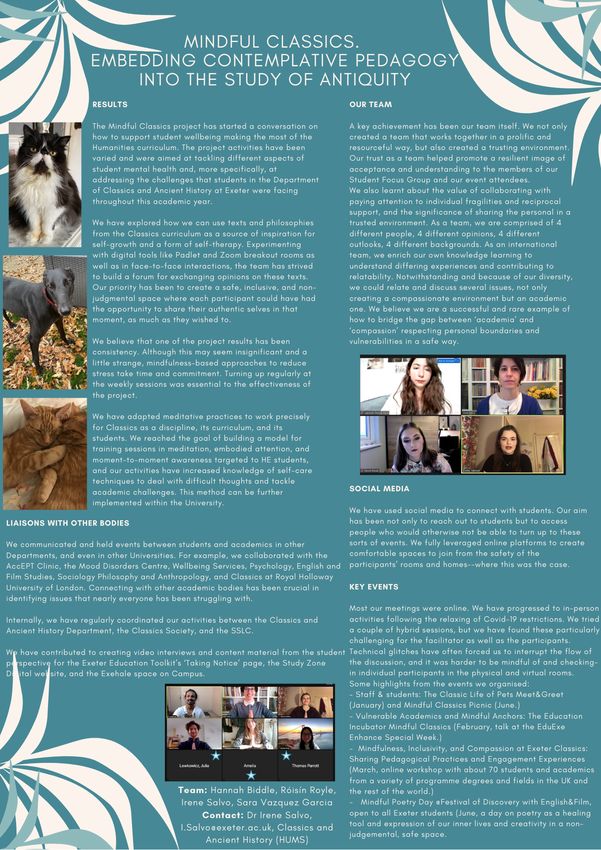
      Mindful Classics: Embedding Contemplative Pedagogy into the Study of
 28
      Antiquity
      Irene Salvo, Katharine Earnshaw, Gabriele Galluzzo, Sharon Marshall, Giovanna
      Colombetti, Inmaculada Adarves-Yorno, Barney Dunn, John Danvers, Sarah Lane,
      and Emma Thom (HUMS)

      Engaging students in the use of progress-testing to enable deep-learning
 29
      Christine Heales and Demelza Green (CMH)

      Creating dialogic pedagogies and practices
      Can We Talk About This? (Dialogic Spaces)
 30
      Erin Walcon and Amy Mellows HUMS)

      Decolonial Knowledge Production and Anti-Racist Pedagogies: Building a
 31
      Cross-Disciplinary Community of Practice
      Kate Wallis, Lara Choksey, Stacey Hynd, Abram Foley, Katie Natanel, Malcolm
      Richards, Angelique Richardson, Nicola Thomas, and Andrea Wallace (HUMS)

      Developing mathematical reasoning and communication through computer-
 32
      aided teaching and assessment
      Gihan Marasingha (CEMPS)

      Rethinking Education Through The Lens of Parallel Texts
 33
      Barrie Cooper, Layal Hakim (CEMPS), and Leif Isaksen (HUMS)

      CartasVivas: A Multimodal Project-Based Learning Approach in Modern
 34
      Languages
      Isabel Santafe and Nuria Capedevila-Argüelles (HUMS)

 Erasmus+ Community– Engaged Learning (CaST)
      Kinder Exeter: Compassion Through Play
 35
      Olya Petrakova-Brown and Maarten Koeners

      Students as Teachers of Multilingualism
 36
      Francesco Goglia

      Hidden Exeter and St Nichola’s Priory
 37
      Fabrizio Nevola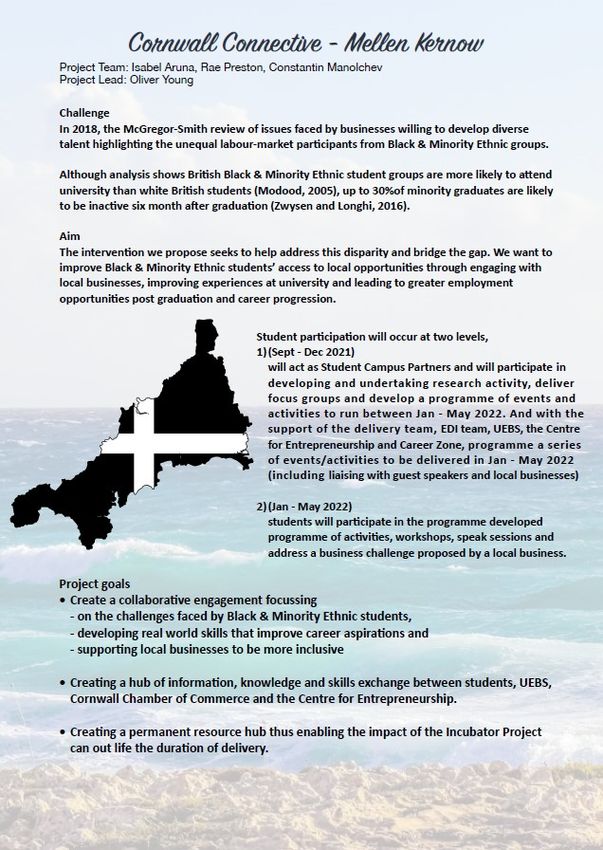
Globally-Engaged Learning
38   Exploring Global Nursing Educational Collaboration in a virtual classroom
     Alison Marchbank (CMH) and Eva Persson (Lund University)

     Understanding international students' academic, well-being and
39
     sociocultural adaptation
     Angela Christidis, Beth Cossey, Meredith Farley, Sue O'Hara, Joshua Papanicola,
     and Emma Sweeney (UEBS)

        Integrating online and on-campus for
              transformative education
     Building assessment confidence: effective use of examples of previous
40
     students' work for online and blended learning contexts
     Lisa Alberici (GSE)

     Exploring the potential of 3D virtual reality (VR) as part of a blended learning
41
     approach to teaching clinical skills to student radiographers
     Rosey Davies, Sue McAnulla, Jenny Shepherd, Karen Knapp, Christine Heales,
     David Harris, Sam Vine, and Sue Rimes (Medical Imaging)

     Virtual Spaces in a Blended Environment
42
     Barrie Cooper, James Bingham (CEMPS)

     Improving the student programming experience via continuous automated
43
     feedback and industry-standard tools
     Barrie Cooper, James Bingham, and Jemma Shipton (CEMPS)

     Lit: Up: Nurturing regional talent through a creative agency pilot scheme
44
     Anna Kiernan, Hazel Beevers, and Kate Wallis (HUMS)

     Improving Neurodiverse experiences at University. The development and
45
     deployment of online training and teaching toolkits.
     Ioanna Kapantai and Manuela Barreto (CLES)

              Racial Equality and Inclusion
     Black British Studies - an open accredited module for the University of Exeter
46
     Malcolm Richards, Ryan Hanley, Nandini Chatterjee, Hanife Hursit, Nour Azzalini-
     Machecler, Diana Valencia Duarte, and Theseus Stefanatos (GSE)

     Elevating cross-cultural care: Transforming educational curricula to foster
47
     cultural competence in the helping professions
     Dora Geraldes Bernardes, Ruth Flanagan, and David Mussell (CLES)

48   Open Cornwall, Mellen Kernow: Improving Employability Access, Progress
     and Success for BAME Students
     Oli Young, Costa Manolchev, Isabel Aruna, and Rae Preston (UEBS)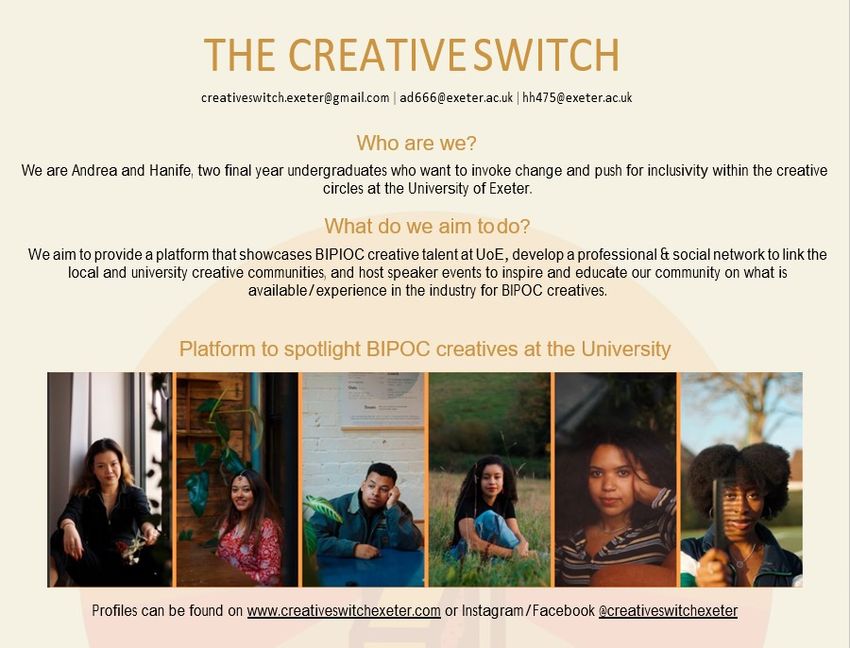
1

2

Project Team:
Sundus Quereshi
Emma Marshall
3
4

                                                                       Active Together
               Rhianna Garrett, Nina Cunningham, Manan Shah, and Sophie Jenkinson
                                     Active Together secured the Education Incubator funding in January
                                     and began planning how we would effectively use the finances. Our
                                     group consists of three students, Rhianna Garrett, Nina Cunningham
                                     and Manan Shah, with aims to change the culture in AU sports clubs
                                     and Guild societies. Our main goals were to provide compulsory
                                     diversity training for AU/Guild staff members, create sports inclusivity
                                     badges that establish a zero-tolerance policy on all forms of racism to
                                     provide safe spaces and promote the voices of students of colour in
                                     both sports societies and the university campus.
                                    To begin, we created our social media presence, with accounts on
                                    Instagram, Twitter and Facebook @atogetherexeter. On these
                                    platforms, we have been posting many educational resources to help
                                    people understand our project and the language around anti-racism.
We felt social media was crucial to gaining the attention of the students. We began to research what we
wanted to accomplish, which involved getting in contact with clubs and societies and understanding what
was lacking when it came to effective anti-racism. From this, we established that these student-led clubs
lacked direction and training when it came to issues related to EDI and made first contact with the
University EDI team which became an ongoing relationship. They provided us with information on EDI
processes in all departments, how our project could best be utilised, and how to grow on the work that
had already been done. February marked the beginning of our first student-led competition, where we
asked students to design our EDI training badge and were awarded a £50 amazon gift voucher. One of
the hardest tasks was getting in contact with the Student Guild and Athletics Union, as they were a key
part of our project. Now that we have contact, we hope future Active Together members will find this
process easier. After this, Rhianna wrote Active Togethers first blog post where she detailed her experi-
ences of racism and how Active Together began.
In March, we started interviewing potential external training providers, as well as continued discussions
with the AU and Guild about how the training can be implemented. We had meetings with multiple training
providers including Diverse Matters, Equality and Diversity UK, Changemakers UNLTD and Diversity
Trust. After meetings with the Guild, AU and the EDI Team at the university, we finalized what we were
looking for from the external trainers. We had realized with meetings with the trainers that the funding that
we had been allocated was not enough for what we were trying to obtain. We realised that more money
would be needed to effectively teach committees about EDI. Active Together was invited to attend a
training session with Beyond Equality, facilitated by the AU, to further understand what current anti-racism
training looked like. From this and our research, we secured extra funding from the AU and the Guild of
£3000 to reach our goals. We organised a meeting with Building the Anti-Racist Classroom (BARC) to
gain more insight on how this non-traditional facilitator planned their anti-racist training and got us in
contact with Loughborough University who we hope to collaborate more with in the future.
In April, we looked to expand our team by hiring someone to work exclusively with our social media
accounts. We set out what we were looking for, and during the Easter holiday break, we started accepting
applications for the role of Social Media Manager at Active Together. We interviewed three candidates for
the role at the end of the month. At the start of May, we released our second blog post where we call
students to action and encourage more university senior members to join us in this conversation.
Eventually, we decided to hire Sophie Jenkinson as our social media manager, who began working with
Active Together in May 2021. We felt this was a necessary step in growing the viewership of Active
Together in the future. Around mid-May, we were delighted to see Active Together was nominated for
outstanding contribution to EDI and/or welfare. This inspired us to start project SLAR2, where we wish to
discuss Active Together’s legacy and longevity, as well as plan a research project that marks the start of
tracking EDI progress. Near the end of May, we secured the training facilitator Diversity Trust for £5000,
run by consultants of CohCo.
5
The Roots Resistance
Asha Ali, Clara El-Akiki, Mishaal Javed, Roman Ibrahim, and Arthur Dart
The Roots Resistance is a student –led initiative. Our aim is to amplify the voices of Black
and People of Colour and their allies with a specific look to the possibilities of art as
transformative expression. This initiative is built on the foundations of collective dialogue,
collective care, from the university community to the wider global community.
In collaboration with students of colour at Exeter who share our vision, we aim to build a
hub of expression limited only by an exclusive commitment to fostering a safe and inclusive
community for all.
In order to do so, we first commissioned a multitude of creative projects from photography,
music performance, poetry, storytelling and film. Some examples include: a short film,
thematically to do with the idea of bringing people from different cultures together through
the conduit of food, a poetry film to show the lives of the Asylum seekers in the UK and
difficulties they face to bring their family members to join them and a visual art piece that
draws attention to the disproportionate impact the pandemic is having on marginalised
communities, with a particular focus on the racism faced by large numbers of the East Asian
community. The many projects are available to view on our website.
In addition to commissioning artists and creatives, the Roots Resistance hosts a number of
speakers and events aimed to inspire and inform; creates written content such as research
articles and blog posts; as well as a podcast that aims to reflect on experiences and
opinions of the current student body and staff. Recent speakers include Mia Sakai,
photographer and founder of Aether Magazine, Roisin Tapponi, film curator and founder of
the Habibi collective, and Dr Muna Abdi, leading education consultant and independent
researcher. Topics of our blogs and podcasts range from film reviews, to photo essays to
book reviews.
In addition, the Roots Resistance is also host to an academic journal, The Roots Review.
To be published in August, The Roots Review includes papers exploring testimonies and
experiences from Palestine, gender-based violence against women of colour in the US and
the place of fashion and photography within India and the diaspora.
With a philosophy grounded in anti-racism and decolonial knowledge production, the Roots
Resistance is a student-led project that seeks to support the POC community in Exeter and
beyond. We hope to amplify the voices of our community. We are here to challenge the
dominant waves of knowledge production in spaces that weren’t made for us, by making a
space of our own.6
Recommended by Who?
Sharlene Asmah, Herbie Mensuoh, Jennifer Mellot, Asha Abdi, and Yasmine Fosu
Following the Decolonising the Curriculum Departmental Review,
which was pioneered by Exeter students on the Penryn Campus,
the aim of this Student-Led Anti-Racism project will primarily be
to continue what was started and put one of the
recommendations made by the students into practice.
The recommendation that we will be focussing on will be
Recommendation 1: Address the under-representation of BAME
authors by reviewing the current reading list of each module to
reflect a broader perspective.
We will be addressing this recommendation by actively adding
suitable BAME authors to our reading lists. In doing so we aim to
see a 30% increase in the number of BAME authors that we see
on our reading lists. As we cannot decolonise the whole Politics
Penryn reading list in the time frame we have, we will begin by
using 3 second year modules in the Politics and International
Relations course and ensuring that at least 3 BAME authors will be included in all 11
weeks that are in a term, this would mean that there will be just under 100 (99) BAME
authors seen in the 3 modules we decide to work on.
Achieving this will be a great start to decolonising the curriculum as it will enable students
to explore and reference different cultural histories and narratives in their work.
Additionally, it would increase a sense of belonging within the University and ultimately
contribute to the work of closing awarding gaps.
Objectives/Aims
• To understand the process of which the authors on the recommended/essential
reading list are formulated.
• To increase the diversity of reading lists by 30%.
• Encourage not only the diversity of authors, but the inclusivity and diversity of the
content in which the lectures teach to students.
Method
• Project research synthesis
• Project value proposition
• Generating options for project delivery
• Testing the project delivery options
Anticipated Outputs
• To have 3 modules adjusted to have
BAME authors included in the reading
list
• To network with staff and students who think about the diversity and inclusivity of
education to generate ideas for diversifying Politics modules.
• To produce a report, documenting our work, and making recommendations for how
to include more BAME authors to the reading list.7
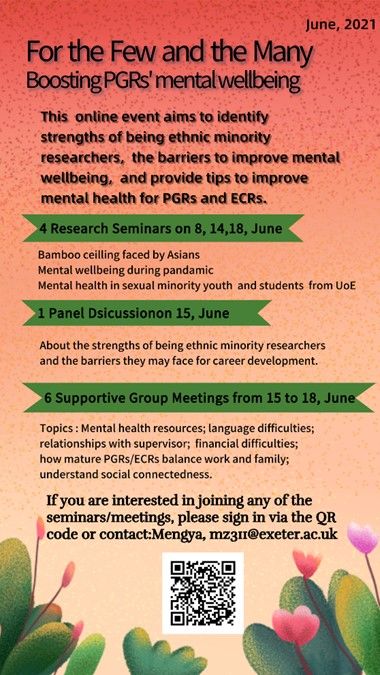
For the few and the many: Enhancing PGRs experience
Mengya Zhao and Tom Lewis
The project aims to address the risk factors of mental health in minority postgraduate
research (PGR) student groups. PGR students are known to suffer from mental health
problems such as depression, anxiety and stress. These mental health problems are well
documented as being more prevalent for BAME PGRs and other international PGRs. Those
with a different cultural identity in predominately white institutions face various barriers and a
range of racial stressors across many different roles, environments, and contextual settings
(e.g., supervision, teaching, researching). These barriers and racial stressors can lead to a
low sense of belongingness. Aside from these cultural and racial factors that ethnic minority
PGRs experience, all PGRs experience a variety of issues such as issues in their
supervisor-PGR relationships, balancing work and family, financial issues, and a lack of
social support during training, which possibly contribute to the widespread poor mental health
in this group. Identifying these issues and resolving them would be ideal for all PGRs.8
Community Partnerships: A Policy Clinic for
social change
Tia Matt and Abi Dymond
The Problem
The Community Justice Hub and Policy Clinic is designed to complement the work of the
Community Law Clinic, which was established in 2017. The purpose is to provide an
interdisciplinary space that can extend the impact of the advice work by looking to address
the causes of the issues seen within the Law Clinic and involving students in research
designed to influence policy and promote social change.
The Law Clinic has a good working relationship with a number of local advice organisations,
such as Cass+ (Community Advice and Support Services). These discussions focus around
how the university can develop further student projects to assist in tackling some of the
issues faced by the people that the charity supports.
Using the expertise of colleagues from both Law and Criminology, we can examine some of
the prominent issues identified by Cass+, such as:
• obtaining community mental health support for individuals in the criminal justice
system;
• high levels of need for community frontline workers with knowledge and expertise who
are able to provide one-to-one support but very low capacity; and
• low levels of legal education for offenders and barriers to smaller organisations
working together effectively to tackle the issues.
Who does this problem impact?
Taken together, these problems impact a number of our most vulnerable citizens and
communities. A key consideration is the profile of the ‘communities’ that attend courts and
the rigid system that will simply ‘process’ them once they’re part of it. In CASS+ experience,
the average defendant displays a minimum of three separate issues or problems; there is
complex interplay across all areas.
Sharing of knowledge and experience across sectors and, where appropriate, the client, will
always encourage a more positive outcome and create more trusted partnerships.
Objectives
The objectives for the project are to co-design a working model that enables us to develop
future projects for the Clinic students and community partners and to define one or two
research briefs for these student projects that can be run through the Policy Clinic in 21/22.9
Bridge to the Future
Maria Rosaria Marsico and South West University Technical College
The University of Exeter have been a great champion for the South West University
Technical College (UTC) project since the opening of the school was first proposed in 2012.
A small number of students opt to study degree-level apprenticeships and UTC student
body is leaning more towards this pathway to employment. It is intended that the
collaboration with the university will strengthen the connection with young people and their
families in order that they have an insight into the value of Higher Education and the
pathways offered that will help them to achieve rewarding and fulfilling careers.
Many of the students who choose to study at the college fall into POLAR4 Quintile 1, which
indicates the lowest rates of participation in higher education.
This project aims to connect the classrooms to a community of learners, in an experiential
learning process in which educators and students from the University of Exeter and UTC
are immersed into a STEM-subject learning experience.
Objectives:
• To empathically understand challenges and aspirations of UTC students
• To creatively co-design hands on activities with UoE students and to inspire UTC stu-
dents
• To promote a sense of social activism and community partnership between current
and prospective students
The success of the project will be defined as follows:
• Uptake of project by students and their families is high (85% or higher).
• Participation in the project includes students intending to or who already specialise in
Engineering.
• Curriculum connection to the project aims and outcomes.
• Demonstrable learner progress through assessment prior to and after project.
• Evaluation of project identifies lessons learned with opportunities to develop repeat
projects for future year-groups.10
Encompass: Decolonising STEM
Layal Hakim, John Bruun, Caitlin Kight, Tina Verhaeghe, Beth Pitcher, Corrina Cory,
Avalon Cory, Houry Melkonian, Barrie Cooper, Sharon Strawbridge, and Helen Smith
STEM has a long way to go when it comes to decolonising the curriculum. Yet, maths,
medicine, IT, physics, and engineering have a long history dating back to the explorations
of those less represented in the current STEM world such as from Africa, the Arabs and
Persians, East and South-East Asia, and renowned women scientists. However, although
the historical explorations are important, how else can STEM subjects be decolonised?
This project aims to answer this question by looking at five various case studies and
explore these ways in the context of higher education. The collaboration across the leads
and sandpit participants gathered plans and ideas, as well as a list of specific topic titles
that can be explored further as a mini case-study research projects.
Students from CEMPS will be appointed to work with the team as co-researchers where
each student will explore one of the titles in depth, with the aim of writing a blog/report and
an end-of-project presentation disseminating their findings. This participatory, sand-pit,
supervision forms great research bonds between students and academic staff, all of whom
are passionate about improving the decolonisation in our college.
After brainstorming sessions, the five case studies to be explored are:
• Exploring perceptions and understanding: interviewing current staff and students on
what decolonising STEM means to them and the modules their studying/delivering.
• Historical exploration: researching about the forgotten hidden treasures of those less
represented in the current stem world (targeting all – ethnicity, sexuality, gender,
disability status).
• Looking beyond history: do (and how do) methods in STEM topics need to be
changed to allow for decolonisation.
• Ownership and sharing of STEM knowledge, and enabling voices.
• Resource design: looking at how the structure and content of the module material can
take decolonisation into consideration.11
Consent Culture
Angelica Bas Gomez, Elizabeth De Lusignan, Hazel Mycroft, and Helen Foster-Collins
(CLES)
Our Education Incubator project is based on the current university approach towards
education around sexual assault and the different ways of reporting sexual harassment.
An investigation by UN Women UK found that 97% of women aged 18-24 have been
sexually harassed, the main reasons for not reporting those situations being the belief that
the incident is not serious enough to report and that reporting would not change anything.
This is a widespread problem across the country and we therefore assume that this
University is no different, making it likely that most female students experience or have
experienced sexual harassment at some point during their time at university and may
have not reported it due to the reasons stated above.
Student Facebook pages such as ‘Penryn Campus Fitfinder’ and ‘ExeFess’ regularly have
anonymous posts about sexual harassment and abuse, whether it be from a victim,
witness or even a perpetrator. There have been many posts recently on these pages with
people asking questions about what is considered as sexual abuse and sharing opinions
on how to improve the situation. We believe that these posts reflect a large range of
opinions and levels of understanding of sexual abuse within the student community. We
would like to be able to educate and empower these students to be allies, with a good
understanding of what constitutes sexual abuse and the confidence to report it if they
witness or experience it.
These anonymous pages allow students to seek support from each other as well as
calling out certain behaviours without the abuser knowing their identity. This is likely an
important reason for students using these anonymous platforms rather than the structured
support already in place.
Our aim is to link up and support the efforts that are currently being carried out within the
university to improve gender safety. One key focus point would include reviewing the
reporting system already in place and potentially improving it to easily report minor
incidents of sexual harassment. This would allow students to report someone without
revealing their identity to the perpetrator and would require no proof from the victim as
there is rarely evidence of these incidents. Being able to identify the perpetrator would
allow the University to identify behavioural patterns and prevent reoffending through
having conversations and education before punishment.
We would also be looking at ways to improve the current University communications
regarding all the support, resources and information around sexual education and consent
already available to students. We believe that the resources are there, but perhaps are
not used to their full potential due to not many students knowing that they exist in the first
place. Being able to integrate all these resources within University Education would
potentially help to reduce the stigma and encourage people to talk about this subject,
which would make easier to call out certain behaviours and ultimately, prevent them.
Our main goal is to reduce the number of incidents through education and make the
victims feel supported and listened to when they choose to report. We hope that the
combination of education programs and the introduction of a new reporting system will
encourage more people to report these incidents when they occur and reduce the number
of reoffenders.12
‘Let’s talk about Service Learning...’
Christine Robins (SSIS)
Exeter offers modules across many departments which provide project-based learning
through substantial engagement with outside communities (e.g. Law’s Pro Bono offers;
SML3042 ‘Transcultural Devon’; my own Oral History module). Other modules (e.g.
language teaching) which engage more obliquely with communities and might be called
‘hands-on’ or ‘experiential’ rather than ‘service learning’.
‘Service learning’ is a term used in the USA to describe learning where the experiential
element outside the classroom consists of work which serves the community and which is
then reflected upon. The designator ‘service learning’ is given to courses which fulfil
certain criteria and is often presided over by a university-wide board. The term is used
less often in the UK, though there is overlap with other terms we use, such as ‘citizenship
training.’ There is a substantial body of academic work on the impact of such learning.
Although the Exeter modules I know about which are community-facing receive strong
feedback from students and community participants, there are no networks across the
University linking the various practitioners of community-facing learning and no discussion
of what (if anything) we have in common pedagogically nor how we could learn from each
other. The outreach work that many staff members do, which often reflects long-standing
and deep relationships with communities outside the university, often does not seem to
‘count’ towards the KPIs of departments and colleges. My project aims to start a
conversation across SSIS and HUMS about this type of work.
Strategic questions include: Should our community-facing modules be more numerous
and evenly distributed for maximum benefit to our students and our communities? Could
more of these modules increase wellbeing and/or employability? Could this be relevant for
how we are ‘a university for Devon and Cornwall’? Might we consider using ‘service
learning’ as a course category, maybe even a designator, like ‘study abroad’ to be put on
degree certificates? But so far, there is no framework in which we can ask and answer
these questions.
As an initial step I aim to:
• map out our offers of such modules, at least across SSIS/HUMS;
• Begin a conversation between convenors about pedagogy and wider strategies in
community-facing modules; assess the desire to create a convenors’ network to
share good practice and (perhaps) embark on a strategic conversation;
• Seek examples of practice and outcomes from students and community members;
• Evaluate the existing ‘service learning’ toolkits in the academic literature and, in
consultation with colleagues, devise a toolkit for potential convenors here.13
Exploring the potential of peer mentoring in
online courses
Lisa Harris, Beth Kewell, and Rose Leach
The challenge
This project will explore ways to engage students more actively in both asynchronous and
real-time settings through a structured process of tutor and peer mentoring throughout a
term 3 PGT module, Digital Business Modules (#BEMM129J).
In this current academic year I have so far run two large online modules (300
undergraduates and 200 postgraduates). The modules run largely asynchronously but
also have a series of synchronous sessions designed to support preparation of the
assignments at suitable intervals through the term. Despite the high degree of flexibility
and accessibility that this structure offers to students, the level of engagement has been
mixed. We’ve observed that those who either don’t attend classes or who attend without
participating, and/or who contribute late (or not at all) to the asynchronous exercises, are
more likely to produce rushed, superficial work and end up with poor or average results.
Large class sizes make it easy to “hide at the back” or avoid attendance altogether.
The problem of low participation is not a new one, but the digital environment makes
absence/lack of contribution more obvious than in a traditional classroom. Tutor attention
often has to focus on encouraging the unprepared/uninterested, so the small number of
engaged students have limited opportunities for feedback in such sessions. They tend to
lose interest and stop attending too. Consequently, many students are not prepared to
perform effectively in job interviews or the workplace more generally, where employers
increasingly seek people with good communication, problem solving and collaboration
skills.
Our plan of action
During the module (May – July) we will test out a variety of ways we might re-design the
module’s real-time sessions and assessment structure to incorporate a mentoring and
collaboration aspect. This will hopefully lead to better quality assessed work across the
whole cohort, positive student feedback, and a reduction in numbers who would otherwise
“slip through the net” if left to their own devices. It will also provide opportunities for good
students to stretch themselves and acquire additional employability and digital skills by
mentoring others. We suggest that involving engaged students as partners in the
mentoring process provides scalability with the large student groups that are becoming
the norm. In addition, peer mentors have a level of credibility and empathy with their
cohort that tutors may lack.
The project team will collect feedback from tutors and students throughout the module. It
will then be written up over the summer for publication as a case study of innovative
teaching and learning that can inform pedagogical decisions for next year more widely.14
Transcultural Devon
Alice Farris, Danielle Hipkins (Modern Languages and Cultures), and Valentina Todino
(Italian Cultural Association - Exeter)
Context and Aims of the Project
Following the developments in European politics and the withdrawal of the UK from the
EU, Modern Languages students face increasing uncertainty for their careers as well as a
chaotic and unpredictable future. This project aimed to help students explore, and to
increase awareness of what it means to be a Modern Languages student in the
post-Brexit era, analysing the changing role of languages in the UK community, with an
aim to enhance cultural cohesion.
Activities
The project was to establish a new final-year module, open to students of all languages in
the Department of Modern Languages and Cultures, to give them the chance to connect
with the local community and explore its cultural diversity. It also proved to be a chance
for students who were not able to go abroad to be exposed to the language and culture
they study, as well as exploring the theme of migration.
The project draws on a series of one-off occasional projects (funded by the Annual Fund,
Community Engagement and Being Human Festival) that sought to address to
community-University integration, and aims to embed the learning from these projects into
the curriculum by means of a living archive (in its initial phases at
http://transculturaldevon.exeter.ac.uk ).
The students who did the module were mainly final year students, who had spent the third
year of their degree studying or working abroad, experiencing for themselves what it
means to settle into a new cultural and linguistic environment. Students were asked to
interview members of the public of different nationalities about their identity and
experience as migrants. They conducted interviews in the mother tongue of the
interviewee via online platforms and they recorded the exchanges. They then analysed
the interviews in terms of the content and subtitled the videos into English. At the end of
the module, we recruited two student interns who will now spend the next couple of
months collecting feedback on the module to understand the impact it had on their
experience. They will also prepare a short video featuring students and interviewees to
advertise the module to prospective students (sample of this kind of work visible at
http://transculturaldevon.exeter.ac.uk).
Outcomes and longer term aims
The module has given students the opportunity to carry out authentic ethnographic
research in Exeter while practicing their language skills and learning how to subtitle a
video. It has also given them the opportunity to connect with the community and discover
the cultural diversity that surrounds them.
Now that the module has come to an end, we have recruited two student interns that have
attended the module, to lead the process of feedback collection as well as the creation of
a short video on the project. They will research the experience of their fellow students and
suggest future improvements and developments, as the module will be offered again next
year. In the video, besides presenting some clips from the interviews, they will talk about
how this module benefited them and aided further connections between the University and
the community.15
Cultural Community Mentoring Project
Project Team: Sonia Cunico, DamienSana Rizvi, Malcolm Richards, and Helen Knowler
(GSE, REEN) Gaucher, and Juan Garcia-Precedo (HUMS)
Background
There has been considerable research into the experiences of people from BIPoC groups
in teacher training courses in relation to recruitment, progress, retention and pass rates
(Advance HE, 2018; Hoodless, 2004; Jones et al., 1996). There is significant evidence to
suggest that both BIPoC ITE students, and newly qualified teachers (NQTs) experience
issues in their training due to inappropriate mentoring, often forcing them to leave their
training programmes if there is a breakdown in their relationship. The poor experiences
are compounded because BIPoC ITE students and NQTs feel that in instances of
mentor-mentee relationship breakdown, the university as the official partner of the school
will inherently side with the school mentor.
What We Did
This project sought to offer the wisdom and guidance of BIPoC mentors to BIPoC teacher
trainees through five sessions. Using a unique participatory action research approach, we
wanted to conduct these sessions with utmost respect for ethical considerations for
participant care, privacy and emotional safety. Digitally-hosted mentoring sessions were
held without the researchers being present whilst the dialogues were taking place, and
were not recorded. This helped mentors and mentee hold personal conversations and
report back after each session in a way that was appropriate for them. The one-to-one
sessions provided opportunities for teacher trainees to discuss various aspects of their
training, including what constituted subject and professional knowledge and values and
beliefs. Due to the pandemic, our recruitment of participants was drastically affected,
despite us changing our recruitment strategy.
What We Have Found
While we are still collecting data from our sessions, preliminary findings from this research
project demonstrate the need for more nurturing spaces of care for BIPoC teachers as
well as developing communities of understanding within ITE that affirm and validate their
racialised experiences. We would ideally like to coordinate with other Southwest ITE
programmes and collaborate with them on a larger project examining this issue in greater
detail once this project has concluded.16
Connected Classrooms - Teaching and Learning
across Continents
Nandini Chatterjee, Gajendra Singh, Rebecca Williams, Ali Raza, Ali Usman Qasmi, and
Fatima Naveed (HUMS)
The aim of the project was to develop a South Asian history module that could be taught
and learned simultaneously and collaboratively in virtually connected classrooms, at
Exeter and the Lahore University of Management Sciences (LUMS), Pakistan. This entails
a radical model of international education that looks beyond treating overseas students as
simply consumers of western university education, and instead looks to study South Asia
together with experts and students located within South Asia, offering students at both
universities a genuinely international experience. As the COVID-19 pandemic struck and
confined us all to home offices, personal desks and Zoom calls, the development of a
module with a primarily online platform became timelier than ever. To this effect, the
following targets were set when considering how to collaborate on the set-up and teaching
of such a module:
• To consider the identity of both the students and the researchers on this
module, as well as the institutional constraints under which it is to be
delivered: Keeping in mind national as well as class, gender, and religious
affiliations, a microcosmic look is needed to enable all students to critically deal with
their respective positions using current scholarship.
• Expertise on South Asia is shared with students and teachers in South Asian
countries: We want to push for an understanding that there may be different ways of
teaching and learning across borders, and every method must be engaged with
critically and openly in order to have a well-rounded teaching/learning experience.
• Shared histories: With a common past that is rooted in colonialism, South Asia and
Britain make for an interesting case-study in tandem, allowing us to highlight their
shared, even exploitative, conflict-ridden pasts.
• To make classrooms a space where real, deconstructive and decolonial
learning can take place on an even plane, rather than on a hierarchical level:
Considering the identities of our students, we are aware that no one geographical
location has a monopoly on ‘expertise’ over the study of South Asia; however, we
are equally insistent that nor does one’s degree level determine their level of
understanding of any topic.
With the support of the Exeter Education Incubator, colleagues and collaborators, we
have accomplished the following:
• Putting in place the institutional agreements required to ensure delivery of the
module in collaboration with LUMS in 2021-22: “HIH2236 Post-Colonial South
Asia: Across and Beyond Nation States.”
• Designing the module reading list and teaching development in discussion with
colleagues at Exeter and LUMS.
• A workshop with leads and collaborators from Exeter and LUMS to trial the use of
Padlet as a way to engage in real-time group discussions in seminars.
• A second workshop with students from Exeter and LUMS working together in
groups, simulating the way a regular seminar will run, and approving the choice of
Padlet as an online teaching and learning aid.17
Crowd Obtained Research and Learning (CORAL)
Exeter
Adam Porter and Jamie Stephens (Biosciences)
The Bahamas Fieldcourse is a flagship module at the University of Exeter delivering
immersive teaching on coral reefs. Our project is designed to add a platform for
generating cutting edge research from the student fieldcourse and also to engage
all students at the university who wish in the process of academic research.
For the last 15 years the Biosciences reef ecology fieldcourse has taken up to 40 students
for a 10 day immersive teaching and learning experience to the island of San Salvador in
The Bahamas.
Over the past few years it has become obvious that there is
a huge opportunity to give added value to the students, the
staff and the University of Exeter, one that together would
build a legacy of both teaching AND research excellence.
With 40 students undertaking fieldwork on the small
Bahamian island of San Salvador, an island with some of the
last, relatively pristine coral reefs in the North Atlantic/
Caribbean Sea, there is an opportunity to collect data from
which cutting edge research could be built. It is hoped that
CORAL will achieve this providing a University case study on
inquiry -ed learning and engagement in research.
Our main activities have/will include(d):
Enhanced Training – we have recruited and trained a
“research cohort” of 6 students also attending the
fieldcourse in 2021 to allow us to see if extra training will
unlock an increase in data accuracy. This included
lectures, practical demonstrations, land based
walkthroughs and practice in Cornwall House Pool
Method Development – After the formal fieldcourse, we will
stay on island for a further week to test additional
methods to look for methodological approaches that
increase student data accuracy.
Crowd Sourced Data Processing – with technologies
available to us today we hope to use the body of
students at the University of Exeter with an interest in
conservation (across disciplines) to engage in data
processing on a grand scale. We hope to capture both
photo and video during our time on San Salvador and,
after training, allow any interested students to generate
data for the CORAL project.
Student Led Research – we will be offering opportunities
for students involved in the Bahamas Fieldcourse to
engage afterwards in the writing of an academic
manuscript to be written on the results of the project to
create a template for further engagement with future
cohorts and students in other courses and disciplines.18
Learning Mathematics Through Art at Primary
School Level
Houry Melkonian (CEMPS)
Project Context:
The project aims to creatively rethink the primary level mathematical pedagogy by
developing artistic learning activities that teaches and communicates mathematical
concepts and skills through the medium of visual art for targeted age groups (Year 5 & 6).
Creating more awareness of how art can contribute to maths educational experience, will
encourage the incorporation of these creative and visual learning activities into the maths
curriculum at primary schools.
Project Aims:
• To design maths activities for Years 5 & 6 primary school levels - samples of which
were trialled and tested at two primary schools in the country
• To promote the use of creative and visual mediums in teaching and learning
mathematics
• To encourage interdisciplinarity by creating collaborations between different
disciplines: mathematics, education, art and psychology.
• To engage university students in educational-type research projects in mathematics.
• To promote accessibility to learning maths at different levels.
• To participate and share the research outcome at academic meetings (i.e. SciCulture
2021 Programme at TU Delft)19
20

    Improving Student Experience and Employability
       through Cloud Technologies in the Computer
                               Science curriculum
                 Matt Collison, Achim Brucker (CEMPS), and James Bingham (Exeter IT)
Across Computer Science industry cloud computing technologies have facilitated major
changes in the way software is developed and deployed. Cloud technologies enable
computer scientists to develop systems that consider the full software lifecycle including
the configuration of the infrastructure and environment where the software will be
deployed. However, teaching of Computer Science (CS) in higher education remains
largely dependent on physical hardware on-site and practical teaching that emphasises
and isolates the design and implementation stages of the software lifecycle.
The deployment environments provided in higher education are often designed and
implemented upfront by IT support so the skills required to integrate the environment and
production of code in a procedural way are often hidden from the student learning and
restricted to local services that are supported by central IT. This means key skills in
practical problem solving, that align with cloud enabled software engineering, that requires
an understanding of computing infrastructure and environments are often not delivered to
students. This talk will explore the challenges of integrating cloud computing in a
Computer Science curriculum and describe a framework developed to evaluate the
technical, practical, legal and ethical merits of using cloud services for teaching Computer
Science skills with reflections on our experience and analytics of the usage statistics using
the cloud in teaching a range of Computer Science modules.
21
22
23

     Personal Values in Education
     Caitlin Kight (Academic Development)
     Personal values contribute to our sense of self and identity, and have a significant impact on daily
     decisions, yet many people struggle to articulate their values or explicitly describe which values
     are informing particular thoughts and behaviours. In part, this is because most people are not
     given regular invitations to, or opportunities for, explicitly reflecting on these core beliefs. In the
     context of higher education, this gap can be particularly impactful because of the way that values
     influence learning – by affecting both pedagogical choices made by educators, and learning
     decisions made by students. This can, in turn shape the acquisition of knowledge and use by both
     parties, which can have downstream effects on all realms of life, including interpersonal
     relationships, career paths, and the pursuit of hobbies and creative endeavours.
     Over the course of the past year, I have been developing a suite of materials that support students
     and staff in identifying their values and contemplating how these beliefs influence all aspects of
     life. This work has grown out of my doctoral research on self-study, which was inspired by
     conversations with early-career teachers grappling to understand how their positionality could
     influence not only their professional decisions, but also the experiences of students impacted by
     those decisions. Because ‘personal values’ doesn’t necessarily sound like the sexiest of topics,
     sessions tend to be intimate, but what they lack in size, they make up for in quality of discussion:
     Participants consistently report that the reflective activities are illuminating, the exchanges with
     peers are enlightening, and the possibilities for application are endless.
     To investigate and situate personal values, I have drawn on a range of techniques and
     contextualising concepts – for example:
     •     Gamification: I developed a board game, Path to Enlightenment, that turns contemplation
           into a game – one that players can engage with independently, or that they can interact with,
           competitively, as a group. This work was supported by the Playful University Incubator
           project spearheaded by Maarten Koeners.
     •     Improv: Improv fosters mindfulness and empathy, which can facilitate greater awareness of
           one’s own self as well as of others. I introduce improv techniques that people can use in
           their own lives to support awareness and decision-making that is aligned with personal
           values.
     •     Habit formation: Through metacognition, people can become aware of their own
           tendencies and begin to use known patterns of behaviour to break bad habits and create
           new ones. I introduce reflective activities and deliberate, proactive habit formation to support
           people in embedding their values in each decision and action.
     •     Ikigai: Psychologists have found that learning a wider vocabulary – including unique words
           from languages of which you are not a native speaker – can help you improve the granularity
           of your emotional intelligence. ‘Ikigai’ is a Japanese word that roughly translates to ‘life’s
           purpose’, though it is a multifaceted concept that links values with a range of personal and
           professional realms over the course of one’s life. I use an ikigai framework to help people
           visualise the ways in which an understanding of personal values can contribute to wellbeing
           by supporting a sense that life is worth living.
     In addition to running standalone sessions for staff and students, I am keen to explore how we can
     embed these techniques and conversations throughout our curriculum. This is vital for challenging
     assumptions, tackling biases, exposing the hidden curriculum, and helping both learners and
     educators connect with course content (and each other) in a deep and profound way. Not only can
     this facilitate deeper learning, but it can also promote compassion and the growth of supportive
     learning communities across the institution.
24
ASPIRE Education Toolkit
Tamsin Kilner, Cat Bailey, Matthew Green, and Katie Steen
Education Toolkit
The Education Toolkit is a collaborative resource offering accessible and inclusive
approaches to teaching and supporting learning. It’s intended to support educators in
developing their practice through a range of content covering, for example: wellbeing and
strategies to support good mental health; creating community online; hybrid teaching; and
decolonising the curriculum.
In this session, we’ll offer a brief overview of the revisions we’ve introduced to the Toolkit,
now in its third year, as well as the rationale for its update. This will include our new
materials on some of the topics mentioned above, as well as offering some thoughts on
creating resources during a pandemic and the lessons we’ve learned as a result!
We’ll also talk about the collaborations we’ve been involved in with academics and
Professional Services staff across the University, and would welcome your thoughts and
suggestions on both our progress to date as well as future developments; we are
particularly interested in hearing from educators interested in co-creating resources to
ensure we address the needs of the education community at Exeter as a whole.
For educators looking to gain recognition of their teaching practice via the ASPIRE
Framework – also run by the Academic Development team – engagement with the
Toolkit as a learner and/or contributor are excellent ways to evidence the professional
development and scholarship associated with the A5 and V3 dimensions of the UK
Professional Standards Framework.25
Challenges Online (Grand Challenges)
Anka Djordjevic
The Challenges Online programme is based on Grand Challenges, which has been
successfully running for the last seven years at the University. Challenges Online ran for
the first time in 2020, and returned on 7-11 June 2021.
Challenges Online is a project week, in which students work in interdisciplinary groups
with other like-minded students to design innovative solutions to real-world sustainability
problems. Top academics and invited speakers share their views and help the groups
apply their skills and knowledge to the questions and issues they are most passionate
about. It helps them to further develop their transferable skills, including teamwork,
presentation skills and project planning.
In 2021, the themes included:
• Climate Emergency
• Fighting Fake News
• Future Food
• Social Inequality
• Planetary Health
The event helps attendees stand out to future employers. Following the Challenges Online
week, the University supports them to continue with your projects so they can make a
longer term impact. The Incubator Café session is a chance to learn more about the
online version of the event, what we learned from this move, and how this learning can be
applied to projects you are working on moving forward.You can also read


