Experience of and Worry About Discrimination, Social Media Use, and Depression Among Asians in the United States During the COVID-19 Pandemic: ...
←
→
Page content transcription
If your browser does not render page correctly, please read the page content below
JOURNAL OF MEDICAL INTERNET RESEARCH                                                                                                              Pan et al

     Original Paper

     Experience of and Worry About Discrimination, Social Media Use,
     and Depression Among Asians in the United States During the
     COVID-19 Pandemic: Cross-sectional Survey Study

     Shuya Pan1,2, PhD; Chia-chen Yang3, PhD; Jiun-Yi Tsai4, PhD; Chenyu Dong1, PhD
     1
      School of Journalism and Communication, Renmin University of China, Beijing, China
     2
      Center of Journalism and Social Development, Renmin University of China, Beijing, China
     3
      School of Educational Foundations, Leadership and Aviation, Oklahoma State University, Stillwater, OK, United States
     4
      School of Communication, College of Social & Behavioral Sciences, Northern Arizona University, Flagstaff, AZ, United States

     Corresponding Author:
     Shuya Pan, PhD
     School of Journalism and Communication
     Renmin University of China
     No. 59 Zhongguancun Street, Haidian District
     Beijing, 100802
     China
     Phone: 86 1082508550
     Email: shuya@ruc.edu.cn

     Abstract
     Background: The COVID-19 outbreak has spurred increasing anti-Asian racism and xenophobia in the United States, which
     might be detrimental to the psychological well-being of Asian people living in the United States.
     Objective: We studied three discrimination-related variables, including (1) experience of discrimination, (2) worry about
     discrimination, and (3) racism-related social media use during the COVID-19 pandemic among Asians in the United States. We
     examined how these three variables were related to depression, and how the association between racism-related social media use
     and depression was moderated by personal experience of and worry about racial discrimination.
     Methods: A web-based, cross-sectional survey was conducted. A total of 209 people (mean age 33.69, SD 11.31 years; 96/209,
     45.93% female) who identified themselves as Asian and resided in the United States were included in the study.
     Results: Experience of discrimination (β=.33, P=.001) and racism-related social media use (β=.14, P=.045) were positively
     associated with depressive symptoms. Worry about discrimination (β=.13, P=.14) was not associated with depression. Worry
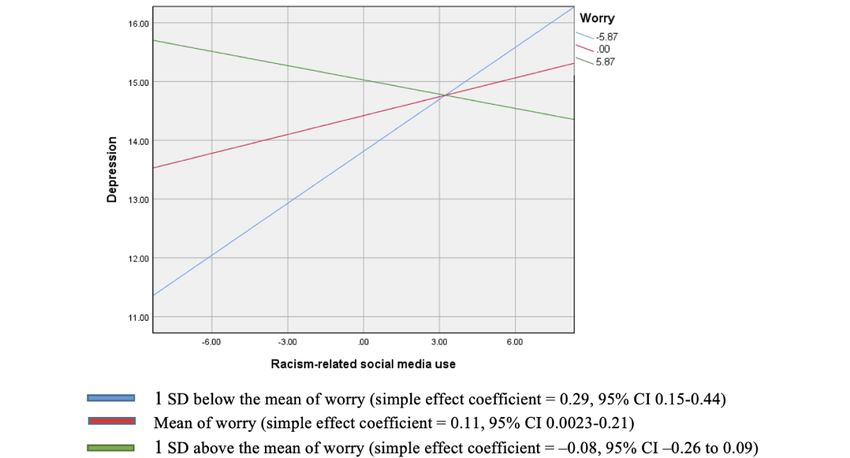
     about discrimination moderated the relationship between racism-related social media use and depression (β=–.25, P=.003) such
     that a positive relationship was observed among those who had low and medium levels of worry.
     Conclusions: The present study provided preliminary evidence that experience of discrimination during the COVID-19 pandemic
     was a risk factor of depressive symptoms among Asian people in the United States. Meanwhile, racism-related social media use
     was found to be negatively associated with the well-being of US Asians, and the relationship between social media use and
     depression was significantly moderated by worry about discrimination. It is critical to develop accessible programs to help US
     Asians cope with racial discrimination both in real lives and on social media during this unprecedented health crisis, especially
     among those who have not been mentally prepared for such challenges.

     (J Med Internet Res 2021;23(9):e29024) doi: 10.2196/29024

     KEYWORDS
     racial discrimination; experience of discrimination; worry about discrimination; depression; social media use; COVID-19

                                                                               attacks against people who appear to be Asian have been
     Introduction                                                              documented [1,2]. The growing discrimination against the Asian
     Since the COVID-19 outbreak, anti-Asian racism and                        community, combined with multifaceted pressures from the
     xenophobia has been spurred in the United States, and violent             COVID-19 crisis, can make Asian people more vulnerable to

     https://www.jmir.org/2021/9/e29024                                                                   J Med Internet Res 2021 | vol. 23 | iss. 9 | e29024 | p. 1
                                                                                                                        (page number not for citation purposes)
XSL• FO
RenderX
JOURNAL OF MEDICAL INTERNET RESEARCH Pan et al
mental health problems. Recent work has provided insights into seeing racist acts against other members of one’s racial group,
the deteriorating impact of COVID-fueled discrimination on was also associated with higher levels of depression and anxiety
Asians’ mental health conditions [3,4], but it leaves two among Asian Americans [21].
important gaps. First, Asians were more likely to use social
Current conceptualizations of racial discrimination vary across
media for COVID-19–related information than other media
literatures, but almost all attempt to measure it in a subjective
sources, thereby amplifying the possibility to encounter
way, asking about the perception of racial discrimination in
discrimination-related news reports or personal narratives [5,6].
cognitive, affective, and behavioral domains [22]. Some scholars
However, there has not been sufficient attention toward how
explain that it is because most incidents of discrimination are
using social media to read, post, and talk about discrimination
subtle and hard to document [23]. Importantly, scholars have
and racism associated with COVID-19 would relate to Asians’
pointed out the necessity to differentiate two related but distinct
well-being. Second, worry emerges as a common emotional
constructs of perceived racial discrimination: one is the
response among these individuals after having directly
perception of discrimination actually encountered by oneself
experienced discrimination and/or reading about personal stories
and the other is the general worry about the fact that oneself
shared on social platforms. Worry could negatively influence
could be a potential target of racial discrimination in the future
one’s mental health, depending on the levels of exposure to
[24]. It is worthwhile to examine the two constructs’ unique
racial discrimination. More empirical research is needed to fully
relationship with depression, as previous literature suggested
explore these contributing factors to mental health outcomes,
that the two might have different psychological implications.
as Asian ethnic groups face lingering metal health consequences
Although experienced discrimination was consistently associated
from the COVID-19 pandemic.
with poor well-being [20,21], the role of worry seemed less
In an attempt to empirically examine the psychological conclusive. Worry is a normal mental reaction to impending
consequences of racial discrimination associated with the events in our lives, and it only poses a threat when it becomes
COVID-19 outbreak among Asian people in the United States, persistent and less controllable [25,26]. Under some situations,
we looked into three factors related to discrimination during it can be instrumental by motivating people to cope, to conduct
this period and examined their associations with depressive more analytical thinking, and to take more goal-oriented actions
symptoms among US Asians. These factors included: (1) [27,28]. In the current study, we included both direct experience
experience of discrimination, (2) worry about discrimination, of discrimination during the COVID-19 outbreak among our
and (3) racism-related social media use during the COVID-19 study participants, as well as their worry about being
outbreak. We also investigated whether the relationship between discriminated. Together, we proposed the following hypothesis
social media use and depression was contingent upon one’s and research questions:
experience of and worry about discrimination.
• Hypothesis 1 (H1): Experience of discrimination would be
Racial discrimination is defined as a phenomenon wherein positively associated with depression among US Asians
people are unfairly treated or disadvantaged because of their during the COVID-19 outbreak.
race or phenotypic difference [7]. This could occur in • Research question (RQ) 1: How would worry about
interpersonal interactions, at the workplace, in education discrimination be associated with depression among US
settings, or in receiving services and justice [8]. In some worse Asians during the COVID-19 outbreak?
cases, racial discrimination could take forms of hate crimes or
In addition to the experience of and worry about discrimination,
physical attacks [9]. It is not a new phenomenon that the
social media also plays a role in US Asians’ psychological
outbreak of an infectious disease could trigger discrimination
well-being during the COVID-19 pandemic [19]. During the
against racial and ethnic minorities [10]. Several recent studies
pandemic, racism-related content has become more visible on
have documented the salient evidence that Asians in the United
social media. A study found a nearly 10-fold increase of tweets
States have encountered increasing levels of racial
containing “Chinese virus” or “China virus” in the week after
discrimination since the COVID-19 outbreak [11,12].
former US President Trump mentioned this term on March 16,
A huge amount of research has provided empirical evidence 2020, compared to the tweets in the week prior [29]. The
that racial discrimination can have negative impacts on the sentiment analysis of these tweets suggested that the majority
well-being of the stigmatized [13-15]. Racial discrimination contained negative emotions, such as fear, sadness, anger, and
can likely damage well-being through the process where one disgust [29]. Another study also analyzed the sentiment of
feels being rejected or excluded by the society and thus finds race-related tweets before and following the emergence of
it harder to take control of their lives [16]. The above-described COVID-19 and found that the proportion of negative tweets
findings were also applicable to the Asian population in the referencing Asians increased by 68.4% from November 2019
United States. [17-19]. Recent studies have found that racial to March 2020 [30].
discrimination against Asian people is negatively associated
Social media use during this period can thus expose Asian users
with psychological well-being among this group during the
to greater risk for mental health concerns. Incidental and
COVID-19 outbreak [20,21]. One study found that direct
frequent encounter with racist posts on social media might make
experiences of racial discrimination during this period were
racism-related information in memory particularly accessible,
associated with higher levels of anxiety and depressive
leading to a perceived social reality where being Asian is unsafe
symptoms among Chinese American parents and youth [20].
and devalued [31]. A study showed that social media exposure
Another study found that vicarious racism, defined as indirect
to COVID-related information was associated with higher odds
experiences of discrimination experienced by hearing about or
https://www.jmir.org/2021/9/e29024 J Med Internet Res 2021 | vol. 23 | iss. 9 | e29024 | p. 2
(page number not for citation purposes)
XSL• FO
RenderXJOURNAL OF MEDICAL INTERNET RESEARCH Pan et al
of anxiety and depression among the public in China during the • RQ3: How would worry about discrimination moderate the
COVID-19 outbreak, after controlling for various demographic relationship between social media use and depression among
factors [32]. The authors attributed the findings to US Asians during the COVID-19 outbreak?
misinformation on social media and users’ risk perception of
contracting COVID-19. Although the interpretation is Methods
reasonable, for US Asians, engagement with COVID-19–related
information on social media, which commonly included Procedures
anti-Asian sentiments [29,30], may trigger another layer of A web-based, cross-sectional survey approved by the
fear—fear for becoming the target of discrimination or institutional review board was first created on Qualtrics and
victimization [33]. Nevertheless, to our knowledge, no research then distributed to qualified participants via Amazon Mechanical
has been conducted on how reading, posting, and talking about Turk (MTurk) in mid-May 2020. Eligible participants included
COVID-19–related racism on social media would relate to US those belonging to Asian ethnic groups and residing in the
Asians’ mental health. To bridge the gap, we proposed the United States. The first page of the questionnaire was a consent
following hypothesis: form providing the participants with brief background on the
• Hypothesis 2 (H2): Racism-related social media use would study and information about anonymity, confidentiality, and
be positively related to depression among US Asians during compensation. The rest of the pages asked questions about
the COVID-19 outbreak. demographic information, media usage, discrimination-related
experiences and perceptions during the COVID-19 outbreak,
Finally, this study attempted to examine how the association and some psychological measurements. Attention checkers were
between racism-related social media use and depression would included to ensure data quality. The survey took an average of
be moderated by personal experience of and worry about 15 minutes to complete.
discrimination. As posited in cultivation theory [34,35], the
effect of media exposure on personal opinions and feelings Participants
would be moderated by personal experiences. They further We recruited 242 eligible participants who were Asians residing
proposed that the moderation effect could go in two different in the United States, and a total of 209 participants were
directions, which were defined as the mainstream effect (ie, included in this study after using a listwise deletion approach
people would be more influenced if they have limited (ie, those who answered “not sure” or “prefer not to answer” in
experiences of the media content) and the resonance effect (ie, any questions were coded as having a missing value and were
people would be more influenced if they have more experiences excluded from the analyses). To determine if we achieved the
of the media content). needed sample size for our regression analyses, an a priori
sample size calculator for multiple regressions was used. The
The vulnerability-stress model also argues that the extent to
result showed that, with the anticipated medium effect size set
which a stressful event could trigger a mental disorder would
at 0.15, the statistical power level set at 0.80, and the
depend on an individual’s vulnerability, which could be
significance level set at P=.05, the minimum sample size
psychological, biological, or situational factors [36]. We
required for the current study was 131. Thus, we had reached
considered depression as the result of the interaction between
the sample size requirement in this study.
worry about discrimination and racism-related social media use.
As mentioned above, worry is an emotional reaction to future The participants were between the ages of 18 and 73 years (mean
uncertainties, which could play a positive role in 33.69, SD 11.31 years). Among them, 96 (45.93%) were female
problem-solving in some situations [27,28]. In our case, worry and 113 (54.07%) were male participants. Most participants
might buffer the influence of racism-related social media use were either single (n=105, 50.24%) or married (n=97, 46.41%).
on depression by motivating people to solve the problem. The majority of the participants had a bachelor’s degree (n=106,
Meanwhile, it is also possible for worry to play a negative role 50.72%), with the remaining holding a degree below (n=50,
in such relationships if it does not direct people to take positive 23.92%) or above the bachelor’s level (n=53, 25.36%). About
actions. As the moderating roles of discrimination-related half of the participants (n=97, 46.41%) has a full-time
experience and worry remained unclear, we proposed the employment. The income levels were relatively evenly
following two additional research questions: distributed among participants, but more than half of the
participants (n=115, 55.02%) reported that their income had
• RQ2: How would the experience of discrimination moderate
somehow been affected by the COVID-19 pandemic.
the relationship between social media use and depression
Meanwhile, most participants did not identify themselves as
among US Asians during the COVID-19 outbreak?
Chinese (n=135, 64.59%). Table 1 presents demographic
information of the sample.
https://www.jmir.org/2021/9/e29024 J Med Internet Res 2021 | vol. 23 | iss. 9 | e29024 | p. 3
(page number not for citation purposes)
XSL• FO
RenderXJOURNAL OF MEDICAL INTERNET RESEARCH Pan et al
Table 1. Descriptive analysis of the sample (N=209).
Variables Respondents, n (%)
Age in years (range: 18-73 years)
≤30 92 (44.02)
>30 117 (55.98)
Gender
Male 113 (54.07)
Female 96 (45.93)
Marital status
Single 105 (50.24)
Married 97 (46.41)
Widowed 2 (0.96)
Divorced 5 (2.39)
Education
Less than high school degree 1 (0.48)
High school graduate 8 (3.83)
Some college but no degree 29 (13.88)
Associate degree 12 (5.74)
Bachelor’s degree 106 (50.72)
Master’s degree 39 (18.66)
Doctoral degree 14 (6.70)
Employment status
Employed, working 40 or more hours per week 97 (46.41)
Employed, working 1-39 hours per week 46 (22.01)
Not employed, looking for work 41 (19.62)
Not employed, not looking for work 21 (10.05)
Retired 4 (1.91)
Income (US $)JOURNAL OF MEDICAL INTERNET RESEARCH Pan et al
Variables Respondents, n (%)
Yes 74 (35.41)
No 135 (64.59)
considered as a control factor because of the close connection
Measurements between the COVID-19 outbreak and China. We also asked
Experience of Discrimination respondents whether their family incomes had been affected
since the COVID-19 outbreak, as it has been documented as a
The 5-item Everyday Discrimination Scale [37] was adapted to
key stressor during the pandemic [39].
measure how often the respondents had experienced
discrimination since the COVID-19 outbreak. The scale ranged Data Analysis
from 1 (“never”) to 5 (“a lot”). The five items were as follows: To address the issues of measurement errors, we performed
(1) “You are treated with less courtesy or respect than other confirmatory factor analysis in Mplus (version 7; Muthén &
people”; (2) “You receive poorer service than other people”; Muthén) by considering experience of discrimination, worry
(3) “People will act as if they think you are dangerous”; (4) about discrimination, social media use, and depression as latent
“People act as if they are afraid of you”; (5) “You are threatened variables. The initial model fit was mediocre, and 3
or harassed.” The item “People act as if they think you are not reverse-coded items of the depression scale had low loadings
smart” from the original scale was changed as “People act as if (JOURNAL OF MEDICAL INTERNET RESEARCH Pan et al
medium levels of worry, social media use was positively and In addition, female Asians were found to be more depressed
significantly related to depression (simple effect coefficient=0.29 than male Asians (β=–.14, P=.02), and Chinese Asians were
for low worry, 95% CI 0.15-0.44; simple slope coefficient=0.11 less depressed than those Asians who were not Chinese (β=–.12,
for medium worry, 95% CI 0.0023-0.21). No significant P=.045).
relationship between social media use and depression was found
at a high level of worry.
Table 2. Ordinary least squares multiple regression analysis of depression scores as a function of discrimination-related variables and control variables
(N=209).
Variables Model 1 Model 2 Model 3
β P value β P value β P value
Age –.18 .02 –.15 .029 –.13 .05
Gender (male) –.12 .08 –.14 .020 –.14 .02
Marital status (married) –.08 .29 –.10 .16 –.11 .12
Education –.04 .62 –.06 .33 –.07 .27
Employed (full time) .04 .62 .03 .61 .02 .72
Income –.06 .45 –.04 .52 –.06 .37
Income affected (yes) .12 .07 .07 .28 .06 .31
Chinese .00 .99 –.11 .06 –.12 .045
Experience of discrimination N/Aa N/A .34JOURNAL OF MEDICAL INTERNET RESEARCH Pan et al
Although worry was not a significant independent variable, it
Discussion was a significant moderator for the relationship between social
Principal Findings media use and depression. Specifically, among Asians with low
and medium levels of worry about discrimination, social media
The present study provides preliminary evidence that experience use was related to higher levels of depression. A possible
of discrimination during the COVID-19 pandemic is a risk factor explanation for our finding might be that Asians with low to
for depressive symptoms among Asians in the United States. medium worry were less prepared for anti-Asian discrimination.
Meanwhile, racism-related social media use was also found to Thus, they felt more overwhelmed and depressed when exposed
be negatively related to the well-being of US Asians, and the to greater amount of racism-related information on social media.
relationship between social media use and depression was Future research should explore in detail how US Asians with
moderated by worry about discrimination, such that social media low and high worry cope with racial discrimination in different
use was associated with greater depression among those who ways that may buffer or exacerbate the influence of social media
were less worried about discrimination. use on depression. Meanwhile, it is also worthwhile to explore
Drawing on survey data from 209 Asians residing in the United more factors that might moderate the relationship between social
States, the study presents the findings consistent with earlier media use and depression, such as coping strategies, perceived
research [20,21] showing that experience of racial discrimination social support, and so forth.
induced by the COVID-19 pandemic was negatively related to In terms of demographic factors considered in our regression
the well-being among Asian people. Effective interventions model, we found that female Asians were more depressed than
should be designed to provide timely assistance to Asians who male Asians, which is consistent with findings of previous
have experienced discrimination during the pandemic to prevent studies [41,42]. Surprisingly, Chinese Asians were found to be
them from developing further depressive symptoms. One less depressed than Asians who were not Chinese. Although
limitation of the current study is the use of an existing Asians are normally being treated as one single ethnic group in
measurement of experienced racial discrimination, which may the United States, research does indicate that there might be
fail to capture the specific experiences of racial discrimination differences in the mental health mechanisms among various
associated with the COVID-19 pandemic. Further research could Asian ethnicities. For example, it was indicated that Chinese
focus on understanding the unique elements of racial Americans had lower prevalence of depression than Korean and
discrimination in the COVID-19 context so that more accurate Vietnamese Americans [43]. Further study is needed to identify
conclusions could be made. how the mental health conditions of different Asian groups have
Using social media to read, post, and talk about racism was also been impacted by the COVID-19 pandemic.
found to be associated with higher depression. It is noteworthy Limitations and Conclusions
that the relationship was significant when controlling for direct
experience of discrimination (albeit with a smaller effect size The study has some limitations. The first is that the research
than direct experience). Given how fast-growing and visible model was not evaluated with a random sample. Therefore,
anti-Asian sentiments have been on social media during the readers are advised to take caution when generalizing the results
pandemic [29,30], and that Asians were more likely to use social to the overall Asian population in the United States or Asian
media than other media sources to obtain COVID-19–related groups in another country. Another limitation is that the
information [5,6], our finding deserves serious attention. It is cross-sectional study does not allow for drawing causal
also worth mentioning that our social media use scale includes conclusions, and thus the findings should be interpreted as
a variety of social media activities (eg, reading, posting, correlations rather than as having a cause-and-effect relationship.
commenting, private messaging) through which individuals Despite all these limitations, the present study extends the
may be exposed to and engage with racism-related information. current literature on rising anti-Asian discrimination and
Relative to single-item questions asking about participants’ associated mental health outcomes in several ways. First, we
social media use in one particular way, such as exposure to or differentiated the actual experience of discrimination and worry
consumption of a certain type of information [32,40], our scale about discrimination and revealed their unique relationship with
has the strength of more comprehensively capturing multiple depression among US Asians in the context of the COVID-19
ways of social media use during the pandemic. pandemic. Another theoretical contribution is providing
Worry about discrimination was not directly associated with important insights into the specific role of racism-related social
depression in the present study. When worry about media use in mental health among a minority group. Importantly,
discrimination was considered alongside the actual experience the results suggest that US Asians with higher versus lower
of discrimination, it was the actual experience that was levels of worry face different degrees of susceptibility to the
detrimental. As shown in previous literature, the benefits and negative influences of racism-related social media use on mental
detriments of worry may have cancelled out each other, leading health.
to a nonsignificant direct association [25-28]. It may be From a practical perspective, immediate and effective
worthwhile for future research to explore possible moderators interventions should be implemented to decrease racist and
of this relationship, such as coping styles and social discriminatory behaviors against US Asians, as direct experience
support-seeking behaviors, to better understand the implications of discrimination was found to be a robust risk factor for
of this type of worry for mental health. depression among this group, after controlling for various
demographic variables. It is also critical to develop accessible
https://www.jmir.org/2021/9/e29024 J Med Internet Res 2021 | vol. 23 | iss. 9 | e29024 | p. 7
(page number not for citation purposes)
XSL• FO
RenderXJOURNAL OF MEDICAL INTERNET RESEARCH Pan et al
programs to help US Asians cope with racial discrimination health crisis, especially among those who have not been
both in real lives and on social media during this unprecedented mentally prepared for such challenges.
Acknowledgments
This study was supported by Journalism and Marxism Research Center, Renmin University of China (Project Number: 19MXG06).
Conflicts of Interest
None declared.
References
1. Covid-19 fueling anti-Asian racism and xenophobia worldwide. Human Rights Watch. URL: https://www.hrw.org/news/
2020/05/12/covid-19-fueling-anti-asian-racism-and-xenophobia-worldwide [accessed 2020-06-01]
2. Haynes S. As coronavirus spreads, so does xenophobia and anti-Asian racism. Time. URL: https://time.com/5797836/
coronavirus-racism-stereotypes-attacks [accessed 2020-05-18]
3. Wu C, Qian Y, Wilkes R. Anti-Asian discrimination and the Asian-white mental health gap during COVID-19. Ethnic and
Racial Studies 2020 Dec 14;44(5):819-835. [doi: 10.1080/01419870.2020.1851739]
4. Choi S, Hong JY, Kim YJ, Park H. Predicting psychological distress amid the COVID-19 pandemic by machine learning:
discrimination and coping mechanisms of Korean immigrants in the U.S. Int J Environ Res Public Health 2020 Aug
20;17(17):6057 [FREE Full text] [doi: 10.3390/ijerph17176057] [Medline: 32825349]
5. Liu PL. COVID-19 information on social media and preventive behaviors: managing the pandemic through personal
responsibility. Soc Sci Med 2021 May;277:113928 [FREE Full text] [doi: 10.1016/j.socscimed.2021.113928] [Medline:
33865093]
6. Yu N, Pan S, Yang C, Tsai J. Exploring the role of media sources on COVID-19-related discrimination experiences and
concerns among Asian people in the United States: cross-sectional survey study. J Med Internet Res 2020 Nov
06;22(11):e21684 [FREE Full text] [doi: 10.2196/21684] [Medline: 33108307]
7. Fox S, Stallworth LE. Racial/ethnic bullying: exploring links between bullying and racism in the US workplace. J Vocat
Behav 2005 Jun;66(3):438-456. [doi: 10.1016/j.jvb.2004.01.002]
8. Chakraborty A, McKenzie K. Does racial discrimination cause mental illness? Br J Psychiatry 2002 Jun;180:475-477. [doi:
10.1192/bjp.180.6.475] [Medline: 12042221]
9. Barnes A, Ephross P. The impact of hate violence on victimsmotional and behavioral responses to attacks. Social Work
1994;39(3):247-251. [doi: 10.1093/sw/39.3.247]
10. Gover AR, Harper SB, Langton L. Anti-Asian hate crime during the COVID-19 pandemic: exploring the reproduction of
inequality. Am J Crim Justice 2020 Jul 07:1-21 [FREE Full text] [doi: 10.1007/s12103-020-09545-1] [Medline: 32837171]
11. Ruiz N, Horowitz J, Tamir C. Many Black and Asian Americans say they have experienced discrimination amid the
COVID-19 outbreak. Pew Research Center. 2020 Jul 01. URL: https://www.pewresearch.org/social-trends/2020/07/01/
many-black-and-asian-americans-say-they-have-experienced-discrimination-amid-the-covid-19-outbreak/ [accessed
2021-08-24]
12. Stop AAPI Hate Reporting Center. Asian Pacific Policy and Planning Council. URL: http://www.
asianpacificpolicyandplanningcouncil.org/stop-aapi-hate/ [accessed 2020-07-17]
13. Benner AD, Wang Y, Shen Y, Boyle AE, Polk R, Cheng Y. Racial/ethnic discrimination and well-being during adolescence:
A meta-analytic review. Am Psychol 2018 Oct;73(7):855-883 [FREE Full text] [doi: 10.1037/amp0000204] [Medline:
30024216]
14. Brown TN, Williams DR, Jackson JS, Neighbors HW, Torres M, Sellers SL, et al. “Being black and feeling blue”: the
mental health consequences of racial discrimination. Race and Society 2000 Jan;2(2):117-131. [doi:
10.1016/s1090-9524(00)00010-3]
15. Feinstein BA, Goldfried MR, Davila J. The relationship between experiences of discrimination and mental health among
lesbians and gay men: An examination of internalized homonegativity and rejection sensitivity as potential mechanisms.
J Consult Clin Psychol 2012 Oct;80(5):917-927. [doi: 10.1037/a0029425]
16. Wirth JH, Williams KD. 'They don't like our kind': consequences of being ostracized while possessing a group membership.
Group Processes & Intergroup Relations 2009 Jan 01;12(1):111-127. [doi: 10.1177/1368430208098780]
17. Hwang W, Goto S. The impact of perceived racial discrimination on the mental health of Asian American and Latino
college students. Cultur Divers Ethnic Minor Psychol 2008 Oct;14(4):326-335. [doi: 10.1037/1099-9809.14.4.326] [Medline:
18954168]
18. Yip T, Gee GC, Takeuchi DT. Racial discrimination and psychological distress: the impact of ethnic identity and age among
immigrant and United States-born Asian adults. Dev Psychol 2008 May;44(3):787-800 [FREE Full text] [doi:
10.1037/0012-1649.44.3.787] [Medline: 18473644]
https://www.jmir.org/2021/9/e29024 J Med Internet Res 2021 | vol. 23 | iss. 9 | e29024 | p. 8
(page number not for citation purposes)
XSL• FO
RenderXJOURNAL OF MEDICAL INTERNET RESEARCH Pan et al
19. Yang C, Tsai J, Pan S. Discrimination and well-being among Asians/Asian Americans during COVID-19: the role of social
media. Cyberpsychol Behav Soc Netw 2020 Dec;23(12):865-870. [doi: 10.1089/cyber.2020.0394] [Medline: 32762541]
20. Cheah CS, Wang C, Ren H, Zong X, Cho HS, Xue X. COVID-19 racism and mental health in Chinese American families.
Pediatrics 2020 Nov;146(5):e2020021816. [doi: 10.1542/peds.2020-021816] [Medline: 32873719]
21. Chae DH, Yip T, Martz CD, Chung K, Richeson JA, Hajat A, et al. Vicarious racism and vigilance during the COVID-19
pandemic: mental health implications among Asian and Black Americans. Public Health Rep 2021 May 25;136(4):508-517.
[doi: 10.1177/00333549211018675] [Medline: 34034574]
22. Atkins R. Instruments measuring perceived racism/racial discrimination: review and critique of factor analytic techniques.
Int J Health Serv 2014 Oct 01;44(4):711-734. [doi: 10.2190/hs.44.4.c]
23. Dovidio JF, Gaertner SL. Changes in the expression and assessment of racial prejudice. In: Knopke HJ, Norrell RJ, Rogers
RW, editors. Opening doors: perspectives on race relations in contemporary America. Tuscaloosa, AL: The University of
Alabama Press; 1991:119-148.
24. Paradies YC. Defining, conceptualizing and characterizing racism in health research. Crit Public Health 2006
Jun;16(2):143-157. [doi: 10.1080/09581590600828881]
25. Craske MG, Rapee RM, Jackel L, Barlow DH. Qualitative dimensions of worry in DSM-III-R generalized anxiety disorder
subjects and nonanxious controls. Behav Res Ther 1989;27(4):397-402. [doi: 10.1016/0005-7967(89)90010-7]
26. Wells A. Meta-cognition and worry: a cognitive model of generalized anxiety disorder. Behav Cogn Psychother 2009 Jun
16;23(3):301-320. [doi: 10.1017/s1352465800015897]
27. Davey GCL, Tallis F, Capuzzo N. Beliefs about the consequences of worrying. Cogn Ther Res 1996 Oct;20(5):499-520.
[doi: 10.1007/bf02227910]
28. Sweeny K, Dooley MD. The surprising upsides of worry. Soc Personal Psychol Compass 2017 Apr 18;11(4):e12311. [doi:
10.1111/spc3.12311]
29. Dubey AD. The resurgence of cyber racism during the COVID-19 pandemic and its aftereffects: analysis of sentiments
and emotions in tweets. JMIR Public Health Surveill 2020 Oct 15;6(4):e19833-e19551 [FREE Full text] [doi: 10.2196/19833]
[Medline: 32936772]
30. Nguyen TT, Criss S, Dwivedi P, Huang D, Keralis J, Hsu E, et al. Exploring U.S. shifts in anti-Asian sentiment with the
emergence of COVID-19. Int J Environ Res Public Health 2020 Sep 25;17(19):7032 [FREE Full text] [doi:
10.3390/ijerph17197032] [Medline: 32993005]
31. Shrum LJ. Media Consumption and Perceptions of Social Reality: Effects and Underlying Processes. In: Bryant J, Oliver
MB, editors. Media Effects: Advances in Theory and Research. New York, NY: Routledge; 2002:50-73.
32. Gao J, Zheng P, Jia Y, Chen H, Mao Y, Chen S, et al. Mental health problems and social media exposure during COVID-19
outbreak. PLoS One 2020;15(4):e0231924 [FREE Full text] [doi: 10.1371/journal.pone.0231924] [Medline: 32298385]
33. Custers K, Dorrance Hall E, Bushnell Smith S, McNallie J. The indirect association between television exposure and
self-protective behavior as a result of worry about crime: the moderating role of gender. Mass Commun Soc 2017 Apr
17;20(5):637-662. [doi: 10.1080/15205436.2017.1317353]
34. Shrum J, Bischak D. Mainstreaming, resonance, and impersonal impact. Human Comm Res 2001 Apr;27(2):187-215. [doi:
10.1111/j.1468-2958.2001.tb00780.x]
35. Gerbner G, Gross L, Signorielli N, Morgan M. Aging with television: images on television drama and conceptions of social
reality. J Commun 1980;30(1):37-47. [doi: 10.1111/j.1460-2466.1980.tb01766.x] [Medline: 7372841]
36. Ingram R, Luxton D. Vulnerability-Stress Models. In: Hankin BL, Abela JRZ, editors. Development of Psychopathology:
a vulnerability stress perspective (pp. 32-46).; Thousand Oaks. Thousand Oaks, CA: Sage Publications, Inc; 2005:32-46.
37. Sternthal MJ, Slopen N, Williams DR. Racial disparities in health. Du Bois Rev 2011 Apr 15;8(1):95-113. [doi:
10.1017/s1742058x11000087]
38. Meadows SO, Brown JS, Elder GH. Depressive symptoms, stress, and support: gendered trajectories from adolescence to
young adulthood. J Youth Adolescence 2006 Mar 18;35(1):89-99. [doi: 10.1007/s10964-005-9021-6]
39. Chiwaya N, Wu J. The coronavirus has destroyed the job market in every state. NBC News. 2020 Apr 14. URL: https:/
/www.nbcnews.com/business/economy/unemployment-claims-state-see-how-covid-19-has-destroyed-job-n1183686
[accessed 2020-07-05]
40. Ni MY, Yang L, Leung CMC, Li N, Yao XI, Wang Y, et al. Mental health, risk factors, and social media use during the
COVID-19 epidemic and cordon sanitaire among the community and health professionals in Wuhan, China: cross-sectional
survey. JMIR Ment Health 2020 May 12;7(5):e19009 [FREE Full text] [doi: 10.2196/19009] [Medline: 32365044]
41. Bromet E, Andrade LH, Hwang I, Sampson NA, Alonso J, de Girolamo G, et al. Cross-national epidemiology of DSM-IV
major depressive episode. BMC Med 2011 Jul 26;9(1):90 [FREE Full text] [doi: 10.1186/1741-7015-9-90] [Medline:
21791035]
42. Salk RH, Hyde JS, Abramson LY. Gender differences in depression in representative national samples: meta-analyses of
diagnoses and symptoms. Psychol Bull 2017 Aug;143(8):783-822 [FREE Full text] [doi: 10.1037/bul0000102] [Medline:
28447828]
https://www.jmir.org/2021/9/e29024 J Med Internet Res 2021 | vol. 23 | iss. 9 | e29024 | p. 9
(page number not for citation purposes)
XSL• FO
RenderXJOURNAL OF MEDICAL INTERNET RESEARCH Pan et al
43. Chau V, Bowie JV, Juon H. The association of perceived discrimination and depressive symptoms among Chinese, Korean,
and Vietnamese Americans. Cultur Divers Ethnic Minor Psychol 2018 Jul;24(3):389-399 [FREE Full text] [doi:
10.1037/cdp0000183] [Medline: 29389149]
Abbreviations
H1: hypothesis 1
H2: hypothesis 2
RQ: research question
Edited by G Eysenbach; submitted 22.03.21; peer-reviewed by D Zhang, D Liu; comments to author 14.04.21; revised version received
28.06.21; accepted 01.08.21; published 01.09.21
Please cite as:
Pan S, Yang CC, Tsai JY, Dong C
Experience of and Worry About Discrimination, Social Media Use, and Depression Among Asians in the United States During the
COVID-19 Pandemic: Cross-sectional Survey Study
J Med Internet Res 2021;23(9):e29024
URL: https://www.jmir.org/2021/9/e29024
doi: 10.2196/29024
PMID: 34351304
©Shuya Pan, Chia-chen Yang, Jiun-Yi Tsai, Chenyu Dong. Originally published in the Journal of Medical Internet Research
(https://www.jmir.org), 01.09.2021. This is an open-access article distributed under the terms of the Creative Commons Attribution
License (https://creativecommons.org/licenses/by/4.0/), which permits unrestricted use, distribution, and reproduction in any
medium, provided the original work, first published in the Journal of Medical Internet Research, is properly cited. The complete
bibliographic information, a link to the original publication on https://www.jmir.org/, as well as this copyright and license
information must be included.
https://www.jmir.org/2021/9/e29024 J Med Internet Res 2021 | vol. 23 | iss. 9 | e29024 | p. 10
(page number not for citation purposes)
XSL• FO
RenderXYou can also read


