Extending the known distribution of Nicosia's chameleon, Archimer
←
→
Page content transcription
If your browser does not render page correctly, please read the page content below

Herpetology Notes, volume 14: 455-460 (2021) (published online on 26 February 2021)

       Extending the known distribution of Nicosia’s chameleon,
         Furcifer nicosiai Jesu, Mattioli & Schimmenti, 1999
                    (Squamata: Chamaeleonidae)

    Francesco Belluardo1,*, Gonçalo M. Rosa2,3, Franco Andreone4, Elodie A. Courtois5, Javier Lobón-Rovira1,
       Ronald A. Nussbaum6, Miary Raselimanana7, Malalatiana Rasoazanany7, Christopher J. Raxworthy8,
                                            and Angelica Crottini1

  The genus Furcifer Fitzinger, 1843 includes 24                 region (Fig. 1, white circles; Table 1) (Randrianantoandro
species of chameleons, most of which are endemic to              et al., 2008; Raselimanana, 2008; Bora et al., 2010;
Madagascar (Glaw and Vences, 2007; Uetz et al., 2020).           Randriamoria, 2011; Brown et al., 2014; Goodman et
Furcifer nicosiai Jesu, Mattioli & Schimmenti, 1999              al., 2018). Furcifer nicosiai habitat encompasses dense
is a medium-sized species belonging to the Furcifer              sub-humid and dry forests of low elevation, between
verrucosus (Cuvier, 1829) phenetic group (Glaw and               57–571 m above sea level ~ a.s.l. (Bora et al., 2010).
Vences, 2007). Although slightly smaller, F. nicosiai is           Several records within the Menabe region (within the
morphologically similar to Furcifer oustaleti (Mocquard,         Paysage Harmonieux Protégé de Menabe Antimena,
1894), whose subadults can be mistaken with adults of            about 60 km south of Tsingy de Bemaraha) refer to
this species (Glaw and Vences, 2007).                            a population of F. nicosiai that appears to have some
  With Tsingy de Bemaraha as the type locality of F.             morphological differences to the population from the
nicosiai (Jesu et al., 1999), the species was thought to         type locality. A molecular characterisation is needed
have a distribution limited to western Madagascar, with,         to assess the taxonomic identity of these populations,
until now, only a few additional records in the Melaky           but for consistency we here continue to assign them to
                                                                 this species (Raselimanana, 2008; Randrianantoandro
                                                                 et al., 2010; Eckhardt et al., 2019) (Fig. 1, white
                                                                 circles; Table 1). In this area, where two populations
1
  Centro de Investigação em Biodiversidade e Recursos
                                                                 of F. nicosiai were recently studied, the species was
    Genéticos, Universidade do Porto, Rua Padre Armando
    Quintas, Campus de Vairão, 4485-661 Vairão, Portugal.        found roosting at 1.8 to 3.5 m height on tree and shrub
2
  Institute of Zoology, Zoological Society of London, Regent’s   branches (2.5 cm diameter at breast height) (Fig. 2F–G).
    Park, NW1 4RY London, United Kingdom.                        These populations were associated with native western
3
  Centre for Ecology, Evolution and Environmental Changes,       deciduous forest with low levels of human impact, with
    Faculdade de Ciências da Universidade de Lisboa, Campo       many lianas and an extensive tree canopy cover.
    Grande,1749-016 Lisboa, Portugal.
                                                                   Here we summarise the data on F. nicosiai distribution
4
  Museo Regionale di Scienze Naturali, Via G. Giolitti 36,
    I-10123 Torino, Italy.
                                                                 and report on a significant range extension (300 km) for
5
  Laboratoire Ecologie, Evolution, Interactions des Systèmes     the species. The new records are the results of multiple
    Amazoniens, Université de Guyane, CNRS, IFREMER,             surveys in Tsaranoro Forest, Makay Massif, Dabara
    Cayenne, France.                                             Forest, and Kirindy Mitea National Park (Fig. 1; Table 1).
6
  Division of Reptiles and Amphibians, Museum of Zoology,        We collected five tissue samples and 25 specimens that
    Research Museums Center, University of Michigan, 3600
                                                                 were fixed in 10% formalin or 90% ethanol and preserved
    Varsity Drive, 48108 Ann Arbor, Michigan, USA.
                                                                 in 70% ethanol for long-term storage. Specimens
7
  Mention Zoologie et Biodiversité Animale, Domaine des
    Sciences et Technologies, Université d’Antananarivo, B.P.    were deposited in the herpetological collections of the
    906, 101 Antananarivo, Madagascar.                           Zoologische Staatssammlung, Munich, Germany (ZSM),
8
  Department of Herpetology, American Museum of Natural          the American Museum of Natural History, New York
    History, 10024 New York, New York, USA.                      City, USA (AMNH), Mention Zoologie et Biodiversité
*
  Corresponding author. E-mail: france89belluardo@gmail.com      Animale, Domaine des Sciences et Technologies,
© 2021 by Herpetology Notes. Open Access by CC BY-NC-ND 4.0.     Université d’Antananarivo, Antananarivo, Madagascar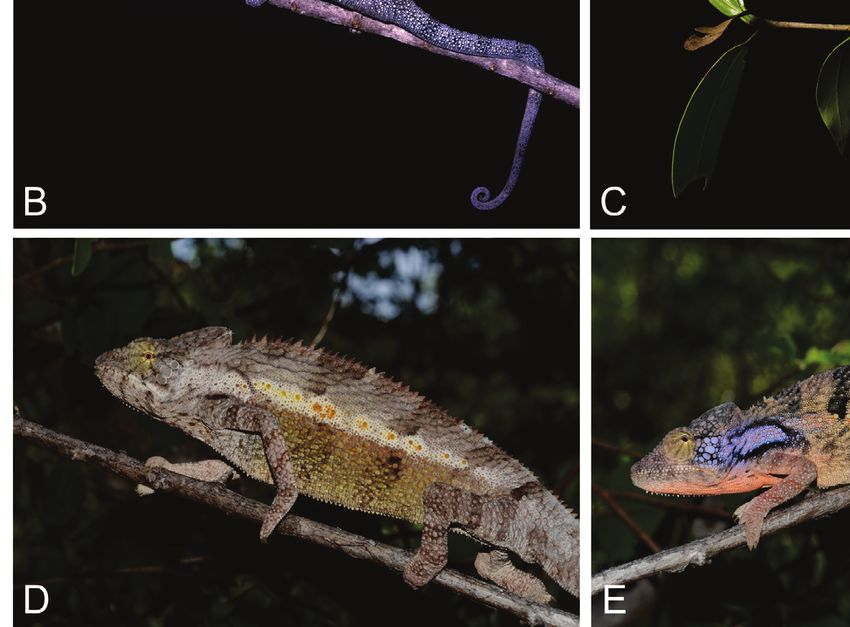
456                                                                                              Francesco Belluardo et al.

                                                                  conservation status of the species. We computed the
                                                                  Area of Occupancy (AOO), using a grid cell width of 2
                                                                  km, and the Extent of Occurrence (EOO) with GeoCAT
                                                                  (Bachman et al., 2011). When precise occurrences
                                                                  (from published data or new distributional records)
                                                                  within protected areas were not available, we assumed
                                                                  that the species occurs in the entire legally protected
                                                                  surface (Table 1).
                                                                    The Tsaranoro Forest is located in the administrative
                                                                  region of Haute Matsiatra, in south-central Madagascar,
                                                                  ca. 32 km south from the town of Ambalavao and only
                                                                  ca. 4 km away from the western entrance of Andringitra
                                                                  National Park. Tsaranoro Forest is a small fragment
                                                                  of semi-deciduous dry forest (46 ha) managed by the
                                                                  local association Tantely, that is managing the forest
                                                                  using selective logging practices and maintaining
                                                                  natural habitat integrity (Gabriel et al., 2018). This
                                                                  forest fragment is surrounded by villages, rice fields,
Figure 1. Geographical distribution of Furcifer nicosiai in       and pastures and it is located at an elevation of ca.
Madagascar: 1–16. Tsingy de Bemaraha National Park (Jesu          900–1000 m a.s.l., at the foothill of a granitic outcrop
et al., 1999; Randrianantoandro et al., 2008; Raselimanana,       that extends in elevation up to 1600 m a.s.l. (Gould and
2008; Bora et al., 2010; Brown et al., 2014; Goodman et           Andrianomena, 2015). This area was surveyed on the
al., 2018); 17–18. Paysage Harmonieux Protégé de Beanka
                                                                  night of 6 December and in the morning of 7 December
(Randriamoria, 2011; Goodman et al., 2018); 19. Paysage
                                                                  2018, where three individuals of F. nicosiai (UADBA-
Harmonieux Protégé du Complexe Tsimembo Manambolomaty
(Goodman et al., 2018); 20. Paysage Harmonieux Protégé du
                                                                  uncatalogued [ACZCV 0795], ZSM 319/2018 [ACZCV
Complexe Lac-Forêt Ambondrombe (Goodman et al., 2018);            0780], and ZSM 320/2018 [ACZCV 0778]) were found
21–31. Paysage Harmonieux Protégé de Menabe Antimena              roosting at high position within the inner and dense
(Raselimanana, 2008; Randrianantoandro et al., 2010; Brown        portion of the forest (Fig. 2C; Table 1).
et al., 2014; Goodman et al., 2018; Eckhardt et al., 2019); 32.     The Makay sandstone Massif is located in the Atsimo
Andranomena Special Reserve (Goodman et al., 2018); 33.           Andrefana region, immediately north and west of the
Dabara forest; 34. Kirindy Mitea National Park; 35. Makay         town of Beroroha, ranging in elevation from 250 to 1034
1 (Base camp); 36. Makay 2 (Dry forest camp); 37. Makay           m a.s.l. The area encompasses numerous deep canyons
3 (Camp 1-Antsoha Forest); 38. Tsaranoro. White circles,
                                                                  with gallery forest, surrounded by an arid savannah
previously known distributional records of F. nicosiai; Black
                                                                  and isolated from the nearest forests by at least 50 km
circles, new distributional records for F. nicosiai. Locality
numbers follow the numeration in Table 1.                         (Rakotondravony and Goodman, 2011). The remaining
                                                                  forests in Makay Massif are mostly composed of
                                                                  degraded vegetation heavily disturbed by human
(UADBA), and the University of Michigan Museum of                 activities (slash-and-burn agriculture, fires, and grazing).
Zoology, Ann Arbor, USA (UMMZ). Field collection                  The closest protected areas are Isalo National Park (ca.
numbers are coded as follows: ACZCV (Angelica                     100 km to the south) and Zombitse-Vohibasia National
Crottini Zoological Collection Voucher), ELO (field               Park (ca. 125 km to the south-west) (Rakotondravony
series of Elodie A. Courtois), and RAN (field series of           and Goodman, 2011). This area was surveyed between
Ronald A. Nussbaum). All individuals were assigned                November 2009 and January 2010. A few individuals of
to F. nicosiai through morphological examination of               F. nicosiai were observed and some collected at three
the collected specimens based on the original species             different sites: Makay 1 (Base camp) (tissues samples
description (Jesu et al., 1999).                                  ELO 019, ELO 024, ELO 036, and ELO 049), Makay
  Based on the IUCN Red List guidelines (IUCN                     2 (Dry forest Camp) (tissue sample ELO 042), and
Standards and Petitions Committee, 2019), and                     Makay 3 (Camp 1-Antsoha Forest) (AMNH R165387,
considering the new distributional records, we                    AMNH R165388, AMNH R165390, AMNH R165391,
recommend and propose a new evaluation of the current             and AMNH R165392) (Fig. 2D–E; Table 1). All these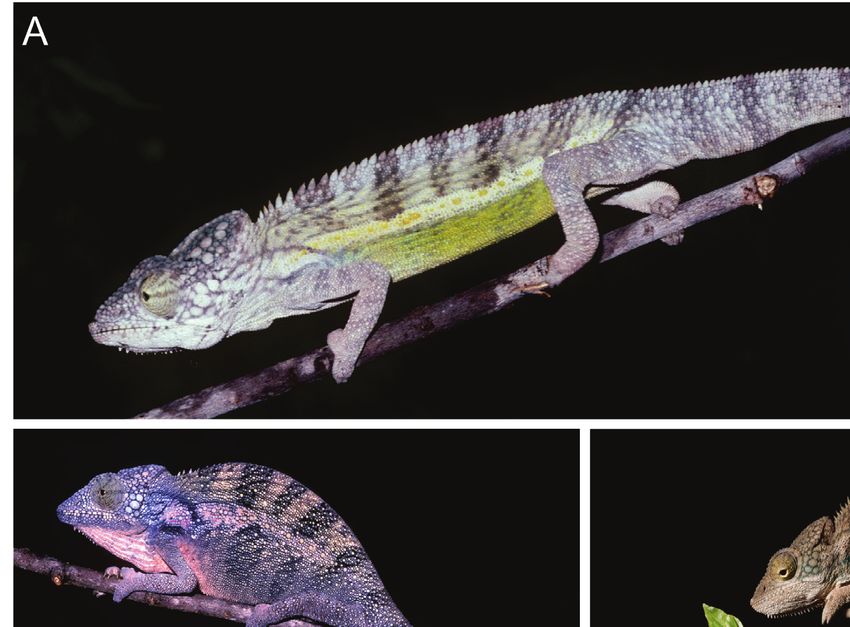
Extending the known distribution of Nicosia’s chameleon 457
Table 1. List of localities where Furcifer nicosiai is reported with information on coordinates, elevation, presence within protected
area (if applicable), and original reference. Localities distribution is represented in Fig. 1. Protected areas are coded as follows: (A)
Tsingy de Bemaraha National Park; (B) Paysage Harmonieux Protégé de Beanka; (C) Paysage Harmonieux Protégé du Complexe
Tsimembo
Table 1. List ofManambolomaty; (D) Paysage
localities where Furcifer nicosiai Harmonieux
is reported with Protégéelevation,
information on coordinates, du Complexe Lac-Forêt
presence within Ambondrombe;
protected area (E) Paysage
(if applicable), and original Harmonieux
reference. Localities
distribution is represented in Fig. 1. Protected areas are coded as follows: (A) Tsingy de Bemaraha National Park; (B) Paysage Harmonieux Protégé de Beanka; (C) Paysage Harmonieux
Protégé de Menabe
Protégé du Complexe Antimena;
Tsimembo (F) Andranomena
Manambolomaty; (D) Paysage Harmonieux Special Reserve;
Protégé du (G) Kirindy
Complexe Lac-Forêt Mitea(E)National
Ambondrombe; Park. Protégé de Menabe Antimena; (F)
Paysage Harmonieux
Réserve Spéciale d’Andranomena; (G) Kirindy Mitea National Park.
Locality Locality name Latitude Longitude Elevation Administrative Protected Reference Notes
number (m a.s.l.) Region area
1 Trano Passage, Antsingy Forest † 18.7167°S 44.7167°E 120–130 Melaky A Jesu et al., 1999; Brown et al., 2014
2 Andolombazimba 1 19.1483°S 44.8283°E 100 Melaky A Raselimanana, 2008
3 Andolombazimba 2 19.1403°S 44.8283°E 59 Melaky A Bora et al., 2010
4 Andranongidro 18.7417°S 44.7117°E 120 Melaky A Raselimanana, 2008
5 Andranopasazy 1 18.7086°S 44.7172°E 146 Melaky A Randrianantoandro et al., 2008;
Bora et al., 2010
6 Anjaha 18.6572°S 44.8221°E 403 Melaky A Randrianantoandro et al., 2008;
Bora et al., 2010
7 Ankilogoa 19.1311°S 44.8089°E 57 Melaky A Bora et al., 2010
8 Ankily 18.6692°S 44.7811°E 286 Melaky A Randrianantoandro et al., 2008;
Bora et al., 2010
9 Antranopasasy 1 (Camp 1) 18.7086°S 44.7189°E 148 Melaky A Brown et al., 2014
10 Antranopasasy 2 18.708°S 44.7164°E 136 Melaky A This study
11 Bendrao 1 18.7972°S 44.8603°E 427 Melaky A Bora et al., 2010
12 Manambolo 19.1333°S 44.8333°E 220 Melaky A This study
13 Ranotsara 19.0356°S 44.7747°E 65 Melaky A Bora et al., 2010
14 Ankazomanga 18.7364°S 44.9139°E 571 Melaky - Randrianantoandro et al., 2008; Nearby (A)
Bora et al., 2010
15 Antsalova 18.6817°S 44.6258°E 103 Melaky - Bora et al., 2010 Nearby (A)
16 Bendrao 2 (Forest Camp 3) 18.7844°S 44.8603°E 439 Melaky - Brown et al., 2014 Nearby (A)
17 Beanka 1 18.0236°S 44.5022°E 220 Melaky B Randriamoria, 2011
18 Beanka 2 18.0519°S 44.5181°E 320 Melaky B Randriamoria, 2011
19 Camp Kimby 18.8725°S 44.24°E 6 Melaky C This study
20 Lac-Forêt Ambondrombe - - - Melaky D Goodman et al., 2018 Coordinates not
available
21 Ampataka 20.0897°S 44.5485°E 20 Menabe E Randrianantoandro et al., 2010
22 Ankidroadroa 19.75°S 44.6167°E 120 Menabe E Raselimanana, 2008
23 Ankoraobato 20.1049°S 44.6162°E 67 Menabe E Randrianantoandro et al., 2010
24 Kiboy 19.805°S 44.6386°E 113 Menabe E Randrianantoandro et al., 2010
25 Kirindy 1 20.075°S 44.6722°E 61 Menabe E Brown et al., 2014
26 Kirindy 2 20.0845°S 44.5526°E 29 Menabe E Randrianantoandro et al., 2010
27 Kirindy 3 CNFEREF (north) 20.0523°S 44.6337°E 49 Menabe E Randrianantoandro et al., 2010
28 Kirindy 4 CNFEREF (south) 20.0729°S 44.6629°E 76 Menabe E Randrianantoandro et al., 2010
29 Kirindy forest 5 20.05°S 44.65°E 30–60 Menabe E Eckhardt et al., 2019
30 Marofandilia 20.1016°S 44.6087°E 57 Menabe E Randrianantoandro et al., 2010
31 Tsitakabasia 19.8035°S 44.6301°E 102 Menabe E Randrianantoandro et al., 2010
32 Andranomena - - - Menabe F Goodman et al., 2018 Coordinates not
available
33 Dabara forest 20.3741°S 44.8476°E 180 Menabe - This study
34 Kirindy forest (Belo) 20.9349°S 43.8804°E 5 Menabe G This study
35 Makay 1 (Base camp) 21.2229°S 45.3252°E 493 Atsimo - This study
Andrefana
36 Makay 2 (Dry forest camp) 21.3116°S 45.1284°E 593 Atsimo - This study
Andrefana
37 Makay 3 (Camp 1-Antsoha Forest) 21.5959°S 45.1144°E 268 Atsimo - This study
Andrefana
38 Tsaranoro 22.0851°S 46.7755°E 974 Haute Matsiatra - This study
† Type locality
chameleons were found roosting on tree branches at The Kirindy Mitea National Park is located on the
2–6 m height in primary deciduous forest. During these coastline of the Menabe region. It incorporates a wide
surveys, many other forests and sites were studied, but variety of lowland habitats (0–40 m a.s.l.) including
F. nicosiai appears to be restricted to relatively large and mangroves, brackish flats, littoral forest, dry spiny
intact blocks of deciduous forest on the eastern side of thicket, and dry deciduous forest (Goodman et al.,
the Makay Massif and was never found in secondary 2018). One individual (UMMZ 228149) was collected
forest, or degraded habitats. in coastal deciduous forest on 1 April 2001 (Table 1).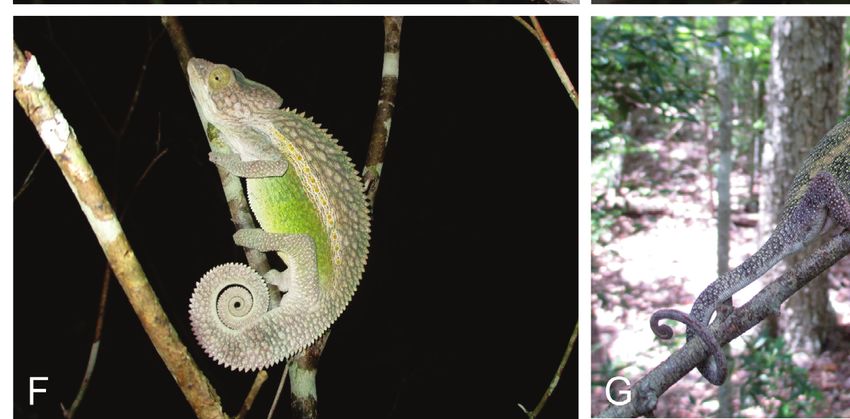
458                                                                                            Francesco Belluardo et al.

Figure 2. Individuals of Furcifer nicosiai collected in Dabara Forest (A) male, (B) female; (C) male from Tsaranoro; (D) male
and (E) female from Makay Massif; (F) male and (G) female from Kirindy CNFEREF (Paysage Harmonieux Protégé de Menabe
Antimena). Photos by C. J. Raxworthy (A–B, D–E), J. Lobón-Rovira (C), and M. Raselimanana (F–G).
Extending the known distribution of Nicosia’s chameleon                                                                      459

  The Dabara Forest is a fragmented dry deciduous              increase in EOO and AOO for F. nicosiai, which
forest in the Menabe region, ca. 30 km south-east of           justifies the proposed re-evaluation of its conservation
the Andranomena Special Reserve and ca. 23 km north-           status concerning its vulnerability to extinction.
east of Kirindy Mitea National Park. This unprotected            The newly estimated AOO (412 km2) meets criterion
forest has become heavily degraded over the past 30            B requirements of threatened categories (AOO < 2000
years, and it is not certain if a population of F. nicosiai    km2), and the taxon can also qualify for subcriterion
still survives in this region. Eight individuals (UMMZ         b(iii), given the above-mentioned threats and conditions
215696, UMMZ 215967, UMMZ 215698, UMMZ                         that question habitat quality for most of its distributional
215699, and UMMZ 215701; UADBA: RAN 51417,                     range (IUCN Standards and Petitions Committee,
RAN 51510, and RAN 51512) of F. nicosiai were                  2019). Nevertheless, to the best of available knowledge,
collected at night roosting on tree branches at 2–6 m          the species is not eligible for any other subcriterion,
height on 27–28 January 1996 (Fig. 2A–B; Table 1).             and we consequently propose to list F. nicosiai within
The original forest at this site included large trees up to    the Near Threatened category. The presence of some
20 m in height and had an extensive closed canopy.             populations in protected areas, as well as the discovery
  This study considerably increases the distribution           of new populations in different regions of western and
of F. nicosiai (Fig. 1, black circles). Tsaranoro Forest       central Madagascar, suggest that new localities could
currently represents the highest elevational record for        be identified in other patches of dry deciduous forest in
the species (974 m a.s.l.), which was previously reported      western Madagascar, possibly further reducing extinction
up to 571 m a.s.l. in Tsingy de Bemaraha National Park         risk. Nevertheless, we stress that future molecular and
(Bora et al., 2010). The current total areas of Extent of      ecological studies improving our knowledge on species
Occurrence (EOO) and Area of Occupancy (AOO) are               genetic diversity and biology, especially characterising
estimated to be 57,367 km2 and 412 km2, respectively.          population viability and trends, intraspecific variation,
The large difference in surface area between these             and connectivity among localities, may qualify the
distributions reflects the highly fragmented habitat of        species for additional subcriteria and make it eligible
this species, with most populations now confined to            for threatened categories.
isolated relict patches of native forest.
  Furcifer nicosiai is listed as Endangered (EN) under         Acknowledgements. We are particularly grateful to the local guide
                                                               Josef Samuel and to Justin Claude Rakotoarisoa (Association
criteria B1ab(iii) of the IUCN Red List (Jenkins et al.,
                                                               Mitsinjo) for the help during fieldwork. We thank Frank Glaw
2011; IUCN Standards and Petitions Committee, 2019).
                                                               for the pre-peer review of the manuscript and Fabio Mattioli for
The main threats to the species are ongoing habitat            providing the .pdf of the species description. The Ministère de
destruction due to expanding agriculture, fire, and            l’Environnement et du Développement Durable provided the
logging. These factors, in combination with the known          research and export permits; MICET and Makay Naturevolution
species distribution at the time of the assessment (limited    provided logistic help. Research was made possible due to the
to Tsingy de Bemaraha National Park and estimated in           assistance of the Madagascar National Parks and the Faculté des
                                                               Sciences (Mention Zoologie et Biodiversité Animale), Université
1566 km2 EOO), were considered enough to classify
                                                               d’Antananarivo. Fieldwork in Tsaranoro Forest was funded by
this species into one of the highest threat categories         the National Geographic Society (grant number EC-50656R-
(Jenkins et al., 2011).                                        18 to FB). The Investigador FCT grant of AC (IF/00209/2014)
  Most of our reports are from small fragments of              and the PhD grants of JLR (PD/BD/140808/2018) and FB (PD/
forest outside legally protected areas (Dabara Forest,         BD/128493/2017) were supported by the Portuguese National
Tsaranoro Forest, and Makay Massif; although part              Funds through FCT (Fundação para a Ciência e a Tecnologia).
                                                               Research was supported by the National Science Foundation; for
of the latter is currently in the process of becoming
                                                               CJR: DEB 1257610, 0641023, 0423286, 9984496 and for CJR
formally protected) and are subject to a variety of threats,   and RAN: DEB 9625873, 9322600, BSR 9024505.
which include fires and deforestation for agriculture
and logging (Rakotondravony and Goodman, 2011;                 References
Gould and Andrianomena, 2015; Gabriel et al., 2018).
                                                               Bachman, S., Moat, J., Hill, A.W., De La Torre, J., Scott, B. (2011):
All these threats are shared by many dry forests in
                                                                 Supporting Red List threat assessments with GeoCAT: geospatial
western Madagascar, even within legally protected
                                                                 conservation assessment tool. ZooKeys 150: 117–126.
areas (Raselimanana, 2008; Whitehurst et al., 2009;            Bora, P., Randrianantoandro, J.C., Randrianavelona, R.,
Randriamoria, 2011; Zinner et al., 2014; Eckhardt et al.,        Hantalalaina, E.F., Andriantsimanarilafy, R.R., Rakotondravony,
2019). Nonetheless, these records reflect a significant          D., et al. (2010): Amphibians and reptiles of the Tsingy de
460 Francesco Belluardo et al.
Bemaraha plateau, western Madagascar: checklist, biogeography Rakotondravony, H.A., Goodman, S.M. (2011): Rapid herpetofaunal
and conservation. Herpetological Conservation and Biology 5: surveys within five isolated forests on sedimentary rock in
111–125. western Madagascar. Herpetological Conservation and Biology
Brown, J.L., Cameron, A., Yoder, A.D., Vences, M. (2014): A 6: 297–311.
necessarily complex model to explain the biogeography of the Randriamoria, T.M. (2011): Un premier aperçu de la diversité
amphibians and reptiles of Madagascar. Nature Communications herpétofaunique d’un bloc forestier isolé, la forêt sèche de
5: 5046. Beanka, dans la partie Ouest de Madagascar. Malagasy Nature
Eckhardt, F., Kraus, C., Kappeler, P.M. (2019): Life histories, 5: 75–88.
demographies and population dynamics of three sympatric Randrianantoandro, J.C., Randrianavelona, R., Andriantsimanarilafy,
chameleon species (Furcifer spp.) from western Madagascar. R.R., Hantalalaina, E.F., Rakotondravony, D., Randrianasolo,
Amphibia-Reptilia 40: 41–54. M., Ravelomanantsoa, H.L., Jenkins, R.K.B. (2008): Identifying
Gabriel, D.N., Gould, L., Cook, S. (2018): Crowding as a primary important areas for the conservation of dwarf chameleons
source of stress in an endangered fragment-dwelling strepsirrhine (Brookesia spp.) in Tsingy de Bemaraha National Park, western
primate. Animal Conservation 21: 76–85. Madagascar. Oryx 42: 578–583.
Glaw F., Vences, M. (2007): A field guide to the amphibians and Randrianantoandro, C., Razafimahatratra, B., Soazandry, M.,
reptiles of Madagascar. Third Edition. Cologne, DE, Vences and Ratsimbazafy, J., Jenkins, R.K.B. (2010): Habitat use by
Glaw Verlag. chameleons in a deciduous forest in western Madagascar.
Goodman, S.M., Raherilalao, M.J., Wohlhauser, S. (2018): Les aires Amphibia-Reptilia 31: 27–35.
protégées terrestres de Madagascar: leur histoire, description Raselimanana, A.P. (2008): Herpétofaune des forêts sèches
et biote / The terrestrial protected areas of Madagascar: their malgaches. Malagasy Nature 1: 46–75.
history, description, and biota. Antananarivo, MG, Association Uetz, P., Freed, P., Hošek, J. (2020): The Reptile Database.
Vahatra. Available at http://www.reptile-database.org. Accessed on 3
Gould, L., Andrianomena, P. (2015): Ring-tailed lemurs (Lemur September 2020.
catta), forest fragments, and community-level conservation in Whitehurst, A.S., Sexton, J.O., Dollar, L. (2009): Land cover change
south-central Madagascar. Primate Conservation 29: 67–73. in western Madagascar’s dry deciduous forests: a comparison of
IUCN Standards and Petitions Committee (2019): Guidelines for forest changes in and around Kirindy Mite National Park. Oryx
using the IUCN Red List categories and criteria version 14. 43: 275–283.
Standards and Petitions Committee. Zinner, D., Wygoda, C., Razafimanantsoa, L., Rasoloarison, R.,
Jenkins, R.K.B., Andreone, F., Andriamazava, A., Anjeriniaina, M., Andrianandrasana, H.T., Ganzhorn, J.U., Torkler, F. (2014):
Brady, L., Glaw, F., et al. (2011): Furcifer nicosiai, The IUCN Analysis of deforestation patterns in the central Menabe,
Red List of Threatened Species 2011. Madagascar, between 1973 and 2010. Regional Environmental
Jesu, R., Mattioli, F., Schimmenti, G. (1999): On the discovery Change 14: 157–166.
of a new large chameleon inhabiting the limestone outcrops
of western Madagascar: Furcifer nicosiai sp. nov. (Reptilia,
Chamaeleonidae). Doriana 7: 1–14.
Accepted by Werner ConradieYou can also read


