FAMILY STUDIES AND HUMAN DEVELOPMENT - ACADEMIC ADVISING GUIDE - College of Agriculture and ...
←
→
Page content transcription
If your browser does not render page correctly, please read the page content below
1

           F A M I L Y S T U D I E S A N D H U M A N D E V E L OPM E N T
                        A C A D E M IC A D V IS I NG G U ID E

Contents of This Guide:
   •   Academic Advising Information……………………………………………………………………………..…….. Page 2-4
   •   Student Responsibilities……………………………………………………………………………………………….. Page 4-5
   •   UA Graduation Requirements ……………………………………………………………………………………… Page 6-7
          o   University Foundation Requirements (English, Math, Foreign Language) ……………. Page 6
          o   Placement Information ……………………………………………………………………………………….. Page 6
          o   University General Education Requirements ……………………………………………………….. Page 7
          o   University Unit and GPA Requirements ……………………………………………………………….. Page 7
   •   Learning to Use Your FSHD Catalog Checklist ………………………………………….………………………. Page 8
   •   Understanding Your Advisement Report ………………………………………….………………………..… Page 8-9
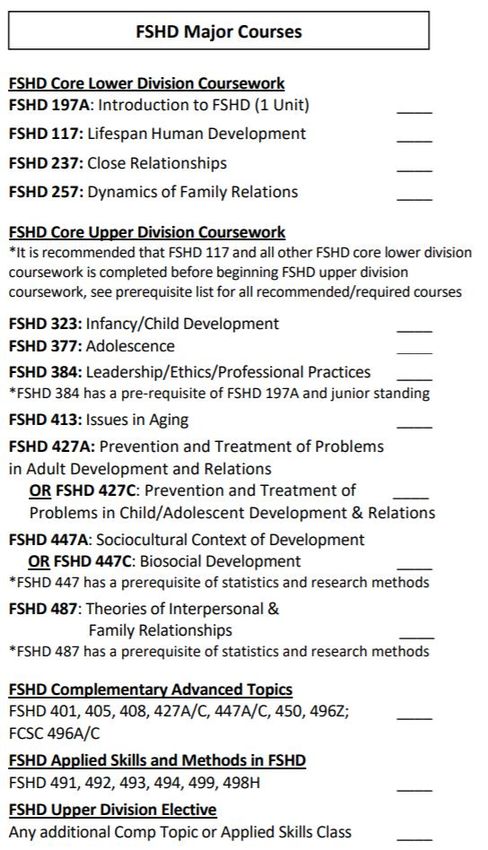
   •   FSHD Requirements ………………………………………………………………….……………………………… Page 10-15
          o   FSHD Supporting Requirements ………………………………………….……………………… Page 10 - 11
          o   FSHD Major Requirements ………………………………………….………………………….…………. Page 12
          o   FSHD Complementary Topics, Applied Skills, and Elective Courses………………… Page 13-14
          o   FSHD Course Descriptions …………………………………………………………………………….. Page 15-16
          o   FSHD Prerequisite Guide …………………………………………………………………………………… Page 17
          o   Minor Requirements ………………………………………….………………………………..………....… Page 18
   •   Coursework for Students Interested in Pre-Health Professions ………………………………… Page 18-19
   •   FSHD Career Opportunities …………………………………………………………………………………………… Page 20
   •   Transfer Credit & Studying Abroad ………………………………………….………………..………………..… Page 21
   •   Registration Tips ………………………………………….………………………………………………….……..… Page 22-24
   •   Important UA Policies ……………………………………………………………………….………………………..… Page 25
   •   Important UA Resources …………………………………………………………………………………………. Page 26-27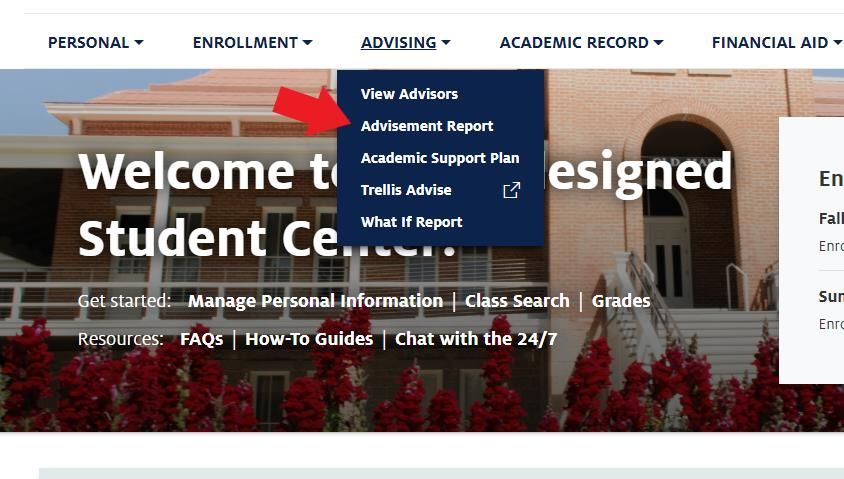
2

                             MEET WITH FSHD ADVISING

Liz Collins, Academic Advisor
eamartin@email.arizona.edu
McClelland Park, room 203
FSHD Majors
To schedule an appointment and view weekly drop-in availability, visit the FSHD Advising Website:
https://cals.arizona.edu/fcs/fshd/advising

Appointments, Drop-Ins, and Email – Determine What is Best for You:
 Schedule an Appointment                      Drop-In Advising                               Email
      20-30 Minute Meeting                Quick 5-10 Minute Meeting               Quick questions/clarifications

 •   Course planning past the        •   General information about            •     Clarification if you are
     current semester                    course offerings or course                 unsure an appointment is
     (graduation plan)                   content                                    necessary
 •   Minor exploration               •   Verification of existing schedule    •     Clarification of a UA policy
 •   Degree checks for               •   General information about major            or procedure
     graduation                          requirements or UA policy            •     Quick review of your
 •   Transfer credit approvals       •   Quick Signatures                           current course schedule
 •   Study Abroad planning           •   Questions like: “Can CHEM 101A       •     Other inquiries – if I can
 •   Concerns about academic             fulfill a NATS requirement?”               answer your question over
     difficulties and advice about   •   If you have an urgent question             email, I will. If your
     academic success strategies         that may be longer than a drop-in          question is more complex,
 •   Personal exploration                question, please feel free to              I’ll recommend that you
     regarding graduate school,          drop-in. We will do what we can            make an appointment or
     internships, jobs, etc.             in the allotted time, and schedule         attend drop-in advising
                                         a follow-up meeting if needed              hours to talk more

 *Make advising appointments         *Drop-in advising is on a first-come,    *Make sure you use your UA
 online & write down your            first-served basis. There may be a       email address for advising
 appointment date and time so        wait, so make sure you have time to      communication. Allow 24-48
 you remember to attend.             stop by.                                 hours for a response.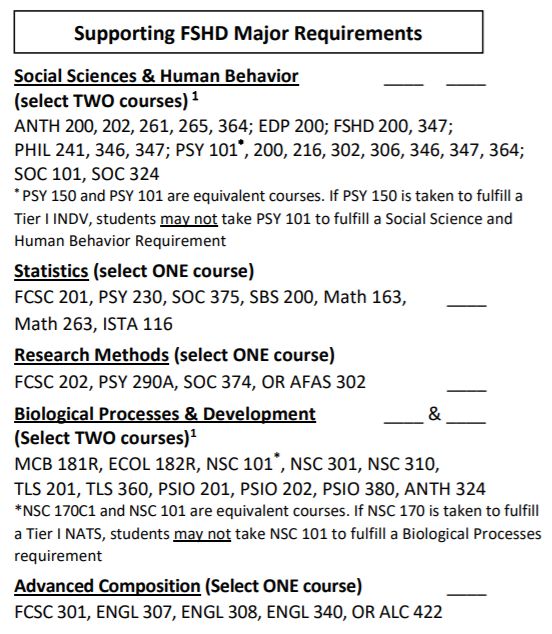
3

Make the Most of Academic Advising: Before, During, and After Your Meeting
Before   • Determine what kind of advising appointment you need
Advising • Familiarize yourself with the UA Calendar and be aware of University and College deadlines
Meeting • Review your academic advisement report
             •   Come prepared with an FSHD catalog checklist and/or questions written down
             •   Bring advising materials from previous appointments
             •   Cancel at least 24 hours in advance if you are unable to attend

During   • Arrive on time
Advising • Sign in at the front office
Meeting • Turn off or silence your cell phone
             •   Be open with your advisor on how things are going academically and personally
             •   Be willing to share things about yourself so we can better understand your goals and interests
             •   Ask question and take notes

After    • Keep an advising folder with information you learn in all your advising appointments
Advising • Complete any necessary follow up steps that your advisor recommended
Meeting • Seek available campus resources and opportunities discussed in your appointment
             •   If something is unclear afterwards, send follow up questions via email or attend drop-in hours

ADVISING ROLES & RESPONSIBILITIES
Student Responsibilities                                 Advisor Responsibilities
•   Read University Email Daily                          •   Provide accurate and consistent information
•   Take the initiative to meet with your advisor at     •   Clarify, interpret, and confirm program
    least once per semester, or as often as needed, to       requirements, policies, procedures, and deadlines
    discuss your progress                                •   Advise students in exploring and defining
•   Be involved in the advising process by being             academic and career goals
    prepared to discuss your goals and educational       •   Assist students with creating short and long-term
    plans during meetings, bring questions and               academic plans
    necessary materials to meeting, and be open to       •   Assist students with making academic and career
    suggestions                                              decisions consistent with interests, values, and
•   Take responsibility for making academic and              abilities
    career decisions based on available information      •   Listen responsively to address questions,
    and advice                                               concerns, and problems
•   Develop a working knowledge of policies,             •   Facilitate relationships between students and
    procedures, deadlines, and campus resources.             other individuals on campus; refer students to
•   Execute an academic plan directed toward                 appropriate support services when needed
    completing your degree                               •   Maintain confidentiality according to the Family
•   Review and become familiar with your                     Educational Rights and Privacy Act (FERPA)
    major/minor requirements each semester and           •   Consider student’s best interest when advocating
    track your progress towards graduation                   for policy or curricular changes
•   Utilize UA resources that will help you succeed      •   Be available and accessible to answer questions
    academically and prepare for life after graduation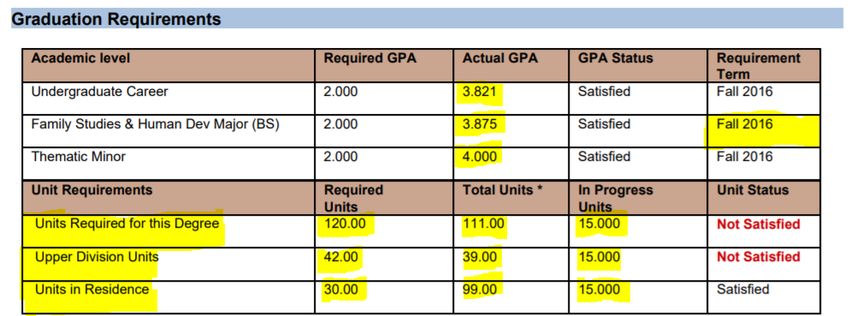
4

                           GET TO KNOW YOUR ADVISORS

As an FSHD student in the College of Agriculture and Life Sciences (CALS), you have two sets of advisors
- an FSHD Major Advisor and a College Advisor. Below is a description of each advisor’s role
FSHD Major Advisors – McClelland Park Room 203:                        CALS CAS Advisors – Forbes Room 203:
Major coursework advising                                              Process forms and petitions, acts as
• Course selection and sequencing, meeting FSHD                        Dean’s signature
   graduation requirements                                             • General education petition
• Evaluation of transfer credit in the major                           • Withdrawals past week 10
Getting involved on campus                                             • Academic eligibility advising for
                                                                          students below 2.0 GPA
• Finding clubs, internships, and research opportunities
•  Connecting with FSHD faculty and internship coordinator Policy interpretation and enforcement
•   Liz Collins – FSHD Academic Advisor –                              https://cals.arizona.edu/students/advising
    eamartin@email.arizona.edu

                                 S T U D E N T R E S P O N S I B I L I T I ES

Student Four Year Timeline: Your advisors are here to help you with all these steps.
Every semester it is recommended that you meet with your advisor at least once (or as much
as needed), and that you always ensure your wellbeing comes first by reaching out for personal
or academic assistance when necessary.
          1st Year                         2nd Year                      3rd year                   4th Year
•   Explore interests,            •   Finalize and declare      •   Research career          •   Apply for
    strengths, and careers            major(s) and minor(s)         options and graduate         graduation and
•   Make tentative plan of        •   Seek volunteer                programs                     meet with your
    classes year by year              opportunities,            •   Talk to advisors,            advisor to
•   Get involved with clubs,          internships, research,        internship                   complete your
    organizations, and                and/or study abroad           coordinators, and            degree check
    volunteering                      programs                      career services to       •   Finalize career,
•   Start looking into            •   Update resume                 enhance professional         professional, or
    internships, research,        •   Develop relationships         skills                       graduate school
    and/or study abroad               with faculty and attend   •   Update resume                plans
•   Start building a resume           office hours              •   Continue volunteer       •   Apply for graduate
•   Start to develop effective    •   Research post-                opportunities,               or professional
    time management and               graduation options and        internships, research,       schools
    study strategies                  talk with mentors             and club involvement     •   Submit resumes
•   Attend office hours               about your goals          •   Take graduate                and begin
•   Explore campus                •   Stay involved in              entrance exams               interviewing
    resources that can                activities that suit      •   Continue connecting
    enhance your academic             interests and goals           with faculty and
    and personal success                                            mentors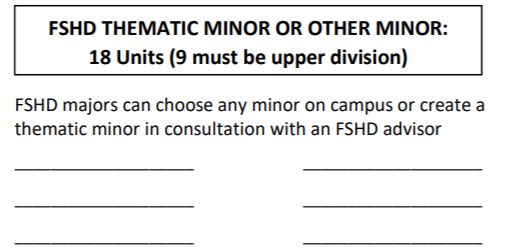
5

Student Semester Timeline: Your advisors are here to help you with all of these steps

 Term Begins:      Identify semester goals and finalize semester schedule

    Week 1:        If necessary, make any last-minute changes to your schedule
                   Check academic deadlines on the Registrar’s website regarding adding and dropping courses
                   for the semester

    Week 2:        Evaluate how you are doing in your classes. Make a time management plan for the semester.
                   The deadline to drop a course without a W occurs the 2nd week of classes

  Weeks 3-8:       Visit your instructors during their office hours before your first exams and papers. Start
                   looking into clubs, volunteer opportunities, and campus resources to support your success.
                   During weeks 3 through 10, you can drop a course through UAccess but will receive a W on
                   your transcript (you can receive a maximum of 18 units of W at the UA)

   Week 7-8:       Get ready to register for next term and make an appointment with your academic advisor

  Week 8-10:       Re-evaluate how you are doing in your current courses. Attend office hours and seek
                   academic assistance when necessary.
                   The final withdrawal deadline will occur week 10

 Weeks 11-13:      During weeks 11-13, students can drop a course with a W only through a Late Change
                   Petition, which must be filed through the College Dean’s Office (Forbes 203) and signed by
                   your instructor

   Week 13 -       Complete any projects due at the end of the term. Verify final exam schedule and start to
  Finals Week:     review. Visit office hours and Think Tank for extra help.
                   Complete withdrawal from all classes is available until the last day of classes

*If you are enrolled in a dynamically dated class (5 weeks, 7 weeks, etc.) make sure you look at the Dates and
Deadlines for those classes to understand add/drop deadlines, as they will be different from 15 week courses
https://www.registrar.arizona.edu/courses/dates-deadlines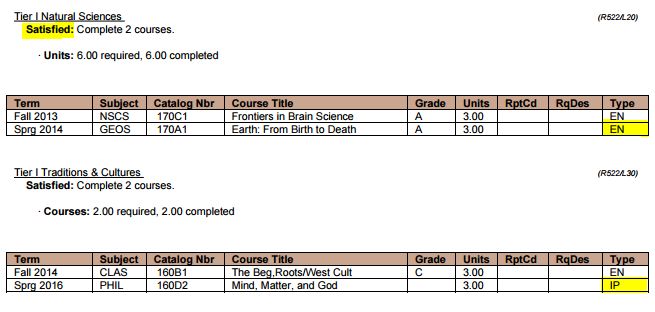
6

                           G R A D U A T I O N R E Q U I R E M E NT S

University Foundation Requirements

 English                               Math
 Choose one of the following           FSHD requires College Algebra
 sequences based on                    • Math 107, Math 112, or Higher Math
 placement
                                       Students must test into College Algebra or complete the
     • ENGL 101 & 102                  necessary math sequence based on placement. For example:
       •    ENGL 107 & 108             • Math 100 → Math 107 or Math 112
                                          *Math 107 does not serve as a prerequisite to other math
       •    ENGL 109H                     and science courses. Consult with your advisor if you have
            (requires placement)          questions about the math course best for you
                                       It is highly recommended that students complete College Algebra
                                       before their junior year. Meet with your advisor to plan
                                       correctly!

 Foreign Language
 FSHD requires 2nd semester language proficiency
 There are 3 Ways to demonstrate proficiency:
 • Complete a 2nd semester language course with a C or better (e.g., SPAN 102, FREN 102)
 • Score the equivalent of 2nd semester skill level on a language proficiency exam administered in
     person by UA
 • AP, IB, or CLEP exam scores

Placement Information
   •       Writing Placement: https://english.arizona.edu/foundations-writing
   •       Math Placement: http://math.arizona.edu/academics/placement
   •       Language Proficiency Requirements and Exam: http://advising.humanities.arizona.edu/second-
           language-proficiency-requirements
   •       Testing Office, for Math Placement Test and CLEP Exam: http://testing.arizona.edu/

Math Substitution Information
FSHD does allow math & foreign language substitutions for students who have a documented learning
disability, which may affect learning and comprehension in math or language courses. If you have this
documentation and believe a substitution may apply to you, please make an appointment to speak
with your academic advisor and the Disability Resource Center. We can talk about the process of
receiving a substitution, and talk about the other types of courses available to fulfill your requirements.
7
General Education Requirements
Tier I Tier II Diversity
Individuals and Societies Diversity Emphasis Course:
(INDV) Focus is on Gender, Race, Class,
Choose 2 courses numbered ARTS Ethnicity, Sexual Orientation, or
150, for example: Non-Western Studies. Can be
HIST 150C1 and ANTH 150B1 fulfilled through approved Tier I
or Tier II Gen Eds
Traditions and Cultures Notes:
(TRAD) Courses used to fulfill Tier I or
Choose 2 courses numbered Humanities Tier II General Education
160, for example: requirements cannot be used
CLAS 160D1 and SPAN 160C1 to fulfill pre-major or major
requirements.
Natural Sciences
(NATS)
Choose 2 courses numbered Natural Sciences
170, for example:
GEOS 170A1 and PTYS 170B2
FSHD does not require students to complete a Tier II INDV Gen Ed
Unit & GPA Requirements
• 120 Overall Units
• 42 Upper Division Units (300-400 level)
• 56 Units must be University Level (Not taken at a community college)
• 30 Units in Residence (In residence means taken at UA)
• 18 of 30 units in Residence must be upper division (300-400 level)
• 2.0 Cumulative GPA and 2.0 Major GPA is required to graduate
o If a student’s GPA falls below a 2.0 at any point in their undergraduate education, they
are placed on academic warning or academic probation, and are required to meet with
academic advisors.8
LEARNING TO USE YOUR FSHD CATALOG CHECKLIST
Access your FSHD Catalog Checklist
You can download your checklist from this link: http://cals.arizona.edu/fcs/fshd/advising/checklists
• Use the checklist for your specific catalog year or requirement term.
o Some requirements are different based on your catalog year, so it is important that you
follow the requirements for your individual requirement term, and become familiar with
those requirements
o Your catalog year is typically the year you started at the UA (although you can elect to
follow later catalog years if requirements change, and if that change benefits you).
▪ For example, if a student is currently following the 2018 catalog requirements
because they started at UA in 2018, they can choose to update their catalog year to
2020 if requirements have changed and if that change benefits them.
o Students cannot go backward in catalog year. If you start at UA in 2020 you cannot follow a
catalog year from 2019, 2018, etc.
o Your catalog year or requirement term can be found on the first page of your advisement
report (see image below, on page #9).
o Your catalog year is important, since it tells you which FSHD checklist to use and what
requirements you will follow for your graduation planning.
• Update your checklist each semester
o Remember that your checklist is a planning tool and it should be used in consultation with
your UAccess Advisement Report and your Academic Advisor
o Bring a completed checklist to appointments to go over questions with your advisor
U N D E R S T A N DI N G Y O U R A D V I S E M E N T R E P O R T
Access Your Advisement Report through your UAccess Student Center:
Your Advisement Report is
the official record of your
progress toward graduation.
It follows the same general
sequence as your FSHD
catalog checklist.
We recommend you utilize
your advisement report to
help you complete your
FSHD checklist, and stay on
track to graduation.9 It’s recommended that you view your advisement report as a PDF document Your Advisement Report tells you important information: • Your requirement term or catalog year • Your GPA (overall GPA, major GPA, and minor GPA) • Units Required, Completed & in Progress Note: Units listed in the total units (middle column) includes all units completed and currently in progress at UA. Community College Transfer students need to pay attention to the Community College Limit on their advisement report - 56 university level units are required to graduate Your Advisement Report also keeps track of the courses you’ve completed and are currently taking. TR = Transfer Course, EN = Taken and completed at UA, IP = In Progress Currently Pay attention to the red “Not Satisfied” areas. If you have questions about unsatisfied requirements, talk with your academic advisor.
10

                              F S H D R E Q U I RE M E N T S

FSHD Supporting Requirements
FSHD Supporting Requirements can be taken at any point, but it is recommended that supporting
courses are completed within the first 2-3 years.

                                                                 Important notes:

                                                                 PSY 150 and PSY 101 are equivalent
                                                                 courses. If you have taken PSY 150
                                                                 to complete your general
                                                                 education Tier I INDV requirement,
                                                                 you cannot take PSY 101 for your
                                                                 supporting social science and
                                                                 human behavior requirement.
                                                                 Students cannot earn credit for
                                                                 both PSY 150 and PSY 101.

                                                                 Statistics and Research Methods
                                                                 are both required before taking
                                                                 two specific upper division FSHD
                                                                 courses – FSHD 447A or FSHD 447C
                                                                 (Sociocultural or Biosocial Context
                                                                 of Development), and FSHD 487
                                                                 (Theories of Interpersonal Family
                                                                 Relationships). Therefore, students
                                                                 should plan to take statistics and
                                                                 research methods before their
                                                                 senior year, in order to complete
                                                                 these FSHD classes before
                                                                 graduation.

                                                                 * Courses taken to fulfill Tier One
                                                                 or Tier Two General Education
                                                                 Requirements may not also apply
                                                                 to FSHD Supporting Coursework.
11
FSHD Supporting Requirements Continued
The FSHD major requires 2 supporting courses focused on Biological Processes & Development, and 1
Advanced Composition/Writing Skills class. FSHD Supporting Requirements can be taken at any point,
but it is recommended that supporting courses are completed within the first 2-3 years.
Courses taken to fulfill the
Biological Processes area may not
also count toward Tier I or Tier II
general education
Biological Processes &
Development: Students
interested in health professions or
graduate schools that require
Biology or Physiology should
consider taking those sciences to
fulfill this supporting requirement.
Students who are not interested
Now that you’ve reviewed all the FSHD Course Requirements, review
in health professions are
the FSHD Course Requirements List (for your catalog year) on our
encouraged to take the NSC, TLS,
website. This list gives you information about course options, typical
or ANTH course options.
semester availability, prerequisites, and other enrollment
information: https://cals.arizona.edu/fcs/fshd/advising/checklists
Midcareer Writing Assessment:
All students must take a course in
this area to fulfill the advanced
composition requirement in the
FSHD major. However, the grade
you must receive in this course
depends on whether you received
a B or better in ENGL 102 or ENGL
109H.
Students who did not pass ENGL
102 or ENGL 109H with a B or
better, must complete this upper
division writing class with a B or
better in order to fulfill the
University of Arizona’s writing
requirement necessary for
graduation.12
FSHD Major Requirements
FSHD Lower Division Coursework:
It is recommended that FSHD Lower
Division Coursework (specifically FSHD
117) is completed before beginning FSHD
Upper Division Coursework.
FSHD Upper Division Coursework:
The FSHD degree consists of 10 total
upper division FSHD courses.
Seven Core Courses are required, and 3
Elective Courses are required.
Some Upper Division FSHD courses have
recommended and required prerequisites
that students must complete before
enrolling. Students should follow the
FSHD Prerequisites Guide (page 17 of this
guide). Following recommended and
required prerequisites will ensure you are
adequately prepared for all your future
coursework.
Complementary Topic: FSHD Upper
Division Content Course of your choosing
(see list below)
Applied Skills & Methods: Courses
designed to give students experience
outside of the classroom (see list below)
Upper Division Elective: Students can
choose to take another Complementary
Topic Course that fits their interests, or
students can choose to complete another
Applied Skills course to gain additional
experience outside of the traditional
classroom setting13
What are Complementary Topics Courses?
Complementary Topics Courses are FSHD courses you get to choose, based on your interests!
• FSHD 401 - Basic Skills in Counseling
• FSHD 405 - Theories of Counseling
• FSHD 408 - Program Planning and Evaluation
• FSHD 427A – Prevention and Treatment of Problems in Adult Development and Relations
• FSHD 427C – Prevention and Treatment of Problems in Child/Adolescent Development and
Relations. *If FSHD 427A is used to fulfill the FSHD core coursework, students may then choose to take FSHD 427C to
complete their Complementary Topic requirement, and vice versa
• FSHD 447A: Sociocultural Context of Development
• FSHD 447C: Biosocial Development *If FSHD 447A is used to fulfill the FSHD core coursework, students may then
choose to take FSHD 447C to complete their Complementary Topic requirement, and vice versa
• FSHD 450 – Human Sexuality
• FSHD 496Z - Topics in FSHD (topics change and are offered based on instructor availability)
Reminder About Upper Division Units: 42 Upper Division Units (300-400 level) are required to
graduate. FSHD Students need to be aware of this requirement and ensure they are meeting it.
What are Applied Skills Courses?
FSHD 493 - Internship or FSHD 494 Practicum
Supervised, experiential, and professional work related to FSHD. These experiences give students the
opportunity to practice classroom learning in a real-world setting. They also provide the opportunity to
gain experience working with organizations, or with demographics, that you are passionate about
• The Internship Course is offered in the fall and spring semesters
• Internships must be completed in Tucson, and students must be FSHD Majors to enroll, and we
recommend that students have completed FSHD 117, FSHD 237, and FSHD 257 before enrolling
• 2.25 GPA (Major and Cumulative GPA) is recommended
• The Practicum Course is offered online in the summer
• Practicum experiences can take place away from Tucson. Practicum is open to FSHD majors and
minors
• To complete 3 units of internship/practicum, students must work 135 total hours at their site
FSHD internship opportunities are posted online here: https://cals.arizona.edu/fcs/fshd/internships-
and-jobs, and sent to the FSHD email listserv weekly
FSHD Internship Coordinator
Connect with our FSHD internship coordinator, Tiffany Ortega – tortega@emaill.arizona.edu
Tiffany can help all FSHD students as they explore internship opportunities and as they begin to
complete their steps for enrolling in internship credit.
All students interested in enrolling in internship or practicum units must complete an internship or
practicum workplan with their worksite. Once completed, this workplan should be submitted to Tiffany
Ortega so she can approve your internship/practicum and enroll you in you in the course.
https://cals.arizona.edu/fcs/fshd/internships/experiential14
FSHD 492 - Directed Research
Supervised work alongside a faculty member, participating in academic research related to FSHD.
These experiences are great for those students interested in graduate school, or those interested in
developing their research skills
• 2.25 GPA (Major and Cumulative GPA) is recommended
• Look at Research Opportunities online:
http://cals.arizona.edu/fcs/fshd/internships/ugra_guidelines OR Contact faculty members you
are interested in working with. Browse faculty research at https://cals.arizona.edu/fcs/ and go
to Directory → Faculty and Appointed Professionals → Family Studies and Human Development
• Once you find a research opportunity, complete the independent study form and turn your
application in to Student Services (McClelland Park room 203) in order to get enrolled. Talk with
your faculty member about the course best for you:
• Research – FSHD 492 (letter graded, does count toward GPA)
• Independent Study – FSHD 499 (Pass/Fail, does not count toward GPA)
• Honors Thesis – FSHD 498H (letter graded, does count toward GPA)
FSHD 491 - Preceptorship
Supervised teaching experience alongside an FSHD faculty member. Preceptors are part of a teaching
team and help facilitate learning in FSHD classes they have previously and successfully completed
• GPA requirements are up to the instructor you are working with
• Talk with instructors you are interested in preceptoring for
• Once you find a preceptor opportunity, complete the preceptor application and turn your
application into Student Services (McClelland Park room 203) in order to get enrolled
Applied Skills Information and Applications Can be Found Online:
https://cals.arizona.edu/fcs/fshd/internships/experiential
Internships: https://cals.arizona.edu/fcs/fshd/internships
Practicum: https://cals.arizona.edu/fcs/fshd/internships/practicum
Research: https://cals.arizona.edu/fcs/fshd/internships/ugra_guidelines
Preceptor Form: http://cals.arizona.edu/fcs/fshd/advising/forms
Turn completed applications in to McClelland Park room 203, and advisors will enroll you in your units
CALS Career Center
Connect with the CALS Career Center for additional assistance with resume building, career
exploration, internship exploration, interview preparation, and graduate school preparation. They also
host a lot of great workshops and events for career preparation and professional development!
https://cals.arizona.edu/students/cals-career-center15 FSHD Course Descriptions FSHD Lower Division Courses FSHD 117: Lifespan Human Development - Behavioral science approach to human development through the lifespan FSHD 237: Close Relationships - Behavioral science approach to close relationship development FSHD 257: Dynamics of Family Relations - Family relationships can be rewarding, challenging, complicated, and more. This course overviews research from the family science field covering topics related to contemporary family life including gender roles, work/family balance, marriage, parenthood, divorce, blended families, family violence, and related topics. FSHD Upper Division Courses FSHD 323: Infancy/Child Development - Growth, development, and socialization of the child within the family setting, from conception to the middle school years; observations of infants and preschoolers FSHD 377: Adolescence - This course is designed to provide you with an in-depth understanding of adolescent development, including the relationships between theory, research, and practice. We will examine various aspects of adolescent development, focusing on the major developmental milestones (such as identity, intimacy, and sexuality), transitions, strengths, and challenges of adolescents, as well as the contexts in which these occur. Additionally, this course will introduce you to the practice of working with adolescents and their caregivers, and provide opportunities for you to apply research and theory to specific issues of adolescent development (such as best practices for structuring out of school programs). FSHD 384: Leadership, Ethics, and Professional Practices - Theories and applications of leadership and communication applied to professional decision-making, planning and control in the workplace. Examination of personal and professional qualities essential for successful internship and career planning. Roles, responsibilities, and ethical standards for professionals will be examined FSHD 413: Issues in Aging - This course addresses major issues facing older adults and their families, society, and how earlier life experiences influence our older adult years. This class will tackle questions such as: What opportunities and challenges do adults face as they age? What resources and barriers shape their lives? How do physiological, psychological, interpersonal/family, economic, and socio- historical factors affect the experience of aging? How do gender, social class, and ethnicity influence the experience of aging? How do government policies, community services, the healthcare system, and health interventions affect the lives and well-being of older adults? FSHD 427A: Prevention and Treatment of Problems in Adult Development & Relations - This course overviews a variety of mental illnesses and relationship problems in adulthood, with specific focus on how those issues impact individuals and their family systems. Prevention and treatment approaches for these issues are discussed, including research-supported therapeutic approaches and family-based strategies.
16

FSHD 427C: Prevention and Treatment of Problems in Child/Adolescent Development & Relations -
This course overviews intellectual disability, learning disabilities, and a variety of mental illnesses in
childhood and adolescence, with specific focus on how those issues impact individuals and their family
systems. Prevention and treatment approaches for these issues are discussed, including play-based
and other therapeutic interventions, family-based methods, and school and community strategies.
FSHD 447A: Sociocultural Context of Development - In-depth examination of human development
from a sociocultural perspective; focus on socialization processes in childhood and adolescence and
the role of the social and cultural context in those processes

FSHD 447C: Biosocial Development - This course addresses topics in human development (e.g., family
relationships, sexual development, competitive behavior, sex differences, the adolescent brain) from
evolutionary and biosocial perspectives

FSHD 487: Theories of Interpersonal & Family Relationships - Critical analysis of selected studies and
current research in family relations

FSHD 401: Basic Skills in Counseling - Selected counseling skills and their applications. Designed for
students needing basic skills in counseling as an adjunct to other primary occupational functions
FSHD 405: Theories of Counseling - Techniques for the study of human behavior; implications for
improving adult-child relationships, applying various theories of counseling
FSHD 408: Program Planning & Evaluation - The overall objective of this course is to guide and assist
students as they conduct a thorough case study of an existing or proposed social service, educational
or community program/agency. The course is designed to provide students with applied knowledge of
program planning components as well as program evaluation techniques.
FSHD 450: Human Sexuality - Overview of human sexuality from development and interpersonal
perspectives, topics to include reproductive physiology and health, sexual function and dysfunction,
educational and intervention strategies
17

 FSHD Prerequisite Guide

                    Course                                   Prerequisites Required/Recommended

FSHD 323 – Infancy/Child Development            Recommended: FSHD 117 or equivalent course (e.g.,
                                                EDP/FSHD/PSY 200, PSY 240)

FSHD 377 - Adolescence                          Recommended: FSHD 117 or equivalent course (e.g.,
                                                EDP/FSHD/PSY 200, PSY 240)

FSHD 384 – Leadership, Ethics & Professional    Required: FSHD 197A; must be an FSHD Major with at least junior
Practices                                       status

FSHD 401 – Basic Skills in Counseling           Recommended: 6 units of social science

FSHD 405 – Theories of Counseling               Recommended: 6 units of social science

FSHD 408 – Program Planning & Evaluation        Recommended: FCSC 202 or equivalent research methods course
                                                (e.g., PSY 290A, SOC 374) AND 6 units of social science

FSHD 413 – Issues in Aging                      Recommended: FSHD 117 or equivalent course (e.g.,
                                                EDP/FSHD/PSY 200, PSY 240) OR 6 units of social science
                                                [recommended]

FSHD 427A – Prevention and Treatment of         Recommended: PSY 101, FSHD 117 or equivalent course (e.g.,
Problems in Adult Development & Relations       EDP/FSHD/PSY 200, PSY 240)

FSHD 427C – Prevention and Treatment of         Recommended: PSY 101, FSHD 117 or equivalent course (e.g.,
Problems in Child/Adolescent Development &      EDP/FSHD/PSY 200, PSY 240)
Relations
FSHD 447A – Sociocultural Context of            Recommended: FSHD 117 or equivalent course (e.g.,
Development                                     EDP/FSHD/PSY 200, PSY 240)
Or                                              Required: Statistics (FCSC 201 OR PSY 230 OR SOC 375 OR SBS 200
FSHD 447C – Biosocial Development               OR Math 163 OR Math 263 OR ISTA 116)
                                                Required: Research Methods (FCSC 202 OR PSY 290A OR SOC 374
                                                OR AFAS 302)

FSHD 450 – Human Sexuality & Relations          No prerequisite

FSHD 487 – Theories of Interpersonal & Family   Recommended: FSHD 117 or equivalent course (e.g.,
Relationships                                   EDP/FSHD/PSY 200, PSY 240)
(Formerly titled: Advanced Family Relations)    Required: Statistics (FCSC 201 OR PSY 230 OR SOC 375 OR SBS 200
                                                OR Math 163 OR Math 263 OR ISTA 116)
                                                Required: Research Methods (FCSC 202 OR PSY 290A OR SOC 374
                                                OR AFAS 302)

FSHD 493 - Internship                           Recommended: FSHD 117, 237, and 257
                                                Required: Must be an FSHD major, department consent required
FSHD 496Z – Topics in FSHD                      No prerequisite
18
Minor Requirements
All FSHD Students are Required to Have a Minor
• Most Minors are at least 18 units, and 9 units must be upper division
• Students are encouraged to choose a minor in an area related to their career goals
• You may choose any minor on campus, or take courses toward a thematic minor
o Minor Advising Directory: http://advising.arizona.edu/advisors/minor
• Many FSHD students also choose to complete a thematic minor. A thematic minor allows
students to create and structure their own minor in consultation with an FSHD advisor
o Thematic minors encourage students to take a variety of courses that will prepare them
for future goals and careers
o Common themes include Counseling, Education, Health, Social Work, and Law & Policy
o For more information about Thematic Minors visit our website:
http://cals.arizona.edu/fcs/fshd/advising/fshd_thematic_minor
F S H D & P R E - HE A L T H P R O F E S S I O N S
FSHD is a friendly major to those students interested in health-related professions:
• Nursing
• Occupational Therapy
• Physical Therapy
• Physician’s Assistant
• Physicians
Students interested in Pre-Health professions should talk with both their FSHD Advisor and a Pre-
Health Advisor about how to incorporate sciences into their UA Degree in order to meet science pre-
requisites
Pre-Health Advising: http://clas.arizona.edu/prehealth/advising-resources19
Example of Incorporating Pre-Health Sciences:
Many pre-health professions require
sciences like biology, chemistry,
physiology, and additional
NSC 170C1 or NSC 101 requirements. Students interested in
CHEM 101A or 151 health focused careers and graduate
programs should not take general
education “170” Natural Science
courses. Instead, they can take lab-
based sciences to fulfill requirements
for their future health related goals
and graduate programs.
CHEM 101B or 152
PSIO 202 Upper Division
MIC 205A Upper Division
Lower Division Upper Division
Students interested in health professions
can also fulfill necessary science courses
within the FSHD Biological Processes &
Development requirements.
Students can also create thematic
minors, focused on a theme of their
choosing (like “Nursing Preparation” or
“Occupational Therapy Preparation”) in
order to fit their necessary science
requirements into their graduation plan.20
FSHD CAREER OPPORTUNITIES
The FSHD program at the University of Arizona provides a multidimensional approach to understanding
human behavior and relationships from psychological, social, cultural, and biological perspectives. You
will build interpersonal skills and learn how to apply your knowledge in a career or graduate program
that suites your interests and goals.
In the FSHD program, you will explore topics like adolescence, child development, family relationships,
mental health, counseling, youth programs, and more. You will partner with faculty that have firsthand
experience working with families and individuals in many contexts. Our program has an excellent
network of community agencies and programs that provide internship opportunities and hands-on
learning for our students to apply what they learn in real-world settings.
Whether you’re stepping directly into a people-focused career after graduation or using your FSHD
degree as a launch-pad into a master’s program, we will provide you with knowledge, skills, and
opportunities to put them to use throughout your experience in our program. Launch your career in
the helping professions to improve life for children, teens, older adults, individuals and families. Soon
you will be providing support to people in need, and you will be well-equipped to meet challenges
head-on.
Family Studies leads to a variety of rewarding careers & graduate school opportunities.
Here are just a few of the possibilities:
• Rehabilitation/Mental Health Counseling • Marriage and Family Counseling
• Social Work • Program Development and Coordination
• Nursing • Child Advocacy
• Occupational Therapy • Family Law
• Human Resources • Social Science Research
• Child Life Specialist • Healthcare
• School Counseling • Medical School
• Social Policy • Physical Therapy
• Community and Public Health • Physician’s Assistant
• Education • Gerontology21
TRANSFER CREDIT
https://transfercredit.arizona.edu/
For all transfer coursework, before taking the course you should verify that credits will transfer to UA
and fulfill necessary requirements.
For courses taken at Arizona Community Colleges:
• Use the aztransfer.com Course Equivalency Guide to make sure that you take correct courses at
your local AZ community college: http://aztransmac2.asu.edu/cgi-bin/WebObjects/CEG
• For a list of common course equivalencies at Pima, Arizona Western, and Rio Salado for FSHD
requirements, see Transfer Course Equivalency List on our website:
https://cals.arizona.edu/fcs/fshd/advising/forms
If You Plan to Take Courses Outside of Arizona:
• View the UA Transfer Credit Guide to see if the out of state courses at the institution you will
attend have already been evaluated: http://aztransfer.com/UACEG/UA_CEG_OutOfState.html
Transfer Credit Approvals:
• For approval of other courses not listed on the UA Transfer Credit Guide or on the
AZTransfer.com Course Equivalency Guide, submit a Course Equivalency or Credit Request here:
https://transfercredit.arizona.edu/content/credit-evaluation
• Math courses need specific approval from the Math department:
http://math.arizona.edu/academics/placement/credits
Transfer Credit Reminders:
• C or better needed in all transfer work
• You cannot GRO classes taken elsewhere
• Once coursework is complete, you need to send official transcripts to the UA:
http://registrar.arizona.edu/academics/sending-college-level-transcripts-
ua?audience=students&cat1=7&cat2=28
Studying Abroad
https://global.arizona.edu/study-abroad
If you plan to study abroad, see your advisor early to talk about planning for your semester away.
Many FSHD students study abroad, and graduating in four years while also studying abroad is feasible
with the right planning:
• Saving some general education & minor coursework is often the best, although if you study at
an institution abroad that has a Family Studies Program, you may be able to earn credit toward
your major
• Consider when you want to go, and consider the classes you would take while away
• See your major advisor to talk more about your study abroad goals and course options!22
R E G I S T R A T I ON T I P S A N D R E M I N D E R S
Check notices and holds - past due balance, academic warning/advising
holds, etc. may restrict you from registering!
Every student is given an enrollment date, which is assigned in UAccess.
Your registration appointment will begin at 6AM on the date assigned,
and remain open until the start of the next semester.
Starting in October and March each semester, you can view your
enrollment date on your UAccess student page.
This will tell you when you can start adding courses to your shopping
cart and when you can begin enrolling in courses.
Remember that your enrollment date is based on your class standing,
which is based on units completed as of the beginning of this semester,
not how many years you’ve been a student.
• Fewer than 30 units = freshmen registration
• 30 or more units = sophomore registration
• 60 or more units = junior registration
• 90 or more units = senior registration
Registration dates are also listed on the Registrar’s Website:
https://www.registrar.arizona.edu/students/courses/enrolling-in-
courses?audience=students&cat1=10
Common Enrollment Error Messages:
If you get an error message when enrolling in a course, take a minute to think about why:
• Do you meet the enrollment requirements and prerequisites listed for the course on UAccess?
o When searching for courses, always click on the course and look at the “enrollment
requirements” listed
o You can also use the “check availability” feature in your UAccess shopping cart in order to
determine your ability to enroll in a course
o During the beginning of your enrollment period, some courses may only be available to
students declared in certain majors. Once all students (Seniors through Freshmen) have had
their enrollment period, departments will often open courses that may have been restricted
to you earlier (like PSY and SOC courses). This means that you can keep courses in your
shopping cart, and try enrolling later, once some courses become available to you.
• Are you trying to enroll in a course that requires department consent?
o Courses like internship, preceptorship, research, or independent study require you to
submit an application before getting permission to enroll in these courses. You cannot
enroll yourself in these courses.
• Are you trying to enroll in a course that is restricted only to Honors students?
• Are you trying to enroll in a course through one of UA’s distance or online campuses? Main campus
students only have ability to enroll in main campus courses.23
• Trying to enroll in more than 19 units?
o You need permission to enroll in more than 19 units, and can get that permission by talking
with your major academic advisor
Examples: Checking Enrollment Requirements
When Registering for FSHD Courses, make sure you look at location (Main Campus)
Courses offered through the Yuma Campus are not available to UA Main Campus students
For all courses, make sure you look at enrollment requirements to determine your eligibility to enroll24
Tips: Searching for Classes
Make sure you are searching in the
correct term
If you want to see all classes offered, even
classes that are currently full, uncheck the
“show open classes only box”
Looking for a specific class in a certain
subject area? Use the subject search area,
and type in the course number
Looking for an online class? You can
search for fully online courses by using
the “mode of instruction”
Use Course Attribute and Course
Attribute Value Fields to search for
general education classes. Remember,
you can fulfill your Diversity Requirement
through approved Gen Ed courses (usually
Tier I INDVS, Tier I TRADs, Tier II
Humanities, and Tier II Arts)
Additional Search Criteria is helpful when
searching for classes offered during
specific times, days, or sessions (7 week
sessions are available for many GE
courses each semester)25
I M P O R T A N T PO L I C Y I N F O R M A T I O N
Get to know the Catalog: http://catalog.arizona.edu/
Get to know the Registrar’s Website: http://www.registrar.arizona.edu/
Dates & Deadlines
• Make sure you understand important deadlines each semester, like last day to add courses, last
day to drop without a W, last day to drop on your own through UAccess, last day to file for
GRO, and last day to receive a refund. Bookmark this page and refer to it every semester
https://www.registrar.arizona.edu/dates-and-deadlines
Grade Replacement Opportunity (GRO)
• You can replace up to 3 courses or 10 units with a new grade. You are only eligible before you
reach 60 units earned at UA
http://registrar.arizona.edu/academics/grade-replacement-opportunity-gro
Withdrawing from Courses
• Understand Withdrawal Deadlines and Withdrawal Options
• You can receive a W in a maximum of 18 units (6 classes)
• Medical / Retroactive Withdrawal is possible for students with medical or personal
circumstances affecting completion of coursework
• Always talk with advisors about these policies and the options best suited for you
Back 2 UA
• You can leave the UA for two semesters, if you are in good academic standing, and return
without having to reapply to the university https://admissions.arizona.edu/how-to-
apply/returning-students/back2ua
• If you have a scholarship, check with the Scholarship Office about taking time away from UA
Financial Aid & Bursar’s Office
• Understand your financial aid and ask questions
• Review information about summer financial aid: https://financialaid.arizona.edu/types-of-
aid/summer
• For tuition and fees visit the bursar’s office: http://bursar.arizona.edu/students/fees
Academic Eligibility
• A 2.0 GPA is required to be in good academic standing. Students below a 2.0 are on academic
warning or probation, and are required to meet with advisors to go over academic plans.
https://catalog.arizona.edu/policy/undergraduate-academic-eligibility-policy
Have a scholarship?
• Make sure you understand how many units you need to take each year at UA: (most require 30
units per academic year at the University of Arizona) https://financialaid.arizona.edu/types-of-
aid/scholarships26
C A M P U S R E S OU R C E S
University Services & Resources
CALS Scholarships:
Registrar: http://registrar.arizona.edu/
https://cals.arizona.edu/students/scholarships
Academic Dates, Deadlines, and Enrollment
Information: Scholarship Universe:
https://www.registrar.arizona.edu/dates-and-deadlines https://financialaid.arizona.edu/scholarshipuni
verse
Academic Catalog: http://catalog.arizona.edu/
UA Phonebook:
Bursar’s Office: http://bursar.arizona.edu/ http://directory.arizona.edu/phonebook
Tuition & Fees Calculator:
https://tuitioncalculator.fso.arizona.edu/#/ UA Libraries: http://new.library.arizona.edu/
Scholarships & Financial Aid: UITS (technology services):
https://financialaid.arizona.edu/ http://uits.arizona.edu/
Student Support Resources
Dean of Students:
Think Tank: thinktank.arizona.edu
https://deanofstudents.arizona.edu/
Campus Resources:
Writing Skills Improvement Program:
https://deanofstudents.arizona.edu/support/c
http://wsip.arizona.edu/
ampus-resources
THRIVE Center: https://thrive.arizona.edu/
Campus Health:
Student Engagement & Career Development: https://www.health.arizona.edu/
http://career.arizona.edu/
CAPS (Counseling Services):
CALS Career Center: https://health.arizona.edu/counseling-psych-
http://cals.arizona.edu/students/cals-career-center services
Campus Recreation: https://rec.arizona.edu/ CALS Life Management Counseling:
https://cals.arizona.edu/life-management-
Disability Resource Center: http://drc.arizona.edu/ services27
Advising Services Transfer Credit Office:
https://transfercredit.arizona.edu/
Advising Resource Center: https://advising.arizona.edu
Advising Directory: Pre-Health Advising:
https://advising.arizona.edu/content/academic- http://clas.arizona.edu/prehealth/advising-
advisor-directory resources
GPA Calculators:
https://advising.arizona.edu/content/online- Pre-Law Advising:
tools/grade-calculators https://theacenter.arizona.edu/pre-law/pre-
law-advising
FSHD Academic Advising
https://cals.arizona.edu/fcs/fshd/advising
Math Placement Testing:
https://www.math.arizona.edu/academics/pla
FSHD Internship Advising
cement/exams
https://cals.arizona.edu/fcs/fshd/internships/experienti
al
Language Placement & Proficiency Testing:
CALS Academic Advising https://advising.humanities.arizona.edu/langu
https://cals.arizona.edu/students/advising age-placement-and-proficiency-exams-faqs
Arizona Transfer Guide: https://www.aztransfer.com/
Student Involvement
Immigrant Student Resource Center:
ASUA: https://asuatoday.arizona.edu/
https://immigrant.arizona.edu/
Student Centers:
https://diversity.arizona.edu/student-centers Transfer Center:
https://transfercenter.arizona.edu/home
UA Leadership Programs:
http://leadership.arizona.edu/ First Cats: https://thrive.arizona.edu/first-cats
Study Abroad: Fostering Success:
https://global.arizona.edu/study-abroad https://fosteringsuccess.arizona.edu/
CALS Clubs & Leadership Programs:
https://cals.arizona.edu/students/campus-life Handshake – UA’s job board and career
development platform:
FSHD Ambassadors: https://career.arizona.edu/jobs/handshake
https://cals.arizona.edu/fcs/fshd/ambassadorsYou can also read


