Find out why an Exactech hip implant may be right for you - Total Hip Replacement
←
→
Page content transcription
If your browser does not render page correctly, please read the page content below

Total Hip Replacement

                        Find out why an Exactech hip
                        implant may be right for you.   01
UNDERSTANDING
     TOTAL HIP REPLACEMENT
     Do I need a total hip replacement?
     Which surgical approach is best for me?
     How long will it last?
     Which implant is right for me?
     These are typical questions patients like you often ask when
     considering total hip replacement surgery. This brochure provides
     information about the way a hip implant works and highlights
     some of the unique benefits of Exactech® total hip systems.

     The information in this brochure is for educational purposes
     only and is not intended to replace the expert guidance of your
     physician. Please direct any questions or concerns you may have
     to your doctor.

02
KNOWING WHEN
YOU NEED SURGERY
Your surgeon may recommend Total Hip Arthroplasty (THA)
when other non-surgical treatments are ineffective. Hip
replacements are performed not only to relieve pain and
restore range of motion, but also to prevent further damage.
The number one reason for joint replacement is osteoarthritis.
Other reasons for joint replacement include rheumatoid
arthritis, avascular necrosis, developmental dysplasia of the hip
or a simple hip fracture. If the hip joint is diseased or damaged,
the muscles around it often weaken, which may make it even
more difficult to move.

  Your doctor will evaluate
  your condition and determine
  if surgery is right for you.

                                                                     03
WHAT IS
               TOTAL HIP REPLACEMENT?
               Total hip replacement involves removing the diseased bone and
               cartilage and replacing them with orthopaedic implants. The
               surgical procedure involves an incision through the skin to gain
               access to the hip joint through the muscles overlying the hip, all
               done while the patient is under anesthesia.

               After the surgeon exposes the hip, your diseased hip ball (femoral
               head) is removed. It is replaced with an artificial ball on a stem,
               such as Exactech’s Novation® or Alteon® femoral stems, which is
               inserted into the hollow part of the thighbone. The stem may be
               pressed into place or cemented using a special acrylic cement.

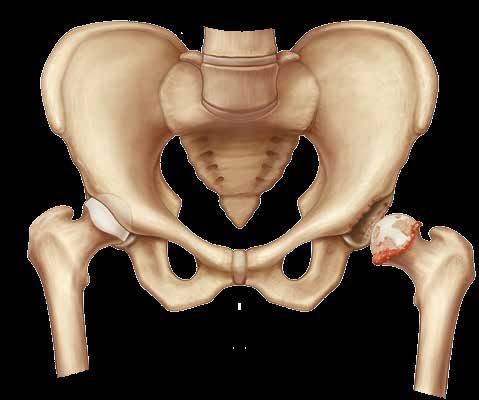
     HEALTHY                                                                         ARTHRITIC
         HIP                                                                         HIP

04
ACETABULAR SHELL

                                                                                 ACETABULAR LINER
                                                                  (Enhanced Cross-linked Polyethylene)

                                                                                   CERAMIC HEAD

                                            POINT OF
                                            ARTICULATION
The hip socket (acetabulum) is              (Bearing Surface)
prepared by “reaming” it, using special
instruments that make it the right
size and shape. A metallic acetabular
shell, such as the Novation® Crown
Cup, is then pressed into place and                             FEMORAL
                                                                STEM
sometimes further secured with bone
screws. A cup-shaped acetabular liner
is then placed in this shell forming
the socket part of the ball-and-socket
replacement. The ball and socket are
then placed together to complete the
implant procedure and the soft tissues
are repaired to complete the surgery.
Each implant is available in a variety of
sizes to accommodate different body
sizes and shapes.

Ask your orthopaedic
surgeon if hip replacement
surgery is right for you.
                                                                                        REPLACED
                                                                                        HIP

                                                                                                         05
06
WHICH SURGICAL APPROACH IS
     BEST FOR ME?
     There are many different surgical approaches that your surgeon can use.
     They include the Anterior Approach (from the front of the hip), Anterolateral
     Approach (from the side of the hip) or the Posterolateral Approach (from the
     back of the hip), to name a few. Exactech provides instrumentation and implants
     that are compatible with whichever surgical approach your surgeon specializes
     in and feels is best for your particular situation.

     Exactech provides Low Profile Instrumentation™ (LPI) and implants to supply
     your orthopaedic surgeon with the tools to enable a more conservative total
     hip replacement. These tools allow your surgeon to make an incision that is
     less invasive to your soft tissues (muscles and skin) and can allow for quicker
     recovery from your total hip replacement.

     Ask your orthopaedic surgeon which surgical approach is
     right for you.

Exactech provides instrumentation and
implants that are compatible with whichever
surgical approach your surgeon feels is best
for your particular situation.

                                                                                       07
HOW LONG
     WILL MY HIP
     IMPLANT LAST?
     There are numerous factors that
     affect the longevity of a total hip
     replacement including patient
     indications (age, weight and activity
     level), implant design and materials
     used during surgery.
     Just like your natural hip, the components of
     a hip implant are subject to wear and friction
     caused by bending, straightening and supporting
     your body weight. In the design of hip implant
     components—particularly the bearing surfaces
     that slide or rub against one another—it is very
     important to ensure the least amount of friction
     possible. Exactech hips feature a number of
     advanced materials and proven design features
     that reduce the amount of wear and stress on
     each component.

     The bearing materials used during surgery are
     another important element of hip arthroplasty.
     In recent years, there have been significant
     advances in these materials that may help to
     increase the longevity of the artificial joint.

08
Advanced Bearing Materials
                   • H
                      ighly Cross-linked or Enhanced Polyethylene—the
                     process of modifying the plastic material used as a
                     bearing surface so it can last longer. Cross-linked
                     polyethylene has a lower wear rate than standard
                     polyethylene. Wear rate is one of the main reasons
                     that hip implants fail and it is an important factor in
                     determining the longevity of hip replacement.1,2
                   	Exactech’s enhanced polyethylene, Connexion GXL®, has
                     been designed to reduce the wear rate of polyethylene
                     while maintaining an appropriate level of fracture
  CONNEXION GXL®
      LINERS         toughness. Connexion GXL is the latest in a broad
                     range of product and material development programs at
                     Exactech that are advancing bearing surface technology
                     to increase the longevity of total hip prostheses. 3,4
                   • M
                      etal—used to create femoral heads, which are used to
                     replace your diseased hip ball. Metal, with a cross-linked
                     polyethylene liner, is the most commonly used bearing
                     surface in hip arthroplasty today.
                   •
                     Ceramic—a non-metallic substance that is derived
                     from aluminum oxide. Ceramic-on-poly ball-and-socket
 BIOLOX®delta        replacement has a very low wear rate and is typically
   CERAMIC
FEMORAL HEAD         used for younger and more active patients.5

                   Implant Materials
                   There have also been improvements made to the materials
                   used for hip stem implants.

                   •	Titanium—the material used in many hip stems, which
                      has been shown to promote bony ingrowth and allows
                      some flexibility in the implant to mimic natural bone.
                   	Exactech’s Novation® and Alteon® hip stems use an
                     advanced manufacturing method to increase the strength
    ALTEON®          of the titanium material.6
 TAPERED WEDGE
     STEM          •	Cobalt Chrome—typically used for cemented hip stems
                      and has a long history of success.

                                                                                  09
WHICH IMPLANT
     IS RIGHT FOR ME?
     Hip implants may be cemented, cementless (press-fit) or a
     combination of both, depending on the method used to hold the
     implant in place. Although there are general guidelines, your surgeon
     will evaluate your particular situation carefully before making any
     decisions regarding which implant is most appropriate for you.

     Do not hesitate to ask which type of implant will
     be used in your situation and why that choice is
     right for you.

10
Cemented Hip Implants
A cemented hip implant is designed to be used with
bone cement, which was first used in hip replacement
in 1961. First, the femoral canal is prepared and then
bone cement is introduced into the femur. The surgeon
BONE then positions the implant within the femoral canal and
CEMENT
the bone cement helps to hold it in the desired position,
providing initial fixation. Cemented implants are
more commonly used in older patients, patients with
FEMORAL rheumatoid arthritis or younger patients with poor bone
CANAL quality.
Exactech cemented hips use design principles that
are clinically proven over the last 20 years and are
enhanced by today’s most modern technical and
surgical innovations.7
Press-Fit Hip Implants
A press-fit hip implant is designed to be inserted into
the prepared femoral canal without the use of bone
cement. Press-fit fixation has been utilized in total
hip replacement since as early as 1943. Initially, the
POROUS
SURFACE FOR femoral canal is prepared in much of the same way as
PRESS-FIT a cemented hip implant; however, a press-fit implant is
designed so that the implant fits tightly into the canal at
the time of surgery. The rough surfaces on the press-
FEMORAL fit hip implant are designed to engage the bone within
CANAL the canal, permitting bone to grow onto the roughened
surface of the implant. Press-fit implants are more
commonly used for younger, more active patients and
patients with good bone quality.
Exactech uses titanium plasma spray as its roughened
surface to allow bone to grow.9
11WILL I BE ABLE TO RETURN TO
NORMAL ACTIVITY?
After successful surgery, you will be eager to return to many of
the activities you enjoy. Going for walks, golfing, boating, biking
and playing with children or grandchildren are usually realistic
expectations. Each of these activities is based on your ability to
comfortably bend and straighten the muscles around your hip.
The degree to which you can perform this movement is defined as
your range of motion, which is shown in the medical illustration
below. A patient’s normal hip provides the potential for range
of motion up to 120-130 degrees of flexion (bending) and 20-30
degrees of extension (straightening).
The decision about activity level is ultimately based on the
suggestions and guidelines of your orthopaedic surgeon as well
as your compliance with your surgeon’s recommended post-
operative therapy.
120°
FLEXION
60°
EXTENSION
30°
0°
RANGE OF MOTION
1213
THE
     EXACTECH DIFFERENCE
     Exactech’s total hip implants are designed to maximize
     range of motion through an innovative neck design
     while maximizing overall strength of the prothesis. The
     precisely designed and machined neck flats feature a
     cross-section (Figure A) that allows one of the greatest
     ranges of motion in the industry.10 This unique cross-
     section has been developed to maintain strength in
     areas where stress is high while increasing the range of
     motion over other neck designs (Figure B).

            A. NECK
         CROSS-SECTION

                                                                FLEXION

                 EXTENSION                     B. RANGE OF
                                                 MOTION

14
References
1. McKellop H, Shen FW, Lu B, Campbell P, Salovey R. Development of an extremely wear-resistant ultra high molecular
weight polyethylene for total hip replacements. J Orthop Res. 1999;17(2):157-67.
2. G
reer KW, King RS, Chan FW. The effects of raw material, irradiation dose and irradiation source on crosslinking on
UHMWPE. Cross-linked and Thermally Treated Ultra-High Molecular Weight Polyethylene for Joint Replacements. ASTM
STP 1445. 2002;209-20.
3. T S-2005-025. Comparison of the wear of current, research and traditional polyethylene cup. Data on file at Exactech.
4. T S-2007-028. Summary of testing for AcuMatch A-Series Acetabular Liners incorporating Connexion GXL Ultra-High
Molecular Weight Polyethylene (UHMWPE). Data on file at Exactech.
5. T aylor SK, Serekian P, Manley M. Wear performance of a contemporary alumina: alumina bearing couple under hip joint
simulation. Transactions of the 44th Annual Meeting of the Orthopaedic Research Society; 1998 Mar 16-19; New Orleans,
LA. p. 51.
6. ETS 0170. Data on file at Exactech.
7. Petty W. Fixation methods. In: Total joint replacement. Ed. by W. Petty. Philadelphia, W.B. Saunders Co., 1991, p. 61-74.
8. P
etty W. Total hip arthroplasty: operative technique. In: Total joint replacement. Ed. by W. Petty. Philadelphia, W.B.
Saunders Co., 1991, p. 245-260.
9. TM-2005-002. Data on file at Exactech.
10. Data on file at Exactech. Lit# 711-63-20.
15WHY
EXACTECH IMPLANTS
ARE RIGHT FOR YOU
Your surgeon will consider a wide variety of variables when selecting the hip implant that’s right
for you. Your age, height, weight, lifestyle and your general health are among the most important
factors. Exactech’s Total Hip implants are designed to accommodate these and other variations
in anatomy to provide you the best possible outcome.
Sure, there are plenty of choices out there and total hip implants are
being introduced every day. But there’s nothing like the confidence that
comes from the test of time. With Exactech’s total hip implants, you have
the best of both worlds—a proven design foundation10, enhanced by
today’s most modern surgical technologies.
For more information
www.GetBackToWhatYouLove.com
©2016 Exactech, Inc. 711-60-92 Rev. B 0316
352-377-1140 • 1-800-EXACTECHYou can also read


