FINDING YOUR WAY MAY | JUN 2020 - Disability Information
←
→
Page content transcription
If your browser does not render page correctly, please read the page content below
Newsletter of IDEAS

                               MAY | JUN 2020

     FINDING YOUR WAY

             Disability Information
          Free, Accurate & Independent

info@ideas.org.au        1800 029 904    www.ideas.org.au
@disabilityinformation   @IDEASAU
                                                I’M FREE
                                                Take Me!
Editorial.

                           Editorial - Diana Palmer
                           IDEAS Executive Officer
                           Welcome to this edition!

                           2020 is certainly shaping us as a year we won’t want
                           to revisit in a hurry at all. Like everyone we are dealing
                           with the impact of the coronavirus within our workplace
                           and home life.

The Government’s response to supporting people with disability dealing with the
impact of the coronavirus has included the implementation of a Disability Information
Helpline. IDEAS is delivering the Helpline on behalf of the Australian Government in
conjunction with a number of other partner organisations. The Helpline is available
Mon-Fri 8am to 8pm (AEST) and on the weekends between 9am and 7pm (AEST).
The phone number is 1800 643 787. The Government also have a page on the
Department of Social Services website www.dss.gov.au for more information.

The service will be able to ensure that people get access to the practical support
they need, keep people informed about the latest official Government information,
connect people with free, independent and emotional support and referral to
advocacy supports as needed.

IDEAS has been part of a large sector call to have other supports put in place and
we will continue to highlight where we can see gaps in systems and supports as we
identify through our interaction with people with disability in our normal course of
information support work.

Coronavirus is having a major impact on everyone’s lives at the moment. Be sure to
follow the Government restrictions on activities and social distancing, that way we
will save lives and help slow the spread. This will help us come out on the other side
with our diverse community intact.

We hope you enjoy this edition.

Regards,
Diana

2                                                 Newsletter of IDEAS May | June 2020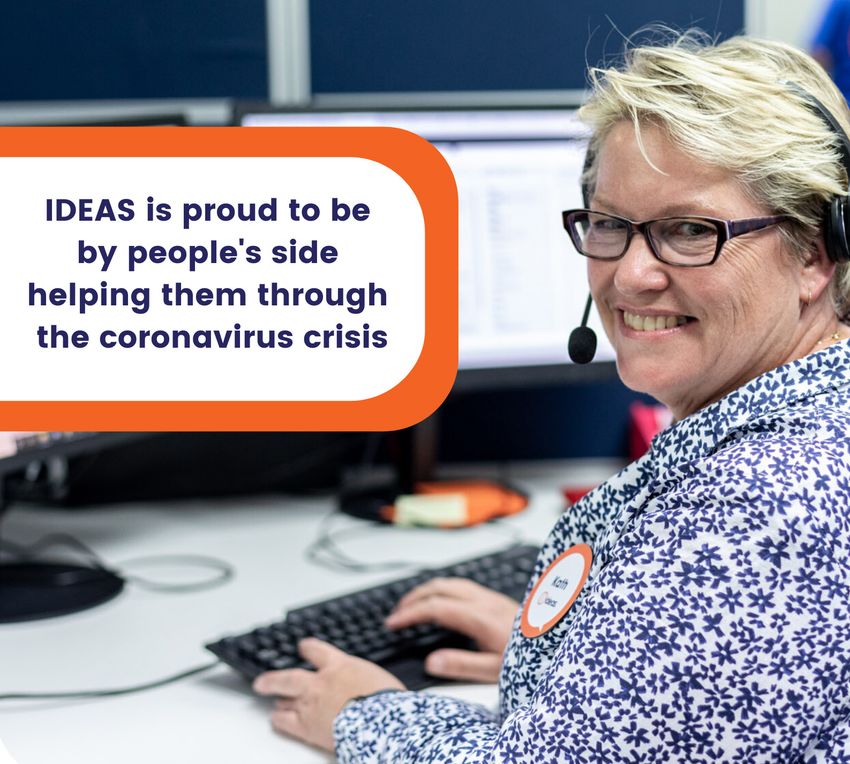
Contents.

 What's inside

  Latest Ideas.
      4       Should I Get the Flu Shot During the
              COVID-19 Crisis?
      5       Seniors Travel Card
                                                     5
      6-7     The Adventures of MIL & Me
      8-9     Our Journey

  News.
      10-11 Royal Commission Update
      12-13 Information Sharing as Market
                                                     10
              Stewardship in the NDIS Report

  Feature: Finding Your Way.
      14-15 What is Coronavirus?
      17      Telehealth                             15
      18-22 In This Together

  Travel and Transport.
      23-25 Power Blog: Touring with a Mobility
              Scooter
                                                     26
      26-27 Things To Do At Home
      28-29 Getting Out and About

  Equipment and Technology.
      30      PoolPod Products
                                                     30
  Book Review
      31      Book Review

 Newsletter of IDEAS May | June 2020                      3
Latest Ideas.

Should I Get the Flu Shot During the COVID-19 Crisis?

Government-funded influenza vaccines should have been available to providers
from early-mid April 2020. Experts are unclear how seasonal flu could worsen
COVID-19, however, it is recommended people avoid having both.

Getting a flu shot can help to protect others in the community including those
who can’t be vaccinated due to sickness or being too young. It can also protect
vulnerable groups such as babies, people over 65 years and pregnant women.

Eligibility
Some people are eligible for a free flu vaccine under the Federal Government’s
National Immunisation Program because they are most at risk. This includes:
    • Children aged six months to five years
    • Pregnant women (during any stage of pregnancy)
    • People aged 65 years and over
    • Aboriginal and Torres Strait Islander people aged 6 months and over
    • People aged six months and over with medical conditions that mean they have
      a higher risk of flu complications

For most cases, the flu vaccine is available through local GPs, Pharmacies,
community health clinics and Aboriginal medical services. With major changes in
place, check with official information channels regarding immunisation programs at
schools and workplaces.
    NATIONAL IMMUNISATION PROGRAM CONTACT DETAILS
          1800 671 811
          https://bit.ly/health-gov-immunisation
          IDEAS ID: 57846
     Information sourced from National Immunisation website.

4                                                  Newsletter of IDEAS May | June 2020
Latest Ideas.

 Seniors Travel Card

In January 2020, a trial began for a new $250 Regional Senior Travel Card. The
prepaid card will let seniors in regional and remote areas buy fuel, use taxi services
or book a NSW Trainlink fare, so as to ease the cost of travel. Each card is valid
for 14 months from the date of issue. Eligible seniors can apply now, with cards
distributed from mid-February 2020. It is a 2-year trial covering 2020 and 2021.

To be eligible for the trial a person must be:
  • Aged over 66 years
  • Receiving the Age Pension (you must have received the Age Pension for at
    least one month), or
  • Receiving either a Service Pension, Disability Pension under the Veteran’s
    Entitlements Act 1986 or a War Widow(er) Pension
  • A Commonwealth Seniors Health Card holder (you must have held your card
    for at least one month), and
  • Living in a designated regional area of NSW outside of Sydney, Newcastle and
    Wollongong.

The Service NSW website has a Register Now point to enable a person to receive
an email or SMS text to see when they can apply for the trial. The Card will be pre-
loaded with $250 to pay for travel-related expenses over the phone, online and at
retail outlets. It is a pre-paid, non-reloadable Visa card with a 4-digit PIN. It can be
used Australia-wide, including in metropolitan areas and with interstate travel.

  SERVICE NSW CONTACT DETAILS
         13 77 88
         www.service.nsw.gov.au
         IDEAS ID: 6783
   Information sourced from Service NSW website.

 Newsletter of IDEAS May | June 2020                                                       5
Latest Ideas.

The Adventures of MIL & Me

Just to explain from the “get-go”, MIL stands for Mother-in-Law. Unlike other
stereotypes, my MIL and I, get along exceedingly well.

It was the spring of 2017. My sister-in-law had just asked me if we would consider a
cruise to Papua New Guinea (PNG) and the little-known Conflict Islands. Husband
said no, MIL said yes, with gusto! Amazing due to her limited mobility. With medical
issues, her desire to travel had been suppressed to the point of letting her passport
expire. So began a learning curve regarding travel and disability.

The Conflict Islands are the remains of an ancient volcanic rim that has no
permanent inhabitants. It is a state that is guarded vigorously by their current owners
to preserve them. Permission was given to anchor in the deep water of the drop
off and a floating jetty was in place to accommodate passengers on the days that
visitors are invited. I give you this picture to demonstrate the logistics of negotiating
our adventurous day.

MIL had chosen not to visit an island the previous day due to the need to manage
steep stairs and use the tender (dinghy) boats to alight the cruise vessel. Soon
after we awoke, MIL sadly told me that she didn’t think she could manage the
day. Reluctantly, I left her and joined the rest of our party. While I waited in the
marshalling area, a man using a wheelchair joined our group. I asked him what day
trip he was doing. He said that he was on the same trip as us so I ran to our room
and told MIL that she should be alright. In a flash, she was ready to come with me,
walking cane in hand.

Nervously we joined the rest of the group and agreed that if things got too rough
we would opt out, but take it one step at a time. Well, the day was superb with
each step an adventure in itself. Leaving the marshalling area, the steep stairs that
we needed to descend seemed less than the previous day, as three attendants
6                                                   Newsletter of IDEAS May | June 2020
Latest Ideas.

guided MIL gently to her seat on the tender. Step one done. Next, from the tender
to the jetty. Five robust men assisted her onto the jetty… the floating jetty. With
flimsy railings it was not weight bearing and it was floating. MIL took a deep breath,
gripped her cane and began. It was like a marathon for her to make the 50 – 70
metres without needing to sit, but she made it, to a seat, albeit a stump. Next, the
beach and soft sand. Moving from stump to rock to seat, we got to the water’s edge.
A man nearby gathered some mates and they all but carried MIL to the waiting
dingy. For the rest of us this meant wading through the water and climbing over the
edge of the boat.

A 1.5km trip to the tour vessel followed, with a climb up to the top deck. By now, we
had caught up to the fellow in the wheelchair and saw he was being helped. On the
tour boat, more crew emerged to help MIL and our wheelchair-using friend. These
people were some young PNG women and men who showed MIL respect and
allowed her discreet dignity in alighting the boat and climbing the stairs. At no time
was there any sense of danger, just carried over the obstacles without fuss and with
dignity. No hoists, no lifts, just strong and caring arms.

MIL settled in with the other passengers and enjoyed a two-hour tour of this remote
yet stunning place. Of course, we needed to do it all in reverse at the end of the tour,
but MIL was curled up with a good book and resting comfortably by early afternoon.
With a bit of recovery and soul revival, the story has been retold to extended family
members for months to come. MIL had given up a little on her bucket list, so she’d
surprised even herself. The adventure’s success is due largely to the wonderful
caring people from PNG who seem to wrap up their elders, and others who need
care, without a second thought. It was a different attitude to people with disabilities
and older people and a matter of course that they were genuinely included. I believe
there is something we can learn from our neighbours in their non-first world country.
Inclusiveness, respect and dignity for our elders and those less able.

 Written by Kath Hetherington - IDEAS Lead Information Officer

 Newsletter of IDEAS May | June 2020                                                  7

Our Journey.

    1981
    1981 WAS A TURNING POINT INTO THE HISTORY
    OF THE AUSTRALIAN AND INTERNATIONAL
    DISABILITY RIGHTS MOVEMENTS.
               The regional Council of DPI applied for a
               grant program from the Federal Government
                                                                                             1996
                                                                                             IDEAS goes
               celebrating the international year of
                                                                                             online with its
               disabled people, to develop a community
                                                                                             first website.
               directory of equipment suppliers available
               for people with disability in the Riverina.
               The project was based in Tumut, as the lead
               Project Officer, Jenny Stanzel lived there.        1988
               IDEAS was formed as an incorporated                IDEAS publishes
               association. Based in Tumut, led by Jenny          newsletters.
               Stanzel. Project funds were gained in
               1984 from the federal Health department
               to establish a national one stop shop for
               information for people with disability. A new
               employee commenced – Sue Gorman.
               With two staff the organisation began             1986                                  1997
               collecting information about services and
                                                                 Disability rights advocacy was        Jenny
               supports available for people with disability
                                                                 recognised as a programme             Stanzel
               and housed it in a computerised database                                                retires
                                                                 area to be funded under the
               using Asksam as a database software.              Disability Services Act 1986.         and Diana
               Jenny Stanzel became well known                                                         Palmer
                                                                 Since then, disability activism
               as a strong advocate for people with                                                    becomes
                                                                 and advocacy began a sustained
               disability and represented people with                                                  the second
                                                                 focus on several important
                                                                                                       Executive
               disability on numerous committees                 cornerstones of disability
                                                                                                       Officer.
               and consultative bodies through the               self-determination; a
               1980’s retiring from the service in 1997.         general move away from
               In 1998 Jenny was award an AM for                 institutional type services to
               her services to people with disability.           community based services;
                                                                 the establishment of ‘public
               In 1981, disability became more than
                                                                 advocates’ and guardianship
               a diagnosis and something to be dealt
                                                                 boards in most states, the
               with by medical professionals. People with
                                                                 Disability Services Act 1986
               disability became united to overcome              (DSA) and the Disability
               their social oppression as a group.“Nothing       Discrimination Act
               About us without us” was appropriated             1992 (DDA).
               by people with disability in their activism.
8                                                              Newsletter of IDEAS May | June 2020
Our Journey.

                                                   2011
2002                                               Productivity Commission
IDEAS moves from                                   Report proposing the NDIS.
Asksam to the                                      “The current disability support
LINCS Database;                                    system is underfunded, unfair,

                                                                                             2018
updating the                                       fragmented, and inefficient, and
website and giving
access to online
information
                            2010
                            Diana Palmer
                                                   gives people with a disability little
                                                   choice and no certainty of access
                                                   to appropriate supports. There
                                                                                             2020
from the IDEAS              wins a Churchill       should be a new national scheme           Independent information
database.                   Fellowship.            - the National Disability Insurance       matters more than ever.
                                                   Scheme (NDIS) - that provides
                                                   insurance cover for all Australians
                                                   in the event of significant disability.
              2008                                 Funding of the scheme should
              IDEAS merges                         be a core function of government          2014
              with DIRC.                           (just like Medicare).”                    NSW Inclusion Act.

2008                                2010–2020                                                            2017
The adoption and                    National Disability Strategy                                         IDEAS
ratification by the                                                                                      becomes
                            “People with disabilities want to
Australian Government                                                                                    a company
of the United Nations
                            bring about a transformation of their
                            lives. They want their human rights                      2013                limited by
Convention for the                                                                   National            guarantee.
                            recognised and realised. They want
Rights of Persons with      the things that everyone else in the                     Disability
Disabilities (CRPD). By     community takes for granted. They                        Insurance
ratifying the United Nationswant somewhere to live, a job, better                    Scheme Act
Convention on the Rights    health care, a good education, a chance                  2013 legislated.
of Persons with Disabilities,
                            to enjoy the company of friends and
Australia joined other      family, to go to the footy and to go to
countries in a global effortthe movies. They want the chance to
to promote the equal and    participate meaningfully in the life of
active participation of all the community. And they are hopeful.
people with disability.     They desire change and they want
                            others in the community to share their
                            vision. They recognise that governments
                            cannot work in isolation and they
                            want others to see the benefits of
                            building more inclusive communities
    Newsletter of IDEAS May (Shut
                             | June                                                                                    9
                                   Out,2020
                                        2009)”
News.

 Royal Commission
 Update

The Royal Commission into Violence, Abuse, Neglect and Exploitation of People
with Disability (Disability Royal Commission) and the Royal Commission into Aged
Care Quality and Safety (Aged Care Royal Commission) have both suspended all
hearings and workshops for the time being.

This is due to the evolving Coronavirus (COVID-19) pandemic and affects all
hearings, face to face consultations and workshops scheduled until at least the
end of May 2020. Consequently, the Aged Care Royal Commission public
submissions deadlines has been extended to 30 June 2020.

     AGED CARE ROYAL COMMISSION CONTACT DETAILS
          1800 960 711
          https://agedcare.royalcommission.gov.au/
          IDEAS ID: 95383

The Disability Royal Commission has issued a Statement of Concern about the
impact of the COVID-19 pandemic on people with disability.

Emergency planning and responses of Australian governments should include a
specific strategy to provide appropriate guidance, support and funding to meet the
particular needs and requirements of people with disability.

10                                               Newsletter of IDEAS May | June 2020
News.
Both Commissions have already conducted hearings on issues relating to the
health system. The Disability Royal Commission held this public hearing in
Sydney from 18 February to 28 February 2020.
The hearing looked specifically at the provision of health care or services for
people with cognitive disability, including people with intellectual disability,
autism and acquired brain injuries. The Commission found that health outcomes
for this group were worse than for the general public. One of the main issues
raised was clear communication between health providers and patients.
DISABILITY ROYAL COMMISSION CONTACT DETAILS
1800 517 199
www.disability.royalcommission.gov.au
IDEAS ID: 95338
eBility Crisis Relief
Temporary Crisis
Exchange for Australians
with disabilities to donate
or find accessible
disability equipment and
non-perishable
consumables. Helping
people connect and share
resources in times of crisis.
ebility-crisis-help.ideas.org.au
Newsletter of IDEAS May | June 2020 11News.
Information Sharing as Market Stewardship
in the NDIS report
In March, IDEAS launched the report ‘Information Sharing as Market Stewardship in
the NDIS’ at the National Library in Canberra and we are pleased to be able to share
this critical research with you.
Prepared by Associate Professor Gemma Carey and Eleanor Malbon from the
University of New South Wales Centre for Social Impact, it examines the distinct role
information provision plays in the NDIS market.
Thissay
Just report
you demonstrates
need help – you how independent
don’t information
have to explain the whole
services
reason andare already
your entireplaying essential
condition. market
Just say stewardship
you cannot do
whatever
functionsit within
is and the
ask NDIS.
for some help.
As both state and federal governments grapple with ensuring the market can meet
the needs of people with a disability, it is clear independent information services
must exist if people are to have choice and control, and the market is responsive.
Our experience and expertise in providing information for people with disability and
the broader community are also recognised, timely given that IDEAS is currently
facing funding uncertainties as there is no guaranteed provision for our service to
continue.
IThe
loveloss
cuddling
of IDEASmy cats,
as an and my dogs
organisation wouldadore
leave ame. They getand
problematic me up
highly
and outconcerning gap in
of bed each the–system
day of market
walking my dogs stewardship in the
is “my time”. My
NDIS, love
dogs leaving
memany NDIS participants
unconditionally andwith
looka at
lack
meof in
clarity
a wayof how thea
I wish
NDIS would.
man works and how
They to my
are use comfort.
it to meet their service needs.
12 Newsletter of IDEAS May | June 2020News.
The report tells us what our customers have been telling us for years - we
simply need good information to be able to make choices.
IDEAS will be continuing the fight to make sure that people always have a
friendly and experienced voice at the end of the line to make life easier.
If you value information, please email info@ideas.org.au and tell us why it
matters to you.
You can download a copy of the report from www.ideas.org.au or contact our
call centre and ask us to send you a copy.
Information sourced from NSW Omdubsmans website and report
IDEAS is now open from
8AM - 8PM AEDT/AEST
Monday to Friday
Freecall: 1800 029 904 Email: info@ideas.org.au
Livechat: www.ideas.org.au
Newsletter of IDEAS May | June 2020 13News. Coronavirus COVID-19 or SARS-CoV 2 (Coronavirus) is a new virus closely related to SARS (Severe Acute Respiratory Syndrome) and is in the same family of viruses as MERS (Middle Eastern Respiratory Syndrome). Spreading worldwide the original outbreak was in Wuhan, Hubei Province in China, in December 2019. Worldwide, there have been more than 2 million confirmed cases (this number is expected to rise), and many deaths reported. People with disability, the elderly and those with chronic health conditions are at greater risk than the rest of the population of dying from COVID-19. The situation is changing rapidly, and it is important to stay informed. You can check our Coronavirus pandemic blog on our website for up to date info or call us for free on 1800 029 904. What are the symptoms? The virus commonly causes fever and may cause coughing, sore throat and shortness of breath. Symptoms take 2-14 days to develop. People with disability, especially those with respiratory and lung conditions and older people are at higher risk of complications. If you have symptoms you should call your doctor or call the National Coronavirus Helpline at 1800 020 080. Do not go to your doctor’s surgery or emergency department without calling ahead so that arrangements to isolate you from other patients can be made. Practice good hygiene by covering your coughs and sneezes, and washing your hands thoroughly for at least 20 seconds with soap and water. You should wear a mask if you have one and avoid public transport and public places. There isn’t a known treatment or vaccine for novel coronavirus just yet. Social Distancing Social distancing is one of the main ways to stop or slow the spread of infectious diseases. It means less contact between you and other people. Stay 1.5 m or two big steps away from other people and avoid social situations where possible. It means not shaking hands, not hugging or kissing or coming into close physical contact with people when you are out and about. 14 Newsletter of IDEAS May | June 2020
News.

Social distancing also means limiting how often you are out and about. Schools,
universities, businesses and other workplaces have put policies in place to help slow
the spread of the COVID-19, including cancelling or postponing events where large
numbers of people are in close contact.

Stop the Spread
The Australian Department of Health has launched a national campaign to help all
Australians be informed and prepared for the coronavirus pandemic.

The campaign focus is on “Stop the Spread and Stay Healthy” and aims to reduce
the risk to individuals and families by providing practical and straightforward steps
to help prevent the spread of disease. The campaign consists of print ads, posters,
TV ads and radio spots, which all aim to educate the general public on ways they
can stop the spread and protect vulnerable people in the community, including older
people and people with disability, from catching the COVID-19 Coronavirus Disease.

These resources are accessible and inclusive, including closed captions and Easy
Read principles with illustrations to aid communication.

  WHERE TO FIND THE RESOURCES
        www.health.gov.au
   Information sourced from the Australian Department of Health website.

 Newsletter of IDEAS May | June 2020                                              15
Latest Ideas.
Simple steps to help
stop the spread.
Cough or sneeze Use a tissue
into your arm
Bin the tissue Wash your hands
Together we can help stop
the spread and stay healthy.
For more information about Coronavirus
(COVID-19) visit health.gov.au
16 Authorised by the Australian Government,Newsletter
Canberra of IDEAS May | June 2020Feature.
Telehealth
What is it?
Telehealth means using telecommunication technology, including telephone and
video calling, like Skype and FaceTime, to conduct bulk billed medical consultations
remotely. This reduces the chance of spreading infection from sick patients to
doctors, nurses and other medical professionals and subsequently to other patients.
How does it work?
Temporary Medicare Benefits Schedule (MBS) and Department of Veteran’s Affairs
(DVA) item numbers will allow GPs and other health professionals to be more
flexible with patients who are at risk or unwell. The new MBS items enable people
to access essential health services in their home while they are in self-isolation or
quarantine. These Medicare item numbers will be in place for six months initially.
Who can access it?
People in isolation or quarantine for COVID-19 can see eligible health providers with
these new telehealth items. Patients who have seen that provider (or another one at
the same practice) at least once face-to-face in the last 12 months are eligible.
Telehealth services will be available to:
• People isolating themselves at home on the advice of a medical practitioner or
following home isolation guidance
• People who meet the testing guidelines for COVID-19
• People over the age of 70
• Aboriginal and Torres Strait Islander people over the age of 50
• People with chronic health conditions or who are immunocompromised
• Parents with new babies and people who are pregnant
How to use it
Contact your GP doctor, mental health practitioner or midwife by phone, especially if
you have cold or flu symptoms and explain your situation.
Information sourced from the Australian Department of Health website.
Newsletter of IDEAS May | June 2020 17Latest Ideas. In This Together In May-June we celebrate National Sorry Day on May 26 and National Reconciliation Week (NRW) from May 27 to June 3. NRW starts and ends by commemorating two significant milestones in the reconciliation journey – the Referendum (27 May 1967) acknowledging Aboriginal and Torres Strait Islander peoples, and the High Court Mabo decision (3 June 1992), respectively. This year marks the 20th year and this year’s theme for NRW is “In This Together”, which, considering the times we are living in, is particularly poignant. National Sorry Day is held on 26 May each year to acknowledge and recognise members of the Stolen Generations. The Bringing Them Home report (tabled in Federal Parliament on 26 May 1997) recommended that a National Sorry Day be celebrated each year. It wasn’t until 13 February 2008 that the Australian Prime Minister of the day, Kevin Rudd, made the Apology to Australia’s Indigenous peoples. Quaden’s journey Quaden Bayles is a young Indigenous boy with a visible disability. He is a person of short stature and was born with achondroplasia dwarfism. He is an advocate for Stand Tall 4 Dwarfism. Earlier this year, Quaden’s mum decided to make a live broadcast on social media showing his pain and suicide ideation after a bullying incident at school. The video went viral with more than 17 million views and was met with an outpouring of love and support for Quaden. He should not have to carry this burden. His social and emotional well-being should be supported and nourished by his community. Quaden has since been in contact with a resilience coach from the United States, who is helping him online to develop the skills and the mind frame he needs to combat his feelings of sadness and suicide ideation. Quaden’s journey from his lowest point of desperation and depression to building resilience skills and self- empowerment has been a tremendous one. 18 Newsletter of IDEAS May | June 2020
Latest Ideas.

The Big Picture
Bullying can be very hurtful and
cause lots of pain. It can even lead
to feeling suicidal. Indigenous people
experience racism, and people
with disability experience ableism
everywhere they go. They are more
likely to experience bullying and
abuse too.

Suicide is the leading cause of
death for young people and suicide
rates are at least 2 and a half times
higher for Aboriginal and Torres Strait
Islander peoples than the national
average. School students with
disabilities are also more likely to be
bullied due to systemic ableism and
a lack of disability awareness and
education in the wider community.
                                           Photo: Stand Tall 4 Dwarfism: Facebook

Systemic disability, cultural awareness and community engagement are needed to
build a more accepting and inclusive society. We are “In This Together”.

Disability and appearance activist, Carly Findlay, spoke up to support Quaden in
the aftermath of the viral video. Carly has a skin condition called Ichthyosis, which
causes redness and dry skin. Carly regularly calls out people who exclude and bully
her for the fact that she looks different.

In 2010, Carly wrote a very profound and candid blog post about bullying in
response to media reports on the death of a young girl by suicide triggered by
bullying.

  Newsletter of IDEAS May | June 2020                                               19
Latest Ideas.
Just
It issay you need help
heartbreaking – youthat
to know don’t have beings
human to explain thethe
have whole
reason
powerand your entire
to make otherscondition. Just say to
feel so worthless you cannot
the point do
they
whatever
take theirit own
is and ask for some help.
life.
She also describes her own experiences of bullying because of the way she looks.
I haveshock
And been bullied
horrorthroughout
the review my life, mostly
found at school.
that while I’ve was
there neverstill
forgotten
strong it. I would
support forbethe
called names,amongst
scheme teased because
people of with
my appearance,
disability
I was once stabbed with a protractor in class, and I felt I never had
and their families and the broader community, there was also
many true friends through my school life. The worst thing I felt was the
disappointment, frustration
exclusion by other kids. I had no and
one toanger about
sit with how the
at lunchtime – I scheme
would sit
was
with operating
another boyonwhothewasground - Every
bullied and Australian
isolated Counts.
or in the library alone.
You can read the full blog post on Carly’s website.
http://carlyfindlay.com.au/2010/02/08/bullying/
Bullying hurts
Bullying, name-calling and violence hurt. When they say “sticks and stones may
break my bones, but words will never hurt me” it is a far cry from the truth.
It can be distressing to know that your child is being bullied. Stay calm and positive
but allow your child a safe space to feel sad and hurt. It is okay not to feel okay, and
the words and actions of others can hurt. Talk about and practice strategies for face
to face or online bullying (known as cyberbullying) and report any bullying incidents
to the school.
School principals, school counsellors and classroom teachers can help kids who
have been bullied. It is important for kids to feel safe and have an adult they can
trust and talk to if they experience bullying. Parents need to talk to their children
about respect and kindness and to educate them about differences they will come
across in their daily lives. Differences include disability, size, shape, skin, hair and
eye colour, cultural, language and religious differences.
20 Newsletter of IDEAS May | June 2020Latest Ideas. Bullying can happen online, in the workplace and community too. It is not just a “school-yard” problem. If you experience bullying in the workplace, you are protected by anti-bullying regulations under the Fair Work Act. Information and resources are available. Please refer to the crisis services listed on the following page. Ableism Visible or discernible differences are a part of life. Everyone is different. People with a disability, however, can face barriers to access and inclusion due to their differences. Social barriers can be just as significant as physical or practical ones. Over 20% of Australians have a disability, however, many of these disabilities are not visible. Ableism is a set of beliefs and practices which devalues and discriminates against people with physical, intellectual, sensory or psychosocial disabilities. Ableism relies on an understanding of disability where people with disability need to be ‘fixed’ in one way or another and is consistent with the medical model of disability. The social model of disability, however, acknowledges that barriers to inclusion and access are external to people with disability and that social expectations and physical barriers to access and inclusion are what need to be addressed. Newsletter of IDEAS May | June 2020 21
Travel and Transport.

Racism. It Stops with Me
Racism comes in many forms. It happens in many places.

It can be easy to ignore it or think it’s not worth the trouble to respond.
But that can just help make it acceptable.
All of us can say no to prejudice.
All of us can take a stand against discrimination.

Cheers turned to boos in the final years of AFL champion footballer Adam Goodes’
career when he publicly called out racism. The Final Quarter is an impassioned
documentary film which tracks Australia’s heated response to Adam Goodes and
was featured at the Sydney Film Festival in 2019.

 Visit www.itstopswithme.humrights.gov.au for information and resources.

If this article has raised any issues for you, please talk to someone. You can contact
Lifeline or Kids Helpline any time of day or night.

     LIFELINE CONTACT DETAILS
           13 11 14 (24 hours 7 days)
            www.lifeline.org.au
           IDEAS ID: 130
      Information sourced from Lifeline website.

     KIDS HELPLINE CONTACT DETAILS
           1800 551 800 (24 hours 7 days)
           www.kidshelpline.com.au
           IDEAS ID: 12313
      Information sourced from Kids Helpline website.

     RECONCILIATION AUSTRALIA CONTACT DETAILS
           02 6153 4400
           www.reconciliation.org.au
           IDEAS ID: 10765
      Information sourced from Reconciliation Australia website.

22                                                   Newsletter of IDEAS May | June 2020
Travel and Transport. Power Blog: Touring with a Mobility Scooter Like many older people, I have a mobility problem. I can walk, but only slowly and for limited distances. That means I miss out on many adventures when I am travelling and I’m limited to visiting places that are easily accessible by hire car or public transport. That rules out most gardens, history walks through towns and much exploring of cities. After much badgering by my daughters and wife, I bought a Luggie Elite mobility scooter, powered by an electric motor and battery, for my recent visit to Norway and Scotland. The scooter is designed to fold up into a compact shape and weighs only 25 kg. It can be carried easily in the boot of a car and best of all in the hold of an aircraft. There are several other makes of mobility scooters that do the same thing. Some actually fold themselves up at the press of a button. Most airlines will carry mobility aids, such as electric wheelchairs and scooters free of charge, but impose conditions. You can’t just rock up at the check-in desk with a scooter. You have to get approval from the airline first. This can involve some serious negotiation. Generally, the battery has to be removed and carried in hand luggage and the airline has to know the weight and overall dimensions in advance. Airport security tends to look askance at the batteries and it is best to carry written authorisation, especially when dealing with security staff who have limited English. Newsletter of IDEAS May | June 2020 23
Travel and Transport.

I found that ‘electric wheelchair’ was a better-understood description than ‘mobility
scooter’, and ‘scooter’ sounds like a child’s toy.

My first overseas trip with my scooter went well. Qantas, Qatar and KLM all agreed
to carry my scooter after some time spent getting to the right department for
approval. Loading at Perth was no problem and the scooter arrived at Oslo along
with me, my wife and other baggage. But then the fun began.

Oslo pavements have spoon drains, in which small scooter wheels stick, and often-
excessive sideways slopes.

On my first tentative trip around the city, my scooter rolled over going around a
corner leaving me holding on to a signpost to prevent me from falling into the gutter.
I was stuck – unable to let go – when two kind Norwegians in a nearby café saw my
predicament and hauled me back upright. “Takk, mange takk og tusen takk,” and I
was on my way.

The following day I explored Oslo’s main shopping mall, the grounds of the royal
palace and the Peace Museum, followed by a cross-fjord trip and long ride to the
Viking Ship and the Kon Tiki museums, then back to my hotel for a recharge.

In Bergen, I was able to explore the city and even take it up Mount Fløyen
overlooking the city on the funicular railway.

In Scotland, we carried the scooter in the boot of our hire car. This allowed me to
take it out and explore towns, gardens and historical sites and to travel further afield
in search of restaurants. I was even allowed to ride my buggy through a stately
home and a church on one occasion.

I successfully negotiated a walk-through Loch Garten Osprey Centre’s pine forests
at Nethy Bridge in spite of uneven ground and protruding roots, only falling off when
I attempted to turn round on a soft sand patch and head back to the car park.

Frank exploring a pine forest at Nethy Bridge in the Strathspey area of the Scottish
Highlands. Abernethy Forest is famous for its ospreys that visit every summer to
breed, and the largest remaining remnant of the ancient Caledonian pine forest in
Scotland.

The only disadvantage is that my mobility scooter tends to rush down slopes and
cannot tackle very steep uphill slopes without my reluctant wife or a kindly bystander
giving me a push. It also proved difficult to use in a crowded area without danger to
other pedestrians. However, I did not run over anyone.

24                                                  Newsletter of IDEAS May | June 2020
Travel and Transport.

The other problem was the airline baggage handlers who clearly ignored the ‘fragile’
warning and broke off two scooter wheels and those of the carrier bag.

In spite of the hazards, I’m convinced that I won’t leave Australia again without my
mobility scooter. I’m uncertain if I will be able to travel as I get older and lose more of
my limited mobility, so I’m seeing as much of the world as possible until then.

  - By Frank Smith

About the Author
‘I have always travelled, and still worked part-time at 79 to earn money to travel.
As an intellectual exercise, I usually try to learn a little of the language spoken in
the country I am to visit, although my command of Norwegian is very limited. I have
been disabled since 2003, the result of stenosis damaging my spinal cord. I was
determined not to let my disability get in the way or to prevent my wife from enjoying
travel.’

     Read more Power Blogs online, where we showcase people with
     disability using their POWER to overcome obstacles and their VOICE
     to tell their own stories and find their own way.
     IDEAS POWER BLOGS
          www.ideas.org.au/stories/power-blog

  Newsletter of IDEAS May | June 2020                                                   25
Travel and Transport.
Things To Do At Home
With Coronavirus restrictions in place, and people confined to home more than ever,
we have some suggestions to help you pass the time.
For Adults and Teens
• Try to exercise and eat healthy.
• Avoid too much time “online”.
• Edit photos.
• Home maintenance or furniture restoration.
• Cook your way through a favourite recipe book.
• Play an instrument or listen to music.
• Crafts or Hobbies – now is a great time to learn a new skill how to knit, sketch,
take photographs, build a scale model, sew a garment.
• Reading – audio-books, hard copy or downloadable.
• Netflix – time to binge-watch your favourite episodes on Netflix, Blue-ray or
DVD.
• Spring cleaning early or decluttering - a draw, a wardrobe, bookshelves,
DVD’s.
• Night owl’s with clear skies and low light pollution, can stargaze, watch for
satellites, meteorites and constellations.
26 Newsletter of IDEAS May | June 2020Travel and Transport.
For Younger Children
The below ideas cover exercise and fun as well as learning. Children need a “brain
break” too, so mix activities for this purpose.
• Colouring in or drawing.
• Playdough
• Board games, card games or puzzles. Use a mix of short and long games,
quiet and noisy games, simple, and harder games.
• Build an indoor tent, fort or cubby.
• Teach a pet a new trick.
• Good old “dress-ups’ and play-acting.
• Boxes - The Biggest Cardboard ones you can find, let their imagination run
wild.
• Crafting and painting
• Make paper bag puppets, sock puppets, characters made from toilet rolls, and
create a play.
• An indoor treasure or scavenger hunt.
• Build with Lego, Duplo – have a tallest tower competition, or build a city.
• Simple cooking – younger children can decorate a pizza with precut
ingredients, or icing and decorate biscuits. Older children can bake a cake or
biscuits or learn an easy recipe (supervised).
• Get some fresh air, a walk, kick a ball, soak in the sun, grab a skipping rope.
• Look through printed photo albums together.
• Plant and nurture a herb garden.
• Tie-die a t-shirt.
This is an abbreviated version.
For more online ideas and activities to try out, visit www.ideas.org.au and
see our Ideas Blog titled “Tips to get you through a staycation”
Or call us to receive a hard copy posted to you.
Newsletter of IDEAS May | June 2020 27Travel and Transport.
Getting Out and About
The Mobility Parking Scheme (MPS) provides parking concessions to people with a
mobility disability. If you’re eligible, Transport for NSW will issue you a licence-style
card called an MPS permit, which will include your photo and other security features.
There are two types of permits available:
• Individual (blue card) – issued for 5 years if you have a permanent disability
• Temporary (red card) – issued for up to six months if you have a temporary
disability
When you apply for an MPS permit in NSW, you will also be issued with an
Australian Disability Parking permit (a large purple card)
To get parking concessions both permits must be displayed.
Concessions are available for pensioners for the cost of an MPS permit.
For more information on Disability Parking Permits
Visit: https://bit.ly/disability-parking-permits
Or call us to receive a hard copy posted to you.
28 Newsletter of IDEAS May | June 2020Travel and Transport.
The National Public Toilet Map
The Toilet Map is a part of the National Continence Program and provides
information on over 19,000 publicly available toilets in Australia. This includes
accessibility, opening hours and facilities such as baby changing and showers.
The Toilet Map is available on mobile devices at www.toiletmap.gov.au and the
official National Toilet Map App can be downloaded from the App Store or on Google
Play.
MLAK
MLAK stands for Master Locksmiths’ Association key. It is a master key that fits into
specially designed locks allowing 24 hour a day access to public toilets. Eligible
people – those with a disability and a letter of authorisation from a doctor, disability
organisation, local council or community health centre – can purchase a key that
opens all accessible toilets displaying the MLAK symbol.
MLAK CONTACT DETAILS
1800 810 698
www.masterlocksmiths.com
IDEAS ID: 9171
Stay On-Time! TabTimer
helping to keep people on time
Utilise your NDIS funding to help you stay on-time
with important medicines and personal care tasks.
TabTimer
helping to keep people on time
Blister Pack Medicine Timers TabTimer
Electronic Pill Boxes
helping to keep people on time
Vibrating Watches Vibrating Door Bells Vibrating Clocks
Automatic Pill Dispensers Talking Watches Talking Clocks & Orientation Clocks
Contact TabTimer and we will help you stay on-time with Assistive Technology.
visit: www.TabTimer.com.au or call: 1300 TAB TIMER (1300 822 846)
For terms and conditions of sale see www.TabTimer.com.au . TabTimer™, ‘helps keep medications on time’™, ‘helping to keep people on time’™ and the TabTimer™ logo are trademarks of TabTimer Pty Ltd © 2018 ABN: 99 137 415 948
Newsletter of IDEAS May | June 2020 29Equipment and Technology.
Poolpod Products
Originally, the Poolpod was developed for the London 2012 Olympic and Paralympic
Games. Across Australia, these unique submersible platform pool lifts are increasing
in number.
Offering independence, dignified access, and eliminating poolside transfers, the
Poolpod has been designed for any swimmer unable to use a pool ladder or steps.
Allowing access by remaining standing, or using the custom-designed submersible
wheelchair, this equipment allows safe access to the water. Control can be through
a wristband, hands free operation, wireless remote control or on-board user controls,
positioned for wheelchair and ambulant users.
Currently, across the eastern seaboard, Poolpods are available at:
• Palm Lake Resort Caloundra • Bairnsdale Aquatic Centre
• Beachmere Moreton Bay • Westbourne Grammar School
• Palm Lake Resort Toowoomba • Collingwood Leisure Centre
• Palm Lake Resort Cooroy-Noosa • Geelong Grammar School
• Palm Lake Resort Tea Gardens – • Harold Holt Swim Centre –
Great Lakes Stonnington
• Aquamoves Shepparton • Ashburton Pool and Recreation
• Gurri Wanyarra Wellbeing Centre- Centre - Boroondara
Bendigo • Hobart Aquatic Centre
• Burnie Aquatic Center
POOLPOD PRODUCTS CONTACT DETAILS
+44 (0)1412 372 127
poolpod@corepdgroup.com
IDEAS ID: 95838
30 Newsletter of IDEAS May | June 2020Book Review.
Book Review
After the Diagnosis: The Journey Beyond (2008) by Trish Robichaud, Jeff
Cadwell & Sylvia McGrath.
The diagnosis of a chronic illness or a disability can really rock a person’s sense of
security and affect how they view their future, whether that is with their work, their
family and friends, and certainly, with any long-term plans they may have.
After the Diagnosis: The Journey Beyond offers insight and support while being a
guide through the different stages that are involved with learning you have a chronic
illness or disability.
The chapters of this book cover the five areas of grief, denial, anger, bargaining,
depression and acceptance. There is a section titled Research which suggests
ways of gaining a sense of control and keeping informed, among other things.
The Decision-making chapter includes prioritising, making lifetime decisions for
your health. The chapter Support Networks discusses ideas for building a solid
foundation and working together. Moving forward offers some thoughts on applying
the knowledge you’ve gained, and building and planning your new journey.
Just sayconquer
As you you need helpstep
each – you don’t
in the have to
journey explaindiagnosis,
beyond the whole
reason
you willand
gainyour entire condition.
confidence that you Just say you cannot
are adjusting to yourdo
new
whatever
reality. it is and ask for some help.
Available through Amazon and Book Depository, and as a digital version through
Changing Paces.
TO WATCH A SUMMARY OF AFTER THE DIAGNOSIS: THE JOURNEY BEYOND
https://youtu.be/Q8YWD_FRaY8
Newsletter of IDEAS May | June 2020 31Disability Infoline
1800 029 904
Text: 0458 296 602 - LiveChat: www.ideas.org.au
Disability Information
Free, Accurate & Independent
IDEAS is a free telephone information service for people with disability, their family,
carers and other supporters.
Ask us the questions, we give you the answers and you make the decisions.
IDEAS accepts selected advertisements and articles for the Newsletter of IDEAS, although this does not provide an
endorsement of these actual services or products. You should always consult with a health professional before making
a decision based on your individual needs. IDEAS gratefully acknowledges funding from the NDIS, the Australian
Government through the Home & Community Care Program & the New South Wales Government FACS (Families
and Community Services Department).You can also read


