FOOD SECURITY SITUATION IN THE KYRGYZ REPUBLIC
←
→
Page content transcription
If your browser does not render page correctly, please read the page content below
Photo: WFP/ Danil Usmanov

 FOOD SECURITY SITUATION IN THE
 KYRGYZ REPUBLIC               FEBRUARY 2021
The health crisis, caused by the COVID-19             As elsewhere, the contraction in economic
outbreak, has led to a profound economic              growth has led to a decline in the population’s
crisis in the Kyrgyz Republic, as the country         income -experienced by 54% of households2 -
sees its economy slow down and its budgetary          and to an increase in the unemployment rate,
expenses rise. Adding to the already fragile          leaving a large number of people unemployed
situation caused by the pandemic, the recent          and without sources of income. A recent
political crisis and the resulting instability have   assessment on the impact of COVID-19 shows
led to even more uncertain prospects. The             that unemployment may be more severe than
resultant negative socio-economic shocks are          predicted as 22% of households reported that
having severe consequences on food security.          at least one member had lost his/her job3.
                                                      Using these results, the minimum number of
DECREASES IN HOUSEHOLD INCOME
                                                      newly unemployed could be estimated around
THREATEN ACCESS TO NUTRITIOUS FOOD -
                                                      344,200 people or 13.3% of economically
MACRO ANALYSIS
                                                      active population4. Adding to the 140,900
According to the National Statistics Committee        people (5.5% of economically active
(NSC), in 2020 the Kyrgyz Republic’s GDP              population) who were unemployed prior to
amounted to 598.3 billion Kyrgyz soms (KGS),          the crisis, assuming they had not found
a decrease of 8.6% compared to 20191.                 employment in the meantime, the estimated
Negative trends were observed in the                  minimum unemployment rate reaches 18.8%.
construction, wholesale and retail trade
sectors.
Graph 1: Gross Domestic Product & Unemployment rate (%,
2007 – 2020)                                                  population for income-generating opportunities. This
                                                              puts additional pressure on the government to deal with
                                                              unemployment and those in need of social protection,
                                                              especially in rural areas.

                                                              Apart from representing about 30% of the country’s
                                                              GDP, remittances are a primary source of income for
                                                              many households and in 2019, they contributed to
                                                              reducing the national poverty rate by 11 percentage
                                                              points indicating that 715,000 people rely on them to
                                                              remain out of poverty8. As a result of the pandemic, in
                                                              Central Asia, 83% of migrants either lost or had a
                                                              reduction in their usual income and, among those who
                                                              have lost their jobs, 90.2% were unable to transfer
                                                              money to their homeland9. Although a significant
                                                              decrease in remittances was forecasted compared to last
                                                              year, official statistics from the NBKR showed only a
                                                              minor decrease in the inflow of remittances (-1.63%) and
                                                              even a marginal increase (+1.2%) when the net inflow
                                                              was considered, due to a considerable decrease in
                                                              outflows.     Most      likely,   with   travel    restrictions,
                                                              remittances that were sent ‘informally’ before are now
Source: WB, NSC and author’s calculation
                                                              sent through formal channels or money transfers,
Given the high share of informal employment (73.8% in         hindering the ability of official statistics to capture the
2018, ILO5), the situation is particularly severe for those   real impact of the pandemic on remittances. A recent
“invisible” to the formal employment systems, by large,       assessment showed that a decrease in volume was
urban and semi-urban populations. With the lost               experienced by 85% of family receiving remittances from
livelihood opportunities, these people are now required       a family member abroad10. Therefore, although not
to become visible to the institutions in order to have the    quantifiable, we could assume a sizeable drop in
possibility of access to the social assistance system.        remittances     in      2020.      Together       with   rising
                                                              unemployment and the reduced purchasing power due
                                                              to higher prices, the reduction or loss of remittances’
In 2018, more than 740,000 Kyrgyz citizens were               income not only jeopardizes the food security of
registered as migrants in different countries, with Russia    vulnerable households, but also increases their risk of
                                                   6
alone absorbing over 86% of all Kyrgyz migrants . Due to      falling into poverty.
the COVID-19 crisis, about two-thirds of migrants (63%)
have reported losing their jobs. As unemployment is
becoming an issue all over the world, both migrants           Rising food prices are impairing access to food – as the
remaining abroad and returning home are at risk of            main staples like wheat and flour have increased by 25-
becoming food insecure7. The assessment showed that           30% in price compared to 2019. This trend is confirmed
most migrants are willing to return back to Kyrgyzstan to     by the Consumer Price Index (CPI) which on average has
look for jobs or open their own businesses to help boost      increased by 17.3% for cereals, meat, fish, milk and dairy
the economy and development of the country. The surge         products, fruits and vegetables. Recent simulations by
of migrants returning could lead to an increase in            the World Bank indicate that a 5% increase in consumer
unemployment and further limit access to basic                prices alone can increase the national poverty level by
resources, including food as they compete with the local      3.6 percentage points.
Graph 2: CPI trend (% of food and non-food items & % of staple   social protection schemes to cover the ‘new poor’. From
food items, 2007-2020)
                                                                 January to November 2020, due to the economic crisis,
                                                                 the number of poverty benefit recipients (“ui-buloogo
                                                                 komok” allowance) has increased by 7%, from 96,080 to
                                                                 102,504 households with children14. As a ‘shock-
                                                                 response’ support, in addition to already existing social
                                                                 protection programmes, one-off food assistance to poor
                                                                 families, people with disabilities, newly poor and
                                                                 unemployed was provided. Families needing food
                                                                 assistance had to call via an ad hoc hotline. Since the
                                                                 beginning of the pandemic, 683,295 people have applied
                                                                 for food assistance to the Ministry of Labour and Social
Source: WB and NSC
                                                                 Development, which has been able to accommodate
Apart from the reduced availability of food and higher           523,880 applicants thus far15.
prices, during the lean season access to food is also
hindered for 20.4% of the economically active
population that derive their livelihood from agriculture         Loss of income sources or a decrease in volume,
(WB, 2020) as they face lower income having invested in          enhances households’ vulnerability as they are likely to
sowing but earning a profit only after the harvest is sold.      adopt negative coping strategies. According to the latest
Therefore, it is particularly crucial to keep monitoring the     impact assessment on COVID-19, as a result of economic
food security and nutrition situation in the country             hardships, 44% of households have cut food costs by
during the lean season in order to promptly address              decreasing their food consumption and/or by moving
critical situations.                                             towards less expensive but less nutritious food options.
                                                                 This behavior is detrimental to further development,
                                                                 perpetuating the cycle of poverty. Moreover, through a
One of the main drivers of the food price surge in               rapid assessment conducted by WFP in May, 82% of
Kyrgyzstan is the depreciation of the national currency          respondents compared to 58% in 2019 have already
owing to the country’s high reliance on imported food -          applied some form of asset depletion coping strategy.
                            11
around 47% for wheat , 37% sugar and 84% for                     This indicates a reduced ability of households to deal
vegetable oil. Notwithstanding that the National Bank of         with shocks, a reduction in current and future
the Kyrgyz Republic (NBKR) has already sold USD 379.5            productivity, and human capital formation.
million in foreign exchange reserves since March, by
February 2021 the Kyrgyz som depreciated by 21.2% vis-
a-vis the US dollar compared to last year (pre-COVID
estimate), after a prolonged period of stability. At the
end of December 2020, reserves amounted to USD 2.81
billion – USD 136.1 million less than two months earlier.

Coupled with the shrinking of the economy, higher
expenses to counter the crisis have widened the budget
deficit run by the national government, which now
amounts to KGS 29.76 billion (USD 360 million), 5.1% of
GDP12. A deficit will also be carried into 2021, amounting                                    Photo: WFP/ Dilshod Ismonaliev
to KGS 8.4 billion (USD 10.1 million) or 1.3% of GDP13.
The tightening of the overall budget may have
repercussions on the availability of funds for enhancing
ADDING FUEL TO THE FLAMES: POLITICAL                             according to the World Bank19. The share of income
INSTABILITY AFTER OCTOBER’S PARLIAMENTARY                        spent on food is an indicator of food security as the
ELECTIONS                                                        poorer and more vulnerable a household, the larger the
                                                                 share of household income spent on food and the
The political unrest in October was an additional strain
                                                                 higher the vulnerability to fluctuation in prices on both
on the country’s economy costing over USD 100 million,
                                                                 the   quality    and    quantity    of    household     food
including the damage caused by the looting of large
                                                                 consumption. A high share of income spent on food
companies, according to preliminary estimates of the
                                                                 leaves households little room for other expenses like
International Business Council of Kyrgyzstan. The
                                                                 education and health services, hindering their ability to
unrest negatively affected the investment climate in the
                                                                 graduate out of poverty. In 2019, it was estimated that
country,      weakening    investors’      confidence    thus
                                                                 46% of the population consumed less than 2,100 kcal per
influencing     investment,    including     foreign    direct
                                                                 day20, implying that the poor (and those just above the
investment (FDI). Within just the week following the
                                                                 poverty line) do not meet their daily adequate energy
elections, the Kyrgyz som lost 3% of its value, impacting
                                                                 consumption.
food prices.
                                                                 The situation is more dramatic in regard to a nutritious
The political instability also delayed the approval
                                                                 diet as up to 76% of households could not afford a
between Kyrgyzstan and Russia of an indicative balance
                                                                 nutrient adequate diet prior to the crisis21 (SOFI, 2020).
that determines the volumes of duty-free deliveries of
                                                                 In the Kyrgyz Republic, dietary patterns are characterized
fuels and lubricants. Kyrgyzstan relies on oil and gas
                                                                 by a high consumption of wheat, potatoes and sugar,
imports, mainly from Russia and Kazakhstan, for more
                                                                 undermining the nutritional status of individuals.
than half of its energy needs particularly during the
                                                                 Consumption levels of nutrient dense food, such as
winter months when hydropower production is low
                                                                 meat, milk and their products have substantially
(IEA). The agreement was strongly requested by oil
                                                                 decreased compared to 1990, while consumption of
traders who had warned the Government that available
                                                                 wheat and wheat products have remained unchanged
volumes would not have been enough to last until the
                                                                 during the same period. An adequate diet is vital for all-
end of the year16.
                                                                 round growth and development, which ultimately leads
Political instability is likely to further disrupt the ability   to an improved quality of life, the graduation out of
of people to have access to food. For a long-term                poverty, and the ability to break the poverty cycle. In
perspective, it may also affect the availability of food in      2020, the World Bank estimated that 40% of the
the markets, seriously undermining the food security and         productivity of the next generation of workers is already
nutrition situation in the country.                              lost relative to the benchmark of complete education
WORSENING AN ALREADY FRAGILE SITUATION                           and full health22.

Poverty: Around 20% or 1.2 million of Kyrgyz citizens            Households that live above the national poverty line but
                                   17
lived on less than USD 1.2 a day (KGS 2,748 per capita           below the minimum subsistence level23 (53% of
per month) in 2019 (NSC), with a high concentration of           population according to calculations (KIHS 2018)) are at
the population living just above the national poverty line.      risk of becoming the ‘new poor’ if they are unable to
In total, 0.5% of the population lived in extreme poverty,       recover from the current crisis. A considerable share of
earning less than USD 0.65 a day (KGS 1,476 per capita           the population falls into the ‘vulnerable’ category as, in
per month). As a result of the pandemic, Kyrgyzstan’s            2020, the minimum subsistence level was almost twice
poor population is projected to increase by another 10%,         as high as the threshold of the national poverty line,
resulting in about 1.9 million poor people in the                reaching USD 2.3124 a day (KGS 5,358.53 per capita per
country18.                                                       month) of which USD 1.5 a day (KGS 3,483.06 per capita
                                                                 per month) only to cover food products25. The amount of
Food Security: Household living below the poverty line
                                                                 minimum subsistence level has grown by 11.5%
spend on average 70% of their income—80 cents, if they
                                                                 compared to last year, in line with the rise in inflation.
earn USD 1.2 per day—to cover their basic food needs,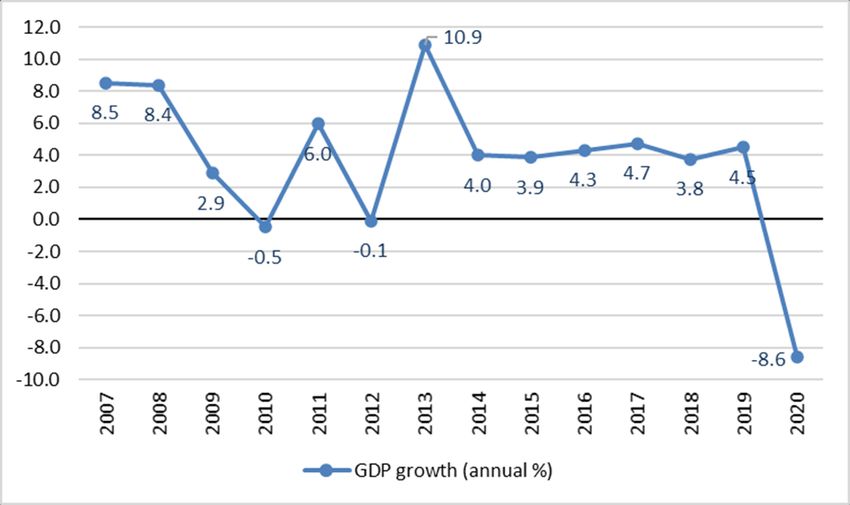
A CONCERNING WAY FORWARD                                           Kyrgyz Republic is influenced by the economic
                                                                   growth in the Russian economy. Since the
1) Gloomy forecasts for 2021: Inflation & Food prices
                                                                   beginning of 2020, crude oil prices slumped
The health, economic and social crisis led by the COVID-
                                                                   dramatically following the ‘Russia–Saudi Arabia oil
19 will have profound repercussions in 2021.The NBKR
                                                                   price war’ in March 2020 and the decline in
forecasts that in 2021 the average inflation rate is
                                                                   consumer demand with the spread of the COVID-19
expected to be around 6.5-6.8%, as prices for almost all
                                                                   pandemic, further impacting the global economy.
types of goods are continuing to rise. The following are
                                                                   The reaction of the Kyrgyz economy to decreasing
among the factors that are likely to affect food prices in
                                                                   oil prices could be due to the fact that oil accounts
2021:
                                                                   for over 30% of Russia’s gross domestic product and
 •   Given its deep integration in regional trade, events
                                                                   over 60% of its exports29. Between January and July
     in the main partner countries of the EAEU, Russia
                                                                   2020, Russia earned 37.7% less from oil exports
     and Kazakhstan in particular, have a chain reaction
                                                                   than the previous year30. Although since mid-
     in the economy of the Kyrgyz Republic. Thus,
                                                                   November 2020 oil prices have experienced slight
     unpredictable policies from larger neighboring
                                                                   increases as the hope for the development of
     countries could cause price shocks. For example, as
                                                                   successful coronavirus vaccinations spread, demand
     Kazakhstan is a main exporter of wheat in the
                                                                   is not expected to fully recover before 2022.
     region and the Kyrgyz Republic a net importer of
                                                               •   Moreover, the food sector in general is likely to
     both wheat and wheat flour26, a key risk for both
                                                                   face increased production and distribution costs
     Kyrgyzstan and the region as a whole could be the
                                                                   associated with compliance to COVID-19 prevention
     possible introduction of more stringent tariff and
                                                    27
                                                                   measures31.
     non-tariff regulation measures by Kazakhstan also
     to the EAEU countries. If introduced, these              2) Impact of new COVID-19 strain & Vaccination Plan
     measures will likely increase the price of wheat,        A new, more contagious strain of coronavirus has
     with dire consequences on the food security of the       emerged and is now spreading in the UK and several
     population of the Kyrgyz Republic for which wheat        other countries. Although there is no evidence on the
     is the main staple. Russia, one of the world's largest   new strain being more deadly, it appears to be up to 70%
     wheat exporters, has imposed an export quota             more contagious32, according to British health officials,
     limiting the export of grains (including wheat, corn,    leading countries to take more stringent measures at
     rye, and barley) to 17.5 million mt and an export tax    borders, and sanitary and epidemiological controls have
     on wheat of USD 30.32 per mt from 15 February to         been strengthened, including at the borders of the
                                              28
     30 June 2021 to non-EAEU countries . This has            Kyrgyz Republic.
     been done in an attempt to stabilize domestic food
                                                              As of 20 January 2021, the total number of cases of
     prices. In case this leads to increased grain supplies
                                                              COVID-19 in the country amounted to 83,430 with 1,392
     to EAEU countries, these actions could have a
                                                              casualties33. A second spike in cases would have a
     positive effect on stabilizing the price of grains,
                                                              tremendous impact on the already-fragile economy.
     including in the Kyrgyz Republic.
                                                              Considering how the economy had shrunk during the
 •   The exchange rate, affected by trade flows and           first wave, although now more prepared, the country will
     foreign currency inflows. If the national currency       have to undergo significant expenditures to enhance its
     continues to depreciate, all food and consumer
                                                              health services.
     goods that Kyrgyzstan imports will rise in price.
 •   Another factor influencing food prices in Kyrgyzstan     The Ministry of Health (MoH) of the Kyrgyz Republic has
     is the cost of fuel. Despite the fact that the Kyrgyz    developed a National Plan for the deployment of
     som is not directly related to the oil market, it has    vaccinations against COVID-19 in three stages, which was
     reacted to the decline in oil quotes due to its          submitted it to the Ministry of Finance. The first stage is
     sensitivity to regional dynamics. With a large share     expected to cover high risk groups (less than 3% of the
     of migrants living in Russia (and remittances            population),       including   medical   workers,    health
     amounting to 30% of GDP), the economy of the             professionals in long-term care facilities, vaccinators and
                                                              teachers.
The second stage will be carried out using vaccines 4) Climate Change impacts on the agriculture sector &
received under the COVAX program for the elderly (aged Exposure to natural disasters
60 and over), people with clinical risk factors and the Agriculture is the most climate-sensitive sector, since its
socially vulnerable. The COVAX programme is predicted productivity depends on climatic conditions such as
to reach more than 1.3 million people in the period from precipitation levels, the seasonal distribution of rainfall
June to July 2021. The third stage of vaccinations will and the moisture content during the growing season.
continue at the expense of the state and donor Over the past five years, anomalies in precipitation from
34
organizations for the remaining populations . March-June have impacted the timeline of the planting
season and/or affected lower valley plantings. These
3) Credit Line Disruptions & Impact on MSMEs
anomalies in climate were observed in the country
After a preliminary analysis conducted in March 2020,
throughout 2020 due to climate change and have been
the IMF decided to provide emergency support to the
already detected this year as some areas of the country
Kyrgyz Republic amounting to USD 242 million given the
have experienced below-normal rainfall in January-
magnitude of the expected financing gap (USD 500
35
February 202138. The stability of the agriculture sector
million) . With this emergency support, the IMF aimed
and produce prices remains at risk in 2021 as below-
also to catalyze other donors’ support to fill the financing
normal rainfalls with above-normal temperatures are
gap. In July, the World Bank approved a financial package
predicted for Kyrgyzstan during March-July 2021 (due to
of USD 121 million to help mitigate the unprecedented
the impact of La Niña cilmate pattern)39.
health, economic, and social challenges caused by the
COVID-19 pandemic36. In August 2020, the Eurasian Fund
for Stabilization and Development (EFSD) decided to Graph 3: Rainfall anomalies - ratio between rainfall for the current
year and the long-term average
provide Kyrgyzstan with a USD 100 million loan.
The widespread concern among donors about the
legality of the October political events, calling the new
government to uphold the Kyrgyz Constitution and the
rule of law, influenced the continuation of aid
disbursement. Russia had suspended the provision of any
financial support to the Kyrgyz Republic until the political
situation in the country stabilized37. Unfortunately, the
EFSD loan was cancelled as the availability period for
disbursement expired on 31 December 2020. As the loan Graph 4: Average rainfall and rainfall predicted levels based on
is not transferable to 2021, the Kyrgyz Republic will have historical observations
to undergo the application process again. This is likely to
have repercussions on the national budget estimates for
2021 approved by the Parliament, including the expected
budget deficit.
The resilience of the financial sectors has been
jeopardized by the economic disruption caused by COVID
-19 and the additional instability had a further impact on
credit lines and their solvency, thus exacerbating the
already increased vulnerability of MSMEs (micro, small
Source: WFP’s Seasonal Monitor for 2020
and medium enterprises). As a result of the economic
recession caused by the pandemic, in 2020 the number
of enterprises present in Kyrgyzstan has decreased by
29% compared to 2019 (NSC, 2020).Kyrgyzstan is a disaster-prone country. The Ministry of CONCLUSION
Emergency Situations of the Kyrgyz Republic (MoES) lists
The COVID-19 related negative shocks are having
20 main natural hazards and processes, including hydro-
particularly dire consequences on the food security
meteorological, geo-physical and biological hazards such
situation in the country. With the economy in sharp
as avalanches, droughts, floods, glacial lake outburst
decline, the increase in poverty rates, the rise in staple
floods, earthquakes, landslides and mudslides,
food prices and with the lean season approaching, it is
epidemics, pests, crop diseases and river erosion. Some
of utmost importance to continue monitoring food
of these hazards (e.g., floods, landslides and mudflows)
security in the country in order to implement in a timely
are predominantly seasonal and occur during spring. The
manner any necessary mitigation measures. Food
scale and frequency of natural disasters associated with
security and social protection systems are critical
climate change increased by 1.5 times over the last
elements in ensuring the country’s stability.
twelve years, which make up 39 percent of all disasters,
causing major destruction and leading to the loss of lives As it is widely known, the lack of access to food may
and livelihoods. In 2019, the direct loss from natural affect the level of confidence that the people have in the
disasters amounted to KGS 323 billion as material Government, sparking unrest and disrupting the political
damage to the economy of the country. The records order in the country. Among other specific driving
show that major floods have occurred between the factors, the last three revolutions were unsurprisingly
months of April and May, with Batken, Osh and Jalal- proceeded by periods of economic downturn, in
Abad provinces being the most exposed. When particular rising unemployment levels, and growing
confronted with natural disasters and socio-economic discontent over the uneven and unjust distribution of
shocks, household-level food security is compromised as material resources and wealth within the nation.
crops and livelihoods and assets are destroyed or
damaged and purchasing power is diminished.
For additional information on the WFP Kyrgyzstan Food Security updates or for the Food Price Monitoring Bulletins,
please contact Elisabetta D’Amico, Economic Analyst, elisabetta.damico@wfp.org
Photo: WFP/ Photo GalleryDATA SOURCES AND METHODOLOGY
1. According to the Ministry of Finance (MoF), in 2020 GDP 21. The nutrient adequate diet includes, per person, the average
amounted to KGS 583.2 billion, -5.3% compared to 2019. http:// energy needs and the recommended intake for protein, fat, four
minfin.gov.kg/ru/novosti/novosti/kyrgyz-respublikasynyn-2020- minerals and nine vitamins.
zhylga-respublikalyk-b7015 22. HCI equals 0.6
2. NSC, 2020. On the results of the sample survey "Impact of the 23. The National Poverty line is empirically derived based on actual
COVID-19 pandemic on households" consumption while the Minimum Subsistence Level is based on
3. Ibid. market prices and physiological requirements as defined by the
4. Using average HH size of 4.23 (meaning that for every 3 families Ministry of Health.
of 4 members, one has 5; KIHS, 2018), economically active 24. Considering average exchange rate during 2020
population of 2,583,600 and total population of 6,618,300 25. http://stat.kg/media/files/9d24bf28-c177-44fd-9bee-
(MLSD, 2020). 1f9a7c017ceb.PDF
5. Informal employment and informal sector as a percent of 26. According to the NSC, in January-November 2020, the Kyrgyz
employment - Harmonized series (%) Republic imported 50% of wheat and 93% of wheat flour from
6. IOM & UNICEF, 2020. Rapid Needs Assessment of the Challenges Kazakhstan, with the remaining 50% wheat being imported from
Facing Migrant Workers and their Families Impacted by the Covid- Russia.
19 Outbreak 27. Sergiy Zorya (WB), 2020. Analysis of regional dynamics of
7. Ibid. wheat and flour sectors in Central Asia, and their impact on
8. http://www.stat.kg/ru/publications/uroven-bednosti-v- Uzbekistan
kyrgyzskoj-respublike/ 28. WB, 2020. COVID-19 and Food Security (Update 14 January
9. Institute for Socio-Political Research of the Russian Academy of 2021)
Sciences - MGIMO University, 2020. Influence of the COVID-19 29. OECD, 2020. Fossil Fuel Support Country Note, Russian
Pandemic on the Position of Migrants and Remittances in Central Federation
Asia 30. https://worldcrunch.com/business-finance/what-the-
10. IOM & UNICEF, 2020. Rapid Needs Assessment of the pandemic-exposes-about-russian-dependence-on-oil
Challenges Facing Migrant Workers and their Families Impacted by 31. OECD, 2020. https://www.oecd.org/coronavirus/policy-
the Covid-19 Outbreak responses/covid-19-and-the-food-and-agriculture-sector-issues-
11. FAO calculations based on average Import Dependency Ratio and-policy-responses-a23f764b/
from 2015 to 2019. 32. https://ru.sputnik.kg/society/20201225/1050895943/
12. http://minfin.gov.kg/ru/novosti/novosti/kyrgyz- kyrgyzstan-koronavirus-shtamm-mery.html
respublikasynyn-2020-zhylga-respublikalyk-b7015 33. https://dataviz.vam.wfp.org/Hunger-Analytics-Hub
13. From approved forecasted budget for 2021 http:// 34. http://med.kg/ru/novosti/3867-vaktsinatsiya-protiv-covid-
minfin.gov.kg/ru/novosti/novosti/utverzhdennyy-byudzhet-2021- 19.html
goda
35. https://www.imf.org/en/News/Articles/2020/05/08/pr20213-
14. Data of Ministry of Labour and Social Development kyrgyz-republic-imf-execboard-approves-us-121-1m-emergency
15. As of January 20, 2021. -asst-rfi-rcf-address-covid19
16. https://www.akchabar.kg/ru/news/v-kyrgyzstane-ai-95-s- 36. https://www.worldbank.org/en/news/press-
nachala-goda-podeshevel-na-1482/ release/2020/07/30/kyrgyz-republic-to-mitigate-pandemic-
17. The National Poverty line of USD 1.2 is calculated using the caused-economic-shocks-for-businesses-vulnerable-people-and-
average exchange rate in 2019 (not in PPP terms) and it is communities-with-world-bank-support
comparable to the international poverty line of USD 3.2 PPP 37. https://www.rbc.ru/
2011, used for low middle-income countries. economics/14/10/2020/5f8740519a794747a9369708
18. World Bank, 2020. Kyrgyz Republic Covid-19 Poverty and 38. FAO Estimated precipitation Anomaly- http://www.fao.org/
Vulnerability Impacts (Preliminary results). This estimate might giews/earthobservation/country/index.jsp?
be more severe as forecasting models are not able to capture lang=en&type=31&code=KGZ
the real decrease in remittances. 39. https://iri.columbia.edu/our-expertise/climate/forecasts/
19. Ibid. seasonal-climate-forecasts/
20. https://sustainabledevelopment-kyrgyzstan.github.io/2-1-1/You can also read


